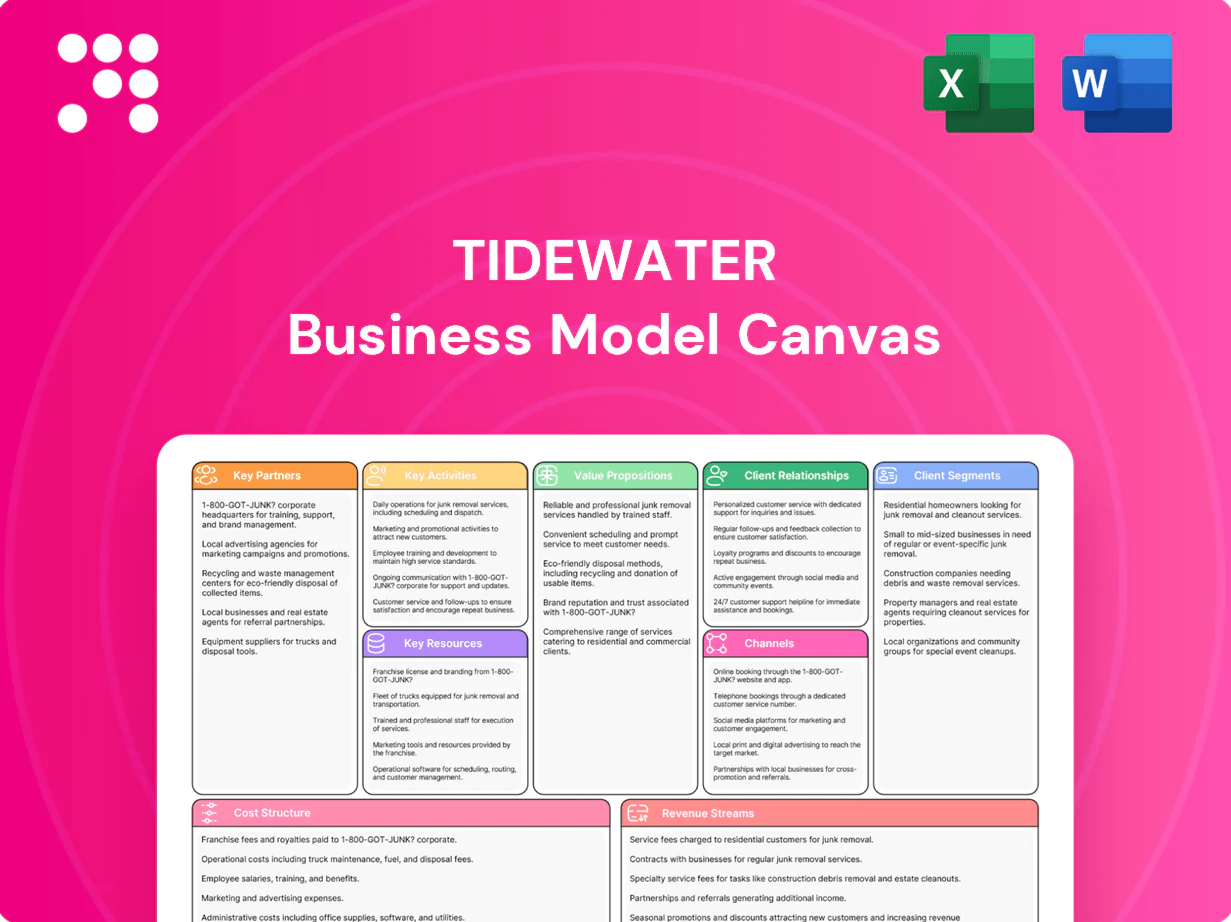
Tidewater Business Model Canvas

Strategic Business Model Canvas — revenue, customers, partners & cost levers in one page
Unlock Tidewater’s strategic playbook with our concise Business Model Canvas—three to five clear sentences reveal how the company creates customer value, monetizes services, and sustains competitive advantage. This downloadable canvas breaks down customer segments, key partners, revenue streams and cost drivers for immediate application. Purchase the full Word and Excel files to benchmark, adapt, and drive smarter decisions.
Partnerships

IOC and NOC operators
Strategic partnerships with international and national oil companies secure multi-year charters (often 3+ years) and supported Tidewater’s 2024 committed-asset utilization above 70%, ensuring stable utilization. Tidewater aligns vessel availability with operator drilling, development, and production schedules to match campaign timing and reduce idle days. Close collaboration improves planning accuracy, cuts downtime, and underpins predictable revenue and fleet deployment.
Drilling contractors and EPCs
Alliances with rig owners and EPCs coordinate rig moves, towing and field development logistics to streamline operations. Early engagement in 2024 integrates marine support into project timelines, reducing interface risk and lowering the chance of cost overruns. This collaboration improves schedule certainty and positions Tidewater to compete for bundled service awards. Such partnerships enable synchronized mobilization and better commercial terms.

Shipyards and OEM equipment suppliers
Shipyards and OEM equipment suppliers enable fleet upgrades, retrofits, and class-required maintenance for Tidewater's ~200-vessel fleet (2024), with preferential parts access reducing off-hire time and improving turnaround metrics. OEM technical support ensures reliability in harsh environments. Co-development with OEMs accelerates adoption of fuel-efficient technologies and digital monitoring systems across the fleet.

Crewing agencies and training institutions
Global crewing partners source certified mariners and specialized personnel, addressing the 2024 BIMCO/ICS estimated shortfall of 147,500 seafarers while enabling joint training programs that ensure STCW, DP and HSE compliance. Stable pipelines reduce recruitment costs and turnover, and competency assurance supports Tidewater’s premium positioning in offshore services.
- Global sourcing: BIMCO/ICS 2024 shortage 147,500
- Standards: STCW, DP, HSE compliance
- Benefit: lower recruitment costs & turnover
- Positioning: competency = premium pricing
Port authorities, regulators, and classification societies
Tidewater’s working ties with port authorities and flag states streamline permits, bunkering and port calls, aligning operations with IMO 2020 0.5% sulphur rules and major flag registries such as Panama (8,000+ ships). Classification societies (DNV, ABS, LR etc.) and IACS (12 members) guide compliance and surveys, while proactive engagement reduces regulatory delays and strengthens safety credibility with customers.
- Permits & bunkering aligned to IMO 2020 0.5% sulphur
- Class-led surveys via DNV/ABS/LR; IACS = 12 members
- Panama flag scale: 8,000+ vessels; boosts port-call efficiency
IOC/NOC charters lift 2024 fleet utilization >70%, yards and crewing speed upgrades
Strategic ties with IOC/NOCs secure multi-year charters supporting Tidewater’s 2024 committed-asset utilization >70% and predictable revenue. Shipyards/OEMs enable upgrades for Tidewater’s ~200-vessel 2024 fleet, reducing off-hire and speeding fuel-efficiency tech adoption. Crewing partners address the BIMCO/ICS 2024 seafarer shortfall 147,500 while ports/class societies speed permits and compliance.
| Partner | 2024 Metric | Impact |
|---|---|---|
| IOC/NOC | Multi-year charters | Utilization >70% |
| Shipyards/OEM | ~200 vessels | Lower off-hire, upgrades |
| Crewing | Shortfall 147,500 | Stable staffing, lower turnover |
| Ports/Class | IMO2020/IACS | Faster permits, compliance |
What is included in the product
 Detailed Word Document
A comprehensive Business Model Canvas for Tidewater that maps customer segments, channels, value propositions and the nine BMC blocks with actionable narratives and competitive advantages; includes linked SWOT, market validation using real company data, and a clean design ideal for investor presentations and strategic decision-making.

 Customizable Excel Spreadsheet
Condenses Tidewater’s operational and revenue drivers into a clean, editable one-page canvas to quickly pinpoint and address client pain points.
Activities

Marine operations and vessel deployment
Daily scheduling, routing, and dynamic positioning operations coordinate Tidewater’s fleet of about 100 vessels to ensure timely offshore logistics and roughly 70% average utilization across active regions. Vessels routinely transport personnel (up to 50 per voyage), fuel, water, and equipment to platforms and rigs, supporting sustained operations. Anchor handling and towing capabilities enable rig moves and complex field work, often involving tugs rated for multi-megawatt bollard pull. Continuous remote monitoring and compliance systems drive safety and maximize asset utilization.
Fleet maintenance and drydocking
Preventive and corrective maintenance preserve asset integrity and, in 2024, Tidewater emphasized scheduled interventions to maintain operational availability. Planned drydockings are aligned with contract windows to limit off-hire and protect revenue streams. Use of OEM parts and adherence to OEM standards ensure reliability and warranty compliance. Data-driven maintenance programs reduce lifecycle costs through condition monitoring and predictive analytics.

HSE and regulatory compliance
Robust safety management systems align with IMO/ISM requirements and applicable flag-state and local regulations to secure access to high-spec offshore contracts. Regular drills, quarterly toolbox talks and annual audits reinforce a safety-first culture and readiness. Structured incident reporting with root-cause analysis and corrective actions drives continuous improvement. Compliance underpins eligibility for deepwater and high-capability projects.

Commercial tendering and contract management
Commercial tendering covers bid preparation, competitive pricing and negotiation to secure time charters and projects; 2024 OSV market improvements increased tender win rates and dayrates significantly. Contract execution enforces KPIs, SLAs and change orders to protect delivery. Relationship management drives renewals and extensions while risk controls guard margins and operational performance.
- Bid preparation
- Pricing & negotiation
- KPIs, SLAs, change orders
- Renewals & extensions
- Risk controls
Digital fleet monitoring and optimization
Digital fleet monitoring combines IoT sensors, dynamic positioning data and fuel analytics to raise vessel efficiency and cut emissions; 2024 studies show voyage optimization can reduce bunker use by 5–8% and fuel analytics lower CO2 intensity per nautical mile. Remote diagnostics cut unplanned downtime by ~25–30%, while real-time dashboards offer customers near-real-time visibility into operations.
- IoT+DP+analytics: 5–8% bunker savings
- Remote diagnostics: ~25–30% less downtime
- Dashboards: real-time customer visibility
Fleet ops: ~100 vessels, ~70% utilization; 5–8% bunker savings, ~25–30% downtime cut
Fleet ops schedule ~100 vessels at ~70% utilization, moving personnel (up to 50), fuel, water and equipment; anchor handling/towing support rig moves. Maintenance (planned drydocks, OEM parts) and safety/ISM compliance protect availability for high-spec contracts. Digital IoT/DP analytics reduced bunker use 5–8% and remote diagnostics cut unplanned downtime ~25–30% in 2024.
| Metric | 2024 |
|---|---|
| Fleet size | ~100 vessels |
| Utilization | ~70% |
| Max personnel/voyage | 50 |
| Bunker savings | 5–8% |
| Downtime reduction | ~25–30% |
Full Version Awaits
Business Model Canvas
The Tidewater Business Model Canvas you’re previewing is the actual deliverable, not a mockup or sample. When you purchase, you’ll receive this same complete file—formatted and ready to use in Word and Excel. No hidden sections, no surprises; what you see is what you’ll download and edit immediately.

Strategic Business Model Canvas — revenue, customers, partners & cost levers in one page
Unlock Tidewater’s strategic playbook with our concise Business Model Canvas—three to five clear sentences reveal how the company creates customer value, monetizes services, and sustains competitive advantage. This downloadable canvas breaks down customer segments, key partners, revenue streams and cost drivers for immediate application. Purchase the full Word and Excel files to benchmark, adapt, and drive smarter decisions.
Partnerships
IOC and NOC operators
Strategic partnerships with international and national oil companies secure multi-year charters (often 3+ years) and supported Tidewater’s 2024 committed-asset utilization above 70%, ensuring stable utilization. Tidewater aligns vessel availability with operator drilling, development, and production schedules to match campaign timing and reduce idle days. Close collaboration improves planning accuracy, cuts downtime, and underpins predictable revenue and fleet deployment.
Drilling contractors and EPCs
Alliances with rig owners and EPCs coordinate rig moves, towing and field development logistics to streamline operations. Early engagement in 2024 integrates marine support into project timelines, reducing interface risk and lowering the chance of cost overruns. This collaboration improves schedule certainty and positions Tidewater to compete for bundled service awards. Such partnerships enable synchronized mobilization and better commercial terms.
Shipyards and OEM equipment suppliers
Shipyards and OEM equipment suppliers enable fleet upgrades, retrofits, and class-required maintenance for Tidewater's ~200-vessel fleet (2024), with preferential parts access reducing off-hire time and improving turnaround metrics. OEM technical support ensures reliability in harsh environments. Co-development with OEMs accelerates adoption of fuel-efficient technologies and digital monitoring systems across the fleet.
Crewing agencies and training institutions
Global crewing partners source certified mariners and specialized personnel, addressing the 2024 BIMCO/ICS estimated shortfall of 147,500 seafarers while enabling joint training programs that ensure STCW, DP and HSE compliance. Stable pipelines reduce recruitment costs and turnover, and competency assurance supports Tidewater’s premium positioning in offshore services.
- Global sourcing: BIMCO/ICS 2024 shortage 147,500
- Standards: STCW, DP, HSE compliance
- Benefit: lower recruitment costs & turnover
- Positioning: competency = premium pricing
Port authorities, regulators, and classification societies
Tidewater’s working ties with port authorities and flag states streamline permits, bunkering and port calls, aligning operations with IMO 2020 0.5% sulphur rules and major flag registries such as Panama (8,000+ ships). Classification societies (DNV, ABS, LR etc.) and IACS (12 members) guide compliance and surveys, while proactive engagement reduces regulatory delays and strengthens safety credibility with customers.
- Permits & bunkering aligned to IMO 2020 0.5% sulphur
- Class-led surveys via DNV/ABS/LR; IACS = 12 members
- Panama flag scale: 8,000+ vessels; boosts port-call efficiency
IOC/NOC charters lift 2024 fleet utilization >70%, yards and crewing speed upgrades
Strategic ties with IOC/NOCs secure multi-year charters supporting Tidewater’s 2024 committed-asset utilization >70% and predictable revenue. Shipyards/OEMs enable upgrades for Tidewater’s ~200-vessel 2024 fleet, reducing off-hire and speeding fuel-efficiency tech adoption. Crewing partners address the BIMCO/ICS 2024 seafarer shortfall 147,500 while ports/class societies speed permits and compliance.
| Partner | 2024 Metric | Impact |
|---|---|---|
| IOC/NOC | Multi-year charters | Utilization >70% |
| Shipyards/OEM | ~200 vessels | Lower off-hire, upgrades |
| Crewing | Shortfall 147,500 | Stable staffing, lower turnover |
| Ports/Class | IMO2020/IACS | Faster permits, compliance |
What is included in the product
Detailed Word Document
A comprehensive Business Model Canvas for Tidewater that maps customer segments, channels, value propositions and the nine BMC blocks with actionable narratives and competitive advantages; includes linked SWOT, market validation using real company data, and a clean design ideal for investor presentations and strategic decision-making.
Customizable Excel Spreadsheet
Condenses Tidewater’s operational and revenue drivers into a clean, editable one-page canvas to quickly pinpoint and address client pain points.
Activities
Marine operations and vessel deployment
Daily scheduling, routing, and dynamic positioning operations coordinate Tidewater’s fleet of about 100 vessels to ensure timely offshore logistics and roughly 70% average utilization across active regions. Vessels routinely transport personnel (up to 50 per voyage), fuel, water, and equipment to platforms and rigs, supporting sustained operations. Anchor handling and towing capabilities enable rig moves and complex field work, often involving tugs rated for multi-megawatt bollard pull. Continuous remote monitoring and compliance systems drive safety and maximize asset utilization.
Fleet maintenance and drydocking
Preventive and corrective maintenance preserve asset integrity and, in 2024, Tidewater emphasized scheduled interventions to maintain operational availability. Planned drydockings are aligned with contract windows to limit off-hire and protect revenue streams. Use of OEM parts and adherence to OEM standards ensure reliability and warranty compliance. Data-driven maintenance programs reduce lifecycle costs through condition monitoring and predictive analytics.
HSE and regulatory compliance
Robust safety management systems align with IMO/ISM requirements and applicable flag-state and local regulations to secure access to high-spec offshore contracts. Regular drills, quarterly toolbox talks and annual audits reinforce a safety-first culture and readiness. Structured incident reporting with root-cause analysis and corrective actions drives continuous improvement. Compliance underpins eligibility for deepwater and high-capability projects.
Commercial tendering and contract management
Commercial tendering covers bid preparation, competitive pricing and negotiation to secure time charters and projects; 2024 OSV market improvements increased tender win rates and dayrates significantly. Contract execution enforces KPIs, SLAs and change orders to protect delivery. Relationship management drives renewals and extensions while risk controls guard margins and operational performance.
- Bid preparation
- Pricing & negotiation
- KPIs, SLAs, change orders
- Renewals & extensions
- Risk controls
Digital fleet monitoring and optimization
Digital fleet monitoring combines IoT sensors, dynamic positioning data and fuel analytics to raise vessel efficiency and cut emissions; 2024 studies show voyage optimization can reduce bunker use by 5–8% and fuel analytics lower CO2 intensity per nautical mile. Remote diagnostics cut unplanned downtime by ~25–30%, while real-time dashboards offer customers near-real-time visibility into operations.
- IoT+DP+analytics: 5–8% bunker savings
- Remote diagnostics: ~25–30% less downtime
- Dashboards: real-time customer visibility
Fleet ops: ~100 vessels, ~70% utilization; 5–8% bunker savings, ~25–30% downtime cut
Fleet ops schedule ~100 vessels at ~70% utilization, moving personnel (up to 50), fuel, water and equipment; anchor handling/towing support rig moves. Maintenance (planned drydocks, OEM parts) and safety/ISM compliance protect availability for high-spec contracts. Digital IoT/DP analytics reduced bunker use 5–8% and remote diagnostics cut unplanned downtime ~25–30% in 2024.
| Metric | 2024 |
|---|---|
| Fleet size | ~100 vessels |
| Utilization | ~70% |
| Max personnel/voyage | 50 |
| Bunker savings | 5–8% |
| Downtime reduction | ~25–30% |
Full Version Awaits
Business Model Canvas
The Tidewater Business Model Canvas you’re previewing is the actual deliverable, not a mockup or sample. When you purchase, you’ll receive this same complete file—formatted and ready to use in Word and Excel. No hidden sections, no surprises; what you see is what you’ll download and edit immediately.
Original: $10.00
-65%$10.00
$3.50Description
Strategic Business Model Canvas — revenue, customers, partners & cost levers in one page
Unlock Tidewater’s strategic playbook with our concise Business Model Canvas—three to five clear sentences reveal how the company creates customer value, monetizes services, and sustains competitive advantage. This downloadable canvas breaks down customer segments, key partners, revenue streams and cost drivers for immediate application. Purchase the full Word and Excel files to benchmark, adapt, and drive smarter decisions.
Partnerships
IOC and NOC operators
Strategic partnerships with international and national oil companies secure multi-year charters (often 3+ years) and supported Tidewater’s 2024 committed-asset utilization above 70%, ensuring stable utilization. Tidewater aligns vessel availability with operator drilling, development, and production schedules to match campaign timing and reduce idle days. Close collaboration improves planning accuracy, cuts downtime, and underpins predictable revenue and fleet deployment.
Drilling contractors and EPCs
Alliances with rig owners and EPCs coordinate rig moves, towing and field development logistics to streamline operations. Early engagement in 2024 integrates marine support into project timelines, reducing interface risk and lowering the chance of cost overruns. This collaboration improves schedule certainty and positions Tidewater to compete for bundled service awards. Such partnerships enable synchronized mobilization and better commercial terms.
Shipyards and OEM equipment suppliers
Shipyards and OEM equipment suppliers enable fleet upgrades, retrofits, and class-required maintenance for Tidewater's ~200-vessel fleet (2024), with preferential parts access reducing off-hire time and improving turnaround metrics. OEM technical support ensures reliability in harsh environments. Co-development with OEMs accelerates adoption of fuel-efficient technologies and digital monitoring systems across the fleet.
Crewing agencies and training institutions
Global crewing partners source certified mariners and specialized personnel, addressing the 2024 BIMCO/ICS estimated shortfall of 147,500 seafarers while enabling joint training programs that ensure STCW, DP and HSE compliance. Stable pipelines reduce recruitment costs and turnover, and competency assurance supports Tidewater’s premium positioning in offshore services.
- Global sourcing: BIMCO/ICS 2024 shortage 147,500
- Standards: STCW, DP, HSE compliance
- Benefit: lower recruitment costs & turnover
- Positioning: competency = premium pricing
Port authorities, regulators, and classification societies
Tidewater’s working ties with port authorities and flag states streamline permits, bunkering and port calls, aligning operations with IMO 2020 0.5% sulphur rules and major flag registries such as Panama (8,000+ ships). Classification societies (DNV, ABS, LR etc.) and IACS (12 members) guide compliance and surveys, while proactive engagement reduces regulatory delays and strengthens safety credibility with customers.
- Permits & bunkering aligned to IMO 2020 0.5% sulphur
- Class-led surveys via DNV/ABS/LR; IACS = 12 members
- Panama flag scale: 8,000+ vessels; boosts port-call efficiency
IOC/NOC charters lift 2024 fleet utilization >70%, yards and crewing speed upgrades
Strategic ties with IOC/NOCs secure multi-year charters supporting Tidewater’s 2024 committed-asset utilization >70% and predictable revenue. Shipyards/OEMs enable upgrades for Tidewater’s ~200-vessel 2024 fleet, reducing off-hire and speeding fuel-efficiency tech adoption. Crewing partners address the BIMCO/ICS 2024 seafarer shortfall 147,500 while ports/class societies speed permits and compliance.
| Partner | 2024 Metric | Impact |
|---|---|---|
| IOC/NOC | Multi-year charters | Utilization >70% |
| Shipyards/OEM | ~200 vessels | Lower off-hire, upgrades |
| Crewing | Shortfall 147,500 | Stable staffing, lower turnover |
| Ports/Class | IMO2020/IACS | Faster permits, compliance |
What is included in the product
Detailed Word Document
A comprehensive Business Model Canvas for Tidewater that maps customer segments, channels, value propositions and the nine BMC blocks with actionable narratives and competitive advantages; includes linked SWOT, market validation using real company data, and a clean design ideal for investor presentations and strategic decision-making.
Customizable Excel Spreadsheet
Condenses Tidewater’s operational and revenue drivers into a clean, editable one-page canvas to quickly pinpoint and address client pain points.
Activities
Marine operations and vessel deployment
Daily scheduling, routing, and dynamic positioning operations coordinate Tidewater’s fleet of about 100 vessels to ensure timely offshore logistics and roughly 70% average utilization across active regions. Vessels routinely transport personnel (up to 50 per voyage), fuel, water, and equipment to platforms and rigs, supporting sustained operations. Anchor handling and towing capabilities enable rig moves and complex field work, often involving tugs rated for multi-megawatt bollard pull. Continuous remote monitoring and compliance systems drive safety and maximize asset utilization.
Fleet maintenance and drydocking
Preventive and corrective maintenance preserve asset integrity and, in 2024, Tidewater emphasized scheduled interventions to maintain operational availability. Planned drydockings are aligned with contract windows to limit off-hire and protect revenue streams. Use of OEM parts and adherence to OEM standards ensure reliability and warranty compliance. Data-driven maintenance programs reduce lifecycle costs through condition monitoring and predictive analytics.
HSE and regulatory compliance
Robust safety management systems align with IMO/ISM requirements and applicable flag-state and local regulations to secure access to high-spec offshore contracts. Regular drills, quarterly toolbox talks and annual audits reinforce a safety-first culture and readiness. Structured incident reporting with root-cause analysis and corrective actions drives continuous improvement. Compliance underpins eligibility for deepwater and high-capability projects.
Commercial tendering and contract management
Commercial tendering covers bid preparation, competitive pricing and negotiation to secure time charters and projects; 2024 OSV market improvements increased tender win rates and dayrates significantly. Contract execution enforces KPIs, SLAs and change orders to protect delivery. Relationship management drives renewals and extensions while risk controls guard margins and operational performance.
- Bid preparation
- Pricing & negotiation
- KPIs, SLAs, change orders
- Renewals & extensions
- Risk controls
Digital fleet monitoring and optimization
Digital fleet monitoring combines IoT sensors, dynamic positioning data and fuel analytics to raise vessel efficiency and cut emissions; 2024 studies show voyage optimization can reduce bunker use by 5–8% and fuel analytics lower CO2 intensity per nautical mile. Remote diagnostics cut unplanned downtime by ~25–30%, while real-time dashboards offer customers near-real-time visibility into operations.
- IoT+DP+analytics: 5–8% bunker savings
- Remote diagnostics: ~25–30% less downtime
- Dashboards: real-time customer visibility
Fleet ops: ~100 vessels, ~70% utilization; 5–8% bunker savings, ~25–30% downtime cut
Fleet ops schedule ~100 vessels at ~70% utilization, moving personnel (up to 50), fuel, water and equipment; anchor handling/towing support rig moves. Maintenance (planned drydocks, OEM parts) and safety/ISM compliance protect availability for high-spec contracts. Digital IoT/DP analytics reduced bunker use 5–8% and remote diagnostics cut unplanned downtime ~25–30% in 2024.
| Metric | 2024 |
|---|---|
| Fleet size | ~100 vessels |
| Utilization | ~70% |
| Max personnel/voyage | 50 |
| Bunker savings | 5–8% |
| Downtime reduction | ~25–30% |
Full Version Awaits
Business Model Canvas
The Tidewater Business Model Canvas you’re previewing is the actual deliverable, not a mockup or sample. When you purchase, you’ll receive this same complete file—formatted and ready to use in Word and Excel. No hidden sections, no surprises; what you see is what you’ll download and edit immediately.











