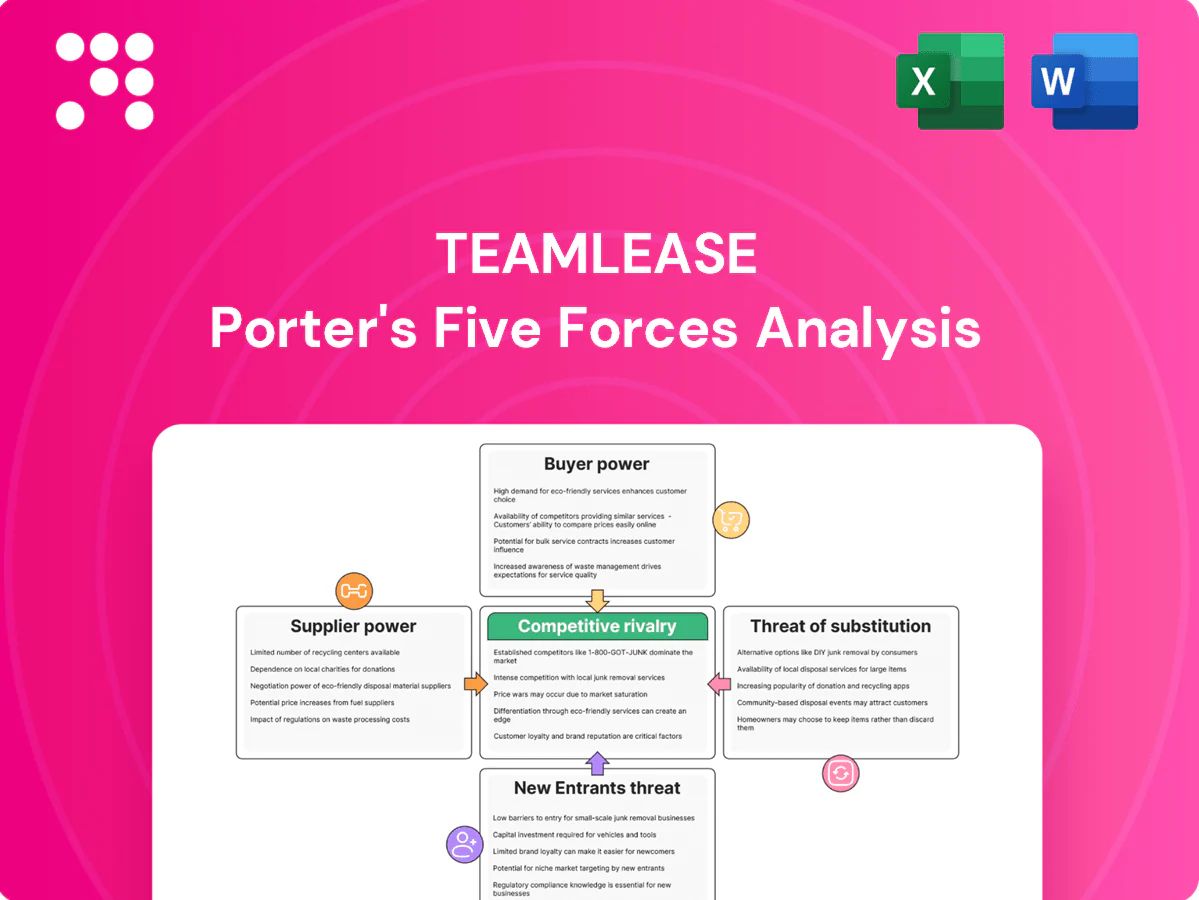
TeamLease Porter's Five Forces Analysis

Go Beyond the Preview—Access the Full Strategic Report
TeamLease faces moderate buyer power, fragmented suppliers, threats from low-cost staffing platforms and regulatory shifts. Competitive rivalry is intense with margin pressure, but brand strength and scale offer defensive advantages. This brief snapshot only scratches the surface. Unlock the full Porter's Five Forces Analysis to explore force-by-force ratings, visuals, and actionable strategy for TeamLease.
Suppliers Bargaining Power

Talent pool as suppliers
Individual workers, specialized professionals and niche-skilled contractors are core input suppliers for TeamLease, and in tight segments such as IT and healthcare these candidates can command higher wages or flexible terms. India’s large workforce—around 520 million people in the 2023–24 labor force—moderates aggregate supplier power. Strong employer brand and clear career pathways further reduce candidate leverage and turnover costs.
Training and skilling partners
Content providers, assessment firms and trainers shape credential pipelines and, when programs are scarce and high-quality, can command premium pricing and exclusivity, evidenced by the skilling sector attracting over USD 1.7 billion in private investment in 2024. Co-developing curricula and outcome-linked contracts reduces supplier leverage by tying payments to placement metrics. Government schemes such as PMKVY and state skilling initiatives in 2024 broaden supplier sources and lower single-vendor dependency.

Job boards and talent platforms
Aggregators like LinkedIn (≈930 million members in 2024) control candidate access and data, giving them leverage to shift pricing or algorithmic visibility and raise acquisition costs for firms such as TeamLease. Multi-channel sourcing and proprietary databases reduce dependency by enabling direct outreach and lowering per-hire costs. API partnerships with platforms can stabilize throughput and predictability of candidate flow.

Technology vendors
ATS, payroll and compliance software are critical infrastructure for TeamLease, giving vendors leverage through high switching costs and integration complexity; as of 2024 many enterprise vendors guarantee 99.9%+ uptime SLAs and APIs but integrations commonly require 3–6 months. Open-architecture stacks and negotiated SLAs limit vendor hold, and selective in-house tools create practical fallback options.
- Critical systems: ATS/payroll/compliance
- Vendor leverage: high switching costs, 3–6 month integrations (2024)
- Mitigants: open APIs, negotiated 99.9%+ SLAs (2024)
- Fallback: selective in-house tooling
Compliance and statutory intermediaries
Compliance intermediaries such as PF/ESI facilitators, background-verification firms and legal advisers materially shape TeamLease service delivery; in 2024 their role increased as regulatory scrutiny rose, allowing specialized providers in regulated states to extract higher fees. Framework agreements and volume bundles have normalized rates, while building internal compliance capability reduces supplier leverage.
- PF/ESI facilitators: regulatory gatekeepers
- Background checkers: operational dependency
- Legal advisors: rent extraction in regulated states
- Frameworks/volumes: rate stabilization
- Internal capability: lowers supplier power
Suppliers gain leverage as India's ≈520m workforce and USD 1.7bn skilling boom tighten hiring
Suppliers (skilled candidates, trainers, ATS/payroll vendors, compliance intermediaries) exert moderate-to-high power in niches (IT/healthcare) where candidates command premiums; India labor force ≈520m (2023–24). Skilling attracted USD 1.7bn private investment (2024); LinkedIn ≈930m members (2024) raise sourcing costs. Vendor switching: 3–6 months; enterprise SLAs 99.9%+ (2024).
| Supplier | 2024 Metric |
|---|---|
| Labor pool | ≈520m |
| Skilling invest | USD 1.7bn |
| ≈930m |
What is included in the product
 Detailed Word Document
Uncovers key drivers of competition, buyer/supplier power, and market entry risks specific to TeamLease, identifying disruptive threats and substitutes that pressure margins. Fully editable Word format for easy integration.

 Customizable Excel Spreadsheet
A concise one-sheet Porter’s Five Forces for TeamLease that highlights staffing-specific pressures and opportunities—perfect for quick board decisions and slide decks, with customizable pressure levels to reflect regulatory shifts or new entrants.
Customers Bargaining Power

Large enterprise clients
Blue-chip employers run competitive RFPs and multi-agency panels, using scale to extract price concessions and enforce stringent SLAs. Their size drives price pressure and negotiating leverage, while payment cycles in India commonly stretch 60–90 days, straining staffing firms' working capital. Comprehensive value-added services—onboarding, compliance, skilling—allow staffing firms to justify premium rate cards and reduce churn.
Price sensitivity and commoditization
In 2024 temporary staffing still largely competes on markup percentages, pushing buyers to shop on price. Transparent benchmarks and online rate comparisons amplify customer price sensitivity. Outcome guarantees and robust compliance assurance shift conversations away from pure commoditization. Bundling payroll, RPO and training increases perceived value and reduces buyer focus on markup alone.

Switching costs are moderate
Clients can shift requisitions across agencies with limited friction, and TeamLease’s data portability and standardized role definitions—supporting over 1.5 million associates on payroll in 2024—shorten transitions to days rather than months. Deep on-site programs and custom workflows raise stickiness, while performance dashboards and SLA-linked reporting create relationship lock-in that reduces effective churn. Overall switching costs sit at a moderate level.

Multi-year contracts vs spot needs
Multi-year contracts give corporate buyers leverage to negotiate lower rates and volume discounts, while spot hiring remains transactional and highly volatile, exposing TeamLease to short-term price swings; a balanced portfolio across sectors helps stabilize pricing and demand, and KPI-linked renewals—tying fees to retention and performance—can protect margins and reduce churn.
- Volume contracts: buyer leverage on rates
- Spot hiring: transactional, volatile
- Sector diversification: stabilizes pricing
- KPI-linked renewals: margin protection
Regulatory and compliance expectations
Buyers demand strict statutory compliance and transfer of labor-related risk to staffing vendors, pushing TeamLease into contracts that include indemnities and insurance clauses. Non-compliance can trigger penalties, service credits and holdbacks, increasing customer bargaining power. Demonstrated audit readiness and visible compliance frameworks counter this power, while certifications and a proven track record serve as negotiation levers.
- Buyers: require statutory compliance and risk transfer
- Penalties: lead to service credits and payment holdbacks
- Audit readiness: reduces buyer leverage
- Certifications/track record: strengthen TeamLease bargaining position
Buyers extract discounts; payroll firm with ~1.5 million, 60–90 day cycles
Large buyers use RFPs and panels to extract discounts; payment cycles commonly run 60–90 days, pressuring working capital. TeamLease held ~1.5 million associates on payroll in 2024, shortening supplier switching to days via data portability, while multi-year/KPI-linked contracts and bundled services raise stickiness and protect margins.
| Metric | 2024 |
|---|---|
| Associates on payroll | ~1.5 million |
| Payment cycles | 60–90 days |
| Switching time | Days |
What You See Is What You Get
TeamLease Porter's Five Forces Analysis
This preview shows the exact TeamLease Porter’s Five Forces analysis you’ll receive—no placeholders or samples. The document is fully formatted and ready for immediate download upon purchase. You’re viewing the final deliverable, so there are no surprises once payment is completed.

Go Beyond the Preview—Access the Full Strategic Report
TeamLease faces moderate buyer power, fragmented suppliers, threats from low-cost staffing platforms and regulatory shifts. Competitive rivalry is intense with margin pressure, but brand strength and scale offer defensive advantages. This brief snapshot only scratches the surface. Unlock the full Porter's Five Forces Analysis to explore force-by-force ratings, visuals, and actionable strategy for TeamLease.
Suppliers Bargaining Power
Talent pool as suppliers
Individual workers, specialized professionals and niche-skilled contractors are core input suppliers for TeamLease, and in tight segments such as IT and healthcare these candidates can command higher wages or flexible terms. India’s large workforce—around 520 million people in the 2023–24 labor force—moderates aggregate supplier power. Strong employer brand and clear career pathways further reduce candidate leverage and turnover costs.
Training and skilling partners
Content providers, assessment firms and trainers shape credential pipelines and, when programs are scarce and high-quality, can command premium pricing and exclusivity, evidenced by the skilling sector attracting over USD 1.7 billion in private investment in 2024. Co-developing curricula and outcome-linked contracts reduces supplier leverage by tying payments to placement metrics. Government schemes such as PMKVY and state skilling initiatives in 2024 broaden supplier sources and lower single-vendor dependency.
Job boards and talent platforms
Aggregators like LinkedIn (≈930 million members in 2024) control candidate access and data, giving them leverage to shift pricing or algorithmic visibility and raise acquisition costs for firms such as TeamLease. Multi-channel sourcing and proprietary databases reduce dependency by enabling direct outreach and lowering per-hire costs. API partnerships with platforms can stabilize throughput and predictability of candidate flow.
Technology vendors
ATS, payroll and compliance software are critical infrastructure for TeamLease, giving vendors leverage through high switching costs and integration complexity; as of 2024 many enterprise vendors guarantee 99.9%+ uptime SLAs and APIs but integrations commonly require 3–6 months. Open-architecture stacks and negotiated SLAs limit vendor hold, and selective in-house tools create practical fallback options.
- Critical systems: ATS/payroll/compliance
- Vendor leverage: high switching costs, 3–6 month integrations (2024)
- Mitigants: open APIs, negotiated 99.9%+ SLAs (2024)
- Fallback: selective in-house tooling
Compliance and statutory intermediaries
Compliance intermediaries such as PF/ESI facilitators, background-verification firms and legal advisers materially shape TeamLease service delivery; in 2024 their role increased as regulatory scrutiny rose, allowing specialized providers in regulated states to extract higher fees. Framework agreements and volume bundles have normalized rates, while building internal compliance capability reduces supplier leverage.
- PF/ESI facilitators: regulatory gatekeepers
- Background checkers: operational dependency
- Legal advisors: rent extraction in regulated states
- Frameworks/volumes: rate stabilization
- Internal capability: lowers supplier power
Suppliers gain leverage as India's ≈520m workforce and USD 1.7bn skilling boom tighten hiring
Suppliers (skilled candidates, trainers, ATS/payroll vendors, compliance intermediaries) exert moderate-to-high power in niches (IT/healthcare) where candidates command premiums; India labor force ≈520m (2023–24). Skilling attracted USD 1.7bn private investment (2024); LinkedIn ≈930m members (2024) raise sourcing costs. Vendor switching: 3–6 months; enterprise SLAs 99.9%+ (2024).
| Supplier | 2024 Metric |
|---|---|
| Labor pool | ≈520m |
| Skilling invest | USD 1.7bn |
| ≈930m |
What is included in the product
Detailed Word Document
Uncovers key drivers of competition, buyer/supplier power, and market entry risks specific to TeamLease, identifying disruptive threats and substitutes that pressure margins. Fully editable Word format for easy integration.
Customizable Excel Spreadsheet
A concise one-sheet Porter’s Five Forces for TeamLease that highlights staffing-specific pressures and opportunities—perfect for quick board decisions and slide decks, with customizable pressure levels to reflect regulatory shifts or new entrants.
Customers Bargaining Power
Large enterprise clients
Blue-chip employers run competitive RFPs and multi-agency panels, using scale to extract price concessions and enforce stringent SLAs. Their size drives price pressure and negotiating leverage, while payment cycles in India commonly stretch 60–90 days, straining staffing firms' working capital. Comprehensive value-added services—onboarding, compliance, skilling—allow staffing firms to justify premium rate cards and reduce churn.
Price sensitivity and commoditization
In 2024 temporary staffing still largely competes on markup percentages, pushing buyers to shop on price. Transparent benchmarks and online rate comparisons amplify customer price sensitivity. Outcome guarantees and robust compliance assurance shift conversations away from pure commoditization. Bundling payroll, RPO and training increases perceived value and reduces buyer focus on markup alone.
Switching costs are moderate
Clients can shift requisitions across agencies with limited friction, and TeamLease’s data portability and standardized role definitions—supporting over 1.5 million associates on payroll in 2024—shorten transitions to days rather than months. Deep on-site programs and custom workflows raise stickiness, while performance dashboards and SLA-linked reporting create relationship lock-in that reduces effective churn. Overall switching costs sit at a moderate level.
Multi-year contracts vs spot needs
Multi-year contracts give corporate buyers leverage to negotiate lower rates and volume discounts, while spot hiring remains transactional and highly volatile, exposing TeamLease to short-term price swings; a balanced portfolio across sectors helps stabilize pricing and demand, and KPI-linked renewals—tying fees to retention and performance—can protect margins and reduce churn.
- Volume contracts: buyer leverage on rates
- Spot hiring: transactional, volatile
- Sector diversification: stabilizes pricing
- KPI-linked renewals: margin protection
Regulatory and compliance expectations
Buyers demand strict statutory compliance and transfer of labor-related risk to staffing vendors, pushing TeamLease into contracts that include indemnities and insurance clauses. Non-compliance can trigger penalties, service credits and holdbacks, increasing customer bargaining power. Demonstrated audit readiness and visible compliance frameworks counter this power, while certifications and a proven track record serve as negotiation levers.
- Buyers: require statutory compliance and risk transfer
- Penalties: lead to service credits and payment holdbacks
- Audit readiness: reduces buyer leverage
- Certifications/track record: strengthen TeamLease bargaining position
Buyers extract discounts; payroll firm with ~1.5 million, 60–90 day cycles
Large buyers use RFPs and panels to extract discounts; payment cycles commonly run 60–90 days, pressuring working capital. TeamLease held ~1.5 million associates on payroll in 2024, shortening supplier switching to days via data portability, while multi-year/KPI-linked contracts and bundled services raise stickiness and protect margins.
| Metric | 2024 |
|---|---|
| Associates on payroll | ~1.5 million |
| Payment cycles | 60–90 days |
| Switching time | Days |
What You See Is What You Get
TeamLease Porter's Five Forces Analysis
This preview shows the exact TeamLease Porter’s Five Forces analysis you’ll receive—no placeholders or samples. The document is fully formatted and ready for immediate download upon purchase. You’re viewing the final deliverable, so there are no surprises once payment is completed.
Description
Go Beyond the Preview—Access the Full Strategic Report
TeamLease faces moderate buyer power, fragmented suppliers, threats from low-cost staffing platforms and regulatory shifts. Competitive rivalry is intense with margin pressure, but brand strength and scale offer defensive advantages. This brief snapshot only scratches the surface. Unlock the full Porter's Five Forces Analysis to explore force-by-force ratings, visuals, and actionable strategy for TeamLease.
Suppliers Bargaining Power
Talent pool as suppliers
Individual workers, specialized professionals and niche-skilled contractors are core input suppliers for TeamLease, and in tight segments such as IT and healthcare these candidates can command higher wages or flexible terms. India’s large workforce—around 520 million people in the 2023–24 labor force—moderates aggregate supplier power. Strong employer brand and clear career pathways further reduce candidate leverage and turnover costs.
Training and skilling partners
Content providers, assessment firms and trainers shape credential pipelines and, when programs are scarce and high-quality, can command premium pricing and exclusivity, evidenced by the skilling sector attracting over USD 1.7 billion in private investment in 2024. Co-developing curricula and outcome-linked contracts reduces supplier leverage by tying payments to placement metrics. Government schemes such as PMKVY and state skilling initiatives in 2024 broaden supplier sources and lower single-vendor dependency.
Job boards and talent platforms
Aggregators like LinkedIn (≈930 million members in 2024) control candidate access and data, giving them leverage to shift pricing or algorithmic visibility and raise acquisition costs for firms such as TeamLease. Multi-channel sourcing and proprietary databases reduce dependency by enabling direct outreach and lowering per-hire costs. API partnerships with platforms can stabilize throughput and predictability of candidate flow.
Technology vendors
ATS, payroll and compliance software are critical infrastructure for TeamLease, giving vendors leverage through high switching costs and integration complexity; as of 2024 many enterprise vendors guarantee 99.9%+ uptime SLAs and APIs but integrations commonly require 3–6 months. Open-architecture stacks and negotiated SLAs limit vendor hold, and selective in-house tools create practical fallback options.
- Critical systems: ATS/payroll/compliance
- Vendor leverage: high switching costs, 3–6 month integrations (2024)
- Mitigants: open APIs, negotiated 99.9%+ SLAs (2024)
- Fallback: selective in-house tooling
Compliance and statutory intermediaries
Compliance intermediaries such as PF/ESI facilitators, background-verification firms and legal advisers materially shape TeamLease service delivery; in 2024 their role increased as regulatory scrutiny rose, allowing specialized providers in regulated states to extract higher fees. Framework agreements and volume bundles have normalized rates, while building internal compliance capability reduces supplier leverage.
- PF/ESI facilitators: regulatory gatekeepers
- Background checkers: operational dependency
- Legal advisors: rent extraction in regulated states
- Frameworks/volumes: rate stabilization
- Internal capability: lowers supplier power
Suppliers gain leverage as India's ≈520m workforce and USD 1.7bn skilling boom tighten hiring
Suppliers (skilled candidates, trainers, ATS/payroll vendors, compliance intermediaries) exert moderate-to-high power in niches (IT/healthcare) where candidates command premiums; India labor force ≈520m (2023–24). Skilling attracted USD 1.7bn private investment (2024); LinkedIn ≈930m members (2024) raise sourcing costs. Vendor switching: 3–6 months; enterprise SLAs 99.9%+ (2024).
| Supplier | 2024 Metric |
|---|---|
| Labor pool | ≈520m |
| Skilling invest | USD 1.7bn |
| ≈930m |
What is included in the product
Detailed Word Document
Uncovers key drivers of competition, buyer/supplier power, and market entry risks specific to TeamLease, identifying disruptive threats and substitutes that pressure margins. Fully editable Word format for easy integration.
Customizable Excel Spreadsheet
A concise one-sheet Porter’s Five Forces for TeamLease that highlights staffing-specific pressures and opportunities—perfect for quick board decisions and slide decks, with customizable pressure levels to reflect regulatory shifts or new entrants.
Customers Bargaining Power
Large enterprise clients
Blue-chip employers run competitive RFPs and multi-agency panels, using scale to extract price concessions and enforce stringent SLAs. Their size drives price pressure and negotiating leverage, while payment cycles in India commonly stretch 60–90 days, straining staffing firms' working capital. Comprehensive value-added services—onboarding, compliance, skilling—allow staffing firms to justify premium rate cards and reduce churn.
Price sensitivity and commoditization
In 2024 temporary staffing still largely competes on markup percentages, pushing buyers to shop on price. Transparent benchmarks and online rate comparisons amplify customer price sensitivity. Outcome guarantees and robust compliance assurance shift conversations away from pure commoditization. Bundling payroll, RPO and training increases perceived value and reduces buyer focus on markup alone.
Switching costs are moderate
Clients can shift requisitions across agencies with limited friction, and TeamLease’s data portability and standardized role definitions—supporting over 1.5 million associates on payroll in 2024—shorten transitions to days rather than months. Deep on-site programs and custom workflows raise stickiness, while performance dashboards and SLA-linked reporting create relationship lock-in that reduces effective churn. Overall switching costs sit at a moderate level.
Multi-year contracts vs spot needs
Multi-year contracts give corporate buyers leverage to negotiate lower rates and volume discounts, while spot hiring remains transactional and highly volatile, exposing TeamLease to short-term price swings; a balanced portfolio across sectors helps stabilize pricing and demand, and KPI-linked renewals—tying fees to retention and performance—can protect margins and reduce churn.
- Volume contracts: buyer leverage on rates
- Spot hiring: transactional, volatile
- Sector diversification: stabilizes pricing
- KPI-linked renewals: margin protection
Regulatory and compliance expectations
Buyers demand strict statutory compliance and transfer of labor-related risk to staffing vendors, pushing TeamLease into contracts that include indemnities and insurance clauses. Non-compliance can trigger penalties, service credits and holdbacks, increasing customer bargaining power. Demonstrated audit readiness and visible compliance frameworks counter this power, while certifications and a proven track record serve as negotiation levers.
- Buyers: require statutory compliance and risk transfer
- Penalties: lead to service credits and payment holdbacks
- Audit readiness: reduces buyer leverage
- Certifications/track record: strengthen TeamLease bargaining position
Buyers extract discounts; payroll firm with ~1.5 million, 60–90 day cycles
Large buyers use RFPs and panels to extract discounts; payment cycles commonly run 60–90 days, pressuring working capital. TeamLease held ~1.5 million associates on payroll in 2024, shortening supplier switching to days via data portability, while multi-year/KPI-linked contracts and bundled services raise stickiness and protect margins.
| Metric | 2024 |
|---|---|
| Associates on payroll | ~1.5 million |
| Payment cycles | 60–90 days |
| Switching time | Days |
What You See Is What You Get
TeamLease Porter's Five Forces Analysis
This preview shows the exact TeamLease Porter’s Five Forces analysis you’ll receive—no placeholders or samples. The document is fully formatted and ready for immediate download upon purchase. You’re viewing the final deliverable, so there are no surprises once payment is completed.











