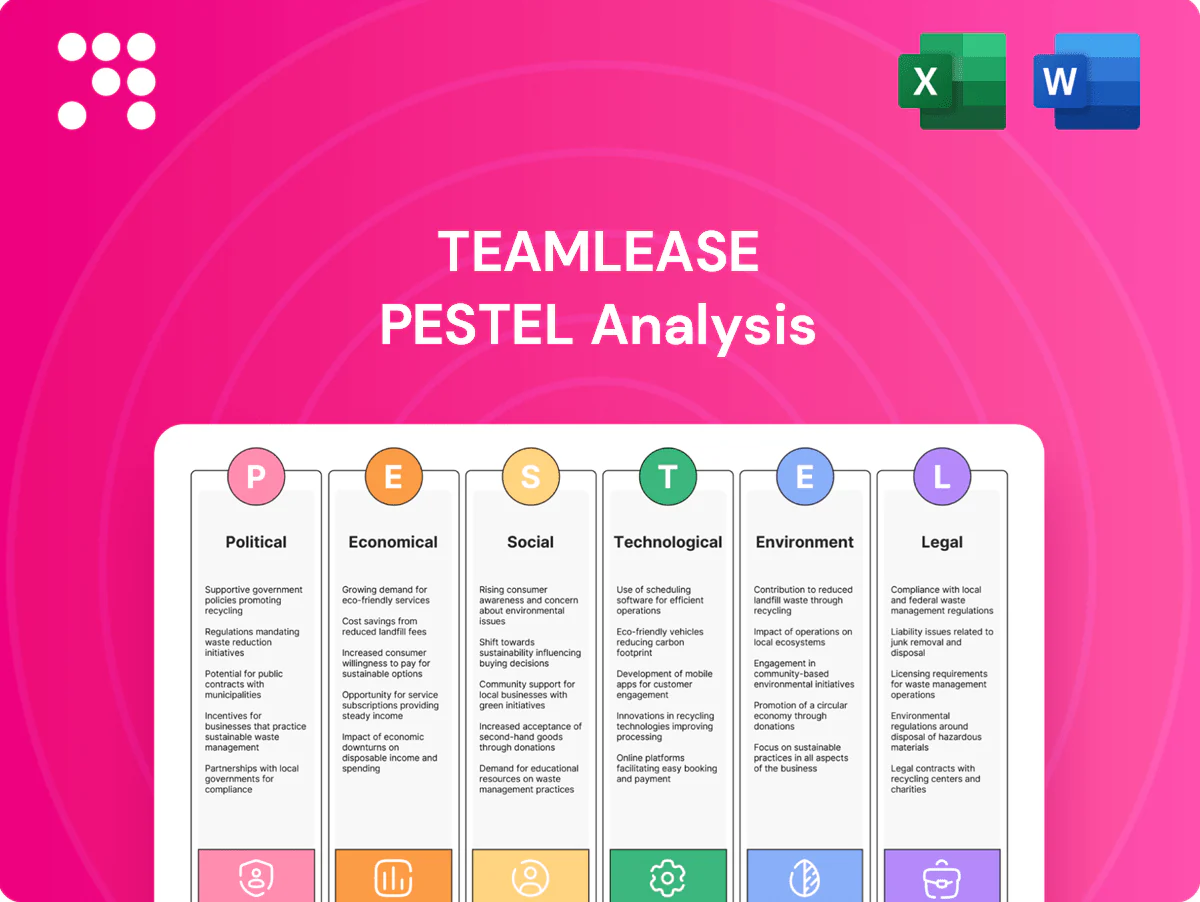
TeamLease PESTLE Analysis

Your Shortcut to Market Insight Starts Here
Unlock how political shifts, labor market trends, and tech disruption shape TeamLease’s trajectory with our concise PESTLE snapshot—designed for investors and strategists who need actionable context fast. For a full, editable breakdown with data-driven insights and risk forecasts, purchase the complete PESTLE analysis and make smarter decisions today.
Political factors

Labour policy reforms and codes
India's four Labour Codes, passed by Parliament in 2020 to consolidate 29 central labour laws, reshape hiring, wages, social security and compliance; for TeamLease—India's largest staffing firm—simplified hiring and uniform definitions can reduce friction in temporary staffing. Transitional uncertainty and staggered state-level rule notifications delay full benefits realization. Proactive compliance advisory and implementation support can convert this policy change into a service revenue and client-retention opportunity.
Central–state federal dynamics
Labour is a concurrent subject in the 7th Schedule, and India comprises 28 states and 8 union territories, producing wide variance in registration, permits and inspection regimes. TeamLease must navigate state-level rules and post-2024 election shifts that influence rollout speed of central labour policies. Building localized compliance playbooks and targeted government relations across key states is strategic.

Public skilling and employability agendas
National Skill Development Mission (launched 2015) and schemes such as the National Apprenticeship Promotion Scheme expand talent pipelines and formalize apprenticeships, enabling TeamLease to source trained candidates more reliably. Public‑private partnerships can co‑fund training, boost placements and reduce candidate acquisition costs. Policy continuity and funding cycles create planning risk for cohort sizing and cash flow. Demonstrating measurable placement and wage uplift outcomes helps secure repeat public‑private projects.

Trade policy and FDI climate
Investor sentiment and FDI inflows (India attracted US$83.6 billion in FY2022-23) lift demand in manufacturing, logistics and services that consume staffing; liberalisation and PLI schemes drive large-scale temporary hiring for ramp-ups. Protectionist shifts or geopolitical tensions can quickly dent cross-border hiring and project staffing. TeamLease’s diversified sector mix captures policy tailwinds across manufacturing, IT and logistics.
- FDI boost: supports staffing demand
- PLI & liberalisation: spurs temp deployments
- Geo-risks: threaten hiring cycles
- TeamLease: diversified, policy-aligned
Election cycles and governance stability
Election cycles, such as India’s Apr–May 2024 general election which involved about 970 million voters, often pause hiring and delay government tenders, creating short-term revenue volatility for TeamLease; post-election shifts can reallocate spend toward infrastructure and skilling, lifting demand for staffing and training. Policy stability after elections supports multi-year managed-services contracts, while scenario planning around election calendars mitigates hiring and tender timing risks.
- Hiring pauses: election periods
- Demand lift: post-election infrastructure/skilling reallocations
- Contract security: policy stability enables long-term managed services
- Mitigation: scenario planning around election calendars
Labour Codes ease temp staffing; state rules and 2024 poll delay revenues
Labour Codes (2020) simplify temp staffing but staggered state rules delay benefits. Election pauses (970m voters in 2024) and state politics create revenue timing risk. FDI-led growth (US$83.6bn in FY2022-23) and PLI boost temp hiring across sectors. Localized compliance, skilling partnerships and govt relations convert policy change into service revenue.
| Metric | Value |
|---|---|
| Labour Codes | 2020 |
| Voters (2024) | ~970 million |
| FDI (FY2022-23) | US$83.6 billion |
What is included in the product
 Detailed Word Document
Explores how macro-environmental factors uniquely affect TeamLease across Political, Economic, Social, Technological, Environmental and Legal dimensions, with data-backed trends and forward-looking insights to help executives, consultants and investors identify actionable threats and opportunities.

 Customizable Excel Spreadsheet
A clean, visually segmented PESTLE summary for TeamLease that clarifies external risks and opportunities at a glance, and can be dropped into presentations or shared across teams to speed decision-making and planning.
Economic factors

GDP growth and formalization
India's strong growth (real GDP ~7.2% in FY24) and ongoing shift from roughly 70% informal employment to formal payrolls (EPFO active subscribers >260m by 2024) expand TeamLease's addressable market; as firms outsource compliance-heavy payroll and staffing, TeamLease gains share. Slower growth compresses hiring cycles and bill rates, while counter-cyclical services like outplacement and gig-enablement smooth revenue volatility.
Wage inflation and cost pass-through
Rising minimum wages and competitive pay pressure compress margins on fixed-price contracts as India recorded consumer inflation averaging about 5.7% in 2023, pushing labour cost resets across sectors. Strong contracting with indexation and escalation clauses in TeamLease agreements enables systematic pass-through to clients, protecting gross margins. Investment in productivity tools and process automation is essential to preserve unit economics amid wage drift. Transparent, line-item pricing strengthens client trust during wage cycles.

Sectoral hiring trends
Manufacturing, e-commerce, BFSI, healthcare and GBS centers are driving bulk staffing demand for TeamLease, with India’s GBS sector targeting about 2.5 million jobs by 2025 per NASSCOM. Cyclical sectors like IT services can swing rapidly, pressuring permanent recruitment and hiring velocity. A diversified client and sector mix smooths revenue volatility. Data-led demand forecasting sharpens bench efficiency and pipeline management.

MSME health and credit availability
MSMEs, which employ about 111 million people and contribute roughly 30% of India’s GDP, are major users of outsourced HR but face chronic cash-flow constraints; easier credit (ADB estimates a roughly $300bn MSME credit gap) boosts hiring and compliance outsourcing. TeamLease must manage receivables risk, offer flexible billing and payment financing; compliance-risk reduction messaging strongly resonates with MSMEs.
- Receivables risk: offer pay-later or invoice factoring
- Flexible billing: subscription, milestone, seasonal plans
- Value prop: compliance-as-service to reduce fines and audits
Currency and inflation dynamics
Imported inflation and INR volatility—INR ~83.5/USD in mid‑2025 and CPI ~5.1% year-on-year—pressure MNC investment and export-led hiring; rising input costs hit technology, travel and facilities. TeamLease sustains margins via pricing discipline, nearshore delivery models and tight cost control. Multicurrency contracts with MNC clients hedge FX risk.
- INR ~83.5/USD (mid‑2025) — FX risk to hiring
- CPI ~5.1% — higher operating costs
- Pricing, nearshore, multicurrency contracts — margin protection
Labour Codes ease temp staffing; state rules and 2024 poll delay revenues
India GDP ~7.2% (FY24) and EPFO >260m expand TeamLease's formal payroll market; diversified sector demand (GBS ~2.5m jobs by 2025) cushions cyclicality. Inflation ~5.1–5.7% and INR ~83.5/USD (mid‑2025) raise wage and input costs, requiring indexation and automation to protect margins. MSMEs (111m employees, ~$300bn credit gap) drive outsourced HR but increase receivable risk, prompting flexible billing and financing.
| Metric | Value |
|---|---|
| GDP (FY24) | ~7.2% |
| EPFO active | >260m (2024) |
| CPI | ~5.1–5.7% |
| INR/USD | ~83.5 (mid‑2025) |
| MSME employees | ~111m; $300bn credit gap |
Preview the Actual Deliverable
TeamLease PESTLE Analysis
The preview shown here is the exact TeamLease PESTLE Analysis document you’ll receive after purchase—fully formatted and ready to use. It contains the same content, structure, and professional layout as the downloadable file. No placeholders or teasers; this is the final version available instantly after payment.

Your Shortcut to Market Insight Starts Here
Unlock how political shifts, labor market trends, and tech disruption shape TeamLease’s trajectory with our concise PESTLE snapshot—designed for investors and strategists who need actionable context fast. For a full, editable breakdown with data-driven insights and risk forecasts, purchase the complete PESTLE analysis and make smarter decisions today.
Political factors
Labour policy reforms and codes
India's four Labour Codes, passed by Parliament in 2020 to consolidate 29 central labour laws, reshape hiring, wages, social security and compliance; for TeamLease—India's largest staffing firm—simplified hiring and uniform definitions can reduce friction in temporary staffing. Transitional uncertainty and staggered state-level rule notifications delay full benefits realization. Proactive compliance advisory and implementation support can convert this policy change into a service revenue and client-retention opportunity.
Central–state federal dynamics
Labour is a concurrent subject in the 7th Schedule, and India comprises 28 states and 8 union territories, producing wide variance in registration, permits and inspection regimes. TeamLease must navigate state-level rules and post-2024 election shifts that influence rollout speed of central labour policies. Building localized compliance playbooks and targeted government relations across key states is strategic.
Public skilling and employability agendas
National Skill Development Mission (launched 2015) and schemes such as the National Apprenticeship Promotion Scheme expand talent pipelines and formalize apprenticeships, enabling TeamLease to source trained candidates more reliably. Public‑private partnerships can co‑fund training, boost placements and reduce candidate acquisition costs. Policy continuity and funding cycles create planning risk for cohort sizing and cash flow. Demonstrating measurable placement and wage uplift outcomes helps secure repeat public‑private projects.
Trade policy and FDI climate
Investor sentiment and FDI inflows (India attracted US$83.6 billion in FY2022-23) lift demand in manufacturing, logistics and services that consume staffing; liberalisation and PLI schemes drive large-scale temporary hiring for ramp-ups. Protectionist shifts or geopolitical tensions can quickly dent cross-border hiring and project staffing. TeamLease’s diversified sector mix captures policy tailwinds across manufacturing, IT and logistics.
- FDI boost: supports staffing demand
- PLI & liberalisation: spurs temp deployments
- Geo-risks: threaten hiring cycles
- TeamLease: diversified, policy-aligned
Election cycles and governance stability
Election cycles, such as India’s Apr–May 2024 general election which involved about 970 million voters, often pause hiring and delay government tenders, creating short-term revenue volatility for TeamLease; post-election shifts can reallocate spend toward infrastructure and skilling, lifting demand for staffing and training. Policy stability after elections supports multi-year managed-services contracts, while scenario planning around election calendars mitigates hiring and tender timing risks.
- Hiring pauses: election periods
- Demand lift: post-election infrastructure/skilling reallocations
- Contract security: policy stability enables long-term managed services
- Mitigation: scenario planning around election calendars
Labour Codes ease temp staffing; state rules and 2024 poll delay revenues
Labour Codes (2020) simplify temp staffing but staggered state rules delay benefits. Election pauses (970m voters in 2024) and state politics create revenue timing risk. FDI-led growth (US$83.6bn in FY2022-23) and PLI boost temp hiring across sectors. Localized compliance, skilling partnerships and govt relations convert policy change into service revenue.
| Metric | Value |
|---|---|
| Labour Codes | 2020 |
| Voters (2024) | ~970 million |
| FDI (FY2022-23) | US$83.6 billion |
What is included in the product
Detailed Word Document
Explores how macro-environmental factors uniquely affect TeamLease across Political, Economic, Social, Technological, Environmental and Legal dimensions, with data-backed trends and forward-looking insights to help executives, consultants and investors identify actionable threats and opportunities.
Customizable Excel Spreadsheet
A clean, visually segmented PESTLE summary for TeamLease that clarifies external risks and opportunities at a glance, and can be dropped into presentations or shared across teams to speed decision-making and planning.
Economic factors
GDP growth and formalization
India's strong growth (real GDP ~7.2% in FY24) and ongoing shift from roughly 70% informal employment to formal payrolls (EPFO active subscribers >260m by 2024) expand TeamLease's addressable market; as firms outsource compliance-heavy payroll and staffing, TeamLease gains share. Slower growth compresses hiring cycles and bill rates, while counter-cyclical services like outplacement and gig-enablement smooth revenue volatility.
Wage inflation and cost pass-through
Rising minimum wages and competitive pay pressure compress margins on fixed-price contracts as India recorded consumer inflation averaging about 5.7% in 2023, pushing labour cost resets across sectors. Strong contracting with indexation and escalation clauses in TeamLease agreements enables systematic pass-through to clients, protecting gross margins. Investment in productivity tools and process automation is essential to preserve unit economics amid wage drift. Transparent, line-item pricing strengthens client trust during wage cycles.
Sectoral hiring trends
Manufacturing, e-commerce, BFSI, healthcare and GBS centers are driving bulk staffing demand for TeamLease, with India’s GBS sector targeting about 2.5 million jobs by 2025 per NASSCOM. Cyclical sectors like IT services can swing rapidly, pressuring permanent recruitment and hiring velocity. A diversified client and sector mix smooths revenue volatility. Data-led demand forecasting sharpens bench efficiency and pipeline management.
MSME health and credit availability
MSMEs, which employ about 111 million people and contribute roughly 30% of India’s GDP, are major users of outsourced HR but face chronic cash-flow constraints; easier credit (ADB estimates a roughly $300bn MSME credit gap) boosts hiring and compliance outsourcing. TeamLease must manage receivables risk, offer flexible billing and payment financing; compliance-risk reduction messaging strongly resonates with MSMEs.
- Receivables risk: offer pay-later or invoice factoring
- Flexible billing: subscription, milestone, seasonal plans
- Value prop: compliance-as-service to reduce fines and audits
Currency and inflation dynamics
Imported inflation and INR volatility—INR ~83.5/USD in mid‑2025 and CPI ~5.1% year-on-year—pressure MNC investment and export-led hiring; rising input costs hit technology, travel and facilities. TeamLease sustains margins via pricing discipline, nearshore delivery models and tight cost control. Multicurrency contracts with MNC clients hedge FX risk.
- INR ~83.5/USD (mid‑2025) — FX risk to hiring
- CPI ~5.1% — higher operating costs
- Pricing, nearshore, multicurrency contracts — margin protection
Labour Codes ease temp staffing; state rules and 2024 poll delay revenues
India GDP ~7.2% (FY24) and EPFO >260m expand TeamLease's formal payroll market; diversified sector demand (GBS ~2.5m jobs by 2025) cushions cyclicality. Inflation ~5.1–5.7% and INR ~83.5/USD (mid‑2025) raise wage and input costs, requiring indexation and automation to protect margins. MSMEs (111m employees, ~$300bn credit gap) drive outsourced HR but increase receivable risk, prompting flexible billing and financing.
| Metric | Value |
|---|---|
| GDP (FY24) | ~7.2% |
| EPFO active | >260m (2024) |
| CPI | ~5.1–5.7% |
| INR/USD | ~83.5 (mid‑2025) |
| MSME employees | ~111m; $300bn credit gap |
Preview the Actual Deliverable
TeamLease PESTLE Analysis
The preview shown here is the exact TeamLease PESTLE Analysis document you’ll receive after purchase—fully formatted and ready to use. It contains the same content, structure, and professional layout as the downloadable file. No placeholders or teasers; this is the final version available instantly after payment.
Original: $10.00
-65%$10.00
$3.50Description
Your Shortcut to Market Insight Starts Here
Unlock how political shifts, labor market trends, and tech disruption shape TeamLease’s trajectory with our concise PESTLE snapshot—designed for investors and strategists who need actionable context fast. For a full, editable breakdown with data-driven insights and risk forecasts, purchase the complete PESTLE analysis and make smarter decisions today.
Political factors
Labour policy reforms and codes
India's four Labour Codes, passed by Parliament in 2020 to consolidate 29 central labour laws, reshape hiring, wages, social security and compliance; for TeamLease—India's largest staffing firm—simplified hiring and uniform definitions can reduce friction in temporary staffing. Transitional uncertainty and staggered state-level rule notifications delay full benefits realization. Proactive compliance advisory and implementation support can convert this policy change into a service revenue and client-retention opportunity.
Central–state federal dynamics
Labour is a concurrent subject in the 7th Schedule, and India comprises 28 states and 8 union territories, producing wide variance in registration, permits and inspection regimes. TeamLease must navigate state-level rules and post-2024 election shifts that influence rollout speed of central labour policies. Building localized compliance playbooks and targeted government relations across key states is strategic.
Public skilling and employability agendas
National Skill Development Mission (launched 2015) and schemes such as the National Apprenticeship Promotion Scheme expand talent pipelines and formalize apprenticeships, enabling TeamLease to source trained candidates more reliably. Public‑private partnerships can co‑fund training, boost placements and reduce candidate acquisition costs. Policy continuity and funding cycles create planning risk for cohort sizing and cash flow. Demonstrating measurable placement and wage uplift outcomes helps secure repeat public‑private projects.
Trade policy and FDI climate
Investor sentiment and FDI inflows (India attracted US$83.6 billion in FY2022-23) lift demand in manufacturing, logistics and services that consume staffing; liberalisation and PLI schemes drive large-scale temporary hiring for ramp-ups. Protectionist shifts or geopolitical tensions can quickly dent cross-border hiring and project staffing. TeamLease’s diversified sector mix captures policy tailwinds across manufacturing, IT and logistics.
- FDI boost: supports staffing demand
- PLI & liberalisation: spurs temp deployments
- Geo-risks: threaten hiring cycles
- TeamLease: diversified, policy-aligned
Election cycles and governance stability
Election cycles, such as India’s Apr–May 2024 general election which involved about 970 million voters, often pause hiring and delay government tenders, creating short-term revenue volatility for TeamLease; post-election shifts can reallocate spend toward infrastructure and skilling, lifting demand for staffing and training. Policy stability after elections supports multi-year managed-services contracts, while scenario planning around election calendars mitigates hiring and tender timing risks.
- Hiring pauses: election periods
- Demand lift: post-election infrastructure/skilling reallocations
- Contract security: policy stability enables long-term managed services
- Mitigation: scenario planning around election calendars
Labour Codes ease temp staffing; state rules and 2024 poll delay revenues
Labour Codes (2020) simplify temp staffing but staggered state rules delay benefits. Election pauses (970m voters in 2024) and state politics create revenue timing risk. FDI-led growth (US$83.6bn in FY2022-23) and PLI boost temp hiring across sectors. Localized compliance, skilling partnerships and govt relations convert policy change into service revenue.
| Metric | Value |
|---|---|
| Labour Codes | 2020 |
| Voters (2024) | ~970 million |
| FDI (FY2022-23) | US$83.6 billion |
What is included in the product
Detailed Word Document
Explores how macro-environmental factors uniquely affect TeamLease across Political, Economic, Social, Technological, Environmental and Legal dimensions, with data-backed trends and forward-looking insights to help executives, consultants and investors identify actionable threats and opportunities.
Customizable Excel Spreadsheet
A clean, visually segmented PESTLE summary for TeamLease that clarifies external risks and opportunities at a glance, and can be dropped into presentations or shared across teams to speed decision-making and planning.
Economic factors
GDP growth and formalization
India's strong growth (real GDP ~7.2% in FY24) and ongoing shift from roughly 70% informal employment to formal payrolls (EPFO active subscribers >260m by 2024) expand TeamLease's addressable market; as firms outsource compliance-heavy payroll and staffing, TeamLease gains share. Slower growth compresses hiring cycles and bill rates, while counter-cyclical services like outplacement and gig-enablement smooth revenue volatility.
Wage inflation and cost pass-through
Rising minimum wages and competitive pay pressure compress margins on fixed-price contracts as India recorded consumer inflation averaging about 5.7% in 2023, pushing labour cost resets across sectors. Strong contracting with indexation and escalation clauses in TeamLease agreements enables systematic pass-through to clients, protecting gross margins. Investment in productivity tools and process automation is essential to preserve unit economics amid wage drift. Transparent, line-item pricing strengthens client trust during wage cycles.
Sectoral hiring trends
Manufacturing, e-commerce, BFSI, healthcare and GBS centers are driving bulk staffing demand for TeamLease, with India’s GBS sector targeting about 2.5 million jobs by 2025 per NASSCOM. Cyclical sectors like IT services can swing rapidly, pressuring permanent recruitment and hiring velocity. A diversified client and sector mix smooths revenue volatility. Data-led demand forecasting sharpens bench efficiency and pipeline management.
MSME health and credit availability
MSMEs, which employ about 111 million people and contribute roughly 30% of India’s GDP, are major users of outsourced HR but face chronic cash-flow constraints; easier credit (ADB estimates a roughly $300bn MSME credit gap) boosts hiring and compliance outsourcing. TeamLease must manage receivables risk, offer flexible billing and payment financing; compliance-risk reduction messaging strongly resonates with MSMEs.
- Receivables risk: offer pay-later or invoice factoring
- Flexible billing: subscription, milestone, seasonal plans
- Value prop: compliance-as-service to reduce fines and audits
Currency and inflation dynamics
Imported inflation and INR volatility—INR ~83.5/USD in mid‑2025 and CPI ~5.1% year-on-year—pressure MNC investment and export-led hiring; rising input costs hit technology, travel and facilities. TeamLease sustains margins via pricing discipline, nearshore delivery models and tight cost control. Multicurrency contracts with MNC clients hedge FX risk.
- INR ~83.5/USD (mid‑2025) — FX risk to hiring
- CPI ~5.1% — higher operating costs
- Pricing, nearshore, multicurrency contracts — margin protection
Labour Codes ease temp staffing; state rules and 2024 poll delay revenues
India GDP ~7.2% (FY24) and EPFO >260m expand TeamLease's formal payroll market; diversified sector demand (GBS ~2.5m jobs by 2025) cushions cyclicality. Inflation ~5.1–5.7% and INR ~83.5/USD (mid‑2025) raise wage and input costs, requiring indexation and automation to protect margins. MSMEs (111m employees, ~$300bn credit gap) drive outsourced HR but increase receivable risk, prompting flexible billing and financing.
| Metric | Value |
|---|---|
| GDP (FY24) | ~7.2% |
| EPFO active | >260m (2024) |
| CPI | ~5.1–5.7% |
| INR/USD | ~83.5 (mid‑2025) |
| MSME employees | ~111m; $300bn credit gap |
Preview the Actual Deliverable
TeamLease PESTLE Analysis
The preview shown here is the exact TeamLease PESTLE Analysis document you’ll receive after purchase—fully formatted and ready to use. It contains the same content, structure, and professional layout as the downloadable file. No placeholders or teasers; this is the final version available instantly after payment.











