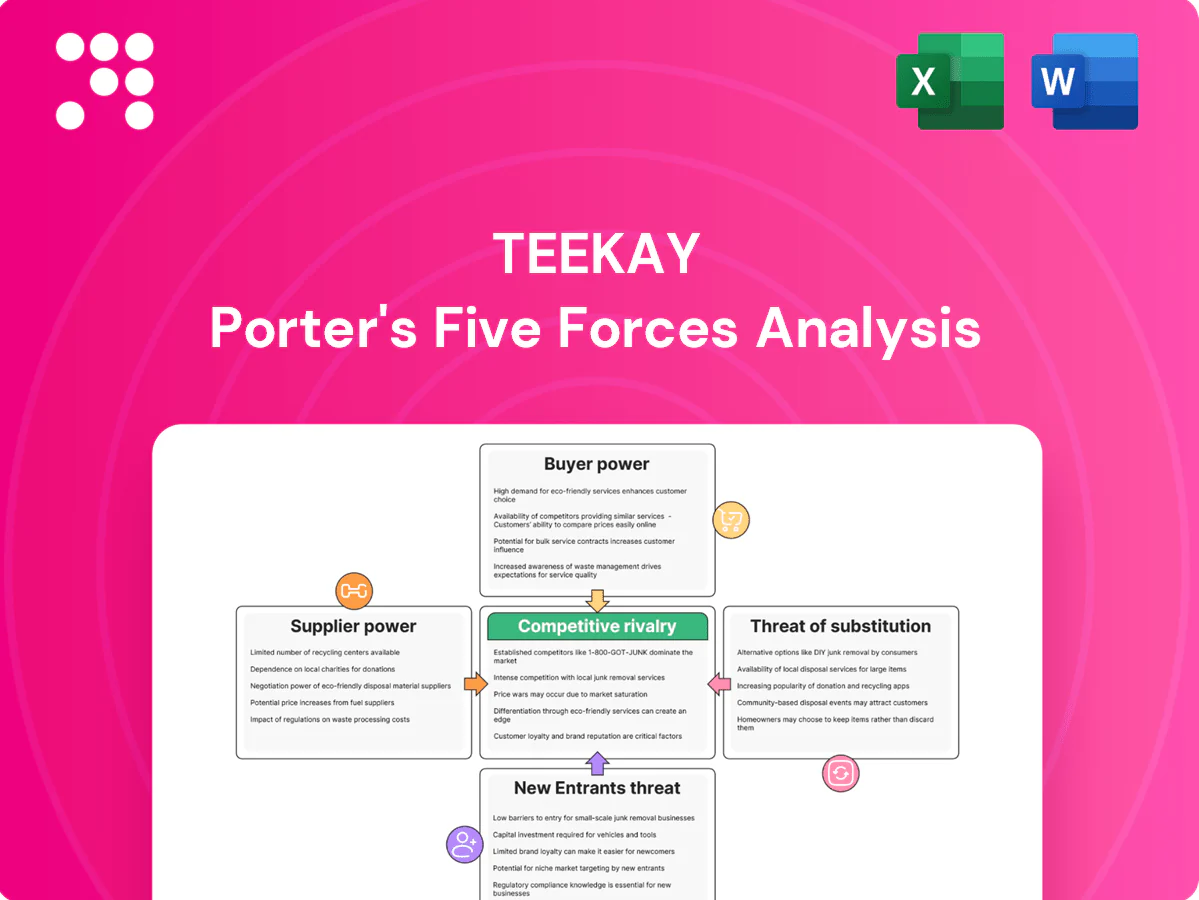
Teekay Porter's Five Forces Analysis

A Must-Have Tool for Decision-Makers
Understanding the competitive landscape is crucial for any business, and Teekay is no exception. Porter's Five Forces analysis provides a powerful framework to dissect the industry's dynamics, revealing the underlying pressures that shape profitability and strategic decision-making.
This brief snapshot only scratches the surface. Unlock the full Porter's Five Forces Analysis to explore Teekay’s competitive dynamics, market pressures, and strategic advantages in detail.
Suppliers Bargaining Power

Concentration of specialized suppliers
The bargaining power of suppliers for Teekay is significantly influenced by the concentration of specialized suppliers. Companies providing highly specialized components like advanced marine engines, sophisticated navigation systems, and niche shipyard services for complex vessels, such as LNG carriers or Floating Production Storage and Offloading units (FPSOs), hold considerable sway because Teekay has few viable alternatives. For instance, the global order book for specialized vessels often features a limited number of shipyards capable of handling such complex construction.
High switching costs for critical inputs
Teekay's reliance on specialized inputs, such as those for its LNG carriers or shuttle tankers, means that switching suppliers for critical components or services can be incredibly costly. Consider the process of building a new vessel or undertaking major dry-docking; these require highly specific expertise and materials, making a change in vendors a significant undertaking. In 2024, the global shipbuilding order book saw continued demand, with prices for specialized vessels remaining elevated, underscoring the investment required to establish new supplier relationships.
Furthermore, long-term agreements for essential resources like marine fuel and specialized crewing services create considerable barriers to switching. These contracts lock Teekay into existing relationships, providing those suppliers with leverage. The intricate nature of Teekay's fleet, requiring unique parts and maintenance knowledge, further limits the ease with which new vendors can be integrated, solidifying the bargaining power of current suppliers.

Impact of regulatory compliance and environmental technology providers
Stricter environmental regulations, particularly those targeting CO2 emission reductions, are significantly shaping the maritime industry. This trend elevates the bargaining power of suppliers who offer compliant fuels, such as Liquefied Natural Gas (LNG), and providers of green technologies essential for meeting these mandates. For instance, the International Maritime Organization's (IMO) ambition to achieve net-zero greenhouse gas emissions by or around 2050 puts immense pressure on shipping companies like Teekay to adopt new solutions.
The increasing demand for sustainable shipping fuels and advanced environmental technologies means that companies possessing these capabilities hold considerable sway. These providers, often dealing with high development and implementation costs, can command premium pricing. The global fleet's transition necessitates substantial investment in new infrastructure and retrofitting, directly benefiting suppliers of these critical, often expensive, solutions.

Labor and crewing agency power
The bargaining power of labor and crewing agencies significantly impacts Teekay, as skilled seafarers and specialized maritime personnel are crucial inputs. Labor shortages or robust union presence in key seafaring regions can escalate crewing expenses, directly affecting Teekay's operational costs. For instance, in 2024, the International Chamber of Shipping reported ongoing challenges in attracting and retaining qualified seafarers across various specializations, a trend that has persisted and intensified.
Geopolitical shifts and evolving global trade routes can further influence the availability and cost of maritime labor. These external factors can create supply-demand imbalances for crewing services, granting agencies more leverage.
- Skilled Seafarer Availability: Shortages in experienced officers and specialized crew members can drive up wages and agency fees.
- Union Influence: Strong maritime unions in certain countries can negotiate favorable terms for their members, increasing labor costs for Teekay.
- Geopolitical Impact: Tensions or conflicts in maritime regions can disrupt crew rotations and increase demand for available personnel, boosting agency power.
Access to financing and insurance providers
Teekay's reliance on external financing for its capital-intensive operations, particularly vessel acquisition and maintenance, grants significant bargaining power to banks and financial institutions. For instance, in 2024, the global shipping finance market saw increased scrutiny due to geopolitical tensions and fluctuating interest rates, potentially leading to tighter lending conditions and higher financing costs for companies like Teekay.
The specialized nature of marine insurance also concentrates power in the hands of a few providers. These insurers, aware of the substantial asset values and inherent risks in maritime transport, can dictate terms and premiums. In 2023, the marine insurance market experienced rising hull and machinery premiums, reflecting increased claims frequency and severity in certain segments, a trend likely to continue influencing Teekay's insurance costs in 2024.
- Financing Dependence: Teekay requires substantial capital for its fleet, making it sensitive to lender terms.
- Insurance Leverage: Specialized marine insurers hold sway due to high asset values and operational risks.
- Market Sensitivity: Global economic conditions and uncertainty directly impact the availability and cost of financing and insurance.
Supplier Leverage Shapes Maritime Operations
The bargaining power of suppliers for Teekay is elevated by the limited number of providers for specialized maritime equipment and services, such as LNG propulsion systems or advanced hull coatings. The high cost and complexity associated with switching these suppliers, coupled with the specialized nature of Teekay's fleet, solidify supplier leverage. For example, the global market for LNG carrier construction in 2024 continued to be dominated by a few key shipyards and component manufacturers.
Environmental regulations are increasingly empowering suppliers of green technologies and compliant fuels, as Teekay, like others in the industry, must invest in solutions to meet targets like the IMO's 2050 net-zero ambition. This trend benefits providers of LNG as a marine fuel and companies developing emissions reduction technologies. The demand for these specialized, often premium-priced, solutions is growing, granting these suppliers significant pricing power.
Labor and crewing agencies also wield considerable power due to ongoing shortages of skilled seafarers, a challenge highlighted by the International Chamber of Shipping's reports throughout 2024. Geopolitical instability can further exacerbate these shortages, increasing demand for available personnel and boosting the leverage of crewing agencies.
| Factor | Impact on Teekay | 2024 Data/Trend |
|---|---|---|
| Specialized Equipment Suppliers | High Bargaining Power | Limited global suppliers for LNG components; high switching costs. |
| Green Technology Providers | Increasing Bargaining Power | Growing demand for emissions reduction solutions to meet IMO targets. |
| Skilled Labor Agencies | High Bargaining Power | Persistent shortages of experienced seafarers reported in 2024. |
What is included in the product
 Detailed Word Document
This Porter's Five Forces analysis provides a comprehensive examination of the competitive landscape for Teekay, detailing the intensity of rivalry, buyer and supplier power, threat of new entrants, and the impact of substitutes.

 Customizable Excel Spreadsheet
Effortlessly identify and mitigate competitive threats by visualizing the intensity of each force, allowing for targeted strategic adjustments.
Customers Bargaining Power

Consolidated customer base in oil and gas
Teekay's customer base is concentrated among major oil and gas corporations, energy traders, and governmental entities. These clients are typically large, sophisticated organizations with substantial leverage, enabling them to negotiate for competitive pricing and advantageous contract conditions.
The bargaining power of these customers is significant due to their size and the consolidated nature of the energy sector. For instance, in 2024, the top five oil and gas supermajors accounted for a substantial portion of global upstream production, giving them considerable sway in chartering and service agreements.
This concentration means Teekay's financial performance is closely tied to its ability to secure and maintain long-term contracts with a limited number of key clients. Successful contract renewals and favorable terms with these major players are crucial for Teekay's revenue stability and profitability.
High volume of purchases by key customers
Large customers, such as major oil companies, often contract for substantial volumes of transportation services. This significant purchasing power grants them considerable leverage to negotiate lower freight rates with Teekay. For instance, in 2023, Teekay's top five customers accounted for approximately 40% of its total revenue, highlighting the critical reliance on these relationships.
Teekay's revenue streams are directly influenced by its dependence on these large volume contracts. The potential loss of a major client or the renewal of a contract at less favorable terms can materially impact the company's financial performance. This concentration risk is a key factor in managing customer relationships and contract negotiations.
The demand for Teekay's crude oil and product tanker services is intrinsically tied to global oil demand and supply dynamics. Fluctuations in these macro-economic factors can affect the volume of cargo available, further empowering large customers who can shift their business to alternative providers if terms are not competitive.

Customer's ability to switch between carriers
Teekay's customers, particularly those using conventional crude and product tankers, benefit from a competitive market with numerous carrier options. This readily available choice significantly enhances their bargaining power, as they can easily switch to a different provider if Teekay’s rates or service levels are not perceived as optimal. For instance, in 2024, the tanker market saw fluctuating freight rates, driven by geopolitical events and global demand shifts, which further emboldened charterers to negotiate favorable terms.

Price sensitivity of transported commodities
The price sensitivity of the commodities Teekay transports, such as crude oil, LNG, and LPG, significantly impacts customer bargaining power. These commodities are frequently exposed to considerable fluctuations in global prices.
This volatility makes customers acutely aware of transportation costs, compelling Teekay to maintain competitive freight rates. For instance, projections for 2025 and 2026 indicate potential downward pressure on oil prices due to anticipated oversupply, which could subsequently dampen demand and exert further pressure on freight rates.
- Commodity Price Volatility: Crude oil, LNG, and LPG prices are subject to global market swings.
- Customer Price Sensitivity: High commodity price volatility translates to increased customer sensitivity to shipping costs.
- Impact on Freight Rates: This sensitivity pressures Teekay to offer competitive pricing for its transportation services.
- 2025-2026 Outlook: Forecasts suggest lower oil prices in 2025-2026 due to excess supply, potentially reducing demand and freight rates.
Potential for backward integration by customers
Some major oil and gas firms, like ExxonMobil and Shell, maintain their own shipping capabilities or secure extensive long-term charter agreements. This reduces their dependence on external marine transport services, such as those provided by Teekay. For instance, in 2023, major integrated oil companies continued to invest in their own logistics, with some operating dedicated tanker fleets to manage a portion of their global oil and gas movements.
This inherent capability for backward integration by customers grants them considerable bargaining power when negotiating rates and terms with third-party providers like Teekay. The threat, even if not fully realized, influences pricing and contract conditions.
However, the significant capital expenditure required to establish and maintain a modern, compliant shipping fleet—estimated in the hundreds of millions of dollars per vessel—acts as a substantial barrier to entry for most potential customer integrators.
- Customer Integration Threat: Large oil and gas companies can leverage their own shipping assets or charters.
- Bargaining Leverage: This capability enhances customer negotiation power against Teekay.
- Capital Intensity Barrier: The high cost of owning and operating fleets limits widespread backward integration.
- 2023 Market Context: Major players maintained investments in logistics, underscoring the ongoing potential for integration.
Client Power: Shaping Shipping Market Dynamics
Teekay's customers, primarily large oil and gas corporations, exert significant bargaining power due to their substantial purchase volumes and the competitive nature of the tanker market. In 2024, the concentration of major oil producers meant that securing contracts with these entities was paramount, as they could easily shift to alternative providers if Teekay's terms were not favorable. This dynamic is further amplified by the price sensitivity of the commodities Teekay transports, such as crude oil and LNG, where even minor fluctuations in global prices make clients keenly aware of shipping costs.
| Customer Segment | Bargaining Power Factors | Impact on Teekay | 2024 Data Point |
|---|---|---|---|
| Major Oil & Gas Corporations | High Volume Purchases, Market Competition | Pressure on Freight Rates, Contract Terms | Top 5 customers accounted for ~40% of revenue in 2023 |
| Energy Traders | Price Sensitivity of Commodities | Demand for Competitive Pricing | Crude oil prices saw significant volatility in early 2024 |
| Governmental Entities | Strategic Importance, Long-Term Contracts | Negotiation Leverage on Service Levels | Long-term LNG contracts are critical for stable revenue |
Preview Before You Purchase
Teekay Porter's Five Forces Analysis
This preview showcases the complete Teekay Porter's Five Forces Analysis, offering a detailed examination of the competitive landscape within the industry. The document you see here is precisely the same professionally formatted analysis you will receive immediately after purchase, ensuring no discrepancies or missing information. You can confidently acquire this comprehensive report, knowing that the insights and strategic overview presented are exactly what you'll be able to utilize for your business planning and decision-making.

A Must-Have Tool for Decision-Makers
Understanding the competitive landscape is crucial for any business, and Teekay is no exception. Porter's Five Forces analysis provides a powerful framework to dissect the industry's dynamics, revealing the underlying pressures that shape profitability and strategic decision-making.
This brief snapshot only scratches the surface. Unlock the full Porter's Five Forces Analysis to explore Teekay’s competitive dynamics, market pressures, and strategic advantages in detail.
Suppliers Bargaining Power
Concentration of specialized suppliers
The bargaining power of suppliers for Teekay is significantly influenced by the concentration of specialized suppliers. Companies providing highly specialized components like advanced marine engines, sophisticated navigation systems, and niche shipyard services for complex vessels, such as LNG carriers or Floating Production Storage and Offloading units (FPSOs), hold considerable sway because Teekay has few viable alternatives. For instance, the global order book for specialized vessels often features a limited number of shipyards capable of handling such complex construction.
High switching costs for critical inputs
Teekay's reliance on specialized inputs, such as those for its LNG carriers or shuttle tankers, means that switching suppliers for critical components or services can be incredibly costly. Consider the process of building a new vessel or undertaking major dry-docking; these require highly specific expertise and materials, making a change in vendors a significant undertaking. In 2024, the global shipbuilding order book saw continued demand, with prices for specialized vessels remaining elevated, underscoring the investment required to establish new supplier relationships.
Furthermore, long-term agreements for essential resources like marine fuel and specialized crewing services create considerable barriers to switching. These contracts lock Teekay into existing relationships, providing those suppliers with leverage. The intricate nature of Teekay's fleet, requiring unique parts and maintenance knowledge, further limits the ease with which new vendors can be integrated, solidifying the bargaining power of current suppliers.
Impact of regulatory compliance and environmental technology providers
Stricter environmental regulations, particularly those targeting CO2 emission reductions, are significantly shaping the maritime industry. This trend elevates the bargaining power of suppliers who offer compliant fuels, such as Liquefied Natural Gas (LNG), and providers of green technologies essential for meeting these mandates. For instance, the International Maritime Organization's (IMO) ambition to achieve net-zero greenhouse gas emissions by or around 2050 puts immense pressure on shipping companies like Teekay to adopt new solutions.
The increasing demand for sustainable shipping fuels and advanced environmental technologies means that companies possessing these capabilities hold considerable sway. These providers, often dealing with high development and implementation costs, can command premium pricing. The global fleet's transition necessitates substantial investment in new infrastructure and retrofitting, directly benefiting suppliers of these critical, often expensive, solutions.
Labor and crewing agency power
The bargaining power of labor and crewing agencies significantly impacts Teekay, as skilled seafarers and specialized maritime personnel are crucial inputs. Labor shortages or robust union presence in key seafaring regions can escalate crewing expenses, directly affecting Teekay's operational costs. For instance, in 2024, the International Chamber of Shipping reported ongoing challenges in attracting and retaining qualified seafarers across various specializations, a trend that has persisted and intensified.
Geopolitical shifts and evolving global trade routes can further influence the availability and cost of maritime labor. These external factors can create supply-demand imbalances for crewing services, granting agencies more leverage.
- Skilled Seafarer Availability: Shortages in experienced officers and specialized crew members can drive up wages and agency fees.
- Union Influence: Strong maritime unions in certain countries can negotiate favorable terms for their members, increasing labor costs for Teekay.
- Geopolitical Impact: Tensions or conflicts in maritime regions can disrupt crew rotations and increase demand for available personnel, boosting agency power.
Access to financing and insurance providers
Teekay's reliance on external financing for its capital-intensive operations, particularly vessel acquisition and maintenance, grants significant bargaining power to banks and financial institutions. For instance, in 2024, the global shipping finance market saw increased scrutiny due to geopolitical tensions and fluctuating interest rates, potentially leading to tighter lending conditions and higher financing costs for companies like Teekay.
The specialized nature of marine insurance also concentrates power in the hands of a few providers. These insurers, aware of the substantial asset values and inherent risks in maritime transport, can dictate terms and premiums. In 2023, the marine insurance market experienced rising hull and machinery premiums, reflecting increased claims frequency and severity in certain segments, a trend likely to continue influencing Teekay's insurance costs in 2024.
- Financing Dependence: Teekay requires substantial capital for its fleet, making it sensitive to lender terms.
- Insurance Leverage: Specialized marine insurers hold sway due to high asset values and operational risks.
- Market Sensitivity: Global economic conditions and uncertainty directly impact the availability and cost of financing and insurance.
Supplier Leverage Shapes Maritime Operations
The bargaining power of suppliers for Teekay is elevated by the limited number of providers for specialized maritime equipment and services, such as LNG propulsion systems or advanced hull coatings. The high cost and complexity associated with switching these suppliers, coupled with the specialized nature of Teekay's fleet, solidify supplier leverage. For example, the global market for LNG carrier construction in 2024 continued to be dominated by a few key shipyards and component manufacturers.
Environmental regulations are increasingly empowering suppliers of green technologies and compliant fuels, as Teekay, like others in the industry, must invest in solutions to meet targets like the IMO's 2050 net-zero ambition. This trend benefits providers of LNG as a marine fuel and companies developing emissions reduction technologies. The demand for these specialized, often premium-priced, solutions is growing, granting these suppliers significant pricing power.
Labor and crewing agencies also wield considerable power due to ongoing shortages of skilled seafarers, a challenge highlighted by the International Chamber of Shipping's reports throughout 2024. Geopolitical instability can further exacerbate these shortages, increasing demand for available personnel and boosting the leverage of crewing agencies.
| Factor | Impact on Teekay | 2024 Data/Trend |
|---|---|---|
| Specialized Equipment Suppliers | High Bargaining Power | Limited global suppliers for LNG components; high switching costs. |
| Green Technology Providers | Increasing Bargaining Power | Growing demand for emissions reduction solutions to meet IMO targets. |
| Skilled Labor Agencies | High Bargaining Power | Persistent shortages of experienced seafarers reported in 2024. |
What is included in the product
Detailed Word Document
This Porter's Five Forces analysis provides a comprehensive examination of the competitive landscape for Teekay, detailing the intensity of rivalry, buyer and supplier power, threat of new entrants, and the impact of substitutes.
Customizable Excel Spreadsheet
Effortlessly identify and mitigate competitive threats by visualizing the intensity of each force, allowing for targeted strategic adjustments.
Customers Bargaining Power
Consolidated customer base in oil and gas
Teekay's customer base is concentrated among major oil and gas corporations, energy traders, and governmental entities. These clients are typically large, sophisticated organizations with substantial leverage, enabling them to negotiate for competitive pricing and advantageous contract conditions.
The bargaining power of these customers is significant due to their size and the consolidated nature of the energy sector. For instance, in 2024, the top five oil and gas supermajors accounted for a substantial portion of global upstream production, giving them considerable sway in chartering and service agreements.
This concentration means Teekay's financial performance is closely tied to its ability to secure and maintain long-term contracts with a limited number of key clients. Successful contract renewals and favorable terms with these major players are crucial for Teekay's revenue stability and profitability.
High volume of purchases by key customers
Large customers, such as major oil companies, often contract for substantial volumes of transportation services. This significant purchasing power grants them considerable leverage to negotiate lower freight rates with Teekay. For instance, in 2023, Teekay's top five customers accounted for approximately 40% of its total revenue, highlighting the critical reliance on these relationships.
Teekay's revenue streams are directly influenced by its dependence on these large volume contracts. The potential loss of a major client or the renewal of a contract at less favorable terms can materially impact the company's financial performance. This concentration risk is a key factor in managing customer relationships and contract negotiations.
The demand for Teekay's crude oil and product tanker services is intrinsically tied to global oil demand and supply dynamics. Fluctuations in these macro-economic factors can affect the volume of cargo available, further empowering large customers who can shift their business to alternative providers if terms are not competitive.
Customer's ability to switch between carriers
Teekay's customers, particularly those using conventional crude and product tankers, benefit from a competitive market with numerous carrier options. This readily available choice significantly enhances their bargaining power, as they can easily switch to a different provider if Teekay’s rates or service levels are not perceived as optimal. For instance, in 2024, the tanker market saw fluctuating freight rates, driven by geopolitical events and global demand shifts, which further emboldened charterers to negotiate favorable terms.
Price sensitivity of transported commodities
The price sensitivity of the commodities Teekay transports, such as crude oil, LNG, and LPG, significantly impacts customer bargaining power. These commodities are frequently exposed to considerable fluctuations in global prices.
This volatility makes customers acutely aware of transportation costs, compelling Teekay to maintain competitive freight rates. For instance, projections for 2025 and 2026 indicate potential downward pressure on oil prices due to anticipated oversupply, which could subsequently dampen demand and exert further pressure on freight rates.
- Commodity Price Volatility: Crude oil, LNG, and LPG prices are subject to global market swings.
- Customer Price Sensitivity: High commodity price volatility translates to increased customer sensitivity to shipping costs.
- Impact on Freight Rates: This sensitivity pressures Teekay to offer competitive pricing for its transportation services.
- 2025-2026 Outlook: Forecasts suggest lower oil prices in 2025-2026 due to excess supply, potentially reducing demand and freight rates.
Potential for backward integration by customers
Some major oil and gas firms, like ExxonMobil and Shell, maintain their own shipping capabilities or secure extensive long-term charter agreements. This reduces their dependence on external marine transport services, such as those provided by Teekay. For instance, in 2023, major integrated oil companies continued to invest in their own logistics, with some operating dedicated tanker fleets to manage a portion of their global oil and gas movements.
This inherent capability for backward integration by customers grants them considerable bargaining power when negotiating rates and terms with third-party providers like Teekay. The threat, even if not fully realized, influences pricing and contract conditions.
However, the significant capital expenditure required to establish and maintain a modern, compliant shipping fleet—estimated in the hundreds of millions of dollars per vessel—acts as a substantial barrier to entry for most potential customer integrators.
- Customer Integration Threat: Large oil and gas companies can leverage their own shipping assets or charters.
- Bargaining Leverage: This capability enhances customer negotiation power against Teekay.
- Capital Intensity Barrier: The high cost of owning and operating fleets limits widespread backward integration.
- 2023 Market Context: Major players maintained investments in logistics, underscoring the ongoing potential for integration.
Client Power: Shaping Shipping Market Dynamics
Teekay's customers, primarily large oil and gas corporations, exert significant bargaining power due to their substantial purchase volumes and the competitive nature of the tanker market. In 2024, the concentration of major oil producers meant that securing contracts with these entities was paramount, as they could easily shift to alternative providers if Teekay's terms were not favorable. This dynamic is further amplified by the price sensitivity of the commodities Teekay transports, such as crude oil and LNG, where even minor fluctuations in global prices make clients keenly aware of shipping costs.
| Customer Segment | Bargaining Power Factors | Impact on Teekay | 2024 Data Point |
|---|---|---|---|
| Major Oil & Gas Corporations | High Volume Purchases, Market Competition | Pressure on Freight Rates, Contract Terms | Top 5 customers accounted for ~40% of revenue in 2023 |
| Energy Traders | Price Sensitivity of Commodities | Demand for Competitive Pricing | Crude oil prices saw significant volatility in early 2024 |
| Governmental Entities | Strategic Importance, Long-Term Contracts | Negotiation Leverage on Service Levels | Long-term LNG contracts are critical for stable revenue |
Preview Before You Purchase
Teekay Porter's Five Forces Analysis
This preview showcases the complete Teekay Porter's Five Forces Analysis, offering a detailed examination of the competitive landscape within the industry. The document you see here is precisely the same professionally formatted analysis you will receive immediately after purchase, ensuring no discrepancies or missing information. You can confidently acquire this comprehensive report, knowing that the insights and strategic overview presented are exactly what you'll be able to utilize for your business planning and decision-making.
Description
A Must-Have Tool for Decision-Makers
Understanding the competitive landscape is crucial for any business, and Teekay is no exception. Porter's Five Forces analysis provides a powerful framework to dissect the industry's dynamics, revealing the underlying pressures that shape profitability and strategic decision-making.
This brief snapshot only scratches the surface. Unlock the full Porter's Five Forces Analysis to explore Teekay’s competitive dynamics, market pressures, and strategic advantages in detail.
Suppliers Bargaining Power
Concentration of specialized suppliers
The bargaining power of suppliers for Teekay is significantly influenced by the concentration of specialized suppliers. Companies providing highly specialized components like advanced marine engines, sophisticated navigation systems, and niche shipyard services for complex vessels, such as LNG carriers or Floating Production Storage and Offloading units (FPSOs), hold considerable sway because Teekay has few viable alternatives. For instance, the global order book for specialized vessels often features a limited number of shipyards capable of handling such complex construction.
High switching costs for critical inputs
Teekay's reliance on specialized inputs, such as those for its LNG carriers or shuttle tankers, means that switching suppliers for critical components or services can be incredibly costly. Consider the process of building a new vessel or undertaking major dry-docking; these require highly specific expertise and materials, making a change in vendors a significant undertaking. In 2024, the global shipbuilding order book saw continued demand, with prices for specialized vessels remaining elevated, underscoring the investment required to establish new supplier relationships.
Furthermore, long-term agreements for essential resources like marine fuel and specialized crewing services create considerable barriers to switching. These contracts lock Teekay into existing relationships, providing those suppliers with leverage. The intricate nature of Teekay's fleet, requiring unique parts and maintenance knowledge, further limits the ease with which new vendors can be integrated, solidifying the bargaining power of current suppliers.
Impact of regulatory compliance and environmental technology providers
Stricter environmental regulations, particularly those targeting CO2 emission reductions, are significantly shaping the maritime industry. This trend elevates the bargaining power of suppliers who offer compliant fuels, such as Liquefied Natural Gas (LNG), and providers of green technologies essential for meeting these mandates. For instance, the International Maritime Organization's (IMO) ambition to achieve net-zero greenhouse gas emissions by or around 2050 puts immense pressure on shipping companies like Teekay to adopt new solutions.
The increasing demand for sustainable shipping fuels and advanced environmental technologies means that companies possessing these capabilities hold considerable sway. These providers, often dealing with high development and implementation costs, can command premium pricing. The global fleet's transition necessitates substantial investment in new infrastructure and retrofitting, directly benefiting suppliers of these critical, often expensive, solutions.
Labor and crewing agency power
The bargaining power of labor and crewing agencies significantly impacts Teekay, as skilled seafarers and specialized maritime personnel are crucial inputs. Labor shortages or robust union presence in key seafaring regions can escalate crewing expenses, directly affecting Teekay's operational costs. For instance, in 2024, the International Chamber of Shipping reported ongoing challenges in attracting and retaining qualified seafarers across various specializations, a trend that has persisted and intensified.
Geopolitical shifts and evolving global trade routes can further influence the availability and cost of maritime labor. These external factors can create supply-demand imbalances for crewing services, granting agencies more leverage.
- Skilled Seafarer Availability: Shortages in experienced officers and specialized crew members can drive up wages and agency fees.
- Union Influence: Strong maritime unions in certain countries can negotiate favorable terms for their members, increasing labor costs for Teekay.
- Geopolitical Impact: Tensions or conflicts in maritime regions can disrupt crew rotations and increase demand for available personnel, boosting agency power.
Access to financing and insurance providers
Teekay's reliance on external financing for its capital-intensive operations, particularly vessel acquisition and maintenance, grants significant bargaining power to banks and financial institutions. For instance, in 2024, the global shipping finance market saw increased scrutiny due to geopolitical tensions and fluctuating interest rates, potentially leading to tighter lending conditions and higher financing costs for companies like Teekay.
The specialized nature of marine insurance also concentrates power in the hands of a few providers. These insurers, aware of the substantial asset values and inherent risks in maritime transport, can dictate terms and premiums. In 2023, the marine insurance market experienced rising hull and machinery premiums, reflecting increased claims frequency and severity in certain segments, a trend likely to continue influencing Teekay's insurance costs in 2024.
- Financing Dependence: Teekay requires substantial capital for its fleet, making it sensitive to lender terms.
- Insurance Leverage: Specialized marine insurers hold sway due to high asset values and operational risks.
- Market Sensitivity: Global economic conditions and uncertainty directly impact the availability and cost of financing and insurance.
Supplier Leverage Shapes Maritime Operations
The bargaining power of suppliers for Teekay is elevated by the limited number of providers for specialized maritime equipment and services, such as LNG propulsion systems or advanced hull coatings. The high cost and complexity associated with switching these suppliers, coupled with the specialized nature of Teekay's fleet, solidify supplier leverage. For example, the global market for LNG carrier construction in 2024 continued to be dominated by a few key shipyards and component manufacturers.
Environmental regulations are increasingly empowering suppliers of green technologies and compliant fuels, as Teekay, like others in the industry, must invest in solutions to meet targets like the IMO's 2050 net-zero ambition. This trend benefits providers of LNG as a marine fuel and companies developing emissions reduction technologies. The demand for these specialized, often premium-priced, solutions is growing, granting these suppliers significant pricing power.
Labor and crewing agencies also wield considerable power due to ongoing shortages of skilled seafarers, a challenge highlighted by the International Chamber of Shipping's reports throughout 2024. Geopolitical instability can further exacerbate these shortages, increasing demand for available personnel and boosting the leverage of crewing agencies.
| Factor | Impact on Teekay | 2024 Data/Trend |
|---|---|---|
| Specialized Equipment Suppliers | High Bargaining Power | Limited global suppliers for LNG components; high switching costs. |
| Green Technology Providers | Increasing Bargaining Power | Growing demand for emissions reduction solutions to meet IMO targets. |
| Skilled Labor Agencies | High Bargaining Power | Persistent shortages of experienced seafarers reported in 2024. |
What is included in the product
Detailed Word Document
This Porter's Five Forces analysis provides a comprehensive examination of the competitive landscape for Teekay, detailing the intensity of rivalry, buyer and supplier power, threat of new entrants, and the impact of substitutes.
Customizable Excel Spreadsheet
Effortlessly identify and mitigate competitive threats by visualizing the intensity of each force, allowing for targeted strategic adjustments.
Customers Bargaining Power
Consolidated customer base in oil and gas
Teekay's customer base is concentrated among major oil and gas corporations, energy traders, and governmental entities. These clients are typically large, sophisticated organizations with substantial leverage, enabling them to negotiate for competitive pricing and advantageous contract conditions.
The bargaining power of these customers is significant due to their size and the consolidated nature of the energy sector. For instance, in 2024, the top five oil and gas supermajors accounted for a substantial portion of global upstream production, giving them considerable sway in chartering and service agreements.
This concentration means Teekay's financial performance is closely tied to its ability to secure and maintain long-term contracts with a limited number of key clients. Successful contract renewals and favorable terms with these major players are crucial for Teekay's revenue stability and profitability.
High volume of purchases by key customers
Large customers, such as major oil companies, often contract for substantial volumes of transportation services. This significant purchasing power grants them considerable leverage to negotiate lower freight rates with Teekay. For instance, in 2023, Teekay's top five customers accounted for approximately 40% of its total revenue, highlighting the critical reliance on these relationships.
Teekay's revenue streams are directly influenced by its dependence on these large volume contracts. The potential loss of a major client or the renewal of a contract at less favorable terms can materially impact the company's financial performance. This concentration risk is a key factor in managing customer relationships and contract negotiations.
The demand for Teekay's crude oil and product tanker services is intrinsically tied to global oil demand and supply dynamics. Fluctuations in these macro-economic factors can affect the volume of cargo available, further empowering large customers who can shift their business to alternative providers if terms are not competitive.
Customer's ability to switch between carriers
Teekay's customers, particularly those using conventional crude and product tankers, benefit from a competitive market with numerous carrier options. This readily available choice significantly enhances their bargaining power, as they can easily switch to a different provider if Teekay’s rates or service levels are not perceived as optimal. For instance, in 2024, the tanker market saw fluctuating freight rates, driven by geopolitical events and global demand shifts, which further emboldened charterers to negotiate favorable terms.
Price sensitivity of transported commodities
The price sensitivity of the commodities Teekay transports, such as crude oil, LNG, and LPG, significantly impacts customer bargaining power. These commodities are frequently exposed to considerable fluctuations in global prices.
This volatility makes customers acutely aware of transportation costs, compelling Teekay to maintain competitive freight rates. For instance, projections for 2025 and 2026 indicate potential downward pressure on oil prices due to anticipated oversupply, which could subsequently dampen demand and exert further pressure on freight rates.
- Commodity Price Volatility: Crude oil, LNG, and LPG prices are subject to global market swings.
- Customer Price Sensitivity: High commodity price volatility translates to increased customer sensitivity to shipping costs.
- Impact on Freight Rates: This sensitivity pressures Teekay to offer competitive pricing for its transportation services.
- 2025-2026 Outlook: Forecasts suggest lower oil prices in 2025-2026 due to excess supply, potentially reducing demand and freight rates.
Potential for backward integration by customers
Some major oil and gas firms, like ExxonMobil and Shell, maintain their own shipping capabilities or secure extensive long-term charter agreements. This reduces their dependence on external marine transport services, such as those provided by Teekay. For instance, in 2023, major integrated oil companies continued to invest in their own logistics, with some operating dedicated tanker fleets to manage a portion of their global oil and gas movements.
This inherent capability for backward integration by customers grants them considerable bargaining power when negotiating rates and terms with third-party providers like Teekay. The threat, even if not fully realized, influences pricing and contract conditions.
However, the significant capital expenditure required to establish and maintain a modern, compliant shipping fleet—estimated in the hundreds of millions of dollars per vessel—acts as a substantial barrier to entry for most potential customer integrators.
- Customer Integration Threat: Large oil and gas companies can leverage their own shipping assets or charters.
- Bargaining Leverage: This capability enhances customer negotiation power against Teekay.
- Capital Intensity Barrier: The high cost of owning and operating fleets limits widespread backward integration.
- 2023 Market Context: Major players maintained investments in logistics, underscoring the ongoing potential for integration.
Client Power: Shaping Shipping Market Dynamics
Teekay's customers, primarily large oil and gas corporations, exert significant bargaining power due to their substantial purchase volumes and the competitive nature of the tanker market. In 2024, the concentration of major oil producers meant that securing contracts with these entities was paramount, as they could easily shift to alternative providers if Teekay's terms were not favorable. This dynamic is further amplified by the price sensitivity of the commodities Teekay transports, such as crude oil and LNG, where even minor fluctuations in global prices make clients keenly aware of shipping costs.
| Customer Segment | Bargaining Power Factors | Impact on Teekay | 2024 Data Point |
|---|---|---|---|
| Major Oil & Gas Corporations | High Volume Purchases, Market Competition | Pressure on Freight Rates, Contract Terms | Top 5 customers accounted for ~40% of revenue in 2023 |
| Energy Traders | Price Sensitivity of Commodities | Demand for Competitive Pricing | Crude oil prices saw significant volatility in early 2024 |
| Governmental Entities | Strategic Importance, Long-Term Contracts | Negotiation Leverage on Service Levels | Long-term LNG contracts are critical for stable revenue |
Preview Before You Purchase
Teekay Porter's Five Forces Analysis
This preview showcases the complete Teekay Porter's Five Forces Analysis, offering a detailed examination of the competitive landscape within the industry. The document you see here is precisely the same professionally formatted analysis you will receive immediately after purchase, ensuring no discrepancies or missing information. You can confidently acquire this comprehensive report, knowing that the insights and strategic overview presented are exactly what you'll be able to utilize for your business planning and decision-making.











