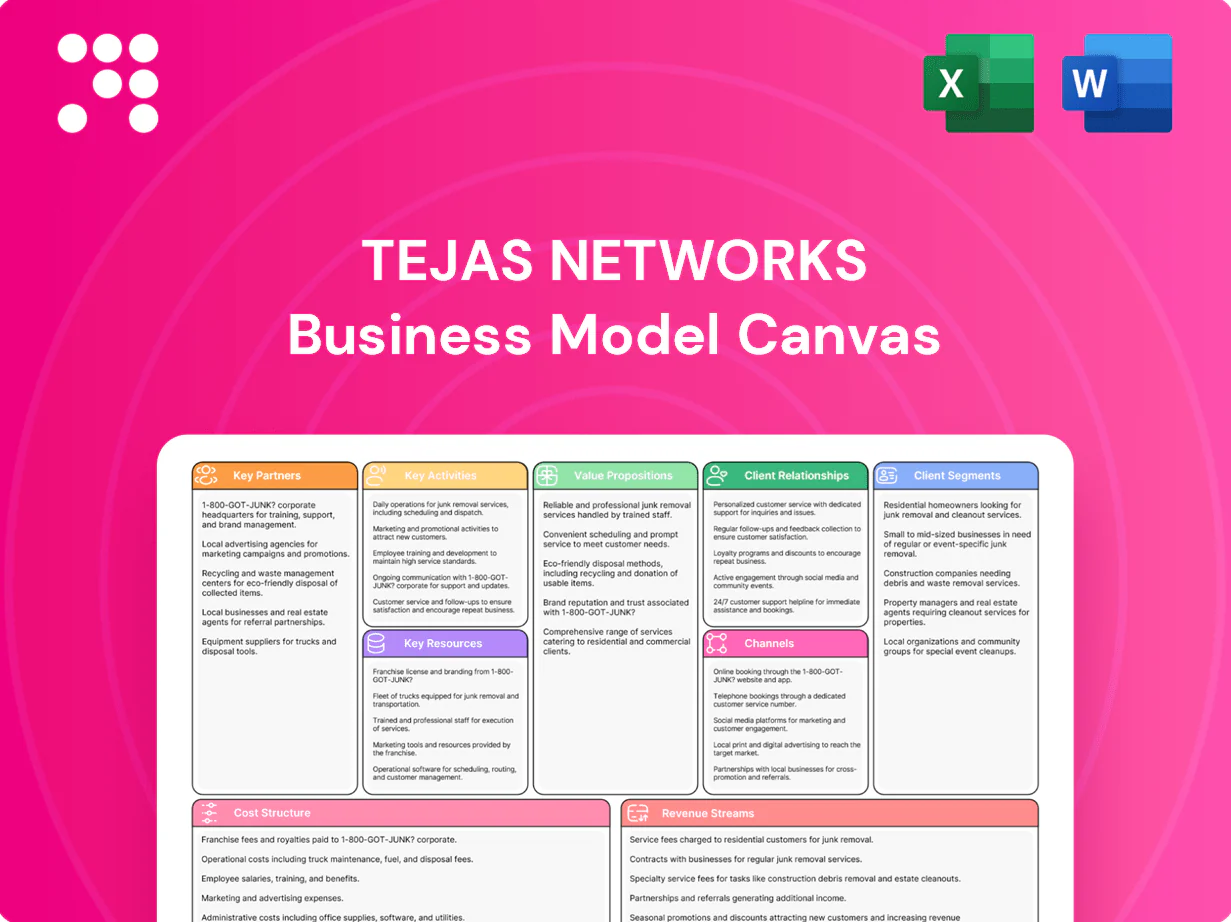
Tejas Networks Business Model Canvas

Telecom Infrastructure Business Model Canvas: Investor Playbook & Growth Snapshot
Unlock the strategic blueprint behind Tejas Networks with a concise Business Model Canvas that outlines its core value propositions, customer segments, revenue streams and partnerships. This snapshot reveals how the company scales in telecom infrastructure and secures market share. Purchase the full, editable Canvas for a section-by-section playbook ideal for investors, consultants and founders.
Partnerships

Optical component and chipset suppliers
Partnerships with transceiver, DSP and silicon vendors secure access to leading-edge components, enabling Tejas to align performance, cost and power roadmaps to carrier needs. Joint validation with vendors accelerates time-to-market and interoperability, supporting growing 400G/800G deployments. Strategic sourcing mitigates supply risk and price volatility; the global optical components market was about USD 12B in 2024, underscoring scale and supplier leverage.
Contract manufacturers and EMS partners
EMS partners provide scalable, quality-controlled production for Tejas Networks optical and packet platforms, handling NPI, PCB assembly, testing and final integration with typical lead-times of 4–8 weeks. Their global footprint supports regional content rules such as India’s localization requirements and helps meet tight delivery SLAs. Flexible contract capacity reduces fixed costs and absorbs demand surges, improving capex efficiency and time-to-market.

Telecom carriers and test labs for interoperability
Early trials with Tier-1 operators and certified labs ensure standards compliance and alignment with GSMA 5G profiles, while field interoperability testing reduces deployment risk and speeds regulatory approvals; joint solution blueprints improve integration with legacy networks, and co-creation with carriers fosters sticky, long-term relationships that drive repeat orders and higher lifetime value.

Software, security, and network management ecosystems
Alliances with orchestration, SDN/NFV and cybersecurity vendors in 2024 expanded Tejas Networks solution value across carrier and enterprise segments. API integrations enable multi-vendor automation and observability, accelerating provisioning and fault isolation. Joint reference architectures simplify OSS/BSS integration while security partnerships harden products for critical infrastructure.
- Orchestration: SDN/NFV
- APIs: automation & observability
- Reference architectures: OSS/BSS
- Security: critical‑infrastructure hardening
Government, defense, and PSUs tender partners
Local SI, EPC, and logistics partners bolster Tejas Networks bids for government, defense, and PSU tenders by ensuring compliance, localization, and robust on-ground execution, enabling faster approvals and deployment. Consortiums expand eligibility for large-scale rollouts and shared-risk contracting improves project delivery and tightens service SLAs, aligning incentives across partners and reducing single-vendor exposure.
- Local SI: compliance and field ops
- EPC/logistics: site readiness and localization
- Consortiums: eligibility for large rollouts
- Shared-risk: improved delivery and SLA adherence
Alliances secure USD 12B optical access, 400G/800G scale
Partnerships with transceiver, DSP and silicon vendors secure access to cutting‑edge components (optical components market ~USD 12B in 2024), enabling 400G/800G alignment. EMS partners provide scalable NPI and PCB assembly with lead‑times of 4–8 weeks, lowering capex and cycle time. Carrier, orchestration, security and local SI alliances accelerate deployments, compliance and stickiness.
| Partner Type | 2024 Metric | Impact |
|---|---|---|
| Optical vendors | Market ~USD 12B | Component access, roadmap alignment |
| EMS | Lead‑times 4–8 weeks | Scalable production, lower CAPEX |
| Carriers/SI/Security | 400G/800G pilots | Faster deploy, higher retention |
What is included in the product
 Detailed Word Document
A concise, pre-written Business Model Canvas for Tejas Networks detailing customer segments, channels, value propositions, revenue streams and key resources across the 9 BMC blocks; ideal for investor presentations, strategy work and SWOT-linked competitive analysis.

 Customizable Excel Spreadsheet
Condenses Tejas Networks’ strategy into a single editable canvas to quickly identify revenue drivers, cost centers, and customer pain points—saving hours of structuring and enabling fast team collaboration and board-ready presentations.
Activities

R&D in optical and packet networking
Continuous R&D across DWDM, OTN, PON, IP/MPLS and routing is central to Tejas Networks, with integrated hardware, firmware and NOS development driving measurable performance and latency gains; active standards participation (ITU‑T, IETF, IEEE) ensures interoperability and future‑proofing, while rigorous lab validation and carrier‑grade benchmarking underpin product reliability for service providers.
Product engineering and platform lifecycle
Product engineering at Tejas focuses on design for manufacturability, testability and serviceability to lower lifecycle costs, reflecting 2024 industry pushes toward operational efficiency. Sustaining engineering delivers regular software updates and feature evolution to deployed platforms. Hardware refresh cycles are synchronized with component roadmaps to avoid supply-chain disruption. Clear end-of-life and migration plans protect customer investments and upgrade paths.

Supply chain management and quality assurance
Strategic sourcing balances cost, availability and regulatory compliance, leveraging Tejas Networks presence as a publicly listed Indian telecom OEM to secure multi-vendor supply. QA systems enforce telecom-grade reliability (designed for 99.999% availability) and maintain certifications such as ISO quality standards. Regular vendor audits and component traceability reduce defects and support warranty claims. Logistics orchestration ensures on-time delivery across domestic and export regions.

Deployment, integration, and professional services
Site surveys, installation, and commissioning enable rapid turn-ups and predictable timelines, while integration with OSS/BSS and legacy networks minimizes downtime and accelerates service activation. Acceptance testing validates carrier-grade SLAs (commonly up to 99.99%) and measured performance; structured knowledge transfer supports smooth handover to operations and reduces ramp-up time.
- Site surveys: faster turn-ups
- Integration: reduced downtime
- Acceptance testing: SLA validation (up to 99.99%)
- Knowledge transfer: smoother operations
After-sales support and managed services
After-sales 24x7 support, dedicated spares and streamlined RMA processes sustain carrier-grade 99.9% uptime; remote monitoring and proactive maintenance reduce incident windows and enable faster MTTR. Regular software patches and security updates close vulnerabilities; managed services convert support into recurring annuity revenue and deepen customer lock-in.
- 24x7 support
- Dedicated spares & RMA
- Remote monitoring
- SW patches & security
- Recurring managed services
Carrier-grade optical/IP platforms, 99.9% uptime, SLAs to 99.99%, 24x7 support
Continuous R&D across DWDM/OTN/PON/IP/MPLS with standards participation and lab validation ensures carrier-grade reliability. Product engineering, sustaining updates and EOL plans reduce lifecycle costs and supply‑chain risk. 24x7 support, remote monitoring and managed services sustain 99.9% uptime and enable SLA delivery up to 99.99%.
| Metric | Value |
|---|---|
| Support | 24x7 |
| Uptime (typical) | 99.9% |
| Max SLA | 99.99% |
| Standards | ITU‑T/IETF/IEEE |
Preview Before You Purchase
Business Model Canvas
The Tejas Networks Business Model Canvas you’re previewing is the actual deliverable, not a mockup. When you purchase, you’ll receive this exact file with all content included, ready-to-edit and present. The same professional layout is provided in downloadable formats—no surprises.

Telecom Infrastructure Business Model Canvas: Investor Playbook & Growth Snapshot
Unlock the strategic blueprint behind Tejas Networks with a concise Business Model Canvas that outlines its core value propositions, customer segments, revenue streams and partnerships. This snapshot reveals how the company scales in telecom infrastructure and secures market share. Purchase the full, editable Canvas for a section-by-section playbook ideal for investors, consultants and founders.
Partnerships
Optical component and chipset suppliers
Partnerships with transceiver, DSP and silicon vendors secure access to leading-edge components, enabling Tejas to align performance, cost and power roadmaps to carrier needs. Joint validation with vendors accelerates time-to-market and interoperability, supporting growing 400G/800G deployments. Strategic sourcing mitigates supply risk and price volatility; the global optical components market was about USD 12B in 2024, underscoring scale and supplier leverage.
Contract manufacturers and EMS partners
EMS partners provide scalable, quality-controlled production for Tejas Networks optical and packet platforms, handling NPI, PCB assembly, testing and final integration with typical lead-times of 4–8 weeks. Their global footprint supports regional content rules such as India’s localization requirements and helps meet tight delivery SLAs. Flexible contract capacity reduces fixed costs and absorbs demand surges, improving capex efficiency and time-to-market.
Telecom carriers and test labs for interoperability
Early trials with Tier-1 operators and certified labs ensure standards compliance and alignment with GSMA 5G profiles, while field interoperability testing reduces deployment risk and speeds regulatory approvals; joint solution blueprints improve integration with legacy networks, and co-creation with carriers fosters sticky, long-term relationships that drive repeat orders and higher lifetime value.
Software, security, and network management ecosystems
Alliances with orchestration, SDN/NFV and cybersecurity vendors in 2024 expanded Tejas Networks solution value across carrier and enterprise segments. API integrations enable multi-vendor automation and observability, accelerating provisioning and fault isolation. Joint reference architectures simplify OSS/BSS integration while security partnerships harden products for critical infrastructure.
- Orchestration: SDN/NFV
- APIs: automation & observability
- Reference architectures: OSS/BSS
- Security: critical‑infrastructure hardening
Government, defense, and PSUs tender partners
Local SI, EPC, and logistics partners bolster Tejas Networks bids for government, defense, and PSU tenders by ensuring compliance, localization, and robust on-ground execution, enabling faster approvals and deployment. Consortiums expand eligibility for large-scale rollouts and shared-risk contracting improves project delivery and tightens service SLAs, aligning incentives across partners and reducing single-vendor exposure.
- Local SI: compliance and field ops
- EPC/logistics: site readiness and localization
- Consortiums: eligibility for large rollouts
- Shared-risk: improved delivery and SLA adherence
Alliances secure USD 12B optical access, 400G/800G scale
Partnerships with transceiver, DSP and silicon vendors secure access to cutting‑edge components (optical components market ~USD 12B in 2024), enabling 400G/800G alignment. EMS partners provide scalable NPI and PCB assembly with lead‑times of 4–8 weeks, lowering capex and cycle time. Carrier, orchestration, security and local SI alliances accelerate deployments, compliance and stickiness.
| Partner Type | 2024 Metric | Impact |
|---|---|---|
| Optical vendors | Market ~USD 12B | Component access, roadmap alignment |
| EMS | Lead‑times 4–8 weeks | Scalable production, lower CAPEX |
| Carriers/SI/Security | 400G/800G pilots | Faster deploy, higher retention |
What is included in the product
Detailed Word Document
A concise, pre-written Business Model Canvas for Tejas Networks detailing customer segments, channels, value propositions, revenue streams and key resources across the 9 BMC blocks; ideal for investor presentations, strategy work and SWOT-linked competitive analysis.
Customizable Excel Spreadsheet
Condenses Tejas Networks’ strategy into a single editable canvas to quickly identify revenue drivers, cost centers, and customer pain points—saving hours of structuring and enabling fast team collaboration and board-ready presentations.
Activities
R&D in optical and packet networking
Continuous R&D across DWDM, OTN, PON, IP/MPLS and routing is central to Tejas Networks, with integrated hardware, firmware and NOS development driving measurable performance and latency gains; active standards participation (ITU‑T, IETF, IEEE) ensures interoperability and future‑proofing, while rigorous lab validation and carrier‑grade benchmarking underpin product reliability for service providers.
Product engineering and platform lifecycle
Product engineering at Tejas focuses on design for manufacturability, testability and serviceability to lower lifecycle costs, reflecting 2024 industry pushes toward operational efficiency. Sustaining engineering delivers regular software updates and feature evolution to deployed platforms. Hardware refresh cycles are synchronized with component roadmaps to avoid supply-chain disruption. Clear end-of-life and migration plans protect customer investments and upgrade paths.
Supply chain management and quality assurance
Strategic sourcing balances cost, availability and regulatory compliance, leveraging Tejas Networks presence as a publicly listed Indian telecom OEM to secure multi-vendor supply. QA systems enforce telecom-grade reliability (designed for 99.999% availability) and maintain certifications such as ISO quality standards. Regular vendor audits and component traceability reduce defects and support warranty claims. Logistics orchestration ensures on-time delivery across domestic and export regions.
Deployment, integration, and professional services
Site surveys, installation, and commissioning enable rapid turn-ups and predictable timelines, while integration with OSS/BSS and legacy networks minimizes downtime and accelerates service activation. Acceptance testing validates carrier-grade SLAs (commonly up to 99.99%) and measured performance; structured knowledge transfer supports smooth handover to operations and reduces ramp-up time.
- Site surveys: faster turn-ups
- Integration: reduced downtime
- Acceptance testing: SLA validation (up to 99.99%)
- Knowledge transfer: smoother operations
After-sales support and managed services
After-sales 24x7 support, dedicated spares and streamlined RMA processes sustain carrier-grade 99.9% uptime; remote monitoring and proactive maintenance reduce incident windows and enable faster MTTR. Regular software patches and security updates close vulnerabilities; managed services convert support into recurring annuity revenue and deepen customer lock-in.
- 24x7 support
- Dedicated spares & RMA
- Remote monitoring
- SW patches & security
- Recurring managed services
Carrier-grade optical/IP platforms, 99.9% uptime, SLAs to 99.99%, 24x7 support
Continuous R&D across DWDM/OTN/PON/IP/MPLS with standards participation and lab validation ensures carrier-grade reliability. Product engineering, sustaining updates and EOL plans reduce lifecycle costs and supply‑chain risk. 24x7 support, remote monitoring and managed services sustain 99.9% uptime and enable SLA delivery up to 99.99%.
| Metric | Value |
|---|---|
| Support | 24x7 |
| Uptime (typical) | 99.9% |
| Max SLA | 99.99% |
| Standards | ITU‑T/IETF/IEEE |
Preview Before You Purchase
Business Model Canvas
The Tejas Networks Business Model Canvas you’re previewing is the actual deliverable, not a mockup. When you purchase, you’ll receive this exact file with all content included, ready-to-edit and present. The same professional layout is provided in downloadable formats—no surprises.
Description
Telecom Infrastructure Business Model Canvas: Investor Playbook & Growth Snapshot
Unlock the strategic blueprint behind Tejas Networks with a concise Business Model Canvas that outlines its core value propositions, customer segments, revenue streams and partnerships. This snapshot reveals how the company scales in telecom infrastructure and secures market share. Purchase the full, editable Canvas for a section-by-section playbook ideal for investors, consultants and founders.
Partnerships
Optical component and chipset suppliers
Partnerships with transceiver, DSP and silicon vendors secure access to leading-edge components, enabling Tejas to align performance, cost and power roadmaps to carrier needs. Joint validation with vendors accelerates time-to-market and interoperability, supporting growing 400G/800G deployments. Strategic sourcing mitigates supply risk and price volatility; the global optical components market was about USD 12B in 2024, underscoring scale and supplier leverage.
Contract manufacturers and EMS partners
EMS partners provide scalable, quality-controlled production for Tejas Networks optical and packet platforms, handling NPI, PCB assembly, testing and final integration with typical lead-times of 4–8 weeks. Their global footprint supports regional content rules such as India’s localization requirements and helps meet tight delivery SLAs. Flexible contract capacity reduces fixed costs and absorbs demand surges, improving capex efficiency and time-to-market.
Telecom carriers and test labs for interoperability
Early trials with Tier-1 operators and certified labs ensure standards compliance and alignment with GSMA 5G profiles, while field interoperability testing reduces deployment risk and speeds regulatory approvals; joint solution blueprints improve integration with legacy networks, and co-creation with carriers fosters sticky, long-term relationships that drive repeat orders and higher lifetime value.
Software, security, and network management ecosystems
Alliances with orchestration, SDN/NFV and cybersecurity vendors in 2024 expanded Tejas Networks solution value across carrier and enterprise segments. API integrations enable multi-vendor automation and observability, accelerating provisioning and fault isolation. Joint reference architectures simplify OSS/BSS integration while security partnerships harden products for critical infrastructure.
- Orchestration: SDN/NFV
- APIs: automation & observability
- Reference architectures: OSS/BSS
- Security: critical‑infrastructure hardening
Government, defense, and PSUs tender partners
Local SI, EPC, and logistics partners bolster Tejas Networks bids for government, defense, and PSU tenders by ensuring compliance, localization, and robust on-ground execution, enabling faster approvals and deployment. Consortiums expand eligibility for large-scale rollouts and shared-risk contracting improves project delivery and tightens service SLAs, aligning incentives across partners and reducing single-vendor exposure.
- Local SI: compliance and field ops
- EPC/logistics: site readiness and localization
- Consortiums: eligibility for large rollouts
- Shared-risk: improved delivery and SLA adherence
Alliances secure USD 12B optical access, 400G/800G scale
Partnerships with transceiver, DSP and silicon vendors secure access to cutting‑edge components (optical components market ~USD 12B in 2024), enabling 400G/800G alignment. EMS partners provide scalable NPI and PCB assembly with lead‑times of 4–8 weeks, lowering capex and cycle time. Carrier, orchestration, security and local SI alliances accelerate deployments, compliance and stickiness.
| Partner Type | 2024 Metric | Impact |
|---|---|---|
| Optical vendors | Market ~USD 12B | Component access, roadmap alignment |
| EMS | Lead‑times 4–8 weeks | Scalable production, lower CAPEX |
| Carriers/SI/Security | 400G/800G pilots | Faster deploy, higher retention |
What is included in the product
Detailed Word Document
A concise, pre-written Business Model Canvas for Tejas Networks detailing customer segments, channels, value propositions, revenue streams and key resources across the 9 BMC blocks; ideal for investor presentations, strategy work and SWOT-linked competitive analysis.
Customizable Excel Spreadsheet
Condenses Tejas Networks’ strategy into a single editable canvas to quickly identify revenue drivers, cost centers, and customer pain points—saving hours of structuring and enabling fast team collaboration and board-ready presentations.
Activities
R&D in optical and packet networking
Continuous R&D across DWDM, OTN, PON, IP/MPLS and routing is central to Tejas Networks, with integrated hardware, firmware and NOS development driving measurable performance and latency gains; active standards participation (ITU‑T, IETF, IEEE) ensures interoperability and future‑proofing, while rigorous lab validation and carrier‑grade benchmarking underpin product reliability for service providers.
Product engineering and platform lifecycle
Product engineering at Tejas focuses on design for manufacturability, testability and serviceability to lower lifecycle costs, reflecting 2024 industry pushes toward operational efficiency. Sustaining engineering delivers regular software updates and feature evolution to deployed platforms. Hardware refresh cycles are synchronized with component roadmaps to avoid supply-chain disruption. Clear end-of-life and migration plans protect customer investments and upgrade paths.
Supply chain management and quality assurance
Strategic sourcing balances cost, availability and regulatory compliance, leveraging Tejas Networks presence as a publicly listed Indian telecom OEM to secure multi-vendor supply. QA systems enforce telecom-grade reliability (designed for 99.999% availability) and maintain certifications such as ISO quality standards. Regular vendor audits and component traceability reduce defects and support warranty claims. Logistics orchestration ensures on-time delivery across domestic and export regions.
Deployment, integration, and professional services
Site surveys, installation, and commissioning enable rapid turn-ups and predictable timelines, while integration with OSS/BSS and legacy networks minimizes downtime and accelerates service activation. Acceptance testing validates carrier-grade SLAs (commonly up to 99.99%) and measured performance; structured knowledge transfer supports smooth handover to operations and reduces ramp-up time.
- Site surveys: faster turn-ups
- Integration: reduced downtime
- Acceptance testing: SLA validation (up to 99.99%)
- Knowledge transfer: smoother operations
After-sales support and managed services
After-sales 24x7 support, dedicated spares and streamlined RMA processes sustain carrier-grade 99.9% uptime; remote monitoring and proactive maintenance reduce incident windows and enable faster MTTR. Regular software patches and security updates close vulnerabilities; managed services convert support into recurring annuity revenue and deepen customer lock-in.
- 24x7 support
- Dedicated spares & RMA
- Remote monitoring
- SW patches & security
- Recurring managed services
Carrier-grade optical/IP platforms, 99.9% uptime, SLAs to 99.99%, 24x7 support
Continuous R&D across DWDM/OTN/PON/IP/MPLS with standards participation and lab validation ensures carrier-grade reliability. Product engineering, sustaining updates and EOL plans reduce lifecycle costs and supply‑chain risk. 24x7 support, remote monitoring and managed services sustain 99.9% uptime and enable SLA delivery up to 99.99%.
| Metric | Value |
|---|---|
| Support | 24x7 |
| Uptime (typical) | 99.9% |
| Max SLA | 99.99% |
| Standards | ITU‑T/IETF/IEEE |
Preview Before You Purchase
Business Model Canvas
The Tejas Networks Business Model Canvas you’re previewing is the actual deliverable, not a mockup. When you purchase, you’ll receive this exact file with all content included, ready-to-edit and present. The same professional layout is provided in downloadable formats—no surprises.











