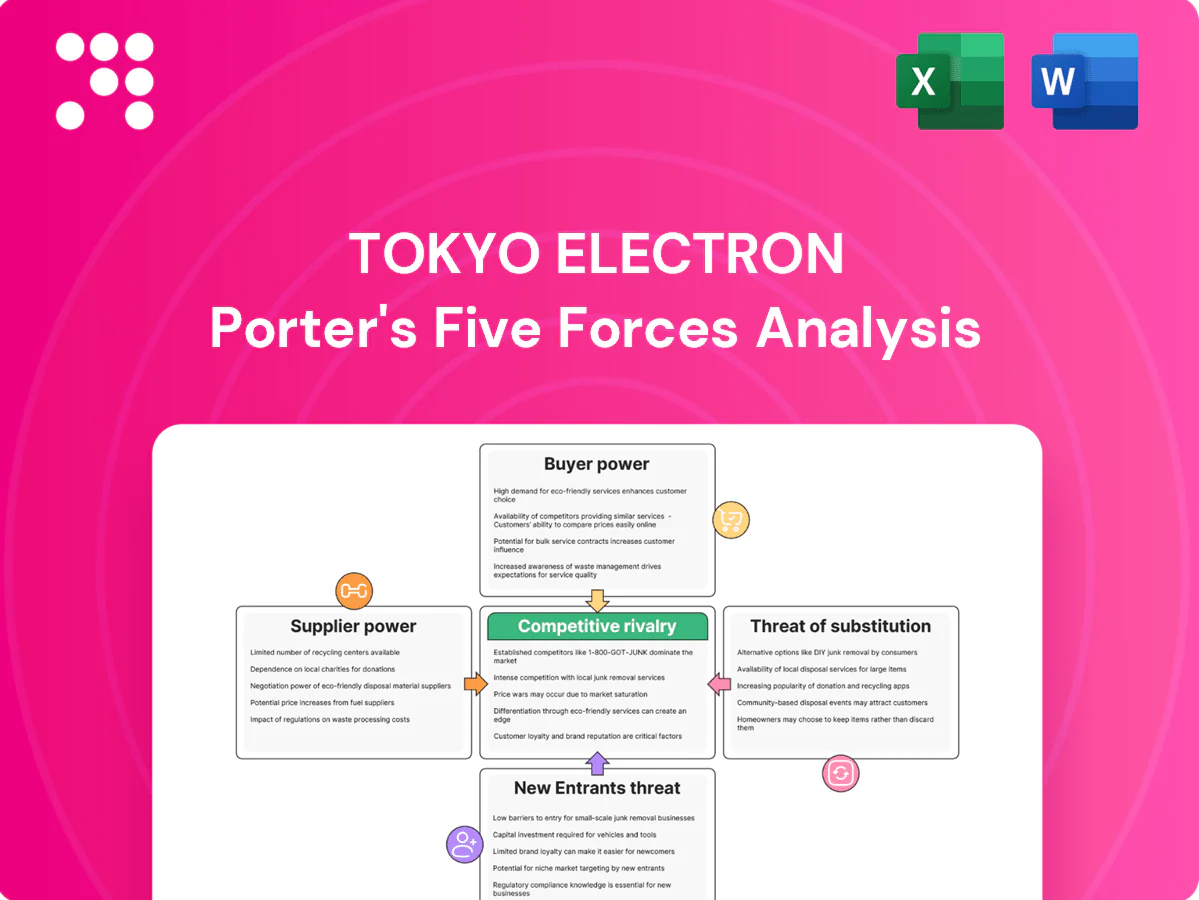
Tokyo Electron Porter's Five Forces Analysis

From Overview to Strategy Blueprint
Tokyo Electron dominates advanced semiconductor-equipment markets with strong scale and high R&D barriers; supplier power is moderate while buyer bargaining and aftermarket competition intensify margins. Threat of new entrants is low but technological shifts and cycles elevate strategic risk. This preview is just the beginning. The full analysis provides a complete strategic snapshot with force-by-force ratings, visuals, and business implications tailored to Tokyo Electron.
Suppliers Bargaining Power

Concentrated critical-component sources
High-spec subsystems such as vacuum pumps, RF power modules, high-purity valves and precision robotics come from a limited set of global vendors, concentrating supplier power and raising switching costs and lead-time risk for Tokyo Electron. TEL’s FY2024 production planning relies heavily on multi-year supply agreements that reduce price volatility but entrench dependency. Any supplier disruption can quickly cascade into delayed deliveries and margin pressure across product cycles.
Specialty process chemicals and gases
Photoresists, developers, specialty gases and advanced ceramics are niche, IP‑heavy inputs where suppliers command pricing and allocation leverage, especially in tight 2024 cycles; qualification takes months to years, limiting rapid switching. Suppliers of high‑purity chemicals can ration volumes during spikes, while TEL—a top‑3 equipment vendor by 2024 revenue—often co‑develops specs, deepening integration but creating lock‑in on commercial terms.

Precision materials and custom parts
SiC/AlN ceramics, quartzware and custom chambers demand sub-micron tolerances and contamination control, and in 2024 only a handful of vendors—with the top three supplying over 60% of high-end parts—can meet thermal and cleanliness specs at scale. Tool throughput and yield hinge on these components, giving suppliers strong pricing leverage that raises OEM input costs. Tokyo Electron pursues dual-sourcing where feasible, but qualifying secondary vendors is time-consuming and often impractical.

Software, controls, and embedded IP
Controllers, sensor suites and embedded software stacks are tightly coupled to TEL tool architectures, creating supplier stickiness; proprietary interfaces and high uptime/security requirements (industry downtime costs >$1M/day for advanced fabs) limit vendor rotation. TEL offsets risk with growing internal software teams and modular, replaceable control modules, supporting its FY2024 sales ~JPY 1.38T.
- Proprietary interfaces: increases switching costs
- Security/uptime: restricts supplier changes
- TEL strategy: internal SW + modular design
- Impact: reduces supplier bargaining power
Logistics and geopolitical exposure
Export controls tightened in 2024 have constrained advanced tool inputs and rare-material flows, while regional compliance and concentrated suppliers in East Asia raise supply‑concentration risk; currency moves (USD/JPY volatility) increase landed costs. TEL’s multi‑region sourcing and several‑week inventory buffers reduce but do not eliminate exposure to geopolitical logistics shocks.
- Export controls: 2024 tightening
- Rare materials: supply risk from concentrated producers
- Regional concentration: East Asia supplier risk
- Currency: USD/JPY volatility raises import costs
- Mitigation: multi-region sourcing, inventory buffers
Top-3 control >60% of high-end parts; export rules raise landed-cost
High-spec subsystems and niche chemicals give suppliers concentrated leverage; top-3 vendors supply >60% of high-end parts and qualification times are months–years, raising switching costs. TEL’s FY2024 sales ~JPY 1.38T and reliance on multi-year contracts reduces price volatility but deepens supplier dependency. 2024 export-controls and USD/JPY swings increase landed-cost and logistics risk.
| Metric | 2024 value |
|---|---|
| FY2024 sales | JPY 1.38T |
| Top-3 share (high-end parts) | >60% |
| Fab downtime cost | >$1M/day |
What is included in the product
 Detailed Word Document
Tailored Porter's Five Forces analysis for Tokyo Electron, revealing competitive intensity, supplier and buyer power, threat of new entrants and substitutes, and highlighting disruptive technologies and strategic levers that affect its pricing power, market share, and long-term profitability.

 Customizable Excel Spreadsheet
Simplifies Tokyo Electron's Porter's Five Forces into a single, actionable sheet—instantly revealing supplier/customer pressures, rivalry, entrants and substitutes for faster strategic decisions.
Customers Bargaining Power

Highly concentrated mega-customers
Foundry, logic, memory and display leaders (TSMC, Samsung, SK Hynix, Micron, BOE etc.) drive over 50% of semiconductor equipment demand, so a handful of mega-customers can dictate price, specs and roadmap priorities; volume commitments are tied to aggressive commercial terms and rebates, and losing a top account can cut utilization and market share materially for Tokyo Electron.
Stringent qualification and co-development
Tool-of-record status demands multi-million-dollar, 6–18 month qualifications at each node, so buyers leverage these quals to extract service, pricing and performance concessions. Co-development projects deepen technical ties and roadmaps but can shift value capture to customers through joint IP and custom specs. Once entrenched, switching costs—both financial and time—are high, partially offsetting buyer negotiating power.

Node transitions and mix shifts
Buyer roadmaps steer tool mix across etch, deposition and coat/develop, and 2024 global semiconductor equipment spending of roughly $80 billion (SEMI) intensified competition for delivery slots. Compressed node timing can force pricing down or speed upgrades, while delays or pull-ins heighten buyer bargaining as fabs vie for capacity. TEL mitigates leverage through detailed capacity planning and prioritized allocations tied to strategic customers and backlog management.

Service, uptime, and total cost demands
Customers judge Tokyo Electron offerings by lifecycle cost, throughput, yield impact and service SLAs, demanding uptime often above 99.9% which compresses warranty and field-service margins; multiyear service contracts (commonly 3–5 years) bundle value but face intense price scrutiny, while data-driven remote support—reducing onsite interventions by roughly 25–30% as of 2024—partially defends pricing.
- Uptime expectation: >99.9%
- Service contracts: 3–5 years
- Remote support impact: ~25–30% fewer field visits (2024)
- Focus metrics: lifecycle cost, throughput, yield, SLA penalties
Dual-sourcing and competitive benchmarking
Buyers benchmark TEL directly against Applied, Lam and niche suppliers at each tool node, and TEL entered 2024 as the third-largest semiconductor equipment supplier by revenue, intensifying price and share pressure from dual-sourcing policies. Clear performance deltas are required to defend price; TEL leans on process wins and fab-wide integration to sustain advantage.
- Dual-sourcing reduces lock-in
- Customers benchmark node-by-node
- Process wins key to retain share
Customers control >50% of demand as 80B USD capex amplifies buyer leverage
Mega-customers (TSMC, Samsung, SK Hynix, Micron, BOE) drive >50% of equipment demand, giving them high price and roadmap leverage in 2024.
Qualification cycles (6–18 months, multi-million-dollar) and high switching costs limit churn but enable customers to extract service and pricing concessions.
2024 SEMI capex ~80B USD intensified competition for delivery slots, increasing buyer bargaining on lead times and rebates.
Service margins compressed by >99.9% uptime demands; remote support cut field visits ~25–30% in 2024.
| Metric | 2024 |
|---|---|
| Industry capex | ~80B USD |
| Customer share | >50% |
| Remote support impact | 25–30% |
Full Version Awaits
Tokyo Electron Porter's Five Forces Analysis
This preview shows the exact Tokyo Electron Porter's Five Forces Analysis you'll receive—no placeholders or mockups. The file displayed is the complete, professionally formatted document ready for immediate download and use the moment you purchase. You’re seeing the final deliverable—precisely the same analysis that will be available to you instantly after payment.

From Overview to Strategy Blueprint
Tokyo Electron dominates advanced semiconductor-equipment markets with strong scale and high R&D barriers; supplier power is moderate while buyer bargaining and aftermarket competition intensify margins. Threat of new entrants is low but technological shifts and cycles elevate strategic risk. This preview is just the beginning. The full analysis provides a complete strategic snapshot with force-by-force ratings, visuals, and business implications tailored to Tokyo Electron.
Suppliers Bargaining Power
Concentrated critical-component sources
High-spec subsystems such as vacuum pumps, RF power modules, high-purity valves and precision robotics come from a limited set of global vendors, concentrating supplier power and raising switching costs and lead-time risk for Tokyo Electron. TEL’s FY2024 production planning relies heavily on multi-year supply agreements that reduce price volatility but entrench dependency. Any supplier disruption can quickly cascade into delayed deliveries and margin pressure across product cycles.
Specialty process chemicals and gases
Photoresists, developers, specialty gases and advanced ceramics are niche, IP‑heavy inputs where suppliers command pricing and allocation leverage, especially in tight 2024 cycles; qualification takes months to years, limiting rapid switching. Suppliers of high‑purity chemicals can ration volumes during spikes, while TEL—a top‑3 equipment vendor by 2024 revenue—often co‑develops specs, deepening integration but creating lock‑in on commercial terms.
Precision materials and custom parts
SiC/AlN ceramics, quartzware and custom chambers demand sub-micron tolerances and contamination control, and in 2024 only a handful of vendors—with the top three supplying over 60% of high-end parts—can meet thermal and cleanliness specs at scale. Tool throughput and yield hinge on these components, giving suppliers strong pricing leverage that raises OEM input costs. Tokyo Electron pursues dual-sourcing where feasible, but qualifying secondary vendors is time-consuming and often impractical.
Software, controls, and embedded IP
Controllers, sensor suites and embedded software stacks are tightly coupled to TEL tool architectures, creating supplier stickiness; proprietary interfaces and high uptime/security requirements (industry downtime costs >$1M/day for advanced fabs) limit vendor rotation. TEL offsets risk with growing internal software teams and modular, replaceable control modules, supporting its FY2024 sales ~JPY 1.38T.
- Proprietary interfaces: increases switching costs
- Security/uptime: restricts supplier changes
- TEL strategy: internal SW + modular design
- Impact: reduces supplier bargaining power
Logistics and geopolitical exposure
Export controls tightened in 2024 have constrained advanced tool inputs and rare-material flows, while regional compliance and concentrated suppliers in East Asia raise supply‑concentration risk; currency moves (USD/JPY volatility) increase landed costs. TEL’s multi‑region sourcing and several‑week inventory buffers reduce but do not eliminate exposure to geopolitical logistics shocks.
- Export controls: 2024 tightening
- Rare materials: supply risk from concentrated producers
- Regional concentration: East Asia supplier risk
- Currency: USD/JPY volatility raises import costs
- Mitigation: multi-region sourcing, inventory buffers
Top-3 control >60% of high-end parts; export rules raise landed-cost
High-spec subsystems and niche chemicals give suppliers concentrated leverage; top-3 vendors supply >60% of high-end parts and qualification times are months–years, raising switching costs. TEL’s FY2024 sales ~JPY 1.38T and reliance on multi-year contracts reduces price volatility but deepens supplier dependency. 2024 export-controls and USD/JPY swings increase landed-cost and logistics risk.
| Metric | 2024 value |
|---|---|
| FY2024 sales | JPY 1.38T |
| Top-3 share (high-end parts) | >60% |
| Fab downtime cost | >$1M/day |
What is included in the product
Detailed Word Document
Tailored Porter's Five Forces analysis for Tokyo Electron, revealing competitive intensity, supplier and buyer power, threat of new entrants and substitutes, and highlighting disruptive technologies and strategic levers that affect its pricing power, market share, and long-term profitability.
Customizable Excel Spreadsheet
Simplifies Tokyo Electron's Porter's Five Forces into a single, actionable sheet—instantly revealing supplier/customer pressures, rivalry, entrants and substitutes for faster strategic decisions.
Customers Bargaining Power
Highly concentrated mega-customers
Foundry, logic, memory and display leaders (TSMC, Samsung, SK Hynix, Micron, BOE etc.) drive over 50% of semiconductor equipment demand, so a handful of mega-customers can dictate price, specs and roadmap priorities; volume commitments are tied to aggressive commercial terms and rebates, and losing a top account can cut utilization and market share materially for Tokyo Electron.
Stringent qualification and co-development
Tool-of-record status demands multi-million-dollar, 6–18 month qualifications at each node, so buyers leverage these quals to extract service, pricing and performance concessions. Co-development projects deepen technical ties and roadmaps but can shift value capture to customers through joint IP and custom specs. Once entrenched, switching costs—both financial and time—are high, partially offsetting buyer negotiating power.
Node transitions and mix shifts
Buyer roadmaps steer tool mix across etch, deposition and coat/develop, and 2024 global semiconductor equipment spending of roughly $80 billion (SEMI) intensified competition for delivery slots. Compressed node timing can force pricing down or speed upgrades, while delays or pull-ins heighten buyer bargaining as fabs vie for capacity. TEL mitigates leverage through detailed capacity planning and prioritized allocations tied to strategic customers and backlog management.
Service, uptime, and total cost demands
Customers judge Tokyo Electron offerings by lifecycle cost, throughput, yield impact and service SLAs, demanding uptime often above 99.9% which compresses warranty and field-service margins; multiyear service contracts (commonly 3–5 years) bundle value but face intense price scrutiny, while data-driven remote support—reducing onsite interventions by roughly 25–30% as of 2024—partially defends pricing.
- Uptime expectation: >99.9%
- Service contracts: 3–5 years
- Remote support impact: ~25–30% fewer field visits (2024)
- Focus metrics: lifecycle cost, throughput, yield, SLA penalties
Dual-sourcing and competitive benchmarking
Buyers benchmark TEL directly against Applied, Lam and niche suppliers at each tool node, and TEL entered 2024 as the third-largest semiconductor equipment supplier by revenue, intensifying price and share pressure from dual-sourcing policies. Clear performance deltas are required to defend price; TEL leans on process wins and fab-wide integration to sustain advantage.
- Dual-sourcing reduces lock-in
- Customers benchmark node-by-node
- Process wins key to retain share
Customers control >50% of demand as 80B USD capex amplifies buyer leverage
Mega-customers (TSMC, Samsung, SK Hynix, Micron, BOE) drive >50% of equipment demand, giving them high price and roadmap leverage in 2024.
Qualification cycles (6–18 months, multi-million-dollar) and high switching costs limit churn but enable customers to extract service and pricing concessions.
2024 SEMI capex ~80B USD intensified competition for delivery slots, increasing buyer bargaining on lead times and rebates.
Service margins compressed by >99.9% uptime demands; remote support cut field visits ~25–30% in 2024.
| Metric | 2024 |
|---|---|
| Industry capex | ~80B USD |
| Customer share | >50% |
| Remote support impact | 25–30% |
Full Version Awaits
Tokyo Electron Porter's Five Forces Analysis
This preview shows the exact Tokyo Electron Porter's Five Forces Analysis you'll receive—no placeholders or mockups. The file displayed is the complete, professionally formatted document ready for immediate download and use the moment you purchase. You’re seeing the final deliverable—precisely the same analysis that will be available to you instantly after payment.
Original: $10.00
-65%$10.00
$3.50Description
From Overview to Strategy Blueprint
Tokyo Electron dominates advanced semiconductor-equipment markets with strong scale and high R&D barriers; supplier power is moderate while buyer bargaining and aftermarket competition intensify margins. Threat of new entrants is low but technological shifts and cycles elevate strategic risk. This preview is just the beginning. The full analysis provides a complete strategic snapshot with force-by-force ratings, visuals, and business implications tailored to Tokyo Electron.
Suppliers Bargaining Power
Concentrated critical-component sources
High-spec subsystems such as vacuum pumps, RF power modules, high-purity valves and precision robotics come from a limited set of global vendors, concentrating supplier power and raising switching costs and lead-time risk for Tokyo Electron. TEL’s FY2024 production planning relies heavily on multi-year supply agreements that reduce price volatility but entrench dependency. Any supplier disruption can quickly cascade into delayed deliveries and margin pressure across product cycles.
Specialty process chemicals and gases
Photoresists, developers, specialty gases and advanced ceramics are niche, IP‑heavy inputs where suppliers command pricing and allocation leverage, especially in tight 2024 cycles; qualification takes months to years, limiting rapid switching. Suppliers of high‑purity chemicals can ration volumes during spikes, while TEL—a top‑3 equipment vendor by 2024 revenue—often co‑develops specs, deepening integration but creating lock‑in on commercial terms.
Precision materials and custom parts
SiC/AlN ceramics, quartzware and custom chambers demand sub-micron tolerances and contamination control, and in 2024 only a handful of vendors—with the top three supplying over 60% of high-end parts—can meet thermal and cleanliness specs at scale. Tool throughput and yield hinge on these components, giving suppliers strong pricing leverage that raises OEM input costs. Tokyo Electron pursues dual-sourcing where feasible, but qualifying secondary vendors is time-consuming and often impractical.
Software, controls, and embedded IP
Controllers, sensor suites and embedded software stacks are tightly coupled to TEL tool architectures, creating supplier stickiness; proprietary interfaces and high uptime/security requirements (industry downtime costs >$1M/day for advanced fabs) limit vendor rotation. TEL offsets risk with growing internal software teams and modular, replaceable control modules, supporting its FY2024 sales ~JPY 1.38T.
- Proprietary interfaces: increases switching costs
- Security/uptime: restricts supplier changes
- TEL strategy: internal SW + modular design
- Impact: reduces supplier bargaining power
Logistics and geopolitical exposure
Export controls tightened in 2024 have constrained advanced tool inputs and rare-material flows, while regional compliance and concentrated suppliers in East Asia raise supply‑concentration risk; currency moves (USD/JPY volatility) increase landed costs. TEL’s multi‑region sourcing and several‑week inventory buffers reduce but do not eliminate exposure to geopolitical logistics shocks.
- Export controls: 2024 tightening
- Rare materials: supply risk from concentrated producers
- Regional concentration: East Asia supplier risk
- Currency: USD/JPY volatility raises import costs
- Mitigation: multi-region sourcing, inventory buffers
Top-3 control >60% of high-end parts; export rules raise landed-cost
High-spec subsystems and niche chemicals give suppliers concentrated leverage; top-3 vendors supply >60% of high-end parts and qualification times are months–years, raising switching costs. TEL’s FY2024 sales ~JPY 1.38T and reliance on multi-year contracts reduces price volatility but deepens supplier dependency. 2024 export-controls and USD/JPY swings increase landed-cost and logistics risk.
| Metric | 2024 value |
|---|---|
| FY2024 sales | JPY 1.38T |
| Top-3 share (high-end parts) | >60% |
| Fab downtime cost | >$1M/day |
What is included in the product
Detailed Word Document
Tailored Porter's Five Forces analysis for Tokyo Electron, revealing competitive intensity, supplier and buyer power, threat of new entrants and substitutes, and highlighting disruptive technologies and strategic levers that affect its pricing power, market share, and long-term profitability.
Customizable Excel Spreadsheet
Simplifies Tokyo Electron's Porter's Five Forces into a single, actionable sheet—instantly revealing supplier/customer pressures, rivalry, entrants and substitutes for faster strategic decisions.
Customers Bargaining Power
Highly concentrated mega-customers
Foundry, logic, memory and display leaders (TSMC, Samsung, SK Hynix, Micron, BOE etc.) drive over 50% of semiconductor equipment demand, so a handful of mega-customers can dictate price, specs and roadmap priorities; volume commitments are tied to aggressive commercial terms and rebates, and losing a top account can cut utilization and market share materially for Tokyo Electron.
Stringent qualification and co-development
Tool-of-record status demands multi-million-dollar, 6–18 month qualifications at each node, so buyers leverage these quals to extract service, pricing and performance concessions. Co-development projects deepen technical ties and roadmaps but can shift value capture to customers through joint IP and custom specs. Once entrenched, switching costs—both financial and time—are high, partially offsetting buyer negotiating power.
Node transitions and mix shifts
Buyer roadmaps steer tool mix across etch, deposition and coat/develop, and 2024 global semiconductor equipment spending of roughly $80 billion (SEMI) intensified competition for delivery slots. Compressed node timing can force pricing down or speed upgrades, while delays or pull-ins heighten buyer bargaining as fabs vie for capacity. TEL mitigates leverage through detailed capacity planning and prioritized allocations tied to strategic customers and backlog management.
Service, uptime, and total cost demands
Customers judge Tokyo Electron offerings by lifecycle cost, throughput, yield impact and service SLAs, demanding uptime often above 99.9% which compresses warranty and field-service margins; multiyear service contracts (commonly 3–5 years) bundle value but face intense price scrutiny, while data-driven remote support—reducing onsite interventions by roughly 25–30% as of 2024—partially defends pricing.
- Uptime expectation: >99.9%
- Service contracts: 3–5 years
- Remote support impact: ~25–30% fewer field visits (2024)
- Focus metrics: lifecycle cost, throughput, yield, SLA penalties
Dual-sourcing and competitive benchmarking
Buyers benchmark TEL directly against Applied, Lam and niche suppliers at each tool node, and TEL entered 2024 as the third-largest semiconductor equipment supplier by revenue, intensifying price and share pressure from dual-sourcing policies. Clear performance deltas are required to defend price; TEL leans on process wins and fab-wide integration to sustain advantage.
- Dual-sourcing reduces lock-in
- Customers benchmark node-by-node
- Process wins key to retain share
Customers control >50% of demand as 80B USD capex amplifies buyer leverage
Mega-customers (TSMC, Samsung, SK Hynix, Micron, BOE) drive >50% of equipment demand, giving them high price and roadmap leverage in 2024.
Qualification cycles (6–18 months, multi-million-dollar) and high switching costs limit churn but enable customers to extract service and pricing concessions.
2024 SEMI capex ~80B USD intensified competition for delivery slots, increasing buyer bargaining on lead times and rebates.
Service margins compressed by >99.9% uptime demands; remote support cut field visits ~25–30% in 2024.
| Metric | 2024 |
|---|---|
| Industry capex | ~80B USD |
| Customer share | >50% |
| Remote support impact | 25–30% |
Full Version Awaits
Tokyo Electron Porter's Five Forces Analysis
This preview shows the exact Tokyo Electron Porter's Five Forces Analysis you'll receive—no placeholders or mockups. The file displayed is the complete, professionally formatted document ready for immediate download and use the moment you purchase. You’re seeing the final deliverable—precisely the same analysis that will be available to you instantly after payment.











