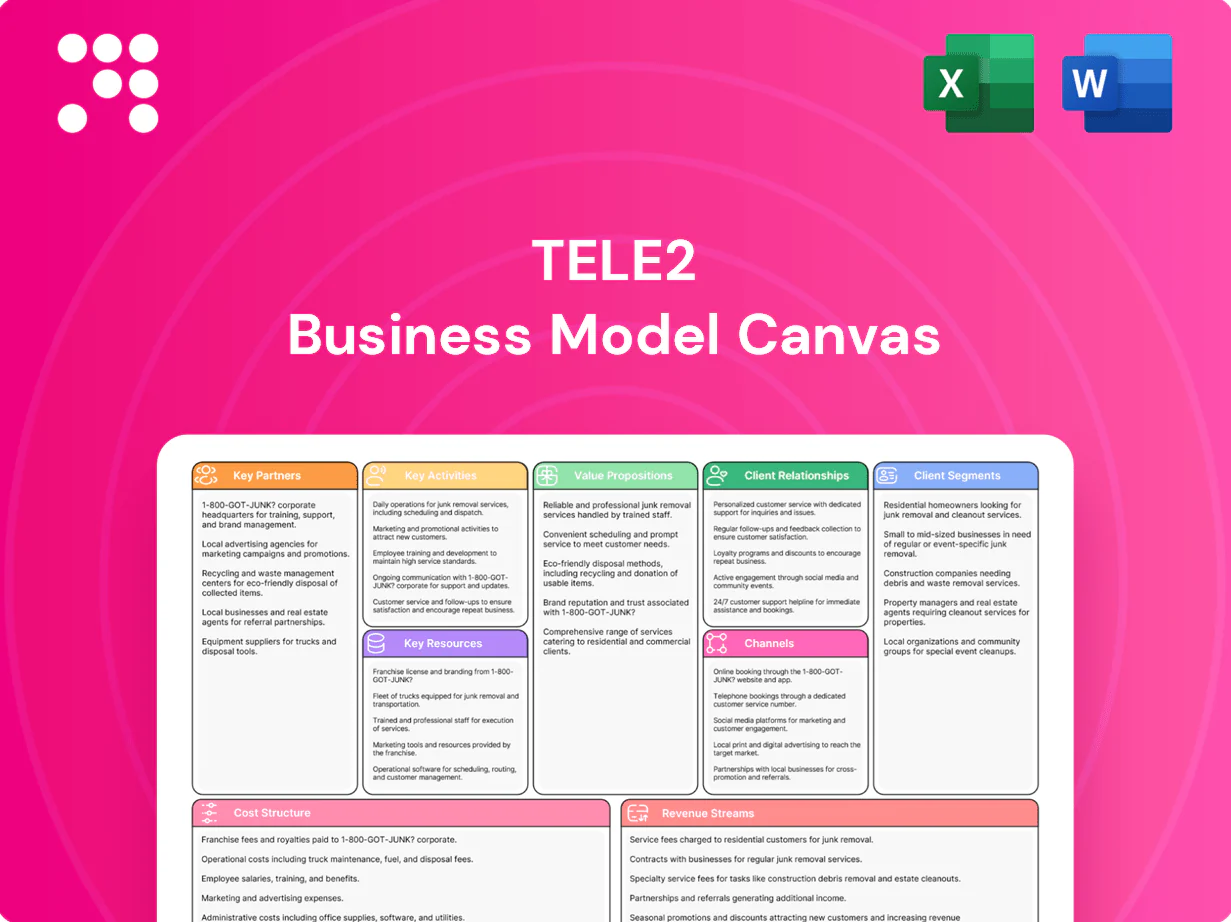
Tele2 Business Model Canvas

Connectivity Business Model Canvas: roadmap to scale, reduce churn and monetize services
Unlock Tele2's strategic blueprint with a concise Business Model Canvas that maps value propositions, customer segments, key partners, channels and revenue streams. This snapshot shows how Tele2 scales, reduces churn and monetizes connectivity in competitive markets. Download the full, editable Word & Excel canvas for a section-by-section roadmap you can use for benchmarking or investor presentations.
Partnerships

Network equipment vendors
Ericsson, Nokia and similar vendors supply RAN and core hardware/software that enable Tele2s 4G/5G upgrades, VoLTE and preparatory steps for 5.5G readiness. Formal joint roadmaps with vendors shorten time-to-market for new features and interop testing. Vendor financing and vendor-led leasing programs help optimize Tele2s capex cycles and preserve liquidity for network expansion.
Tower and infrastructure providers
Towercos and fiber backhaul partners enable Tele2 to expand coverage efficiently, with industry data in 2024 showing tower-sharing models cut rollout time and capital intensity and site sharing can lower deployment costs by up to 40%. Fiber backhaul supports multi-Gbps capacity and reduced latency, crucial for enterprise customers. Energy and power-backup partners lift resilience toward 99.95% availability, while neutral-host DAS partners improve indoor quality by roughly 30–35%.

Content and OTT partners
Content and OTT partners like Netflix (≈260 million subs globally in 2024) enrich Tele2 bundled offers, increasing perceived value and average revenue per user. Zero‑rating or promotional data deals drive mobile data usage and improve retention metrics. Co‑marketing campaigns expand reach across digital audiences, while flexible licensing enables seasonal packages and churn-responsive offers.

Wholesale and MVNO partners
Wholesale and MVNO partners monetize excess capacity by reselling minutes, data and roaming bundles, while cross-border agreements reduce bilateral settlement costs and improve regional roaming economics; wholesale backhaul and IP transit partners maintain latency and packet-loss SLAs, and binding SLAs with partners convert capacity into predictable, contracted revenue streams.
- MVNOs monetize spare capacity
- Cross-border roaming improves margins
- Backhaul/IP transit ensure QoS
- SLAs create predictable revenue
Regulators and spectrum authorities
Regulators and spectrum authorities allocate the radio spectrum vital to Tele2’s service quality and capacity, with national auctions and assignments guiding bandwidth availability in 2024. Constructive engagement shapes fair competition and rollout obligations, while compliance partners ensure security and privacy standards. Active participation in auctions secures future bandwidth and network growth.
- 2024: ongoing national spectrum auctions
- Compliance partners: security/privacy certification
- Regulatory engagement: rollout and competition terms
Vendors, towercos & OTT cut deployment costs 40% and lift QoE ~30%
Tele2 partners with vendors (Ericsson, Nokia) for RAN/core, vendor financing and joint roadmaps to accelerate 4G/5G/5.5G features and VoLTE.
Towercos/fiber partners cut deployment costs up to 40% and enable multi‑Gbps backhaul; energy/DAS partners boost indoor QoE ~30–35% and availability toward 99.95%.
Content/OTT (Netflix ≈260M subs in 2024), MVNOs and wholesale deals monetize capacity, improve ARPU and roaming margins.
| Partner | 2024 metric |
|---|---|
| Vendors | Roadmaps, vendor finance |
| Towercos/Fiber | Deployment cost −40% |
| OTT | Netflix ≈260M subs |
What is included in the product
 Detailed Word Document
A comprehensive Business Model Canvas for Tele2 covering customer segments, channels, value propositions, revenue streams, key partners, activities, resources and cost structure, with competitive advantage analysis and linked SWOT—ideal for presentations, investor discussions and strategic decision-making.

 Customizable Excel Spreadsheet
High-level, editable Tele2 Business Model Canvas that pinpoints customer pains and corresponding solutions, streamlining strategy sessions and saving hours of formatting for teams and boards.
Activities

Network planning and deployment
Site acquisition, RAN rollout and fiber backhaul expansion drive Tele2s coverage build-out, with continuous optimization of radio parameters and transport routes improving reliability and peak speeds. 5G densification prioritizes urban hotspots to boost capacity and latency-sensitive services. Rural fill-in projects address regulatory coverage obligations and uphold brand promises to underserved areas.
Spectrum management and optimization
Carrier aggregation and targeted refarming balance capacity and cost by boosting peak throughput up to 3x while freeing low-value bands for LTE, reducing spectrum OPEX pressure in 2024. Spectrum auctions and active participation in secondary markets secured critical mid-band assets during 2024, supporting nationwide coverage. Rigorous interference management preserved QoS and reduced dropped calls amid rising load. Analytics on demand patterns (yoy traffic +30% in 2024) guide capex and spectrum investments.

Product development and bundling
Pricing design aligns with value-for-money positioning, supporting Tele2’s 2024 strategy after net sales of SEK 23.8 billion; tiered tariffs emphasize transparent monthly fees and add-on elasticity. Converged mobile, broadband and TV bundles lifted ARPU by ~20% in pilot markets, increasing revenue per customer and reducing churn. Add-ons such as roaming packs, cloud storage and security suites boost stickiness, while rapid experimentation—A/B tests and weekly iterations—refines offer mix and uptake.

Customer service and retention
Omnichannel support (phone, chat, app, store) resolves issues quickly by routing to specialized teams and using IVR/chatbot triage to cut resolution time.
Proactive care reduces churn through targeted outreach using usage anomaly detection and retention offers tailored to at-risk segments.
Loyalty programs reward tenure and usage with tiered benefits; NPS tracking feeds back into process fixes and agent training.
- omnichannel-routing
- proactive-outreach
- loyalty-tiers
- nps-driven-improvements
Billing, IT, and data analytics
Robust BSS/OSS ensures accurate charging and fulfillment for Tele2, enabling real-time billing and reduced disputes; self-service portals lower cost-to-serve by shifting routine tasks to customers while improving NPS. Advanced data models detect churn and upsell signals from usage patterns; security and compliance (GDPR: fines up to 4% of global turnover) protect customer trust.
- Real-time billing
- Self-service portals
- Churn prediction
- GDPR compliance
5G densification lifts traffic +30% yoy, 3x peak speeds
Site acquisition, RAN rollout and fiber backhaul scale 5G coverage while densification targets urban hotspots; carrier aggregation raises peak throughput up to 3x as demand rose +30% yoy in 2024. Spectrum purchases in 2024 secured mid-band capacity supporting nationwide coverage. Pricing and converged bundles lifted ARPU ~20% in pilots, contributing to net sales SEK 23.8 billion in 2024. BSS/OSS real-time billing and GDPR compliance protect revenue and trust.
| Activity | KPI | 2024 stat |
|---|---|---|
| Coverage & 5G densification | Traffic growth | +30% yoy |
| Spectrum | Mid-band acquisitions | Secured in 2024 |
| Pricing & bundles | ARPU uplift | ~+20% (pilots) |
| Operations | Revenue | SEK 23.8 bn |
Delivered as Displayed
Business Model Canvas
The Tele2 Business Model Canvas shown here is the actual deliverable, not a mockup, and contains the same content you’ll receive after purchase. When you buy, you’ll instantly download the complete file in editable Word and Excel formats. No placeholders, no extras—what you see is what you’ll get, ready to present and adapt.

Connectivity Business Model Canvas: roadmap to scale, reduce churn and monetize services
Unlock Tele2's strategic blueprint with a concise Business Model Canvas that maps value propositions, customer segments, key partners, channels and revenue streams. This snapshot shows how Tele2 scales, reduces churn and monetizes connectivity in competitive markets. Download the full, editable Word & Excel canvas for a section-by-section roadmap you can use for benchmarking or investor presentations.
Partnerships
Network equipment vendors
Ericsson, Nokia and similar vendors supply RAN and core hardware/software that enable Tele2s 4G/5G upgrades, VoLTE and preparatory steps for 5.5G readiness. Formal joint roadmaps with vendors shorten time-to-market for new features and interop testing. Vendor financing and vendor-led leasing programs help optimize Tele2s capex cycles and preserve liquidity for network expansion.
Tower and infrastructure providers
Towercos and fiber backhaul partners enable Tele2 to expand coverage efficiently, with industry data in 2024 showing tower-sharing models cut rollout time and capital intensity and site sharing can lower deployment costs by up to 40%. Fiber backhaul supports multi-Gbps capacity and reduced latency, crucial for enterprise customers. Energy and power-backup partners lift resilience toward 99.95% availability, while neutral-host DAS partners improve indoor quality by roughly 30–35%.
Content and OTT partners
Content and OTT partners like Netflix (≈260 million subs globally in 2024) enrich Tele2 bundled offers, increasing perceived value and average revenue per user. Zero‑rating or promotional data deals drive mobile data usage and improve retention metrics. Co‑marketing campaigns expand reach across digital audiences, while flexible licensing enables seasonal packages and churn-responsive offers.
Wholesale and MVNO partners
Wholesale and MVNO partners monetize excess capacity by reselling minutes, data and roaming bundles, while cross-border agreements reduce bilateral settlement costs and improve regional roaming economics; wholesale backhaul and IP transit partners maintain latency and packet-loss SLAs, and binding SLAs with partners convert capacity into predictable, contracted revenue streams.
- MVNOs monetize spare capacity
- Cross-border roaming improves margins
- Backhaul/IP transit ensure QoS
- SLAs create predictable revenue
Regulators and spectrum authorities
Regulators and spectrum authorities allocate the radio spectrum vital to Tele2’s service quality and capacity, with national auctions and assignments guiding bandwidth availability in 2024. Constructive engagement shapes fair competition and rollout obligations, while compliance partners ensure security and privacy standards. Active participation in auctions secures future bandwidth and network growth.
- 2024: ongoing national spectrum auctions
- Compliance partners: security/privacy certification
- Regulatory engagement: rollout and competition terms
Vendors, towercos & OTT cut deployment costs 40% and lift QoE ~30%
Tele2 partners with vendors (Ericsson, Nokia) for RAN/core, vendor financing and joint roadmaps to accelerate 4G/5G/5.5G features and VoLTE.
Towercos/fiber partners cut deployment costs up to 40% and enable multi‑Gbps backhaul; energy/DAS partners boost indoor QoE ~30–35% and availability toward 99.95%.
Content/OTT (Netflix ≈260M subs in 2024), MVNOs and wholesale deals monetize capacity, improve ARPU and roaming margins.
| Partner | 2024 metric |
|---|---|
| Vendors | Roadmaps, vendor finance |
| Towercos/Fiber | Deployment cost −40% |
| OTT | Netflix ≈260M subs |
What is included in the product
Detailed Word Document
A comprehensive Business Model Canvas for Tele2 covering customer segments, channels, value propositions, revenue streams, key partners, activities, resources and cost structure, with competitive advantage analysis and linked SWOT—ideal for presentations, investor discussions and strategic decision-making.
Customizable Excel Spreadsheet
High-level, editable Tele2 Business Model Canvas that pinpoints customer pains and corresponding solutions, streamlining strategy sessions and saving hours of formatting for teams and boards.
Activities
Network planning and deployment
Site acquisition, RAN rollout and fiber backhaul expansion drive Tele2s coverage build-out, with continuous optimization of radio parameters and transport routes improving reliability and peak speeds. 5G densification prioritizes urban hotspots to boost capacity and latency-sensitive services. Rural fill-in projects address regulatory coverage obligations and uphold brand promises to underserved areas.
Spectrum management and optimization
Carrier aggregation and targeted refarming balance capacity and cost by boosting peak throughput up to 3x while freeing low-value bands for LTE, reducing spectrum OPEX pressure in 2024. Spectrum auctions and active participation in secondary markets secured critical mid-band assets during 2024, supporting nationwide coverage. Rigorous interference management preserved QoS and reduced dropped calls amid rising load. Analytics on demand patterns (yoy traffic +30% in 2024) guide capex and spectrum investments.
Product development and bundling
Pricing design aligns with value-for-money positioning, supporting Tele2’s 2024 strategy after net sales of SEK 23.8 billion; tiered tariffs emphasize transparent monthly fees and add-on elasticity. Converged mobile, broadband and TV bundles lifted ARPU by ~20% in pilot markets, increasing revenue per customer and reducing churn. Add-ons such as roaming packs, cloud storage and security suites boost stickiness, while rapid experimentation—A/B tests and weekly iterations—refines offer mix and uptake.
Customer service and retention
Omnichannel support (phone, chat, app, store) resolves issues quickly by routing to specialized teams and using IVR/chatbot triage to cut resolution time.
Proactive care reduces churn through targeted outreach using usage anomaly detection and retention offers tailored to at-risk segments.
Loyalty programs reward tenure and usage with tiered benefits; NPS tracking feeds back into process fixes and agent training.
- omnichannel-routing
- proactive-outreach
- loyalty-tiers
- nps-driven-improvements
Billing, IT, and data analytics
Robust BSS/OSS ensures accurate charging and fulfillment for Tele2, enabling real-time billing and reduced disputes; self-service portals lower cost-to-serve by shifting routine tasks to customers while improving NPS. Advanced data models detect churn and upsell signals from usage patterns; security and compliance (GDPR: fines up to 4% of global turnover) protect customer trust.
- Real-time billing
- Self-service portals
- Churn prediction
- GDPR compliance
5G densification lifts traffic +30% yoy, 3x peak speeds
Site acquisition, RAN rollout and fiber backhaul scale 5G coverage while densification targets urban hotspots; carrier aggregation raises peak throughput up to 3x as demand rose +30% yoy in 2024. Spectrum purchases in 2024 secured mid-band capacity supporting nationwide coverage. Pricing and converged bundles lifted ARPU ~20% in pilots, contributing to net sales SEK 23.8 billion in 2024. BSS/OSS real-time billing and GDPR compliance protect revenue and trust.
| Activity | KPI | 2024 stat |
|---|---|---|
| Coverage & 5G densification | Traffic growth | +30% yoy |
| Spectrum | Mid-band acquisitions | Secured in 2024 |
| Pricing & bundles | ARPU uplift | ~+20% (pilots) |
| Operations | Revenue | SEK 23.8 bn |
Delivered as Displayed
Business Model Canvas
The Tele2 Business Model Canvas shown here is the actual deliverable, not a mockup, and contains the same content you’ll receive after purchase. When you buy, you’ll instantly download the complete file in editable Word and Excel formats. No placeholders, no extras—what you see is what you’ll get, ready to present and adapt.
Original: $10.00
-65%$10.00
$3.50Description
Connectivity Business Model Canvas: roadmap to scale, reduce churn and monetize services
Unlock Tele2's strategic blueprint with a concise Business Model Canvas that maps value propositions, customer segments, key partners, channels and revenue streams. This snapshot shows how Tele2 scales, reduces churn and monetizes connectivity in competitive markets. Download the full, editable Word & Excel canvas for a section-by-section roadmap you can use for benchmarking or investor presentations.
Partnerships
Network equipment vendors
Ericsson, Nokia and similar vendors supply RAN and core hardware/software that enable Tele2s 4G/5G upgrades, VoLTE and preparatory steps for 5.5G readiness. Formal joint roadmaps with vendors shorten time-to-market for new features and interop testing. Vendor financing and vendor-led leasing programs help optimize Tele2s capex cycles and preserve liquidity for network expansion.
Tower and infrastructure providers
Towercos and fiber backhaul partners enable Tele2 to expand coverage efficiently, with industry data in 2024 showing tower-sharing models cut rollout time and capital intensity and site sharing can lower deployment costs by up to 40%. Fiber backhaul supports multi-Gbps capacity and reduced latency, crucial for enterprise customers. Energy and power-backup partners lift resilience toward 99.95% availability, while neutral-host DAS partners improve indoor quality by roughly 30–35%.
Content and OTT partners
Content and OTT partners like Netflix (≈260 million subs globally in 2024) enrich Tele2 bundled offers, increasing perceived value and average revenue per user. Zero‑rating or promotional data deals drive mobile data usage and improve retention metrics. Co‑marketing campaigns expand reach across digital audiences, while flexible licensing enables seasonal packages and churn-responsive offers.
Wholesale and MVNO partners
Wholesale and MVNO partners monetize excess capacity by reselling minutes, data and roaming bundles, while cross-border agreements reduce bilateral settlement costs and improve regional roaming economics; wholesale backhaul and IP transit partners maintain latency and packet-loss SLAs, and binding SLAs with partners convert capacity into predictable, contracted revenue streams.
- MVNOs monetize spare capacity
- Cross-border roaming improves margins
- Backhaul/IP transit ensure QoS
- SLAs create predictable revenue
Regulators and spectrum authorities
Regulators and spectrum authorities allocate the radio spectrum vital to Tele2’s service quality and capacity, with national auctions and assignments guiding bandwidth availability in 2024. Constructive engagement shapes fair competition and rollout obligations, while compliance partners ensure security and privacy standards. Active participation in auctions secures future bandwidth and network growth.
- 2024: ongoing national spectrum auctions
- Compliance partners: security/privacy certification
- Regulatory engagement: rollout and competition terms
Vendors, towercos & OTT cut deployment costs 40% and lift QoE ~30%
Tele2 partners with vendors (Ericsson, Nokia) for RAN/core, vendor financing and joint roadmaps to accelerate 4G/5G/5.5G features and VoLTE.
Towercos/fiber partners cut deployment costs up to 40% and enable multi‑Gbps backhaul; energy/DAS partners boost indoor QoE ~30–35% and availability toward 99.95%.
Content/OTT (Netflix ≈260M subs in 2024), MVNOs and wholesale deals monetize capacity, improve ARPU and roaming margins.
| Partner | 2024 metric |
|---|---|
| Vendors | Roadmaps, vendor finance |
| Towercos/Fiber | Deployment cost −40% |
| OTT | Netflix ≈260M subs |
What is included in the product
Detailed Word Document
A comprehensive Business Model Canvas for Tele2 covering customer segments, channels, value propositions, revenue streams, key partners, activities, resources and cost structure, with competitive advantage analysis and linked SWOT—ideal for presentations, investor discussions and strategic decision-making.
Customizable Excel Spreadsheet
High-level, editable Tele2 Business Model Canvas that pinpoints customer pains and corresponding solutions, streamlining strategy sessions and saving hours of formatting for teams and boards.
Activities
Network planning and deployment
Site acquisition, RAN rollout and fiber backhaul expansion drive Tele2s coverage build-out, with continuous optimization of radio parameters and transport routes improving reliability and peak speeds. 5G densification prioritizes urban hotspots to boost capacity and latency-sensitive services. Rural fill-in projects address regulatory coverage obligations and uphold brand promises to underserved areas.
Spectrum management and optimization
Carrier aggregation and targeted refarming balance capacity and cost by boosting peak throughput up to 3x while freeing low-value bands for LTE, reducing spectrum OPEX pressure in 2024. Spectrum auctions and active participation in secondary markets secured critical mid-band assets during 2024, supporting nationwide coverage. Rigorous interference management preserved QoS and reduced dropped calls amid rising load. Analytics on demand patterns (yoy traffic +30% in 2024) guide capex and spectrum investments.
Product development and bundling
Pricing design aligns with value-for-money positioning, supporting Tele2’s 2024 strategy after net sales of SEK 23.8 billion; tiered tariffs emphasize transparent monthly fees and add-on elasticity. Converged mobile, broadband and TV bundles lifted ARPU by ~20% in pilot markets, increasing revenue per customer and reducing churn. Add-ons such as roaming packs, cloud storage and security suites boost stickiness, while rapid experimentation—A/B tests and weekly iterations—refines offer mix and uptake.
Customer service and retention
Omnichannel support (phone, chat, app, store) resolves issues quickly by routing to specialized teams and using IVR/chatbot triage to cut resolution time.
Proactive care reduces churn through targeted outreach using usage anomaly detection and retention offers tailored to at-risk segments.
Loyalty programs reward tenure and usage with tiered benefits; NPS tracking feeds back into process fixes and agent training.
- omnichannel-routing
- proactive-outreach
- loyalty-tiers
- nps-driven-improvements
Billing, IT, and data analytics
Robust BSS/OSS ensures accurate charging and fulfillment for Tele2, enabling real-time billing and reduced disputes; self-service portals lower cost-to-serve by shifting routine tasks to customers while improving NPS. Advanced data models detect churn and upsell signals from usage patterns; security and compliance (GDPR: fines up to 4% of global turnover) protect customer trust.
- Real-time billing
- Self-service portals
- Churn prediction
- GDPR compliance
5G densification lifts traffic +30% yoy, 3x peak speeds
Site acquisition, RAN rollout and fiber backhaul scale 5G coverage while densification targets urban hotspots; carrier aggregation raises peak throughput up to 3x as demand rose +30% yoy in 2024. Spectrum purchases in 2024 secured mid-band capacity supporting nationwide coverage. Pricing and converged bundles lifted ARPU ~20% in pilots, contributing to net sales SEK 23.8 billion in 2024. BSS/OSS real-time billing and GDPR compliance protect revenue and trust.
| Activity | KPI | 2024 stat |
|---|---|---|
| Coverage & 5G densification | Traffic growth | +30% yoy |
| Spectrum | Mid-band acquisitions | Secured in 2024 |
| Pricing & bundles | ARPU uplift | ~+20% (pilots) |
| Operations | Revenue | SEK 23.8 bn |
Delivered as Displayed
Business Model Canvas
The Tele2 Business Model Canvas shown here is the actual deliverable, not a mockup, and contains the same content you’ll receive after purchase. When you buy, you’ll instantly download the complete file in editable Word and Excel formats. No placeholders, no extras—what you see is what you’ll get, ready to present and adapt.











