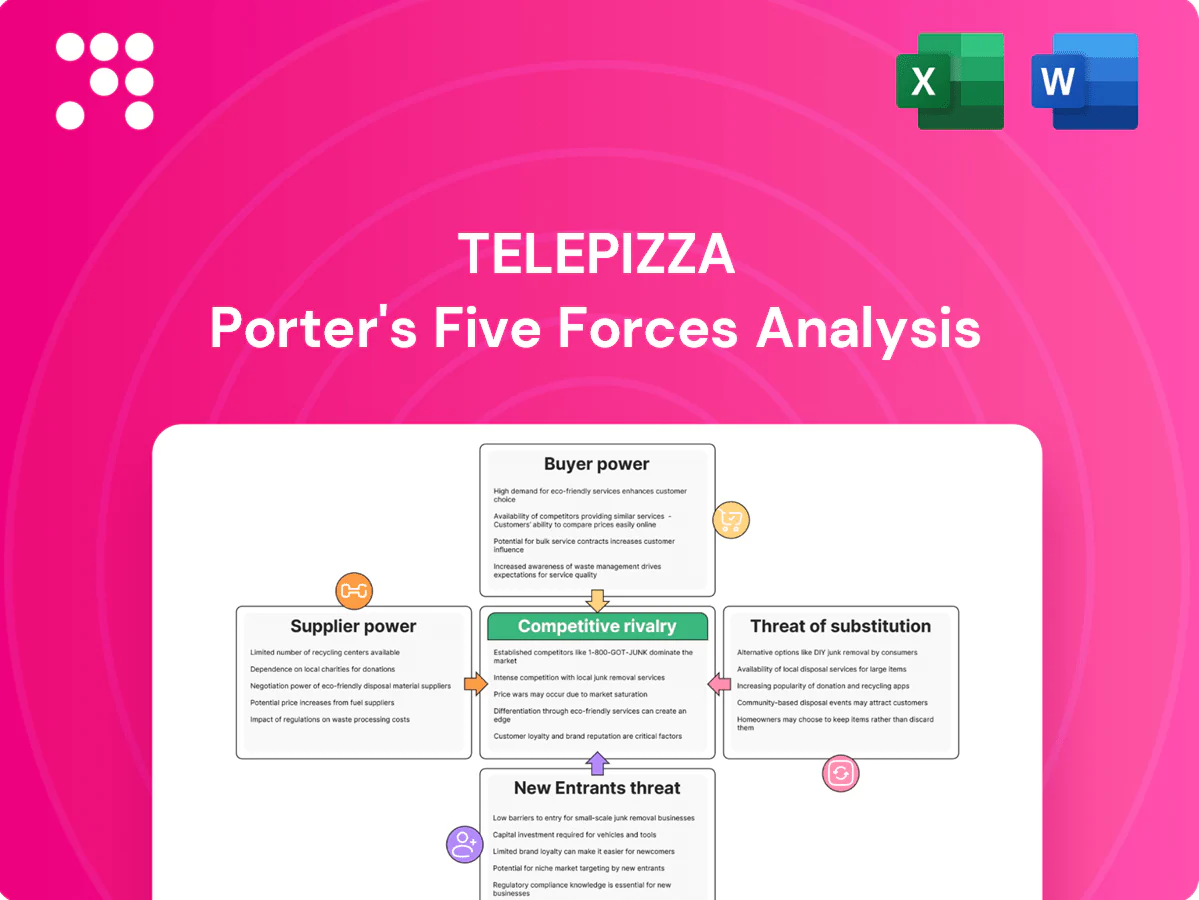
Telepizza Porter's Five Forces Analysis

Don't Miss the Bigger Picture
Telepizza faces fierce rivalry from global and local chains, growing buyer power via delivery platforms, and supplier cost pressure, while substitutes and new delivery-focused entrants squeeze margins; this snapshot highlights core tensions and strategic levers. This brief snapshot only scratches the surface. Unlock the full Porter's Five Forces Analysis to explore Telepizza’s competitive dynamics, market pressures, and strategic advantages in detail.
Suppliers Bargaining Power

Fragmented ingredient suppliers
Core inputs like flour, vegetables and packaging are widely available—world wheat production was about 784 million tonnes in 2024 (USDA)—limiting individual supplier leverage. Telepizza can multi-source and switch vendors to manage cost and quality, using standardized specs to enable competitive bidding across regions. Local shortages or logistics can still create pockets of dependency in some markets.
Dairy and protein volatility
Cheese and meat inputs show high price volatility, with 2024 episodic dairy spot-price spikes exceeding 15%, and protein markets similarly swinging double digits, concentrating cost pressure on Telepizza suppliers. Index-linked contracts and hedging lower peak exposure but cannot fully remove pass-through lag, so franchisees report margin squeeze when passthrough takes weeks. Strategic supplier partnerships or regional co-ops can improve bargaining position and reduce short-term cost shocks.

Private-label and centralized procurement
Corporate-led procurement and preferred-vendor lists concentrate buying power at Telepizza, enabling negotiated pricing and service terms that franchisees cannot secure independently. Volume aggregation across the network routinely delivers industry-standard foodservice procurement discounts of roughly 5–15%, improving gross margins. Centralized QA standardizes specs and lowers switching costs by making supplier changes procedural and predictable. Strict compliance enforcement is essential to consistently realize these scale benefits.

Logistics and last-mile dependencies
Cold-chain and just-in-time deliveries are critical to Telepizza’s freshness, with the global cold chain market reaching about $300B in 2024, heightening supplier leverage over quality-sensitive routes. Reliance on third-party distributors creates hold-up risks in some markets; dual-sourcing and safety stocks improve resilience. Urban congestion and rising fuel pushed bargaining power toward reliable logistics partners in 2024.
- dual-sourcing
- safety-stocks
- third-party-hold-up
- fuel-and-congestion
Technology and packaging suppliers
Technology and packaging suppliers (pizza boxes, ovens, POS, delivery tech) exert moderate bargaining power: long-term contracts lock pricing and service levels and raise switching costs through integrations, while interoperable systems and API-based vendors lower friction and enable periodic re-tendering to keep terms competitive.
- Integration stickiness raises switching costs
- Long-term contracts reduce flexibility
- Interoperability lowers switching friction
- Periodic re-tendering maintains competitive terms
Grains stable; dairy spikes >15%; cold-chain ~$300B; procurement -5-15%
Telepizza faces generally low supplier power for staples (global wheat 784m t in 2024) but concentrated cost risk from dairy/meat with 2024 dairy spot spikes >15%. Centralized procurement yields 5–15% foodservice discounts, offsetting supplier leverage. Cold-chain/logistics (global market ~$300B in 2024) and tech integration pose moderate hold-up risks.
| Supplier | Leverage | 2024 metric |
|---|---|---|
| Grains | Low | Wheat 784m t |
| Dairy/Meat | High volatility | Spot spikes >15% |
| Logistics | Moderate | Cold chain ~$300B |
| Procurement | Mitigant | Discounts 5–15% |
What is included in the product
 Detailed Word Document
Comprehensive Porter’s Five Forces for Telepizza assessing competitive rivalry, supplier and buyer power, threat of substitutes and new entrants, plus disruptive risks and strategic levers to protect margins and market share.

 Customizable Excel Spreadsheet
A one-sheet Telepizza Five Forces summary with editable pressure levels and a radar chart—no macros—so teams can instantly assess competitive pressure and drop the clean, copy-ready layout into decks, dashboards, or reports.
Customers Bargaining Power

Highly price-sensitive mass market
Customers in value-focused segments react quickly to promotions, making demand highly elastic and fueling frequent discounting wars and bundle-driven spikes.
Telepizza must manage the trade-off between larger ticket sizes and higher transaction volumes to protect margins, especially when rivals chase volume with low prices.
Clear, differentiated value propositions—loyalty benefits, quality claims, or convenience—can reduce price bargaining and stabilize average spend.
Low switching costs and many choices
Low switching costs let consumers hop between pizza chains, independents and other cuisines with little friction, and aggregators have pushed transparency—global online food delivery spending hit about $200bn in 2024—making price and ratings instantly comparable. Loyalty programs and exclusive SKUs cut churn, while consistency and rapid delivery remain primary retention levers.

Digital platforms concentrate power
Delivery aggregators can own the customer relationship and data, capturing roughly 40% of delivery orders in Spain and charging commission fees typically between 20–30%, which compresses unit economics and forces menu price adjustments. Telepizza’s own app and direct channels reduce platform dependence, while data-driven CRM (loyalty, personalized offers) offsets aggregator bargaining power by boosting repeat direct sales.

Local taste expectations
Buyers demand localized flavors and promotions, and poor adaptation erodes willingness to pay and repeat purchase rates; Telepizza relies on franchisee insights to tailor offers, while rapid menu testing accelerates fit and differentiation.
- Localization drives retention
- Adaptation affects price tolerance
- Franchisees = local market intelligence
- Rapid testing = faster differentiation
Service and reliability expectations
Delivery time, order accuracy and customer service are primary drivers of repurchase for Telepizza; social reviews and ratings magnify service failures and increase buyer leverage in negotiations. Operational KPIs and delivery-time guarantees can restore confidence, while proactive recovery policies (refunds, free items) reduce defection risk.
Price wars: aggregators take ≈40%, fees 20–30%
Customers are price-sensitive; demand elastic drives frequent discounting wars and bundles. Low switching costs and aggregators (≈40% of Spanish delivery orders, 20–30% commissions) amplify buyer power. Loyalty, direct app sales and rapid localized testing raise retention and average ticket.
| Metric | 2024 |
|---|---|
| Global online delivery market | $200bn |
| Spain aggregator share | ≈40% |
| Aggregator commissions | 20–30% |
Preview the Actual Deliverable
Telepizza Porter's Five Forces Analysis
This preview shows the exact Telepizza Porter's Five Forces analysis you'll receive immediately after purchase—no placeholders or mockups. The document displayed is fully formatted, professionally written, and ready for download and use the moment you buy. You're looking at the actual deliverable; completion of payment grants instant access to this identical file.

Don't Miss the Bigger Picture
Telepizza faces fierce rivalry from global and local chains, growing buyer power via delivery platforms, and supplier cost pressure, while substitutes and new delivery-focused entrants squeeze margins; this snapshot highlights core tensions and strategic levers. This brief snapshot only scratches the surface. Unlock the full Porter's Five Forces Analysis to explore Telepizza’s competitive dynamics, market pressures, and strategic advantages in detail.
Suppliers Bargaining Power
Fragmented ingredient suppliers
Core inputs like flour, vegetables and packaging are widely available—world wheat production was about 784 million tonnes in 2024 (USDA)—limiting individual supplier leverage. Telepizza can multi-source and switch vendors to manage cost and quality, using standardized specs to enable competitive bidding across regions. Local shortages or logistics can still create pockets of dependency in some markets.
Dairy and protein volatility
Cheese and meat inputs show high price volatility, with 2024 episodic dairy spot-price spikes exceeding 15%, and protein markets similarly swinging double digits, concentrating cost pressure on Telepizza suppliers. Index-linked contracts and hedging lower peak exposure but cannot fully remove pass-through lag, so franchisees report margin squeeze when passthrough takes weeks. Strategic supplier partnerships or regional co-ops can improve bargaining position and reduce short-term cost shocks.
Private-label and centralized procurement
Corporate-led procurement and preferred-vendor lists concentrate buying power at Telepizza, enabling negotiated pricing and service terms that franchisees cannot secure independently. Volume aggregation across the network routinely delivers industry-standard foodservice procurement discounts of roughly 5–15%, improving gross margins. Centralized QA standardizes specs and lowers switching costs by making supplier changes procedural and predictable. Strict compliance enforcement is essential to consistently realize these scale benefits.
Logistics and last-mile dependencies
Cold-chain and just-in-time deliveries are critical to Telepizza’s freshness, with the global cold chain market reaching about $300B in 2024, heightening supplier leverage over quality-sensitive routes. Reliance on third-party distributors creates hold-up risks in some markets; dual-sourcing and safety stocks improve resilience. Urban congestion and rising fuel pushed bargaining power toward reliable logistics partners in 2024.
- dual-sourcing
- safety-stocks
- third-party-hold-up
- fuel-and-congestion
Technology and packaging suppliers
Technology and packaging suppliers (pizza boxes, ovens, POS, delivery tech) exert moderate bargaining power: long-term contracts lock pricing and service levels and raise switching costs through integrations, while interoperable systems and API-based vendors lower friction and enable periodic re-tendering to keep terms competitive.
- Integration stickiness raises switching costs
- Long-term contracts reduce flexibility
- Interoperability lowers switching friction
- Periodic re-tendering maintains competitive terms
Grains stable; dairy spikes >15%; cold-chain ~$300B; procurement -5-15%
Telepizza faces generally low supplier power for staples (global wheat 784m t in 2024) but concentrated cost risk from dairy/meat with 2024 dairy spot spikes >15%. Centralized procurement yields 5–15% foodservice discounts, offsetting supplier leverage. Cold-chain/logistics (global market ~$300B in 2024) and tech integration pose moderate hold-up risks.
| Supplier | Leverage | 2024 metric |
|---|---|---|
| Grains | Low | Wheat 784m t |
| Dairy/Meat | High volatility | Spot spikes >15% |
| Logistics | Moderate | Cold chain ~$300B |
| Procurement | Mitigant | Discounts 5–15% |
What is included in the product
Detailed Word Document
Comprehensive Porter’s Five Forces for Telepizza assessing competitive rivalry, supplier and buyer power, threat of substitutes and new entrants, plus disruptive risks and strategic levers to protect margins and market share.
Customizable Excel Spreadsheet
A one-sheet Telepizza Five Forces summary with editable pressure levels and a radar chart—no macros—so teams can instantly assess competitive pressure and drop the clean, copy-ready layout into decks, dashboards, or reports.
Customers Bargaining Power
Highly price-sensitive mass market
Customers in value-focused segments react quickly to promotions, making demand highly elastic and fueling frequent discounting wars and bundle-driven spikes.
Telepizza must manage the trade-off between larger ticket sizes and higher transaction volumes to protect margins, especially when rivals chase volume with low prices.
Clear, differentiated value propositions—loyalty benefits, quality claims, or convenience—can reduce price bargaining and stabilize average spend.
Low switching costs and many choices
Low switching costs let consumers hop between pizza chains, independents and other cuisines with little friction, and aggregators have pushed transparency—global online food delivery spending hit about $200bn in 2024—making price and ratings instantly comparable. Loyalty programs and exclusive SKUs cut churn, while consistency and rapid delivery remain primary retention levers.
Digital platforms concentrate power
Delivery aggregators can own the customer relationship and data, capturing roughly 40% of delivery orders in Spain and charging commission fees typically between 20–30%, which compresses unit economics and forces menu price adjustments. Telepizza’s own app and direct channels reduce platform dependence, while data-driven CRM (loyalty, personalized offers) offsets aggregator bargaining power by boosting repeat direct sales.
Local taste expectations
Buyers demand localized flavors and promotions, and poor adaptation erodes willingness to pay and repeat purchase rates; Telepizza relies on franchisee insights to tailor offers, while rapid menu testing accelerates fit and differentiation.
- Localization drives retention
- Adaptation affects price tolerance
- Franchisees = local market intelligence
- Rapid testing = faster differentiation
Service and reliability expectations
Delivery time, order accuracy and customer service are primary drivers of repurchase for Telepizza; social reviews and ratings magnify service failures and increase buyer leverage in negotiations. Operational KPIs and delivery-time guarantees can restore confidence, while proactive recovery policies (refunds, free items) reduce defection risk.
Price wars: aggregators take ≈40%, fees 20–30%
Customers are price-sensitive; demand elastic drives frequent discounting wars and bundles. Low switching costs and aggregators (≈40% of Spanish delivery orders, 20–30% commissions) amplify buyer power. Loyalty, direct app sales and rapid localized testing raise retention and average ticket.
| Metric | 2024 |
|---|---|
| Global online delivery market | $200bn |
| Spain aggregator share | ≈40% |
| Aggregator commissions | 20–30% |
Preview the Actual Deliverable
Telepizza Porter's Five Forces Analysis
This preview shows the exact Telepizza Porter's Five Forces analysis you'll receive immediately after purchase—no placeholders or mockups. The document displayed is fully formatted, professionally written, and ready for download and use the moment you buy. You're looking at the actual deliverable; completion of payment grants instant access to this identical file.
Original: $10.00
-65%$10.00
$3.50Description
Don't Miss the Bigger Picture
Telepizza faces fierce rivalry from global and local chains, growing buyer power via delivery platforms, and supplier cost pressure, while substitutes and new delivery-focused entrants squeeze margins; this snapshot highlights core tensions and strategic levers. This brief snapshot only scratches the surface. Unlock the full Porter's Five Forces Analysis to explore Telepizza’s competitive dynamics, market pressures, and strategic advantages in detail.
Suppliers Bargaining Power
Fragmented ingredient suppliers
Core inputs like flour, vegetables and packaging are widely available—world wheat production was about 784 million tonnes in 2024 (USDA)—limiting individual supplier leverage. Telepizza can multi-source and switch vendors to manage cost and quality, using standardized specs to enable competitive bidding across regions. Local shortages or logistics can still create pockets of dependency in some markets.
Dairy and protein volatility
Cheese and meat inputs show high price volatility, with 2024 episodic dairy spot-price spikes exceeding 15%, and protein markets similarly swinging double digits, concentrating cost pressure on Telepizza suppliers. Index-linked contracts and hedging lower peak exposure but cannot fully remove pass-through lag, so franchisees report margin squeeze when passthrough takes weeks. Strategic supplier partnerships or regional co-ops can improve bargaining position and reduce short-term cost shocks.
Private-label and centralized procurement
Corporate-led procurement and preferred-vendor lists concentrate buying power at Telepizza, enabling negotiated pricing and service terms that franchisees cannot secure independently. Volume aggregation across the network routinely delivers industry-standard foodservice procurement discounts of roughly 5–15%, improving gross margins. Centralized QA standardizes specs and lowers switching costs by making supplier changes procedural and predictable. Strict compliance enforcement is essential to consistently realize these scale benefits.
Logistics and last-mile dependencies
Cold-chain and just-in-time deliveries are critical to Telepizza’s freshness, with the global cold chain market reaching about $300B in 2024, heightening supplier leverage over quality-sensitive routes. Reliance on third-party distributors creates hold-up risks in some markets; dual-sourcing and safety stocks improve resilience. Urban congestion and rising fuel pushed bargaining power toward reliable logistics partners in 2024.
- dual-sourcing
- safety-stocks
- third-party-hold-up
- fuel-and-congestion
Technology and packaging suppliers
Technology and packaging suppliers (pizza boxes, ovens, POS, delivery tech) exert moderate bargaining power: long-term contracts lock pricing and service levels and raise switching costs through integrations, while interoperable systems and API-based vendors lower friction and enable periodic re-tendering to keep terms competitive.
- Integration stickiness raises switching costs
- Long-term contracts reduce flexibility
- Interoperability lowers switching friction
- Periodic re-tendering maintains competitive terms
Grains stable; dairy spikes >15%; cold-chain ~$300B; procurement -5-15%
Telepizza faces generally low supplier power for staples (global wheat 784m t in 2024) but concentrated cost risk from dairy/meat with 2024 dairy spot spikes >15%. Centralized procurement yields 5–15% foodservice discounts, offsetting supplier leverage. Cold-chain/logistics (global market ~$300B in 2024) and tech integration pose moderate hold-up risks.
| Supplier | Leverage | 2024 metric |
|---|---|---|
| Grains | Low | Wheat 784m t |
| Dairy/Meat | High volatility | Spot spikes >15% |
| Logistics | Moderate | Cold chain ~$300B |
| Procurement | Mitigant | Discounts 5–15% |
What is included in the product
Detailed Word Document
Comprehensive Porter’s Five Forces for Telepizza assessing competitive rivalry, supplier and buyer power, threat of substitutes and new entrants, plus disruptive risks and strategic levers to protect margins and market share.
Customizable Excel Spreadsheet
A one-sheet Telepizza Five Forces summary with editable pressure levels and a radar chart—no macros—so teams can instantly assess competitive pressure and drop the clean, copy-ready layout into decks, dashboards, or reports.
Customers Bargaining Power
Highly price-sensitive mass market
Customers in value-focused segments react quickly to promotions, making demand highly elastic and fueling frequent discounting wars and bundle-driven spikes.
Telepizza must manage the trade-off between larger ticket sizes and higher transaction volumes to protect margins, especially when rivals chase volume with low prices.
Clear, differentiated value propositions—loyalty benefits, quality claims, or convenience—can reduce price bargaining and stabilize average spend.
Low switching costs and many choices
Low switching costs let consumers hop between pizza chains, independents and other cuisines with little friction, and aggregators have pushed transparency—global online food delivery spending hit about $200bn in 2024—making price and ratings instantly comparable. Loyalty programs and exclusive SKUs cut churn, while consistency and rapid delivery remain primary retention levers.
Digital platforms concentrate power
Delivery aggregators can own the customer relationship and data, capturing roughly 40% of delivery orders in Spain and charging commission fees typically between 20–30%, which compresses unit economics and forces menu price adjustments. Telepizza’s own app and direct channels reduce platform dependence, while data-driven CRM (loyalty, personalized offers) offsets aggregator bargaining power by boosting repeat direct sales.
Local taste expectations
Buyers demand localized flavors and promotions, and poor adaptation erodes willingness to pay and repeat purchase rates; Telepizza relies on franchisee insights to tailor offers, while rapid menu testing accelerates fit and differentiation.
- Localization drives retention
- Adaptation affects price tolerance
- Franchisees = local market intelligence
- Rapid testing = faster differentiation
Service and reliability expectations
Delivery time, order accuracy and customer service are primary drivers of repurchase for Telepizza; social reviews and ratings magnify service failures and increase buyer leverage in negotiations. Operational KPIs and delivery-time guarantees can restore confidence, while proactive recovery policies (refunds, free items) reduce defection risk.
Price wars: aggregators take ≈40%, fees 20–30%
Customers are price-sensitive; demand elastic drives frequent discounting wars and bundles. Low switching costs and aggregators (≈40% of Spanish delivery orders, 20–30% commissions) amplify buyer power. Loyalty, direct app sales and rapid localized testing raise retention and average ticket.
| Metric | 2024 |
|---|---|
| Global online delivery market | $200bn |
| Spain aggregator share | ≈40% |
| Aggregator commissions | 20–30% |
Preview the Actual Deliverable
Telepizza Porter's Five Forces Analysis
This preview shows the exact Telepizza Porter's Five Forces analysis you'll receive immediately after purchase—no placeholders or mockups. The document displayed is fully formatted, professionally written, and ready for download and use the moment you buy. You're looking at the actual deliverable; completion of payment grants instant access to this identical file.











