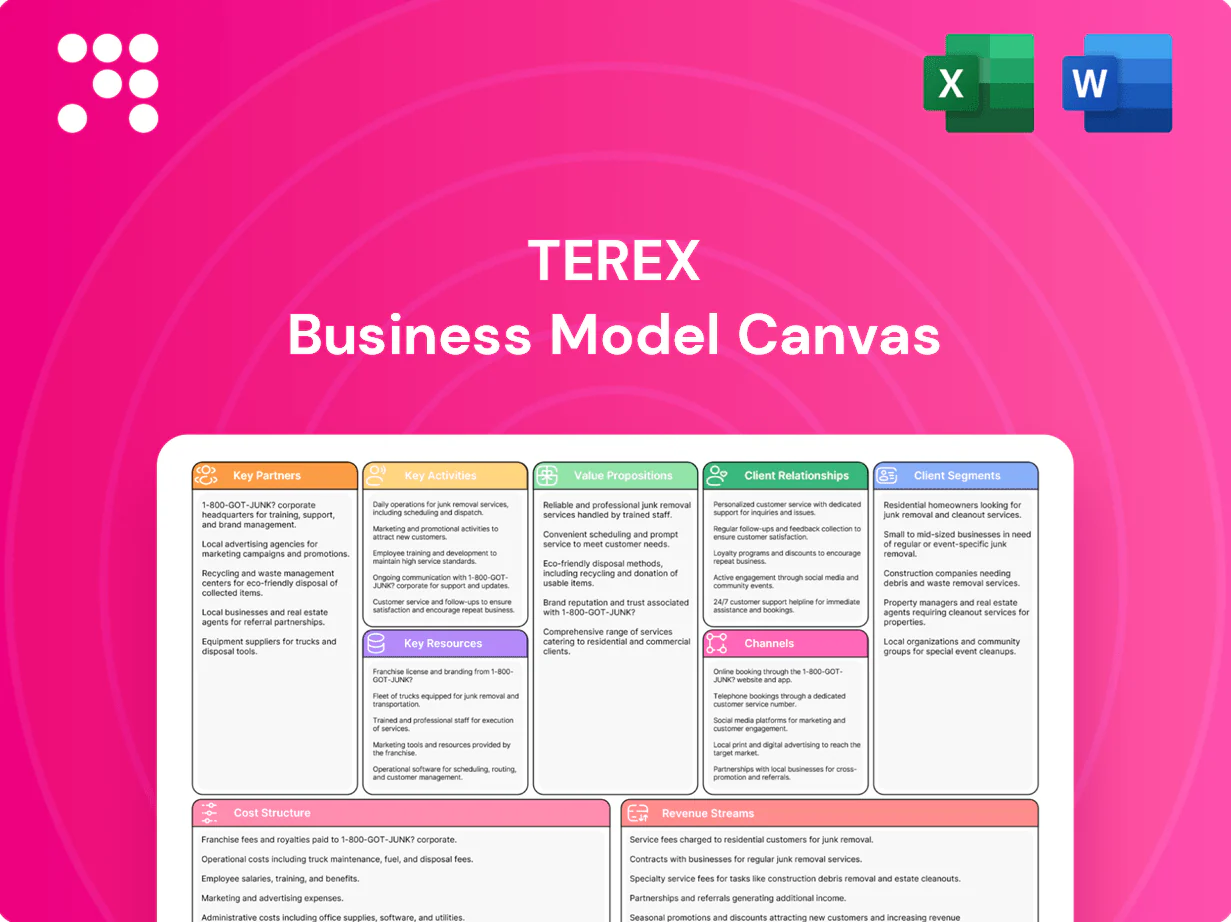
Terex Business Model Canvas

Unlock a strategic blueprint with an in-depth Business Model Canvas for heavy equipment
Unlock Terex’s strategic blueprint with our in-depth Business Model Canvas. This concise, actionable analysis reveals how Terex creates value, scales operations, and sustains competitive advantage across segments. Perfect for investors, consultants, and founders seeking tactical insights and benchmarking tools. Purchase the full Word/Excel canvas to get every building block, financial implications, and ready-to-use templates.
Partnerships

Global component suppliers
Strategic relationships with steel, hydraulics, powertrain, electronics and battery suppliers secure quality inputs and cost stability, leveraging global steel output of 1.86 billion tonnes in 2023 to ensure material availability. Long-term contracts (commonly 3–5 year tenors) reduce lead-time volatility and support capacity planning. Co-engineering with key vendors accelerates innovation and regulatory compliance. Dual-sourcing across 2+ regions mitigates supply risk.
Dealers and rental alliances
Authorized dealers and major rental partners expand Terex's global reach and local service density, supporting on-site maintenance and parts; Terex reported 2024 revenue of $3.7 billion and broad dealer/rental distribution. Partners manage sales, fleet rotation and utilization optimization, improving uptime and resale values. Rental-fleet telematics provided 2024 usage and failure data that guide product upgrades, while joint promotions smooth demand across cycles.

Technology and telematics partners
IoT, telematics and software partners enable connected Terex equipment and predictive maintenance, with predictive maintenance cutting maintenance costs 10–40% and downtime up to 50% (industry studies). Integration with fleet management platforms can improve customer ROI by ~15% through fuel, usage and scheduling gains. Cybersecurity and data-standard partnerships (ISO/IEC 27001, NIST) ensure reliability. Analytics alliances boost machine performance insights and uptime by up to 20%.

Financing and insurance providers
OEM financing partners facilitate Terex customer purchases through leasing, loans and residual-value programs that lower upfront cost and shorten sales cycles.
Insurance partners underwrite uptime guarantees and transfer operational risk, enabling service-level commitments and extended warranties.
Structured finance expands access in emerging markets and dealer programs improve inventory turns and cash-flow management.
Service, training, and compliance bodies
Collaboration with safety regulators, certification bodies, and training firms ensures Terex operators meet regulatory requirements and reduces onsite incidents; Terex serves customers in 50+ countries and aligns training with ISO standards. Accredited training programs improve customer safety outcomes and uptime. Service partners expand certified maintenance coverage and participation in standards bodies helps shape industry best practices.
- Regulatory alignment
- Accredited training
- Certified service network
- Standards influence
Long-term supply, 50+ countries, $3.7B, 10-40% savings
Terex secures supply through long-term steel, hydraulics and powertrain contracts (global steel 1.86B t in 2023) and dual-sourcing to limit disruption. Dealer and rental partners expand service in 50+ countries and supported Terex 2024 revenue of $3.7B. IoT/analytics and finance partners drive 10–40% maintenance cost savings and broaden purchase access.
| Partner Type | Role | 2024 Metric |
|---|---|---|
| Suppliers | Inputs, co-engineering | Steel 1.86B t(2023) |
| Dealers/Rentals | Distribution/service | $3.7B revenue (2024) |
| IoT/Finance | Uptime, financing | 10–40% cost savings |
What is included in the product
 Detailed Word Document
A comprehensive Business Model Canvas for Terex outlining its nine blocks—customer segments, value propositions, channels, customer relationships, revenue streams, key resources, key activities, key partnerships, and cost structure—reflecting real-world operations, competitive advantages, SWOT-linked insights, and presentation-ready clarity for investors and analysts.

 Customizable Excel Spreadsheet
Condenses Terex’s heavy-equipment strategy into a digestible one-page canvas that saves hours of structuring, speeds decision-making, and enables quick comparison, collaboration and board-ready presentations.
Activities

Design and engineering
Mechanical, electrical and software design for aerial platforms and processing equipment underpin Terex differentiation, supporting a product portfolio that drove roughly $3.0 billion in 2024 revenue. Rapid prototyping and iterative testing shorten development cycles and uphold safety certifications and uptime targets. Localization adapts machines to regional regulations and climates, while sustained cost-down engineering initiatives improved margins across 2024 product lines.
Manufacturing and quality assurance
Global assembly and fabrication align supply with regional demand, and in 2024 Terex (NYSE: TEX) maintained manufacturing footprints across North America, Europe and Asia to reduce lead times. Lean operations and targeted automation raise throughput and consistency while trimming cycle variability. Rigorous supplier quality management prevents downstream defects through incoming inspection and supplier audits. End-of-line testing validates safety-critical systems before shipment.

Supply chain and procurement
Strategic sourcing at Terex manages commodity exposure and availability through supplier consolidation and long-term contracts, cutting volatility as container spot rates dropped about 80% from 2021 peaks to 2024. Inventory planning balances service levels with working capital via optimized inventory turns. Logistics optimization reduces lead times and freight cost, and risk management builds resilience to disruptions through dual sourcing and contingency inventory.

Aftermarket support and services
Aftermarket parts, field service, rebuilds and operator training maximize Terex equipment uptime and availability; integrated rebuild programs recovered assets into fleet service at lower cost. Telematics-enabled diagnostics cut unplanned downtime an estimated 25% in field deployments (2024). Active warranty management and upgrade programs can extend asset life ~15%; reman/recycling reduce lifecycle emissions ~40%.
- parts
- field service
- rebuilds
- training
- telematics
- warranty
- upgrades
- reman
- recycling
Sales enablement and channel management
Dealer development, targeted pricing and incentive programs drove channel growth in 2024, supporting Terex's reported $3.6B revenue by improving fill rates and margin capture. Key account management aligned modular solutions to large-fleet customers, reducing churn and increasing multi-unit orders. Marketing demos and rental partner programs accelerated adoption, while digital quoting and e-order tools cut cycle times and errors.
- Dealer expansion: network optimization
- Pricing & incentives: margin + volume focus
- Key accounts: fleet-aligned solutions
- Marketing/demos: rental partner acceleration
- Digital tools: faster quotes & orders
Design, local assembly and telematics enabled $3.0B revenue, 25% less downtime
Mechanical, electrical and software design, rapid prototyping and localization drove Terex product differentiation and supported ~$3.0B product revenue in 2024. Global assembly across NA, EU and Asia with lean automation reduced lead times and improved margins. Strategic sourcing and inventory planning offset volatility as container rates fell ~80% vs 2021. Aftermarket, telematics and rebuilds cut downtime ~25% and extended asset life ~15%.
| Metric | 2024 | Impact |
|---|---|---|
| Product rev | $3.0B | Portfolio strength |
| Total rev | $3.6B | Channel effectiveness |
| Downtime | -25% | Uptime |
| Emissions (reman) | -40% | Lifecycle |
Delivered as Displayed
Business Model Canvas
The Terex Business Model Canvas you’re previewing is the actual deliverable, not a mockup or sample. When you purchase, you’ll receive this same document—complete, fully formatted, and ready to edit. Files are provided in Word and Excel so you can present, customize, and apply the canvas immediately.

Unlock a strategic blueprint with an in-depth Business Model Canvas for heavy equipment
Unlock Terex’s strategic blueprint with our in-depth Business Model Canvas. This concise, actionable analysis reveals how Terex creates value, scales operations, and sustains competitive advantage across segments. Perfect for investors, consultants, and founders seeking tactical insights and benchmarking tools. Purchase the full Word/Excel canvas to get every building block, financial implications, and ready-to-use templates.
Partnerships
Global component suppliers
Strategic relationships with steel, hydraulics, powertrain, electronics and battery suppliers secure quality inputs and cost stability, leveraging global steel output of 1.86 billion tonnes in 2023 to ensure material availability. Long-term contracts (commonly 3–5 year tenors) reduce lead-time volatility and support capacity planning. Co-engineering with key vendors accelerates innovation and regulatory compliance. Dual-sourcing across 2+ regions mitigates supply risk.
Dealers and rental alliances
Authorized dealers and major rental partners expand Terex's global reach and local service density, supporting on-site maintenance and parts; Terex reported 2024 revenue of $3.7 billion and broad dealer/rental distribution. Partners manage sales, fleet rotation and utilization optimization, improving uptime and resale values. Rental-fleet telematics provided 2024 usage and failure data that guide product upgrades, while joint promotions smooth demand across cycles.
Technology and telematics partners
IoT, telematics and software partners enable connected Terex equipment and predictive maintenance, with predictive maintenance cutting maintenance costs 10–40% and downtime up to 50% (industry studies). Integration with fleet management platforms can improve customer ROI by ~15% through fuel, usage and scheduling gains. Cybersecurity and data-standard partnerships (ISO/IEC 27001, NIST) ensure reliability. Analytics alliances boost machine performance insights and uptime by up to 20%.
Financing and insurance providers
OEM financing partners facilitate Terex customer purchases through leasing, loans and residual-value programs that lower upfront cost and shorten sales cycles.
Insurance partners underwrite uptime guarantees and transfer operational risk, enabling service-level commitments and extended warranties.
Structured finance expands access in emerging markets and dealer programs improve inventory turns and cash-flow management.
Service, training, and compliance bodies
Collaboration with safety regulators, certification bodies, and training firms ensures Terex operators meet regulatory requirements and reduces onsite incidents; Terex serves customers in 50+ countries and aligns training with ISO standards. Accredited training programs improve customer safety outcomes and uptime. Service partners expand certified maintenance coverage and participation in standards bodies helps shape industry best practices.
- Regulatory alignment
- Accredited training
- Certified service network
- Standards influence
Long-term supply, 50+ countries, $3.7B, 10-40% savings
Terex secures supply through long-term steel, hydraulics and powertrain contracts (global steel 1.86B t in 2023) and dual-sourcing to limit disruption. Dealer and rental partners expand service in 50+ countries and supported Terex 2024 revenue of $3.7B. IoT/analytics and finance partners drive 10–40% maintenance cost savings and broaden purchase access.
| Partner Type | Role | 2024 Metric |
|---|---|---|
| Suppliers | Inputs, co-engineering | Steel 1.86B t(2023) |
| Dealers/Rentals | Distribution/service | $3.7B revenue (2024) |
| IoT/Finance | Uptime, financing | 10–40% cost savings |
What is included in the product
Detailed Word Document
A comprehensive Business Model Canvas for Terex outlining its nine blocks—customer segments, value propositions, channels, customer relationships, revenue streams, key resources, key activities, key partnerships, and cost structure—reflecting real-world operations, competitive advantages, SWOT-linked insights, and presentation-ready clarity for investors and analysts.
Customizable Excel Spreadsheet
Condenses Terex’s heavy-equipment strategy into a digestible one-page canvas that saves hours of structuring, speeds decision-making, and enables quick comparison, collaboration and board-ready presentations.
Activities
Design and engineering
Mechanical, electrical and software design for aerial platforms and processing equipment underpin Terex differentiation, supporting a product portfolio that drove roughly $3.0 billion in 2024 revenue. Rapid prototyping and iterative testing shorten development cycles and uphold safety certifications and uptime targets. Localization adapts machines to regional regulations and climates, while sustained cost-down engineering initiatives improved margins across 2024 product lines.
Manufacturing and quality assurance
Global assembly and fabrication align supply with regional demand, and in 2024 Terex (NYSE: TEX) maintained manufacturing footprints across North America, Europe and Asia to reduce lead times. Lean operations and targeted automation raise throughput and consistency while trimming cycle variability. Rigorous supplier quality management prevents downstream defects through incoming inspection and supplier audits. End-of-line testing validates safety-critical systems before shipment.
Supply chain and procurement
Strategic sourcing at Terex manages commodity exposure and availability through supplier consolidation and long-term contracts, cutting volatility as container spot rates dropped about 80% from 2021 peaks to 2024. Inventory planning balances service levels with working capital via optimized inventory turns. Logistics optimization reduces lead times and freight cost, and risk management builds resilience to disruptions through dual sourcing and contingency inventory.
Aftermarket support and services
Aftermarket parts, field service, rebuilds and operator training maximize Terex equipment uptime and availability; integrated rebuild programs recovered assets into fleet service at lower cost. Telematics-enabled diagnostics cut unplanned downtime an estimated 25% in field deployments (2024). Active warranty management and upgrade programs can extend asset life ~15%; reman/recycling reduce lifecycle emissions ~40%.
- parts
- field service
- rebuilds
- training
- telematics
- warranty
- upgrades
- reman
- recycling
Sales enablement and channel management
Dealer development, targeted pricing and incentive programs drove channel growth in 2024, supporting Terex's reported $3.6B revenue by improving fill rates and margin capture. Key account management aligned modular solutions to large-fleet customers, reducing churn and increasing multi-unit orders. Marketing demos and rental partner programs accelerated adoption, while digital quoting and e-order tools cut cycle times and errors.
- Dealer expansion: network optimization
- Pricing & incentives: margin + volume focus
- Key accounts: fleet-aligned solutions
- Marketing/demos: rental partner acceleration
- Digital tools: faster quotes & orders
Design, local assembly and telematics enabled $3.0B revenue, 25% less downtime
Mechanical, electrical and software design, rapid prototyping and localization drove Terex product differentiation and supported ~$3.0B product revenue in 2024. Global assembly across NA, EU and Asia with lean automation reduced lead times and improved margins. Strategic sourcing and inventory planning offset volatility as container rates fell ~80% vs 2021. Aftermarket, telematics and rebuilds cut downtime ~25% and extended asset life ~15%.
| Metric | 2024 | Impact |
|---|---|---|
| Product rev | $3.0B | Portfolio strength |
| Total rev | $3.6B | Channel effectiveness |
| Downtime | -25% | Uptime |
| Emissions (reman) | -40% | Lifecycle |
Delivered as Displayed
Business Model Canvas
The Terex Business Model Canvas you’re previewing is the actual deliverable, not a mockup or sample. When you purchase, you’ll receive this same document—complete, fully formatted, and ready to edit. Files are provided in Word and Excel so you can present, customize, and apply the canvas immediately.
Original: $10.00
-65%$10.00
$3.50Description
Unlock a strategic blueprint with an in-depth Business Model Canvas for heavy equipment
Unlock Terex’s strategic blueprint with our in-depth Business Model Canvas. This concise, actionable analysis reveals how Terex creates value, scales operations, and sustains competitive advantage across segments. Perfect for investors, consultants, and founders seeking tactical insights and benchmarking tools. Purchase the full Word/Excel canvas to get every building block, financial implications, and ready-to-use templates.
Partnerships
Global component suppliers
Strategic relationships with steel, hydraulics, powertrain, electronics and battery suppliers secure quality inputs and cost stability, leveraging global steel output of 1.86 billion tonnes in 2023 to ensure material availability. Long-term contracts (commonly 3–5 year tenors) reduce lead-time volatility and support capacity planning. Co-engineering with key vendors accelerates innovation and regulatory compliance. Dual-sourcing across 2+ regions mitigates supply risk.
Dealers and rental alliances
Authorized dealers and major rental partners expand Terex's global reach and local service density, supporting on-site maintenance and parts; Terex reported 2024 revenue of $3.7 billion and broad dealer/rental distribution. Partners manage sales, fleet rotation and utilization optimization, improving uptime and resale values. Rental-fleet telematics provided 2024 usage and failure data that guide product upgrades, while joint promotions smooth demand across cycles.
Technology and telematics partners
IoT, telematics and software partners enable connected Terex equipment and predictive maintenance, with predictive maintenance cutting maintenance costs 10–40% and downtime up to 50% (industry studies). Integration with fleet management platforms can improve customer ROI by ~15% through fuel, usage and scheduling gains. Cybersecurity and data-standard partnerships (ISO/IEC 27001, NIST) ensure reliability. Analytics alliances boost machine performance insights and uptime by up to 20%.
Financing and insurance providers
OEM financing partners facilitate Terex customer purchases through leasing, loans and residual-value programs that lower upfront cost and shorten sales cycles.
Insurance partners underwrite uptime guarantees and transfer operational risk, enabling service-level commitments and extended warranties.
Structured finance expands access in emerging markets and dealer programs improve inventory turns and cash-flow management.
Service, training, and compliance bodies
Collaboration with safety regulators, certification bodies, and training firms ensures Terex operators meet regulatory requirements and reduces onsite incidents; Terex serves customers in 50+ countries and aligns training with ISO standards. Accredited training programs improve customer safety outcomes and uptime. Service partners expand certified maintenance coverage and participation in standards bodies helps shape industry best practices.
- Regulatory alignment
- Accredited training
- Certified service network
- Standards influence
Long-term supply, 50+ countries, $3.7B, 10-40% savings
Terex secures supply through long-term steel, hydraulics and powertrain contracts (global steel 1.86B t in 2023) and dual-sourcing to limit disruption. Dealer and rental partners expand service in 50+ countries and supported Terex 2024 revenue of $3.7B. IoT/analytics and finance partners drive 10–40% maintenance cost savings and broaden purchase access.
| Partner Type | Role | 2024 Metric |
|---|---|---|
| Suppliers | Inputs, co-engineering | Steel 1.86B t(2023) |
| Dealers/Rentals | Distribution/service | $3.7B revenue (2024) |
| IoT/Finance | Uptime, financing | 10–40% cost savings |
What is included in the product
Detailed Word Document
A comprehensive Business Model Canvas for Terex outlining its nine blocks—customer segments, value propositions, channels, customer relationships, revenue streams, key resources, key activities, key partnerships, and cost structure—reflecting real-world operations, competitive advantages, SWOT-linked insights, and presentation-ready clarity for investors and analysts.
Customizable Excel Spreadsheet
Condenses Terex’s heavy-equipment strategy into a digestible one-page canvas that saves hours of structuring, speeds decision-making, and enables quick comparison, collaboration and board-ready presentations.
Activities
Design and engineering
Mechanical, electrical and software design for aerial platforms and processing equipment underpin Terex differentiation, supporting a product portfolio that drove roughly $3.0 billion in 2024 revenue. Rapid prototyping and iterative testing shorten development cycles and uphold safety certifications and uptime targets. Localization adapts machines to regional regulations and climates, while sustained cost-down engineering initiatives improved margins across 2024 product lines.
Manufacturing and quality assurance
Global assembly and fabrication align supply with regional demand, and in 2024 Terex (NYSE: TEX) maintained manufacturing footprints across North America, Europe and Asia to reduce lead times. Lean operations and targeted automation raise throughput and consistency while trimming cycle variability. Rigorous supplier quality management prevents downstream defects through incoming inspection and supplier audits. End-of-line testing validates safety-critical systems before shipment.
Supply chain and procurement
Strategic sourcing at Terex manages commodity exposure and availability through supplier consolidation and long-term contracts, cutting volatility as container spot rates dropped about 80% from 2021 peaks to 2024. Inventory planning balances service levels with working capital via optimized inventory turns. Logistics optimization reduces lead times and freight cost, and risk management builds resilience to disruptions through dual sourcing and contingency inventory.
Aftermarket support and services
Aftermarket parts, field service, rebuilds and operator training maximize Terex equipment uptime and availability; integrated rebuild programs recovered assets into fleet service at lower cost. Telematics-enabled diagnostics cut unplanned downtime an estimated 25% in field deployments (2024). Active warranty management and upgrade programs can extend asset life ~15%; reman/recycling reduce lifecycle emissions ~40%.
- parts
- field service
- rebuilds
- training
- telematics
- warranty
- upgrades
- reman
- recycling
Sales enablement and channel management
Dealer development, targeted pricing and incentive programs drove channel growth in 2024, supporting Terex's reported $3.6B revenue by improving fill rates and margin capture. Key account management aligned modular solutions to large-fleet customers, reducing churn and increasing multi-unit orders. Marketing demos and rental partner programs accelerated adoption, while digital quoting and e-order tools cut cycle times and errors.
- Dealer expansion: network optimization
- Pricing & incentives: margin + volume focus
- Key accounts: fleet-aligned solutions
- Marketing/demos: rental partner acceleration
- Digital tools: faster quotes & orders
Design, local assembly and telematics enabled $3.0B revenue, 25% less downtime
Mechanical, electrical and software design, rapid prototyping and localization drove Terex product differentiation and supported ~$3.0B product revenue in 2024. Global assembly across NA, EU and Asia with lean automation reduced lead times and improved margins. Strategic sourcing and inventory planning offset volatility as container rates fell ~80% vs 2021. Aftermarket, telematics and rebuilds cut downtime ~25% and extended asset life ~15%.
| Metric | 2024 | Impact |
|---|---|---|
| Product rev | $3.0B | Portfolio strength |
| Total rev | $3.6B | Channel effectiveness |
| Downtime | -25% | Uptime |
| Emissions (reman) | -40% | Lifecycle |
Delivered as Displayed
Business Model Canvas
The Terex Business Model Canvas you’re previewing is the actual deliverable, not a mockup or sample. When you purchase, you’ll receive this same document—complete, fully formatted, and ready to edit. Files are provided in Word and Excel so you can present, customize, and apply the canvas immediately.











