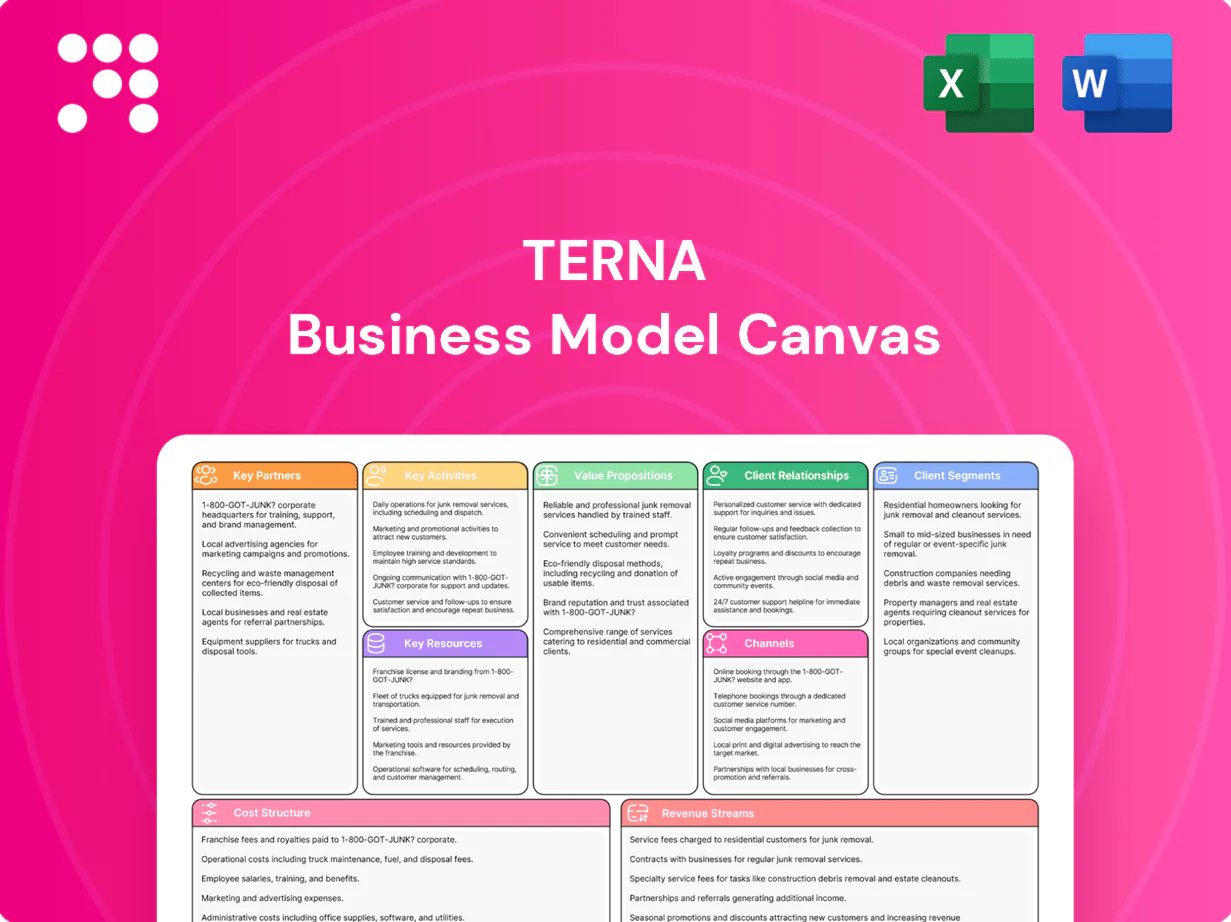
Terna Business Model Canvas

Explore the Transmission Business Model Canvas: value drivers, partnerships, regulated revenue
Explore Terna’s Business Model Canvas: three to five clear sentences mapping how the company creates value, leverages key partnerships, and captures regulated transmission revenues while managing costs and risks. This concise snapshot reveals strategic levers and growth opportunities—purchase the full, editable Canvas for a complete nine-block analysis, financial implications, and ready-to-use templates for investors and strategists.
Partnerships

Energy regulators and government bodies
Collaboration with ARERA and the Ministry ensures Terna complies with regulatory frameworks and tariff models, supporting predictable remunerations under ARERA's regimes.
Joint planning aligns grid investments with Italy's NECP and EU Fit for 55 directives (EU target: 55% GHG reduction by 2030).
Continuous dialogue expedites permitting, incentives and security-of-supply mandates.
This partnership stabilizes revenues and guides long-term planning.
ENTSO-E and neighboring TSOs
Cooperation with ENTSO-E, which comprises 42 transmission system operators across 35 countries, enables Terna to coordinate cross-border flows and participate in European market coupling mechanisms. Joint operational protocols with neighboring TSOs improve system stability and congestion management through common restoration and redispatch procedures. Shared planning aligns interconnector development and capacity allocation with the EU 15% interconnection target for 2030, reinforcing a unified European electricity market.

Distribution system operators (DSOs)
Alignment with DSOs coordinates transmission–distribution interfaces and outage planning to minimize disruption across Terna’s ~74,000 km national grid. Data sharing enables enhanced voltage control, congestion relief and smoother distributed resource integration. Joint TSO–DSO projects accelerate grid flexibility and smart grid deployment. These partnerships measurably boost end-to-end reliability and operational efficiency.

Generators, RES developers, and aggregators
- Connections: faster commissioning, lower delays
- Ancillary services: improved curtailment, frequency support
- Forecasting: better short‑term balance, reduced reserves
- Scale: supports Terna’s 2024 grid expansion and investment program
OEMs, EPCs, and digital/telecom vendors
OEMs supply high-voltage transformers, substations and control gear to maintain Terna’s ~75,000 km national grid (2024). EPC partners execute large-scale projects to schedule and budget, while ICT and cybersecurity vendors deliver SCADA/EMS, analytics and secure comms. These partnerships drive quality, innovation and lifecycle support across assets.
- Suppliers: HV equipment, substations, control systems
- EPCs: on-time, on-budget delivery
- ICT/cyber: SCADA/EMS, analytics, secure comms
Key partnerships secure tariffs, grid access and equipment for expansion and reliability
Key partnerships with regulators, ENTSO-E, DSOs, generators, OEMs and EPCs secure tariff frameworks, cross‑border coordination, grid access and supply of critical equipment, enabling Terna’s 2024 expansion and reliability targets.
| Partner | Role | 2024 metric |
|---|---|---|
| ARERA/Ministry | Tariff/regulatory certainty | Stable remunerations |
| ENTSO-E | Cross‑border coordination | 42 TSOs; 15% interconnect target |
| Generators/OEMs | Connections & equipment | 75,000 km network |
What is included in the product
 Detailed Word Document
A comprehensive Business Model Canvas for Terna detailing customer segments, channels, value propositions and revenue streams across the 9 BMC blocks, reflecting real-world grid operations and strategy; includes SWOT, competitive advantages and polished narratives for investor presentations and decision-making.

 Customizable Excel Spreadsheet
High-level view of Terna’s business model with editable cells to quickly map grid operations, revenue streams and regulatory drivers, relieving the pain of fragmented strategic data. Great for aligning stakeholders, speeding decision-making and saving hours of formatting for fast executive reviews.
Activities

Transmission grid planning and expansion
Long-term planning identifies reinforcements, new lines and substations across Terna’s ~74,000 km transmission network, prioritising projects over decades and targeting annual regulated investments of around €1.5–2.0bn (2024). Scenario analysis models demand, RES growth, storage and electrification to 2030 (EU renewables target ~42–45%). Stakeholder consultations refine priorities and environmental routing. Execution aligns investments with national regulatory plans and EU targets.
Real-time system operation and balancing
24/7 control centers manage real-time dispatch, frequency and voltage across Terna’s ~74,000 km national grid, coordinating hundreds of live operators. Balancing markets and reserve procurements (around 5 GW of operational reserves in 2024) absorb variability from growing renewables. Continuous contingency analysis and automated remedial actions reduce outages and congestion. Close coordination with TSOs and DSOs sustains system reliability.

Asset maintenance and lifecycle management
Risk-based maintenance at Terna prioritizes interventions to enhance grid availability and safety, reducing unplanned outages by up to 50% through targeted actions. Condition monitoring, drones and advanced diagnostics enable predictive interventions, cutting maintenance costs by 20–30% and optimizing crew deployment. Strategic refurbishment programs extend asset life by an estimated 15–25%, lowering total cost of ownership, while standardized processes ensure regulatory compliance and consistent quality.

Interconnector and market coupling management
Terna plans and operates cross-border links to boost trade and system security, calculating and allocating capacity under EU network codes; day-ahead market coupling across the EU (≈95% coverage) improves price convergence and efficiency. Congestion revenues are reinvested into grid reinforcements, supporting Terna’s 2024–29 capex plan of €17.6bn.
- Interconnector planning & operation
- EU network codes for capacity allocation
- Market coupling → price convergence (~95% EU)
- Congestion revenues fund reinforcements (€17.6bn capex 2024–29)
Digitalization, data, and cybersecurity
SCADA/EMS, PMUs and enterprise data lakes deliver sub-second synchrophasor visibility and petabyte-scale historical records, boosting situational awareness across Terna's grid; in 2024 Terna reported over €1bn invested in digitalisation and telecom upgrades.
- SCADA/EMS + PMUs: sub-second visibility
- Data lakes: petabyte historical archives
- Analytics: forecasting, congestion prediction, asset health
- Cybersecurity: protects critical infra and markets
- Secure telecoms: resilient operations
Long-term planning drives €1.5–2.0bn/yr, ~5 GW reserves
Long-term planning drives €1.5–2.0bn pa regulated investments (2024) across Terna’s ~74,000 km grid. 24/7 control centers and ~5 GW reserves (2024) manage renewables variability and frequency. Risk-based maintenance, digitalisation (€1bn invested 2024) and interconnector ops support reliability and EU market coupling (~95% coverage).
| Metric | Value |
|---|---|
| Grid length | ~74,000 km |
| Annual investment (2024) | €1.5–2.0bn |
| 2024–29 capex | €17.6bn |
| Digitalisation 2024 | €1bn |
| Operational reserves 2024 | ~5 GW |
| Market coupling | ~95% EU |
Delivered as Displayed
Business Model Canvas
The Terna Business Model Canvas shown here is the exact document you’ll receive after purchase, not a mockup or sample. This preview displays the real content, layout, and structure so you know precisely what to expect. Upon completing your order you’ll instantly download the full, editable file—ready to use, present, and customize with no surprises.

Explore the Transmission Business Model Canvas: value drivers, partnerships, regulated revenue
Explore Terna’s Business Model Canvas: three to five clear sentences mapping how the company creates value, leverages key partnerships, and captures regulated transmission revenues while managing costs and risks. This concise snapshot reveals strategic levers and growth opportunities—purchase the full, editable Canvas for a complete nine-block analysis, financial implications, and ready-to-use templates for investors and strategists.
Partnerships
Energy regulators and government bodies
Collaboration with ARERA and the Ministry ensures Terna complies with regulatory frameworks and tariff models, supporting predictable remunerations under ARERA's regimes.
Joint planning aligns grid investments with Italy's NECP and EU Fit for 55 directives (EU target: 55% GHG reduction by 2030).
Continuous dialogue expedites permitting, incentives and security-of-supply mandates.
This partnership stabilizes revenues and guides long-term planning.
ENTSO-E and neighboring TSOs
Cooperation with ENTSO-E, which comprises 42 transmission system operators across 35 countries, enables Terna to coordinate cross-border flows and participate in European market coupling mechanisms. Joint operational protocols with neighboring TSOs improve system stability and congestion management through common restoration and redispatch procedures. Shared planning aligns interconnector development and capacity allocation with the EU 15% interconnection target for 2030, reinforcing a unified European electricity market.
Distribution system operators (DSOs)
Alignment with DSOs coordinates transmission–distribution interfaces and outage planning to minimize disruption across Terna’s ~74,000 km national grid. Data sharing enables enhanced voltage control, congestion relief and smoother distributed resource integration. Joint TSO–DSO projects accelerate grid flexibility and smart grid deployment. These partnerships measurably boost end-to-end reliability and operational efficiency.
Generators, RES developers, and aggregators
- Connections: faster commissioning, lower delays
- Ancillary services: improved curtailment, frequency support
- Forecasting: better short‑term balance, reduced reserves
- Scale: supports Terna’s 2024 grid expansion and investment program
OEMs, EPCs, and digital/telecom vendors
OEMs supply high-voltage transformers, substations and control gear to maintain Terna’s ~75,000 km national grid (2024). EPC partners execute large-scale projects to schedule and budget, while ICT and cybersecurity vendors deliver SCADA/EMS, analytics and secure comms. These partnerships drive quality, innovation and lifecycle support across assets.
- Suppliers: HV equipment, substations, control systems
- EPCs: on-time, on-budget delivery
- ICT/cyber: SCADA/EMS, analytics, secure comms
Key partnerships secure tariffs, grid access and equipment for expansion and reliability
Key partnerships with regulators, ENTSO-E, DSOs, generators, OEMs and EPCs secure tariff frameworks, cross‑border coordination, grid access and supply of critical equipment, enabling Terna’s 2024 expansion and reliability targets.
| Partner | Role | 2024 metric |
|---|---|---|
| ARERA/Ministry | Tariff/regulatory certainty | Stable remunerations |
| ENTSO-E | Cross‑border coordination | 42 TSOs; 15% interconnect target |
| Generators/OEMs | Connections & equipment | 75,000 km network |
What is included in the product
Detailed Word Document
A comprehensive Business Model Canvas for Terna detailing customer segments, channels, value propositions and revenue streams across the 9 BMC blocks, reflecting real-world grid operations and strategy; includes SWOT, competitive advantages and polished narratives for investor presentations and decision-making.
Customizable Excel Spreadsheet
High-level view of Terna’s business model with editable cells to quickly map grid operations, revenue streams and regulatory drivers, relieving the pain of fragmented strategic data. Great for aligning stakeholders, speeding decision-making and saving hours of formatting for fast executive reviews.
Activities
Transmission grid planning and expansion
Long-term planning identifies reinforcements, new lines and substations across Terna’s ~74,000 km transmission network, prioritising projects over decades and targeting annual regulated investments of around €1.5–2.0bn (2024). Scenario analysis models demand, RES growth, storage and electrification to 2030 (EU renewables target ~42–45%). Stakeholder consultations refine priorities and environmental routing. Execution aligns investments with national regulatory plans and EU targets.
Real-time system operation and balancing
24/7 control centers manage real-time dispatch, frequency and voltage across Terna’s ~74,000 km national grid, coordinating hundreds of live operators. Balancing markets and reserve procurements (around 5 GW of operational reserves in 2024) absorb variability from growing renewables. Continuous contingency analysis and automated remedial actions reduce outages and congestion. Close coordination with TSOs and DSOs sustains system reliability.
Asset maintenance and lifecycle management
Risk-based maintenance at Terna prioritizes interventions to enhance grid availability and safety, reducing unplanned outages by up to 50% through targeted actions. Condition monitoring, drones and advanced diagnostics enable predictive interventions, cutting maintenance costs by 20–30% and optimizing crew deployment. Strategic refurbishment programs extend asset life by an estimated 15–25%, lowering total cost of ownership, while standardized processes ensure regulatory compliance and consistent quality.
Interconnector and market coupling management
Terna plans and operates cross-border links to boost trade and system security, calculating and allocating capacity under EU network codes; day-ahead market coupling across the EU (≈95% coverage) improves price convergence and efficiency. Congestion revenues are reinvested into grid reinforcements, supporting Terna’s 2024–29 capex plan of €17.6bn.
- Interconnector planning & operation
- EU network codes for capacity allocation
- Market coupling → price convergence (~95% EU)
- Congestion revenues fund reinforcements (€17.6bn capex 2024–29)
Digitalization, data, and cybersecurity
SCADA/EMS, PMUs and enterprise data lakes deliver sub-second synchrophasor visibility and petabyte-scale historical records, boosting situational awareness across Terna's grid; in 2024 Terna reported over €1bn invested in digitalisation and telecom upgrades.
- SCADA/EMS + PMUs: sub-second visibility
- Data lakes: petabyte historical archives
- Analytics: forecasting, congestion prediction, asset health
- Cybersecurity: protects critical infra and markets
- Secure telecoms: resilient operations
Long-term planning drives €1.5–2.0bn/yr, ~5 GW reserves
Long-term planning drives €1.5–2.0bn pa regulated investments (2024) across Terna’s ~74,000 km grid. 24/7 control centers and ~5 GW reserves (2024) manage renewables variability and frequency. Risk-based maintenance, digitalisation (€1bn invested 2024) and interconnector ops support reliability and EU market coupling (~95% coverage).
| Metric | Value |
|---|---|
| Grid length | ~74,000 km |
| Annual investment (2024) | €1.5–2.0bn |
| 2024–29 capex | €17.6bn |
| Digitalisation 2024 | €1bn |
| Operational reserves 2024 | ~5 GW |
| Market coupling | ~95% EU |
Delivered as Displayed
Business Model Canvas
The Terna Business Model Canvas shown here is the exact document you’ll receive after purchase, not a mockup or sample. This preview displays the real content, layout, and structure so you know precisely what to expect. Upon completing your order you’ll instantly download the full, editable file—ready to use, present, and customize with no surprises.
Description
Explore the Transmission Business Model Canvas: value drivers, partnerships, regulated revenue
Explore Terna’s Business Model Canvas: three to five clear sentences mapping how the company creates value, leverages key partnerships, and captures regulated transmission revenues while managing costs and risks. This concise snapshot reveals strategic levers and growth opportunities—purchase the full, editable Canvas for a complete nine-block analysis, financial implications, and ready-to-use templates for investors and strategists.
Partnerships
Energy regulators and government bodies
Collaboration with ARERA and the Ministry ensures Terna complies with regulatory frameworks and tariff models, supporting predictable remunerations under ARERA's regimes.
Joint planning aligns grid investments with Italy's NECP and EU Fit for 55 directives (EU target: 55% GHG reduction by 2030).
Continuous dialogue expedites permitting, incentives and security-of-supply mandates.
This partnership stabilizes revenues and guides long-term planning.
ENTSO-E and neighboring TSOs
Cooperation with ENTSO-E, which comprises 42 transmission system operators across 35 countries, enables Terna to coordinate cross-border flows and participate in European market coupling mechanisms. Joint operational protocols with neighboring TSOs improve system stability and congestion management through common restoration and redispatch procedures. Shared planning aligns interconnector development and capacity allocation with the EU 15% interconnection target for 2030, reinforcing a unified European electricity market.
Distribution system operators (DSOs)
Alignment with DSOs coordinates transmission–distribution interfaces and outage planning to minimize disruption across Terna’s ~74,000 km national grid. Data sharing enables enhanced voltage control, congestion relief and smoother distributed resource integration. Joint TSO–DSO projects accelerate grid flexibility and smart grid deployment. These partnerships measurably boost end-to-end reliability and operational efficiency.
Generators, RES developers, and aggregators
- Connections: faster commissioning, lower delays
- Ancillary services: improved curtailment, frequency support
- Forecasting: better short‑term balance, reduced reserves
- Scale: supports Terna’s 2024 grid expansion and investment program
OEMs, EPCs, and digital/telecom vendors
OEMs supply high-voltage transformers, substations and control gear to maintain Terna’s ~75,000 km national grid (2024). EPC partners execute large-scale projects to schedule and budget, while ICT and cybersecurity vendors deliver SCADA/EMS, analytics and secure comms. These partnerships drive quality, innovation and lifecycle support across assets.
- Suppliers: HV equipment, substations, control systems
- EPCs: on-time, on-budget delivery
- ICT/cyber: SCADA/EMS, analytics, secure comms
Key partnerships secure tariffs, grid access and equipment for expansion and reliability
Key partnerships with regulators, ENTSO-E, DSOs, generators, OEMs and EPCs secure tariff frameworks, cross‑border coordination, grid access and supply of critical equipment, enabling Terna’s 2024 expansion and reliability targets.
| Partner | Role | 2024 metric |
|---|---|---|
| ARERA/Ministry | Tariff/regulatory certainty | Stable remunerations |
| ENTSO-E | Cross‑border coordination | 42 TSOs; 15% interconnect target |
| Generators/OEMs | Connections & equipment | 75,000 km network |
What is included in the product
Detailed Word Document
A comprehensive Business Model Canvas for Terna detailing customer segments, channels, value propositions and revenue streams across the 9 BMC blocks, reflecting real-world grid operations and strategy; includes SWOT, competitive advantages and polished narratives for investor presentations and decision-making.
Customizable Excel Spreadsheet
High-level view of Terna’s business model with editable cells to quickly map grid operations, revenue streams and regulatory drivers, relieving the pain of fragmented strategic data. Great for aligning stakeholders, speeding decision-making and saving hours of formatting for fast executive reviews.
Activities
Transmission grid planning and expansion
Long-term planning identifies reinforcements, new lines and substations across Terna’s ~74,000 km transmission network, prioritising projects over decades and targeting annual regulated investments of around €1.5–2.0bn (2024). Scenario analysis models demand, RES growth, storage and electrification to 2030 (EU renewables target ~42–45%). Stakeholder consultations refine priorities and environmental routing. Execution aligns investments with national regulatory plans and EU targets.
Real-time system operation and balancing
24/7 control centers manage real-time dispatch, frequency and voltage across Terna’s ~74,000 km national grid, coordinating hundreds of live operators. Balancing markets and reserve procurements (around 5 GW of operational reserves in 2024) absorb variability from growing renewables. Continuous contingency analysis and automated remedial actions reduce outages and congestion. Close coordination with TSOs and DSOs sustains system reliability.
Asset maintenance and lifecycle management
Risk-based maintenance at Terna prioritizes interventions to enhance grid availability and safety, reducing unplanned outages by up to 50% through targeted actions. Condition monitoring, drones and advanced diagnostics enable predictive interventions, cutting maintenance costs by 20–30% and optimizing crew deployment. Strategic refurbishment programs extend asset life by an estimated 15–25%, lowering total cost of ownership, while standardized processes ensure regulatory compliance and consistent quality.
Interconnector and market coupling management
Terna plans and operates cross-border links to boost trade and system security, calculating and allocating capacity under EU network codes; day-ahead market coupling across the EU (≈95% coverage) improves price convergence and efficiency. Congestion revenues are reinvested into grid reinforcements, supporting Terna’s 2024–29 capex plan of €17.6bn.
- Interconnector planning & operation
- EU network codes for capacity allocation
- Market coupling → price convergence (~95% EU)
- Congestion revenues fund reinforcements (€17.6bn capex 2024–29)
Digitalization, data, and cybersecurity
SCADA/EMS, PMUs and enterprise data lakes deliver sub-second synchrophasor visibility and petabyte-scale historical records, boosting situational awareness across Terna's grid; in 2024 Terna reported over €1bn invested in digitalisation and telecom upgrades.
- SCADA/EMS + PMUs: sub-second visibility
- Data lakes: petabyte historical archives
- Analytics: forecasting, congestion prediction, asset health
- Cybersecurity: protects critical infra and markets
- Secure telecoms: resilient operations
Long-term planning drives €1.5–2.0bn/yr, ~5 GW reserves
Long-term planning drives €1.5–2.0bn pa regulated investments (2024) across Terna’s ~74,000 km grid. 24/7 control centers and ~5 GW reserves (2024) manage renewables variability and frequency. Risk-based maintenance, digitalisation (€1bn invested 2024) and interconnector ops support reliability and EU market coupling (~95% coverage).
| Metric | Value |
|---|---|
| Grid length | ~74,000 km |
| Annual investment (2024) | €1.5–2.0bn |
| 2024–29 capex | €17.6bn |
| Digitalisation 2024 | €1bn |
| Operational reserves 2024 | ~5 GW |
| Market coupling | ~95% EU |
Delivered as Displayed
Business Model Canvas
The Terna Business Model Canvas shown here is the exact document you’ll receive after purchase, not a mockup or sample. This preview displays the real content, layout, and structure so you know precisely what to expect. Upon completing your order you’ll instantly download the full, editable file—ready to use, present, and customize with no surprises.











