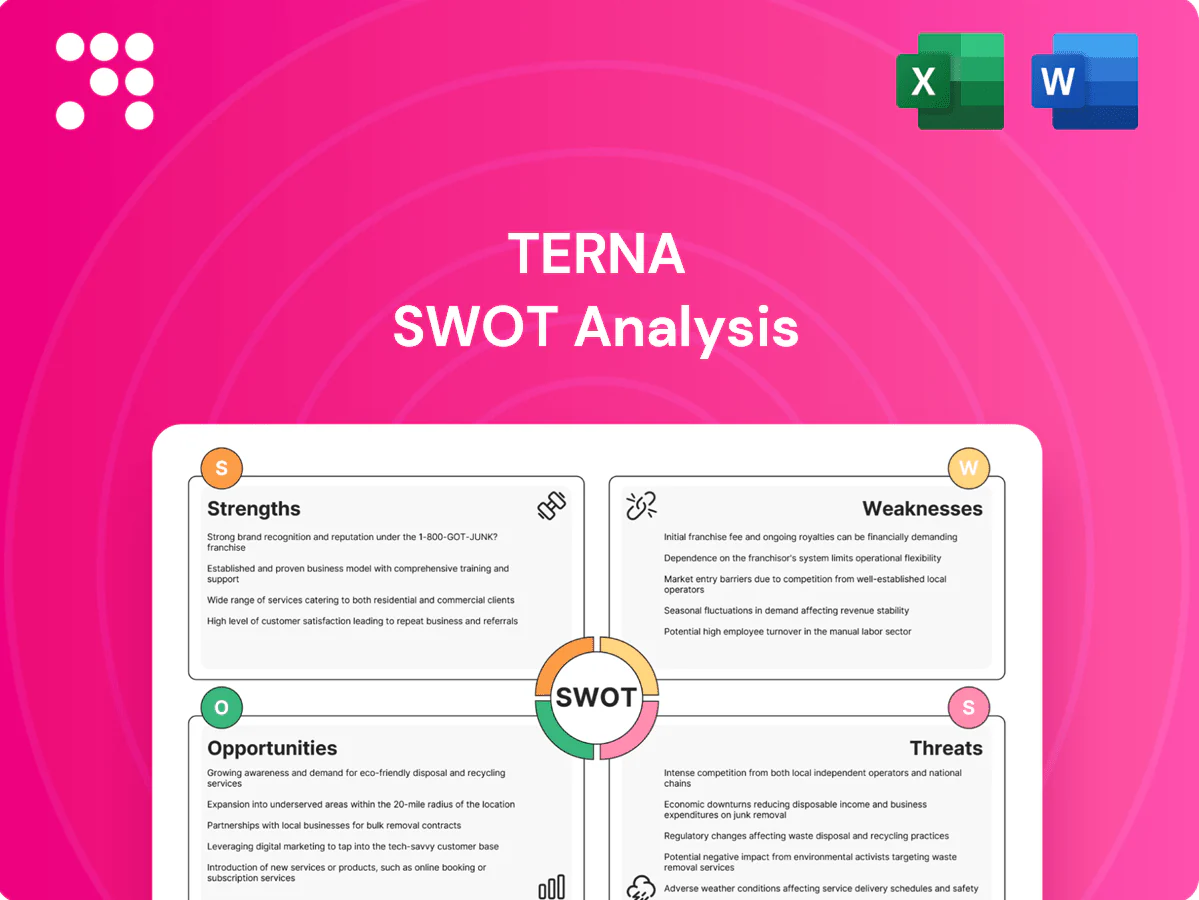
Terna SWOT Analysis

Go Beyond the Preview—Access the Full Strategic Report
Terna’s SWOT highlights its dominant Italian transmission network, strong regulatory ties, and growth in grid modernization, alongside exposure to regulatory shifts and capex demands. Want the full strategic picture and financial context? Purchase the complete SWOT for an editable, investor-ready report and Excel model.
Strengths

National TSO Monopoly
As Italy’s sole high‑voltage TSO, Terna operates as a regulated natural monopoly, delivering stable, predictable revenues and managing over 74,000 km of transmission lines. Exclusive responsibility for planning and dispatching reduces competitive pressure and enhances nationwide coordination. This central role supports system reliability for a peak demand around 55 GW and provides long‑term investment certainty for grid modernization.
Regulated Revenue Framework
Terna benefits from a transparent ARERA-regulated revenue framework that anchors returns to the regulated asset base, reducing cash-flow volatility and supporting investment-grade credit metrics. Multi-year tariff cycles and incentive schemes align tariff recovery with efficient capex and opex, promoting disciplined grid expansion. The predictable cash flow enables access to low-cost financing, including capital markets and green bonds, for infrastructure projects.

Extensive Grid Asset Base
Terna operates Italy’s national high-voltage network of roughly 74,000 km, including cross-border interconnections and centralized control systems, supporting national grid balancing. Scale yields operating leverage and advanced technical expertise, reflected in a regulated RAB of about €17.8bn (2023). The deep asset base enhances system resilience and creates high barriers to entry for potential rivals.

Renewables Integration Expertise
Terna’s proven expertise in connecting and balancing intermittent renewables—backed by operation of roughly 74,000 km of high‑voltage grid—enables reliable integration of large PV and wind volumes into Italy’s system. Grid planning, digital dispatch solutions and experience in storage and grid codes strengthen its role in meeting Italy’s decarbonization targets, positioning Terna as a key enabler of the energy transition.
- Network: ~74,000 km high‑voltage grid
- Strength: renewables integration & storage dispatch
- Advantage: advanced grid planning and digital tools
Cross-Border Interconnections
Interties with neighboring countries bolster security of supply and market integration, enabling imports/exports that optimize system costs and lower wholesale price volatility. They enhance flexibility during demand peaks and supply shocks, while opening ancillary services and congestion revenue opportunities; Terna operates ~74,000 km of transmission lines (2023), underpinning cross-border flows.
- Security of supply: enhanced via cross-border flows
- Cost optimization: imports/exports reduce system costs
- Flexibility: better peak/shock management
- Revenue: ancillary services and congestion rents
Italy high‑voltage grid monopoly — €17.8bn RAB underpinning stable regulated cash flows
Terna’s monopoly on Italy’s high‑voltage grid (~74,000 km) generates stable, regulated cash flows and high barriers to entry. Regulated RAB ~€17.8bn (2023) and ARERA multi‑year tariffs support investment‑grade financing and grid modernization. Expertise in renewables integration and cross‑border interties underpins system reliability for peak demand ~55 GW.
| Metric | Value |
|---|---|
| High‑voltage lines | ~74,000 km |
| RAB (2023) | €17.8bn |
| Peak demand | ~55 GW |
What is included in the product
 Detailed Word Document
Delivers a strategic overview of Terna’s internal and external business factors, outlining strengths, weaknesses, opportunities and threats related to its regulated transmission monopoly, grid modernization and digitalization efforts, regulatory and market risks, and growth prospects from renewables integration and cross‑border interconnections.

 Customizable Excel Spreadsheet
Provides a clear SWOT matrix tailored to Terna for rapid alignment of grid strategy and regulatory priorities, with an editable format that enables quick updates to reflect market shifts and policy changes.
Weaknesses

Regulatory Dependency
Earnings are highly dependent on ARERA decisions and periodic tariff resets (multi‑year regulatory periods typically set every 4 years), so changes to allowed WACC or incentive schemes can materially compress returns; compliance obligations further limit strategic flexibility and concentrate risk in policy and regulatory cycles, exposing Terna to timing and political risk around each tariff review.
Capital-Intensive Profile
Terna's capital-intensive profile requires continuous grid reinforcement under its 2024–2028 investment plan of roughly €11.6bn, creating sustained multi-year capex needs. Cost overruns or project delays can materially impair IRR and shareholder returns. Large investment programs push net debt and constrain free cash flow, while rising borrowing costs materially affect project economics and financing flexibility.

Permitting and Siting Delays
Transmission lines face complex permitting, prolonged environmental reviews and local opposition, with approvals commonly taking 4–7 years. Slow permits delay grid expansions critical for renewables and Terna’s multi-year capex (€10+ billion scale) creating schedule risk and cost inflation. Cumulative delays have raised project budgets and can erode stakeholder trust and planning credibility.

Technology Modernization Needs
Digitalization, grid automation and cybersecurity demand continuous capital and operational spending, raising Terna’s investment intensity and execution risk. Legacy transmission assets and long asset lives can limit rapid integration of advanced control and flexibility solutions. Transitioning to smart grids is operationally complex and skills gaps in power-electronics and OT cybersecurity can slow deployment and increase rollout delays.
- Ongoing capex and Opex pressure
- Legacy assets limit advanced integration
- Operational complexity of smart-grid rollout
- Workforce skills gap raises execution risk
Concentration in Italian Market
Terna’s network and regulated operations are concentrated in Italy, tying revenue and investment recovery to Italian demand cycles and national energy policy; the company is the sole national TSO listed on Borsa Italiana. Limited geographic diversification raises country risk: domestic economic shocks, regulatory changes or tariff reviews can delay capex and affect cash flow, reducing optionality versus multi-country TSOs.
- Exposure: national network concentrated in Italy
- Country risk: regulatory/tariff dependence
- Investment timing: vulnerable to domestic shocks
- Optionality: less flexibility than multi-country TSOs
Tariff resets, €11.6bn capex strain cash flow; 4–7y permits and Italy concentration add risk
Earnings hinge on ARERA tariff resets (4‑year cycles) that can compress allowed WACC and returns; 2024–28 capex of €11.6bn creates sustained debt and FCF pressure. Permitting commonly takes 4–7 years, delaying renewables integration and inflating costs. Domestic concentration (sole national TSO listed in Italy) limits geographic diversification and increases country risk.
| Metric | Value |
|---|---|
| 2024–28 Capex | €11.6bn |
| Regulatory cycle | 4 years |
| Permitting | 4–7 years |
| Geographic exposure | Italy (sole listed national TSO) |
Preview the Actual Deliverable
Terna SWOT Analysis
This is the actual SWOT analysis document you’ll receive upon purchase—no surprises, just professional quality. The preview below is taken directly from the full Terna SWOT report you'll get. Purchase unlocks the entire, editable version, complete with strengths, weaknesses, opportunities and threats, ready for download.

Go Beyond the Preview—Access the Full Strategic Report
Terna’s SWOT highlights its dominant Italian transmission network, strong regulatory ties, and growth in grid modernization, alongside exposure to regulatory shifts and capex demands. Want the full strategic picture and financial context? Purchase the complete SWOT for an editable, investor-ready report and Excel model.
Strengths
National TSO Monopoly
As Italy’s sole high‑voltage TSO, Terna operates as a regulated natural monopoly, delivering stable, predictable revenues and managing over 74,000 km of transmission lines. Exclusive responsibility for planning and dispatching reduces competitive pressure and enhances nationwide coordination. This central role supports system reliability for a peak demand around 55 GW and provides long‑term investment certainty for grid modernization.
Regulated Revenue Framework
Terna benefits from a transparent ARERA-regulated revenue framework that anchors returns to the regulated asset base, reducing cash-flow volatility and supporting investment-grade credit metrics. Multi-year tariff cycles and incentive schemes align tariff recovery with efficient capex and opex, promoting disciplined grid expansion. The predictable cash flow enables access to low-cost financing, including capital markets and green bonds, for infrastructure projects.
Extensive Grid Asset Base
Terna operates Italy’s national high-voltage network of roughly 74,000 km, including cross-border interconnections and centralized control systems, supporting national grid balancing. Scale yields operating leverage and advanced technical expertise, reflected in a regulated RAB of about €17.8bn (2023). The deep asset base enhances system resilience and creates high barriers to entry for potential rivals.
Renewables Integration Expertise
Terna’s proven expertise in connecting and balancing intermittent renewables—backed by operation of roughly 74,000 km of high‑voltage grid—enables reliable integration of large PV and wind volumes into Italy’s system. Grid planning, digital dispatch solutions and experience in storage and grid codes strengthen its role in meeting Italy’s decarbonization targets, positioning Terna as a key enabler of the energy transition.
- Network: ~74,000 km high‑voltage grid
- Strength: renewables integration & storage dispatch
- Advantage: advanced grid planning and digital tools
Cross-Border Interconnections
Interties with neighboring countries bolster security of supply and market integration, enabling imports/exports that optimize system costs and lower wholesale price volatility. They enhance flexibility during demand peaks and supply shocks, while opening ancillary services and congestion revenue opportunities; Terna operates ~74,000 km of transmission lines (2023), underpinning cross-border flows.
- Security of supply: enhanced via cross-border flows
- Cost optimization: imports/exports reduce system costs
- Flexibility: better peak/shock management
- Revenue: ancillary services and congestion rents
Italy high‑voltage grid monopoly — €17.8bn RAB underpinning stable regulated cash flows
Terna’s monopoly on Italy’s high‑voltage grid (~74,000 km) generates stable, regulated cash flows and high barriers to entry. Regulated RAB ~€17.8bn (2023) and ARERA multi‑year tariffs support investment‑grade financing and grid modernization. Expertise in renewables integration and cross‑border interties underpins system reliability for peak demand ~55 GW.
| Metric | Value |
|---|---|
| High‑voltage lines | ~74,000 km |
| RAB (2023) | €17.8bn |
| Peak demand | ~55 GW |
What is included in the product
Detailed Word Document
Delivers a strategic overview of Terna’s internal and external business factors, outlining strengths, weaknesses, opportunities and threats related to its regulated transmission monopoly, grid modernization and digitalization efforts, regulatory and market risks, and growth prospects from renewables integration and cross‑border interconnections.
Customizable Excel Spreadsheet
Provides a clear SWOT matrix tailored to Terna for rapid alignment of grid strategy and regulatory priorities, with an editable format that enables quick updates to reflect market shifts and policy changes.
Weaknesses
Regulatory Dependency
Earnings are highly dependent on ARERA decisions and periodic tariff resets (multi‑year regulatory periods typically set every 4 years), so changes to allowed WACC or incentive schemes can materially compress returns; compliance obligations further limit strategic flexibility and concentrate risk in policy and regulatory cycles, exposing Terna to timing and political risk around each tariff review.
Capital-Intensive Profile
Terna's capital-intensive profile requires continuous grid reinforcement under its 2024–2028 investment plan of roughly €11.6bn, creating sustained multi-year capex needs. Cost overruns or project delays can materially impair IRR and shareholder returns. Large investment programs push net debt and constrain free cash flow, while rising borrowing costs materially affect project economics and financing flexibility.
Permitting and Siting Delays
Transmission lines face complex permitting, prolonged environmental reviews and local opposition, with approvals commonly taking 4–7 years. Slow permits delay grid expansions critical for renewables and Terna’s multi-year capex (€10+ billion scale) creating schedule risk and cost inflation. Cumulative delays have raised project budgets and can erode stakeholder trust and planning credibility.
Technology Modernization Needs
Digitalization, grid automation and cybersecurity demand continuous capital and operational spending, raising Terna’s investment intensity and execution risk. Legacy transmission assets and long asset lives can limit rapid integration of advanced control and flexibility solutions. Transitioning to smart grids is operationally complex and skills gaps in power-electronics and OT cybersecurity can slow deployment and increase rollout delays.
- Ongoing capex and Opex pressure
- Legacy assets limit advanced integration
- Operational complexity of smart-grid rollout
- Workforce skills gap raises execution risk
Concentration in Italian Market
Terna’s network and regulated operations are concentrated in Italy, tying revenue and investment recovery to Italian demand cycles and national energy policy; the company is the sole national TSO listed on Borsa Italiana. Limited geographic diversification raises country risk: domestic economic shocks, regulatory changes or tariff reviews can delay capex and affect cash flow, reducing optionality versus multi-country TSOs.
- Exposure: national network concentrated in Italy
- Country risk: regulatory/tariff dependence
- Investment timing: vulnerable to domestic shocks
- Optionality: less flexibility than multi-country TSOs
Tariff resets, €11.6bn capex strain cash flow; 4–7y permits and Italy concentration add risk
Earnings hinge on ARERA tariff resets (4‑year cycles) that can compress allowed WACC and returns; 2024–28 capex of €11.6bn creates sustained debt and FCF pressure. Permitting commonly takes 4–7 years, delaying renewables integration and inflating costs. Domestic concentration (sole national TSO listed in Italy) limits geographic diversification and increases country risk.
| Metric | Value |
|---|---|
| 2024–28 Capex | €11.6bn |
| Regulatory cycle | 4 years |
| Permitting | 4–7 years |
| Geographic exposure | Italy (sole listed national TSO) |
Preview the Actual Deliverable
Terna SWOT Analysis
This is the actual SWOT analysis document you’ll receive upon purchase—no surprises, just professional quality. The preview below is taken directly from the full Terna SWOT report you'll get. Purchase unlocks the entire, editable version, complete with strengths, weaknesses, opportunities and threats, ready for download.
Original: $10.00
-65%$10.00
$3.50Description
Go Beyond the Preview—Access the Full Strategic Report
Terna’s SWOT highlights its dominant Italian transmission network, strong regulatory ties, and growth in grid modernization, alongside exposure to regulatory shifts and capex demands. Want the full strategic picture and financial context? Purchase the complete SWOT for an editable, investor-ready report and Excel model.
Strengths
National TSO Monopoly
As Italy’s sole high‑voltage TSO, Terna operates as a regulated natural monopoly, delivering stable, predictable revenues and managing over 74,000 km of transmission lines. Exclusive responsibility for planning and dispatching reduces competitive pressure and enhances nationwide coordination. This central role supports system reliability for a peak demand around 55 GW and provides long‑term investment certainty for grid modernization.
Regulated Revenue Framework
Terna benefits from a transparent ARERA-regulated revenue framework that anchors returns to the regulated asset base, reducing cash-flow volatility and supporting investment-grade credit metrics. Multi-year tariff cycles and incentive schemes align tariff recovery with efficient capex and opex, promoting disciplined grid expansion. The predictable cash flow enables access to low-cost financing, including capital markets and green bonds, for infrastructure projects.
Extensive Grid Asset Base
Terna operates Italy’s national high-voltage network of roughly 74,000 km, including cross-border interconnections and centralized control systems, supporting national grid balancing. Scale yields operating leverage and advanced technical expertise, reflected in a regulated RAB of about €17.8bn (2023). The deep asset base enhances system resilience and creates high barriers to entry for potential rivals.
Renewables Integration Expertise
Terna’s proven expertise in connecting and balancing intermittent renewables—backed by operation of roughly 74,000 km of high‑voltage grid—enables reliable integration of large PV and wind volumes into Italy’s system. Grid planning, digital dispatch solutions and experience in storage and grid codes strengthen its role in meeting Italy’s decarbonization targets, positioning Terna as a key enabler of the energy transition.
- Network: ~74,000 km high‑voltage grid
- Strength: renewables integration & storage dispatch
- Advantage: advanced grid planning and digital tools
Cross-Border Interconnections
Interties with neighboring countries bolster security of supply and market integration, enabling imports/exports that optimize system costs and lower wholesale price volatility. They enhance flexibility during demand peaks and supply shocks, while opening ancillary services and congestion revenue opportunities; Terna operates ~74,000 km of transmission lines (2023), underpinning cross-border flows.
- Security of supply: enhanced via cross-border flows
- Cost optimization: imports/exports reduce system costs
- Flexibility: better peak/shock management
- Revenue: ancillary services and congestion rents
Italy high‑voltage grid monopoly — €17.8bn RAB underpinning stable regulated cash flows
Terna’s monopoly on Italy’s high‑voltage grid (~74,000 km) generates stable, regulated cash flows and high barriers to entry. Regulated RAB ~€17.8bn (2023) and ARERA multi‑year tariffs support investment‑grade financing and grid modernization. Expertise in renewables integration and cross‑border interties underpins system reliability for peak demand ~55 GW.
| Metric | Value |
|---|---|
| High‑voltage lines | ~74,000 km |
| RAB (2023) | €17.8bn |
| Peak demand | ~55 GW |
What is included in the product
Detailed Word Document
Delivers a strategic overview of Terna’s internal and external business factors, outlining strengths, weaknesses, opportunities and threats related to its regulated transmission monopoly, grid modernization and digitalization efforts, regulatory and market risks, and growth prospects from renewables integration and cross‑border interconnections.
Customizable Excel Spreadsheet
Provides a clear SWOT matrix tailored to Terna for rapid alignment of grid strategy and regulatory priorities, with an editable format that enables quick updates to reflect market shifts and policy changes.
Weaknesses
Regulatory Dependency
Earnings are highly dependent on ARERA decisions and periodic tariff resets (multi‑year regulatory periods typically set every 4 years), so changes to allowed WACC or incentive schemes can materially compress returns; compliance obligations further limit strategic flexibility and concentrate risk in policy and regulatory cycles, exposing Terna to timing and political risk around each tariff review.
Capital-Intensive Profile
Terna's capital-intensive profile requires continuous grid reinforcement under its 2024–2028 investment plan of roughly €11.6bn, creating sustained multi-year capex needs. Cost overruns or project delays can materially impair IRR and shareholder returns. Large investment programs push net debt and constrain free cash flow, while rising borrowing costs materially affect project economics and financing flexibility.
Permitting and Siting Delays
Transmission lines face complex permitting, prolonged environmental reviews and local opposition, with approvals commonly taking 4–7 years. Slow permits delay grid expansions critical for renewables and Terna’s multi-year capex (€10+ billion scale) creating schedule risk and cost inflation. Cumulative delays have raised project budgets and can erode stakeholder trust and planning credibility.
Technology Modernization Needs
Digitalization, grid automation and cybersecurity demand continuous capital and operational spending, raising Terna’s investment intensity and execution risk. Legacy transmission assets and long asset lives can limit rapid integration of advanced control and flexibility solutions. Transitioning to smart grids is operationally complex and skills gaps in power-electronics and OT cybersecurity can slow deployment and increase rollout delays.
- Ongoing capex and Opex pressure
- Legacy assets limit advanced integration
- Operational complexity of smart-grid rollout
- Workforce skills gap raises execution risk
Concentration in Italian Market
Terna’s network and regulated operations are concentrated in Italy, tying revenue and investment recovery to Italian demand cycles and national energy policy; the company is the sole national TSO listed on Borsa Italiana. Limited geographic diversification raises country risk: domestic economic shocks, regulatory changes or tariff reviews can delay capex and affect cash flow, reducing optionality versus multi-country TSOs.
- Exposure: national network concentrated in Italy
- Country risk: regulatory/tariff dependence
- Investment timing: vulnerable to domestic shocks
- Optionality: less flexibility than multi-country TSOs
Tariff resets, €11.6bn capex strain cash flow; 4–7y permits and Italy concentration add risk
Earnings hinge on ARERA tariff resets (4‑year cycles) that can compress allowed WACC and returns; 2024–28 capex of €11.6bn creates sustained debt and FCF pressure. Permitting commonly takes 4–7 years, delaying renewables integration and inflating costs. Domestic concentration (sole national TSO listed in Italy) limits geographic diversification and increases country risk.
| Metric | Value |
|---|---|
| 2024–28 Capex | €11.6bn |
| Regulatory cycle | 4 years |
| Permitting | 4–7 years |
| Geographic exposure | Italy (sole listed national TSO) |
Preview the Actual Deliverable
Terna SWOT Analysis
This is the actual SWOT analysis document you’ll receive upon purchase—no surprises, just professional quality. The preview below is taken directly from the full Terna SWOT report you'll get. Purchase unlocks the entire, editable version, complete with strengths, weaknesses, opportunities and threats, ready for download.











