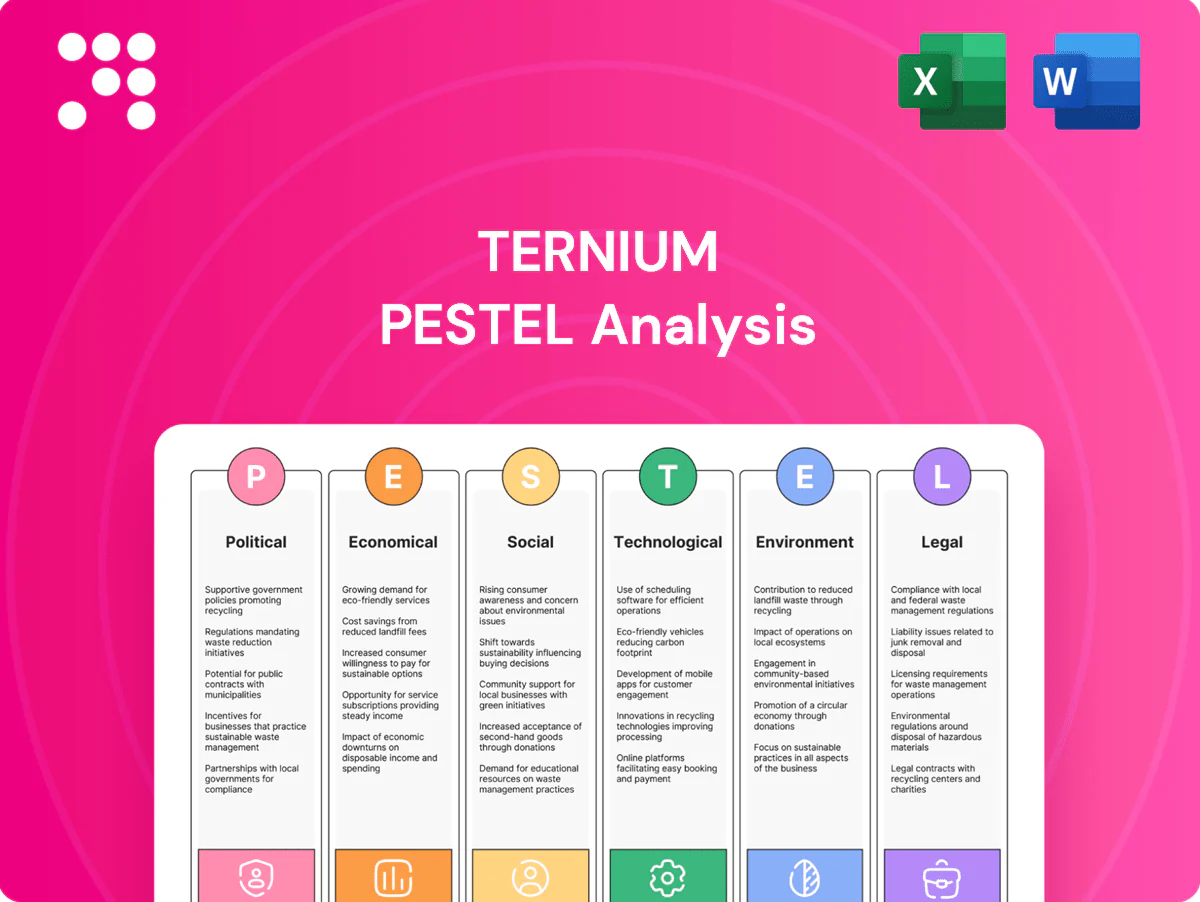
Ternium PESTLE Analysis

Your Competitive Advantage Starts with This Report
Stay ahead with our targeted PESTLE Analysis of Ternium—distilling political, economic, social, technological, legal, and environmental forces that will shape the company’s trajectory. Built for investors, strategists, and advisors, it highlights risks and untapped opportunities. Ready-to-use and fully sourced, it saves you research time. Purchase the full report to access the complete, actionable insights instantly.
Political factors

Trade policy and tariffs exposure
Steel is highly exposed to anti-dumping duties, safeguards and quotas across the Americas, which have repeatedly disrupted flows of coils, sheets and pipes.
The US Section 232 steel tariff (25%) remains in force and USMCA (effective July 1, 2020), Mercosur (Argentina, Brazil, Paraguay, Uruguay) and bilateral measures can abruptly reshape trade routes.
Ternium must navigate changing tariff walls between Mexico, Brazil, Argentina and the US; proactive trade compliance and targeted lobbying help mitigate margin shocks.
Industrial policy and infrastructure spend
Government-led infrastructure and housing programs are lifting construction steel demand, while the US Infrastructure Investment and Jobs Act (~$1.2 trillion) and nearshoring trends boost flat steel needs for manufacturing; Mexico attracted about $37 billion in FDI in 2023, underpinning supply-chain shifts. Policy continuity is crucial for Ternium’s multi-year capex on mills and finishing lines, and its footprint across Mexico, Argentina and Brazil gains when public investment accelerates.

Energy policy and pricing controls
Natural gas and electricity policies directly alter steelmaking costs; US Henry Hub averaged about 2.9 USD/MMBtu in 2024, influencing regional benchmark feeds for Argentina and Mexico. Subsidies, price caps and pipeline access determine competitiveness versus imports by changing delivered energy cost spreads. Argentina and Mexico frameworks can shift cost curves quickly, while long-term contracts and on-site cogeneration provide hedges against policy volatility.

Resource nationalism and mining licenses
Resource nationalism can hit Ternium’s iron ore and limestone sourcing because stable concession regimes are critical; 2024 benchmark iron ore 62% Fe averaged roughly $110/t, making royalty or export-tax shifts material to margins. Changes to royalties, export taxes or community approvals have delayed mining projects regionally, while governments increasingly impose local-content and beneficiation rules. Diversified sourcing across Mexico, US and South America reduces single-country political risk.
- 62% Fe iron ore ~ $110/t (2024)
- Royalty/export-tax changes = project delays
- Rising local-content/beneficiation mandates
- Geographic sourcing diversification lowers risk
Geopolitical volatility and currency stability
Elections, fiscal stress and governance issues across Latin America have amplified demand and FX volatility, with several regional currencies experiencing intra-year swings of up to 20% in 2023–24, pressuring margins and working capital. Policy reversals also raised borrowing costs, slowing capital-intensive expansions and raising financing spreads for steel projects. Political unrest frequently disrupts logistics and procurement chains, though Ternium’s presence in 5+ countries provides partial offset through geographic diversification.
- Election cycles: heightened policy uncertainty, tighter credit
- FX volatility: ±20% swings 2023–24, impacts margins
- Logistics risk: supply interruptions raise OPEX
- Mitigation: multi-country footprint reduces single-market exposure
Trade barriers, policy swings and input costs squeeze steel margins amid US IIJA and nearshoring
Ternium faces trade barriers (US Section 232 25%), shifting USMCA/Mercosur rules and anti-dumping measures that reshape flows and margins. Public investment (US IIJA ~$1.2T) and Mexico FDI ~$37B (2023) support construction demand and nearshoring. Energy and input policy swings (Henry Hub ~$2.9/MMBtu in 2024; 62% Fe iron ore ~$110/t in 2024) plus ±20% FX moves 2023–24 pressure costs and financing.
| Metric | Value |
|---|---|
| US tariff | Section 232 25% |
| US IIJA | $1.2T |
| Mexico FDI | $37B (2023) |
| Henry Hub | $2.9/MMBtu (2024) |
| 62% Fe ore | $110/t (2024) |
| FX volatility | ±20% (2023–24) |
What is included in the product
 Detailed Word Document
Explores how macro factors—Political, Economic, Social, Technological, Environmental, and Legal—uniquely affect Ternium’s steel operations across Latin America and the U.S., using current data and trends to identify risks and growth levers. Designed for executives and investors, it delivers actionable, forward‑looking insights ready for plans, decks, or scenario strategy.

 Customizable Excel Spreadsheet
A concise, visually segmented PESTLE summary for Ternium that highlights external risks and market drivers, ready to drop into presentations or share across teams for faster strategic alignment.
Economic factors

Cyclical steel demand across end-markets
End-market cycles — construction, automotive, appliances and energy — drive volatile coil and sheet demand: US housing starts fell to about 1.3m units in 2024 while global crude steel output was roughly 1.85bn t in 2024 (worldsteel estimate), so slowdowns quickly cut orders. Backlogs and multi-year contracts smooth receipts but do not remove swings. Ternium’s product-mix flexibility supports utilization when segments diverge.
Global price swings and Chinese exports
International HRC and slab prices closely follow supply-demand swings and export incentives; HRC benchmark spreads narrowed in 2024 as global spot fell versus 2023 peaks. Surges in Chinese exports (roughly +20% YoY in early 2024) pressured Americas pricing and spreads, compressing margins. Regional protection measures temporarily supported local premiums but often decoupled from global trends. Ternium’s upstream-downstream integration and captive scrap access cushion margin compression.

Input costs: iron ore, coal, energy
Volatile raw materials reset steel spreads monthly; 62% iron ore futures averaged about US$120/t in 2024 and seaborne coking coal traded near US$300/t at peaks, driving spread compression. Ternium's captive ore and long-term supply contracts blunt cost volatility but basis risk across regions remains. Energy shocks hit blast furnaces harder than DRI/EAF — US Henry Hub averaged ~US$2.8/MMBtu in 2024. Active hedging and operational flexibility are key levers.

FX, inflation, and interest rates
MXN, ARS and BRL volatility materially affects Ternium’s top line, input costs and US dollar debt servicing — ARS fell about 60% in 2024, MXN ~7% weaker YTD 2025 and BRL ~10% in 2024; Ternium reported net debt ~US$3.3bn and 2024 capex ~US$800m, amplifying FX sensitivity.
- FX: ARS -60% (2024); MXN -7% YTD 2025; BRL -10% (2024)
- Inflation: ARG ~216% (2024); MEX ~4.9% (2024); BRA ~4.3% (2024)
- Rates: policy cycles alter capex timing and customer financing
- Mismatch: dollarized inputs vs local sales raise currency risk
Capacity utilization and logistics
Freight rates, port congestion and rail availability directly shape Ternium’s delivered costs, with bottlenecks raising landed steel costs and high rail service reliability lowering working-capital needs.
High global and regional capacity utilization supports pricing discipline for flat and long products, while slack capacity historically forces discounting; nearshoring to North America has shifted significant volumes and altered modal mixes.
Strategic inventory positioning and multi-route logistics (ports, short-sea, rail alternatives) preserve supply reliability and limit margin erosion during spikes in freight or port delays.
- Freight/port congestion drive delivered cost volatility
- Utilization rates determine pricing leverage
- Nearshoring reorients flows to North America
- Inventory and multi-route mitigate disruption
Trade barriers, policy swings and input costs squeeze steel margins amid US IIJA and nearshoring
Ternium faces demand cyclicality from construction/auto (US housing starts ~1.3m in 2024) and global steel at ~1.85bn t (2024), pressuring volumes; product-mix flexibility cushions swings. Raw-materials (62% Fe ore ~US$120/t; coking coal peaks ~US$300/t) and energy (Henry Hub ~US$2.8/MMBtu) compress spreads despite captive sources. FX and macro (ARS -60% 2024; MXN -7% YTD 2025; BRL -10% 2024; net debt ~US$3.3bn; 2024 capex ~US$800m) heighten risk.
| Metric | 2024/2025 |
|---|---|
| Global crude steel | ~1.85bn t (2024) |
| US housing starts | ~1.3m (2024) |
| Iron ore (62%) | ~US$120/t (2024) |
| Coking coal | ~US$300/t peak (2024) |
| Henry Hub | ~US$2.8/MMBtu (2024) |
| FX moves | ARS -60% (2024); MXN -7% YTD 2025; BRL -10% (2024) |
| Debt/Capex | Net debt ~US$3.3bn; 2024 capex ~US$800m |
Preview Before You Purchase
Ternium PESTLE Analysis
The Ternium PESTLE Analysis preview shown here is the exact document you’ll receive after purchase—fully formatted and ready to use. The layout, content, and structure visible are identical to the file you’ll download immediately after payment. No placeholders or teasers—this is the real, professionally structured analysis you’ll own upon checkout.

Your Competitive Advantage Starts with This Report
Stay ahead with our targeted PESTLE Analysis of Ternium—distilling political, economic, social, technological, legal, and environmental forces that will shape the company’s trajectory. Built for investors, strategists, and advisors, it highlights risks and untapped opportunities. Ready-to-use and fully sourced, it saves you research time. Purchase the full report to access the complete, actionable insights instantly.
Political factors
Trade policy and tariffs exposure
Steel is highly exposed to anti-dumping duties, safeguards and quotas across the Americas, which have repeatedly disrupted flows of coils, sheets and pipes.
The US Section 232 steel tariff (25%) remains in force and USMCA (effective July 1, 2020), Mercosur (Argentina, Brazil, Paraguay, Uruguay) and bilateral measures can abruptly reshape trade routes.
Ternium must navigate changing tariff walls between Mexico, Brazil, Argentina and the US; proactive trade compliance and targeted lobbying help mitigate margin shocks.
Industrial policy and infrastructure spend
Government-led infrastructure and housing programs are lifting construction steel demand, while the US Infrastructure Investment and Jobs Act (~$1.2 trillion) and nearshoring trends boost flat steel needs for manufacturing; Mexico attracted about $37 billion in FDI in 2023, underpinning supply-chain shifts. Policy continuity is crucial for Ternium’s multi-year capex on mills and finishing lines, and its footprint across Mexico, Argentina and Brazil gains when public investment accelerates.
Energy policy and pricing controls
Natural gas and electricity policies directly alter steelmaking costs; US Henry Hub averaged about 2.9 USD/MMBtu in 2024, influencing regional benchmark feeds for Argentina and Mexico. Subsidies, price caps and pipeline access determine competitiveness versus imports by changing delivered energy cost spreads. Argentina and Mexico frameworks can shift cost curves quickly, while long-term contracts and on-site cogeneration provide hedges against policy volatility.
Resource nationalism and mining licenses
Resource nationalism can hit Ternium’s iron ore and limestone sourcing because stable concession regimes are critical; 2024 benchmark iron ore 62% Fe averaged roughly $110/t, making royalty or export-tax shifts material to margins. Changes to royalties, export taxes or community approvals have delayed mining projects regionally, while governments increasingly impose local-content and beneficiation rules. Diversified sourcing across Mexico, US and South America reduces single-country political risk.
- 62% Fe iron ore ~ $110/t (2024)
- Royalty/export-tax changes = project delays
- Rising local-content/beneficiation mandates
- Geographic sourcing diversification lowers risk
Geopolitical volatility and currency stability
Elections, fiscal stress and governance issues across Latin America have amplified demand and FX volatility, with several regional currencies experiencing intra-year swings of up to 20% in 2023–24, pressuring margins and working capital. Policy reversals also raised borrowing costs, slowing capital-intensive expansions and raising financing spreads for steel projects. Political unrest frequently disrupts logistics and procurement chains, though Ternium’s presence in 5+ countries provides partial offset through geographic diversification.
- Election cycles: heightened policy uncertainty, tighter credit
- FX volatility: ±20% swings 2023–24, impacts margins
- Logistics risk: supply interruptions raise OPEX
- Mitigation: multi-country footprint reduces single-market exposure
Trade barriers, policy swings and input costs squeeze steel margins amid US IIJA and nearshoring
Ternium faces trade barriers (US Section 232 25%), shifting USMCA/Mercosur rules and anti-dumping measures that reshape flows and margins. Public investment (US IIJA ~$1.2T) and Mexico FDI ~$37B (2023) support construction demand and nearshoring. Energy and input policy swings (Henry Hub ~$2.9/MMBtu in 2024; 62% Fe iron ore ~$110/t in 2024) plus ±20% FX moves 2023–24 pressure costs and financing.
| Metric | Value |
|---|---|
| US tariff | Section 232 25% |
| US IIJA | $1.2T |
| Mexico FDI | $37B (2023) |
| Henry Hub | $2.9/MMBtu (2024) |
| 62% Fe ore | $110/t (2024) |
| FX volatility | ±20% (2023–24) |
What is included in the product
Detailed Word Document
Explores how macro factors—Political, Economic, Social, Technological, Environmental, and Legal—uniquely affect Ternium’s steel operations across Latin America and the U.S., using current data and trends to identify risks and growth levers. Designed for executives and investors, it delivers actionable, forward‑looking insights ready for plans, decks, or scenario strategy.
Customizable Excel Spreadsheet
A concise, visually segmented PESTLE summary for Ternium that highlights external risks and market drivers, ready to drop into presentations or share across teams for faster strategic alignment.
Economic factors
Cyclical steel demand across end-markets
End-market cycles — construction, automotive, appliances and energy — drive volatile coil and sheet demand: US housing starts fell to about 1.3m units in 2024 while global crude steel output was roughly 1.85bn t in 2024 (worldsteel estimate), so slowdowns quickly cut orders. Backlogs and multi-year contracts smooth receipts but do not remove swings. Ternium’s product-mix flexibility supports utilization when segments diverge.
Global price swings and Chinese exports
International HRC and slab prices closely follow supply-demand swings and export incentives; HRC benchmark spreads narrowed in 2024 as global spot fell versus 2023 peaks. Surges in Chinese exports (roughly +20% YoY in early 2024) pressured Americas pricing and spreads, compressing margins. Regional protection measures temporarily supported local premiums but often decoupled from global trends. Ternium’s upstream-downstream integration and captive scrap access cushion margin compression.
Input costs: iron ore, coal, energy
Volatile raw materials reset steel spreads monthly; 62% iron ore futures averaged about US$120/t in 2024 and seaborne coking coal traded near US$300/t at peaks, driving spread compression. Ternium's captive ore and long-term supply contracts blunt cost volatility but basis risk across regions remains. Energy shocks hit blast furnaces harder than DRI/EAF — US Henry Hub averaged ~US$2.8/MMBtu in 2024. Active hedging and operational flexibility are key levers.
FX, inflation, and interest rates
MXN, ARS and BRL volatility materially affects Ternium’s top line, input costs and US dollar debt servicing — ARS fell about 60% in 2024, MXN ~7% weaker YTD 2025 and BRL ~10% in 2024; Ternium reported net debt ~US$3.3bn and 2024 capex ~US$800m, amplifying FX sensitivity.
- FX: ARS -60% (2024); MXN -7% YTD 2025; BRL -10% (2024)
- Inflation: ARG ~216% (2024); MEX ~4.9% (2024); BRA ~4.3% (2024)
- Rates: policy cycles alter capex timing and customer financing
- Mismatch: dollarized inputs vs local sales raise currency risk
Capacity utilization and logistics
Freight rates, port congestion and rail availability directly shape Ternium’s delivered costs, with bottlenecks raising landed steel costs and high rail service reliability lowering working-capital needs.
High global and regional capacity utilization supports pricing discipline for flat and long products, while slack capacity historically forces discounting; nearshoring to North America has shifted significant volumes and altered modal mixes.
Strategic inventory positioning and multi-route logistics (ports, short-sea, rail alternatives) preserve supply reliability and limit margin erosion during spikes in freight or port delays.
- Freight/port congestion drive delivered cost volatility
- Utilization rates determine pricing leverage
- Nearshoring reorients flows to North America
- Inventory and multi-route mitigate disruption
Trade barriers, policy swings and input costs squeeze steel margins amid US IIJA and nearshoring
Ternium faces demand cyclicality from construction/auto (US housing starts ~1.3m in 2024) and global steel at ~1.85bn t (2024), pressuring volumes; product-mix flexibility cushions swings. Raw-materials (62% Fe ore ~US$120/t; coking coal peaks ~US$300/t) and energy (Henry Hub ~US$2.8/MMBtu) compress spreads despite captive sources. FX and macro (ARS -60% 2024; MXN -7% YTD 2025; BRL -10% 2024; net debt ~US$3.3bn; 2024 capex ~US$800m) heighten risk.
| Metric | 2024/2025 |
|---|---|
| Global crude steel | ~1.85bn t (2024) |
| US housing starts | ~1.3m (2024) |
| Iron ore (62%) | ~US$120/t (2024) |
| Coking coal | ~US$300/t peak (2024) |
| Henry Hub | ~US$2.8/MMBtu (2024) |
| FX moves | ARS -60% (2024); MXN -7% YTD 2025; BRL -10% (2024) |
| Debt/Capex | Net debt ~US$3.3bn; 2024 capex ~US$800m |
Preview Before You Purchase
Ternium PESTLE Analysis
The Ternium PESTLE Analysis preview shown here is the exact document you’ll receive after purchase—fully formatted and ready to use. The layout, content, and structure visible are identical to the file you’ll download immediately after payment. No placeholders or teasers—this is the real, professionally structured analysis you’ll own upon checkout.
Original: $10.00
-65%$10.00
$3.50Description
Your Competitive Advantage Starts with This Report
Stay ahead with our targeted PESTLE Analysis of Ternium—distilling political, economic, social, technological, legal, and environmental forces that will shape the company’s trajectory. Built for investors, strategists, and advisors, it highlights risks and untapped opportunities. Ready-to-use and fully sourced, it saves you research time. Purchase the full report to access the complete, actionable insights instantly.
Political factors
Trade policy and tariffs exposure
Steel is highly exposed to anti-dumping duties, safeguards and quotas across the Americas, which have repeatedly disrupted flows of coils, sheets and pipes.
The US Section 232 steel tariff (25%) remains in force and USMCA (effective July 1, 2020), Mercosur (Argentina, Brazil, Paraguay, Uruguay) and bilateral measures can abruptly reshape trade routes.
Ternium must navigate changing tariff walls between Mexico, Brazil, Argentina and the US; proactive trade compliance and targeted lobbying help mitigate margin shocks.
Industrial policy and infrastructure spend
Government-led infrastructure and housing programs are lifting construction steel demand, while the US Infrastructure Investment and Jobs Act (~$1.2 trillion) and nearshoring trends boost flat steel needs for manufacturing; Mexico attracted about $37 billion in FDI in 2023, underpinning supply-chain shifts. Policy continuity is crucial for Ternium’s multi-year capex on mills and finishing lines, and its footprint across Mexico, Argentina and Brazil gains when public investment accelerates.
Energy policy and pricing controls
Natural gas and electricity policies directly alter steelmaking costs; US Henry Hub averaged about 2.9 USD/MMBtu in 2024, influencing regional benchmark feeds for Argentina and Mexico. Subsidies, price caps and pipeline access determine competitiveness versus imports by changing delivered energy cost spreads. Argentina and Mexico frameworks can shift cost curves quickly, while long-term contracts and on-site cogeneration provide hedges against policy volatility.
Resource nationalism and mining licenses
Resource nationalism can hit Ternium’s iron ore and limestone sourcing because stable concession regimes are critical; 2024 benchmark iron ore 62% Fe averaged roughly $110/t, making royalty or export-tax shifts material to margins. Changes to royalties, export taxes or community approvals have delayed mining projects regionally, while governments increasingly impose local-content and beneficiation rules. Diversified sourcing across Mexico, US and South America reduces single-country political risk.
- 62% Fe iron ore ~ $110/t (2024)
- Royalty/export-tax changes = project delays
- Rising local-content/beneficiation mandates
- Geographic sourcing diversification lowers risk
Geopolitical volatility and currency stability
Elections, fiscal stress and governance issues across Latin America have amplified demand and FX volatility, with several regional currencies experiencing intra-year swings of up to 20% in 2023–24, pressuring margins and working capital. Policy reversals also raised borrowing costs, slowing capital-intensive expansions and raising financing spreads for steel projects. Political unrest frequently disrupts logistics and procurement chains, though Ternium’s presence in 5+ countries provides partial offset through geographic diversification.
- Election cycles: heightened policy uncertainty, tighter credit
- FX volatility: ±20% swings 2023–24, impacts margins
- Logistics risk: supply interruptions raise OPEX
- Mitigation: multi-country footprint reduces single-market exposure
Trade barriers, policy swings and input costs squeeze steel margins amid US IIJA and nearshoring
Ternium faces trade barriers (US Section 232 25%), shifting USMCA/Mercosur rules and anti-dumping measures that reshape flows and margins. Public investment (US IIJA ~$1.2T) and Mexico FDI ~$37B (2023) support construction demand and nearshoring. Energy and input policy swings (Henry Hub ~$2.9/MMBtu in 2024; 62% Fe iron ore ~$110/t in 2024) plus ±20% FX moves 2023–24 pressure costs and financing.
| Metric | Value |
|---|---|
| US tariff | Section 232 25% |
| US IIJA | $1.2T |
| Mexico FDI | $37B (2023) |
| Henry Hub | $2.9/MMBtu (2024) |
| 62% Fe ore | $110/t (2024) |
| FX volatility | ±20% (2023–24) |
What is included in the product
Detailed Word Document
Explores how macro factors—Political, Economic, Social, Technological, Environmental, and Legal—uniquely affect Ternium’s steel operations across Latin America and the U.S., using current data and trends to identify risks and growth levers. Designed for executives and investors, it delivers actionable, forward‑looking insights ready for plans, decks, or scenario strategy.
Customizable Excel Spreadsheet
A concise, visually segmented PESTLE summary for Ternium that highlights external risks and market drivers, ready to drop into presentations or share across teams for faster strategic alignment.
Economic factors
Cyclical steel demand across end-markets
End-market cycles — construction, automotive, appliances and energy — drive volatile coil and sheet demand: US housing starts fell to about 1.3m units in 2024 while global crude steel output was roughly 1.85bn t in 2024 (worldsteel estimate), so slowdowns quickly cut orders. Backlogs and multi-year contracts smooth receipts but do not remove swings. Ternium’s product-mix flexibility supports utilization when segments diverge.
Global price swings and Chinese exports
International HRC and slab prices closely follow supply-demand swings and export incentives; HRC benchmark spreads narrowed in 2024 as global spot fell versus 2023 peaks. Surges in Chinese exports (roughly +20% YoY in early 2024) pressured Americas pricing and spreads, compressing margins. Regional protection measures temporarily supported local premiums but often decoupled from global trends. Ternium’s upstream-downstream integration and captive scrap access cushion margin compression.
Input costs: iron ore, coal, energy
Volatile raw materials reset steel spreads monthly; 62% iron ore futures averaged about US$120/t in 2024 and seaborne coking coal traded near US$300/t at peaks, driving spread compression. Ternium's captive ore and long-term supply contracts blunt cost volatility but basis risk across regions remains. Energy shocks hit blast furnaces harder than DRI/EAF — US Henry Hub averaged ~US$2.8/MMBtu in 2024. Active hedging and operational flexibility are key levers.
FX, inflation, and interest rates
MXN, ARS and BRL volatility materially affects Ternium’s top line, input costs and US dollar debt servicing — ARS fell about 60% in 2024, MXN ~7% weaker YTD 2025 and BRL ~10% in 2024; Ternium reported net debt ~US$3.3bn and 2024 capex ~US$800m, amplifying FX sensitivity.
- FX: ARS -60% (2024); MXN -7% YTD 2025; BRL -10% (2024)
- Inflation: ARG ~216% (2024); MEX ~4.9% (2024); BRA ~4.3% (2024)
- Rates: policy cycles alter capex timing and customer financing
- Mismatch: dollarized inputs vs local sales raise currency risk
Capacity utilization and logistics
Freight rates, port congestion and rail availability directly shape Ternium’s delivered costs, with bottlenecks raising landed steel costs and high rail service reliability lowering working-capital needs.
High global and regional capacity utilization supports pricing discipline for flat and long products, while slack capacity historically forces discounting; nearshoring to North America has shifted significant volumes and altered modal mixes.
Strategic inventory positioning and multi-route logistics (ports, short-sea, rail alternatives) preserve supply reliability and limit margin erosion during spikes in freight or port delays.
- Freight/port congestion drive delivered cost volatility
- Utilization rates determine pricing leverage
- Nearshoring reorients flows to North America
- Inventory and multi-route mitigate disruption
Trade barriers, policy swings and input costs squeeze steel margins amid US IIJA and nearshoring
Ternium faces demand cyclicality from construction/auto (US housing starts ~1.3m in 2024) and global steel at ~1.85bn t (2024), pressuring volumes; product-mix flexibility cushions swings. Raw-materials (62% Fe ore ~US$120/t; coking coal peaks ~US$300/t) and energy (Henry Hub ~US$2.8/MMBtu) compress spreads despite captive sources. FX and macro (ARS -60% 2024; MXN -7% YTD 2025; BRL -10% 2024; net debt ~US$3.3bn; 2024 capex ~US$800m) heighten risk.
| Metric | 2024/2025 |
|---|---|
| Global crude steel | ~1.85bn t (2024) |
| US housing starts | ~1.3m (2024) |
| Iron ore (62%) | ~US$120/t (2024) |
| Coking coal | ~US$300/t peak (2024) |
| Henry Hub | ~US$2.8/MMBtu (2024) |
| FX moves | ARS -60% (2024); MXN -7% YTD 2025; BRL -10% (2024) |
| Debt/Capex | Net debt ~US$3.3bn; 2024 capex ~US$800m |
Preview Before You Purchase
Ternium PESTLE Analysis
The Ternium PESTLE Analysis preview shown here is the exact document you’ll receive after purchase—fully formatted and ready to use. The layout, content, and structure visible are identical to the file you’ll download immediately after payment. No placeholders or teasers—this is the real, professionally structured analysis you’ll own upon checkout.











