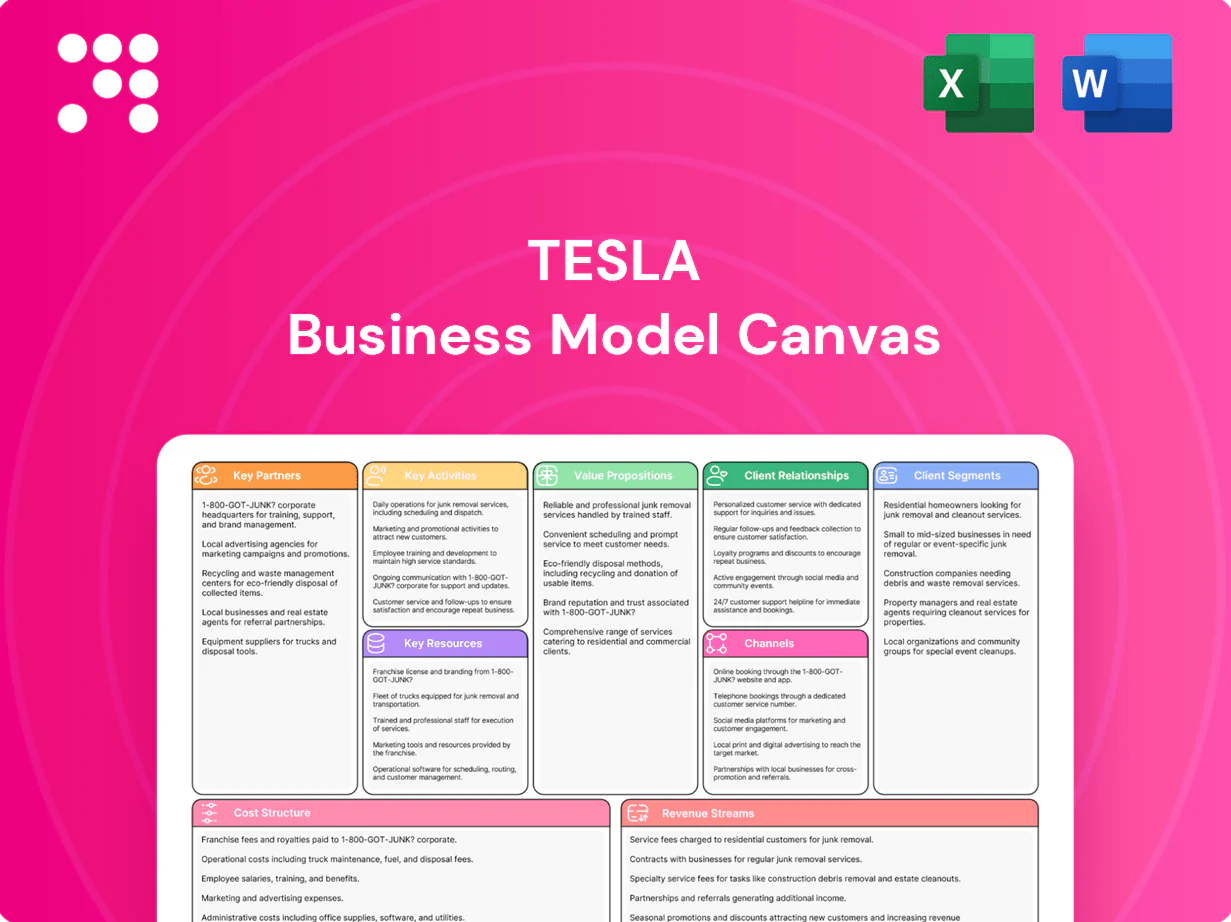
Tesla Business Model Canvas

EV Leader's Business Model Canvas: Vertical Integration, Software & Revenue Streams
Tesla’s Business Model Canvas maps how cutting-edge EV tech, vertical integration, and software-driven services create durable competitive advantage. Learn how customer segments, revenue streams, and partnerships align to scale profitably. Download the full, editable canvas for a section-by-section strategic playbook. Perfect for investors, founders, and consultants seeking actionable insights.
Partnerships

Battery and Materials Suppliers
Tesla partners with cell makers Panasonic, CATL and LG Energy Solution and with mining firms to secure lithium, nickel, graphite and cathode materials, aligning capacity, quality and regional cost stability. Co‑development on chemistries ties cell roadmaps to vehicle and storage needs as Tesla targets 3 TWh of cell production by 2030. Long‑term contracts de‑risk commodity and supply‑chain volatility.
Manufacturing and Equipment Vendors
Tesla partners with automation, robotics, casting (including large-frame die-casting suppliers) and semiconductor vendors to scale its six vehicle factories in 2024, using joint process engineering to improve yield, cycle times and safety. Vendor-managed inventory and on-site vendor support cut downtime, while strategic tooling partnerships accelerate new-model ramps and line changeovers.

Energy Utilities and Project Developers
Utilities and project developers collaborate on grid-scale storage, interconnection and demand-response to enable deployment of Tesla Megapacks and virtual power plants; projects are commonly sized in the hundreds of megawatts to gigawatt-scale. Long-term offtake and services agreements, typically 10–20 years, underpin project finance. Integration partnerships streamline permitting and access to grid-services revenue streams.

Charging and Infrastructure Allies
Site hosts, real estate owners and grid operators enable Supercharger siting and reliable power delivery, while payment and interoperability partners expanded non-Tesla access in 2024, increasing uptime and utilization. Collaborative deployments focus on high-power charging with minimal capex per site through revenue-sharing and host incentives. Local authorities streamline permits and offer incentives to accelerate rollouts.
- Site hosts: leases, revenue-share
- Grid: capacity, demand charges
- Payment: roaming, billing
- Local gov: permits, incentives
Financial, Insurance, and Fleet Partners
Financial, insurance, and fleet partners expand affordability through lending, leasing, and Tesla Insurance (launched 2019), while fleet managers and mobility platforms—evidenced by large orders such as Hertz’s 100,000-vehicle agreement—drive volume and specialized services. Risk-sharing structures with banks and lessors improve consumer and corporate financing terms, and data-sharing from vehicle telematics enhances underwriting accuracy and residual-value forecasting.
- Deliveries: 1.8 million+ vehicles (2023)
- Fleet demand: Hertz 100,000 order
- Insurance: Tesla Insurance active since 2019
- Benefits: improved financing, better underwriting, stronger residual forecasts
EV leader secures 3 TWh cells, scales six factories and GW storage
Tesla secures cells with Panasonic, CATL, LG and miners to reach a 3 TWh cell target by 2030; long-term contracts reduce commodity risk. Manufacturing and automation partners scale six vehicle factories in 2024 to raise throughput and reduce cycle times. Utilities, hosts and payment partners enable Megapack grid projects (100s MW–GW) and expanded Supercharger access; finance partners support fleet deals and 1.8M deliveries in 2023.
| Partnership | Key partners | Metric |
|---|---|---|
| Cells | Panasonic, CATL, LG, miners | 3 TWh target by 2030 |
| Manufacturing | Robotics, casting, semis | 6 factories (2024) |
| Storage/Grid | Utilities, developers | 100s MW–GW projects |
| Charging/Hosts | Site owners, payment | Non‑Tesla access expanded 2024 |
| Finance | Banks, insurers, fleets | 1.8M deliveries (2023); Hertz 100k |
What is included in the product
 Detailed Word Document
A comprehensive, pre-written Business Model Canvas for Tesla outlining its nine blocks—customer segments, value propositions (EVs, energy products, software/services), channels (direct sales, online, Supercharger), key activities (R&D, gigafactories), resources (battery tech, brand), partners, cost structure and revenue streams—highlighting vertical integration, software-led differentiation, scale advantages and linked SWOT insights for investors and strategists.

 Customizable Excel Spreadsheet
Condenses Tesla's strategy into a digestible one-page snapshot that pinpoints customer pain points—range anxiety, charging access, and production scaling—and shows how vertical integration, the Supercharger network, OTA updates, and Gigafactory scale address them for rapid decision-making and team alignment.
Activities

EV and Energy Product Development
Tesla designs vehicles, battery packs, power electronics and energy systems in-house, driving pack costs below $100 per kWh by 2024 and improving range and performance. Iterative engineering and scale across Gigafactories lowered cost per kWh and increased output, supporting over 1.8 million vehicles produced in 2023. Vertical integration aligns hardware, software and manufacturing, while rapid prototyping and OTA updates deliver features across millions of vehicles in weeks.
High-Volume Manufacturing
Tesla Gigafactories produce vehicles, battery cells with partners Panasonic, CATL and LG, and energy storage systems; Tesla reported about 1.8 million vehicle deliveries in 2024 and cumulative Energy deployments around 50 GWh by end‑2024. Advanced casting, stamping and automated assembly raise throughput and margins. Continuous improvement tackles yield, scrap and line availability. Global production balances logistics costs and local incentives.

Software and Autonomy
Tesla develops its vehicle OS, infotainment, OTA update framework and driver‑assistance stacks in‑house, delivering continuous feature releases via over‑the‑air updates. Fleet data collection feeds model training and enables iterative improvements to autonomy and infotainment; Full Self‑Driving has been offered as a subscription (available in 2024). Subscription features drive recurring revenue while cybersecurity and rigorous safety validation remain core.

Charging Network Deployment
Tesla expands Superchargers via site acquisition, grid upgrades and hardware installation, reaching over 55,000 stalls at roughly 7,000 stations worldwide by 2024; grid upgrades typically range $50,000–$300,000 per site. Operations cover load management, dynamic pricing and preventive maintenance; real‑time analytics boost utilization to ~85% and uptime to >99%. Partnerships secure power access and prime real estate faster and cheaper.
- Scale: 55,000+ stalls / ~7,000 stations (2024)
- Grid cost: $50k–$300k/site
- Ops: load mgmt, pricing, maintenance
- Analytics: ~85% utilization, >99% uptime
- Partners: utilities, landlords
Sales, Delivery, and Service
Tesla runs direct e-commerce, logistics and customer onboarding to support a global fleet that delivered approximately 1.8 million vehicles in 2024, scaling service operations. Mobile service, service centers and parts supply prioritize uptime, while OTA diagnostics and streamlined warranty/repair workflows reduce dealer visits. Education and training programs reinforce safe, efficient product use.
- Direct sales & logistics: global delivery ~1.8M (2024)
- Service network: mobile vans, centers, parts inventory
- OTA + diagnostics: faster repairs, reduced downtime
- Training: customer and technician education
Integrated EV platform cuts battery cost under $100/kWh
Tesla integrates design, manufacturing, software and charging ops to cut battery cost below $100/kWh (2024), scale production (~1.8M vehicle deliveries in 2024) and deploy energy (~50 GWh cumulative by end‑2024). Vertical integration, OTA updates and Supercharger expansion (55,000+ stalls, ~7,000 stations) drive margins, uptime and recurring revenue via subscriptions.
| Metric | 2024 |
|---|---|
| Vehicle deliveries | ~1.8M |
| Battery cost | <$100/kWh |
| Energy deployed | ~50 GWh |
| Supercharger stalls | 55,000+ |
What You See Is What You Get
Business Model Canvas
The document you see is the exact Tesla Business Model Canvas you’ll receive after purchase. It’s not a mockup—this live preview shows the real, fully editable file with the same structure, content, and formatting. After buying, you’ll download the complete Word and Excel deliverable.

EV Leader's Business Model Canvas: Vertical Integration, Software & Revenue Streams
Tesla’s Business Model Canvas maps how cutting-edge EV tech, vertical integration, and software-driven services create durable competitive advantage. Learn how customer segments, revenue streams, and partnerships align to scale profitably. Download the full, editable canvas for a section-by-section strategic playbook. Perfect for investors, founders, and consultants seeking actionable insights.
Partnerships
Battery and Materials Suppliers
Tesla partners with cell makers Panasonic, CATL and LG Energy Solution and with mining firms to secure lithium, nickel, graphite and cathode materials, aligning capacity, quality and regional cost stability. Co‑development on chemistries ties cell roadmaps to vehicle and storage needs as Tesla targets 3 TWh of cell production by 2030. Long‑term contracts de‑risk commodity and supply‑chain volatility.
Manufacturing and Equipment Vendors
Tesla partners with automation, robotics, casting (including large-frame die-casting suppliers) and semiconductor vendors to scale its six vehicle factories in 2024, using joint process engineering to improve yield, cycle times and safety. Vendor-managed inventory and on-site vendor support cut downtime, while strategic tooling partnerships accelerate new-model ramps and line changeovers.
Energy Utilities and Project Developers
Utilities and project developers collaborate on grid-scale storage, interconnection and demand-response to enable deployment of Tesla Megapacks and virtual power plants; projects are commonly sized in the hundreds of megawatts to gigawatt-scale. Long-term offtake and services agreements, typically 10–20 years, underpin project finance. Integration partnerships streamline permitting and access to grid-services revenue streams.
Charging and Infrastructure Allies
Site hosts, real estate owners and grid operators enable Supercharger siting and reliable power delivery, while payment and interoperability partners expanded non-Tesla access in 2024, increasing uptime and utilization. Collaborative deployments focus on high-power charging with minimal capex per site through revenue-sharing and host incentives. Local authorities streamline permits and offer incentives to accelerate rollouts.
- Site hosts: leases, revenue-share
- Grid: capacity, demand charges
- Payment: roaming, billing
- Local gov: permits, incentives
Financial, Insurance, and Fleet Partners
Financial, insurance, and fleet partners expand affordability through lending, leasing, and Tesla Insurance (launched 2019), while fleet managers and mobility platforms—evidenced by large orders such as Hertz’s 100,000-vehicle agreement—drive volume and specialized services. Risk-sharing structures with banks and lessors improve consumer and corporate financing terms, and data-sharing from vehicle telematics enhances underwriting accuracy and residual-value forecasting.
- Deliveries: 1.8 million+ vehicles (2023)
- Fleet demand: Hertz 100,000 order
- Insurance: Tesla Insurance active since 2019
- Benefits: improved financing, better underwriting, stronger residual forecasts
EV leader secures 3 TWh cells, scales six factories and GW storage
Tesla secures cells with Panasonic, CATL, LG and miners to reach a 3 TWh cell target by 2030; long-term contracts reduce commodity risk. Manufacturing and automation partners scale six vehicle factories in 2024 to raise throughput and reduce cycle times. Utilities, hosts and payment partners enable Megapack grid projects (100s MW–GW) and expanded Supercharger access; finance partners support fleet deals and 1.8M deliveries in 2023.
| Partnership | Key partners | Metric |
|---|---|---|
| Cells | Panasonic, CATL, LG, miners | 3 TWh target by 2030 |
| Manufacturing | Robotics, casting, semis | 6 factories (2024) |
| Storage/Grid | Utilities, developers | 100s MW–GW projects |
| Charging/Hosts | Site owners, payment | Non‑Tesla access expanded 2024 |
| Finance | Banks, insurers, fleets | 1.8M deliveries (2023); Hertz 100k |
What is included in the product
Detailed Word Document
A comprehensive, pre-written Business Model Canvas for Tesla outlining its nine blocks—customer segments, value propositions (EVs, energy products, software/services), channels (direct sales, online, Supercharger), key activities (R&D, gigafactories), resources (battery tech, brand), partners, cost structure and revenue streams—highlighting vertical integration, software-led differentiation, scale advantages and linked SWOT insights for investors and strategists.
Customizable Excel Spreadsheet
Condenses Tesla's strategy into a digestible one-page snapshot that pinpoints customer pain points—range anxiety, charging access, and production scaling—and shows how vertical integration, the Supercharger network, OTA updates, and Gigafactory scale address them for rapid decision-making and team alignment.
Activities
EV and Energy Product Development
Tesla designs vehicles, battery packs, power electronics and energy systems in-house, driving pack costs below $100 per kWh by 2024 and improving range and performance. Iterative engineering and scale across Gigafactories lowered cost per kWh and increased output, supporting over 1.8 million vehicles produced in 2023. Vertical integration aligns hardware, software and manufacturing, while rapid prototyping and OTA updates deliver features across millions of vehicles in weeks.
High-Volume Manufacturing
Tesla Gigafactories produce vehicles, battery cells with partners Panasonic, CATL and LG, and energy storage systems; Tesla reported about 1.8 million vehicle deliveries in 2024 and cumulative Energy deployments around 50 GWh by end‑2024. Advanced casting, stamping and automated assembly raise throughput and margins. Continuous improvement tackles yield, scrap and line availability. Global production balances logistics costs and local incentives.
Software and Autonomy
Tesla develops its vehicle OS, infotainment, OTA update framework and driver‑assistance stacks in‑house, delivering continuous feature releases via over‑the‑air updates. Fleet data collection feeds model training and enables iterative improvements to autonomy and infotainment; Full Self‑Driving has been offered as a subscription (available in 2024). Subscription features drive recurring revenue while cybersecurity and rigorous safety validation remain core.
Charging Network Deployment
Tesla expands Superchargers via site acquisition, grid upgrades and hardware installation, reaching over 55,000 stalls at roughly 7,000 stations worldwide by 2024; grid upgrades typically range $50,000–$300,000 per site. Operations cover load management, dynamic pricing and preventive maintenance; real‑time analytics boost utilization to ~85% and uptime to >99%. Partnerships secure power access and prime real estate faster and cheaper.
- Scale: 55,000+ stalls / ~7,000 stations (2024)
- Grid cost: $50k–$300k/site
- Ops: load mgmt, pricing, maintenance
- Analytics: ~85% utilization, >99% uptime
- Partners: utilities, landlords
Sales, Delivery, and Service
Tesla runs direct e-commerce, logistics and customer onboarding to support a global fleet that delivered approximately 1.8 million vehicles in 2024, scaling service operations. Mobile service, service centers and parts supply prioritize uptime, while OTA diagnostics and streamlined warranty/repair workflows reduce dealer visits. Education and training programs reinforce safe, efficient product use.
- Direct sales & logistics: global delivery ~1.8M (2024)
- Service network: mobile vans, centers, parts inventory
- OTA + diagnostics: faster repairs, reduced downtime
- Training: customer and technician education
Integrated EV platform cuts battery cost under $100/kWh
Tesla integrates design, manufacturing, software and charging ops to cut battery cost below $100/kWh (2024), scale production (~1.8M vehicle deliveries in 2024) and deploy energy (~50 GWh cumulative by end‑2024). Vertical integration, OTA updates and Supercharger expansion (55,000+ stalls, ~7,000 stations) drive margins, uptime and recurring revenue via subscriptions.
| Metric | 2024 |
|---|---|
| Vehicle deliveries | ~1.8M |
| Battery cost | <$100/kWh |
| Energy deployed | ~50 GWh |
| Supercharger stalls | 55,000+ |
What You See Is What You Get
Business Model Canvas
The document you see is the exact Tesla Business Model Canvas you’ll receive after purchase. It’s not a mockup—this live preview shows the real, fully editable file with the same structure, content, and formatting. After buying, you’ll download the complete Word and Excel deliverable.
Original: $10.00
-65%$10.00
$3.50Description
EV Leader's Business Model Canvas: Vertical Integration, Software & Revenue Streams
Tesla’s Business Model Canvas maps how cutting-edge EV tech, vertical integration, and software-driven services create durable competitive advantage. Learn how customer segments, revenue streams, and partnerships align to scale profitably. Download the full, editable canvas for a section-by-section strategic playbook. Perfect for investors, founders, and consultants seeking actionable insights.
Partnerships
Battery and Materials Suppliers
Tesla partners with cell makers Panasonic, CATL and LG Energy Solution and with mining firms to secure lithium, nickel, graphite and cathode materials, aligning capacity, quality and regional cost stability. Co‑development on chemistries ties cell roadmaps to vehicle and storage needs as Tesla targets 3 TWh of cell production by 2030. Long‑term contracts de‑risk commodity and supply‑chain volatility.
Manufacturing and Equipment Vendors
Tesla partners with automation, robotics, casting (including large-frame die-casting suppliers) and semiconductor vendors to scale its six vehicle factories in 2024, using joint process engineering to improve yield, cycle times and safety. Vendor-managed inventory and on-site vendor support cut downtime, while strategic tooling partnerships accelerate new-model ramps and line changeovers.
Energy Utilities and Project Developers
Utilities and project developers collaborate on grid-scale storage, interconnection and demand-response to enable deployment of Tesla Megapacks and virtual power plants; projects are commonly sized in the hundreds of megawatts to gigawatt-scale. Long-term offtake and services agreements, typically 10–20 years, underpin project finance. Integration partnerships streamline permitting and access to grid-services revenue streams.
Charging and Infrastructure Allies
Site hosts, real estate owners and grid operators enable Supercharger siting and reliable power delivery, while payment and interoperability partners expanded non-Tesla access in 2024, increasing uptime and utilization. Collaborative deployments focus on high-power charging with minimal capex per site through revenue-sharing and host incentives. Local authorities streamline permits and offer incentives to accelerate rollouts.
- Site hosts: leases, revenue-share
- Grid: capacity, demand charges
- Payment: roaming, billing
- Local gov: permits, incentives
Financial, Insurance, and Fleet Partners
Financial, insurance, and fleet partners expand affordability through lending, leasing, and Tesla Insurance (launched 2019), while fleet managers and mobility platforms—evidenced by large orders such as Hertz’s 100,000-vehicle agreement—drive volume and specialized services. Risk-sharing structures with banks and lessors improve consumer and corporate financing terms, and data-sharing from vehicle telematics enhances underwriting accuracy and residual-value forecasting.
- Deliveries: 1.8 million+ vehicles (2023)
- Fleet demand: Hertz 100,000 order
- Insurance: Tesla Insurance active since 2019
- Benefits: improved financing, better underwriting, stronger residual forecasts
EV leader secures 3 TWh cells, scales six factories and GW storage
Tesla secures cells with Panasonic, CATL, LG and miners to reach a 3 TWh cell target by 2030; long-term contracts reduce commodity risk. Manufacturing and automation partners scale six vehicle factories in 2024 to raise throughput and reduce cycle times. Utilities, hosts and payment partners enable Megapack grid projects (100s MW–GW) and expanded Supercharger access; finance partners support fleet deals and 1.8M deliveries in 2023.
| Partnership | Key partners | Metric |
|---|---|---|
| Cells | Panasonic, CATL, LG, miners | 3 TWh target by 2030 |
| Manufacturing | Robotics, casting, semis | 6 factories (2024) |
| Storage/Grid | Utilities, developers | 100s MW–GW projects |
| Charging/Hosts | Site owners, payment | Non‑Tesla access expanded 2024 |
| Finance | Banks, insurers, fleets | 1.8M deliveries (2023); Hertz 100k |
What is included in the product
Detailed Word Document
A comprehensive, pre-written Business Model Canvas for Tesla outlining its nine blocks—customer segments, value propositions (EVs, energy products, software/services), channels (direct sales, online, Supercharger), key activities (R&D, gigafactories), resources (battery tech, brand), partners, cost structure and revenue streams—highlighting vertical integration, software-led differentiation, scale advantages and linked SWOT insights for investors and strategists.
Customizable Excel Spreadsheet
Condenses Tesla's strategy into a digestible one-page snapshot that pinpoints customer pain points—range anxiety, charging access, and production scaling—and shows how vertical integration, the Supercharger network, OTA updates, and Gigafactory scale address them for rapid decision-making and team alignment.
Activities
EV and Energy Product Development
Tesla designs vehicles, battery packs, power electronics and energy systems in-house, driving pack costs below $100 per kWh by 2024 and improving range and performance. Iterative engineering and scale across Gigafactories lowered cost per kWh and increased output, supporting over 1.8 million vehicles produced in 2023. Vertical integration aligns hardware, software and manufacturing, while rapid prototyping and OTA updates deliver features across millions of vehicles in weeks.
High-Volume Manufacturing
Tesla Gigafactories produce vehicles, battery cells with partners Panasonic, CATL and LG, and energy storage systems; Tesla reported about 1.8 million vehicle deliveries in 2024 and cumulative Energy deployments around 50 GWh by end‑2024. Advanced casting, stamping and automated assembly raise throughput and margins. Continuous improvement tackles yield, scrap and line availability. Global production balances logistics costs and local incentives.
Software and Autonomy
Tesla develops its vehicle OS, infotainment, OTA update framework and driver‑assistance stacks in‑house, delivering continuous feature releases via over‑the‑air updates. Fleet data collection feeds model training and enables iterative improvements to autonomy and infotainment; Full Self‑Driving has been offered as a subscription (available in 2024). Subscription features drive recurring revenue while cybersecurity and rigorous safety validation remain core.
Charging Network Deployment
Tesla expands Superchargers via site acquisition, grid upgrades and hardware installation, reaching over 55,000 stalls at roughly 7,000 stations worldwide by 2024; grid upgrades typically range $50,000–$300,000 per site. Operations cover load management, dynamic pricing and preventive maintenance; real‑time analytics boost utilization to ~85% and uptime to >99%. Partnerships secure power access and prime real estate faster and cheaper.
- Scale: 55,000+ stalls / ~7,000 stations (2024)
- Grid cost: $50k–$300k/site
- Ops: load mgmt, pricing, maintenance
- Analytics: ~85% utilization, >99% uptime
- Partners: utilities, landlords
Sales, Delivery, and Service
Tesla runs direct e-commerce, logistics and customer onboarding to support a global fleet that delivered approximately 1.8 million vehicles in 2024, scaling service operations. Mobile service, service centers and parts supply prioritize uptime, while OTA diagnostics and streamlined warranty/repair workflows reduce dealer visits. Education and training programs reinforce safe, efficient product use.
- Direct sales & logistics: global delivery ~1.8M (2024)
- Service network: mobile vans, centers, parts inventory
- OTA + diagnostics: faster repairs, reduced downtime
- Training: customer and technician education
Integrated EV platform cuts battery cost under $100/kWh
Tesla integrates design, manufacturing, software and charging ops to cut battery cost below $100/kWh (2024), scale production (~1.8M vehicle deliveries in 2024) and deploy energy (~50 GWh cumulative by end‑2024). Vertical integration, OTA updates and Supercharger expansion (55,000+ stalls, ~7,000 stations) drive margins, uptime and recurring revenue via subscriptions.
| Metric | 2024 |
|---|---|
| Vehicle deliveries | ~1.8M |
| Battery cost | <$100/kWh |
| Energy deployed | ~50 GWh |
| Supercharger stalls | 55,000+ |
What You See Is What You Get
Business Model Canvas
The document you see is the exact Tesla Business Model Canvas you’ll receive after purchase. It’s not a mockup—this live preview shows the real, fully editable file with the same structure, content, and formatting. After buying, you’ll download the complete Word and Excel deliverable.











