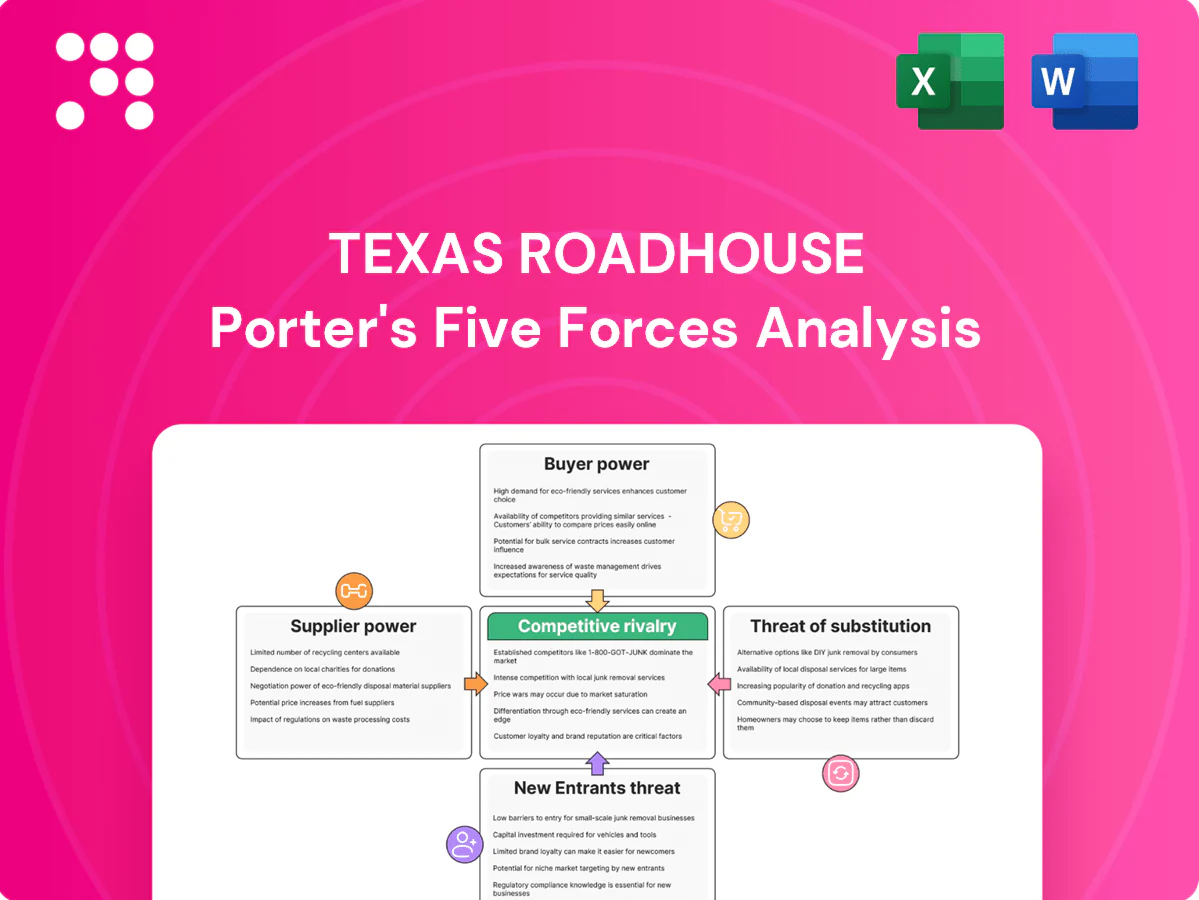
Texas Roadhouse Porter's Five Forces Analysis

A Must-Have Tool for Decision-Makers
Texas Roadhouse faces moderate supplier power, intense rivalry among casual-dining chains, and rising substitute threats from fast-casual and delivery services. Buyer price sensitivity and national-scale competitors pressure margins, while franchise scale limits new entrant impact. This brief snapshot only scratches the surface. Unlock the full Porter's Five Forces Analysis to explore Texas Roadhouse’s competitive dynamics and strategic implications in detail.
Suppliers Bargaining Power

Concentrated beef packers
Beef is a core input for Texas Roadhouse and U.S. fed-cattle processing remains highly concentrated: the Big Four packers (Tyson, JBS, Cargill, National Beef) account for roughly 85% of slaughter capacity, lifting supplier power. Tight cattle cycles and supply shocks amplify price volatility, constraining procurement flexibility despite specification-driven buying. Texas Roadhouse mandates USDA Choice and uses multiple approved vendors, but true leverage versus packer concentration is limited.
Commodity price volatility
Beef, pork and dairy costs remained volatile in 2024 as feed price swings and herd adjustments pushed wholesale beef up about 8% year-over-year, compressing margins before menu prices could adjust. Texas Roadhouse’s value positioning limits rapid pass-through, so sudden spikes hit EBIT. Diversifying cuts and mix mitigates some risk, but material exposure to protein cycles persists.

Fresh, from-scratch requirements
Daily scratch prep and hand-cut steaks raise dependence on consistent, high-quality inputs for Texas Roadhouse, which operated about 652 restaurants in 2024; tighter specs lower substitutability and subtly increase supplier power. Local and regional sourcing cuts single-point failure risk but adds coordination complexity and logistics cost. Enhanced QA requirements elevate switching costs for the firm.

Logistics and cold chain reliability
Perishables for Texas Roadhouse rely on refrigerated distribution; carrier constraints, diesel price volatility and seasonal disruptions increase supplier leverage and can raise logistics costs by double-digit percentages during shocks. Texas Roadhouse scale (about 700 restaurants in 2024) improves routing efficiency but cannot fully absorb system-wide cold-chain outages, and backup distributors reduce downtime risk without eliminating exposure.
- Cold-chain dependence: high
- Scale: ~700 restaurants (2024)
- Supplier leverage: rises with carrier shortages/fuel spikes
- Backup distributors: mitigation, not elimination
Skilled labor as a quasi-supplier
Butchers, grill cooks and servers function as quasi-suppliers for Texas Roadhouse—critical operational inputs whose scarcity in 2024 kept industry wage pressure elevated and scheduling risk high.
Tight labor markets in 2024 coincided with restaurant job openings near historic highs, extending training pipelines that reduce vulnerability but require months to mature and constrain throughput flexibility, indirectly boosting vendor power.
- Labor as input: butchers/grill cooks/servers essential
- Wage pressure: 2024 tight labor market raised costs
- Training lag: pipelines lower risk but are time-consuming
- Indirect vendor power: limited throughput reduces bargaining leverage
Concentrated packer power and rising beef costs squeeze casual-dining margins
Supplier power is elevated: the Big Four packers control ~85% of U.S. fed‑cattle slaughter, limiting Texas Roadhouse procurement leverage. Wholesale beef rose about 8% YoY in 2024, compressing margins while Texas Roadhouse ran ~700 restaurants. Tight 2024 labor markets and cold‑chain fragility further raise input risk despite multiple approved vendors and backup distributors.
| Metric | Value (2024) |
|---|---|
| Big Four packer share | ~85% |
| Wholesale beef change | +8% YoY |
| Texas Roadhouse restaurants | ~700 |
| Labor market | Elevated openings, wage pressure |
What is included in the product
 Detailed Word Document
Uncovers key drivers of competition, buyer and supplier power, threat of substitutes and new entrants, and intensity of rivalry specifically for Texas Roadhouse. Identifies disruptive threats and protective market dynamics with strategic commentary to inform pricing, expansion, and defensive moves.

 Customizable Excel Spreadsheet
One-sheet Porter's Five Forces for Texas Roadhouse that highlights competitive pressures at a glance—customizable scores and radar chart make strategy tweaks fast and boardroom-ready.
Customers Bargaining Power

Highly substitutable dining choices
Guests can switch among casual dining, steakhouses, or quick-service at low cost, raising buyer power across the category; Texas Roadhouse operated 700+ restaurants in 2024, intensifying competitive exposure. Abundant alternatives elevate buyer leverage at the category level. Texas Roadhouse counters with value pricing and experiential dining. Choice overload keeps pressure on price and service consistency.
Price sensitivity in value segment
Texas Roadhouse’s core family and value-seeking guests are highly price-sensitive, so menu price increases must be calibrated to avoid traffic erosion. Promotional offers and perceived portion value (signature 8–12 oz steaks) help retain loyalty. With restaurant inflation running roughly 5–6% across 2023–24, the risk of trade-down to cheaper casual or fast-casual alternatives rises materially.

Digital reviews and social amplification
Online ratings rapidly reward or punish Texas Roadhouse’s service and food; with about 680 restaurants in 2024, sharp swings in reviews can affect foot traffic and same-store sales. Visibility of wait times, menu prices and offers on apps raises pricing transparency and narrows negotiation room for customers. The chain’s lively atmosphere drives advocacy that lowers buyer power, but viral negative reviews can spike churn and local sales declines.

Low switching costs, but experience stickiness
Customers can easily try competitors, keeping bargaining leverage high; Texas Roadhouse still operated over 700 restaurants in 2024, with systemwide sales around $4 billion, so choice is plentiful. Signature rolls, line dancing, and hand-cut steaks create emotional loyalty that tempers price sensitivity. Consistent hospitality—reflected in low reported churn—reduces switching propensity, but any service slip erodes that buffer quickly.
- Low switching costs
- Emotional loyalty from experience
- Consistent hospitality lowers churn
- Service lapses quickly increase customer defections
To-go and delivery expectations
To-go and delivery expectations have become core for casual dining; by 2024 off-premise accounted for roughly one-third of industry sales, driving demand for accurate, hot, and timely orders with minimal fees. Meeting these expectations reduces defection risk, while poor execution amplifies buyer bargaining as customers switch channels easily. For Texas Roadhouse, inconsistent off-premise execution would increase sensitivity to price and convenience.
- 2024 off-premise ≈ one-third of industry sales
- Customers demand accuracy, heat, speed, low fees
- Poor execution raises channel-switching and buyer leverage
Customers wield pricing power; 700+ units, ≈ $4B sales
Customers have high bargaining power: low switching costs across casual dining, pricing sensitivity among core guests, and review-driven traffic swings; Texas Roadhouse operated 700+ restaurants in 2024 with systemwide sales ≈ $4B and off-premise ≈ 33%, while restaurant inflation ran ~5–6% in 2023–24.
| Metric | 2024 |
|---|---|
| Restaurants | 700+ |
| Systemwide sales | ≈ $4B |
| Off‑premise share | ≈ 33% |
| Restaurant inflation | 5–6% |
Same Document Delivered
Texas Roadhouse Porter's Five Forces Analysis
This Texas Roadhouse Porter's Five Forces Analysis provides a concise evaluation of competitive rivalry, supplier and buyer power, threat of substitutes, and barriers to entry, highlighting strategic implications for investors and managers. This preview is the exact document you'll receive immediately after purchase—fully formatted and ready to use. No samples or placeholders; what you see is what you download.

A Must-Have Tool for Decision-Makers
Texas Roadhouse faces moderate supplier power, intense rivalry among casual-dining chains, and rising substitute threats from fast-casual and delivery services. Buyer price sensitivity and national-scale competitors pressure margins, while franchise scale limits new entrant impact. This brief snapshot only scratches the surface. Unlock the full Porter's Five Forces Analysis to explore Texas Roadhouse’s competitive dynamics and strategic implications in detail.
Suppliers Bargaining Power
Concentrated beef packers
Beef is a core input for Texas Roadhouse and U.S. fed-cattle processing remains highly concentrated: the Big Four packers (Tyson, JBS, Cargill, National Beef) account for roughly 85% of slaughter capacity, lifting supplier power. Tight cattle cycles and supply shocks amplify price volatility, constraining procurement flexibility despite specification-driven buying. Texas Roadhouse mandates USDA Choice and uses multiple approved vendors, but true leverage versus packer concentration is limited.
Commodity price volatility
Beef, pork and dairy costs remained volatile in 2024 as feed price swings and herd adjustments pushed wholesale beef up about 8% year-over-year, compressing margins before menu prices could adjust. Texas Roadhouse’s value positioning limits rapid pass-through, so sudden spikes hit EBIT. Diversifying cuts and mix mitigates some risk, but material exposure to protein cycles persists.
Fresh, from-scratch requirements
Daily scratch prep and hand-cut steaks raise dependence on consistent, high-quality inputs for Texas Roadhouse, which operated about 652 restaurants in 2024; tighter specs lower substitutability and subtly increase supplier power. Local and regional sourcing cuts single-point failure risk but adds coordination complexity and logistics cost. Enhanced QA requirements elevate switching costs for the firm.
Logistics and cold chain reliability
Perishables for Texas Roadhouse rely on refrigerated distribution; carrier constraints, diesel price volatility and seasonal disruptions increase supplier leverage and can raise logistics costs by double-digit percentages during shocks. Texas Roadhouse scale (about 700 restaurants in 2024) improves routing efficiency but cannot fully absorb system-wide cold-chain outages, and backup distributors reduce downtime risk without eliminating exposure.
- Cold-chain dependence: high
- Scale: ~700 restaurants (2024)
- Supplier leverage: rises with carrier shortages/fuel spikes
- Backup distributors: mitigation, not elimination
Skilled labor as a quasi-supplier
Butchers, grill cooks and servers function as quasi-suppliers for Texas Roadhouse—critical operational inputs whose scarcity in 2024 kept industry wage pressure elevated and scheduling risk high.
Tight labor markets in 2024 coincided with restaurant job openings near historic highs, extending training pipelines that reduce vulnerability but require months to mature and constrain throughput flexibility, indirectly boosting vendor power.
- Labor as input: butchers/grill cooks/servers essential
- Wage pressure: 2024 tight labor market raised costs
- Training lag: pipelines lower risk but are time-consuming
- Indirect vendor power: limited throughput reduces bargaining leverage
Concentrated packer power and rising beef costs squeeze casual-dining margins
Supplier power is elevated: the Big Four packers control ~85% of U.S. fed‑cattle slaughter, limiting Texas Roadhouse procurement leverage. Wholesale beef rose about 8% YoY in 2024, compressing margins while Texas Roadhouse ran ~700 restaurants. Tight 2024 labor markets and cold‑chain fragility further raise input risk despite multiple approved vendors and backup distributors.
| Metric | Value (2024) |
|---|---|
| Big Four packer share | ~85% |
| Wholesale beef change | +8% YoY |
| Texas Roadhouse restaurants | ~700 |
| Labor market | Elevated openings, wage pressure |
What is included in the product
Detailed Word Document
Uncovers key drivers of competition, buyer and supplier power, threat of substitutes and new entrants, and intensity of rivalry specifically for Texas Roadhouse. Identifies disruptive threats and protective market dynamics with strategic commentary to inform pricing, expansion, and defensive moves.
Customizable Excel Spreadsheet
One-sheet Porter's Five Forces for Texas Roadhouse that highlights competitive pressures at a glance—customizable scores and radar chart make strategy tweaks fast and boardroom-ready.
Customers Bargaining Power
Highly substitutable dining choices
Guests can switch among casual dining, steakhouses, or quick-service at low cost, raising buyer power across the category; Texas Roadhouse operated 700+ restaurants in 2024, intensifying competitive exposure. Abundant alternatives elevate buyer leverage at the category level. Texas Roadhouse counters with value pricing and experiential dining. Choice overload keeps pressure on price and service consistency.
Price sensitivity in value segment
Texas Roadhouse’s core family and value-seeking guests are highly price-sensitive, so menu price increases must be calibrated to avoid traffic erosion. Promotional offers and perceived portion value (signature 8–12 oz steaks) help retain loyalty. With restaurant inflation running roughly 5–6% across 2023–24, the risk of trade-down to cheaper casual or fast-casual alternatives rises materially.
Digital reviews and social amplification
Online ratings rapidly reward or punish Texas Roadhouse’s service and food; with about 680 restaurants in 2024, sharp swings in reviews can affect foot traffic and same-store sales. Visibility of wait times, menu prices and offers on apps raises pricing transparency and narrows negotiation room for customers. The chain’s lively atmosphere drives advocacy that lowers buyer power, but viral negative reviews can spike churn and local sales declines.
Low switching costs, but experience stickiness
Customers can easily try competitors, keeping bargaining leverage high; Texas Roadhouse still operated over 700 restaurants in 2024, with systemwide sales around $4 billion, so choice is plentiful. Signature rolls, line dancing, and hand-cut steaks create emotional loyalty that tempers price sensitivity. Consistent hospitality—reflected in low reported churn—reduces switching propensity, but any service slip erodes that buffer quickly.
- Low switching costs
- Emotional loyalty from experience
- Consistent hospitality lowers churn
- Service lapses quickly increase customer defections
To-go and delivery expectations
To-go and delivery expectations have become core for casual dining; by 2024 off-premise accounted for roughly one-third of industry sales, driving demand for accurate, hot, and timely orders with minimal fees. Meeting these expectations reduces defection risk, while poor execution amplifies buyer bargaining as customers switch channels easily. For Texas Roadhouse, inconsistent off-premise execution would increase sensitivity to price and convenience.
- 2024 off-premise ≈ one-third of industry sales
- Customers demand accuracy, heat, speed, low fees
- Poor execution raises channel-switching and buyer leverage
Customers wield pricing power; 700+ units, ≈ $4B sales
Customers have high bargaining power: low switching costs across casual dining, pricing sensitivity among core guests, and review-driven traffic swings; Texas Roadhouse operated 700+ restaurants in 2024 with systemwide sales ≈ $4B and off-premise ≈ 33%, while restaurant inflation ran ~5–6% in 2023–24.
| Metric | 2024 |
|---|---|
| Restaurants | 700+ |
| Systemwide sales | ≈ $4B |
| Off‑premise share | ≈ 33% |
| Restaurant inflation | 5–6% |
Same Document Delivered
Texas Roadhouse Porter's Five Forces Analysis
This Texas Roadhouse Porter's Five Forces Analysis provides a concise evaluation of competitive rivalry, supplier and buyer power, threat of substitutes, and barriers to entry, highlighting strategic implications for investors and managers. This preview is the exact document you'll receive immediately after purchase—fully formatted and ready to use. No samples or placeholders; what you see is what you download.
Original: $10.00
-65%$10.00
$3.50Description
A Must-Have Tool for Decision-Makers
Texas Roadhouse faces moderate supplier power, intense rivalry among casual-dining chains, and rising substitute threats from fast-casual and delivery services. Buyer price sensitivity and national-scale competitors pressure margins, while franchise scale limits new entrant impact. This brief snapshot only scratches the surface. Unlock the full Porter's Five Forces Analysis to explore Texas Roadhouse’s competitive dynamics and strategic implications in detail.
Suppliers Bargaining Power
Concentrated beef packers
Beef is a core input for Texas Roadhouse and U.S. fed-cattle processing remains highly concentrated: the Big Four packers (Tyson, JBS, Cargill, National Beef) account for roughly 85% of slaughter capacity, lifting supplier power. Tight cattle cycles and supply shocks amplify price volatility, constraining procurement flexibility despite specification-driven buying. Texas Roadhouse mandates USDA Choice and uses multiple approved vendors, but true leverage versus packer concentration is limited.
Commodity price volatility
Beef, pork and dairy costs remained volatile in 2024 as feed price swings and herd adjustments pushed wholesale beef up about 8% year-over-year, compressing margins before menu prices could adjust. Texas Roadhouse’s value positioning limits rapid pass-through, so sudden spikes hit EBIT. Diversifying cuts and mix mitigates some risk, but material exposure to protein cycles persists.
Fresh, from-scratch requirements
Daily scratch prep and hand-cut steaks raise dependence on consistent, high-quality inputs for Texas Roadhouse, which operated about 652 restaurants in 2024; tighter specs lower substitutability and subtly increase supplier power. Local and regional sourcing cuts single-point failure risk but adds coordination complexity and logistics cost. Enhanced QA requirements elevate switching costs for the firm.
Logistics and cold chain reliability
Perishables for Texas Roadhouse rely on refrigerated distribution; carrier constraints, diesel price volatility and seasonal disruptions increase supplier leverage and can raise logistics costs by double-digit percentages during shocks. Texas Roadhouse scale (about 700 restaurants in 2024) improves routing efficiency but cannot fully absorb system-wide cold-chain outages, and backup distributors reduce downtime risk without eliminating exposure.
- Cold-chain dependence: high
- Scale: ~700 restaurants (2024)
- Supplier leverage: rises with carrier shortages/fuel spikes
- Backup distributors: mitigation, not elimination
Skilled labor as a quasi-supplier
Butchers, grill cooks and servers function as quasi-suppliers for Texas Roadhouse—critical operational inputs whose scarcity in 2024 kept industry wage pressure elevated and scheduling risk high.
Tight labor markets in 2024 coincided with restaurant job openings near historic highs, extending training pipelines that reduce vulnerability but require months to mature and constrain throughput flexibility, indirectly boosting vendor power.
- Labor as input: butchers/grill cooks/servers essential
- Wage pressure: 2024 tight labor market raised costs
- Training lag: pipelines lower risk but are time-consuming
- Indirect vendor power: limited throughput reduces bargaining leverage
Concentrated packer power and rising beef costs squeeze casual-dining margins
Supplier power is elevated: the Big Four packers control ~85% of U.S. fed‑cattle slaughter, limiting Texas Roadhouse procurement leverage. Wholesale beef rose about 8% YoY in 2024, compressing margins while Texas Roadhouse ran ~700 restaurants. Tight 2024 labor markets and cold‑chain fragility further raise input risk despite multiple approved vendors and backup distributors.
| Metric | Value (2024) |
|---|---|
| Big Four packer share | ~85% |
| Wholesale beef change | +8% YoY |
| Texas Roadhouse restaurants | ~700 |
| Labor market | Elevated openings, wage pressure |
What is included in the product
Detailed Word Document
Uncovers key drivers of competition, buyer and supplier power, threat of substitutes and new entrants, and intensity of rivalry specifically for Texas Roadhouse. Identifies disruptive threats and protective market dynamics with strategic commentary to inform pricing, expansion, and defensive moves.
Customizable Excel Spreadsheet
One-sheet Porter's Five Forces for Texas Roadhouse that highlights competitive pressures at a glance—customizable scores and radar chart make strategy tweaks fast and boardroom-ready.
Customers Bargaining Power
Highly substitutable dining choices
Guests can switch among casual dining, steakhouses, or quick-service at low cost, raising buyer power across the category; Texas Roadhouse operated 700+ restaurants in 2024, intensifying competitive exposure. Abundant alternatives elevate buyer leverage at the category level. Texas Roadhouse counters with value pricing and experiential dining. Choice overload keeps pressure on price and service consistency.
Price sensitivity in value segment
Texas Roadhouse’s core family and value-seeking guests are highly price-sensitive, so menu price increases must be calibrated to avoid traffic erosion. Promotional offers and perceived portion value (signature 8–12 oz steaks) help retain loyalty. With restaurant inflation running roughly 5–6% across 2023–24, the risk of trade-down to cheaper casual or fast-casual alternatives rises materially.
Digital reviews and social amplification
Online ratings rapidly reward or punish Texas Roadhouse’s service and food; with about 680 restaurants in 2024, sharp swings in reviews can affect foot traffic and same-store sales. Visibility of wait times, menu prices and offers on apps raises pricing transparency and narrows negotiation room for customers. The chain’s lively atmosphere drives advocacy that lowers buyer power, but viral negative reviews can spike churn and local sales declines.
Low switching costs, but experience stickiness
Customers can easily try competitors, keeping bargaining leverage high; Texas Roadhouse still operated over 700 restaurants in 2024, with systemwide sales around $4 billion, so choice is plentiful. Signature rolls, line dancing, and hand-cut steaks create emotional loyalty that tempers price sensitivity. Consistent hospitality—reflected in low reported churn—reduces switching propensity, but any service slip erodes that buffer quickly.
- Low switching costs
- Emotional loyalty from experience
- Consistent hospitality lowers churn
- Service lapses quickly increase customer defections
To-go and delivery expectations
To-go and delivery expectations have become core for casual dining; by 2024 off-premise accounted for roughly one-third of industry sales, driving demand for accurate, hot, and timely orders with minimal fees. Meeting these expectations reduces defection risk, while poor execution amplifies buyer bargaining as customers switch channels easily. For Texas Roadhouse, inconsistent off-premise execution would increase sensitivity to price and convenience.
- 2024 off-premise ≈ one-third of industry sales
- Customers demand accuracy, heat, speed, low fees
- Poor execution raises channel-switching and buyer leverage
Customers wield pricing power; 700+ units, ≈ $4B sales
Customers have high bargaining power: low switching costs across casual dining, pricing sensitivity among core guests, and review-driven traffic swings; Texas Roadhouse operated 700+ restaurants in 2024 with systemwide sales ≈ $4B and off-premise ≈ 33%, while restaurant inflation ran ~5–6% in 2023–24.
| Metric | 2024 |
|---|---|
| Restaurants | 700+ |
| Systemwide sales | ≈ $4B |
| Off‑premise share | ≈ 33% |
| Restaurant inflation | 5–6% |
Same Document Delivered
Texas Roadhouse Porter's Five Forces Analysis
This Texas Roadhouse Porter's Five Forces Analysis provides a concise evaluation of competitive rivalry, supplier and buyer power, threat of substitutes, and barriers to entry, highlighting strategic implications for investors and managers. This preview is the exact document you'll receive immediately after purchase—fully formatted and ready to use. No samples or placeholders; what you see is what you download.











