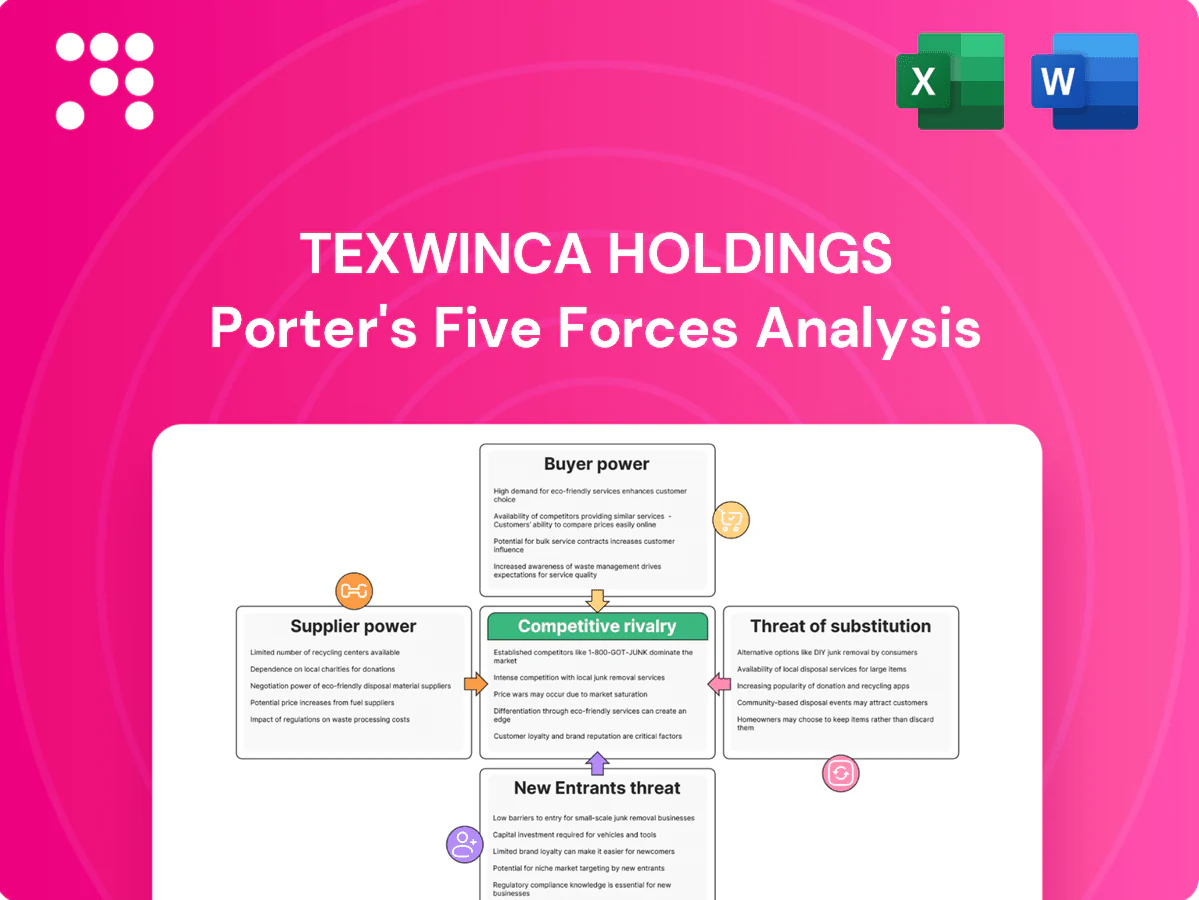
Texwinca Holdings Porter's Five Forces Analysis

Go Beyond the Preview—Access the Full Strategic Report
Texwinca Holdings faces a complex mix of supplier leverage, shifting buyer preferences, and competitive pressure from both low-cost producers and niche brands, while regulatory and input-cost volatility amplify strategic risk; this snapshot highlights key tensions but skips granular metrics. Unlock the full Porter's Five Forces Analysis to see force-by-force ratings, visuals, and actionable recommendations tailored to Texwinca Holdings.
Suppliers Bargaining Power

Concentration of yarn and dye suppliers
Core inputs like cotton/polyester yarns, dyes and chemicals are concentrated among Asian suppliers, with Asia accounting for over 70% of global textile dye and yarn exports in 2024 (UN Comtrade), giving suppliers negotiating leverage. Texwinca’s scale partially offsets this through volume contracts and long-term purchase agreements. Vertical integration into knitting reduces upstream dependence, but specialty dyes and advanced finishes still leave select suppliers with pricing power.
Raw material price volatility
Cotton and crude-derived polyester price swings pass through quickly and squeeze margins; global cotton production was 118.1 million bales in 2023/24 (USDA), underscoring supply sensitivity. Hedging and a diversified fiber mix smooth cost volatility but cannot remove shock exposure. Buyers resist rapid price hikes, compressing Texwinca during spikes; long-term contracts help but leave basis risk.

Compliance and sustainability requirements
Certified chemicals, traceable fibers and strict wastewater standards—textile production accounts for about 20% of global industrial water pollution—narrow Texwinca’s qualified supplier pool. Fewer compliant vendors can command price premiums and stricter contract terms, increasing supplier leverage. Texwinca must invest in audits, laboratory testing and certifications to maintain approvals. These obligations raise switching costs and supplier influence.

Logistics and lead-time dependencies
Just-in-time fabric flows make on-time deliveries critical for Texwinca, so shipping disruptions give suppliers leverage via expedited-fee premiums often in the 10–25% range and prioritization of capacity; dual-sourcing and safety stocks reduce outage risk but typically increase working-capital needs. Proximity to mills lowers lead-time variability yet constrains supplier choice and negotiating power.
- Lead-time sensitivity: JIT fabric flows
- Supplier leverage: expedited fees 10–25%
- Mitigation cost: dual-sourcing raises working capital
- Proximity trade-off: lower risk, fewer options
Specialized machinery and maintenance
Knit machines and finishing equipment used by Texwinca demand OEM parts and specialist service, and equipment vendors retain leverage over after-sales pricing and firmware/upgrades; the global textile machinery market was estimated at about USD 21.8 billion in 2024, concentrating supplier power. Downtime risk forces acceptance of unfavorable terms; in-house engineering reduces outage duration but does not eliminate dependency on OEM components and certified service.
- OEM parts required
- Vendors control upgrades/pricing
- Downtime drives concession
- In-house engineering mitigates but not removes reliance
Asia >70% dyes/yarns; cotton 118.1m bales raise costs
Suppliers concentrated in Asia (>70% of dye/yarn exports in 2024, UN Comtrade) exert pricing leverage; Texwinca offsets via volume contracts and vertical knitting. Commodity swings (global cotton 118.1m bales 2023/24, USDA) and certified-input scarcity raise costs and switching barriers. OEM machinery dependence and JIT flows create outage-driven concessions.
| Metric | 2024 | Impact |
|---|---|---|
| Asia share dyes/yarns | >70% | Supplier leverage |
| Global cotton | 118.1m bales | Price volatility |
| Expedited fees | 10–25% | Cost from delays |
What is included in the product
 Detailed Word Document
Tailored Porter's Five Forces analysis for Texwinca Holdings highlighting competitive intensity, buyer and supplier power, threat of substitutes and new entrants, and identifying disruptive risks and strategic barriers to protect market share.

 Customizable Excel Spreadsheet
Clear one‑sheet Porter's Five Forces for Texwinca Holdings—perfect for quick boardroom decisions and pitch decks, with a spider/radar chart to instantly visualize strategic pressure. Customize force levels and swap in your own data to model scenarios (pre/post regulation, new entrants) without macros, making it easy for non‑finance users and seamless to integrate into broader reports.
Customers Bargaining Power

Diverse customer mix across OEM/retail
Texwinca Holdings (HKEX: 0708) faces strong buyer leverage as large brands and retailers push hard on price and payment terms, while the group’s owned retail chain provides captive demand that partially offsets this pressure; wholesale partners still create volume concentration risk. Multi-channel exposure across wholesale, own retail and exports improves balance but unevenly across markets.
Low switching costs in textiles
Buyers can shift orders among comparable mills quickly, with re-qualification often completed within weeks, keeping switching costs low and intensifying price competition in a global apparel market valued at about 1.7 trillion USD in 2024. Standardized fabric specs compress margins, while differentiated finishes and proven quality increase customer stickiness. Service levels and on-time delivery act as critical moats, reducing churn and protecting premium contracts.

Demand cyclicality and inventory risk
Retail slowdowns lead customers to cut orders and impose chargebacks, pressuring Texwinca’s margins. Buyers increasingly demand shorter lead times and consignment-like payment or return terms, shifting cash and inventory risk to suppliers. Texwinca carries forecasting exposure and greige fabric inventory risk across its supply chain. Improved agile production reduces lead times but does not eliminate pronounced buyer leverage.

E-commerce transparency and benchmarking
E-commerce transparency and benchmarking mean online sourcing platforms raise price visibility—global e-commerce penetration reached about 25% of retail sales in 2024—compressing margins on commoditized SKUs and forcing Texwinca to pursue value-added innovations to defend pricing; long-term programs and vendor-managed inventory (VMI) can lock volumes and stabilize revenue.
- Price visibility: compresses margins
- Commoditized SKUs: benchmarking pressure
- Defense: value-added innovation
- Volume security: long-term contracts & VMI
Compliance and CSR gatekeeping
Global brands enforce strict social and environmental audits and can delist non-compliant suppliers regardless of price, forcing Texwinca to absorb rising compliance costs tied to evolving standards; approved-vendor status reduces customer churn but entrenches buyer leverage over pricing and terms.
- Audit enforcement: regular third-party audits
- Delisting risk: non-compliance overrides price
- Cost impact: compliance raises supplier expenses
- Vendor status: lowers churn, increases buyer sway
Retailer leverage squeezes apparel mills; 1.7T USD market, 25% e-commerce
Texwinca (HKEX: 0708) faces strong buyer leverage as large retailers push price/payment terms while owned retail mitigates some pressure; buyers can re-qualify mills within weeks, keeping switching costs low. Global apparel market ~1.7 trillion USD in 2024 and 25% e-commerce penetration heighten price transparency; long-term contracts and VMI are key defenses.
| Metric | 2024 | Impact |
|---|---|---|
| Global apparel market | 1.7 trillion USD | Large buyer scale |
| E-commerce share | 25% | Price transparency |
| Re-qualification | Within weeks | Low switching costs |
Full Version Awaits
Texwinca Holdings Porter's Five Forces Analysis
This preview shows the exact Porter's Five Forces analysis for Texwinca Holdings you'll receive immediately after purchase—no placeholders or samples. The document is fully formatted, professionally written, and ready for download and use the moment you buy. It covers competitive rivalry, supplier and buyer power, threat of substitutes, and barriers to entry. What you see is the final deliverable available instantly after payment.

Go Beyond the Preview—Access the Full Strategic Report
Texwinca Holdings faces a complex mix of supplier leverage, shifting buyer preferences, and competitive pressure from both low-cost producers and niche brands, while regulatory and input-cost volatility amplify strategic risk; this snapshot highlights key tensions but skips granular metrics. Unlock the full Porter's Five Forces Analysis to see force-by-force ratings, visuals, and actionable recommendations tailored to Texwinca Holdings.
Suppliers Bargaining Power
Concentration of yarn and dye suppliers
Core inputs like cotton/polyester yarns, dyes and chemicals are concentrated among Asian suppliers, with Asia accounting for over 70% of global textile dye and yarn exports in 2024 (UN Comtrade), giving suppliers negotiating leverage. Texwinca’s scale partially offsets this through volume contracts and long-term purchase agreements. Vertical integration into knitting reduces upstream dependence, but specialty dyes and advanced finishes still leave select suppliers with pricing power.
Raw material price volatility
Cotton and crude-derived polyester price swings pass through quickly and squeeze margins; global cotton production was 118.1 million bales in 2023/24 (USDA), underscoring supply sensitivity. Hedging and a diversified fiber mix smooth cost volatility but cannot remove shock exposure. Buyers resist rapid price hikes, compressing Texwinca during spikes; long-term contracts help but leave basis risk.
Compliance and sustainability requirements
Certified chemicals, traceable fibers and strict wastewater standards—textile production accounts for about 20% of global industrial water pollution—narrow Texwinca’s qualified supplier pool. Fewer compliant vendors can command price premiums and stricter contract terms, increasing supplier leverage. Texwinca must invest in audits, laboratory testing and certifications to maintain approvals. These obligations raise switching costs and supplier influence.
Logistics and lead-time dependencies
Just-in-time fabric flows make on-time deliveries critical for Texwinca, so shipping disruptions give suppliers leverage via expedited-fee premiums often in the 10–25% range and prioritization of capacity; dual-sourcing and safety stocks reduce outage risk but typically increase working-capital needs. Proximity to mills lowers lead-time variability yet constrains supplier choice and negotiating power.
- Lead-time sensitivity: JIT fabric flows
- Supplier leverage: expedited fees 10–25%
- Mitigation cost: dual-sourcing raises working capital
- Proximity trade-off: lower risk, fewer options
Specialized machinery and maintenance
Knit machines and finishing equipment used by Texwinca demand OEM parts and specialist service, and equipment vendors retain leverage over after-sales pricing and firmware/upgrades; the global textile machinery market was estimated at about USD 21.8 billion in 2024, concentrating supplier power. Downtime risk forces acceptance of unfavorable terms; in-house engineering reduces outage duration but does not eliminate dependency on OEM components and certified service.
- OEM parts required
- Vendors control upgrades/pricing
- Downtime drives concession
- In-house engineering mitigates but not removes reliance
Asia >70% dyes/yarns; cotton 118.1m bales raise costs
Suppliers concentrated in Asia (>70% of dye/yarn exports in 2024, UN Comtrade) exert pricing leverage; Texwinca offsets via volume contracts and vertical knitting. Commodity swings (global cotton 118.1m bales 2023/24, USDA) and certified-input scarcity raise costs and switching barriers. OEM machinery dependence and JIT flows create outage-driven concessions.
| Metric | 2024 | Impact |
|---|---|---|
| Asia share dyes/yarns | >70% | Supplier leverage |
| Global cotton | 118.1m bales | Price volatility |
| Expedited fees | 10–25% | Cost from delays |
What is included in the product
Detailed Word Document
Tailored Porter's Five Forces analysis for Texwinca Holdings highlighting competitive intensity, buyer and supplier power, threat of substitutes and new entrants, and identifying disruptive risks and strategic barriers to protect market share.
Customizable Excel Spreadsheet
Clear one‑sheet Porter's Five Forces for Texwinca Holdings—perfect for quick boardroom decisions and pitch decks, with a spider/radar chart to instantly visualize strategic pressure. Customize force levels and swap in your own data to model scenarios (pre/post regulation, new entrants) without macros, making it easy for non‑finance users and seamless to integrate into broader reports.
Customers Bargaining Power
Diverse customer mix across OEM/retail
Texwinca Holdings (HKEX: 0708) faces strong buyer leverage as large brands and retailers push hard on price and payment terms, while the group’s owned retail chain provides captive demand that partially offsets this pressure; wholesale partners still create volume concentration risk. Multi-channel exposure across wholesale, own retail and exports improves balance but unevenly across markets.
Low switching costs in textiles
Buyers can shift orders among comparable mills quickly, with re-qualification often completed within weeks, keeping switching costs low and intensifying price competition in a global apparel market valued at about 1.7 trillion USD in 2024. Standardized fabric specs compress margins, while differentiated finishes and proven quality increase customer stickiness. Service levels and on-time delivery act as critical moats, reducing churn and protecting premium contracts.
Demand cyclicality and inventory risk
Retail slowdowns lead customers to cut orders and impose chargebacks, pressuring Texwinca’s margins. Buyers increasingly demand shorter lead times and consignment-like payment or return terms, shifting cash and inventory risk to suppliers. Texwinca carries forecasting exposure and greige fabric inventory risk across its supply chain. Improved agile production reduces lead times but does not eliminate pronounced buyer leverage.
E-commerce transparency and benchmarking
E-commerce transparency and benchmarking mean online sourcing platforms raise price visibility—global e-commerce penetration reached about 25% of retail sales in 2024—compressing margins on commoditized SKUs and forcing Texwinca to pursue value-added innovations to defend pricing; long-term programs and vendor-managed inventory (VMI) can lock volumes and stabilize revenue.
- Price visibility: compresses margins
- Commoditized SKUs: benchmarking pressure
- Defense: value-added innovation
- Volume security: long-term contracts & VMI
Compliance and CSR gatekeeping
Global brands enforce strict social and environmental audits and can delist non-compliant suppliers regardless of price, forcing Texwinca to absorb rising compliance costs tied to evolving standards; approved-vendor status reduces customer churn but entrenches buyer leverage over pricing and terms.
- Audit enforcement: regular third-party audits
- Delisting risk: non-compliance overrides price
- Cost impact: compliance raises supplier expenses
- Vendor status: lowers churn, increases buyer sway
Retailer leverage squeezes apparel mills; 1.7T USD market, 25% e-commerce
Texwinca (HKEX: 0708) faces strong buyer leverage as large retailers push price/payment terms while owned retail mitigates some pressure; buyers can re-qualify mills within weeks, keeping switching costs low. Global apparel market ~1.7 trillion USD in 2024 and 25% e-commerce penetration heighten price transparency; long-term contracts and VMI are key defenses.
| Metric | 2024 | Impact |
|---|---|---|
| Global apparel market | 1.7 trillion USD | Large buyer scale |
| E-commerce share | 25% | Price transparency |
| Re-qualification | Within weeks | Low switching costs |
Full Version Awaits
Texwinca Holdings Porter's Five Forces Analysis
This preview shows the exact Porter's Five Forces analysis for Texwinca Holdings you'll receive immediately after purchase—no placeholders or samples. The document is fully formatted, professionally written, and ready for download and use the moment you buy. It covers competitive rivalry, supplier and buyer power, threat of substitutes, and barriers to entry. What you see is the final deliverable available instantly after payment.
Original: $10.00
-65%$10.00
$3.50Description
Go Beyond the Preview—Access the Full Strategic Report
Texwinca Holdings faces a complex mix of supplier leverage, shifting buyer preferences, and competitive pressure from both low-cost producers and niche brands, while regulatory and input-cost volatility amplify strategic risk; this snapshot highlights key tensions but skips granular metrics. Unlock the full Porter's Five Forces Analysis to see force-by-force ratings, visuals, and actionable recommendations tailored to Texwinca Holdings.
Suppliers Bargaining Power
Concentration of yarn and dye suppliers
Core inputs like cotton/polyester yarns, dyes and chemicals are concentrated among Asian suppliers, with Asia accounting for over 70% of global textile dye and yarn exports in 2024 (UN Comtrade), giving suppliers negotiating leverage. Texwinca’s scale partially offsets this through volume contracts and long-term purchase agreements. Vertical integration into knitting reduces upstream dependence, but specialty dyes and advanced finishes still leave select suppliers with pricing power.
Raw material price volatility
Cotton and crude-derived polyester price swings pass through quickly and squeeze margins; global cotton production was 118.1 million bales in 2023/24 (USDA), underscoring supply sensitivity. Hedging and a diversified fiber mix smooth cost volatility but cannot remove shock exposure. Buyers resist rapid price hikes, compressing Texwinca during spikes; long-term contracts help but leave basis risk.
Compliance and sustainability requirements
Certified chemicals, traceable fibers and strict wastewater standards—textile production accounts for about 20% of global industrial water pollution—narrow Texwinca’s qualified supplier pool. Fewer compliant vendors can command price premiums and stricter contract terms, increasing supplier leverage. Texwinca must invest in audits, laboratory testing and certifications to maintain approvals. These obligations raise switching costs and supplier influence.
Logistics and lead-time dependencies
Just-in-time fabric flows make on-time deliveries critical for Texwinca, so shipping disruptions give suppliers leverage via expedited-fee premiums often in the 10–25% range and prioritization of capacity; dual-sourcing and safety stocks reduce outage risk but typically increase working-capital needs. Proximity to mills lowers lead-time variability yet constrains supplier choice and negotiating power.
- Lead-time sensitivity: JIT fabric flows
- Supplier leverage: expedited fees 10–25%
- Mitigation cost: dual-sourcing raises working capital
- Proximity trade-off: lower risk, fewer options
Specialized machinery and maintenance
Knit machines and finishing equipment used by Texwinca demand OEM parts and specialist service, and equipment vendors retain leverage over after-sales pricing and firmware/upgrades; the global textile machinery market was estimated at about USD 21.8 billion in 2024, concentrating supplier power. Downtime risk forces acceptance of unfavorable terms; in-house engineering reduces outage duration but does not eliminate dependency on OEM components and certified service.
- OEM parts required
- Vendors control upgrades/pricing
- Downtime drives concession
- In-house engineering mitigates but not removes reliance
Asia >70% dyes/yarns; cotton 118.1m bales raise costs
Suppliers concentrated in Asia (>70% of dye/yarn exports in 2024, UN Comtrade) exert pricing leverage; Texwinca offsets via volume contracts and vertical knitting. Commodity swings (global cotton 118.1m bales 2023/24, USDA) and certified-input scarcity raise costs and switching barriers. OEM machinery dependence and JIT flows create outage-driven concessions.
| Metric | 2024 | Impact |
|---|---|---|
| Asia share dyes/yarns | >70% | Supplier leverage |
| Global cotton | 118.1m bales | Price volatility |
| Expedited fees | 10–25% | Cost from delays |
What is included in the product
Detailed Word Document
Tailored Porter's Five Forces analysis for Texwinca Holdings highlighting competitive intensity, buyer and supplier power, threat of substitutes and new entrants, and identifying disruptive risks and strategic barriers to protect market share.
Customizable Excel Spreadsheet
Clear one‑sheet Porter's Five Forces for Texwinca Holdings—perfect for quick boardroom decisions and pitch decks, with a spider/radar chart to instantly visualize strategic pressure. Customize force levels and swap in your own data to model scenarios (pre/post regulation, new entrants) without macros, making it easy for non‑finance users and seamless to integrate into broader reports.
Customers Bargaining Power
Diverse customer mix across OEM/retail
Texwinca Holdings (HKEX: 0708) faces strong buyer leverage as large brands and retailers push hard on price and payment terms, while the group’s owned retail chain provides captive demand that partially offsets this pressure; wholesale partners still create volume concentration risk. Multi-channel exposure across wholesale, own retail and exports improves balance but unevenly across markets.
Low switching costs in textiles
Buyers can shift orders among comparable mills quickly, with re-qualification often completed within weeks, keeping switching costs low and intensifying price competition in a global apparel market valued at about 1.7 trillion USD in 2024. Standardized fabric specs compress margins, while differentiated finishes and proven quality increase customer stickiness. Service levels and on-time delivery act as critical moats, reducing churn and protecting premium contracts.
Demand cyclicality and inventory risk
Retail slowdowns lead customers to cut orders and impose chargebacks, pressuring Texwinca’s margins. Buyers increasingly demand shorter lead times and consignment-like payment or return terms, shifting cash and inventory risk to suppliers. Texwinca carries forecasting exposure and greige fabric inventory risk across its supply chain. Improved agile production reduces lead times but does not eliminate pronounced buyer leverage.
E-commerce transparency and benchmarking
E-commerce transparency and benchmarking mean online sourcing platforms raise price visibility—global e-commerce penetration reached about 25% of retail sales in 2024—compressing margins on commoditized SKUs and forcing Texwinca to pursue value-added innovations to defend pricing; long-term programs and vendor-managed inventory (VMI) can lock volumes and stabilize revenue.
- Price visibility: compresses margins
- Commoditized SKUs: benchmarking pressure
- Defense: value-added innovation
- Volume security: long-term contracts & VMI
Compliance and CSR gatekeeping
Global brands enforce strict social and environmental audits and can delist non-compliant suppliers regardless of price, forcing Texwinca to absorb rising compliance costs tied to evolving standards; approved-vendor status reduces customer churn but entrenches buyer leverage over pricing and terms.
- Audit enforcement: regular third-party audits
- Delisting risk: non-compliance overrides price
- Cost impact: compliance raises supplier expenses
- Vendor status: lowers churn, increases buyer sway
Retailer leverage squeezes apparel mills; 1.7T USD market, 25% e-commerce
Texwinca (HKEX: 0708) faces strong buyer leverage as large retailers push price/payment terms while owned retail mitigates some pressure; buyers can re-qualify mills within weeks, keeping switching costs low. Global apparel market ~1.7 trillion USD in 2024 and 25% e-commerce penetration heighten price transparency; long-term contracts and VMI are key defenses.
| Metric | 2024 | Impact |
|---|---|---|
| Global apparel market | 1.7 trillion USD | Large buyer scale |
| E-commerce share | 25% | Price transparency |
| Re-qualification | Within weeks | Low switching costs |
Full Version Awaits
Texwinca Holdings Porter's Five Forces Analysis
This preview shows the exact Porter's Five Forces analysis for Texwinca Holdings you'll receive immediately after purchase—no placeholders or samples. The document is fully formatted, professionally written, and ready for download and use the moment you buy. It covers competitive rivalry, supplier and buyer power, threat of substitutes, and barriers to entry. What you see is the final deliverable available instantly after payment.











