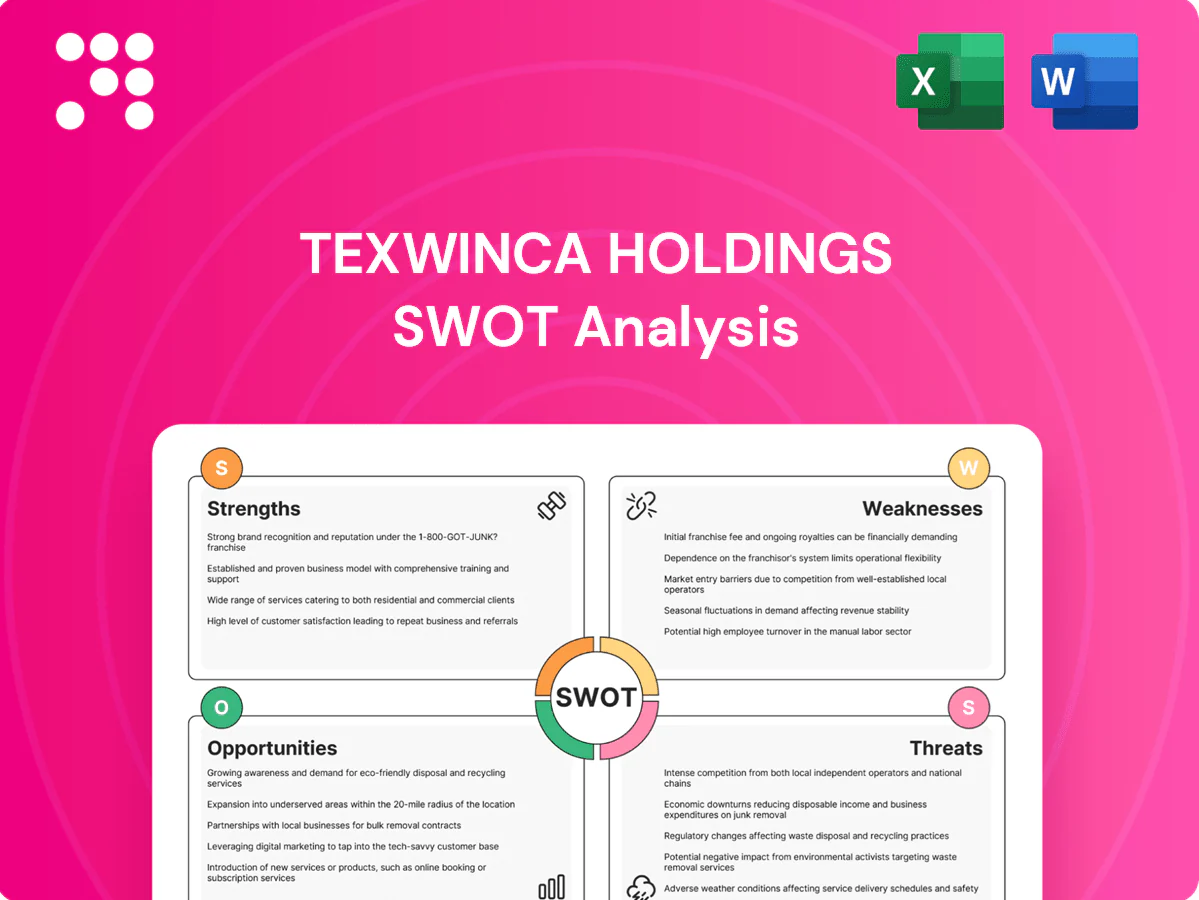
Texwinca Holdings SWOT Analysis

Elevate Your Analysis with the Complete SWOT Report
Texwinca Holdings shows diversified manufacturing reach and strong export channels but faces margin pressure from rising input costs and intense competition in textiles. Our full SWOT uncovers actionable strategies, financial context, and risk scenarios. Purchase the complete report for editable Word and Excel deliverables to support investment or strategic planning.
Strengths

Integrated textile-to-retail value chain
Operating across knitted fabric, garment manufacturing and retail gives Texwinca end-to-end control, shortening lead times and strengthening quality checks. Vertical integration lowers transaction costs and, per industry studies, can reduce inventory holdings by about 20% while improving forecast accuracy. This model enables faster reaction to fashion trends and better alignment of inventory with point-of-sale demand.
Diversified revenue mix
Texwinca Holdings (HKEX: 2678) operates across manufacturing, trading, retailing and property investment, giving multiple income streams that can smooth earnings through apparel cycles.
Investment properties and retail outlets provide rental income and asset backing that can offset garment volatility.
This diversification can improve financing flexibility and overall resilience.

Established sourcing and scale advantages
Established sourcing and scale give Texwinca durable supply security; longstanding supplier relationships and decades of production experience helped maintain input continuity through 2024. Scale enables stronger negotiation on raw materials, logistics and equipment, lowering purchase and freight costs per unit. Standardized processes lift throughput and cut unit costs, supporting competitive pricing and helping preserve stable margins into 2024.

Product development and quality control
In-house fabric and garment capabilities let Texwinca coordinate R&D and rapid sampling, shortening lead times and aligning specs with market needs. Closed-loop feedback from retail and wholesale channels continually refines designs and technical packs. Rigorous quality oversight across sourcing, cutting, and finishing lowers defects and returns, reinforcing customer trust and repeat orders.
- Integrated R&D/sampling
- Channel-driven design feedback
- End-to-end quality control
- Higher customer retention
Multi-channel market access
Multi-channel market access via own retail stores, wholesale partnerships and trading operations broadens Texwinca Holdings reach, enabling targeted brand visibility and higher-margin sell-through through direct retail while wholesale scales volume with lower fixed costs.
- Own retail: brand visibility and margin upside
- Wholesale: volume growth, geographic coverage
- Trading: channel flexibility for inventory clearance
- Improves cash conversion and working capital management
Vertical integration cuts inventory 20%, secures counter-cyclical cashflow
Texwinca (HKEX: 2678) leverages vertical integration to shorten lead times and, per industry studies, can cut inventory about 20% versus peers in 2024.
Diversified revenues across manufacturing, retail, trading and property provide counter-cyclical cashflow and asset backing.
Scale and in-house R&D improve margins and speed to market, sustaining supply continuity through 2024.
| Metric | Value (2024) |
|---|---|
| Listing | HKEX: 2678 |
| Inventory reduction | ~20% (industry) |
| Channels | Mfg / Retail / Trading / Property |
What is included in the product
 Detailed Word Document
Provides a concise strategic overview of Texwinca Holdings’ internal strengths and weaknesses and external opportunities and threats, mapping competitive position, growth drivers, operational gaps, and market risks to inform strategic decisions.

 Customizable Excel Spreadsheet
Provides a concise SWOT matrix for Texwinca Holdings to quickly identify strengths, weaknesses, opportunities, and threats, easing strategic alignment and risk prioritization. Ideal for executives needing a high-level snapshot to support fast, data-driven decisions and stakeholder briefings.
Weaknesses

Exposure to commoditized fabrics
Texwinca (1268 HK) faces margin pressure as knitted fabrics are highly commoditized, driving intense price competition and low product differentiation that compresses gross margins during demand slowdowns.
Inventory and fashion cycle risk
Texwinca’s retail and garment operations face style, size and seasonality risks that make accurate forecasting critical; mis-forecasting forces markdowns and write-offs that compress margins. Longer production lead times in apparel amplify demand mismatch, increasing the likelihood of obsolete stock. Large portions of cash tied up in inventory strain working capital and limit flexibility to respond to market shifts.

High operating leverage
Manufacturing plants and retail networks entail significant fixed costs, leaving Texwinca with a highly fixed cost base. Underutilization of factory capacity or softer retail footfall quickly degrades margins during downturns. Energy, water and compliance costs further pressure profitability, and short-term flexing of labor and asset commitments is difficult.

Customer concentration in OEM/wholesale
Dependence on a handful of OEM/wholesale buyers gives those customers disproportionate bargaining power, pressuring margins and payment terms. Order volatility from major accounts magnifies revenue swings and working capital strain. Losing a single large account would materially reduce volumes and underutilize capacity, while diversifying the customer base is typically slow and resource-intensive.
- Buyer concentration increases negotiation risk
- Order volatility drives revenue and cashflow swings
- Single-account loss would materially cut volumes
- Customer diversification requires time and capital
Retail footprint sensitivity
Physical stores expose Texwinca to rising rent, labor and maintenance costs that compress margins; volatile footfall and a global e-commerce share near 22% in 2023 erode store productivity, while closures or remodels tie up capital and time and brand-building needs continuous marketing spend to sustain traffic.
- Rent, labor, maintenance pressure
- Footfall volatility vs 22% e‑commerce
- Capex/time for closures/remodels
- Ongoing marketing required
Margin squeeze from commoditized knitwear, markdowns and buyer-driven order volatility
Texwinca (1268 HK) faces margin pressure from commoditized knitted fabrics and intense price competition, amplified by retail style/seasonality mismatch that forces markdowns and inventory write-offs. High fixed costs across plants and stores reduce flexibility during downturns, while buyer concentration and volatile orders magnify revenue and working-capital swings; e‑commerce was ~22% of apparel sales in 2023.
| Metric | Value |
|---|---|
| Ticker | 1268 HK |
| E‑commerce share (apparel) | ~22% (2023) |
| Key risks | Margin compression, inventory days, buyer concentration |
Full Version Awaits
Texwinca Holdings SWOT Analysis
This is the actual SWOT analysis document you’ll receive upon purchase—no surprises, just professional quality. The Texwinca Holdings SWOT covers key strengths, weaknesses, opportunities and threats with actionable insights and data-backed observations. The preview shown is identical to the downloadable file, fully editable and ready for use after checkout.

Elevate Your Analysis with the Complete SWOT Report
Texwinca Holdings shows diversified manufacturing reach and strong export channels but faces margin pressure from rising input costs and intense competition in textiles. Our full SWOT uncovers actionable strategies, financial context, and risk scenarios. Purchase the complete report for editable Word and Excel deliverables to support investment or strategic planning.
Strengths
Integrated textile-to-retail value chain
Operating across knitted fabric, garment manufacturing and retail gives Texwinca end-to-end control, shortening lead times and strengthening quality checks. Vertical integration lowers transaction costs and, per industry studies, can reduce inventory holdings by about 20% while improving forecast accuracy. This model enables faster reaction to fashion trends and better alignment of inventory with point-of-sale demand.
Diversified revenue mix
Texwinca Holdings (HKEX: 2678) operates across manufacturing, trading, retailing and property investment, giving multiple income streams that can smooth earnings through apparel cycles.
Investment properties and retail outlets provide rental income and asset backing that can offset garment volatility.
This diversification can improve financing flexibility and overall resilience.
Established sourcing and scale advantages
Established sourcing and scale give Texwinca durable supply security; longstanding supplier relationships and decades of production experience helped maintain input continuity through 2024. Scale enables stronger negotiation on raw materials, logistics and equipment, lowering purchase and freight costs per unit. Standardized processes lift throughput and cut unit costs, supporting competitive pricing and helping preserve stable margins into 2024.
Product development and quality control
In-house fabric and garment capabilities let Texwinca coordinate R&D and rapid sampling, shortening lead times and aligning specs with market needs. Closed-loop feedback from retail and wholesale channels continually refines designs and technical packs. Rigorous quality oversight across sourcing, cutting, and finishing lowers defects and returns, reinforcing customer trust and repeat orders.
- Integrated R&D/sampling
- Channel-driven design feedback
- End-to-end quality control
- Higher customer retention
Multi-channel market access
Multi-channel market access via own retail stores, wholesale partnerships and trading operations broadens Texwinca Holdings reach, enabling targeted brand visibility and higher-margin sell-through through direct retail while wholesale scales volume with lower fixed costs.
- Own retail: brand visibility and margin upside
- Wholesale: volume growth, geographic coverage
- Trading: channel flexibility for inventory clearance
- Improves cash conversion and working capital management
Vertical integration cuts inventory 20%, secures counter-cyclical cashflow
Texwinca (HKEX: 2678) leverages vertical integration to shorten lead times and, per industry studies, can cut inventory about 20% versus peers in 2024.
Diversified revenues across manufacturing, retail, trading and property provide counter-cyclical cashflow and asset backing.
Scale and in-house R&D improve margins and speed to market, sustaining supply continuity through 2024.
| Metric | Value (2024) |
|---|---|
| Listing | HKEX: 2678 |
| Inventory reduction | ~20% (industry) |
| Channels | Mfg / Retail / Trading / Property |
What is included in the product
Detailed Word Document
Provides a concise strategic overview of Texwinca Holdings’ internal strengths and weaknesses and external opportunities and threats, mapping competitive position, growth drivers, operational gaps, and market risks to inform strategic decisions.
Customizable Excel Spreadsheet
Provides a concise SWOT matrix for Texwinca Holdings to quickly identify strengths, weaknesses, opportunities, and threats, easing strategic alignment and risk prioritization. Ideal for executives needing a high-level snapshot to support fast, data-driven decisions and stakeholder briefings.
Weaknesses
Exposure to commoditized fabrics
Texwinca (1268 HK) faces margin pressure as knitted fabrics are highly commoditized, driving intense price competition and low product differentiation that compresses gross margins during demand slowdowns.
Inventory and fashion cycle risk
Texwinca’s retail and garment operations face style, size and seasonality risks that make accurate forecasting critical; mis-forecasting forces markdowns and write-offs that compress margins. Longer production lead times in apparel amplify demand mismatch, increasing the likelihood of obsolete stock. Large portions of cash tied up in inventory strain working capital and limit flexibility to respond to market shifts.
High operating leverage
Manufacturing plants and retail networks entail significant fixed costs, leaving Texwinca with a highly fixed cost base. Underutilization of factory capacity or softer retail footfall quickly degrades margins during downturns. Energy, water and compliance costs further pressure profitability, and short-term flexing of labor and asset commitments is difficult.
Customer concentration in OEM/wholesale
Dependence on a handful of OEM/wholesale buyers gives those customers disproportionate bargaining power, pressuring margins and payment terms. Order volatility from major accounts magnifies revenue swings and working capital strain. Losing a single large account would materially reduce volumes and underutilize capacity, while diversifying the customer base is typically slow and resource-intensive.
- Buyer concentration increases negotiation risk
- Order volatility drives revenue and cashflow swings
- Single-account loss would materially cut volumes
- Customer diversification requires time and capital
Retail footprint sensitivity
Physical stores expose Texwinca to rising rent, labor and maintenance costs that compress margins; volatile footfall and a global e-commerce share near 22% in 2023 erode store productivity, while closures or remodels tie up capital and time and brand-building needs continuous marketing spend to sustain traffic.
- Rent, labor, maintenance pressure
- Footfall volatility vs 22% e‑commerce
- Capex/time for closures/remodels
- Ongoing marketing required
Margin squeeze from commoditized knitwear, markdowns and buyer-driven order volatility
Texwinca (1268 HK) faces margin pressure from commoditized knitted fabrics and intense price competition, amplified by retail style/seasonality mismatch that forces markdowns and inventory write-offs. High fixed costs across plants and stores reduce flexibility during downturns, while buyer concentration and volatile orders magnify revenue and working-capital swings; e‑commerce was ~22% of apparel sales in 2023.
| Metric | Value |
|---|---|
| Ticker | 1268 HK |
| E‑commerce share (apparel) | ~22% (2023) |
| Key risks | Margin compression, inventory days, buyer concentration |
Full Version Awaits
Texwinca Holdings SWOT Analysis
This is the actual SWOT analysis document you’ll receive upon purchase—no surprises, just professional quality. The Texwinca Holdings SWOT covers key strengths, weaknesses, opportunities and threats with actionable insights and data-backed observations. The preview shown is identical to the downloadable file, fully editable and ready for use after checkout.
Description
Elevate Your Analysis with the Complete SWOT Report
Texwinca Holdings shows diversified manufacturing reach and strong export channels but faces margin pressure from rising input costs and intense competition in textiles. Our full SWOT uncovers actionable strategies, financial context, and risk scenarios. Purchase the complete report for editable Word and Excel deliverables to support investment or strategic planning.
Strengths
Integrated textile-to-retail value chain
Operating across knitted fabric, garment manufacturing and retail gives Texwinca end-to-end control, shortening lead times and strengthening quality checks. Vertical integration lowers transaction costs and, per industry studies, can reduce inventory holdings by about 20% while improving forecast accuracy. This model enables faster reaction to fashion trends and better alignment of inventory with point-of-sale demand.
Diversified revenue mix
Texwinca Holdings (HKEX: 2678) operates across manufacturing, trading, retailing and property investment, giving multiple income streams that can smooth earnings through apparel cycles.
Investment properties and retail outlets provide rental income and asset backing that can offset garment volatility.
This diversification can improve financing flexibility and overall resilience.
Established sourcing and scale advantages
Established sourcing and scale give Texwinca durable supply security; longstanding supplier relationships and decades of production experience helped maintain input continuity through 2024. Scale enables stronger negotiation on raw materials, logistics and equipment, lowering purchase and freight costs per unit. Standardized processes lift throughput and cut unit costs, supporting competitive pricing and helping preserve stable margins into 2024.
Product development and quality control
In-house fabric and garment capabilities let Texwinca coordinate R&D and rapid sampling, shortening lead times and aligning specs with market needs. Closed-loop feedback from retail and wholesale channels continually refines designs and technical packs. Rigorous quality oversight across sourcing, cutting, and finishing lowers defects and returns, reinforcing customer trust and repeat orders.
- Integrated R&D/sampling
- Channel-driven design feedback
- End-to-end quality control
- Higher customer retention
Multi-channel market access
Multi-channel market access via own retail stores, wholesale partnerships and trading operations broadens Texwinca Holdings reach, enabling targeted brand visibility and higher-margin sell-through through direct retail while wholesale scales volume with lower fixed costs.
- Own retail: brand visibility and margin upside
- Wholesale: volume growth, geographic coverage
- Trading: channel flexibility for inventory clearance
- Improves cash conversion and working capital management
Vertical integration cuts inventory 20%, secures counter-cyclical cashflow
Texwinca (HKEX: 2678) leverages vertical integration to shorten lead times and, per industry studies, can cut inventory about 20% versus peers in 2024.
Diversified revenues across manufacturing, retail, trading and property provide counter-cyclical cashflow and asset backing.
Scale and in-house R&D improve margins and speed to market, sustaining supply continuity through 2024.
| Metric | Value (2024) |
|---|---|
| Listing | HKEX: 2678 |
| Inventory reduction | ~20% (industry) |
| Channels | Mfg / Retail / Trading / Property |
What is included in the product
Detailed Word Document
Provides a concise strategic overview of Texwinca Holdings’ internal strengths and weaknesses and external opportunities and threats, mapping competitive position, growth drivers, operational gaps, and market risks to inform strategic decisions.
Customizable Excel Spreadsheet
Provides a concise SWOT matrix for Texwinca Holdings to quickly identify strengths, weaknesses, opportunities, and threats, easing strategic alignment and risk prioritization. Ideal for executives needing a high-level snapshot to support fast, data-driven decisions and stakeholder briefings.
Weaknesses
Exposure to commoditized fabrics
Texwinca (1268 HK) faces margin pressure as knitted fabrics are highly commoditized, driving intense price competition and low product differentiation that compresses gross margins during demand slowdowns.
Inventory and fashion cycle risk
Texwinca’s retail and garment operations face style, size and seasonality risks that make accurate forecasting critical; mis-forecasting forces markdowns and write-offs that compress margins. Longer production lead times in apparel amplify demand mismatch, increasing the likelihood of obsolete stock. Large portions of cash tied up in inventory strain working capital and limit flexibility to respond to market shifts.
High operating leverage
Manufacturing plants and retail networks entail significant fixed costs, leaving Texwinca with a highly fixed cost base. Underutilization of factory capacity or softer retail footfall quickly degrades margins during downturns. Energy, water and compliance costs further pressure profitability, and short-term flexing of labor and asset commitments is difficult.
Customer concentration in OEM/wholesale
Dependence on a handful of OEM/wholesale buyers gives those customers disproportionate bargaining power, pressuring margins and payment terms. Order volatility from major accounts magnifies revenue swings and working capital strain. Losing a single large account would materially reduce volumes and underutilize capacity, while diversifying the customer base is typically slow and resource-intensive.
- Buyer concentration increases negotiation risk
- Order volatility drives revenue and cashflow swings
- Single-account loss would materially cut volumes
- Customer diversification requires time and capital
Retail footprint sensitivity
Physical stores expose Texwinca to rising rent, labor and maintenance costs that compress margins; volatile footfall and a global e-commerce share near 22% in 2023 erode store productivity, while closures or remodels tie up capital and time and brand-building needs continuous marketing spend to sustain traffic.
- Rent, labor, maintenance pressure
- Footfall volatility vs 22% e‑commerce
- Capex/time for closures/remodels
- Ongoing marketing required
Margin squeeze from commoditized knitwear, markdowns and buyer-driven order volatility
Texwinca (1268 HK) faces margin pressure from commoditized knitted fabrics and intense price competition, amplified by retail style/seasonality mismatch that forces markdowns and inventory write-offs. High fixed costs across plants and stores reduce flexibility during downturns, while buyer concentration and volatile orders magnify revenue and working-capital swings; e‑commerce was ~22% of apparel sales in 2023.
| Metric | Value |
|---|---|
| Ticker | 1268 HK |
| E‑commerce share (apparel) | ~22% (2023) |
| Key risks | Margin compression, inventory days, buyer concentration |
Full Version Awaits
Texwinca Holdings SWOT Analysis
This is the actual SWOT analysis document you’ll receive upon purchase—no surprises, just professional quality. The Texwinca Holdings SWOT covers key strengths, weaknesses, opportunities and threats with actionable insights and data-backed observations. The preview shown is identical to the downloadable file, fully editable and ready for use after checkout.











