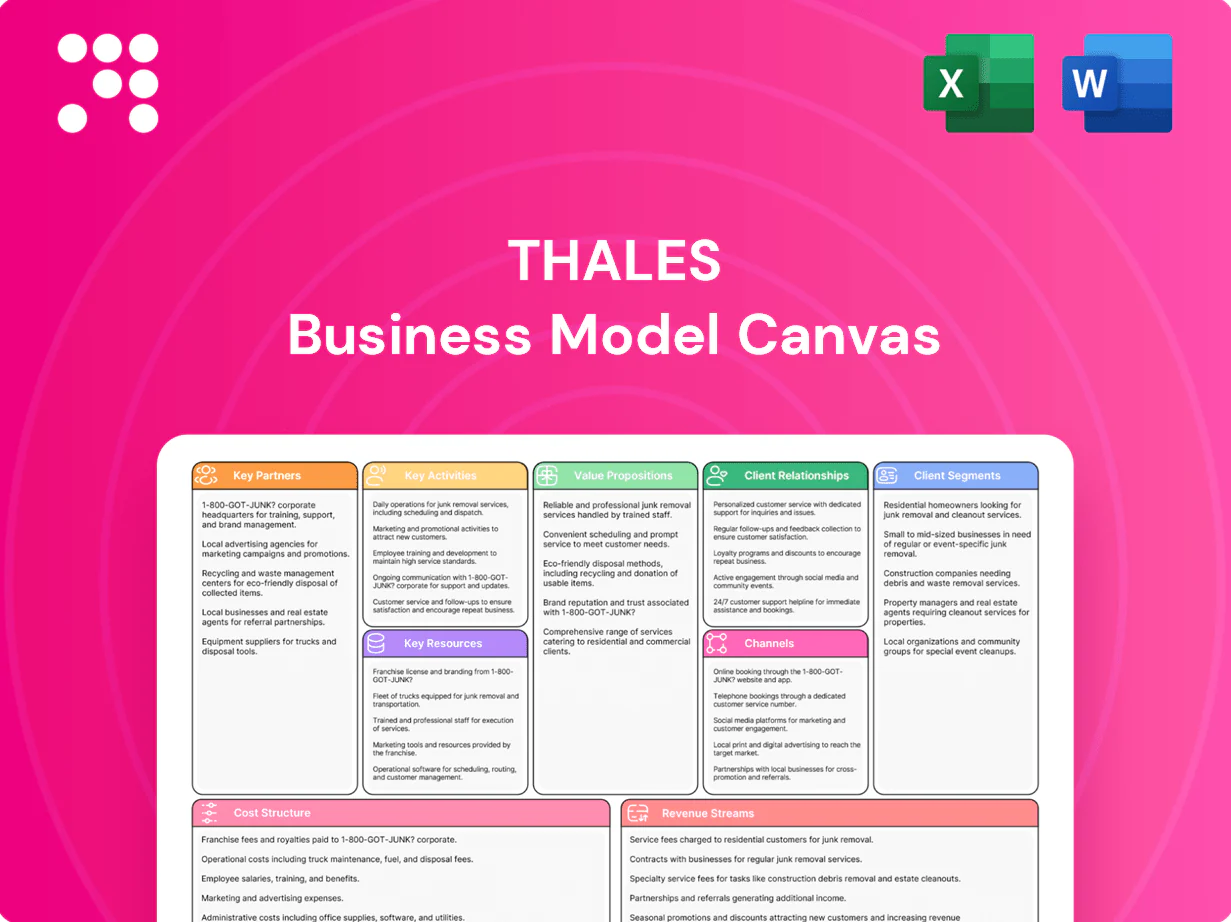
Thales Business Model Canvas

Business Model Canvas: how a leading defense and aerospace innovator creates value
Explore Thales’s Business Model Canvas to uncover how the company engineers value across defense, aerospace, and digital identity—linking alliances, technologies, and revenue streams into a cohesive growth engine. This concise snapshot highlights opportunities and risks for investors and strategists. Download the full, editable Canvas in Word and Excel to benchmark, adapt, and act on Thales’s proven strategy.
Partnerships

Government and defense ministries
Thales builds trusted relationships with national ministries of defence, interior ministries and security agencies, enabling access to classified programs and multi-year procurement pipelines; the company reported about 81,000 employees in 2024 and leverages a backlog near €30bn to secure long-term work. These partnerships shape requirements and standards that guide solution design and interoperability across platforms. Close ties support national sovereignty objectives and smooth export approval processes amid global defence spending above €2.3tn in 2024.
Prime contractors and aerospace OEMs
Collaborations with Airbus, Boeing, Dassault and major shipyards integrate Thales subsystems into flagship platforms, with joint bids improving competitiveness on complex programs. In 2024 technical roadmaps were aligned across partners for interoperability and certification. Risk and workload are shared across program lifecycles, reducing single-party exposure and accelerating delivery timelines.

Universities and research institutes
Academic partnerships accelerate Thales innovation in AI, quantum, photonics and cybersecurity through joint labs and funded chairs that expand research capacity and co-create IP feeding future product portfolios. Internships and joint PhD programs strengthen talent pipelines, enabling rapid transfer of cutting‑edge research into engineering teams. These alliances lower time‑to‑market and de‑risk next‑generation systems.

Cloud, cybersecurity, and telecom partners
Alliances with hyperscalers (AWS 31%, Azure 23%, GCP 11% market share in 2024), telcos and security vendors enable secure cloud, 5G and edge solutions, while joint offerings tackle data sovereignty and regulatory compliance. Integration partnerships cut deployment cycles and co-marketing expands enterprise reach and pipeline.
- Hyperscaler alignment: market-share driven
- Data sovereignty: compliant stacks
- Faster TTM via integration
- Broader reach through co-marketing
Strategic suppliers and deep-tech startups
Strategic suppliers for semiconductors, sensors and emerging quantum components underpin Thales performance, with the EU producing about 10 percent of global semiconductors and relying on imports for the rest in 2024.
Collaborations with deep-tech startups accelerate regulated-market deployment of breakthroughs while supplier development programs and multi-sourcing reduce supply risk and cost volatility.
Defence prime: ~81k employees, €30bn backlog; AWS 31% Azure 23%
Thales secures long-term national defence contracts via ties to ministries and agencies, supported by ~81,000 employees and a backlog near €30bn (2024). Strategic OEM alliances (Airbus, Dassault, Boeing) enable integrated subsystems and shared program risk. Academic, startup and supplier partnerships accelerate AI/quantum/cyber innovations and reduce supply-chain risk. Hyperscaler and telco alliances address cloud, 5G and data‑sovereignty needs (AWS 31%, Azure 23%, GCP 11% 2024).
| Partner type | Key metric | 2024 data |
|---|---|---|
| Governments | Backlog / national spend | €30bn / €2.3tn defence |
| OEMs | Joint programs | Platform integration, shared risk |
| Hyperscalers | Cloud market share | AWS 31% / Azure 23% / GCP 11% |
| Suppliers | Semiconductor reliance | EU ~10% global production |
What is included in the product
 Detailed Word Document
A comprehensive, pre-written Business Model Canvas for Thales that maps customer segments, channels, value propositions, key activities, partners, resources, cost structure and revenue streams with real-world operational detail. Ideal for investors and strategists, it includes competitive advantages and linked SWOT insights to support presentations, funding discussions and decision-making.

 Customizable Excel Spreadsheet
Condenses Thales’s complex defense, aerospace and digital-security strategy into a single editable canvas, saving hours of structuring while enabling quick comparisons, team collaboration and fast executive summaries.
Activities

Advanced R&D in AI, cyber, and quantum
Thales invests over €1bn annually in advanced R&D (2024) to push state-of-the-art AI algorithms, secure architectures and quantum-resistant systems, accelerating commercial readiness. Rapid prototyping validates performance and resilience across defense and aerospace use cases, shortening time-to-contract. Active patenting and standards engagement scale and protect IP, while technology maturation de-risks program bids and supports multi-year tenders.
Systems engineering and integration
Systems engineering and integration deliver end-to-end architectures for complex mission systems, combining sensors, software, communications and command layers across programs supported by Thales’s global footprint of ~80,000 employees in 68 countries. Integration ensures interoperability with legacy platforms and NATO/coalition standards (STANAG), while certified test and validation regimes (DO-178C, ISO 9001) confirm safety and performance.

Industrialization and secure manufacturing
Production adheres to stringent quality and export controls, supporting Thales group revenue of €17.2 billion (2023) and certification across 50+ industrial sites in 2024 to meet ITAR/EAR and NATO standards.
Secure supply chains protect sensitive components via supplier audits and traceability programs covering critical suppliers across 30+ countries in 2024.
Lean operations—continuous improvement and automation—drive throughput and cost efficiency, while configuration management maintains end-to-end traceability for each unit.

Certification, compliance, and accreditation
Thales manages certification across aviation, defense and cybersecurity standards (AS9100, NATO, ISO 27001), securing formal approvals that enable deployment in regulated environments; continuous audits and surveillance audits sustain conformity, while detailed safety cases and operational documentation reduce operational risk and support airworthiness and mission assurance.
- Certification: AS9100, ISO 27001, NATO
- Compliance: regulatory approvals for regulated deployments
- Audits: continuous internal and external surveillance
- Risk reduction: safety cases, technical documentation
Lifecycle services and upgrades
Lifecycle services and upgrades deliver through-life support that maximizes system availability; predictive maintenance cuts downtime by up to 40% and support costs ~30% (2024 industry averages). Continuous cyber hardening and software updates shrink vulnerability windows and maintain operational resilience. Modular capability upgrades extend asset life and mission relevance.
- Through-life support: higher availability
- Predictive maintenance: −40% downtime, −30% cost (2024)
- Cyber hardening: reduced vulnerability window
- Capability upgrades: extended useful life
>€1bn R&D, integrated systems cut downtime ~40%
Thales invests >€1bn p.a. in advanced R&D (2024), fast-prototyping AI/quantum-resistant systems and patenting to de-risk bids. Systems engineering integrates sensors, comms and software across 80,000 employees in 68 countries, meeting STANAG/DO-178C. Production, certification (AS9100/ISO27001/NATO) and secure supply chains across 50+ sites ensure compliant delivery; through-life services cut downtime ~40% and support costs ~30%.
| Metric | Value |
|---|---|
| R&D spend (2024) | €>1bn |
| Revenue (2023) | €17.2bn |
| Employees / Countries | ~80,000 / 68 |
| Certified sites (2024) | 50+ |
Full Document Unlocks After Purchase
Business Model Canvas
The document previewed here is the actual Thales Business Model Canvas you’ll receive after purchase, not a mockup. When you buy, you’ll get this exact, fully editable file in Word and Excel formats. No placeholders, no missing sections—just the complete, ready-to-use canvas.

Business Model Canvas: how a leading defense and aerospace innovator creates value
Explore Thales’s Business Model Canvas to uncover how the company engineers value across defense, aerospace, and digital identity—linking alliances, technologies, and revenue streams into a cohesive growth engine. This concise snapshot highlights opportunities and risks for investors and strategists. Download the full, editable Canvas in Word and Excel to benchmark, adapt, and act on Thales’s proven strategy.
Partnerships
Government and defense ministries
Thales builds trusted relationships with national ministries of defence, interior ministries and security agencies, enabling access to classified programs and multi-year procurement pipelines; the company reported about 81,000 employees in 2024 and leverages a backlog near €30bn to secure long-term work. These partnerships shape requirements and standards that guide solution design and interoperability across platforms. Close ties support national sovereignty objectives and smooth export approval processes amid global defence spending above €2.3tn in 2024.
Prime contractors and aerospace OEMs
Collaborations with Airbus, Boeing, Dassault and major shipyards integrate Thales subsystems into flagship platforms, with joint bids improving competitiveness on complex programs. In 2024 technical roadmaps were aligned across partners for interoperability and certification. Risk and workload are shared across program lifecycles, reducing single-party exposure and accelerating delivery timelines.
Universities and research institutes
Academic partnerships accelerate Thales innovation in AI, quantum, photonics and cybersecurity through joint labs and funded chairs that expand research capacity and co-create IP feeding future product portfolios. Internships and joint PhD programs strengthen talent pipelines, enabling rapid transfer of cutting‑edge research into engineering teams. These alliances lower time‑to‑market and de‑risk next‑generation systems.
Cloud, cybersecurity, and telecom partners
Alliances with hyperscalers (AWS 31%, Azure 23%, GCP 11% market share in 2024), telcos and security vendors enable secure cloud, 5G and edge solutions, while joint offerings tackle data sovereignty and regulatory compliance. Integration partnerships cut deployment cycles and co-marketing expands enterprise reach and pipeline.
- Hyperscaler alignment: market-share driven
- Data sovereignty: compliant stacks
- Faster TTM via integration
- Broader reach through co-marketing
Strategic suppliers and deep-tech startups
Strategic suppliers for semiconductors, sensors and emerging quantum components underpin Thales performance, with the EU producing about 10 percent of global semiconductors and relying on imports for the rest in 2024.
Collaborations with deep-tech startups accelerate regulated-market deployment of breakthroughs while supplier development programs and multi-sourcing reduce supply risk and cost volatility.
Defence prime: ~81k employees, €30bn backlog; AWS 31% Azure 23%
Thales secures long-term national defence contracts via ties to ministries and agencies, supported by ~81,000 employees and a backlog near €30bn (2024). Strategic OEM alliances (Airbus, Dassault, Boeing) enable integrated subsystems and shared program risk. Academic, startup and supplier partnerships accelerate AI/quantum/cyber innovations and reduce supply-chain risk. Hyperscaler and telco alliances address cloud, 5G and data‑sovereignty needs (AWS 31%, Azure 23%, GCP 11% 2024).
| Partner type | Key metric | 2024 data |
|---|---|---|
| Governments | Backlog / national spend | €30bn / €2.3tn defence |
| OEMs | Joint programs | Platform integration, shared risk |
| Hyperscalers | Cloud market share | AWS 31% / Azure 23% / GCP 11% |
| Suppliers | Semiconductor reliance | EU ~10% global production |
What is included in the product
Detailed Word Document
A comprehensive, pre-written Business Model Canvas for Thales that maps customer segments, channels, value propositions, key activities, partners, resources, cost structure and revenue streams with real-world operational detail. Ideal for investors and strategists, it includes competitive advantages and linked SWOT insights to support presentations, funding discussions and decision-making.
Customizable Excel Spreadsheet
Condenses Thales’s complex defense, aerospace and digital-security strategy into a single editable canvas, saving hours of structuring while enabling quick comparisons, team collaboration and fast executive summaries.
Activities
Advanced R&D in AI, cyber, and quantum
Thales invests over €1bn annually in advanced R&D (2024) to push state-of-the-art AI algorithms, secure architectures and quantum-resistant systems, accelerating commercial readiness. Rapid prototyping validates performance and resilience across defense and aerospace use cases, shortening time-to-contract. Active patenting and standards engagement scale and protect IP, while technology maturation de-risks program bids and supports multi-year tenders.
Systems engineering and integration
Systems engineering and integration deliver end-to-end architectures for complex mission systems, combining sensors, software, communications and command layers across programs supported by Thales’s global footprint of ~80,000 employees in 68 countries. Integration ensures interoperability with legacy platforms and NATO/coalition standards (STANAG), while certified test and validation regimes (DO-178C, ISO 9001) confirm safety and performance.
Industrialization and secure manufacturing
Production adheres to stringent quality and export controls, supporting Thales group revenue of €17.2 billion (2023) and certification across 50+ industrial sites in 2024 to meet ITAR/EAR and NATO standards.
Secure supply chains protect sensitive components via supplier audits and traceability programs covering critical suppliers across 30+ countries in 2024.
Lean operations—continuous improvement and automation—drive throughput and cost efficiency, while configuration management maintains end-to-end traceability for each unit.
Certification, compliance, and accreditation
Thales manages certification across aviation, defense and cybersecurity standards (AS9100, NATO, ISO 27001), securing formal approvals that enable deployment in regulated environments; continuous audits and surveillance audits sustain conformity, while detailed safety cases and operational documentation reduce operational risk and support airworthiness and mission assurance.
- Certification: AS9100, ISO 27001, NATO
- Compliance: regulatory approvals for regulated deployments
- Audits: continuous internal and external surveillance
- Risk reduction: safety cases, technical documentation
Lifecycle services and upgrades
Lifecycle services and upgrades deliver through-life support that maximizes system availability; predictive maintenance cuts downtime by up to 40% and support costs ~30% (2024 industry averages). Continuous cyber hardening and software updates shrink vulnerability windows and maintain operational resilience. Modular capability upgrades extend asset life and mission relevance.
- Through-life support: higher availability
- Predictive maintenance: −40% downtime, −30% cost (2024)
- Cyber hardening: reduced vulnerability window
- Capability upgrades: extended useful life
>€1bn R&D, integrated systems cut downtime ~40%
Thales invests >€1bn p.a. in advanced R&D (2024), fast-prototyping AI/quantum-resistant systems and patenting to de-risk bids. Systems engineering integrates sensors, comms and software across 80,000 employees in 68 countries, meeting STANAG/DO-178C. Production, certification (AS9100/ISO27001/NATO) and secure supply chains across 50+ sites ensure compliant delivery; through-life services cut downtime ~40% and support costs ~30%.
| Metric | Value |
|---|---|
| R&D spend (2024) | €>1bn |
| Revenue (2023) | €17.2bn |
| Employees / Countries | ~80,000 / 68 |
| Certified sites (2024) | 50+ |
Full Document Unlocks After Purchase
Business Model Canvas
The document previewed here is the actual Thales Business Model Canvas you’ll receive after purchase, not a mockup. When you buy, you’ll get this exact, fully editable file in Word and Excel formats. No placeholders, no missing sections—just the complete, ready-to-use canvas.
Description
Business Model Canvas: how a leading defense and aerospace innovator creates value
Explore Thales’s Business Model Canvas to uncover how the company engineers value across defense, aerospace, and digital identity—linking alliances, technologies, and revenue streams into a cohesive growth engine. This concise snapshot highlights opportunities and risks for investors and strategists. Download the full, editable Canvas in Word and Excel to benchmark, adapt, and act on Thales’s proven strategy.
Partnerships
Government and defense ministries
Thales builds trusted relationships with national ministries of defence, interior ministries and security agencies, enabling access to classified programs and multi-year procurement pipelines; the company reported about 81,000 employees in 2024 and leverages a backlog near €30bn to secure long-term work. These partnerships shape requirements and standards that guide solution design and interoperability across platforms. Close ties support national sovereignty objectives and smooth export approval processes amid global defence spending above €2.3tn in 2024.
Prime contractors and aerospace OEMs
Collaborations with Airbus, Boeing, Dassault and major shipyards integrate Thales subsystems into flagship platforms, with joint bids improving competitiveness on complex programs. In 2024 technical roadmaps were aligned across partners for interoperability and certification. Risk and workload are shared across program lifecycles, reducing single-party exposure and accelerating delivery timelines.
Universities and research institutes
Academic partnerships accelerate Thales innovation in AI, quantum, photonics and cybersecurity through joint labs and funded chairs that expand research capacity and co-create IP feeding future product portfolios. Internships and joint PhD programs strengthen talent pipelines, enabling rapid transfer of cutting‑edge research into engineering teams. These alliances lower time‑to‑market and de‑risk next‑generation systems.
Cloud, cybersecurity, and telecom partners
Alliances with hyperscalers (AWS 31%, Azure 23%, GCP 11% market share in 2024), telcos and security vendors enable secure cloud, 5G and edge solutions, while joint offerings tackle data sovereignty and regulatory compliance. Integration partnerships cut deployment cycles and co-marketing expands enterprise reach and pipeline.
- Hyperscaler alignment: market-share driven
- Data sovereignty: compliant stacks
- Faster TTM via integration
- Broader reach through co-marketing
Strategic suppliers and deep-tech startups
Strategic suppliers for semiconductors, sensors and emerging quantum components underpin Thales performance, with the EU producing about 10 percent of global semiconductors and relying on imports for the rest in 2024.
Collaborations with deep-tech startups accelerate regulated-market deployment of breakthroughs while supplier development programs and multi-sourcing reduce supply risk and cost volatility.
Defence prime: ~81k employees, €30bn backlog; AWS 31% Azure 23%
Thales secures long-term national defence contracts via ties to ministries and agencies, supported by ~81,000 employees and a backlog near €30bn (2024). Strategic OEM alliances (Airbus, Dassault, Boeing) enable integrated subsystems and shared program risk. Academic, startup and supplier partnerships accelerate AI/quantum/cyber innovations and reduce supply-chain risk. Hyperscaler and telco alliances address cloud, 5G and data‑sovereignty needs (AWS 31%, Azure 23%, GCP 11% 2024).
| Partner type | Key metric | 2024 data |
|---|---|---|
| Governments | Backlog / national spend | €30bn / €2.3tn defence |
| OEMs | Joint programs | Platform integration, shared risk |
| Hyperscalers | Cloud market share | AWS 31% / Azure 23% / GCP 11% |
| Suppliers | Semiconductor reliance | EU ~10% global production |
What is included in the product
Detailed Word Document
A comprehensive, pre-written Business Model Canvas for Thales that maps customer segments, channels, value propositions, key activities, partners, resources, cost structure and revenue streams with real-world operational detail. Ideal for investors and strategists, it includes competitive advantages and linked SWOT insights to support presentations, funding discussions and decision-making.
Customizable Excel Spreadsheet
Condenses Thales’s complex defense, aerospace and digital-security strategy into a single editable canvas, saving hours of structuring while enabling quick comparisons, team collaboration and fast executive summaries.
Activities
Advanced R&D in AI, cyber, and quantum
Thales invests over €1bn annually in advanced R&D (2024) to push state-of-the-art AI algorithms, secure architectures and quantum-resistant systems, accelerating commercial readiness. Rapid prototyping validates performance and resilience across defense and aerospace use cases, shortening time-to-contract. Active patenting and standards engagement scale and protect IP, while technology maturation de-risks program bids and supports multi-year tenders.
Systems engineering and integration
Systems engineering and integration deliver end-to-end architectures for complex mission systems, combining sensors, software, communications and command layers across programs supported by Thales’s global footprint of ~80,000 employees in 68 countries. Integration ensures interoperability with legacy platforms and NATO/coalition standards (STANAG), while certified test and validation regimes (DO-178C, ISO 9001) confirm safety and performance.
Industrialization and secure manufacturing
Production adheres to stringent quality and export controls, supporting Thales group revenue of €17.2 billion (2023) and certification across 50+ industrial sites in 2024 to meet ITAR/EAR and NATO standards.
Secure supply chains protect sensitive components via supplier audits and traceability programs covering critical suppliers across 30+ countries in 2024.
Lean operations—continuous improvement and automation—drive throughput and cost efficiency, while configuration management maintains end-to-end traceability for each unit.
Certification, compliance, and accreditation
Thales manages certification across aviation, defense and cybersecurity standards (AS9100, NATO, ISO 27001), securing formal approvals that enable deployment in regulated environments; continuous audits and surveillance audits sustain conformity, while detailed safety cases and operational documentation reduce operational risk and support airworthiness and mission assurance.
- Certification: AS9100, ISO 27001, NATO
- Compliance: regulatory approvals for regulated deployments
- Audits: continuous internal and external surveillance
- Risk reduction: safety cases, technical documentation
Lifecycle services and upgrades
Lifecycle services and upgrades deliver through-life support that maximizes system availability; predictive maintenance cuts downtime by up to 40% and support costs ~30% (2024 industry averages). Continuous cyber hardening and software updates shrink vulnerability windows and maintain operational resilience. Modular capability upgrades extend asset life and mission relevance.
- Through-life support: higher availability
- Predictive maintenance: −40% downtime, −30% cost (2024)
- Cyber hardening: reduced vulnerability window
- Capability upgrades: extended useful life
>€1bn R&D, integrated systems cut downtime ~40%
Thales invests >€1bn p.a. in advanced R&D (2024), fast-prototyping AI/quantum-resistant systems and patenting to de-risk bids. Systems engineering integrates sensors, comms and software across 80,000 employees in 68 countries, meeting STANAG/DO-178C. Production, certification (AS9100/ISO27001/NATO) and secure supply chains across 50+ sites ensure compliant delivery; through-life services cut downtime ~40% and support costs ~30%.
| Metric | Value |
|---|---|
| R&D spend (2024) | €>1bn |
| Revenue (2023) | €17.2bn |
| Employees / Countries | ~80,000 / 68 |
| Certified sites (2024) | 50+ |
Full Document Unlocks After Purchase
Business Model Canvas
The document previewed here is the actual Thales Business Model Canvas you’ll receive after purchase, not a mockup. When you buy, you’ll get this exact, fully editable file in Word and Excel formats. No placeholders, no missing sections—just the complete, ready-to-use canvas.











