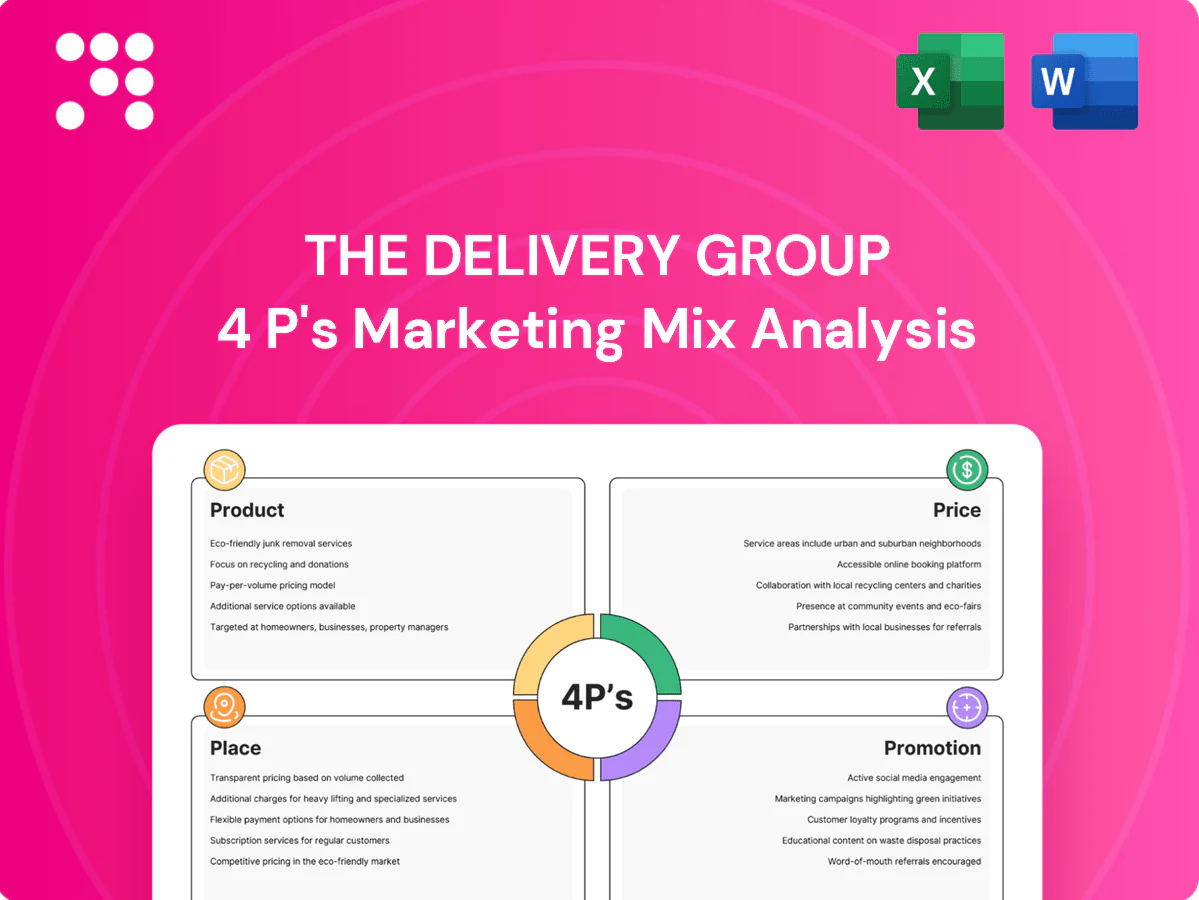
The Delivery Group Marketing Mix

Go Beyond the Snapshot—Get the Full Strategy
Discover how The Delivery Group integrates product offerings, dynamic pricing, targeted distribution, and persuasive promotion to dominate last-mile logistics; this snapshot highlights strengths and opportunities. Purchase the full 4P's Marketing Mix Analysis for editable, data-backed insights, templates, and actionable strategies you can apply immediately.
Product

Downstream access mail services
Downstream access mail services provide end-to-end DSA routing that sorts high-volume letters into final-mile networks with sortation speeds exceeding 20,000 items/hour and service tiers from economy to priority. Focused on reliability and regulatory compliance, DSA typically cuts postal spend versus retail by ~30% (2023–24 industry averages). Comprehensive reporting benchmarks savings and performance with delivery SLAs and ROI metrics for clients.
Parcel sortation and consolidation
The Delivery Group consolidates multi-carrier volumes to capture scale efficiencies and deliver double-digit improvements in cost and on-time performance. Automated national sortation centers boost speed and accuracy, processing millions of parcels weekly. Single-IT integration and label standardization cut onboarding to under 30 days, while proactive exception handling minimizes delays and loss.

E-commerce fulfilment operations
Pick, pack and dispatch services manage D2C and B2B flows from receipt to outbound with inventory management, SKU kitting and value-added prep, supporting inventory accuracy of 99.5% and reducing order lead time by up to 48 hours. Integrations with marketplaces and carts automate order flow across channels, enabling same-day dispatch for orders before typical cut-offs of 14:00–17:00. SLAs emphasize cut-offs, same-day dispatch and peak resilience with peak throughput uplift of up to 3x.

Delivery management platform
The Delivery Group delivery management platform offers an online portal and APIs for booking, tracking and analytics with rate shopping, service selection and address validation; real-time visibility reduces WISMO and support queries while custom dashboards surface OTIF, carrier performance and cost-to-serve.
- Booking, tracking, analytics
- Rate shopping & address validation
- Real-time visibility cuts WISMO/support
- Dashboards: OTIF, carrier KPIs, cost-to-serve
International and returns solutions
International and returns solutions offer duties, customs documentation and DDP/DDU choices to lower friction; in 2024 DDP adoption rose ~18% as merchants prioritized full landed-cost pricing. Tracked/untracked tiers align margin needs by product and destination, with tracked services boosting deliverability by ~12%. Branded and paperless returns speed restock and lift NPS; compliance workflows cut delay-related surcharges up to ~30%.
- Cross-border: DDP/DDU, duties, customs docs
- Service tiers: tracked vs untracked for margin fit (~12% deliverability gain)
- Returns: branded, paperless = faster restock, higher NPS (~8%)
- Compliance: reduces delays/surcharges (~30%, saves ~$3–$4/parcel)
Fulfillment: >20,000/hr, ~30% postal savings, 99.5% accuracy
Integrated product suite: DSA sortation >20,000 items/hr, postal spend ~30% lower (2023–24), onboarding <30 days, inventory accuracy 99.5% and peak throughput up to 3x; DDP adoption +18% (2024), tracked +12% deliverability, returns lift NPS ~8% and compliance saves ~$3–$4/parcel.
| Metric | Value |
|---|---|
| Sort speed | >20,000/hr |
| Postal spend | ~30%↓ |
| Inventory acc. | 99.5% |
What is included in the product
 Detailed Word Document
Delivers a company-specific deep dive into The Delivery Group’s Product, Price, Place, and Promotion strategies, using actual brand practices and competitive context to ground insights. Ideal for managers, consultants, and marketers seeking a structured, ready-to-use analysis with examples, benchmarking, and strategic implications for reports or presentations.

 Customizable Excel Spreadsheet
Condenses The Delivery Group's 4Ps into a high‑level, easily digestible summary for leadership presentations and rapid alignment; customizable for decks or workshops and ideal for helping non‑marketing stakeholders quickly grasp the brand’s strategic direction.
Place

UK-wide fulfilment hubs
UK-wide fulfilment hubs sit beside major transport corridors such as the M1, M6 and M25 to cut trunking distances and enable faster inter-regional flows. Proximity to carrier depots accelerates handover, supporting later cut-offs and higher same-day dispatch rates. Capacity planning and flexible racking absorb seasonal peaks, while ISO 27001 and Cyber Essentials audited sites ensure compliant, secure handling of regulated mail.
Nationwide collection network
Regular scheduled collections cover 95% of the top 50 commercial regions and major e-commerce clusters, operating daily to match demand. Flexible on‑demand pick-ups absorb up to 40% of promo spikes. Consolidation at regional cross‑docks cuts linehaul costs ~18%. Time‑definite pick‑ups hit 98% of customer warehouse windows.

Multi-carrier final-mile partnerships
Ties with postal operators and parcel couriers provide broad service choice across ground, air, and local same‑day options, with last‑mile representing up to 53% of total delivery cost. Intelligent routing selects the optimal carrier by weight, destination, and SLA, and multi‑carrier strategies have cut failed deliveries and delays by as much as 30% in retailer case studies. Redundancy shields against outages/backlogs; customers gain one contract covering multiple carriers and rates.

Seamless IT integrations
- APIs/webhooks: real-time sync
- Automation: label/manifesting
- Data: track-trace + billing
- Onboarding: faster go-live
Inventory positioning and cross-docking
Inventory positioned close to demand cuts delivery times and last-mile costs, driving up to 30% faster transit and materially lowering freight spend; cross-dock flows bypass storage for fast-moving SKUs, trimming dwell by up to 40%; carrier-optimized handovers cut failed deliveries by ~20%; continuous improvement lifted lane OTIF 5–8% in 2024 pilots.
- Near-demand: up to 30% faster
- Cross-dock: ≤40% lower dwell
- Handover: ~20% fewer failed deliveries
- CI: 5–8% OTIF gains (2024)
UK M1/M6/M25 hubs cut linehaul 18%, failed deliveries 30%
UK fulfilment hubs on M1/M6/M25 reduce trunking, supporting 95% regional coverage and 98% time‑definite pick‑ups; ISO 27001 sites secure regulated mail. Multi‑carrier routing cuts failed deliveries up to 30% and reduces linehaul costs ~18%; last‑mile is ~53% of delivery cost. APIs (part of a $4.3B 2024 API market) speed onboarding by ~60% and lift OTIF 5–8% in 2024 pilots.
| Metric | Value (2024/25) |
|---|---|
| Regional coverage | 95% |
| Same‑day/OTIF gains | 5–8% |
| Failed deliveries cut | ~30% |
| API market | $4.3B (2024) |
Full Version Awaits
The Delivery Group 4P's Marketing Mix Analysis
The preview shown here is the actual Delivery Group 4P's Marketing Mix Analysis you’ll receive instantly after purchase — no mockups or samples. This editable, full-length document is complete and ready to use for strategy, planning, or presentations. Buy with confidence: the file you see is the exact file you'll download upon checkout.

Go Beyond the Snapshot—Get the Full Strategy
Discover how The Delivery Group integrates product offerings, dynamic pricing, targeted distribution, and persuasive promotion to dominate last-mile logistics; this snapshot highlights strengths and opportunities. Purchase the full 4P's Marketing Mix Analysis for editable, data-backed insights, templates, and actionable strategies you can apply immediately.
Product
Downstream access mail services
Downstream access mail services provide end-to-end DSA routing that sorts high-volume letters into final-mile networks with sortation speeds exceeding 20,000 items/hour and service tiers from economy to priority. Focused on reliability and regulatory compliance, DSA typically cuts postal spend versus retail by ~30% (2023–24 industry averages). Comprehensive reporting benchmarks savings and performance with delivery SLAs and ROI metrics for clients.
Parcel sortation and consolidation
The Delivery Group consolidates multi-carrier volumes to capture scale efficiencies and deliver double-digit improvements in cost and on-time performance. Automated national sortation centers boost speed and accuracy, processing millions of parcels weekly. Single-IT integration and label standardization cut onboarding to under 30 days, while proactive exception handling minimizes delays and loss.
E-commerce fulfilment operations
Pick, pack and dispatch services manage D2C and B2B flows from receipt to outbound with inventory management, SKU kitting and value-added prep, supporting inventory accuracy of 99.5% and reducing order lead time by up to 48 hours. Integrations with marketplaces and carts automate order flow across channels, enabling same-day dispatch for orders before typical cut-offs of 14:00–17:00. SLAs emphasize cut-offs, same-day dispatch and peak resilience with peak throughput uplift of up to 3x.
Delivery management platform
The Delivery Group delivery management platform offers an online portal and APIs for booking, tracking and analytics with rate shopping, service selection and address validation; real-time visibility reduces WISMO and support queries while custom dashboards surface OTIF, carrier performance and cost-to-serve.
- Booking, tracking, analytics
- Rate shopping & address validation
- Real-time visibility cuts WISMO/support
- Dashboards: OTIF, carrier KPIs, cost-to-serve
International and returns solutions
International and returns solutions offer duties, customs documentation and DDP/DDU choices to lower friction; in 2024 DDP adoption rose ~18% as merchants prioritized full landed-cost pricing. Tracked/untracked tiers align margin needs by product and destination, with tracked services boosting deliverability by ~12%. Branded and paperless returns speed restock and lift NPS; compliance workflows cut delay-related surcharges up to ~30%.
- Cross-border: DDP/DDU, duties, customs docs
- Service tiers: tracked vs untracked for margin fit (~12% deliverability gain)
- Returns: branded, paperless = faster restock, higher NPS (~8%)
- Compliance: reduces delays/surcharges (~30%, saves ~$3–$4/parcel)
Fulfillment: >20,000/hr, ~30% postal savings, 99.5% accuracy
Integrated product suite: DSA sortation >20,000 items/hr, postal spend ~30% lower (2023–24), onboarding <30 days, inventory accuracy 99.5% and peak throughput up to 3x; DDP adoption +18% (2024), tracked +12% deliverability, returns lift NPS ~8% and compliance saves ~$3–$4/parcel.
| Metric | Value |
|---|---|
| Sort speed | >20,000/hr |
| Postal spend | ~30%↓ |
| Inventory acc. | 99.5% |
What is included in the product
Detailed Word Document
Delivers a company-specific deep dive into The Delivery Group’s Product, Price, Place, and Promotion strategies, using actual brand practices and competitive context to ground insights. Ideal for managers, consultants, and marketers seeking a structured, ready-to-use analysis with examples, benchmarking, and strategic implications for reports or presentations.
Customizable Excel Spreadsheet
Condenses The Delivery Group's 4Ps into a high‑level, easily digestible summary for leadership presentations and rapid alignment; customizable for decks or workshops and ideal for helping non‑marketing stakeholders quickly grasp the brand’s strategic direction.
Place
UK-wide fulfilment hubs
UK-wide fulfilment hubs sit beside major transport corridors such as the M1, M6 and M25 to cut trunking distances and enable faster inter-regional flows. Proximity to carrier depots accelerates handover, supporting later cut-offs and higher same-day dispatch rates. Capacity planning and flexible racking absorb seasonal peaks, while ISO 27001 and Cyber Essentials audited sites ensure compliant, secure handling of regulated mail.
Nationwide collection network
Regular scheduled collections cover 95% of the top 50 commercial regions and major e-commerce clusters, operating daily to match demand. Flexible on‑demand pick-ups absorb up to 40% of promo spikes. Consolidation at regional cross‑docks cuts linehaul costs ~18%. Time‑definite pick‑ups hit 98% of customer warehouse windows.
Multi-carrier final-mile partnerships
Ties with postal operators and parcel couriers provide broad service choice across ground, air, and local same‑day options, with last‑mile representing up to 53% of total delivery cost. Intelligent routing selects the optimal carrier by weight, destination, and SLA, and multi‑carrier strategies have cut failed deliveries and delays by as much as 30% in retailer case studies. Redundancy shields against outages/backlogs; customers gain one contract covering multiple carriers and rates.
Seamless IT integrations
- APIs/webhooks: real-time sync
- Automation: label/manifesting
- Data: track-trace + billing
- Onboarding: faster go-live
Inventory positioning and cross-docking
Inventory positioned close to demand cuts delivery times and last-mile costs, driving up to 30% faster transit and materially lowering freight spend; cross-dock flows bypass storage for fast-moving SKUs, trimming dwell by up to 40%; carrier-optimized handovers cut failed deliveries by ~20%; continuous improvement lifted lane OTIF 5–8% in 2024 pilots.
- Near-demand: up to 30% faster
- Cross-dock: ≤40% lower dwell
- Handover: ~20% fewer failed deliveries
- CI: 5–8% OTIF gains (2024)
UK M1/M6/M25 hubs cut linehaul 18%, failed deliveries 30%
UK fulfilment hubs on M1/M6/M25 reduce trunking, supporting 95% regional coverage and 98% time‑definite pick‑ups; ISO 27001 sites secure regulated mail. Multi‑carrier routing cuts failed deliveries up to 30% and reduces linehaul costs ~18%; last‑mile is ~53% of delivery cost. APIs (part of a $4.3B 2024 API market) speed onboarding by ~60% and lift OTIF 5–8% in 2024 pilots.
| Metric | Value (2024/25) |
|---|---|
| Regional coverage | 95% |
| Same‑day/OTIF gains | 5–8% |
| Failed deliveries cut | ~30% |
| API market | $4.3B (2024) |
Full Version Awaits
The Delivery Group 4P's Marketing Mix Analysis
The preview shown here is the actual Delivery Group 4P's Marketing Mix Analysis you’ll receive instantly after purchase — no mockups or samples. This editable, full-length document is complete and ready to use for strategy, planning, or presentations. Buy with confidence: the file you see is the exact file you'll download upon checkout.
Original: $10.00
-65%$10.00
$3.50Description
Go Beyond the Snapshot—Get the Full Strategy
Discover how The Delivery Group integrates product offerings, dynamic pricing, targeted distribution, and persuasive promotion to dominate last-mile logistics; this snapshot highlights strengths and opportunities. Purchase the full 4P's Marketing Mix Analysis for editable, data-backed insights, templates, and actionable strategies you can apply immediately.
Product
Downstream access mail services
Downstream access mail services provide end-to-end DSA routing that sorts high-volume letters into final-mile networks with sortation speeds exceeding 20,000 items/hour and service tiers from economy to priority. Focused on reliability and regulatory compliance, DSA typically cuts postal spend versus retail by ~30% (2023–24 industry averages). Comprehensive reporting benchmarks savings and performance with delivery SLAs and ROI metrics for clients.
Parcel sortation and consolidation
The Delivery Group consolidates multi-carrier volumes to capture scale efficiencies and deliver double-digit improvements in cost and on-time performance. Automated national sortation centers boost speed and accuracy, processing millions of parcels weekly. Single-IT integration and label standardization cut onboarding to under 30 days, while proactive exception handling minimizes delays and loss.
E-commerce fulfilment operations
Pick, pack and dispatch services manage D2C and B2B flows from receipt to outbound with inventory management, SKU kitting and value-added prep, supporting inventory accuracy of 99.5% and reducing order lead time by up to 48 hours. Integrations with marketplaces and carts automate order flow across channels, enabling same-day dispatch for orders before typical cut-offs of 14:00–17:00. SLAs emphasize cut-offs, same-day dispatch and peak resilience with peak throughput uplift of up to 3x.
Delivery management platform
The Delivery Group delivery management platform offers an online portal and APIs for booking, tracking and analytics with rate shopping, service selection and address validation; real-time visibility reduces WISMO and support queries while custom dashboards surface OTIF, carrier performance and cost-to-serve.
- Booking, tracking, analytics
- Rate shopping & address validation
- Real-time visibility cuts WISMO/support
- Dashboards: OTIF, carrier KPIs, cost-to-serve
International and returns solutions
International and returns solutions offer duties, customs documentation and DDP/DDU choices to lower friction; in 2024 DDP adoption rose ~18% as merchants prioritized full landed-cost pricing. Tracked/untracked tiers align margin needs by product and destination, with tracked services boosting deliverability by ~12%. Branded and paperless returns speed restock and lift NPS; compliance workflows cut delay-related surcharges up to ~30%.
- Cross-border: DDP/DDU, duties, customs docs
- Service tiers: tracked vs untracked for margin fit (~12% deliverability gain)
- Returns: branded, paperless = faster restock, higher NPS (~8%)
- Compliance: reduces delays/surcharges (~30%, saves ~$3–$4/parcel)
Fulfillment: >20,000/hr, ~30% postal savings, 99.5% accuracy
Integrated product suite: DSA sortation >20,000 items/hr, postal spend ~30% lower (2023–24), onboarding <30 days, inventory accuracy 99.5% and peak throughput up to 3x; DDP adoption +18% (2024), tracked +12% deliverability, returns lift NPS ~8% and compliance saves ~$3–$4/parcel.
| Metric | Value |
|---|---|
| Sort speed | >20,000/hr |
| Postal spend | ~30%↓ |
| Inventory acc. | 99.5% |
What is included in the product
Detailed Word Document
Delivers a company-specific deep dive into The Delivery Group’s Product, Price, Place, and Promotion strategies, using actual brand practices and competitive context to ground insights. Ideal for managers, consultants, and marketers seeking a structured, ready-to-use analysis with examples, benchmarking, and strategic implications for reports or presentations.
Customizable Excel Spreadsheet
Condenses The Delivery Group's 4Ps into a high‑level, easily digestible summary for leadership presentations and rapid alignment; customizable for decks or workshops and ideal for helping non‑marketing stakeholders quickly grasp the brand’s strategic direction.
Place
UK-wide fulfilment hubs
UK-wide fulfilment hubs sit beside major transport corridors such as the M1, M6 and M25 to cut trunking distances and enable faster inter-regional flows. Proximity to carrier depots accelerates handover, supporting later cut-offs and higher same-day dispatch rates. Capacity planning and flexible racking absorb seasonal peaks, while ISO 27001 and Cyber Essentials audited sites ensure compliant, secure handling of regulated mail.
Nationwide collection network
Regular scheduled collections cover 95% of the top 50 commercial regions and major e-commerce clusters, operating daily to match demand. Flexible on‑demand pick-ups absorb up to 40% of promo spikes. Consolidation at regional cross‑docks cuts linehaul costs ~18%. Time‑definite pick‑ups hit 98% of customer warehouse windows.
Multi-carrier final-mile partnerships
Ties with postal operators and parcel couriers provide broad service choice across ground, air, and local same‑day options, with last‑mile representing up to 53% of total delivery cost. Intelligent routing selects the optimal carrier by weight, destination, and SLA, and multi‑carrier strategies have cut failed deliveries and delays by as much as 30% in retailer case studies. Redundancy shields against outages/backlogs; customers gain one contract covering multiple carriers and rates.
Seamless IT integrations
- APIs/webhooks: real-time sync
- Automation: label/manifesting
- Data: track-trace + billing
- Onboarding: faster go-live
Inventory positioning and cross-docking
Inventory positioned close to demand cuts delivery times and last-mile costs, driving up to 30% faster transit and materially lowering freight spend; cross-dock flows bypass storage for fast-moving SKUs, trimming dwell by up to 40%; carrier-optimized handovers cut failed deliveries by ~20%; continuous improvement lifted lane OTIF 5–8% in 2024 pilots.
- Near-demand: up to 30% faster
- Cross-dock: ≤40% lower dwell
- Handover: ~20% fewer failed deliveries
- CI: 5–8% OTIF gains (2024)
UK M1/M6/M25 hubs cut linehaul 18%, failed deliveries 30%
UK fulfilment hubs on M1/M6/M25 reduce trunking, supporting 95% regional coverage and 98% time‑definite pick‑ups; ISO 27001 sites secure regulated mail. Multi‑carrier routing cuts failed deliveries up to 30% and reduces linehaul costs ~18%; last‑mile is ~53% of delivery cost. APIs (part of a $4.3B 2024 API market) speed onboarding by ~60% and lift OTIF 5–8% in 2024 pilots.
| Metric | Value (2024/25) |
|---|---|
| Regional coverage | 95% |
| Same‑day/OTIF gains | 5–8% |
| Failed deliveries cut | ~30% |
| API market | $4.3B (2024) |
Full Version Awaits
The Delivery Group 4P's Marketing Mix Analysis
The preview shown here is the actual Delivery Group 4P's Marketing Mix Analysis you’ll receive instantly after purchase — no mockups or samples. This editable, full-length document is complete and ready to use for strategy, planning, or presentations. Buy with confidence: the file you see is the exact file you'll download upon checkout.











