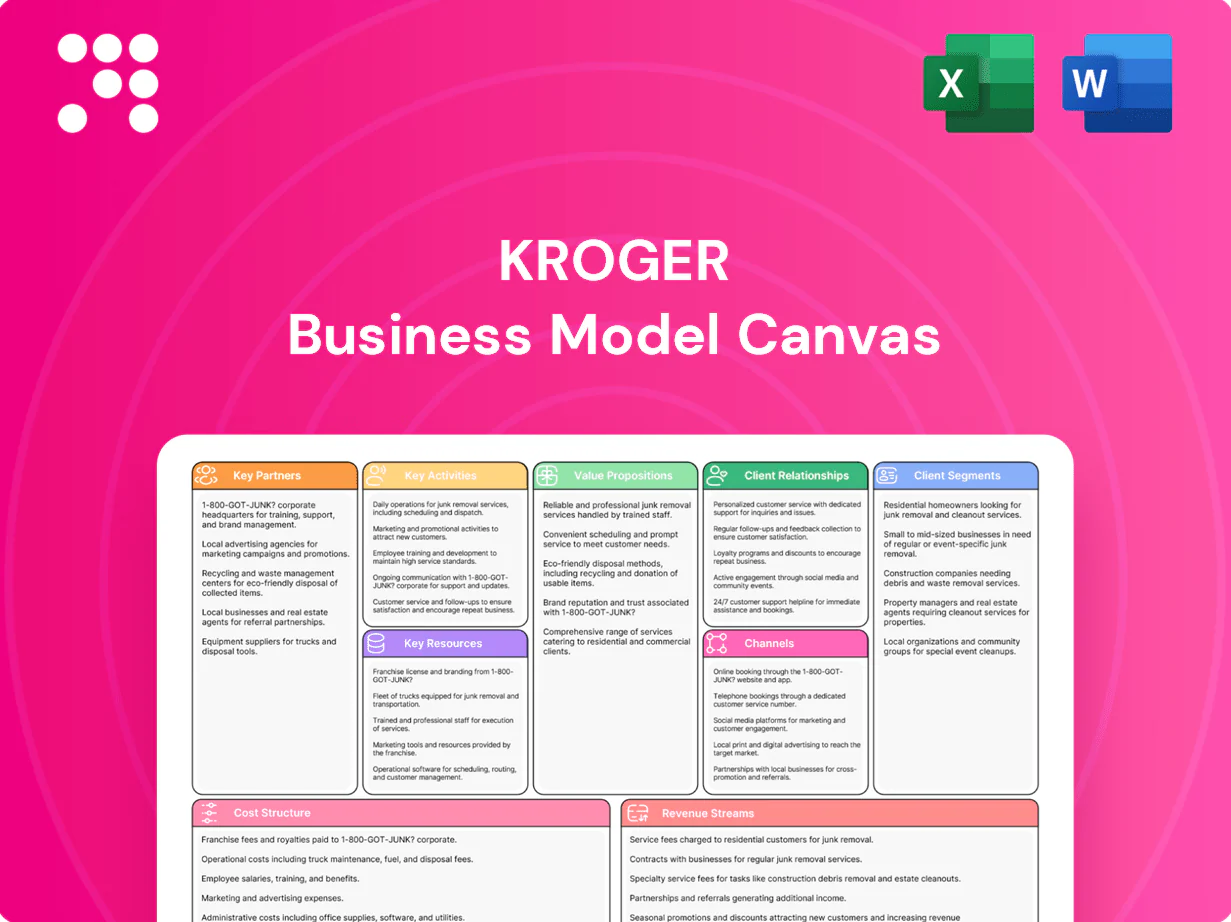
Kroger Business Model Canvas

Discover Grocery Leader Business Model Canvas: loyalty, private label, logistics driving margins
Discover Kroger’s Business Model Canvas: a concise breakdown of its customer segments, value propositions, key partners, and revenue streams that power grocery leadership. This preview reveals strategic levers—loyalty, private label, and logistics—that drive margins and growth. Want the full, editable Canvas with financial implications and tactical recommendations? Download the complete Word & Excel files to benchmark or build winning strategies.
Partnerships

National CPG suppliers
Strategic partnerships with thousands of national CPG suppliers secure breadth and depth across Kroger’s roughly 2,800 stores, including promotional funding that supports assortment and pricing. Joint business planning aligns category growth, new-item launches, and pricing to retailer sales goals. Co-marketing and supplier-funded trade spend drive traffic and higher basket size. Reliable supplier supply chains underpin on-shelf availability and service levels.
Fresh producers and local farms
Direct-sourcing partnerships with fresh producers and local farms boost freshness, quality, and seasonal variety for Kroger’s network of approximately 2,800 stores, shortening farm-to-shelf lead times. Collaborations with regional growers differentiate assortments and reduce inventory lag, while joint traceability and food-safety programs protect brand trust and compliance. Volume commitments from Kroger stabilize pricing and secure supply during peak seasons.

Logistics and last‑mile partners
Carrier networks, cold‑chain specialists and delivery partners extend Kroger’s geographic reach and speed, with last‑mile typically accounting for about 53% of total fulfillment cost. Third‑party delivery services augment Kroger’s own fleet during peaks to maintain capacity and reduce missed windows. Joint forecasting with partners can boost on‑time, in‑full performance materially, while cost‑sharing and density gains commonly cut per‑order logistics costs by roughly 10–25%.

Technology and automation providers
Technology and automation providers power Kroger’s e-commerce, fulfillment automation, data platforms and payments to scale digital growth; automated customer fulfillment centers raise pick accuracy and lower unit costs, while personalization engines and media tech boost marketing ROI and monetization; cybersecurity and compliance vendors reduce operational and regulatory risk.
- e‑commerce platforms
- fulfillment automation
- data & personalization engines
- payments & media tech
- cybersecurity & compliance
Pharmacy, healthcare, and fuel partners
- PBM partnerships: expanded reimbursement and access
- Pharmacy scale: 2,200+ locations
- Clinics/vaccines: drive healthcare visits and ancillary sales
- Fuel centers: 1,500+ with loyalty discounts
- Result: higher trip frequency and cross-category spend
Grocery leader: $156.8B revenue, ~2,800 stores
Kroger’s key partnerships span thousands of CPG suppliers, direct‑sourcing farms, carriers/delivery partners, and tech vendors, supporting on‑shelf availability across ~2,800 stores and ~2,200 pharmacies. Supplier trade funds, joint planning and PBM relationships drive assortment, pricing and healthcare reach; cold‑chain and 3PLs cut logistics costs 10–25% and last‑mile is ~53% of fulfillment cost. FY2024 revenue ~156.8B USD.
| Metric | 2024 |
|---|---|
| Stores | ~2,800 |
| Pharmacies | ~2,200 |
| Fuel centers | 1,500+ |
| Last‑mile % of fulfillment | ~53% |
| FY revenue | $156.8B |
What is included in the product
 Detailed Word Document
A comprehensive Kroger Business Model Canvas detailing customer segments, channels, value propositions, key partners, activities, resources, cost structure and revenue streams aligned with real-world grocery operations and omnichannel strategy. Ideal for investors and analysts, it includes competitive advantages and SWOT-linked insights to support strategic decisions and funding discussions.

 Customizable Excel Spreadsheet
High-level view of Kroger’s business model with editable cells, distilling retail, private-label, and omnichannel operations into a one-page tool that saves hours of formatting while enabling fast comparison, team collaboration, and board-ready summaries.
Activities

Merchandising and category management
Assortment curation balances national brands with Kroger private labels across banners to serve diverse demographics in over 2,700 stores. Price architecture, planograms and promotional calendars drive category sales and margin optimization. Supplier negotiations secure trade funds and product innovation. Data-led decisions using loyalty insights from over 60 million households in 2024 tailor assortments to local store demand.
Supply chain and store operations
Forecasting, replenishment, and a network of roughly 150 distribution centers feeding about 2,800 Kroger stores sustain freshness and high on-shelf availability across a store base serving ~60 million customers weekly in 2024. In-store execution, tight inventory control, and dynamic labor scheduling drive service levels and faster replenishment cycles. Focused waste-reduction programs and shrink management—targeting industry-level shrink near 1.5%—protect margins. Daily safety and compliance checks are embedded into operations to reduce incidents and regulatory risk.

Private-label product development
R&D and centralized sourcing optimize formulations for value—Kroger's Simple Truth and other private labels account for about one-quarter of sales, delivering quality at lower price points. In-house manufacturing and QA sustain consistency and margin advantage, while tiered good-better-best lines meet varied customer needs and allow rapid iteration to outpace national brands.

Digital commerce and fulfillment
Kroger's website, app, and centralized order management enable pickup and delivery at scale, supporting curbside, in-store pick, and automated fulfillment to increase throughput and reduce labor intensity. Dynamic slotting, batching, and optimized routing materially lower last-mile costs while continuous UX testing and feature updates raise conversion and loyalty. Integration across channels and fulfillment types drives operational efficiency and repeat purchase behavior.
- Omni-channel OMS
- Curbside + in-store + automated CFCs
- Slotting, batching, routing
- UX-driven conversion & loyalty
Customer analytics and retail media
Kroger leverages loyalty data from over 60 million households to personalize pricing, promotions, and targeted offers. Kroger Precision Marketing (launched 2019) uses audience activation and closed-loop measurement to attract advertiser spend and prove ROI. Store-level insights inform space, assortment, and promo cadence while privacy and governance (GDPR/CCPA-aligned controls) preserve consumer trust.
- Loyalty reach: >60M households
- Retail media: KPM audience activation & closed-loop measurement
- Operations: store-level space, mix, promo guidance
- Compliance: GDPR/CCPA-aligned privacy controls
Omni-channel grocer: >60M loyalty households, ~2,800 stores, precision marketing
Assortment curation blends national brands and private labels (private labels ≈25% of sales) across ~2,800 stores to serve ~60M weekly shoppers (2024) using loyalty insights from >60M households.
Logistics: ~150 distribution centers, forecasting, replenishment and shrink control (~1.5%) sustain high on-shelf availability.
Omni-channel OMS, pickup/delivery, customer fulfillment centers and Kroger Precision Marketing drive conversion and ad revenue.
| Metric | 2024 |
|---|---|
| Stores | ~2,800 |
| Households (loyalty) | >60M |
| Weekly shoppers | ~60M |
| Distribution centers | ~150 |
| Private label share | ~25% |
| Shrink | ~1.5% |
Preview Before You Purchase
Business Model Canvas
The document you're previewing is the actual Kroger Business Model Canvas you will receive after purchase. It’s not a mockup—every block, insight, and formatting shown is included in the delivered file. Upon checkout you’ll get this exact document ready to download and edit in Word and Excel.

Discover Grocery Leader Business Model Canvas: loyalty, private label, logistics driving margins
Discover Kroger’s Business Model Canvas: a concise breakdown of its customer segments, value propositions, key partners, and revenue streams that power grocery leadership. This preview reveals strategic levers—loyalty, private label, and logistics—that drive margins and growth. Want the full, editable Canvas with financial implications and tactical recommendations? Download the complete Word & Excel files to benchmark or build winning strategies.
Partnerships
National CPG suppliers
Strategic partnerships with thousands of national CPG suppliers secure breadth and depth across Kroger’s roughly 2,800 stores, including promotional funding that supports assortment and pricing. Joint business planning aligns category growth, new-item launches, and pricing to retailer sales goals. Co-marketing and supplier-funded trade spend drive traffic and higher basket size. Reliable supplier supply chains underpin on-shelf availability and service levels.
Fresh producers and local farms
Direct-sourcing partnerships with fresh producers and local farms boost freshness, quality, and seasonal variety for Kroger’s network of approximately 2,800 stores, shortening farm-to-shelf lead times. Collaborations with regional growers differentiate assortments and reduce inventory lag, while joint traceability and food-safety programs protect brand trust and compliance. Volume commitments from Kroger stabilize pricing and secure supply during peak seasons.
Logistics and last‑mile partners
Carrier networks, cold‑chain specialists and delivery partners extend Kroger’s geographic reach and speed, with last‑mile typically accounting for about 53% of total fulfillment cost. Third‑party delivery services augment Kroger’s own fleet during peaks to maintain capacity and reduce missed windows. Joint forecasting with partners can boost on‑time, in‑full performance materially, while cost‑sharing and density gains commonly cut per‑order logistics costs by roughly 10–25%.
Technology and automation providers
Technology and automation providers power Kroger’s e-commerce, fulfillment automation, data platforms and payments to scale digital growth; automated customer fulfillment centers raise pick accuracy and lower unit costs, while personalization engines and media tech boost marketing ROI and monetization; cybersecurity and compliance vendors reduce operational and regulatory risk.
- e‑commerce platforms
- fulfillment automation
- data & personalization engines
- payments & media tech
- cybersecurity & compliance
Pharmacy, healthcare, and fuel partners
- PBM partnerships: expanded reimbursement and access
- Pharmacy scale: 2,200+ locations
- Clinics/vaccines: drive healthcare visits and ancillary sales
- Fuel centers: 1,500+ with loyalty discounts
- Result: higher trip frequency and cross-category spend
Grocery leader: $156.8B revenue, ~2,800 stores
Kroger’s key partnerships span thousands of CPG suppliers, direct‑sourcing farms, carriers/delivery partners, and tech vendors, supporting on‑shelf availability across ~2,800 stores and ~2,200 pharmacies. Supplier trade funds, joint planning and PBM relationships drive assortment, pricing and healthcare reach; cold‑chain and 3PLs cut logistics costs 10–25% and last‑mile is ~53% of fulfillment cost. FY2024 revenue ~156.8B USD.
| Metric | 2024 |
|---|---|
| Stores | ~2,800 |
| Pharmacies | ~2,200 |
| Fuel centers | 1,500+ |
| Last‑mile % of fulfillment | ~53% |
| FY revenue | $156.8B |
What is included in the product
Detailed Word Document
A comprehensive Kroger Business Model Canvas detailing customer segments, channels, value propositions, key partners, activities, resources, cost structure and revenue streams aligned with real-world grocery operations and omnichannel strategy. Ideal for investors and analysts, it includes competitive advantages and SWOT-linked insights to support strategic decisions and funding discussions.
Customizable Excel Spreadsheet
High-level view of Kroger’s business model with editable cells, distilling retail, private-label, and omnichannel operations into a one-page tool that saves hours of formatting while enabling fast comparison, team collaboration, and board-ready summaries.
Activities
Merchandising and category management
Assortment curation balances national brands with Kroger private labels across banners to serve diverse demographics in over 2,700 stores. Price architecture, planograms and promotional calendars drive category sales and margin optimization. Supplier negotiations secure trade funds and product innovation. Data-led decisions using loyalty insights from over 60 million households in 2024 tailor assortments to local store demand.
Supply chain and store operations
Forecasting, replenishment, and a network of roughly 150 distribution centers feeding about 2,800 Kroger stores sustain freshness and high on-shelf availability across a store base serving ~60 million customers weekly in 2024. In-store execution, tight inventory control, and dynamic labor scheduling drive service levels and faster replenishment cycles. Focused waste-reduction programs and shrink management—targeting industry-level shrink near 1.5%—protect margins. Daily safety and compliance checks are embedded into operations to reduce incidents and regulatory risk.
Private-label product development
R&D and centralized sourcing optimize formulations for value—Kroger's Simple Truth and other private labels account for about one-quarter of sales, delivering quality at lower price points. In-house manufacturing and QA sustain consistency and margin advantage, while tiered good-better-best lines meet varied customer needs and allow rapid iteration to outpace national brands.
Digital commerce and fulfillment
Kroger's website, app, and centralized order management enable pickup and delivery at scale, supporting curbside, in-store pick, and automated fulfillment to increase throughput and reduce labor intensity. Dynamic slotting, batching, and optimized routing materially lower last-mile costs while continuous UX testing and feature updates raise conversion and loyalty. Integration across channels and fulfillment types drives operational efficiency and repeat purchase behavior.
- Omni-channel OMS
- Curbside + in-store + automated CFCs
- Slotting, batching, routing
- UX-driven conversion & loyalty
Customer analytics and retail media
Kroger leverages loyalty data from over 60 million households to personalize pricing, promotions, and targeted offers. Kroger Precision Marketing (launched 2019) uses audience activation and closed-loop measurement to attract advertiser spend and prove ROI. Store-level insights inform space, assortment, and promo cadence while privacy and governance (GDPR/CCPA-aligned controls) preserve consumer trust.
- Loyalty reach: >60M households
- Retail media: KPM audience activation & closed-loop measurement
- Operations: store-level space, mix, promo guidance
- Compliance: GDPR/CCPA-aligned privacy controls
Omni-channel grocer: >60M loyalty households, ~2,800 stores, precision marketing
Assortment curation blends national brands and private labels (private labels ≈25% of sales) across ~2,800 stores to serve ~60M weekly shoppers (2024) using loyalty insights from >60M households.
Logistics: ~150 distribution centers, forecasting, replenishment and shrink control (~1.5%) sustain high on-shelf availability.
Omni-channel OMS, pickup/delivery, customer fulfillment centers and Kroger Precision Marketing drive conversion and ad revenue.
| Metric | 2024 |
|---|---|
| Stores | ~2,800 |
| Households (loyalty) | >60M |
| Weekly shoppers | ~60M |
| Distribution centers | ~150 |
| Private label share | ~25% |
| Shrink | ~1.5% |
Preview Before You Purchase
Business Model Canvas
The document you're previewing is the actual Kroger Business Model Canvas you will receive after purchase. It’s not a mockup—every block, insight, and formatting shown is included in the delivered file. Upon checkout you’ll get this exact document ready to download and edit in Word and Excel.
Description
Discover Grocery Leader Business Model Canvas: loyalty, private label, logistics driving margins
Discover Kroger’s Business Model Canvas: a concise breakdown of its customer segments, value propositions, key partners, and revenue streams that power grocery leadership. This preview reveals strategic levers—loyalty, private label, and logistics—that drive margins and growth. Want the full, editable Canvas with financial implications and tactical recommendations? Download the complete Word & Excel files to benchmark or build winning strategies.
Partnerships
National CPG suppliers
Strategic partnerships with thousands of national CPG suppliers secure breadth and depth across Kroger’s roughly 2,800 stores, including promotional funding that supports assortment and pricing. Joint business planning aligns category growth, new-item launches, and pricing to retailer sales goals. Co-marketing and supplier-funded trade spend drive traffic and higher basket size. Reliable supplier supply chains underpin on-shelf availability and service levels.
Fresh producers and local farms
Direct-sourcing partnerships with fresh producers and local farms boost freshness, quality, and seasonal variety for Kroger’s network of approximately 2,800 stores, shortening farm-to-shelf lead times. Collaborations with regional growers differentiate assortments and reduce inventory lag, while joint traceability and food-safety programs protect brand trust and compliance. Volume commitments from Kroger stabilize pricing and secure supply during peak seasons.
Logistics and last‑mile partners
Carrier networks, cold‑chain specialists and delivery partners extend Kroger’s geographic reach and speed, with last‑mile typically accounting for about 53% of total fulfillment cost. Third‑party delivery services augment Kroger’s own fleet during peaks to maintain capacity and reduce missed windows. Joint forecasting with partners can boost on‑time, in‑full performance materially, while cost‑sharing and density gains commonly cut per‑order logistics costs by roughly 10–25%.
Technology and automation providers
Technology and automation providers power Kroger’s e-commerce, fulfillment automation, data platforms and payments to scale digital growth; automated customer fulfillment centers raise pick accuracy and lower unit costs, while personalization engines and media tech boost marketing ROI and monetization; cybersecurity and compliance vendors reduce operational and regulatory risk.
- e‑commerce platforms
- fulfillment automation
- data & personalization engines
- payments & media tech
- cybersecurity & compliance
Pharmacy, healthcare, and fuel partners
- PBM partnerships: expanded reimbursement and access
- Pharmacy scale: 2,200+ locations
- Clinics/vaccines: drive healthcare visits and ancillary sales
- Fuel centers: 1,500+ with loyalty discounts
- Result: higher trip frequency and cross-category spend
Grocery leader: $156.8B revenue, ~2,800 stores
Kroger’s key partnerships span thousands of CPG suppliers, direct‑sourcing farms, carriers/delivery partners, and tech vendors, supporting on‑shelf availability across ~2,800 stores and ~2,200 pharmacies. Supplier trade funds, joint planning and PBM relationships drive assortment, pricing and healthcare reach; cold‑chain and 3PLs cut logistics costs 10–25% and last‑mile is ~53% of fulfillment cost. FY2024 revenue ~156.8B USD.
| Metric | 2024 |
|---|---|
| Stores | ~2,800 |
| Pharmacies | ~2,200 |
| Fuel centers | 1,500+ |
| Last‑mile % of fulfillment | ~53% |
| FY revenue | $156.8B |
What is included in the product
Detailed Word Document
A comprehensive Kroger Business Model Canvas detailing customer segments, channels, value propositions, key partners, activities, resources, cost structure and revenue streams aligned with real-world grocery operations and omnichannel strategy. Ideal for investors and analysts, it includes competitive advantages and SWOT-linked insights to support strategic decisions and funding discussions.
Customizable Excel Spreadsheet
High-level view of Kroger’s business model with editable cells, distilling retail, private-label, and omnichannel operations into a one-page tool that saves hours of formatting while enabling fast comparison, team collaboration, and board-ready summaries.
Activities
Merchandising and category management
Assortment curation balances national brands with Kroger private labels across banners to serve diverse demographics in over 2,700 stores. Price architecture, planograms and promotional calendars drive category sales and margin optimization. Supplier negotiations secure trade funds and product innovation. Data-led decisions using loyalty insights from over 60 million households in 2024 tailor assortments to local store demand.
Supply chain and store operations
Forecasting, replenishment, and a network of roughly 150 distribution centers feeding about 2,800 Kroger stores sustain freshness and high on-shelf availability across a store base serving ~60 million customers weekly in 2024. In-store execution, tight inventory control, and dynamic labor scheduling drive service levels and faster replenishment cycles. Focused waste-reduction programs and shrink management—targeting industry-level shrink near 1.5%—protect margins. Daily safety and compliance checks are embedded into operations to reduce incidents and regulatory risk.
Private-label product development
R&D and centralized sourcing optimize formulations for value—Kroger's Simple Truth and other private labels account for about one-quarter of sales, delivering quality at lower price points. In-house manufacturing and QA sustain consistency and margin advantage, while tiered good-better-best lines meet varied customer needs and allow rapid iteration to outpace national brands.
Digital commerce and fulfillment
Kroger's website, app, and centralized order management enable pickup and delivery at scale, supporting curbside, in-store pick, and automated fulfillment to increase throughput and reduce labor intensity. Dynamic slotting, batching, and optimized routing materially lower last-mile costs while continuous UX testing and feature updates raise conversion and loyalty. Integration across channels and fulfillment types drives operational efficiency and repeat purchase behavior.
- Omni-channel OMS
- Curbside + in-store + automated CFCs
- Slotting, batching, routing
- UX-driven conversion & loyalty
Customer analytics and retail media
Kroger leverages loyalty data from over 60 million households to personalize pricing, promotions, and targeted offers. Kroger Precision Marketing (launched 2019) uses audience activation and closed-loop measurement to attract advertiser spend and prove ROI. Store-level insights inform space, assortment, and promo cadence while privacy and governance (GDPR/CCPA-aligned controls) preserve consumer trust.
- Loyalty reach: >60M households
- Retail media: KPM audience activation & closed-loop measurement
- Operations: store-level space, mix, promo guidance
- Compliance: GDPR/CCPA-aligned privacy controls
Omni-channel grocer: >60M loyalty households, ~2,800 stores, precision marketing
Assortment curation blends national brands and private labels (private labels ≈25% of sales) across ~2,800 stores to serve ~60M weekly shoppers (2024) using loyalty insights from >60M households.
Logistics: ~150 distribution centers, forecasting, replenishment and shrink control (~1.5%) sustain high on-shelf availability.
Omni-channel OMS, pickup/delivery, customer fulfillment centers and Kroger Precision Marketing drive conversion and ad revenue.
| Metric | 2024 |
|---|---|
| Stores | ~2,800 |
| Households (loyalty) | >60M |
| Weekly shoppers | ~60M |
| Distribution centers | ~150 |
| Private label share | ~25% |
| Shrink | ~1.5% |
Preview Before You Purchase
Business Model Canvas
The document you're previewing is the actual Kroger Business Model Canvas you will receive after purchase. It’s not a mockup—every block, insight, and formatting shown is included in the delivered file. Upon checkout you’ll get this exact document ready to download and edit in Word and Excel.











