Trainline SWOT Analysis

Make Insightful Decisions Backed by Expert Research
Trainline’s digital-first ticketing platform leverages strong brand recognition, extensive rail partnerships, and data-driven pricing to scale across Europe, but it faces regulatory risks, platform dependency, and intense competition from incumbents and OTAs. Want the full story behind its strengths, risks, and growth drivers? Purchase the complete SWOT analysis for a professionally formatted Word report and editable Excel tools to strategize and invest with confidence.
Strengths

Market-leading aggregation platform
Trainline unifies disparate rail and coach operators into a single marketplace across 45 European countries, creating a one-stop shop that reduces friction for travelers. Its multi-operator inventory improves price and route transparency and, by aggregating millions of tickets and fares, strengthens customer acquisition and retention.
Strong brand and app engagement
High mobile adoption and habit-forming use cases (search, live updates, tickets) drive frequent engagement, with Trainline operating across the UK and European markets and listed on the London Stock Exchange (TRN). App stickiness supports repeat bookings and data-driven personalization, increasing customer lifetime value. Brand recognition as the default rail booking app in key markets boosts organic traffic, while network effects from supply-partner scale and user density reinforce its leading position.

Rich real-time data and analytics
Access to live journey updates and fares delivers a superior user experience, with Trainline aggregating real-time info across over 30 European markets. Data insights drive dynamic recommendations and upsell, boosting ancillary conversion through personalized offers. Operational telemetry sharpens search relevance and on-time info, and these capabilities differentiate Trainline versus operator sites and smaller rivals.

Seamless digital ticketing
Seamless digital ticketing reduces physical friction and last-mile pain by delivering mobile tickets and in-app wallets directly to millions of users, shortening access time and cancellations at gates. QR codes and API integrations shorten purchase cycles and distribution costs; frictionless refunds and easy changes improve trust and reduce churn, driving higher conversion rates and stronger loyalty.
- Mobile tickets: fewer gate issues
- QR/API: faster purchases
- Easy refunds: lower churn
- Convenience: higher conversion & repeat usage
Pan-European reach and partnerships
Trainline operates across 36 European countries with 200+ operator integrations, expanding its addressable market and enabling scale. Deep commercial agreements and direct API integrations create high barriers to entry for competitors. Multi-language and multi-currency capabilities facilitate cross-border bookings while geographic diversification smooths seasonal and country-specific demand volatility.
- Coverage: 36 countries
- Integrations: 200+ operators
- Cross-border: multi-language, multi-currency
- Resilience: geographic diversification reduces volatility
Unified rail and coach marketplace across 45 European countries
Trainline unifies rail and coach inventory into a single marketplace across 45 European countries, aggregating millions of fares to boost discovery and retention. High mobile adoption and habit-forming features (search, live updates, tickets) create strong app stickiness and repeat bookings. Live journey updates across 30+ markets and seamless mobile ticketing (QR/API, easy refunds) reduce friction and increase conversion; commercial scale (36 countries, 200+ operator integrations) raises entry barriers.
| Metric | Value |
|---|---|
| Countries (marketplace) | 45 |
| Countries (integrations) | 36 |
| Operator integrations | 200+ |
| Live markets | 30+ |
| Listing | London Stock Exchange (TRN) |
What is included in the product
 Detailed Word Document
Provides a concise SWOT overview of Trainline, highlighting its core strengths, operational weaknesses, market opportunities, and external threats to inform strategic decisions and competitive positioning.

 Customizable Excel Spreadsheet
Provides a concise, visual Trainline SWOT matrix to quickly identify operational strengths and market opportunities while addressing pain points like ticketing friction, route coverage gaps, and competitive pricing pressures.
Weaknesses

Dependence on third-party operators
Trainline relies on more than 270 rail and coach partners across 45 countries, meaning operators control schedules, fares and service quality and thus shape the product customers see. API limitations or commercial disputes with these partners can quickly degrade availability and pricing accuracy, harming conversion and brand trust. Limited control over disruptions and partner-driven margin terms directly compress Trainline’s unit economics and profitability.
Commission-driven revenue model
Reliance on booking fees and commissions leaves Trainline exposed to pricing pressure as operators or regulators seek lower fees, which can compress the companys take rate. That dependency makes earnings sensitive to passenger volume cycles, driving notable quarterly volatility. Efforts to diversify revenue beyond ticketing—ancillary products and B2B services—remain relatively nascent and under-monetized.

Complex integrations and upkeep
Maintaining reliable connections across 270+ rail and coach operators is costly, with Trainline’s platform processing millions of bookings daily and amplifying impact from integration failures. Legacy systems and differing standards raise technical debt and slow feature delivery. Outages or data mismatches quickly erode user trust, while ongoing PCI DSS, national rail certification and API compliance create recurring overhead.

Exposure to seasonal and macro demand
Trainline faces sharp seasonality and macro sensitivity: travel volumes plunged by over 90% at the COVID-19 peak and UK rail journeys were still around 80% of 2019 levels in 2023–24 (ORR), while strikes have caused thousands of cancellations, cutting bookings. Fixed platform costs amplify revenue drops and forecasting across multiple markets becomes more uncertain.
- Seasonality & cycles
- Pandemic shock: >90% drop
- Strikes: thousands cancelled
- Fixed costs amplify downturns
- Harder multi-market forecasting
Competitive parity on core features
Basic search, compare and book functions are increasingly commoditized; Trainline, listed on the LSE since 2019, faces similar utilities from operators’ apps and large OTAs that leverage scale and direct inventory access.
Differentiation must therefore come from superior UX, broader inventory and proprietary data, but these assets are replicable over time and require sustained innovation spend to defend market position.
- Competitive parity
- Replicable differentiation
- Needs sustained R&D spend
Heavy partner control: API limits, disputes compress margins across 270+ partners in 45 countries
Trainline’s limited control over 270+ rail and coach partners across 45 countries exposes it to API limits, commercial disputes and partner-driven margin pressure that compress unit economics. Heavy reliance on booking fees/commissions and seasonal demand makes earnings volatile—travel was ~80% of 2019 levels in 2023–24 (ORR) after a >90% COVID peak collapse. Technical debt from diverse integrations raises outage risk and ongoing compliance costs.
| Metric | Value |
|---|---|
| Partners | 270+ |
| Countries | 45 |
| UK travel 2023–24 (ORR) | ~80% of 2019 |
| Pandemic peak drop | >90% |
Preview the Actual Deliverable
Trainline SWOT Analysis
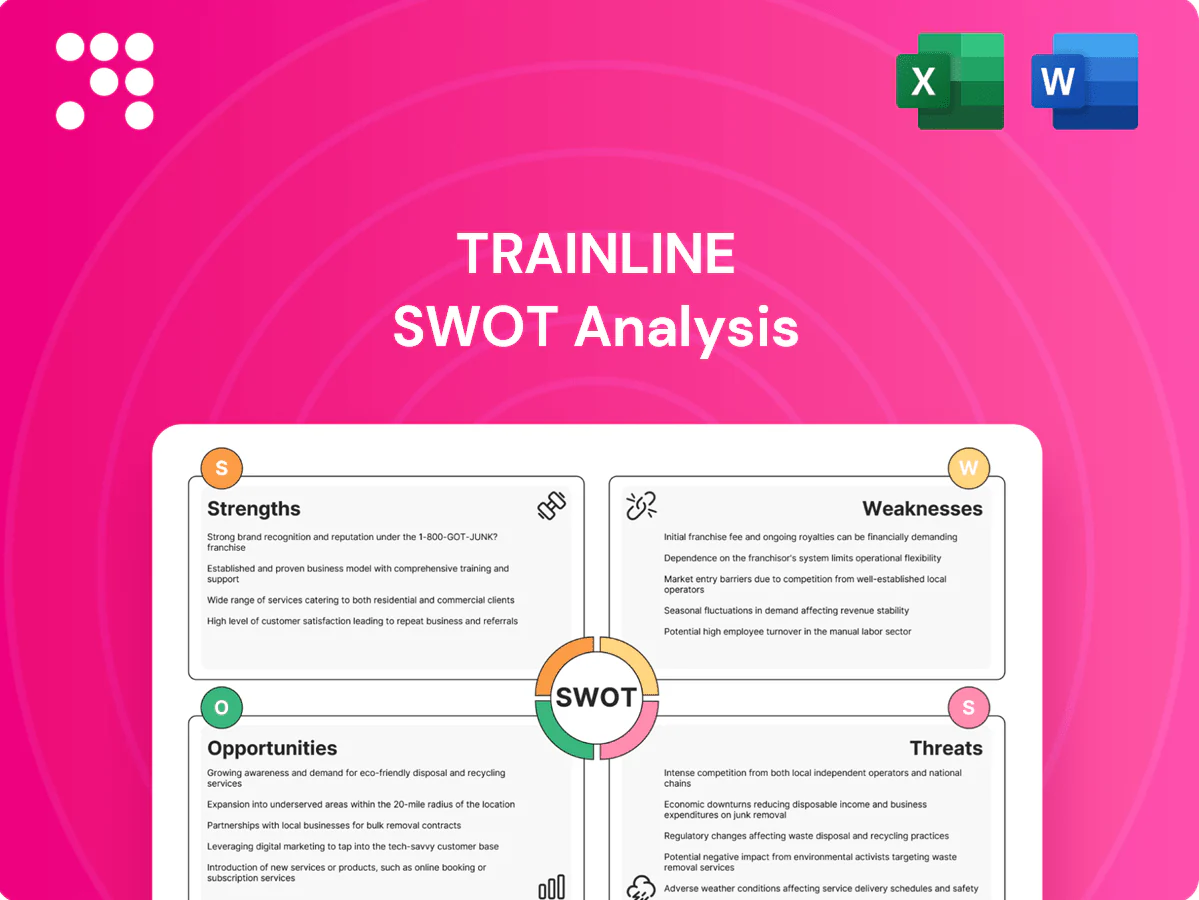
This is the actual Trainline SWOT analysis document you’ll receive upon purchase—no surprises, just professional quality. The preview below is taken directly from the full report and reflects the same structured, editable file included in your download. Purchase unlocks the complete, in-depth version with full findings and recommendations. Buy now to access the entire document immediately after payment.

Make Insightful Decisions Backed by Expert Research
Trainline’s digital-first ticketing platform leverages strong brand recognition, extensive rail partnerships, and data-driven pricing to scale across Europe, but it faces regulatory risks, platform dependency, and intense competition from incumbents and OTAs. Want the full story behind its strengths, risks, and growth drivers? Purchase the complete SWOT analysis for a professionally formatted Word report and editable Excel tools to strategize and invest with confidence.
Strengths
Market-leading aggregation platform
Trainline unifies disparate rail and coach operators into a single marketplace across 45 European countries, creating a one-stop shop that reduces friction for travelers. Its multi-operator inventory improves price and route transparency and, by aggregating millions of tickets and fares, strengthens customer acquisition and retention.
Strong brand and app engagement
High mobile adoption and habit-forming use cases (search, live updates, tickets) drive frequent engagement, with Trainline operating across the UK and European markets and listed on the London Stock Exchange (TRN). App stickiness supports repeat bookings and data-driven personalization, increasing customer lifetime value. Brand recognition as the default rail booking app in key markets boosts organic traffic, while network effects from supply-partner scale and user density reinforce its leading position.
Rich real-time data and analytics
Access to live journey updates and fares delivers a superior user experience, with Trainline aggregating real-time info across over 30 European markets. Data insights drive dynamic recommendations and upsell, boosting ancillary conversion through personalized offers. Operational telemetry sharpens search relevance and on-time info, and these capabilities differentiate Trainline versus operator sites and smaller rivals.
Seamless digital ticketing
Seamless digital ticketing reduces physical friction and last-mile pain by delivering mobile tickets and in-app wallets directly to millions of users, shortening access time and cancellations at gates. QR codes and API integrations shorten purchase cycles and distribution costs; frictionless refunds and easy changes improve trust and reduce churn, driving higher conversion rates and stronger loyalty.
- Mobile tickets: fewer gate issues
- QR/API: faster purchases
- Easy refunds: lower churn
- Convenience: higher conversion & repeat usage
Pan-European reach and partnerships
Trainline operates across 36 European countries with 200+ operator integrations, expanding its addressable market and enabling scale. Deep commercial agreements and direct API integrations create high barriers to entry for competitors. Multi-language and multi-currency capabilities facilitate cross-border bookings while geographic diversification smooths seasonal and country-specific demand volatility.
- Coverage: 36 countries
- Integrations: 200+ operators
- Cross-border: multi-language, multi-currency
- Resilience: geographic diversification reduces volatility
Unified rail and coach marketplace across 45 European countries
Trainline unifies rail and coach inventory into a single marketplace across 45 European countries, aggregating millions of fares to boost discovery and retention. High mobile adoption and habit-forming features (search, live updates, tickets) create strong app stickiness and repeat bookings. Live journey updates across 30+ markets and seamless mobile ticketing (QR/API, easy refunds) reduce friction and increase conversion; commercial scale (36 countries, 200+ operator integrations) raises entry barriers.
| Metric | Value |
|---|---|
| Countries (marketplace) | 45 |
| Countries (integrations) | 36 |
| Operator integrations | 200+ |
| Live markets | 30+ |
| Listing | London Stock Exchange (TRN) |
What is included in the product
Detailed Word Document
Provides a concise SWOT overview of Trainline, highlighting its core strengths, operational weaknesses, market opportunities, and external threats to inform strategic decisions and competitive positioning.
Customizable Excel Spreadsheet
Provides a concise, visual Trainline SWOT matrix to quickly identify operational strengths and market opportunities while addressing pain points like ticketing friction, route coverage gaps, and competitive pricing pressures.
Weaknesses
Dependence on third-party operators
Trainline relies on more than 270 rail and coach partners across 45 countries, meaning operators control schedules, fares and service quality and thus shape the product customers see. API limitations or commercial disputes with these partners can quickly degrade availability and pricing accuracy, harming conversion and brand trust. Limited control over disruptions and partner-driven margin terms directly compress Trainline’s unit economics and profitability.
Commission-driven revenue model
Reliance on booking fees and commissions leaves Trainline exposed to pricing pressure as operators or regulators seek lower fees, which can compress the companys take rate. That dependency makes earnings sensitive to passenger volume cycles, driving notable quarterly volatility. Efforts to diversify revenue beyond ticketing—ancillary products and B2B services—remain relatively nascent and under-monetized.
Complex integrations and upkeep
Maintaining reliable connections across 270+ rail and coach operators is costly, with Trainline’s platform processing millions of bookings daily and amplifying impact from integration failures. Legacy systems and differing standards raise technical debt and slow feature delivery. Outages or data mismatches quickly erode user trust, while ongoing PCI DSS, national rail certification and API compliance create recurring overhead.
Exposure to seasonal and macro demand
Trainline faces sharp seasonality and macro sensitivity: travel volumes plunged by over 90% at the COVID-19 peak and UK rail journeys were still around 80% of 2019 levels in 2023–24 (ORR), while strikes have caused thousands of cancellations, cutting bookings. Fixed platform costs amplify revenue drops and forecasting across multiple markets becomes more uncertain.
- Seasonality & cycles
- Pandemic shock: >90% drop
- Strikes: thousands cancelled
- Fixed costs amplify downturns
- Harder multi-market forecasting
Competitive parity on core features
Basic search, compare and book functions are increasingly commoditized; Trainline, listed on the LSE since 2019, faces similar utilities from operators’ apps and large OTAs that leverage scale and direct inventory access.
Differentiation must therefore come from superior UX, broader inventory and proprietary data, but these assets are replicable over time and require sustained innovation spend to defend market position.
- Competitive parity
- Replicable differentiation
- Needs sustained R&D spend
Heavy partner control: API limits, disputes compress margins across 270+ partners in 45 countries
Trainline’s limited control over 270+ rail and coach partners across 45 countries exposes it to API limits, commercial disputes and partner-driven margin pressure that compress unit economics. Heavy reliance on booking fees/commissions and seasonal demand makes earnings volatile—travel was ~80% of 2019 levels in 2023–24 (ORR) after a >90% COVID peak collapse. Technical debt from diverse integrations raises outage risk and ongoing compliance costs.
| Metric | Value |
|---|---|
| Partners | 270+ |
| Countries | 45 |
| UK travel 2023–24 (ORR) | ~80% of 2019 |
| Pandemic peak drop | >90% |
Preview the Actual Deliverable
Trainline SWOT Analysis
This is the actual Trainline SWOT analysis document you’ll receive upon purchase—no surprises, just professional quality. The preview below is taken directly from the full report and reflects the same structured, editable file included in your download. Purchase unlocks the complete, in-depth version with full findings and recommendations. Buy now to access the entire document immediately after payment.
Description
Make Insightful Decisions Backed by Expert Research
Trainline’s digital-first ticketing platform leverages strong brand recognition, extensive rail partnerships, and data-driven pricing to scale across Europe, but it faces regulatory risks, platform dependency, and intense competition from incumbents and OTAs. Want the full story behind its strengths, risks, and growth drivers? Purchase the complete SWOT analysis for a professionally formatted Word report and editable Excel tools to strategize and invest with confidence.
Strengths
Market-leading aggregation platform
Trainline unifies disparate rail and coach operators into a single marketplace across 45 European countries, creating a one-stop shop that reduces friction for travelers. Its multi-operator inventory improves price and route transparency and, by aggregating millions of tickets and fares, strengthens customer acquisition and retention.
Strong brand and app engagement
High mobile adoption and habit-forming use cases (search, live updates, tickets) drive frequent engagement, with Trainline operating across the UK and European markets and listed on the London Stock Exchange (TRN). App stickiness supports repeat bookings and data-driven personalization, increasing customer lifetime value. Brand recognition as the default rail booking app in key markets boosts organic traffic, while network effects from supply-partner scale and user density reinforce its leading position.
Rich real-time data and analytics
Access to live journey updates and fares delivers a superior user experience, with Trainline aggregating real-time info across over 30 European markets. Data insights drive dynamic recommendations and upsell, boosting ancillary conversion through personalized offers. Operational telemetry sharpens search relevance and on-time info, and these capabilities differentiate Trainline versus operator sites and smaller rivals.
Seamless digital ticketing
Seamless digital ticketing reduces physical friction and last-mile pain by delivering mobile tickets and in-app wallets directly to millions of users, shortening access time and cancellations at gates. QR codes and API integrations shorten purchase cycles and distribution costs; frictionless refunds and easy changes improve trust and reduce churn, driving higher conversion rates and stronger loyalty.
- Mobile tickets: fewer gate issues
- QR/API: faster purchases
- Easy refunds: lower churn
- Convenience: higher conversion & repeat usage
Pan-European reach and partnerships
Trainline operates across 36 European countries with 200+ operator integrations, expanding its addressable market and enabling scale. Deep commercial agreements and direct API integrations create high barriers to entry for competitors. Multi-language and multi-currency capabilities facilitate cross-border bookings while geographic diversification smooths seasonal and country-specific demand volatility.
- Coverage: 36 countries
- Integrations: 200+ operators
- Cross-border: multi-language, multi-currency
- Resilience: geographic diversification reduces volatility
Unified rail and coach marketplace across 45 European countries
Trainline unifies rail and coach inventory into a single marketplace across 45 European countries, aggregating millions of fares to boost discovery and retention. High mobile adoption and habit-forming features (search, live updates, tickets) create strong app stickiness and repeat bookings. Live journey updates across 30+ markets and seamless mobile ticketing (QR/API, easy refunds) reduce friction and increase conversion; commercial scale (36 countries, 200+ operator integrations) raises entry barriers.
| Metric | Value |
|---|---|
| Countries (marketplace) | 45 |
| Countries (integrations) | 36 |
| Operator integrations | 200+ |
| Live markets | 30+ |
| Listing | London Stock Exchange (TRN) |
What is included in the product
Detailed Word Document
Provides a concise SWOT overview of Trainline, highlighting its core strengths, operational weaknesses, market opportunities, and external threats to inform strategic decisions and competitive positioning.
Customizable Excel Spreadsheet
Provides a concise, visual Trainline SWOT matrix to quickly identify operational strengths and market opportunities while addressing pain points like ticketing friction, route coverage gaps, and competitive pricing pressures.
Weaknesses
Dependence on third-party operators
Trainline relies on more than 270 rail and coach partners across 45 countries, meaning operators control schedules, fares and service quality and thus shape the product customers see. API limitations or commercial disputes with these partners can quickly degrade availability and pricing accuracy, harming conversion and brand trust. Limited control over disruptions and partner-driven margin terms directly compress Trainline’s unit economics and profitability.
Commission-driven revenue model
Reliance on booking fees and commissions leaves Trainline exposed to pricing pressure as operators or regulators seek lower fees, which can compress the companys take rate. That dependency makes earnings sensitive to passenger volume cycles, driving notable quarterly volatility. Efforts to diversify revenue beyond ticketing—ancillary products and B2B services—remain relatively nascent and under-monetized.
Complex integrations and upkeep
Maintaining reliable connections across 270+ rail and coach operators is costly, with Trainline’s platform processing millions of bookings daily and amplifying impact from integration failures. Legacy systems and differing standards raise technical debt and slow feature delivery. Outages or data mismatches quickly erode user trust, while ongoing PCI DSS, national rail certification and API compliance create recurring overhead.
Exposure to seasonal and macro demand
Trainline faces sharp seasonality and macro sensitivity: travel volumes plunged by over 90% at the COVID-19 peak and UK rail journeys were still around 80% of 2019 levels in 2023–24 (ORR), while strikes have caused thousands of cancellations, cutting bookings. Fixed platform costs amplify revenue drops and forecasting across multiple markets becomes more uncertain.
- Seasonality & cycles
- Pandemic shock: >90% drop
- Strikes: thousands cancelled
- Fixed costs amplify downturns
- Harder multi-market forecasting
Competitive parity on core features
Basic search, compare and book functions are increasingly commoditized; Trainline, listed on the LSE since 2019, faces similar utilities from operators’ apps and large OTAs that leverage scale and direct inventory access.
Differentiation must therefore come from superior UX, broader inventory and proprietary data, but these assets are replicable over time and require sustained innovation spend to defend market position.
- Competitive parity
- Replicable differentiation
- Needs sustained R&D spend
Heavy partner control: API limits, disputes compress margins across 270+ partners in 45 countries
Trainline’s limited control over 270+ rail and coach partners across 45 countries exposes it to API limits, commercial disputes and partner-driven margin pressure that compress unit economics. Heavy reliance on booking fees/commissions and seasonal demand makes earnings volatile—travel was ~80% of 2019 levels in 2023–24 (ORR) after a >90% COVID peak collapse. Technical debt from diverse integrations raises outage risk and ongoing compliance costs.
| Metric | Value |
|---|---|
| Partners | 270+ |
| Countries | 45 |
| UK travel 2023–24 (ORR) | ~80% of 2019 |
| Pandemic peak drop | >90% |
Preview the Actual Deliverable
Trainline SWOT Analysis
This is the actual Trainline SWOT analysis document you’ll receive upon purchase—no surprises, just professional quality. The preview below is taken directly from the full report and reflects the same structured, editable file included in your download. Purchase unlocks the complete, in-depth version with full findings and recommendations. Buy now to access the entire document immediately after payment.











