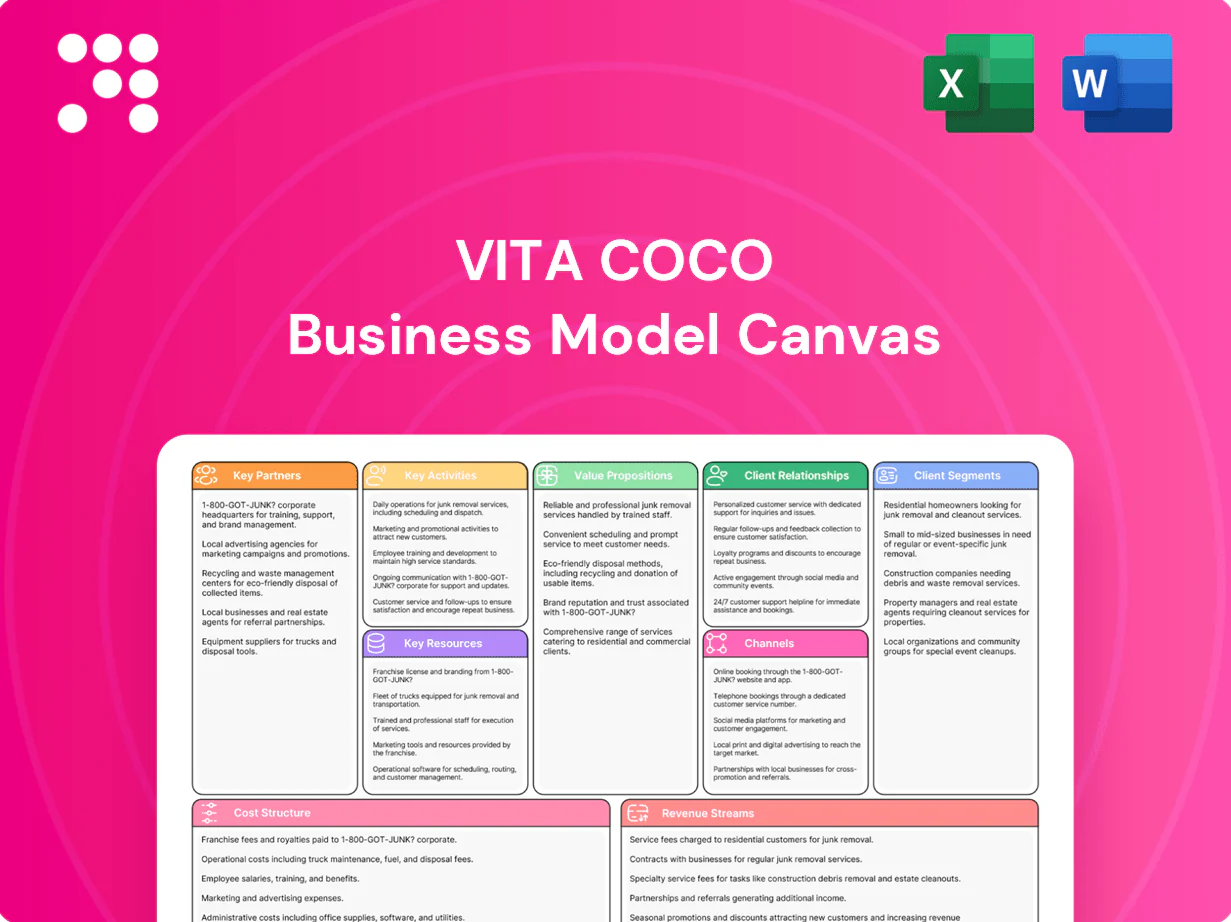
Vita Coco Business Model Canvas

Business Model Canvas for a coconut water brand: sourcing, partners, retail + DTC
Explore Vita Coco's Business Model Canvas to see how the brand creates value through sourcing, strategic partnerships, and retail-plus-DTC distribution. This concise snapshot highlights customer segments, revenue streams, and cost structure with actionable insights. Purchase the full, editable canvas in Word and Excel for benchmarking, strategic planning, and investor-ready analysis.
Partnerships

Tropical farmers & co-packers
Long-term contracts with tropical farmers secure coconut supply and price stability, underpinning Vita Coco’s growth in a global coconut water market valued at about $6.4B in 2024. Co-packers provide flexible, scalable production across regions, lowering capex and smoothing seasonality. Joint agronomy programs with growers improve yields and sustainability, raising farm productivity and quality.
Global distributors & retailers
Alliances with grocers, convenience chains, club stores and wholesalers expand Vita Coco shelf presence across 60+ countries and national chains. Distributors provide last-mile reach and in-store merchandising, reaching hundreds of thousands of retail doors. Joint business planning with major partners aligns promotions and velocity goals, often lifting promotional velocity double digits. Data sharing refines assortment and pricing using POS and distribution analytics.

Logistics & cold-chain providers
Third-party logistics optimize ocean, port, and over-the-road transport for Vita Coco, leveraging carriers to balance cost and speed; in 2024 the global cold-chain market exceeded $200 billion, underscoring scale and choices. Regional warehousing reduces stockouts and lead times by enabling nearer-market replenishment. Rigorous temperature and quality controls protect coconut water integrity and brand trust. Freight partners enable tailored cost-service trade-offs.

Sustainability & packaging partners
NGOs and certification bodies support responsible sourcing and community impact, strengthening Vita Coco's ESG credibility. Packaging suppliers provide Tetra Pak, aluminum and recycled materials to lower plastic reliance; packaging represents about 40% of global plastic use (UNEP). Collaborations aim to reduce plastic, water use and emissions across the supply chain.
- partners: NGOs, cert bodies
- materials: Tetra Pak, aluminum, recycled
- impact: cut plastic/water/emissions
- credibility: stronger ESG claims
Ingredient & innovation partners
Ingredient and innovation partners — suppliers of guayusa, flavors and functional additives — underpin R&D while lab and pilot facilities shorten formulation cycles; tech partners supply data, forecasting and ecommerce tools to optimize supply and merchandising, and co-creation with partners accelerates limited-time offerings and new formats for rapid market tests.
- R&D suppliers: guayusa, flavors, additives
- Labs: pilot formulation & scale-up
- Tech: data, forecasting, ecommerce
- Co-creation: limited-time offers & new formats
Farmer contracts stabilize supply in $6.4B coconut water market
Long-term farmer contracts secure coconut supply and price stability in a $6.4B global coconut water market (2024), aided by co-packers to lower capex and smooth seasonality.
Retail, distributor and cold-chain partners extend shelf presence to 60+ countries; global cold-chain market exceeded $200B in 2024.
NGOs, certifiers and packaging suppliers bolster ESG and reduce plastic/water/emissions; packaging equals ~40% of global plastic use (UNEP).
| Partner | Role | 2024 metric |
|---|---|---|
| Farmers | Supply/stability | $6.4B market |
| Co-packers | Scale/flex | 60+ countries |
| Cold-chain | Transport | >$200B market |
| Packaging/NGOs | ESG | ~40% plastic use |
What is included in the product
 Detailed Word Document
A concise, pre-written Business Model Canvas for Vita Coco outlining customer segments, channels, value propositions, revenue streams and key resources across the 9 classic blocks; includes competitive advantages and linked SWOT insights for presentations, investor discussions, and strategic planning.

 Customizable Excel Spreadsheet
High-level view of Vita Coco’s business model with editable cells, relieving the pain of scattered strategy by consolidating value proposition, channels, partnerships, and revenue streams onto one collaborative page.
Activities

Ethical sourcing & quality control
Procure coconuts and botanicals with farm-to-factory traceability systems updated in 2024 to strengthen origin verification and ethical sourcing. Test raw materials for taste, safety, and batch consistency via laboratory assays and sensory panels before blending. Manage supplier audits and certifications through third-party auditors to enforce compliance. Continuously balance cost, quality, and resilience in sourcing decisions.
Brand building & demand generation
Vita Coco runs omni-channel marketing across digital, retail and experiential, activating influencers and athletes to boost credibility, optimizing trade promotions and pricing, and measuring ROI to reallocate spend; the global coconut water market was estimated near $5.5B in 2024 and Vita Coco, founded in 2004, retains a leading share that drives scale benefits for promotional efficiency.

Product innovation & portfolio management
Vita Coco focuses on product innovation and portfolio management by developing new flavors, pack sizes, and functional lines while maintaining a 2024 pipeline across coconut water, clean energy, and sustainable water initiatives. Stage-gate testing is used to reduce launch failure risk and accelerate learnings. SKU rationalization is prioritized to boost velocity and retailer sell-through. Continuous NPD aligns with premium positioning and supply-chain sustainability.

Sales execution & category management
Drive retail distribution by securing primary placements, secondary displays and cold-box space to boost impulse conversion and maintain distribution density across channels.
Use POS and Nielsen/IRI channel-region assortment data to tailor SKU mix and seasonality, and train field teams on retail excellence and execution metrics.
Coordinate with buyer calendars for timely resets and promotional windows to maximize share of shelf.
- placements
- secondary displays
- cold-box
- data-led assortment
- team training
- buyer-calendar alignment
Supply chain planning & logistics
Supply chain planning for Vita Coco centers on forecasting demand and balancing inventory across retail, DC and co-packer nodes to reduce stockouts and obsolescence. Production runs are coordinated with co-packers to align SKU mix and seasonal peaks while optimizing freight modes and lanes for cost and lead-time. Disruptions are mitigated through targeted safety stock and dual sourcing strategies to preserve on-shelf availability.
- Forecasting: align demand signals across channels
- Co-packing: synchronized production runs
- Logistics: freight mode and lane optimization
- Resilience: safety stock and dual sourcing
Traceable coconuts, lab-tested batches, omni-channel retail and dual-sourced co-packer resilience
Procure traceable coconuts; lab-test batches; manage supplier audits; run omni-channel marketing, NPD pipeline and retail execution; coordinate co-packer production, forecasting and dual-sourcing for resilience.
| Metric | 2024 Value |
|---|---|
| Global coconut water market | $5.5B |
| Founded | 2004 |
Preview Before You Purchase
Business Model Canvas
The document you're previewing is the actual Vita Coco Business Model Canvas you'll receive after purchase, not a mockup. This is a direct snapshot of the final file, showing real content and structure. After ordering you'll get the complete, ready-to-edit document formatted exactly as shown—no placeholders, no surprises.

Business Model Canvas for a coconut water brand: sourcing, partners, retail + DTC
Explore Vita Coco's Business Model Canvas to see how the brand creates value through sourcing, strategic partnerships, and retail-plus-DTC distribution. This concise snapshot highlights customer segments, revenue streams, and cost structure with actionable insights. Purchase the full, editable canvas in Word and Excel for benchmarking, strategic planning, and investor-ready analysis.
Partnerships
Tropical farmers & co-packers
Long-term contracts with tropical farmers secure coconut supply and price stability, underpinning Vita Coco’s growth in a global coconut water market valued at about $6.4B in 2024. Co-packers provide flexible, scalable production across regions, lowering capex and smoothing seasonality. Joint agronomy programs with growers improve yields and sustainability, raising farm productivity and quality.
Global distributors & retailers
Alliances with grocers, convenience chains, club stores and wholesalers expand Vita Coco shelf presence across 60+ countries and national chains. Distributors provide last-mile reach and in-store merchandising, reaching hundreds of thousands of retail doors. Joint business planning with major partners aligns promotions and velocity goals, often lifting promotional velocity double digits. Data sharing refines assortment and pricing using POS and distribution analytics.
Logistics & cold-chain providers
Third-party logistics optimize ocean, port, and over-the-road transport for Vita Coco, leveraging carriers to balance cost and speed; in 2024 the global cold-chain market exceeded $200 billion, underscoring scale and choices. Regional warehousing reduces stockouts and lead times by enabling nearer-market replenishment. Rigorous temperature and quality controls protect coconut water integrity and brand trust. Freight partners enable tailored cost-service trade-offs.
Sustainability & packaging partners
NGOs and certification bodies support responsible sourcing and community impact, strengthening Vita Coco's ESG credibility. Packaging suppliers provide Tetra Pak, aluminum and recycled materials to lower plastic reliance; packaging represents about 40% of global plastic use (UNEP). Collaborations aim to reduce plastic, water use and emissions across the supply chain.
- partners: NGOs, cert bodies
- materials: Tetra Pak, aluminum, recycled
- impact: cut plastic/water/emissions
- credibility: stronger ESG claims
Ingredient & innovation partners
Ingredient and innovation partners — suppliers of guayusa, flavors and functional additives — underpin R&D while lab and pilot facilities shorten formulation cycles; tech partners supply data, forecasting and ecommerce tools to optimize supply and merchandising, and co-creation with partners accelerates limited-time offerings and new formats for rapid market tests.
- R&D suppliers: guayusa, flavors, additives
- Labs: pilot formulation & scale-up
- Tech: data, forecasting, ecommerce
- Co-creation: limited-time offers & new formats
Farmer contracts stabilize supply in $6.4B coconut water market
Long-term farmer contracts secure coconut supply and price stability in a $6.4B global coconut water market (2024), aided by co-packers to lower capex and smooth seasonality.
Retail, distributor and cold-chain partners extend shelf presence to 60+ countries; global cold-chain market exceeded $200B in 2024.
NGOs, certifiers and packaging suppliers bolster ESG and reduce plastic/water/emissions; packaging equals ~40% of global plastic use (UNEP).
| Partner | Role | 2024 metric |
|---|---|---|
| Farmers | Supply/stability | $6.4B market |
| Co-packers | Scale/flex | 60+ countries |
| Cold-chain | Transport | >$200B market |
| Packaging/NGOs | ESG | ~40% plastic use |
What is included in the product
Detailed Word Document
A concise, pre-written Business Model Canvas for Vita Coco outlining customer segments, channels, value propositions, revenue streams and key resources across the 9 classic blocks; includes competitive advantages and linked SWOT insights for presentations, investor discussions, and strategic planning.
Customizable Excel Spreadsheet
High-level view of Vita Coco’s business model with editable cells, relieving the pain of scattered strategy by consolidating value proposition, channels, partnerships, and revenue streams onto one collaborative page.
Activities
Ethical sourcing & quality control
Procure coconuts and botanicals with farm-to-factory traceability systems updated in 2024 to strengthen origin verification and ethical sourcing. Test raw materials for taste, safety, and batch consistency via laboratory assays and sensory panels before blending. Manage supplier audits and certifications through third-party auditors to enforce compliance. Continuously balance cost, quality, and resilience in sourcing decisions.
Brand building & demand generation
Vita Coco runs omni-channel marketing across digital, retail and experiential, activating influencers and athletes to boost credibility, optimizing trade promotions and pricing, and measuring ROI to reallocate spend; the global coconut water market was estimated near $5.5B in 2024 and Vita Coco, founded in 2004, retains a leading share that drives scale benefits for promotional efficiency.
Product innovation & portfolio management
Vita Coco focuses on product innovation and portfolio management by developing new flavors, pack sizes, and functional lines while maintaining a 2024 pipeline across coconut water, clean energy, and sustainable water initiatives. Stage-gate testing is used to reduce launch failure risk and accelerate learnings. SKU rationalization is prioritized to boost velocity and retailer sell-through. Continuous NPD aligns with premium positioning and supply-chain sustainability.
Sales execution & category management
Drive retail distribution by securing primary placements, secondary displays and cold-box space to boost impulse conversion and maintain distribution density across channels.
Use POS and Nielsen/IRI channel-region assortment data to tailor SKU mix and seasonality, and train field teams on retail excellence and execution metrics.
Coordinate with buyer calendars for timely resets and promotional windows to maximize share of shelf.
- placements
- secondary displays
- cold-box
- data-led assortment
- team training
- buyer-calendar alignment
Supply chain planning & logistics
Supply chain planning for Vita Coco centers on forecasting demand and balancing inventory across retail, DC and co-packer nodes to reduce stockouts and obsolescence. Production runs are coordinated with co-packers to align SKU mix and seasonal peaks while optimizing freight modes and lanes for cost and lead-time. Disruptions are mitigated through targeted safety stock and dual sourcing strategies to preserve on-shelf availability.
- Forecasting: align demand signals across channels
- Co-packing: synchronized production runs
- Logistics: freight mode and lane optimization
- Resilience: safety stock and dual sourcing
Traceable coconuts, lab-tested batches, omni-channel retail and dual-sourced co-packer resilience
Procure traceable coconuts; lab-test batches; manage supplier audits; run omni-channel marketing, NPD pipeline and retail execution; coordinate co-packer production, forecasting and dual-sourcing for resilience.
| Metric | 2024 Value |
|---|---|
| Global coconut water market | $5.5B |
| Founded | 2004 |
Preview Before You Purchase
Business Model Canvas
The document you're previewing is the actual Vita Coco Business Model Canvas you'll receive after purchase, not a mockup. This is a direct snapshot of the final file, showing real content and structure. After ordering you'll get the complete, ready-to-edit document formatted exactly as shown—no placeholders, no surprises.
Description
Business Model Canvas for a coconut water brand: sourcing, partners, retail + DTC
Explore Vita Coco's Business Model Canvas to see how the brand creates value through sourcing, strategic partnerships, and retail-plus-DTC distribution. This concise snapshot highlights customer segments, revenue streams, and cost structure with actionable insights. Purchase the full, editable canvas in Word and Excel for benchmarking, strategic planning, and investor-ready analysis.
Partnerships
Tropical farmers & co-packers
Long-term contracts with tropical farmers secure coconut supply and price stability, underpinning Vita Coco’s growth in a global coconut water market valued at about $6.4B in 2024. Co-packers provide flexible, scalable production across regions, lowering capex and smoothing seasonality. Joint agronomy programs with growers improve yields and sustainability, raising farm productivity and quality.
Global distributors & retailers
Alliances with grocers, convenience chains, club stores and wholesalers expand Vita Coco shelf presence across 60+ countries and national chains. Distributors provide last-mile reach and in-store merchandising, reaching hundreds of thousands of retail doors. Joint business planning with major partners aligns promotions and velocity goals, often lifting promotional velocity double digits. Data sharing refines assortment and pricing using POS and distribution analytics.
Logistics & cold-chain providers
Third-party logistics optimize ocean, port, and over-the-road transport for Vita Coco, leveraging carriers to balance cost and speed; in 2024 the global cold-chain market exceeded $200 billion, underscoring scale and choices. Regional warehousing reduces stockouts and lead times by enabling nearer-market replenishment. Rigorous temperature and quality controls protect coconut water integrity and brand trust. Freight partners enable tailored cost-service trade-offs.
Sustainability & packaging partners
NGOs and certification bodies support responsible sourcing and community impact, strengthening Vita Coco's ESG credibility. Packaging suppliers provide Tetra Pak, aluminum and recycled materials to lower plastic reliance; packaging represents about 40% of global plastic use (UNEP). Collaborations aim to reduce plastic, water use and emissions across the supply chain.
- partners: NGOs, cert bodies
- materials: Tetra Pak, aluminum, recycled
- impact: cut plastic/water/emissions
- credibility: stronger ESG claims
Ingredient & innovation partners
Ingredient and innovation partners — suppliers of guayusa, flavors and functional additives — underpin R&D while lab and pilot facilities shorten formulation cycles; tech partners supply data, forecasting and ecommerce tools to optimize supply and merchandising, and co-creation with partners accelerates limited-time offerings and new formats for rapid market tests.
- R&D suppliers: guayusa, flavors, additives
- Labs: pilot formulation & scale-up
- Tech: data, forecasting, ecommerce
- Co-creation: limited-time offers & new formats
Farmer contracts stabilize supply in $6.4B coconut water market
Long-term farmer contracts secure coconut supply and price stability in a $6.4B global coconut water market (2024), aided by co-packers to lower capex and smooth seasonality.
Retail, distributor and cold-chain partners extend shelf presence to 60+ countries; global cold-chain market exceeded $200B in 2024.
NGOs, certifiers and packaging suppliers bolster ESG and reduce plastic/water/emissions; packaging equals ~40% of global plastic use (UNEP).
| Partner | Role | 2024 metric |
|---|---|---|
| Farmers | Supply/stability | $6.4B market |
| Co-packers | Scale/flex | 60+ countries |
| Cold-chain | Transport | >$200B market |
| Packaging/NGOs | ESG | ~40% plastic use |
What is included in the product
Detailed Word Document
A concise, pre-written Business Model Canvas for Vita Coco outlining customer segments, channels, value propositions, revenue streams and key resources across the 9 classic blocks; includes competitive advantages and linked SWOT insights for presentations, investor discussions, and strategic planning.
Customizable Excel Spreadsheet
High-level view of Vita Coco’s business model with editable cells, relieving the pain of scattered strategy by consolidating value proposition, channels, partnerships, and revenue streams onto one collaborative page.
Activities
Ethical sourcing & quality control
Procure coconuts and botanicals with farm-to-factory traceability systems updated in 2024 to strengthen origin verification and ethical sourcing. Test raw materials for taste, safety, and batch consistency via laboratory assays and sensory panels before blending. Manage supplier audits and certifications through third-party auditors to enforce compliance. Continuously balance cost, quality, and resilience in sourcing decisions.
Brand building & demand generation
Vita Coco runs omni-channel marketing across digital, retail and experiential, activating influencers and athletes to boost credibility, optimizing trade promotions and pricing, and measuring ROI to reallocate spend; the global coconut water market was estimated near $5.5B in 2024 and Vita Coco, founded in 2004, retains a leading share that drives scale benefits for promotional efficiency.
Product innovation & portfolio management
Vita Coco focuses on product innovation and portfolio management by developing new flavors, pack sizes, and functional lines while maintaining a 2024 pipeline across coconut water, clean energy, and sustainable water initiatives. Stage-gate testing is used to reduce launch failure risk and accelerate learnings. SKU rationalization is prioritized to boost velocity and retailer sell-through. Continuous NPD aligns with premium positioning and supply-chain sustainability.
Sales execution & category management
Drive retail distribution by securing primary placements, secondary displays and cold-box space to boost impulse conversion and maintain distribution density across channels.
Use POS and Nielsen/IRI channel-region assortment data to tailor SKU mix and seasonality, and train field teams on retail excellence and execution metrics.
Coordinate with buyer calendars for timely resets and promotional windows to maximize share of shelf.
- placements
- secondary displays
- cold-box
- data-led assortment
- team training
- buyer-calendar alignment
Supply chain planning & logistics
Supply chain planning for Vita Coco centers on forecasting demand and balancing inventory across retail, DC and co-packer nodes to reduce stockouts and obsolescence. Production runs are coordinated with co-packers to align SKU mix and seasonal peaks while optimizing freight modes and lanes for cost and lead-time. Disruptions are mitigated through targeted safety stock and dual sourcing strategies to preserve on-shelf availability.
- Forecasting: align demand signals across channels
- Co-packing: synchronized production runs
- Logistics: freight mode and lane optimization
- Resilience: safety stock and dual sourcing
Traceable coconuts, lab-tested batches, omni-channel retail and dual-sourced co-packer resilience
Procure traceable coconuts; lab-test batches; manage supplier audits; run omni-channel marketing, NPD pipeline and retail execution; coordinate co-packer production, forecasting and dual-sourcing for resilience.
| Metric | 2024 Value |
|---|---|
| Global coconut water market | $5.5B |
| Founded | 2004 |
Preview Before You Purchase
Business Model Canvas
The document you're previewing is the actual Vita Coco Business Model Canvas you'll receive after purchase, not a mockup. This is a direct snapshot of the final file, showing real content and structure. After ordering you'll get the complete, ready-to-edit document formatted exactly as shown—no placeholders, no surprises.











