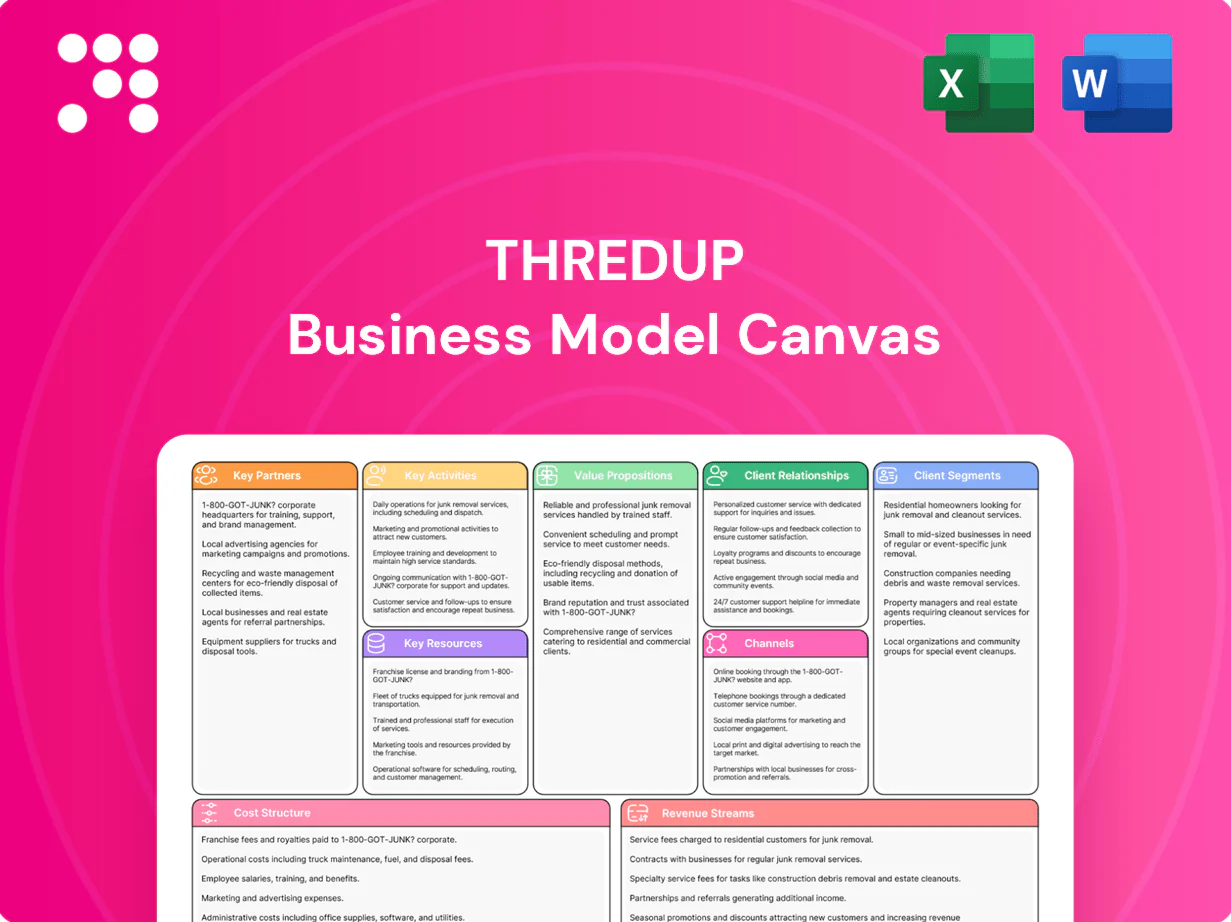
ThredUp Business Model Canvas

Resale Platform Business Model Canvas: tech logistics, partner networks & revenue focus
Explore ThredUp’s Business Model Canvas to see how resale, tech-driven logistics, and partner networks combine to create value and drive growth. This concise snapshot highlights customer segments, revenue streams, and competitive advantages. Purchase the full, editable Canvas to get section-by-section strategic insights, financial implications, and a ready-to-use template for benchmarking or investor presentations.
Partnerships

Brand and Retailer Collaborations
Partnerships with brands and retailers like Macy's and Gap expand thredUP supply and credibility, tapping a resale market projected to reach 218 billion USD by 2026. Co-branded shops and clean-out drives align incentives toward circularity and can cut partner returns and waste. Deals commonly include revenue sharing and anonymized data insights to optimize inventory and pricing. These collaborations boost assortment while sharing economics and customer analytics.
Logistics and Shipping Providers
Integrated carrier partners handle inbound Clean Out Kits and outbound orders, processing millions of kits annually (2024) to maintain reliable fulfillment. Volume-based rates cut per-unit shipping costs by double-digit percentages, enabling 2-day SLA coverage in major metros. Reverse logistics expertise increases intake throughput and resale yield, while multi-carrier networks expand geographic coverage and resilience.

Authentication and Quality Vendors
Third-party authentication and condition-grading experts verify provenance and compliance, strengthening buyer trust and reducing fraud or mislabeling risk. Automation partners for imaging and AI tagging standardize listings and improve consistency across millions of SKUs. Specialized cleaning and repair vendors extend item life, increasing sell-through and lifetime value.

Technology and Data Platforms
Cloud, AI/ML, and analytics partners power dynamic pricing, search relevancy, and personalization—helping ThredUp scale inventory matching and improve conversion; industry forecasts in 2024 project the global resale market to reach about $350 billion by 2029, boosting demand for these systems. Payment processors and fraud-prevention tools secure transactions while MarTech platforms enable lifecycle marketing and remarketing; marketplace and API integrations expand distribution and partner-sourced GMV.
- Cloud + AI/ML: real-time pricing & personalization
- Payments & fraud tools: reduce chargebacks, secure CNP
- MarTech: lifecycle & remarketing lift LTV
- Marketplaces/APIs: expand reach & incremental GMV
Sustainability and Nonprofit Alliances
Sustainability and nonprofit alliances boost ThredUp’s mission alignment and awareness, leveraging UNEP data that fashion produces about 92 million tonnes of textile waste annually to drive urgency. Joint campaigns educate consumers on waste reduction and resale, supporting a resale market projected to reach 218 billion USD by 2026. Donation pathways for unlisted items expand social impact, while certifications and reporting partners strengthen ESG credibility.
- Partnerships: enviro/nonprofits
- Campaigns: consumer education
- Donations: unlisted-item pathways
- ESG: certifications & reporting
Brands and carriers scale resale to $218B by 2026 with faster, cheaper processing
Brand/retailer deals (Macy's, Gap) expand supply and trust as resale market nears 218 billion USD by 2026. Carrier partners process millions of Clean Out Kits annually (2024), enabling 2-day metro SLAs and lower unit costs. Tech, authentication, repair, payments and ESG partners boost pricing, yield, fraud control and mission credibility.
| Partnership | 2024 metric | Impact |
|---|---|---|
| Brands/retailers | Market: $218B by 2026 | Supply & credibility |
| Carriers | Millions kits/year (2024) | Lower costs, 2-day SLA |
| Tech & services | AI/ML, auth, payments | Pricing, fraud, LTV |
What is included in the product
 Detailed Word Document
A comprehensive Business Model Canvas for ThredUp organized into 9 classic blocks, detailing customer segments, channels, value propositions, revenue and cost structures, and operational flows; includes competitive advantages and linked SWOT analysis ideal for presentations, investor discussions, and strategic decision-making.

 Customizable Excel Spreadsheet
High-level, editable Business Model Canvas that distills ThredUp’s resale platform into a one-page snapshot, relieving the pain of lengthy strategy alignment and fragmented documents. Perfect for fast team collaboration, comparisons, and executive reviews.
Activities

Item Intake and Processing
Receiving, sorting, cleaning and quality grading occur at centralized facilities where standardized workflows and conveyor-line KPIs boost throughput and cut handling time; decisions on accept/reject and dynamic pricing are made per-item. Barcoding and high-resolution imaging link each item to inventory and listings; the global resale market reached an estimated $218B by 2024 (thredUP report projection).
Cataloging and Dynamic Pricing
Cataloging creates listings with multi-angle photos, standardized metadata, and precise size/brand attribution to maximize search and filter matches; in 2024 ThredUp emphasized automated attribute extraction to speed intake. Algorithmic pricing adapts to demand, seasonality, and sell-through targets, while systematic A/B testing refines title, imagery, and price to boost conversion and margin. Dynamic price drops and time-limited promotions are used to balance velocity and ASP, closing inventory loops within targeted sell-through windows.

Fulfillment and Reverse Logistics
Picking, packing and track-and-trace shipping ensure accurate order fulfilment and visibility; industry online apparel return rates run about 20–30%, so efficient reverse logistics and inspection preserve resale value and recovery margins. Packaging optimization typically trims shipping cost and damage rates by roughly 5–15%, while strict service-level management protects delivery promises and customer retention.

Platform Development and UX
Platform development and UX focus on continuous improvement of web and mobile apps to simplify discovery and checkout, with search, filters and personalization driving higher conversion and average order value. Seller portals streamline kit requests, intake and faster payouts for consignors while security, performance and WCAG accessibility standards are maintained. ThredUp’s 2024 Resale Report underscores rising resale demand, supporting investment in platform features.
- Search & personalization: boost conversion
- Seller portals: faster kits & payouts
- Security & performance: PCI, encryption, monitoring
- Accessibility: WCAG compliance
Marketing and Community Building
Performance marketing drives acquisition across paid channels with focused CPA optimization, while CRM lifecycle campaigns nurture repeat buyers and sellers to lift LTV; thredUP’s 2024 Resale Report highlights accelerating market demand. Content and social amplify sustainability messaging to increase engagement and conversion. Partnerships and PR expand brand trust and awareness, fueling marketplace liquidity.
- Performance: paid acquisition, CPA focus
- CRM: lifecycle campaigns for LTV
- Content: sustainability-led social
- Partnerships/PR: trust & awareness
Centralized grading and algorithmic pricing boost resale margins as global market hits $218B
Centralized intake, per-item grading and dynamic pricing optimize throughput and margin; global resale market estimated at $218B by 2024. Automated cataloging, imaging and algorithmic pricing accelerate listing velocity and conversion. Efficient pick/pack/returns and packaging reduce costs; apparel return rates run ~20–30% and packaging optimization cuts shipping/damage 5–15%.
| Metric | 2024 |
|---|---|
| Global resale market | $218B |
| Apparel return rate | 20–30% |
| Packaging savings | 5–15% |
Preview Before You Purchase
Business Model Canvas
The document you’re previewing is the exact ThredUp Business Model Canvas you’ll receive after purchase, not a mockup or sample. When you buy, you’ll instantly download this complete, professionally formatted file ready for editing and presentation. No hidden pages or altered content—what you see is what you get.

Resale Platform Business Model Canvas: tech logistics, partner networks & revenue focus
Explore ThredUp’s Business Model Canvas to see how resale, tech-driven logistics, and partner networks combine to create value and drive growth. This concise snapshot highlights customer segments, revenue streams, and competitive advantages. Purchase the full, editable Canvas to get section-by-section strategic insights, financial implications, and a ready-to-use template for benchmarking or investor presentations.
Partnerships
Brand and Retailer Collaborations
Partnerships with brands and retailers like Macy's and Gap expand thredUP supply and credibility, tapping a resale market projected to reach 218 billion USD by 2026. Co-branded shops and clean-out drives align incentives toward circularity and can cut partner returns and waste. Deals commonly include revenue sharing and anonymized data insights to optimize inventory and pricing. These collaborations boost assortment while sharing economics and customer analytics.
Logistics and Shipping Providers
Integrated carrier partners handle inbound Clean Out Kits and outbound orders, processing millions of kits annually (2024) to maintain reliable fulfillment. Volume-based rates cut per-unit shipping costs by double-digit percentages, enabling 2-day SLA coverage in major metros. Reverse logistics expertise increases intake throughput and resale yield, while multi-carrier networks expand geographic coverage and resilience.
Authentication and Quality Vendors
Third-party authentication and condition-grading experts verify provenance and compliance, strengthening buyer trust and reducing fraud or mislabeling risk. Automation partners for imaging and AI tagging standardize listings and improve consistency across millions of SKUs. Specialized cleaning and repair vendors extend item life, increasing sell-through and lifetime value.
Technology and Data Platforms
Cloud, AI/ML, and analytics partners power dynamic pricing, search relevancy, and personalization—helping ThredUp scale inventory matching and improve conversion; industry forecasts in 2024 project the global resale market to reach about $350 billion by 2029, boosting demand for these systems. Payment processors and fraud-prevention tools secure transactions while MarTech platforms enable lifecycle marketing and remarketing; marketplace and API integrations expand distribution and partner-sourced GMV.
- Cloud + AI/ML: real-time pricing & personalization
- Payments & fraud tools: reduce chargebacks, secure CNP
- MarTech: lifecycle & remarketing lift LTV
- Marketplaces/APIs: expand reach & incremental GMV
Sustainability and Nonprofit Alliances
Sustainability and nonprofit alliances boost ThredUp’s mission alignment and awareness, leveraging UNEP data that fashion produces about 92 million tonnes of textile waste annually to drive urgency. Joint campaigns educate consumers on waste reduction and resale, supporting a resale market projected to reach 218 billion USD by 2026. Donation pathways for unlisted items expand social impact, while certifications and reporting partners strengthen ESG credibility.
- Partnerships: enviro/nonprofits
- Campaigns: consumer education
- Donations: unlisted-item pathways
- ESG: certifications & reporting
Brands and carriers scale resale to $218B by 2026 with faster, cheaper processing
Brand/retailer deals (Macy's, Gap) expand supply and trust as resale market nears 218 billion USD by 2026. Carrier partners process millions of Clean Out Kits annually (2024), enabling 2-day metro SLAs and lower unit costs. Tech, authentication, repair, payments and ESG partners boost pricing, yield, fraud control and mission credibility.
| Partnership | 2024 metric | Impact |
|---|---|---|
| Brands/retailers | Market: $218B by 2026 | Supply & credibility |
| Carriers | Millions kits/year (2024) | Lower costs, 2-day SLA |
| Tech & services | AI/ML, auth, payments | Pricing, fraud, LTV |
What is included in the product
Detailed Word Document
A comprehensive Business Model Canvas for ThredUp organized into 9 classic blocks, detailing customer segments, channels, value propositions, revenue and cost structures, and operational flows; includes competitive advantages and linked SWOT analysis ideal for presentations, investor discussions, and strategic decision-making.
Customizable Excel Spreadsheet
High-level, editable Business Model Canvas that distills ThredUp’s resale platform into a one-page snapshot, relieving the pain of lengthy strategy alignment and fragmented documents. Perfect for fast team collaboration, comparisons, and executive reviews.
Activities
Item Intake and Processing
Receiving, sorting, cleaning and quality grading occur at centralized facilities where standardized workflows and conveyor-line KPIs boost throughput and cut handling time; decisions on accept/reject and dynamic pricing are made per-item. Barcoding and high-resolution imaging link each item to inventory and listings; the global resale market reached an estimated $218B by 2024 (thredUP report projection).
Cataloging and Dynamic Pricing
Cataloging creates listings with multi-angle photos, standardized metadata, and precise size/brand attribution to maximize search and filter matches; in 2024 ThredUp emphasized automated attribute extraction to speed intake. Algorithmic pricing adapts to demand, seasonality, and sell-through targets, while systematic A/B testing refines title, imagery, and price to boost conversion and margin. Dynamic price drops and time-limited promotions are used to balance velocity and ASP, closing inventory loops within targeted sell-through windows.
Fulfillment and Reverse Logistics
Picking, packing and track-and-trace shipping ensure accurate order fulfilment and visibility; industry online apparel return rates run about 20–30%, so efficient reverse logistics and inspection preserve resale value and recovery margins. Packaging optimization typically trims shipping cost and damage rates by roughly 5–15%, while strict service-level management protects delivery promises and customer retention.
Platform Development and UX
Platform development and UX focus on continuous improvement of web and mobile apps to simplify discovery and checkout, with search, filters and personalization driving higher conversion and average order value. Seller portals streamline kit requests, intake and faster payouts for consignors while security, performance and WCAG accessibility standards are maintained. ThredUp’s 2024 Resale Report underscores rising resale demand, supporting investment in platform features.
- Search & personalization: boost conversion
- Seller portals: faster kits & payouts
- Security & performance: PCI, encryption, monitoring
- Accessibility: WCAG compliance
Marketing and Community Building
Performance marketing drives acquisition across paid channels with focused CPA optimization, while CRM lifecycle campaigns nurture repeat buyers and sellers to lift LTV; thredUP’s 2024 Resale Report highlights accelerating market demand. Content and social amplify sustainability messaging to increase engagement and conversion. Partnerships and PR expand brand trust and awareness, fueling marketplace liquidity.
- Performance: paid acquisition, CPA focus
- CRM: lifecycle campaigns for LTV
- Content: sustainability-led social
- Partnerships/PR: trust & awareness
Centralized grading and algorithmic pricing boost resale margins as global market hits $218B
Centralized intake, per-item grading and dynamic pricing optimize throughput and margin; global resale market estimated at $218B by 2024. Automated cataloging, imaging and algorithmic pricing accelerate listing velocity and conversion. Efficient pick/pack/returns and packaging reduce costs; apparel return rates run ~20–30% and packaging optimization cuts shipping/damage 5–15%.
| Metric | 2024 |
|---|---|
| Global resale market | $218B |
| Apparel return rate | 20–30% |
| Packaging savings | 5–15% |
Preview Before You Purchase
Business Model Canvas
The document you’re previewing is the exact ThredUp Business Model Canvas you’ll receive after purchase, not a mockup or sample. When you buy, you’ll instantly download this complete, professionally formatted file ready for editing and presentation. No hidden pages or altered content—what you see is what you get.
Description
Resale Platform Business Model Canvas: tech logistics, partner networks & revenue focus
Explore ThredUp’s Business Model Canvas to see how resale, tech-driven logistics, and partner networks combine to create value and drive growth. This concise snapshot highlights customer segments, revenue streams, and competitive advantages. Purchase the full, editable Canvas to get section-by-section strategic insights, financial implications, and a ready-to-use template for benchmarking or investor presentations.
Partnerships
Brand and Retailer Collaborations
Partnerships with brands and retailers like Macy's and Gap expand thredUP supply and credibility, tapping a resale market projected to reach 218 billion USD by 2026. Co-branded shops and clean-out drives align incentives toward circularity and can cut partner returns and waste. Deals commonly include revenue sharing and anonymized data insights to optimize inventory and pricing. These collaborations boost assortment while sharing economics and customer analytics.
Logistics and Shipping Providers
Integrated carrier partners handle inbound Clean Out Kits and outbound orders, processing millions of kits annually (2024) to maintain reliable fulfillment. Volume-based rates cut per-unit shipping costs by double-digit percentages, enabling 2-day SLA coverage in major metros. Reverse logistics expertise increases intake throughput and resale yield, while multi-carrier networks expand geographic coverage and resilience.
Authentication and Quality Vendors
Third-party authentication and condition-grading experts verify provenance and compliance, strengthening buyer trust and reducing fraud or mislabeling risk. Automation partners for imaging and AI tagging standardize listings and improve consistency across millions of SKUs. Specialized cleaning and repair vendors extend item life, increasing sell-through and lifetime value.
Technology and Data Platforms
Cloud, AI/ML, and analytics partners power dynamic pricing, search relevancy, and personalization—helping ThredUp scale inventory matching and improve conversion; industry forecasts in 2024 project the global resale market to reach about $350 billion by 2029, boosting demand for these systems. Payment processors and fraud-prevention tools secure transactions while MarTech platforms enable lifecycle marketing and remarketing; marketplace and API integrations expand distribution and partner-sourced GMV.
- Cloud + AI/ML: real-time pricing & personalization
- Payments & fraud tools: reduce chargebacks, secure CNP
- MarTech: lifecycle & remarketing lift LTV
- Marketplaces/APIs: expand reach & incremental GMV
Sustainability and Nonprofit Alliances
Sustainability and nonprofit alliances boost ThredUp’s mission alignment and awareness, leveraging UNEP data that fashion produces about 92 million tonnes of textile waste annually to drive urgency. Joint campaigns educate consumers on waste reduction and resale, supporting a resale market projected to reach 218 billion USD by 2026. Donation pathways for unlisted items expand social impact, while certifications and reporting partners strengthen ESG credibility.
- Partnerships: enviro/nonprofits
- Campaigns: consumer education
- Donations: unlisted-item pathways
- ESG: certifications & reporting
Brands and carriers scale resale to $218B by 2026 with faster, cheaper processing
Brand/retailer deals (Macy's, Gap) expand supply and trust as resale market nears 218 billion USD by 2026. Carrier partners process millions of Clean Out Kits annually (2024), enabling 2-day metro SLAs and lower unit costs. Tech, authentication, repair, payments and ESG partners boost pricing, yield, fraud control and mission credibility.
| Partnership | 2024 metric | Impact |
|---|---|---|
| Brands/retailers | Market: $218B by 2026 | Supply & credibility |
| Carriers | Millions kits/year (2024) | Lower costs, 2-day SLA |
| Tech & services | AI/ML, auth, payments | Pricing, fraud, LTV |
What is included in the product
Detailed Word Document
A comprehensive Business Model Canvas for ThredUp organized into 9 classic blocks, detailing customer segments, channels, value propositions, revenue and cost structures, and operational flows; includes competitive advantages and linked SWOT analysis ideal for presentations, investor discussions, and strategic decision-making.
Customizable Excel Spreadsheet
High-level, editable Business Model Canvas that distills ThredUp’s resale platform into a one-page snapshot, relieving the pain of lengthy strategy alignment and fragmented documents. Perfect for fast team collaboration, comparisons, and executive reviews.
Activities
Item Intake and Processing
Receiving, sorting, cleaning and quality grading occur at centralized facilities where standardized workflows and conveyor-line KPIs boost throughput and cut handling time; decisions on accept/reject and dynamic pricing are made per-item. Barcoding and high-resolution imaging link each item to inventory and listings; the global resale market reached an estimated $218B by 2024 (thredUP report projection).
Cataloging and Dynamic Pricing
Cataloging creates listings with multi-angle photos, standardized metadata, and precise size/brand attribution to maximize search and filter matches; in 2024 ThredUp emphasized automated attribute extraction to speed intake. Algorithmic pricing adapts to demand, seasonality, and sell-through targets, while systematic A/B testing refines title, imagery, and price to boost conversion and margin. Dynamic price drops and time-limited promotions are used to balance velocity and ASP, closing inventory loops within targeted sell-through windows.
Fulfillment and Reverse Logistics
Picking, packing and track-and-trace shipping ensure accurate order fulfilment and visibility; industry online apparel return rates run about 20–30%, so efficient reverse logistics and inspection preserve resale value and recovery margins. Packaging optimization typically trims shipping cost and damage rates by roughly 5–15%, while strict service-level management protects delivery promises and customer retention.
Platform Development and UX
Platform development and UX focus on continuous improvement of web and mobile apps to simplify discovery and checkout, with search, filters and personalization driving higher conversion and average order value. Seller portals streamline kit requests, intake and faster payouts for consignors while security, performance and WCAG accessibility standards are maintained. ThredUp’s 2024 Resale Report underscores rising resale demand, supporting investment in platform features.
- Search & personalization: boost conversion
- Seller portals: faster kits & payouts
- Security & performance: PCI, encryption, monitoring
- Accessibility: WCAG compliance
Marketing and Community Building
Performance marketing drives acquisition across paid channels with focused CPA optimization, while CRM lifecycle campaigns nurture repeat buyers and sellers to lift LTV; thredUP’s 2024 Resale Report highlights accelerating market demand. Content and social amplify sustainability messaging to increase engagement and conversion. Partnerships and PR expand brand trust and awareness, fueling marketplace liquidity.
- Performance: paid acquisition, CPA focus
- CRM: lifecycle campaigns for LTV
- Content: sustainability-led social
- Partnerships/PR: trust & awareness
Centralized grading and algorithmic pricing boost resale margins as global market hits $218B
Centralized intake, per-item grading and dynamic pricing optimize throughput and margin; global resale market estimated at $218B by 2024. Automated cataloging, imaging and algorithmic pricing accelerate listing velocity and conversion. Efficient pick/pack/returns and packaging reduce costs; apparel return rates run ~20–30% and packaging optimization cuts shipping/damage 5–15%.
| Metric | 2024 |
|---|---|
| Global resale market | $218B |
| Apparel return rate | 20–30% |
| Packaging savings | 5–15% |
Preview Before You Purchase
Business Model Canvas
The document you’re previewing is the exact ThredUp Business Model Canvas you’ll receive after purchase, not a mockup or sample. When you buy, you’ll instantly download this complete, professionally formatted file ready for editing and presentation. No hidden pages or altered content—what you see is what you get.











