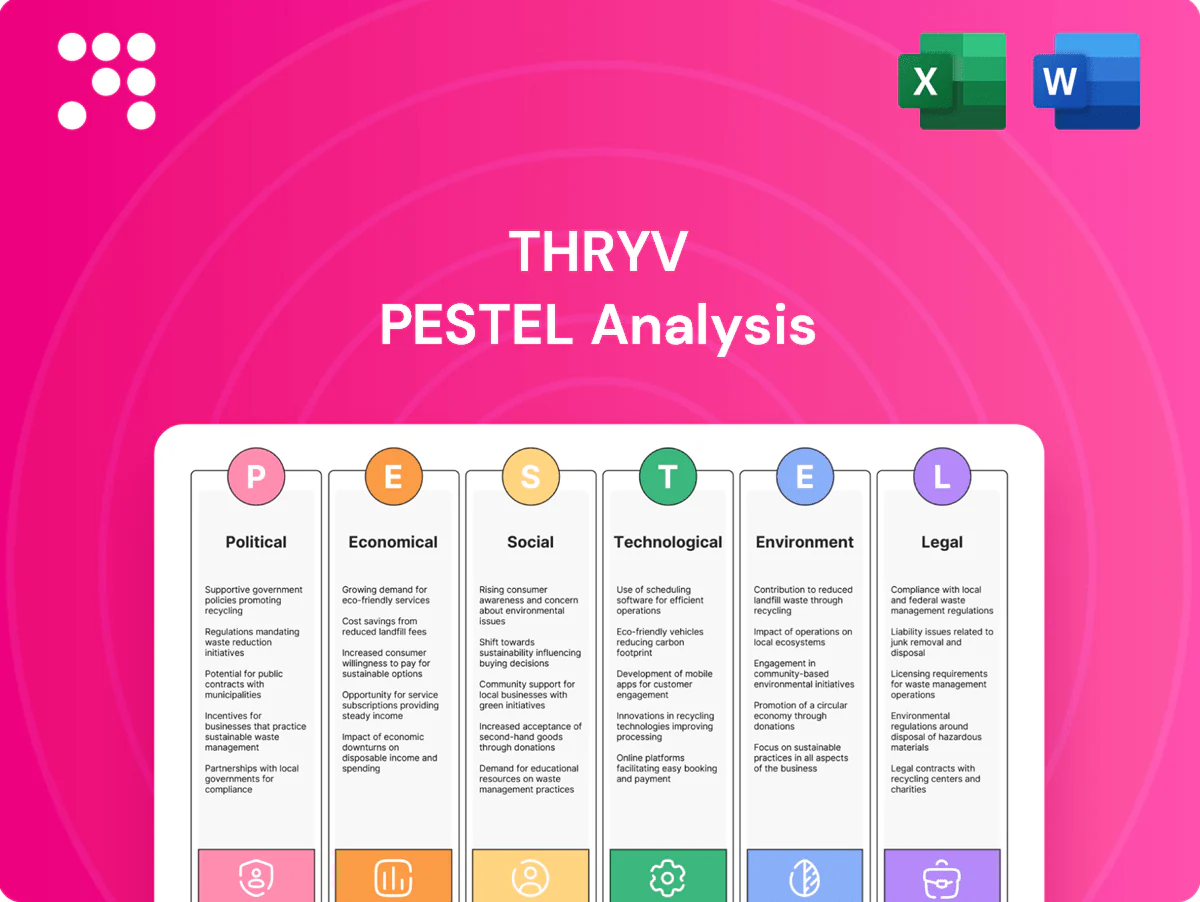
Thryv PESTLE Analysis

Make Smarter Strategic Decisions with a Complete PESTEL View
Gain strategic clarity with our PESTLE Analysis of Thryv, uncovering political, economic, social, technological, legal and environmental forces shaping its outlook. This concise briefing highlights risks and opportunities for investors and managers. Purchase the full report for detailed, actionable insights and ready-to-use templates.
Political factors

SMB digital policy support
Government incentives and grants for small-business digitization—over $1 billion in federal and state SMB digital grants announced through 2023–24—can lift adoption of platforms like Thryv by defraying CRM, e-commerce and cybersecurity costs. National and local programs accelerate pipeline; budget cuts or reprioritization can sharply slow demand. Monitoring policy calendars helps align go-to-market with funding windows.
Data localization and sovereignty
Rising data localization laws in more than 80 jurisdictions force changes in cloud architecture and vendor selection, increasing demand for regional data centers and residency options. Thryv may need localized infrastructure or partners to serve regulated U.S. states and global markets, as compliance can raise IT and operational costs by up to 25%. Compliance can be a market differentiator; noncompliance risks market exclusion and fines up to 4% of global revenue under GDPR-style regimes.

Digital taxation and platform levies
Expanding digital services taxes and marketplace levies—now in 40+ jurisdictions—and the OECD 15% global minimum tax increase pressure on margins or force higher prices for Thryv’s SMB customers. Cross-border operations face overlapping regimes and rising reporting burdens under OECD frameworks. Proactive tax structuring and dynamic pricing models mitigate volatility, while transparent pass-through fees preserve unit economics.

Procurement and public-sector outreach
Local governments—about 90,000 in the US—run small‑business enablement programs where certification and public procurement unlock channel access; the federal small‑business contracting goal is statutorily 23% of prime dollars. Political turnover often resets vendor lists and priorities, so building bipartisan relationships preserves continuity and recurring revenue opportunities.
- local_count: ~90,000
- fed_smb_goal: 23%
- procurement_channel: certification unlocks access
- risk: turnover resets vendor lists
- mitigation: bipartisan relationships
Trade policy and cloud supply chain
Export controls on advanced AI chips since 2022 and tariff shifts have lengthened cloud hardware lead times by 20–30% in 2023–24, while geopolitical tensions risk vendor delisting; OFAC maintained about 6,000 SDNs by mid‑2025, constraining Thryv’s payment and support footprints. Multi‑vendor cloud strategies lower concentration risk and clear geo‑fencing plus robust KYC/AML and machine‑learning screening keep operations compliant.
- Export controls: higher lead times 20–30%
- Sanctions: ~6,000 OFAC SDNs (mid‑2025)
- Strategy: multi‑vendor reduces single‑vendor risk
- Compliance: geo‑fencing + KYC/AML + ML screening
Grants, data localization and taxes reshape SMB digital services; monitor policy calendars
Government SMB digitization grants—over $1B nationwide through 2023–24—boost Thryv adoption but funding shifts can cut demand; monitor policy calendars. Data localization in 80+ jurisdictions and GDPR-style fines up to 4% of global revenue drive need for regional infrastructure and raise costs up to 25%. Digital services taxes (40+ jurisdictions) and OECD 15% minimum tax pressure margins; multi‑vendor/cloud strategies mitigate export/sanctions risks (OFAC ~6,000 SDNs mid‑2025).
| Metric | Value |
|---|---|
| SMB grants | >$1B (2023–24) |
| Data localization | 80+ jurisdictions |
| GDPR fines | Up to 4% global revenue |
| Compliance cost impact | Up to 25% |
| Digital services tax | 40+ jurisdictions |
| OECD min tax | 15% |
| Local governments (US) | ~90,000 |
| Fed SMB contracting goal | 23% |
| Export lead times | +20–30% (2023–24) |
| OFAC SDNs | ~6,000 (mid‑2025) |
What is included in the product
 Detailed Word Document
Explores how external macro-environmental factors uniquely affect Thryv across Political, Economic, Social, Technological, Environmental, and Legal dimensions, with each category expanded into specific sub-points and examples. Every section is data-backed, forward-looking, and formatted for executives, consultants, and investors to identify risks, opportunities, and scenario-driven strategies.

 Customizable Excel Spreadsheet
Condensed Thryv PESTLE summary highlighting key external risks and opportunities, formatted for quick insertion into presentations or team briefs to speed alignment and decision-making.
Economic factors

SMB spending sensitivity
Small businesses, which make up 99.9% of US firms per the SBA, are highly cyclical and commonly cut software spend in downturns and expand it in growth phases. Elevated policy rates around 5.25–5.50% in 2024 and tighter credit availability increase churn and constrain seat expansion for Thryv customers. Clear packaging and ROI proof points lower perceived budget risk, while flexible contract terms improve retention during tight cycles.
Inflation and pricing power
Rising input costs for support, hosting and talent squeeze gross margins as US CPI ran about 3.4% in 2024 (BLS), increasing wage and service-price pressure. Thryv can use value-based pricing and tiering to lift realized price without spiking churn, while pushing annual plans to lock revenue and improve cash predictability. Clear upgrade paths drive ARPU expansion—SaaS firms commonly see mid-single-digit ARPU uplifts from upgrades.

Payments volume and take rates
Integrated payments drive transactional revenue for Thryv, with company revenue around $610 million in FY2024 and payments contributing a meaningful but variable share as consumer demand shifts.
Recessionary dips compress payments volume and ancillary fees, historically reducing processing volumes by mid-single digits in slowdowns and pressuring take rates.
Tightening interchange optimization, lowering fraud losses and chargebacks (card-not-present fraud rising industrywide) are key to protecting margin.
Diversifying across SMB verticals—home services, healthcare, legal—smooths volatility in payments flows and stabilizes take-rate revenue.

FX and international expansion
Foreign revenue exposes Thryv to currency risk and billing complexity as multi-currency invoicing and repatriation can compress margins; localized pricing and forward hedging reduce FX drag and stabilize reported ARR. Using regional partners lowers customer acquisition cost and improves collections while strict local tax compliance avoids fines and operational disruption.
- FX exposure: multi-currency billing
- Mitigation: localized pricing + hedging
- Sales: regional partners lower CAC
- Risk: comply with local taxes
Labor market and service costs
Tight US tech labor markets push engineering and support costs higher, with median US software engineer pay around $120,000 in 2024 (Glassdoor), pressuring Thryv’s unit economics. Automation and AI-driven support can protect margins, with vendors reporting support-cost reductions near 30% in 2024. Nearshore talent pools (30–50% lower labor costs vs US) balance cost and agility, while a strong employer brand cuts turnover-related expenses.
- Tech pay: ~120k (2024)
- AI/support savings: ~30% (2024)
- Nearshore cost delta: 30–50%
- Employer brand reduces turnover costs
Grants, data localization and taxes reshape SMB digital services; monitor policy calendars
SMB cyclicality (99.9% of US firms) and 2024 policy rates ~5.25–5.50% raise churn and limit seat expansion; clear ROI and flexible contracts reduce budget risk. Thryv revenue ~$610M FY2024; CPI ~3.4% and median engineer pay ~$120k squeeze margins. Payments volatility and FX risk affect take-rates; AI/support cuts costs ~30%, nearshore saves 30–50%.
| Metric | 2024/2025 |
|---|---|
| SMB share (US) | 99.9% |
| Policy rates | 5.25–5.50% |
| Revenue (Thryv) | $610M FY2024 |
| CPI (US) | ~3.4% |
| Median engineer pay | $120k |
| AI support savings | ~30% |
| Nearshore cost delta | 30–50% |
Same Document Delivered
Thryv PESTLE Analysis
The preview shown here is the exact document you’ll receive after purchase—fully formatted and ready to use. This Thryv PESTLE Analysis is the real, finished file with complete content and structure. No placeholders or teasers; download the same document immediately after checkout.

Make Smarter Strategic Decisions with a Complete PESTEL View
Gain strategic clarity with our PESTLE Analysis of Thryv, uncovering political, economic, social, technological, legal and environmental forces shaping its outlook. This concise briefing highlights risks and opportunities for investors and managers. Purchase the full report for detailed, actionable insights and ready-to-use templates.
Political factors
SMB digital policy support
Government incentives and grants for small-business digitization—over $1 billion in federal and state SMB digital grants announced through 2023–24—can lift adoption of platforms like Thryv by defraying CRM, e-commerce and cybersecurity costs. National and local programs accelerate pipeline; budget cuts or reprioritization can sharply slow demand. Monitoring policy calendars helps align go-to-market with funding windows.
Data localization and sovereignty
Rising data localization laws in more than 80 jurisdictions force changes in cloud architecture and vendor selection, increasing demand for regional data centers and residency options. Thryv may need localized infrastructure or partners to serve regulated U.S. states and global markets, as compliance can raise IT and operational costs by up to 25%. Compliance can be a market differentiator; noncompliance risks market exclusion and fines up to 4% of global revenue under GDPR-style regimes.
Digital taxation and platform levies
Expanding digital services taxes and marketplace levies—now in 40+ jurisdictions—and the OECD 15% global minimum tax increase pressure on margins or force higher prices for Thryv’s SMB customers. Cross-border operations face overlapping regimes and rising reporting burdens under OECD frameworks. Proactive tax structuring and dynamic pricing models mitigate volatility, while transparent pass-through fees preserve unit economics.
Procurement and public-sector outreach
Local governments—about 90,000 in the US—run small‑business enablement programs where certification and public procurement unlock channel access; the federal small‑business contracting goal is statutorily 23% of prime dollars. Political turnover often resets vendor lists and priorities, so building bipartisan relationships preserves continuity and recurring revenue opportunities.
- local_count: ~90,000
- fed_smb_goal: 23%
- procurement_channel: certification unlocks access
- risk: turnover resets vendor lists
- mitigation: bipartisan relationships
Trade policy and cloud supply chain
Export controls on advanced AI chips since 2022 and tariff shifts have lengthened cloud hardware lead times by 20–30% in 2023–24, while geopolitical tensions risk vendor delisting; OFAC maintained about 6,000 SDNs by mid‑2025, constraining Thryv’s payment and support footprints. Multi‑vendor cloud strategies lower concentration risk and clear geo‑fencing plus robust KYC/AML and machine‑learning screening keep operations compliant.
- Export controls: higher lead times 20–30%
- Sanctions: ~6,000 OFAC SDNs (mid‑2025)
- Strategy: multi‑vendor reduces single‑vendor risk
- Compliance: geo‑fencing + KYC/AML + ML screening
Grants, data localization and taxes reshape SMB digital services; monitor policy calendars
Government SMB digitization grants—over $1B nationwide through 2023–24—boost Thryv adoption but funding shifts can cut demand; monitor policy calendars. Data localization in 80+ jurisdictions and GDPR-style fines up to 4% of global revenue drive need for regional infrastructure and raise costs up to 25%. Digital services taxes (40+ jurisdictions) and OECD 15% minimum tax pressure margins; multi‑vendor/cloud strategies mitigate export/sanctions risks (OFAC ~6,000 SDNs mid‑2025).
| Metric | Value |
|---|---|
| SMB grants | >$1B (2023–24) |
| Data localization | 80+ jurisdictions |
| GDPR fines | Up to 4% global revenue |
| Compliance cost impact | Up to 25% |
| Digital services tax | 40+ jurisdictions |
| OECD min tax | 15% |
| Local governments (US) | ~90,000 |
| Fed SMB contracting goal | 23% |
| Export lead times | +20–30% (2023–24) |
| OFAC SDNs | ~6,000 (mid‑2025) |
What is included in the product
Detailed Word Document
Explores how external macro-environmental factors uniquely affect Thryv across Political, Economic, Social, Technological, Environmental, and Legal dimensions, with each category expanded into specific sub-points and examples. Every section is data-backed, forward-looking, and formatted for executives, consultants, and investors to identify risks, opportunities, and scenario-driven strategies.
Customizable Excel Spreadsheet
Condensed Thryv PESTLE summary highlighting key external risks and opportunities, formatted for quick insertion into presentations or team briefs to speed alignment and decision-making.
Economic factors
SMB spending sensitivity
Small businesses, which make up 99.9% of US firms per the SBA, are highly cyclical and commonly cut software spend in downturns and expand it in growth phases. Elevated policy rates around 5.25–5.50% in 2024 and tighter credit availability increase churn and constrain seat expansion for Thryv customers. Clear packaging and ROI proof points lower perceived budget risk, while flexible contract terms improve retention during tight cycles.
Inflation and pricing power
Rising input costs for support, hosting and talent squeeze gross margins as US CPI ran about 3.4% in 2024 (BLS), increasing wage and service-price pressure. Thryv can use value-based pricing and tiering to lift realized price without spiking churn, while pushing annual plans to lock revenue and improve cash predictability. Clear upgrade paths drive ARPU expansion—SaaS firms commonly see mid-single-digit ARPU uplifts from upgrades.
Payments volume and take rates
Integrated payments drive transactional revenue for Thryv, with company revenue around $610 million in FY2024 and payments contributing a meaningful but variable share as consumer demand shifts.
Recessionary dips compress payments volume and ancillary fees, historically reducing processing volumes by mid-single digits in slowdowns and pressuring take rates.
Tightening interchange optimization, lowering fraud losses and chargebacks (card-not-present fraud rising industrywide) are key to protecting margin.
Diversifying across SMB verticals—home services, healthcare, legal—smooths volatility in payments flows and stabilizes take-rate revenue.
FX and international expansion
Foreign revenue exposes Thryv to currency risk and billing complexity as multi-currency invoicing and repatriation can compress margins; localized pricing and forward hedging reduce FX drag and stabilize reported ARR. Using regional partners lowers customer acquisition cost and improves collections while strict local tax compliance avoids fines and operational disruption.
- FX exposure: multi-currency billing
- Mitigation: localized pricing + hedging
- Sales: regional partners lower CAC
- Risk: comply with local taxes
Labor market and service costs
Tight US tech labor markets push engineering and support costs higher, with median US software engineer pay around $120,000 in 2024 (Glassdoor), pressuring Thryv’s unit economics. Automation and AI-driven support can protect margins, with vendors reporting support-cost reductions near 30% in 2024. Nearshore talent pools (30–50% lower labor costs vs US) balance cost and agility, while a strong employer brand cuts turnover-related expenses.
- Tech pay: ~120k (2024)
- AI/support savings: ~30% (2024)
- Nearshore cost delta: 30–50%
- Employer brand reduces turnover costs
Grants, data localization and taxes reshape SMB digital services; monitor policy calendars
SMB cyclicality (99.9% of US firms) and 2024 policy rates ~5.25–5.50% raise churn and limit seat expansion; clear ROI and flexible contracts reduce budget risk. Thryv revenue ~$610M FY2024; CPI ~3.4% and median engineer pay ~$120k squeeze margins. Payments volatility and FX risk affect take-rates; AI/support cuts costs ~30%, nearshore saves 30–50%.
| Metric | 2024/2025 |
|---|---|
| SMB share (US) | 99.9% |
| Policy rates | 5.25–5.50% |
| Revenue (Thryv) | $610M FY2024 |
| CPI (US) | ~3.4% |
| Median engineer pay | $120k |
| AI support savings | ~30% |
| Nearshore cost delta | 30–50% |
Same Document Delivered
Thryv PESTLE Analysis
The preview shown here is the exact document you’ll receive after purchase—fully formatted and ready to use. This Thryv PESTLE Analysis is the real, finished file with complete content and structure. No placeholders or teasers; download the same document immediately after checkout.
Original: $10.00
-65%$10.00
$3.50Description
Make Smarter Strategic Decisions with a Complete PESTEL View
Gain strategic clarity with our PESTLE Analysis of Thryv, uncovering political, economic, social, technological, legal and environmental forces shaping its outlook. This concise briefing highlights risks and opportunities for investors and managers. Purchase the full report for detailed, actionable insights and ready-to-use templates.
Political factors
SMB digital policy support
Government incentives and grants for small-business digitization—over $1 billion in federal and state SMB digital grants announced through 2023–24—can lift adoption of platforms like Thryv by defraying CRM, e-commerce and cybersecurity costs. National and local programs accelerate pipeline; budget cuts or reprioritization can sharply slow demand. Monitoring policy calendars helps align go-to-market with funding windows.
Data localization and sovereignty
Rising data localization laws in more than 80 jurisdictions force changes in cloud architecture and vendor selection, increasing demand for regional data centers and residency options. Thryv may need localized infrastructure or partners to serve regulated U.S. states and global markets, as compliance can raise IT and operational costs by up to 25%. Compliance can be a market differentiator; noncompliance risks market exclusion and fines up to 4% of global revenue under GDPR-style regimes.
Digital taxation and platform levies
Expanding digital services taxes and marketplace levies—now in 40+ jurisdictions—and the OECD 15% global minimum tax increase pressure on margins or force higher prices for Thryv’s SMB customers. Cross-border operations face overlapping regimes and rising reporting burdens under OECD frameworks. Proactive tax structuring and dynamic pricing models mitigate volatility, while transparent pass-through fees preserve unit economics.
Procurement and public-sector outreach
Local governments—about 90,000 in the US—run small‑business enablement programs where certification and public procurement unlock channel access; the federal small‑business contracting goal is statutorily 23% of prime dollars. Political turnover often resets vendor lists and priorities, so building bipartisan relationships preserves continuity and recurring revenue opportunities.
- local_count: ~90,000
- fed_smb_goal: 23%
- procurement_channel: certification unlocks access
- risk: turnover resets vendor lists
- mitigation: bipartisan relationships
Trade policy and cloud supply chain
Export controls on advanced AI chips since 2022 and tariff shifts have lengthened cloud hardware lead times by 20–30% in 2023–24, while geopolitical tensions risk vendor delisting; OFAC maintained about 6,000 SDNs by mid‑2025, constraining Thryv’s payment and support footprints. Multi‑vendor cloud strategies lower concentration risk and clear geo‑fencing plus robust KYC/AML and machine‑learning screening keep operations compliant.
- Export controls: higher lead times 20–30%
- Sanctions: ~6,000 OFAC SDNs (mid‑2025)
- Strategy: multi‑vendor reduces single‑vendor risk
- Compliance: geo‑fencing + KYC/AML + ML screening
Grants, data localization and taxes reshape SMB digital services; monitor policy calendars
Government SMB digitization grants—over $1B nationwide through 2023–24—boost Thryv adoption but funding shifts can cut demand; monitor policy calendars. Data localization in 80+ jurisdictions and GDPR-style fines up to 4% of global revenue drive need for regional infrastructure and raise costs up to 25%. Digital services taxes (40+ jurisdictions) and OECD 15% minimum tax pressure margins; multi‑vendor/cloud strategies mitigate export/sanctions risks (OFAC ~6,000 SDNs mid‑2025).
| Metric | Value |
|---|---|
| SMB grants | >$1B (2023–24) |
| Data localization | 80+ jurisdictions |
| GDPR fines | Up to 4% global revenue |
| Compliance cost impact | Up to 25% |
| Digital services tax | 40+ jurisdictions |
| OECD min tax | 15% |
| Local governments (US) | ~90,000 |
| Fed SMB contracting goal | 23% |
| Export lead times | +20–30% (2023–24) |
| OFAC SDNs | ~6,000 (mid‑2025) |
What is included in the product
Detailed Word Document
Explores how external macro-environmental factors uniquely affect Thryv across Political, Economic, Social, Technological, Environmental, and Legal dimensions, with each category expanded into specific sub-points and examples. Every section is data-backed, forward-looking, and formatted for executives, consultants, and investors to identify risks, opportunities, and scenario-driven strategies.
Customizable Excel Spreadsheet
Condensed Thryv PESTLE summary highlighting key external risks and opportunities, formatted for quick insertion into presentations or team briefs to speed alignment and decision-making.
Economic factors
SMB spending sensitivity
Small businesses, which make up 99.9% of US firms per the SBA, are highly cyclical and commonly cut software spend in downturns and expand it in growth phases. Elevated policy rates around 5.25–5.50% in 2024 and tighter credit availability increase churn and constrain seat expansion for Thryv customers. Clear packaging and ROI proof points lower perceived budget risk, while flexible contract terms improve retention during tight cycles.
Inflation and pricing power
Rising input costs for support, hosting and talent squeeze gross margins as US CPI ran about 3.4% in 2024 (BLS), increasing wage and service-price pressure. Thryv can use value-based pricing and tiering to lift realized price without spiking churn, while pushing annual plans to lock revenue and improve cash predictability. Clear upgrade paths drive ARPU expansion—SaaS firms commonly see mid-single-digit ARPU uplifts from upgrades.
Payments volume and take rates
Integrated payments drive transactional revenue for Thryv, with company revenue around $610 million in FY2024 and payments contributing a meaningful but variable share as consumer demand shifts.
Recessionary dips compress payments volume and ancillary fees, historically reducing processing volumes by mid-single digits in slowdowns and pressuring take rates.
Tightening interchange optimization, lowering fraud losses and chargebacks (card-not-present fraud rising industrywide) are key to protecting margin.
Diversifying across SMB verticals—home services, healthcare, legal—smooths volatility in payments flows and stabilizes take-rate revenue.
FX and international expansion
Foreign revenue exposes Thryv to currency risk and billing complexity as multi-currency invoicing and repatriation can compress margins; localized pricing and forward hedging reduce FX drag and stabilize reported ARR. Using regional partners lowers customer acquisition cost and improves collections while strict local tax compliance avoids fines and operational disruption.
- FX exposure: multi-currency billing
- Mitigation: localized pricing + hedging
- Sales: regional partners lower CAC
- Risk: comply with local taxes
Labor market and service costs
Tight US tech labor markets push engineering and support costs higher, with median US software engineer pay around $120,000 in 2024 (Glassdoor), pressuring Thryv’s unit economics. Automation and AI-driven support can protect margins, with vendors reporting support-cost reductions near 30% in 2024. Nearshore talent pools (30–50% lower labor costs vs US) balance cost and agility, while a strong employer brand cuts turnover-related expenses.
- Tech pay: ~120k (2024)
- AI/support savings: ~30% (2024)
- Nearshore cost delta: 30–50%
- Employer brand reduces turnover costs
Grants, data localization and taxes reshape SMB digital services; monitor policy calendars
SMB cyclicality (99.9% of US firms) and 2024 policy rates ~5.25–5.50% raise churn and limit seat expansion; clear ROI and flexible contracts reduce budget risk. Thryv revenue ~$610M FY2024; CPI ~3.4% and median engineer pay ~$120k squeeze margins. Payments volatility and FX risk affect take-rates; AI/support cuts costs ~30%, nearshore saves 30–50%.
| Metric | 2024/2025 |
|---|---|
| SMB share (US) | 99.9% |
| Policy rates | 5.25–5.50% |
| Revenue (Thryv) | $610M FY2024 |
| CPI (US) | ~3.4% |
| Median engineer pay | $120k |
| AI support savings | ~30% |
| Nearshore cost delta | 30–50% |
Same Document Delivered
Thryv PESTLE Analysis
The preview shown here is the exact document you’ll receive after purchase—fully formatted and ready to use. This Thryv PESTLE Analysis is the real, finished file with complete content and structure. No placeholders or teasers; download the same document immediately after checkout.











