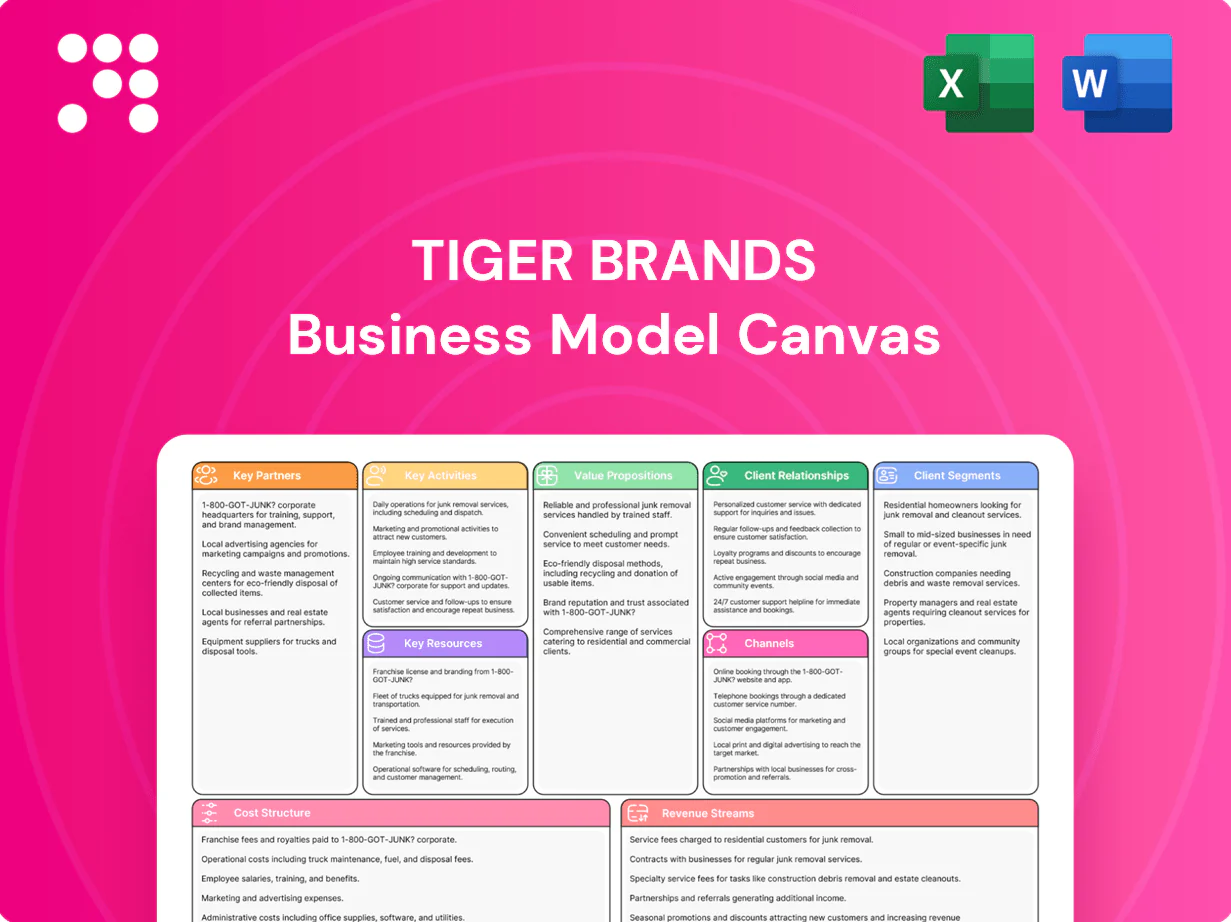
Tiger Brands Business Model Canvas

Business Model Canvas: strategic snapshot of customer segments, value, revenue
Unlock the full strategic blueprint behind Tiger Brands with our Business Model Canvas that maps customer segments, value propositions, and revenue streams. This concise, actionable snapshot reveals key partnerships, cost drivers, and growth levers for investors and strategists. Download the complete Word/Excel canvas to benchmark, plan, and execute with confidence.
Partnerships

Agricultural suppliers and contract farmers
Secure, diversified sourcing of grains, sugar, oils and other inputs from over 1,000 contract farmers and multiple suppliers underpins continuous production at Tiger Brands, supporting FY2024 operating continuity. Long-term contracts covering more than 60% of core inputs reduce price volatility and ensure quality specs. Collaboration on sustainable farming (soil and water projects) improves resilience and traceability. Joint planning aligns harvest cycles with plant capacity.
Ingredient and packaging vendors
Specialist providers of flavors, vitamins and functional additives enable Tiger Brands to differentiate SKUs and address health trends, supporting product innovation within a group reporting FY2024 revenue of R32.7bn and listed on the JSE as TBS. Packaging partners supply cost-effective, recyclable formats that protect shelf life, while co-development has delivered ~10% reductions in packaging waste and transport costs. Dual-sourcing across key ingredients mitigates supply risk.

Retailers, wholesalers, and spaza distributors
Retail chains and independent wholesalers give Tiger Brands national scale and shelf visibility, while route-to-market partners—including spaza-focused distributors—ensure penetration of township and rural outlets. Joint business plans with these partners align assortment, pricing and promotions to category demand. Regular data sharing enhances demand forecasting and on-shelf availability across channels.

Logistics, warehousing, and co-packers
Third-party logistics expand Tiger Brands distribution coverage and improve delivery reliability across South Africa and export markets, while temperature-controlled storage protects perishable product integrity throughout the cold chain. Co-packers provide flexible surge capacity during peak seasons, reducing stockouts and capital tied in excess inventory. Network optimization lowers lead times and transportation costs, improving on-shelf availability and margin resilience.
- 3PLs: wider reach, better fill rates
- Cold storage: preserves quality, reduces spoilage
- Co-packers: scalable peak capacity
- Network optimization: lower lead times & costs
Regulators, standards bodies, and industry groups
Compliance partnerships with regulators and standards bodies secure food safety and labeling accuracy, reducing legal and market risks after the 2017 listeria outbreak linked to Tiger Brands caused 1 060 confirmed cases and 216 deaths.
HACCP/ISO certification builds consumer trust and market access; industry forums enable policy advocacy and rapid best-practice diffusion.
Early regulator engagement shortens approval timelines and lowers recall incidence.
- 2017 listeria: 1 060 cases, 216 deaths
Partnerships secure >1,000 farms, >60% inputs and R32.7bn FY2024 revenue
Key partnerships secure inputs from >1,000 contract farmers and dual-sourced suppliers, with >60% of core inputs on long-term contracts supporting FY2024 revenue of R32.7bn. Innovation partners (flavors, additives) and packaging co-developments cut packaging waste ~10% and support SKU differentiation. 3PLs, cold storage and co-packers improve fill rates and reduce lead times; compliance partners restore trust after 2017 listeria (1 060 cases; 216 deaths).
| Partner | Role | Impact |
|---|---|---|
| Contract farmers | Sourcing | 1 000+ farms, >60% inputs |
| Packaging partners | Co-dev | -10% waste |
| 3PL/cold storage | Distribution | Higher fill, lower spoilage |
What is included in the product
 Detailed Word Document
A concise, pre-written Business Model Canvas for Tiger Brands detailing customer segments, channels, value propositions and revenue streams across the 9 BMC blocks, reflecting real-world operations, competitive advantages, SWOT-linked insights and investor-ready presentation format.

 Customizable Excel Spreadsheet
High-level view of Tiger Brands’ business model with editable cells to quickly pinpoint operational bottlenecks and cost drivers, ideal for team collaboration and rapid strategy pivots.
Activities

High-volume food manufacturing and processing
Operate mills, plants and canneries across South Africa and into 20+ export markets, converting raw inputs into branded goods with an integrated supply chain and a workforce of over 8,000. Lean practices deliver 3–5% yield and throughput gains, tightening cost control and boosting gross margins. Rigorous preventive maintenance has cut unplanned downtime by ~25%, while continuous improvement programs preserve quality and margin resilience.
Category management and brand marketing
Category management and brand marketing at Tiger Brands plans portfolios across grains, snacks, beverages and groceries, aligning SKUs to retail demand and channel roles. Price-pack architecture balances value and premium tiers to protect market share and margin. Promotions, media and in-store execution focus on penetration and shopping frequency, while consumer insights and FY2024 market feedback drive targeted messaging and NPD.

Supply chain planning and distribution
In 2024 Tiger Brands runs rigorous S&OP cycles to align demand and supply across categories, shortening lead times and improving fill rates. Inventory is optimized across distribution centres and retail nodes to balance service levels and working capital. Advanced analytics and machine learning are used to boost forecast accuracy and cut waste. Last-mile networks ensure reliable reach into both formal retailers and informal trade channels.

R&D and product innovation
R&D and product innovation at Tiger Brands focuses on new flavors, formats and health-forward options, with reformulations targeting cost, nutrition and regulatory shifts; FY2024 R&D-led launches contributed to improved margin resilience after group turnover of R34.3 billion in 2024. Pilots and scale-ups emphasize efficiency, using sensory testing and rapid consumer feedback loops to cut time-to-market.
- new flavors/formats
- reformulate for cost & nutrition
- pilot→scale efficiency
- sensory + rapid feedback
Quality assurance and compliance
Implement rigorous testing from raw intake to finished goods with lab checkpoints and GMP controls, supporting over 95% batch-level traceability in 2024; traceability systems enable swift recalls and reduced time-to-recall to under 24 hours in simulations. Supplier audits (covering >1,000 suppliers in 2024) enforce standards while ongoing staff training embeds a culture of food safety.
- Traceability: >95% batch coverage 2024
- Recall readiness: <24h drills
- Supplier audits: >1,000 in 2024
- Training: continuous GMP/FSMS
R34.3bn FMCG: integrated mills, 20+ export markets, >8,000 staff, >95% traceability
Operate integrated mills, plants and canneries across South Africa and 20+ export markets, converting inputs into branded FMCG with >8,000 staff and lean practices driving 3–5% yield gains. Demand-led category management and S&OP shorten lead times and improve fill rates; R&D and reformulation support NPD and margin resilience after group turnover of R34.3bn in 2024. Food safety, >95% batch traceability and >1,000 supplier audits sustain quality.
| Metric | 2024 |
|---|---|
| Revenue | R34.3bn |
| Employees | >8,000 |
| Supplier audits | >1,000 |
| Traceability | >95% |
| Downtime red. | ~25% |
| Time-to-recall | <24h (drill) |
What You See Is What You Get
Business Model Canvas
The Tiger Brands Business Model Canvas you see here is the actual deliverable, not a mockup. It’s a direct excerpt from the full document you’ll receive after purchase. When you buy, you’ll download this exact file—complete, editable and ready to use in Word and Excel with all content preserved.

Business Model Canvas: strategic snapshot of customer segments, value, revenue
Unlock the full strategic blueprint behind Tiger Brands with our Business Model Canvas that maps customer segments, value propositions, and revenue streams. This concise, actionable snapshot reveals key partnerships, cost drivers, and growth levers for investors and strategists. Download the complete Word/Excel canvas to benchmark, plan, and execute with confidence.
Partnerships
Agricultural suppliers and contract farmers
Secure, diversified sourcing of grains, sugar, oils and other inputs from over 1,000 contract farmers and multiple suppliers underpins continuous production at Tiger Brands, supporting FY2024 operating continuity. Long-term contracts covering more than 60% of core inputs reduce price volatility and ensure quality specs. Collaboration on sustainable farming (soil and water projects) improves resilience and traceability. Joint planning aligns harvest cycles with plant capacity.
Ingredient and packaging vendors
Specialist providers of flavors, vitamins and functional additives enable Tiger Brands to differentiate SKUs and address health trends, supporting product innovation within a group reporting FY2024 revenue of R32.7bn and listed on the JSE as TBS. Packaging partners supply cost-effective, recyclable formats that protect shelf life, while co-development has delivered ~10% reductions in packaging waste and transport costs. Dual-sourcing across key ingredients mitigates supply risk.
Retailers, wholesalers, and spaza distributors
Retail chains and independent wholesalers give Tiger Brands national scale and shelf visibility, while route-to-market partners—including spaza-focused distributors—ensure penetration of township and rural outlets. Joint business plans with these partners align assortment, pricing and promotions to category demand. Regular data sharing enhances demand forecasting and on-shelf availability across channels.
Logistics, warehousing, and co-packers
Third-party logistics expand Tiger Brands distribution coverage and improve delivery reliability across South Africa and export markets, while temperature-controlled storage protects perishable product integrity throughout the cold chain. Co-packers provide flexible surge capacity during peak seasons, reducing stockouts and capital tied in excess inventory. Network optimization lowers lead times and transportation costs, improving on-shelf availability and margin resilience.
- 3PLs: wider reach, better fill rates
- Cold storage: preserves quality, reduces spoilage
- Co-packers: scalable peak capacity
- Network optimization: lower lead times & costs
Regulators, standards bodies, and industry groups
Compliance partnerships with regulators and standards bodies secure food safety and labeling accuracy, reducing legal and market risks after the 2017 listeria outbreak linked to Tiger Brands caused 1 060 confirmed cases and 216 deaths.
HACCP/ISO certification builds consumer trust and market access; industry forums enable policy advocacy and rapid best-practice diffusion.
Early regulator engagement shortens approval timelines and lowers recall incidence.
- 2017 listeria: 1 060 cases, 216 deaths
Partnerships secure >1,000 farms, >60% inputs and R32.7bn FY2024 revenue
Key partnerships secure inputs from >1,000 contract farmers and dual-sourced suppliers, with >60% of core inputs on long-term contracts supporting FY2024 revenue of R32.7bn. Innovation partners (flavors, additives) and packaging co-developments cut packaging waste ~10% and support SKU differentiation. 3PLs, cold storage and co-packers improve fill rates and reduce lead times; compliance partners restore trust after 2017 listeria (1 060 cases; 216 deaths).
| Partner | Role | Impact |
|---|---|---|
| Contract farmers | Sourcing | 1 000+ farms, >60% inputs |
| Packaging partners | Co-dev | -10% waste |
| 3PL/cold storage | Distribution | Higher fill, lower spoilage |
What is included in the product
Detailed Word Document
A concise, pre-written Business Model Canvas for Tiger Brands detailing customer segments, channels, value propositions and revenue streams across the 9 BMC blocks, reflecting real-world operations, competitive advantages, SWOT-linked insights and investor-ready presentation format.
Customizable Excel Spreadsheet
High-level view of Tiger Brands’ business model with editable cells to quickly pinpoint operational bottlenecks and cost drivers, ideal for team collaboration and rapid strategy pivots.
Activities
High-volume food manufacturing and processing
Operate mills, plants and canneries across South Africa and into 20+ export markets, converting raw inputs into branded goods with an integrated supply chain and a workforce of over 8,000. Lean practices deliver 3–5% yield and throughput gains, tightening cost control and boosting gross margins. Rigorous preventive maintenance has cut unplanned downtime by ~25%, while continuous improvement programs preserve quality and margin resilience.
Category management and brand marketing
Category management and brand marketing at Tiger Brands plans portfolios across grains, snacks, beverages and groceries, aligning SKUs to retail demand and channel roles. Price-pack architecture balances value and premium tiers to protect market share and margin. Promotions, media and in-store execution focus on penetration and shopping frequency, while consumer insights and FY2024 market feedback drive targeted messaging and NPD.
Supply chain planning and distribution
In 2024 Tiger Brands runs rigorous S&OP cycles to align demand and supply across categories, shortening lead times and improving fill rates. Inventory is optimized across distribution centres and retail nodes to balance service levels and working capital. Advanced analytics and machine learning are used to boost forecast accuracy and cut waste. Last-mile networks ensure reliable reach into both formal retailers and informal trade channels.
R&D and product innovation
R&D and product innovation at Tiger Brands focuses on new flavors, formats and health-forward options, with reformulations targeting cost, nutrition and regulatory shifts; FY2024 R&D-led launches contributed to improved margin resilience after group turnover of R34.3 billion in 2024. Pilots and scale-ups emphasize efficiency, using sensory testing and rapid consumer feedback loops to cut time-to-market.
- new flavors/formats
- reformulate for cost & nutrition
- pilot→scale efficiency
- sensory + rapid feedback
Quality assurance and compliance
Implement rigorous testing from raw intake to finished goods with lab checkpoints and GMP controls, supporting over 95% batch-level traceability in 2024; traceability systems enable swift recalls and reduced time-to-recall to under 24 hours in simulations. Supplier audits (covering >1,000 suppliers in 2024) enforce standards while ongoing staff training embeds a culture of food safety.
- Traceability: >95% batch coverage 2024
- Recall readiness: <24h drills
- Supplier audits: >1,000 in 2024
- Training: continuous GMP/FSMS
R34.3bn FMCG: integrated mills, 20+ export markets, >8,000 staff, >95% traceability
Operate integrated mills, plants and canneries across South Africa and 20+ export markets, converting inputs into branded FMCG with >8,000 staff and lean practices driving 3–5% yield gains. Demand-led category management and S&OP shorten lead times and improve fill rates; R&D and reformulation support NPD and margin resilience after group turnover of R34.3bn in 2024. Food safety, >95% batch traceability and >1,000 supplier audits sustain quality.
| Metric | 2024 |
|---|---|
| Revenue | R34.3bn |
| Employees | >8,000 |
| Supplier audits | >1,000 |
| Traceability | >95% |
| Downtime red. | ~25% |
| Time-to-recall | <24h (drill) |
What You See Is What You Get
Business Model Canvas
The Tiger Brands Business Model Canvas you see here is the actual deliverable, not a mockup. It’s a direct excerpt from the full document you’ll receive after purchase. When you buy, you’ll download this exact file—complete, editable and ready to use in Word and Excel with all content preserved.
Description
Business Model Canvas: strategic snapshot of customer segments, value, revenue
Unlock the full strategic blueprint behind Tiger Brands with our Business Model Canvas that maps customer segments, value propositions, and revenue streams. This concise, actionable snapshot reveals key partnerships, cost drivers, and growth levers for investors and strategists. Download the complete Word/Excel canvas to benchmark, plan, and execute with confidence.
Partnerships
Agricultural suppliers and contract farmers
Secure, diversified sourcing of grains, sugar, oils and other inputs from over 1,000 contract farmers and multiple suppliers underpins continuous production at Tiger Brands, supporting FY2024 operating continuity. Long-term contracts covering more than 60% of core inputs reduce price volatility and ensure quality specs. Collaboration on sustainable farming (soil and water projects) improves resilience and traceability. Joint planning aligns harvest cycles with plant capacity.
Ingredient and packaging vendors
Specialist providers of flavors, vitamins and functional additives enable Tiger Brands to differentiate SKUs and address health trends, supporting product innovation within a group reporting FY2024 revenue of R32.7bn and listed on the JSE as TBS. Packaging partners supply cost-effective, recyclable formats that protect shelf life, while co-development has delivered ~10% reductions in packaging waste and transport costs. Dual-sourcing across key ingredients mitigates supply risk.
Retailers, wholesalers, and spaza distributors
Retail chains and independent wholesalers give Tiger Brands national scale and shelf visibility, while route-to-market partners—including spaza-focused distributors—ensure penetration of township and rural outlets. Joint business plans with these partners align assortment, pricing and promotions to category demand. Regular data sharing enhances demand forecasting and on-shelf availability across channels.
Logistics, warehousing, and co-packers
Third-party logistics expand Tiger Brands distribution coverage and improve delivery reliability across South Africa and export markets, while temperature-controlled storage protects perishable product integrity throughout the cold chain. Co-packers provide flexible surge capacity during peak seasons, reducing stockouts and capital tied in excess inventory. Network optimization lowers lead times and transportation costs, improving on-shelf availability and margin resilience.
- 3PLs: wider reach, better fill rates
- Cold storage: preserves quality, reduces spoilage
- Co-packers: scalable peak capacity
- Network optimization: lower lead times & costs
Regulators, standards bodies, and industry groups
Compliance partnerships with regulators and standards bodies secure food safety and labeling accuracy, reducing legal and market risks after the 2017 listeria outbreak linked to Tiger Brands caused 1 060 confirmed cases and 216 deaths.
HACCP/ISO certification builds consumer trust and market access; industry forums enable policy advocacy and rapid best-practice diffusion.
Early regulator engagement shortens approval timelines and lowers recall incidence.
- 2017 listeria: 1 060 cases, 216 deaths
Partnerships secure >1,000 farms, >60% inputs and R32.7bn FY2024 revenue
Key partnerships secure inputs from >1,000 contract farmers and dual-sourced suppliers, with >60% of core inputs on long-term contracts supporting FY2024 revenue of R32.7bn. Innovation partners (flavors, additives) and packaging co-developments cut packaging waste ~10% and support SKU differentiation. 3PLs, cold storage and co-packers improve fill rates and reduce lead times; compliance partners restore trust after 2017 listeria (1 060 cases; 216 deaths).
| Partner | Role | Impact |
|---|---|---|
| Contract farmers | Sourcing | 1 000+ farms, >60% inputs |
| Packaging partners | Co-dev | -10% waste |
| 3PL/cold storage | Distribution | Higher fill, lower spoilage |
What is included in the product
Detailed Word Document
A concise, pre-written Business Model Canvas for Tiger Brands detailing customer segments, channels, value propositions and revenue streams across the 9 BMC blocks, reflecting real-world operations, competitive advantages, SWOT-linked insights and investor-ready presentation format.
Customizable Excel Spreadsheet
High-level view of Tiger Brands’ business model with editable cells to quickly pinpoint operational bottlenecks and cost drivers, ideal for team collaboration and rapid strategy pivots.
Activities
High-volume food manufacturing and processing
Operate mills, plants and canneries across South Africa and into 20+ export markets, converting raw inputs into branded goods with an integrated supply chain and a workforce of over 8,000. Lean practices deliver 3–5% yield and throughput gains, tightening cost control and boosting gross margins. Rigorous preventive maintenance has cut unplanned downtime by ~25%, while continuous improvement programs preserve quality and margin resilience.
Category management and brand marketing
Category management and brand marketing at Tiger Brands plans portfolios across grains, snacks, beverages and groceries, aligning SKUs to retail demand and channel roles. Price-pack architecture balances value and premium tiers to protect market share and margin. Promotions, media and in-store execution focus on penetration and shopping frequency, while consumer insights and FY2024 market feedback drive targeted messaging and NPD.
Supply chain planning and distribution
In 2024 Tiger Brands runs rigorous S&OP cycles to align demand and supply across categories, shortening lead times and improving fill rates. Inventory is optimized across distribution centres and retail nodes to balance service levels and working capital. Advanced analytics and machine learning are used to boost forecast accuracy and cut waste. Last-mile networks ensure reliable reach into both formal retailers and informal trade channels.
R&D and product innovation
R&D and product innovation at Tiger Brands focuses on new flavors, formats and health-forward options, with reformulations targeting cost, nutrition and regulatory shifts; FY2024 R&D-led launches contributed to improved margin resilience after group turnover of R34.3 billion in 2024. Pilots and scale-ups emphasize efficiency, using sensory testing and rapid consumer feedback loops to cut time-to-market.
- new flavors/formats
- reformulate for cost & nutrition
- pilot→scale efficiency
- sensory + rapid feedback
Quality assurance and compliance
Implement rigorous testing from raw intake to finished goods with lab checkpoints and GMP controls, supporting over 95% batch-level traceability in 2024; traceability systems enable swift recalls and reduced time-to-recall to under 24 hours in simulations. Supplier audits (covering >1,000 suppliers in 2024) enforce standards while ongoing staff training embeds a culture of food safety.
- Traceability: >95% batch coverage 2024
- Recall readiness: <24h drills
- Supplier audits: >1,000 in 2024
- Training: continuous GMP/FSMS
R34.3bn FMCG: integrated mills, 20+ export markets, >8,000 staff, >95% traceability
Operate integrated mills, plants and canneries across South Africa and 20+ export markets, converting inputs into branded FMCG with >8,000 staff and lean practices driving 3–5% yield gains. Demand-led category management and S&OP shorten lead times and improve fill rates; R&D and reformulation support NPD and margin resilience after group turnover of R34.3bn in 2024. Food safety, >95% batch traceability and >1,000 supplier audits sustain quality.
| Metric | 2024 |
|---|---|
| Revenue | R34.3bn |
| Employees | >8,000 |
| Supplier audits | >1,000 |
| Traceability | >95% |
| Downtime red. | ~25% |
| Time-to-recall | <24h (drill) |
What You See Is What You Get
Business Model Canvas
The Tiger Brands Business Model Canvas you see here is the actual deliverable, not a mockup. It’s a direct excerpt from the full document you’ll receive after purchase. When you buy, you’ll download this exact file—complete, editable and ready to use in Word and Excel with all content preserved.











