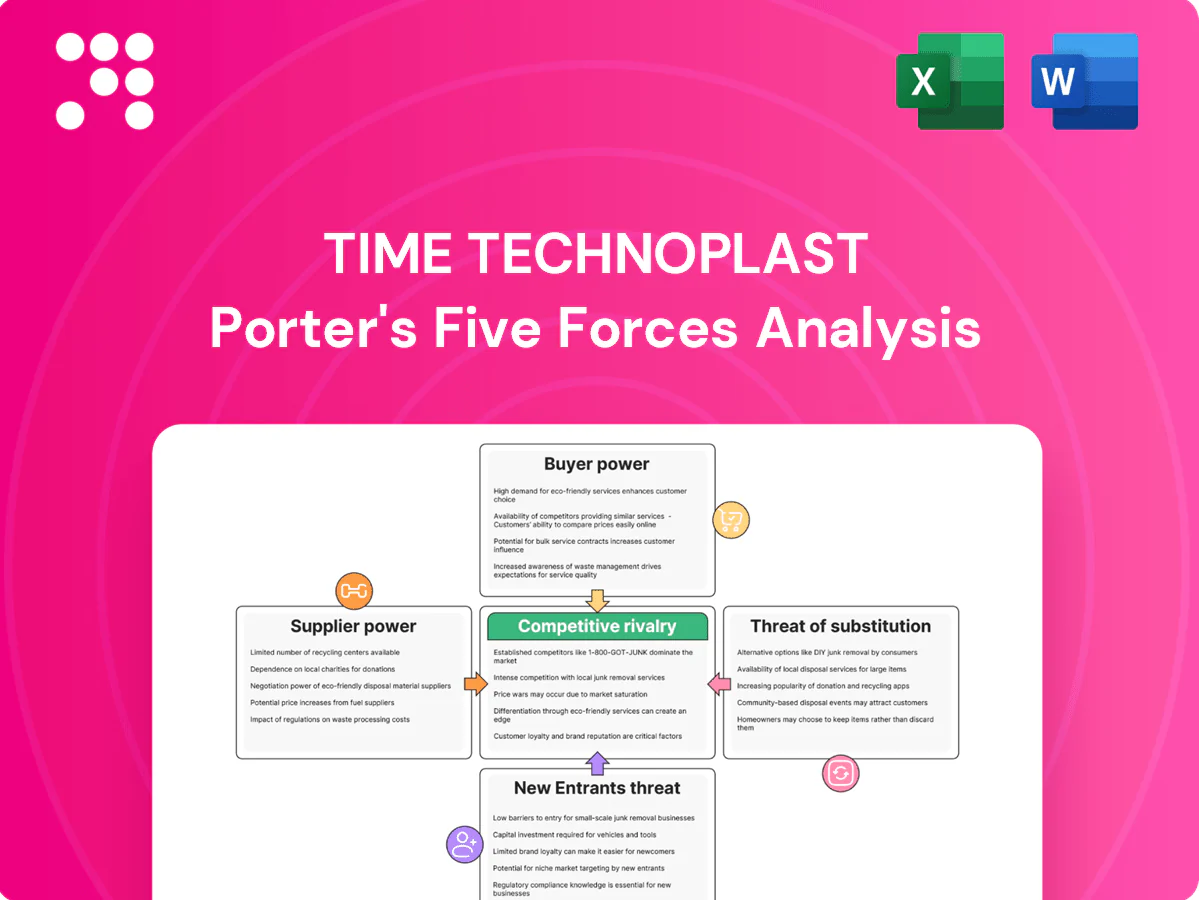
Time Technoplast Porter's Five Forces Analysis

A Must-Have Tool for Decision-Makers
Time Technoplast’s Porter's Five Forces snapshot highlights competitive intensity, supplier and buyer power, substitute threats and entry barriers, revealing pressures on margins and growth. Want deeper, data-driven force ratings, visuals and strategic implications? Unlock the full Porter's Five Forces Analysis to inform investment or strategy decisions.
Suppliers Bargaining Power

Concentrated petrochemical feedstock
Polymer resins like HDPE and PP are supplied by a concentrated set of large petrochemical firms, giving suppliers pricing leverage. Long-term offtake contracts (typically 3–5 years) stabilize volumes but tie Time Technoplast pricing to naphtha/ethylene cycles. Any upstream disruption can compress margins and delay deliveries. Diversifying suppliers and resin grades is essential to reduce supplier leverage.
Additives and specialty inputs
Performance additives, masterbatches and liners are highly specialized and less fungible, making suppliers more influential; qualification cycles of 6–18 months materially increase dependence on approved vendors. This raises switching costs and can lock Time Technoplast into specific formulations and price structures. Strategic sourcing, supplier consolidation and dual-qualification of key inputs reduce concentration risk and preserve negotiating leverage.

Capital equipment and tooling
Extrusion blow molding and composite winding equipment are supplied by a concentrated set of global OEMs—typically 3–5 major players—giving suppliers notable leverage. Tooling precision (tolerances often within sub-millimeter ranges) directly impacts throughput and quality, with misalignment increasing rework and downtime. Mold lead times commonly run 12–24 weeks, creating timing power for suppliers; Time Technoplast reduces exposure via in-house tool rooms and standardized platforms that shorten turnaround and lower supplier dependence.

Energy and logistics sensitivity
Energy costs materially influence Time Technoplast’s processing economics for continuous operations; in 2024 Indian industrial power tariffs rose about 5% y/y, amplifying unit costs, while diesel/delivery fuel volatility pushed road freight rates up intermittently. Transport of bulky drums/IBCs adds freight risk and handling cost; power and logistics suppliers can compress margins during spikes, though multi-site manufacturing near key customers reduces this supplier leverage.
- Energy sensitivity: higher tariffs ↑ unit cost
- Freight risk: bulky IBCs increase transport volatility
- Supplier pressure: price spikes compress margins
- Mitigation: multi-site footprint lowers supplier power
Counter-leverage via scale
Time Technoplast’s high volumes and multi-vertical demand give it counter-leverage over suppliers, with FY24 consolidated revenue around INR 3,200 crore supporting scale-based negotiations; consolidated procurement and vendor development programs have secured better pricing and lead times. Data-driven demand forecasting and ERP integration improved supplier fill rates and reliability in 2024. Strategic collaboration on recycled resins aligns cost reduction with ESG targets and circularity goals.
- Scale: FY24 revenue ~INR 3,200 crore
- Procurement: centralized sourcing + vendor development
- Forecasting: ERP-driven supplier reliability improvements in 2024
- ESG: joint recycled resin programs for cost and sustainability
Resin oligopoly and timing power squeeze margins despite INR 3,200cr scale
Resin supply is concentrated among large petrochemical firms, with 3–5 dominant players and 3–5yr offtake contracts linking pricing to naphtha/ethylene cycles. Specialized additives and masterbatches (qualification 6–18 months) raise switching costs; equipment OEMs (3–5) and 12–24wk mold lead times add timing power. Energy + freight volatility in 2024 (industrial power tariffs +5% y/y) compress margins, but FY24 revenue ~INR 3,200 crore and centralized sourcing improve negotiating leverage.
| Metric | 2024 | Impact |
|---|---|---|
| FY24 revenue | INR 3,200 crore | Scale for leverage |
| Power tariffs | +5% y/y | ↑ unit cost |
| Mold lead time | 12–24 weeks | Supplier timing power |
What is included in the product
 Detailed Word Document
Tailored Porter's Five Forces for Time Technoplast assessing competitive rivalry, supplier and buyer power, threat of substitutes and new entrants, and identifying strategic levers to protect margins and market share.

 Customizable Excel Spreadsheet
One-sheet Porter’s Five Forces for Time Technoplast—quickly pinpoint supplier, buyer, entrant, substitute and rivalry pressures to guide fast strategic fixes.
Customers Bargaining Power

Large B2B buyers with volume
Large B2B buyers in chemicals, FMCG, oil & gas and agro place repeat, high-volume orders that drive roughly 60–70% of industrial packaging demand and use formal tendering to extract 5–12% price concessions. Multi-year contracts, common in 2024 procurement, can squeeze margins by about 2–6% while stabilizing plant utilization by 8–15%. Time Technoplast offsets pressure through value-added design and engineering, enabling premium pricing of 3–7% on specialized solutions.
Approval and certification lock-in
UN-certified drums, IBCs and composite LPG cylinders require customer and regulator approvals, with qualification and changeover commonly taking 6–12 months, which slows switching and reduces buyer power. At rebid cycles, typically every 1–3 years, buyers invite competing approved vendors to pressure pricing and terms. Superior compliance, audit readiness and documented approvals retain accounts and limit churn.

Moderate switching costs
Packaging changes drive operational switching costs—retooling handling lines, safety approvals and warranty adjustments—though viable alternatives exist. Buyers evaluate total cost of ownership, not just unit price, factoring in downtime and compliance. Time Technoplast's consolidated revenue of INR 3,803 crore in FY2024 supports investments in service reliability and on-time delivery, which blunt buyers' incentive to switch.

Price transparency in commodities
Resin-linked price indices make input costs highly visible to buyers, and in 2024 resin-index clauses became standard in many contracts, enhancing buyer leverage. Pass-through clauses limit Time Technoplasts margin expansion in downturns by allowing buyers to adjust prices with raw material moves. Buyers increasingly secure resin-adjusted pricing and volume rebates while Time Technoplast leans on design and sustainability differentiation to counter commoditization.
- resin-index visibility: standardized in 2024
- pass-throughs: cap margin upside in declines
- buyer tactics: resin-adjusted pricing + rebates
- differentiation: design & sustainability mitigate commoditization
ESG and circularity demands
Customers increasingly demand recycled content and take-back programs; by 2024 regulators such as the EU have tightened recycled-content and producer-responsibility rules, narrowing qualified suppliers and raising switching costs. Suppliers with audited ESG data gain stickiness and pricing latitude, while firms failing to meet standards face heightened buyer power and rapid substitution.
- Recycled-content mandates (2024 regulatory tightening)
- Take-back expectations raise entry barriers
- Audited ESG data = pricing power
- Noncompliance = increased buyer switching
B2B tenders push 5–12%; multi-yr deals trim margins 2–6%
Large B2B buyers (60–70% demand) use tenders to win 5–12% concessions; multi-year contracts (1–3 yrs) cut margins 2–6% but stabilize utilization 8–15%. Qualification windows (6–12 months) and 2024 resin-index clauses limit switching; Time Technoplast’s FY2024 revenue INR 3,803 crore funds differentiation (3–7% premium) and ESG compliance to blunt buyer power.
| Metric | 2024 |
|---|---|
| Buyer share of demand | 60–70% |
| Tender concessions | 5–12% |
| Margin impact (multi-year) | 2–6% |
| TT revenue | INR 3,803 cr |
Same Document Delivered
Time Technoplast Porter's Five Forces Analysis
This preview shows the exact Time Technoplast Porter’s Five Forces analysis you’ll receive—no placeholders or samples. The file displayed is the full, professionally formatted document ready for immediate download upon purchase. You’re viewing the final deliverable, complete and ready to use. No surprises, just the analysis as delivered.

A Must-Have Tool for Decision-Makers
Time Technoplast’s Porter's Five Forces snapshot highlights competitive intensity, supplier and buyer power, substitute threats and entry barriers, revealing pressures on margins and growth. Want deeper, data-driven force ratings, visuals and strategic implications? Unlock the full Porter's Five Forces Analysis to inform investment or strategy decisions.
Suppliers Bargaining Power
Concentrated petrochemical feedstock
Polymer resins like HDPE and PP are supplied by a concentrated set of large petrochemical firms, giving suppliers pricing leverage. Long-term offtake contracts (typically 3–5 years) stabilize volumes but tie Time Technoplast pricing to naphtha/ethylene cycles. Any upstream disruption can compress margins and delay deliveries. Diversifying suppliers and resin grades is essential to reduce supplier leverage.
Additives and specialty inputs
Performance additives, masterbatches and liners are highly specialized and less fungible, making suppliers more influential; qualification cycles of 6–18 months materially increase dependence on approved vendors. This raises switching costs and can lock Time Technoplast into specific formulations and price structures. Strategic sourcing, supplier consolidation and dual-qualification of key inputs reduce concentration risk and preserve negotiating leverage.
Capital equipment and tooling
Extrusion blow molding and composite winding equipment are supplied by a concentrated set of global OEMs—typically 3–5 major players—giving suppliers notable leverage. Tooling precision (tolerances often within sub-millimeter ranges) directly impacts throughput and quality, with misalignment increasing rework and downtime. Mold lead times commonly run 12–24 weeks, creating timing power for suppliers; Time Technoplast reduces exposure via in-house tool rooms and standardized platforms that shorten turnaround and lower supplier dependence.
Energy and logistics sensitivity
Energy costs materially influence Time Technoplast’s processing economics for continuous operations; in 2024 Indian industrial power tariffs rose about 5% y/y, amplifying unit costs, while diesel/delivery fuel volatility pushed road freight rates up intermittently. Transport of bulky drums/IBCs adds freight risk and handling cost; power and logistics suppliers can compress margins during spikes, though multi-site manufacturing near key customers reduces this supplier leverage.
- Energy sensitivity: higher tariffs ↑ unit cost
- Freight risk: bulky IBCs increase transport volatility
- Supplier pressure: price spikes compress margins
- Mitigation: multi-site footprint lowers supplier power
Counter-leverage via scale
Time Technoplast’s high volumes and multi-vertical demand give it counter-leverage over suppliers, with FY24 consolidated revenue around INR 3,200 crore supporting scale-based negotiations; consolidated procurement and vendor development programs have secured better pricing and lead times. Data-driven demand forecasting and ERP integration improved supplier fill rates and reliability in 2024. Strategic collaboration on recycled resins aligns cost reduction with ESG targets and circularity goals.
- Scale: FY24 revenue ~INR 3,200 crore
- Procurement: centralized sourcing + vendor development
- Forecasting: ERP-driven supplier reliability improvements in 2024
- ESG: joint recycled resin programs for cost and sustainability
Resin oligopoly and timing power squeeze margins despite INR 3,200cr scale
Resin supply is concentrated among large petrochemical firms, with 3–5 dominant players and 3–5yr offtake contracts linking pricing to naphtha/ethylene cycles. Specialized additives and masterbatches (qualification 6–18 months) raise switching costs; equipment OEMs (3–5) and 12–24wk mold lead times add timing power. Energy + freight volatility in 2024 (industrial power tariffs +5% y/y) compress margins, but FY24 revenue ~INR 3,200 crore and centralized sourcing improve negotiating leverage.
| Metric | 2024 | Impact |
|---|---|---|
| FY24 revenue | INR 3,200 crore | Scale for leverage |
| Power tariffs | +5% y/y | ↑ unit cost |
| Mold lead time | 12–24 weeks | Supplier timing power |
What is included in the product
Detailed Word Document
Tailored Porter's Five Forces for Time Technoplast assessing competitive rivalry, supplier and buyer power, threat of substitutes and new entrants, and identifying strategic levers to protect margins and market share.
Customizable Excel Spreadsheet
One-sheet Porter’s Five Forces for Time Technoplast—quickly pinpoint supplier, buyer, entrant, substitute and rivalry pressures to guide fast strategic fixes.
Customers Bargaining Power
Large B2B buyers with volume
Large B2B buyers in chemicals, FMCG, oil & gas and agro place repeat, high-volume orders that drive roughly 60–70% of industrial packaging demand and use formal tendering to extract 5–12% price concessions. Multi-year contracts, common in 2024 procurement, can squeeze margins by about 2–6% while stabilizing plant utilization by 8–15%. Time Technoplast offsets pressure through value-added design and engineering, enabling premium pricing of 3–7% on specialized solutions.
Approval and certification lock-in
UN-certified drums, IBCs and composite LPG cylinders require customer and regulator approvals, with qualification and changeover commonly taking 6–12 months, which slows switching and reduces buyer power. At rebid cycles, typically every 1–3 years, buyers invite competing approved vendors to pressure pricing and terms. Superior compliance, audit readiness and documented approvals retain accounts and limit churn.
Moderate switching costs
Packaging changes drive operational switching costs—retooling handling lines, safety approvals and warranty adjustments—though viable alternatives exist. Buyers evaluate total cost of ownership, not just unit price, factoring in downtime and compliance. Time Technoplast's consolidated revenue of INR 3,803 crore in FY2024 supports investments in service reliability and on-time delivery, which blunt buyers' incentive to switch.
Price transparency in commodities
Resin-linked price indices make input costs highly visible to buyers, and in 2024 resin-index clauses became standard in many contracts, enhancing buyer leverage. Pass-through clauses limit Time Technoplasts margin expansion in downturns by allowing buyers to adjust prices with raw material moves. Buyers increasingly secure resin-adjusted pricing and volume rebates while Time Technoplast leans on design and sustainability differentiation to counter commoditization.
- resin-index visibility: standardized in 2024
- pass-throughs: cap margin upside in declines
- buyer tactics: resin-adjusted pricing + rebates
- differentiation: design & sustainability mitigate commoditization
ESG and circularity demands
Customers increasingly demand recycled content and take-back programs; by 2024 regulators such as the EU have tightened recycled-content and producer-responsibility rules, narrowing qualified suppliers and raising switching costs. Suppliers with audited ESG data gain stickiness and pricing latitude, while firms failing to meet standards face heightened buyer power and rapid substitution.
- Recycled-content mandates (2024 regulatory tightening)
- Take-back expectations raise entry barriers
- Audited ESG data = pricing power
- Noncompliance = increased buyer switching
B2B tenders push 5–12%; multi-yr deals trim margins 2–6%
Large B2B buyers (60–70% demand) use tenders to win 5–12% concessions; multi-year contracts (1–3 yrs) cut margins 2–6% but stabilize utilization 8–15%. Qualification windows (6–12 months) and 2024 resin-index clauses limit switching; Time Technoplast’s FY2024 revenue INR 3,803 crore funds differentiation (3–7% premium) and ESG compliance to blunt buyer power.
| Metric | 2024 |
|---|---|
| Buyer share of demand | 60–70% |
| Tender concessions | 5–12% |
| Margin impact (multi-year) | 2–6% |
| TT revenue | INR 3,803 cr |
Same Document Delivered
Time Technoplast Porter's Five Forces Analysis
This preview shows the exact Time Technoplast Porter’s Five Forces analysis you’ll receive—no placeholders or samples. The file displayed is the full, professionally formatted document ready for immediate download upon purchase. You’re viewing the final deliverable, complete and ready to use. No surprises, just the analysis as delivered.
Original: $10.00
-65%$10.00
$3.50Description
A Must-Have Tool for Decision-Makers
Time Technoplast’s Porter's Five Forces snapshot highlights competitive intensity, supplier and buyer power, substitute threats and entry barriers, revealing pressures on margins and growth. Want deeper, data-driven force ratings, visuals and strategic implications? Unlock the full Porter's Five Forces Analysis to inform investment or strategy decisions.
Suppliers Bargaining Power
Concentrated petrochemical feedstock
Polymer resins like HDPE and PP are supplied by a concentrated set of large petrochemical firms, giving suppliers pricing leverage. Long-term offtake contracts (typically 3–5 years) stabilize volumes but tie Time Technoplast pricing to naphtha/ethylene cycles. Any upstream disruption can compress margins and delay deliveries. Diversifying suppliers and resin grades is essential to reduce supplier leverage.
Additives and specialty inputs
Performance additives, masterbatches and liners are highly specialized and less fungible, making suppliers more influential; qualification cycles of 6–18 months materially increase dependence on approved vendors. This raises switching costs and can lock Time Technoplast into specific formulations and price structures. Strategic sourcing, supplier consolidation and dual-qualification of key inputs reduce concentration risk and preserve negotiating leverage.
Capital equipment and tooling
Extrusion blow molding and composite winding equipment are supplied by a concentrated set of global OEMs—typically 3–5 major players—giving suppliers notable leverage. Tooling precision (tolerances often within sub-millimeter ranges) directly impacts throughput and quality, with misalignment increasing rework and downtime. Mold lead times commonly run 12–24 weeks, creating timing power for suppliers; Time Technoplast reduces exposure via in-house tool rooms and standardized platforms that shorten turnaround and lower supplier dependence.
Energy and logistics sensitivity
Energy costs materially influence Time Technoplast’s processing economics for continuous operations; in 2024 Indian industrial power tariffs rose about 5% y/y, amplifying unit costs, while diesel/delivery fuel volatility pushed road freight rates up intermittently. Transport of bulky drums/IBCs adds freight risk and handling cost; power and logistics suppliers can compress margins during spikes, though multi-site manufacturing near key customers reduces this supplier leverage.
- Energy sensitivity: higher tariffs ↑ unit cost
- Freight risk: bulky IBCs increase transport volatility
- Supplier pressure: price spikes compress margins
- Mitigation: multi-site footprint lowers supplier power
Counter-leverage via scale
Time Technoplast’s high volumes and multi-vertical demand give it counter-leverage over suppliers, with FY24 consolidated revenue around INR 3,200 crore supporting scale-based negotiations; consolidated procurement and vendor development programs have secured better pricing and lead times. Data-driven demand forecasting and ERP integration improved supplier fill rates and reliability in 2024. Strategic collaboration on recycled resins aligns cost reduction with ESG targets and circularity goals.
- Scale: FY24 revenue ~INR 3,200 crore
- Procurement: centralized sourcing + vendor development
- Forecasting: ERP-driven supplier reliability improvements in 2024
- ESG: joint recycled resin programs for cost and sustainability
Resin oligopoly and timing power squeeze margins despite INR 3,200cr scale
Resin supply is concentrated among large petrochemical firms, with 3–5 dominant players and 3–5yr offtake contracts linking pricing to naphtha/ethylene cycles. Specialized additives and masterbatches (qualification 6–18 months) raise switching costs; equipment OEMs (3–5) and 12–24wk mold lead times add timing power. Energy + freight volatility in 2024 (industrial power tariffs +5% y/y) compress margins, but FY24 revenue ~INR 3,200 crore and centralized sourcing improve negotiating leverage.
| Metric | 2024 | Impact |
|---|---|---|
| FY24 revenue | INR 3,200 crore | Scale for leverage |
| Power tariffs | +5% y/y | ↑ unit cost |
| Mold lead time | 12–24 weeks | Supplier timing power |
What is included in the product
Detailed Word Document
Tailored Porter's Five Forces for Time Technoplast assessing competitive rivalry, supplier and buyer power, threat of substitutes and new entrants, and identifying strategic levers to protect margins and market share.
Customizable Excel Spreadsheet
One-sheet Porter’s Five Forces for Time Technoplast—quickly pinpoint supplier, buyer, entrant, substitute and rivalry pressures to guide fast strategic fixes.
Customers Bargaining Power
Large B2B buyers with volume
Large B2B buyers in chemicals, FMCG, oil & gas and agro place repeat, high-volume orders that drive roughly 60–70% of industrial packaging demand and use formal tendering to extract 5–12% price concessions. Multi-year contracts, common in 2024 procurement, can squeeze margins by about 2–6% while stabilizing plant utilization by 8–15%. Time Technoplast offsets pressure through value-added design and engineering, enabling premium pricing of 3–7% on specialized solutions.
Approval and certification lock-in
UN-certified drums, IBCs and composite LPG cylinders require customer and regulator approvals, with qualification and changeover commonly taking 6–12 months, which slows switching and reduces buyer power. At rebid cycles, typically every 1–3 years, buyers invite competing approved vendors to pressure pricing and terms. Superior compliance, audit readiness and documented approvals retain accounts and limit churn.
Moderate switching costs
Packaging changes drive operational switching costs—retooling handling lines, safety approvals and warranty adjustments—though viable alternatives exist. Buyers evaluate total cost of ownership, not just unit price, factoring in downtime and compliance. Time Technoplast's consolidated revenue of INR 3,803 crore in FY2024 supports investments in service reliability and on-time delivery, which blunt buyers' incentive to switch.
Price transparency in commodities
Resin-linked price indices make input costs highly visible to buyers, and in 2024 resin-index clauses became standard in many contracts, enhancing buyer leverage. Pass-through clauses limit Time Technoplasts margin expansion in downturns by allowing buyers to adjust prices with raw material moves. Buyers increasingly secure resin-adjusted pricing and volume rebates while Time Technoplast leans on design and sustainability differentiation to counter commoditization.
- resin-index visibility: standardized in 2024
- pass-throughs: cap margin upside in declines
- buyer tactics: resin-adjusted pricing + rebates
- differentiation: design & sustainability mitigate commoditization
ESG and circularity demands
Customers increasingly demand recycled content and take-back programs; by 2024 regulators such as the EU have tightened recycled-content and producer-responsibility rules, narrowing qualified suppliers and raising switching costs. Suppliers with audited ESG data gain stickiness and pricing latitude, while firms failing to meet standards face heightened buyer power and rapid substitution.
- Recycled-content mandates (2024 regulatory tightening)
- Take-back expectations raise entry barriers
- Audited ESG data = pricing power
- Noncompliance = increased buyer switching
B2B tenders push 5–12%; multi-yr deals trim margins 2–6%
Large B2B buyers (60–70% demand) use tenders to win 5–12% concessions; multi-year contracts (1–3 yrs) cut margins 2–6% but stabilize utilization 8–15%. Qualification windows (6–12 months) and 2024 resin-index clauses limit switching; Time Technoplast’s FY2024 revenue INR 3,803 crore funds differentiation (3–7% premium) and ESG compliance to blunt buyer power.
| Metric | 2024 |
|---|---|
| Buyer share of demand | 60–70% |
| Tender concessions | 5–12% |
| Margin impact (multi-year) | 2–6% |
| TT revenue | INR 3,803 cr |
Same Document Delivered
Time Technoplast Porter's Five Forces Analysis
This preview shows the exact Time Technoplast Porter’s Five Forces analysis you’ll receive—no placeholders or samples. The file displayed is the full, professionally formatted document ready for immediate download upon purchase. You’re viewing the final deliverable, complete and ready to use. No surprises, just the analysis as delivered.











