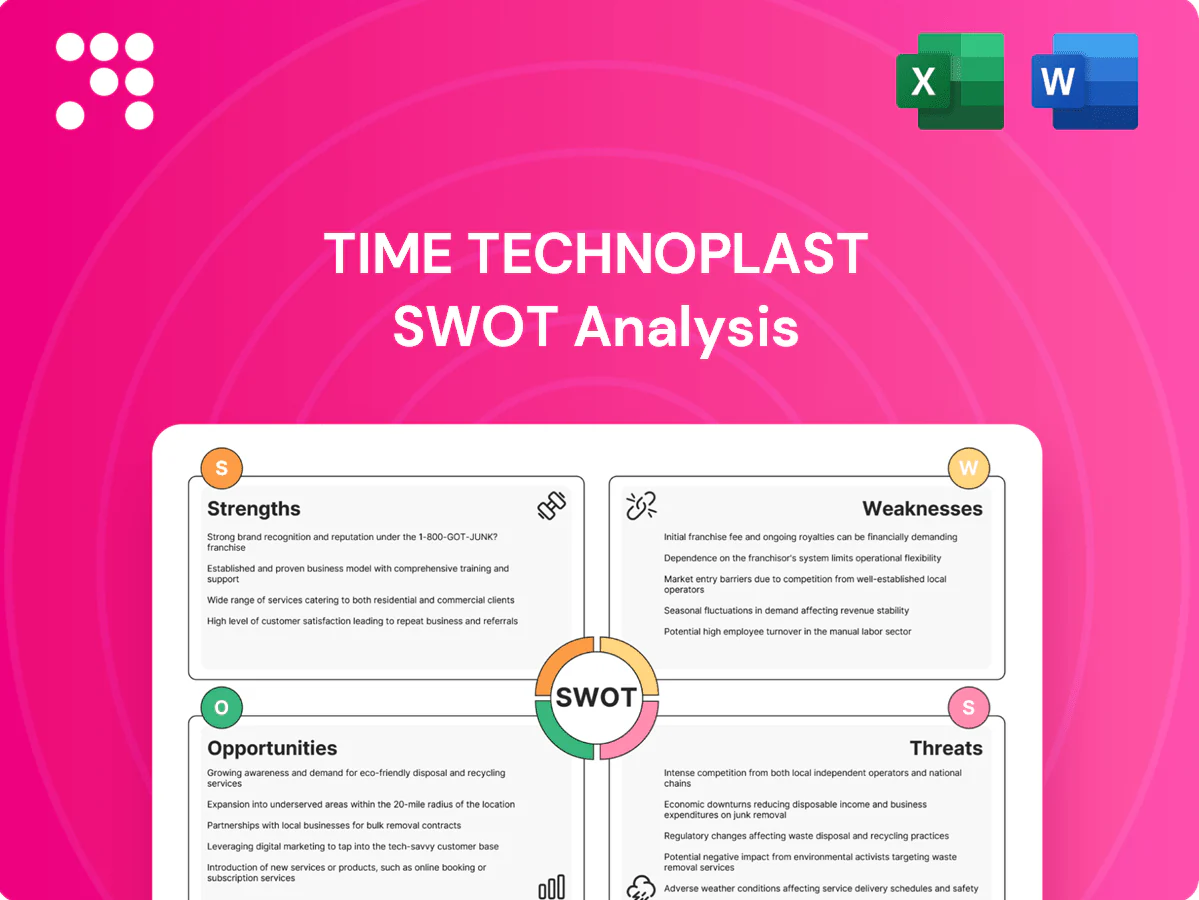
Time Technoplast SWOT Analysis

Elevate Your Analysis with the Complete SWOT Report
Time Technoplast’s resilience in specialty polymers and global footprint mask evolving supply and margin pressures that demand close scrutiny. Our concise SWOT highlights strengths, weaknesses, opportunities and threats—yet the full analysis uncovers financial context, strategic scenarios, and actionable recommendations. Purchase the complete, editable SWOT to plan, pitch, or invest with confidence.
Strengths

Diversified polymer portfolio
Diversified polymer portfolio serves industrial packaging, lifestyle goods, auto components and composite cylinders, reducing single-market reliance; with operations in 9 countries and exports to 60+ countries this mix enables cross-selling and shared processing know-how to boost asset utilization, smooth cyclical demand and enhance resilience versus sector-specific shocks.
Advanced processing capabilities
Deep expertise in blow molding, injection molding and composites enables Time Technoplast to deliver complex, high‑spec products and supports exports to over 100 countries. Manufacturing know‑how across its global operations and more than 3,000 employees creates cost and quality advantages versus smaller peers. That capacity drives faster customization for OEM and B2B clients and forms a defensible process moat.

Composite cylinder leadership
Lightweight composite cylinders, up to 70% lighter than steel, offer clear safety and handling advantages and eliminate corrosion issues common to metal cylinders.
Time Technoplast’s certified product portfolio with industry type approvals creates technical and regulatory barriers to entry for competitors.
Growing adoption by LPG/CNG distributors drives recurring demand; this niche commands higher margins and enhances brand credibility in fleet and domestic segments.

Sustainability-focused solutions
Reusable drums, recyclable polymers and lighter components reduce lifecycle emissions, strengthening Time Technoplast’s appeal to customers with ESG targets and circular procurement clauses that expanded in 2024.
This sustainability positioning enables premium pricing and improves tender win rates as regulators in 2024 tightened circularity and packaging rules across key markets.
- Reusable drums: lower lifecycle CO2 and waste
- Recyclable polymers: supports circular supply chains
- Lighter components: reduce transport emissions
- Aligns with 2024 regulatory tightening and ESG-driven tenders
Broad sector exposure
Time Technoplasts supplies chemicals, food, pharma, auto, energy and consumer segments, widening demand pools and enabling cross-sector sales that smooth cyclical swings; this multi-industry reach reduces revenue volatility and captures growth from formalization and safety upgrades in industries moving to higher-specification packaging and containment.
- Sector diversification: lowers earnings cyclicality
- End-markets: chemicals, food, pharma, auto, energy, consumer
- Growth drivers: formalization and safety compliance upgrades
- Negotiation leverage: stronger supplier and client bargaining power
Global polymer group exporting to 60+ countries; composites 70% lighter
Diversified polymer portfolio across 9 countries and exports to 60+ countries (2024) reduces single-market risk and boosts asset utilization. Global manufacturing expertise in blow/injection molding and composites with >3,000 employees (2024) creates cost/quality advantages and a process moat. Lightweight composite cylinders (up to 70% lighter than steel) and certified product approvals drive higher-margin recurring demand and regulatory barriers.
| Metric | Value (2024) |
|---|---|
| Countries of operation | 9 |
| Export reach | 60+ countries |
| Employees | >3,000 |
| Composite weight reduction | Up to 70% |
What is included in the product
 Detailed Word Document
Provides a concise SWOT overview of Time Technoplast, highlighting its core strengths, operational weaknesses, market opportunities, and external threats to assess competitive positioning and strategic priorities.

 Customizable Excel Spreadsheet
Provides a concise SWOT matrix for Time Technoplast to quickly pinpoint strengths, expose risks, and streamline strategic actions for faster resolution of operational and market pain points.
Weaknesses

Commodity input sensitivity
Time Technoplast faces sharp cost volatility as PE and PP resin prices drove input cost swings—spot resin indices moved about 15% year‑on‑year in 2024, tightening margins. Pass‑through clauses in customer contracts typically lag by one to two quarters, compressing EBITDA during price spikes. Extended inventory holding can amplify P&L swings, while hedging instruments remain limited for specialty polymers, leaving exposure to feedstock volatility.
Capital intensity and tooling
High capital expenditure on molds, tooling and certifications drives substantial fixed costs for Time Technoplast, making margins sensitive to volume fluctuations. Utilization dips in plants meaningfully reduce returns on deployed capital, while frequent customer-driven design changes force repeated reinvestment in tooling. In downturns payback periods for new lines can stretch well beyond initial forecasts.

B2B concentration risk
Heavy B2B concentration leaves Time Technoplast exposed as a limited set of large industrial customers can dictate pricing and extend payment terms, pressuring cash conversion. Tender-driven sales compress margins and increase competitive pressure on bids. Lengthy customer qualification and approval cycles slow order conversion, making revenue lumpy with project-timing swings that complicate quarterly predictability.

Aftermarket and brand visibility
Aftermarket and brand visibility remain weak for Time Technoplast, with consumer-facing brand equity modest outside a few industrial and safety-product categories; limited retail pull constrains pricing in lifestyle lines and higher-margin consumer segments. Heavy dependence on institutional and B2B channels reduces marketing leverage and slows efforts to premiumize product mix, limiting margin expansion and brand-led growth.
- Modest consumer brand equity
- Limited retail pull hurts lifestyle pricing
- Dependence on institutional channels
- Slows premiumization
Regulatory and certification burden
Composite cylinders and pharma/food packaging lines require stringent approvals (eg, US FDA, EU food-contact regulations), driving high compliance costs and frequent third-party and regulator audits; homologation for new geographies often involves country-specific testing and certifications, and delays of months to years can stall product launches and revenue recognition.
- Regulatory approvals: FDA, EU FCM required
- Compliance impact: higher audit frequency and costs
- Market entry: homologation hurdles per country
- Time risk: approval delays can be months–years
Packaging player faces ~15% YoY resin swings, lagged pass-through and high capex
Time Technoplast faces feedstock cost swings (PE/PP spot indices ~15% YoY in 2024) with pass-through typically lagging 1–2 quarters, compressing EBITDA; high capex on tooling raises fixed-cost leverage and elongates payback in downturns; concentrated B2B customers pressure pricing and cash conversion; weak consumer brand and heavy regulatory homologation (approvals can take months–years) slow premiumization.
| Metric | Value/Note |
|---|---|
| Resin volatility (2024) | ~15% YoY |
| Pass-through lag | 1–2 quarters |
| Approval delays | Months–years |
Preview the Actual Deliverable
Time Technoplast SWOT Analysis
This is the actual Time Technoplast SWOT analysis document you’ll receive upon purchase—no surprises, just professional quality. The preview below is taken directly from the full report you'll get, with all strengths, weaknesses, opportunities and threats clearly laid out. Purchase unlocks the editable, complete version instantly.

Elevate Your Analysis with the Complete SWOT Report
Time Technoplast’s resilience in specialty polymers and global footprint mask evolving supply and margin pressures that demand close scrutiny. Our concise SWOT highlights strengths, weaknesses, opportunities and threats—yet the full analysis uncovers financial context, strategic scenarios, and actionable recommendations. Purchase the complete, editable SWOT to plan, pitch, or invest with confidence.
Strengths
Diversified polymer portfolio
Diversified polymer portfolio serves industrial packaging, lifestyle goods, auto components and composite cylinders, reducing single-market reliance; with operations in 9 countries and exports to 60+ countries this mix enables cross-selling and shared processing know-how to boost asset utilization, smooth cyclical demand and enhance resilience versus sector-specific shocks.
Advanced processing capabilities
Deep expertise in blow molding, injection molding and composites enables Time Technoplast to deliver complex, high‑spec products and supports exports to over 100 countries. Manufacturing know‑how across its global operations and more than 3,000 employees creates cost and quality advantages versus smaller peers. That capacity drives faster customization for OEM and B2B clients and forms a defensible process moat.
Composite cylinder leadership
Lightweight composite cylinders, up to 70% lighter than steel, offer clear safety and handling advantages and eliminate corrosion issues common to metal cylinders.
Time Technoplast’s certified product portfolio with industry type approvals creates technical and regulatory barriers to entry for competitors.
Growing adoption by LPG/CNG distributors drives recurring demand; this niche commands higher margins and enhances brand credibility in fleet and domestic segments.
Sustainability-focused solutions
Reusable drums, recyclable polymers and lighter components reduce lifecycle emissions, strengthening Time Technoplast’s appeal to customers with ESG targets and circular procurement clauses that expanded in 2024.
This sustainability positioning enables premium pricing and improves tender win rates as regulators in 2024 tightened circularity and packaging rules across key markets.
- Reusable drums: lower lifecycle CO2 and waste
- Recyclable polymers: supports circular supply chains
- Lighter components: reduce transport emissions
- Aligns with 2024 regulatory tightening and ESG-driven tenders
Broad sector exposure
Time Technoplasts supplies chemicals, food, pharma, auto, energy and consumer segments, widening demand pools and enabling cross-sector sales that smooth cyclical swings; this multi-industry reach reduces revenue volatility and captures growth from formalization and safety upgrades in industries moving to higher-specification packaging and containment.
- Sector diversification: lowers earnings cyclicality
- End-markets: chemicals, food, pharma, auto, energy, consumer
- Growth drivers: formalization and safety compliance upgrades
- Negotiation leverage: stronger supplier and client bargaining power
Global polymer group exporting to 60+ countries; composites 70% lighter
Diversified polymer portfolio across 9 countries and exports to 60+ countries (2024) reduces single-market risk and boosts asset utilization. Global manufacturing expertise in blow/injection molding and composites with >3,000 employees (2024) creates cost/quality advantages and a process moat. Lightweight composite cylinders (up to 70% lighter than steel) and certified product approvals drive higher-margin recurring demand and regulatory barriers.
| Metric | Value (2024) |
|---|---|
| Countries of operation | 9 |
| Export reach | 60+ countries |
| Employees | >3,000 |
| Composite weight reduction | Up to 70% |
What is included in the product
Detailed Word Document
Provides a concise SWOT overview of Time Technoplast, highlighting its core strengths, operational weaknesses, market opportunities, and external threats to assess competitive positioning and strategic priorities.
Customizable Excel Spreadsheet
Provides a concise SWOT matrix for Time Technoplast to quickly pinpoint strengths, expose risks, and streamline strategic actions for faster resolution of operational and market pain points.
Weaknesses
Commodity input sensitivity
Time Technoplast faces sharp cost volatility as PE and PP resin prices drove input cost swings—spot resin indices moved about 15% year‑on‑year in 2024, tightening margins. Pass‑through clauses in customer contracts typically lag by one to two quarters, compressing EBITDA during price spikes. Extended inventory holding can amplify P&L swings, while hedging instruments remain limited for specialty polymers, leaving exposure to feedstock volatility.
Capital intensity and tooling
High capital expenditure on molds, tooling and certifications drives substantial fixed costs for Time Technoplast, making margins sensitive to volume fluctuations. Utilization dips in plants meaningfully reduce returns on deployed capital, while frequent customer-driven design changes force repeated reinvestment in tooling. In downturns payback periods for new lines can stretch well beyond initial forecasts.
B2B concentration risk
Heavy B2B concentration leaves Time Technoplast exposed as a limited set of large industrial customers can dictate pricing and extend payment terms, pressuring cash conversion. Tender-driven sales compress margins and increase competitive pressure on bids. Lengthy customer qualification and approval cycles slow order conversion, making revenue lumpy with project-timing swings that complicate quarterly predictability.
Aftermarket and brand visibility
Aftermarket and brand visibility remain weak for Time Technoplast, with consumer-facing brand equity modest outside a few industrial and safety-product categories; limited retail pull constrains pricing in lifestyle lines and higher-margin consumer segments. Heavy dependence on institutional and B2B channels reduces marketing leverage and slows efforts to premiumize product mix, limiting margin expansion and brand-led growth.
- Modest consumer brand equity
- Limited retail pull hurts lifestyle pricing
- Dependence on institutional channels
- Slows premiumization
Regulatory and certification burden
Composite cylinders and pharma/food packaging lines require stringent approvals (eg, US FDA, EU food-contact regulations), driving high compliance costs and frequent third-party and regulator audits; homologation for new geographies often involves country-specific testing and certifications, and delays of months to years can stall product launches and revenue recognition.
- Regulatory approvals: FDA, EU FCM required
- Compliance impact: higher audit frequency and costs
- Market entry: homologation hurdles per country
- Time risk: approval delays can be months–years
Packaging player faces ~15% YoY resin swings, lagged pass-through and high capex
Time Technoplast faces feedstock cost swings (PE/PP spot indices ~15% YoY in 2024) with pass-through typically lagging 1–2 quarters, compressing EBITDA; high capex on tooling raises fixed-cost leverage and elongates payback in downturns; concentrated B2B customers pressure pricing and cash conversion; weak consumer brand and heavy regulatory homologation (approvals can take months–years) slow premiumization.
| Metric | Value/Note |
|---|---|
| Resin volatility (2024) | ~15% YoY |
| Pass-through lag | 1–2 quarters |
| Approval delays | Months–years |
Preview the Actual Deliverable
Time Technoplast SWOT Analysis
This is the actual Time Technoplast SWOT analysis document you’ll receive upon purchase—no surprises, just professional quality. The preview below is taken directly from the full report you'll get, with all strengths, weaknesses, opportunities and threats clearly laid out. Purchase unlocks the editable, complete version instantly.
Original: $10.00
-65%$10.00
$3.50Description
Elevate Your Analysis with the Complete SWOT Report
Time Technoplast’s resilience in specialty polymers and global footprint mask evolving supply and margin pressures that demand close scrutiny. Our concise SWOT highlights strengths, weaknesses, opportunities and threats—yet the full analysis uncovers financial context, strategic scenarios, and actionable recommendations. Purchase the complete, editable SWOT to plan, pitch, or invest with confidence.
Strengths
Diversified polymer portfolio
Diversified polymer portfolio serves industrial packaging, lifestyle goods, auto components and composite cylinders, reducing single-market reliance; with operations in 9 countries and exports to 60+ countries this mix enables cross-selling and shared processing know-how to boost asset utilization, smooth cyclical demand and enhance resilience versus sector-specific shocks.
Advanced processing capabilities
Deep expertise in blow molding, injection molding and composites enables Time Technoplast to deliver complex, high‑spec products and supports exports to over 100 countries. Manufacturing know‑how across its global operations and more than 3,000 employees creates cost and quality advantages versus smaller peers. That capacity drives faster customization for OEM and B2B clients and forms a defensible process moat.
Composite cylinder leadership
Lightweight composite cylinders, up to 70% lighter than steel, offer clear safety and handling advantages and eliminate corrosion issues common to metal cylinders.
Time Technoplast’s certified product portfolio with industry type approvals creates technical and regulatory barriers to entry for competitors.
Growing adoption by LPG/CNG distributors drives recurring demand; this niche commands higher margins and enhances brand credibility in fleet and domestic segments.
Sustainability-focused solutions
Reusable drums, recyclable polymers and lighter components reduce lifecycle emissions, strengthening Time Technoplast’s appeal to customers with ESG targets and circular procurement clauses that expanded in 2024.
This sustainability positioning enables premium pricing and improves tender win rates as regulators in 2024 tightened circularity and packaging rules across key markets.
- Reusable drums: lower lifecycle CO2 and waste
- Recyclable polymers: supports circular supply chains
- Lighter components: reduce transport emissions
- Aligns with 2024 regulatory tightening and ESG-driven tenders
Broad sector exposure
Time Technoplasts supplies chemicals, food, pharma, auto, energy and consumer segments, widening demand pools and enabling cross-sector sales that smooth cyclical swings; this multi-industry reach reduces revenue volatility and captures growth from formalization and safety upgrades in industries moving to higher-specification packaging and containment.
- Sector diversification: lowers earnings cyclicality
- End-markets: chemicals, food, pharma, auto, energy, consumer
- Growth drivers: formalization and safety compliance upgrades
- Negotiation leverage: stronger supplier and client bargaining power
Global polymer group exporting to 60+ countries; composites 70% lighter
Diversified polymer portfolio across 9 countries and exports to 60+ countries (2024) reduces single-market risk and boosts asset utilization. Global manufacturing expertise in blow/injection molding and composites with >3,000 employees (2024) creates cost/quality advantages and a process moat. Lightweight composite cylinders (up to 70% lighter than steel) and certified product approvals drive higher-margin recurring demand and regulatory barriers.
| Metric | Value (2024) |
|---|---|
| Countries of operation | 9 |
| Export reach | 60+ countries |
| Employees | >3,000 |
| Composite weight reduction | Up to 70% |
What is included in the product
Detailed Word Document
Provides a concise SWOT overview of Time Technoplast, highlighting its core strengths, operational weaknesses, market opportunities, and external threats to assess competitive positioning and strategic priorities.
Customizable Excel Spreadsheet
Provides a concise SWOT matrix for Time Technoplast to quickly pinpoint strengths, expose risks, and streamline strategic actions for faster resolution of operational and market pain points.
Weaknesses
Commodity input sensitivity
Time Technoplast faces sharp cost volatility as PE and PP resin prices drove input cost swings—spot resin indices moved about 15% year‑on‑year in 2024, tightening margins. Pass‑through clauses in customer contracts typically lag by one to two quarters, compressing EBITDA during price spikes. Extended inventory holding can amplify P&L swings, while hedging instruments remain limited for specialty polymers, leaving exposure to feedstock volatility.
Capital intensity and tooling
High capital expenditure on molds, tooling and certifications drives substantial fixed costs for Time Technoplast, making margins sensitive to volume fluctuations. Utilization dips in plants meaningfully reduce returns on deployed capital, while frequent customer-driven design changes force repeated reinvestment in tooling. In downturns payback periods for new lines can stretch well beyond initial forecasts.
B2B concentration risk
Heavy B2B concentration leaves Time Technoplast exposed as a limited set of large industrial customers can dictate pricing and extend payment terms, pressuring cash conversion. Tender-driven sales compress margins and increase competitive pressure on bids. Lengthy customer qualification and approval cycles slow order conversion, making revenue lumpy with project-timing swings that complicate quarterly predictability.
Aftermarket and brand visibility
Aftermarket and brand visibility remain weak for Time Technoplast, with consumer-facing brand equity modest outside a few industrial and safety-product categories; limited retail pull constrains pricing in lifestyle lines and higher-margin consumer segments. Heavy dependence on institutional and B2B channels reduces marketing leverage and slows efforts to premiumize product mix, limiting margin expansion and brand-led growth.
- Modest consumer brand equity
- Limited retail pull hurts lifestyle pricing
- Dependence on institutional channels
- Slows premiumization
Regulatory and certification burden
Composite cylinders and pharma/food packaging lines require stringent approvals (eg, US FDA, EU food-contact regulations), driving high compliance costs and frequent third-party and regulator audits; homologation for new geographies often involves country-specific testing and certifications, and delays of months to years can stall product launches and revenue recognition.
- Regulatory approvals: FDA, EU FCM required
- Compliance impact: higher audit frequency and costs
- Market entry: homologation hurdles per country
- Time risk: approval delays can be months–years
Packaging player faces ~15% YoY resin swings, lagged pass-through and high capex
Time Technoplast faces feedstock cost swings (PE/PP spot indices ~15% YoY in 2024) with pass-through typically lagging 1–2 quarters, compressing EBITDA; high capex on tooling raises fixed-cost leverage and elongates payback in downturns; concentrated B2B customers pressure pricing and cash conversion; weak consumer brand and heavy regulatory homologation (approvals can take months–years) slow premiumization.
| Metric | Value/Note |
|---|---|
| Resin volatility (2024) | ~15% YoY |
| Pass-through lag | 1–2 quarters |
| Approval delays | Months–years |
Preview the Actual Deliverable
Time Technoplast SWOT Analysis
This is the actual Time Technoplast SWOT analysis document you’ll receive upon purchase—no surprises, just professional quality. The preview below is taken directly from the full report you'll get, with all strengths, weaknesses, opportunities and threats clearly laid out. Purchase unlocks the editable, complete version instantly.











