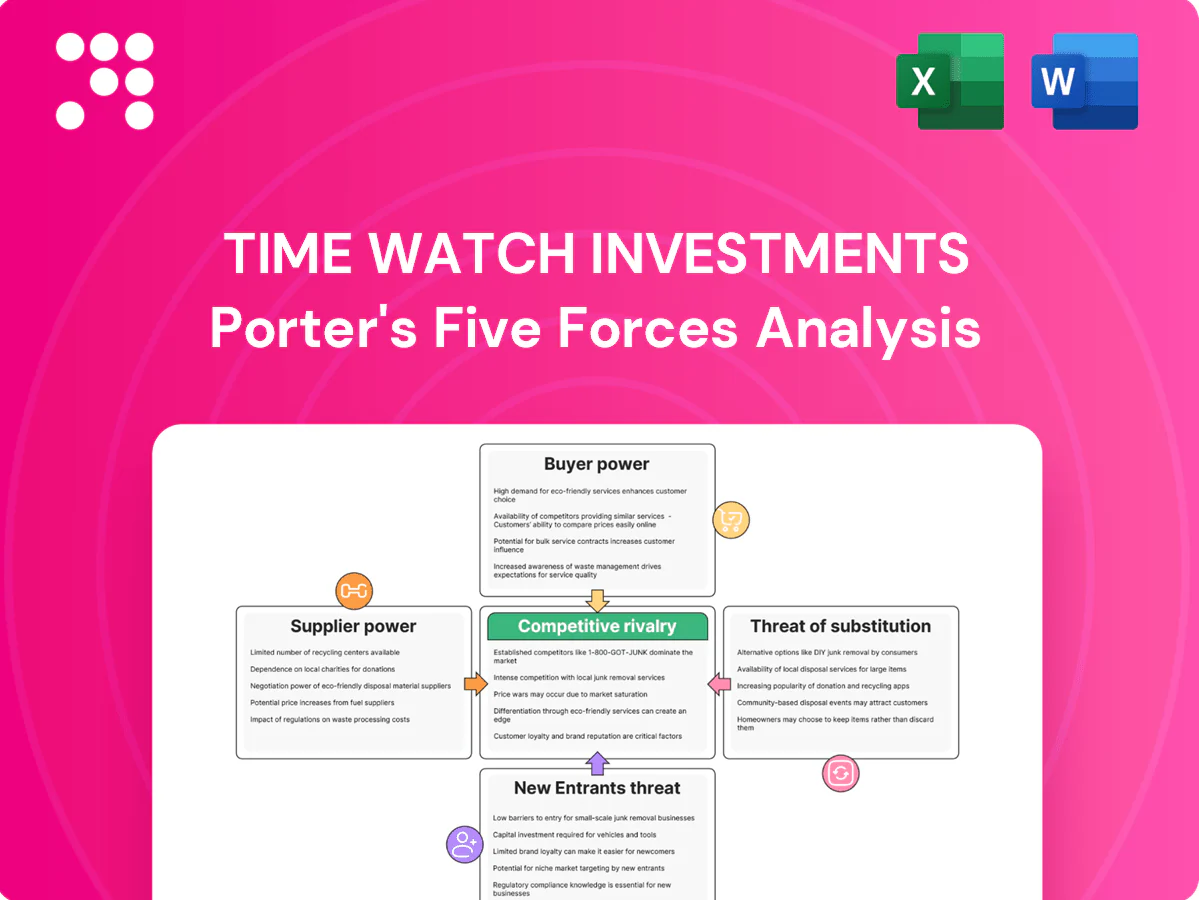
Time Watch Investments Porter's Five Forces Analysis

A Must-Have Tool for Decision-Makers
Time Watch Investments’ Porter's Five Forces snapshot highlights buyer and supplier power, competitive rivalry, threats from entrants and substitutes, and where strategic leverage exists. This brief overview identifies key pressure points affecting margins and growth. Unlock the full Porter's Five Forces Analysis to explore detailed force ratings, visuals, and actionable recommendations tailored to Time Watch Investments.
Suppliers Bargaining Power

Movement sourcing concentration
Watch movements are concentrated among a few reputable suppliers—ETA/Swatch, Sellita, Miyota and Seiko—giving suppliers significant leverage; premium chronometer-grade calibers remain scarce. Time Watch’s trading in movements deepens access and partly offsets concentration risk. Dual-sourcing and adopting standard calibers reduce dependence, but supplier lead times (commonly 8–24 weeks) and MOQs (often hundreds–thousands) pressure working capital.
Specialized components
Specialized sapphire crystals, cases, dials and bracelets demand precision vendors and China remains the world’s dominant source for these components, concentrating supply and choice. Switching suppliers typically requires 6–12 months for new tooling, QA validation and cosmetic alignment, producing moderate switching costs. Long-term vendor development programs materially lower defect rates and price volatility. Significant quality lapses can erode brand equity and raise leverage for proven suppliers.

Scale and purchasing power
As a brand-owner and manufacturer, Time Watch’s larger consolidated orders drive negotiation leverage, with 2024 procurement benchmarks showing top-quartile buyers achieving roughly 18–22% unit-cost reductions through scale. Volume bundling across product lines secures better pricing and priority allocation, though mix complexity from high SKU and color variety can dilute realized savings. Supplier rebates and multi-year framework agreements anchor costs and stabilize margins.

FX and import exposure
Imported components expose Time Watch to FX and tariff swings, giving suppliers greater bargaining latitude; in 2024 the renminbi weakened roughly 4% vs USD, pressuring COGS and margins. Hedging programs and localizing inputs can cut pass-through risk, but suppliers have pushed for price adjustments during volatile 2022–24 trade and tariff episodes.
- FX pass-through: Renminbi ≈‑4% vs USD in 2024
- Cost impact: higher COGS when imports rise
- Mitigants: hedging, local sourcing
- Supplier behavior: price adjustment demands in volatile periods
Quality and compliance risks
Compliance with CSRD rollout in 2024 and rising supply-chain due-diligence laws shrank qualified vendor pools, raising costs as audited, certified suppliers command premiums and longer lead times. Tightening regulations increase switching barriers and documentation burdens, while stable compliant partners gain bargaining power during audits and peak seasons.
- CSRD 2024: higher reporting scope
- Audited suppliers: price premium & longer lead times
- Regulation → higher switching costs
- Compliant partners: leverage in audits/peaks
High supplier power: lead times 8–24 weeks, cost cuts 18–22%
Suppliers hold moderate–high power: movement suppliers concentrated (ETA/Swatch, Sellita, Miyota, Seiko) with lead times 8–24 weeks and MOQs in the hundreds–thousands, while Time Watch’s scale buys ~18–22% unit-cost reductions. FX (renminbi ≈‑4% vs USD in 2024) and CSRD 2024 compliance lift costs and switching barriers. Dual-sourcing, hedging and local sourcing partly mitigate risks.
| Metric | 2024 |
|---|---|
| Movement lead time | 8–24 weeks |
| MOQ | 100s–1,000s |
| Top-quartile cost reduction | 18–22% |
| RMB vs USD | ≈‑4% |
What is included in the product
 Detailed Word Document
Uncovers key drivers of competition, buyer and supplier power, threat of new entrants and substitutes, and regulatory dynamics shaping Time Watch Investments’ market positioning, while identifying disruptive threats and strategic defenses.

 Customizable Excel Spreadsheet
A concise one-sheet Porter's Five Forces for Time Watch Investments that instantly visualizes competitive pressure with a radar chart, lets you swap in updated data or scenario tabs (pre/post regulation, new entrants), and produces a clean, slide-ready summary—no macros or finance expertise required.
Customers Bargaining Power

Abundant alternatives
Consumers face many domestic and foreign watch brands at comparable price points, increasing choice and bargaining power. High online price transparency—with e-commerce capturing about 22.3% of global retail sales in 2024—heightens sensitivity to discounts and fuels cross-shopping, lowering switching costs. Loyalty programs and limited editions can partially counteract by creating scarcity and perceived value.
Channel bargaining leverage
Department stores, malls and large e-tailers negotiate commissions (commonly 10–30%), return rights and marketing subsidies, using traffic control to extract favorable margin splits. High online return rates (often 20–30% in 2024 for apparel/accessories) increase retailer leverage on terms. Sell-through incentives and data-sharing agreements can rebalance margins and inventory risk. Diversifying channels reduces reliance on any single retailer and limits bargaining exposure.

Direct-to-consumer offset
Direct-to-consumer offset lets Time Watch reclaim margin and first-party data, with DTC often delivering 15–30% higher gross margins and enabling dynamic pricing and ~20% faster inventory turns versus wholesale. Buyers still expect promotions—over 60% say festival discounts guide purchases in 2024. Maintaining seamless omnichannel fulfillment and service is therefore critical to sustain pricing power and protect margins.

Brand equity and gifting
Tian Wang’s strong recognition in China gives it measurable pricing power in gifting occasions in 2024, as perceived quality and robust after-sales service reduce buyer risk and justify premiums. Storytelling and celebrity endorsements further lift willingness to pay, though brand equity must be actively refreshed to avoid commoditization.
- Brand strength: supports premium in gifting
- After-sales: lowers buyer risk
- Storytelling/endorsements: increase WTP
- Risk: needs refresh to prevent commoditization (2024)
Bulk and corporate orders
Bulk corporate gifting and promotional orders deliver scale but routinely demand 10–25% discounts and customization, raising buyer bargaining power.
Corporate buyers typically solicit 3–6 quotes, intensifying price competition, while fast lead times under 14 days and reliable QC can support a 5–10% premium.
Framework agreements of 12–24 months help stabilize volumes and pricing, reducing order volatility for Time Watch Investments.
- discounts 10–25%
- quotes compared 3–6
- lead times <14 days
- frameworks 12–24 months
DTC restores pricing power as e-commerce hits 22.3%
Consumers face many domestic and foreign brands at similar price points, and 22.3% global e-commerce penetration in 2024 raises price sensitivity and cross-shopping. Retailers extract 10–30% commissions; online returns of 20–30% increase retailer leverage. DTC boosts gross margins 15–30% and speeds inventory turns ~20%, helping offset customer bargaining power.
| Metric | 2024 | Impact |
|---|---|---|
| E-commerce penetration | 22.3% | Higher price transparency |
| Online returns | 20–30% | Retailer leverage up |
| Retailer commissions | 10–30% | Margin pressure |
| DTC margin uplift | 15–30% | Restores pricing power |
Preview the Actual Deliverable
Time Watch Investments Porter's Five Forces Analysis
This preview shows the exact Time Watch Investments Porter's Five Forces Analysis you'll receive after purchase—no placeholders, no mockups. The file displayed here is the fully formatted, professionally written document ready for immediate download and use the moment you complete payment. What you see is precisely the deliverable you will get.

A Must-Have Tool for Decision-Makers
Time Watch Investments’ Porter's Five Forces snapshot highlights buyer and supplier power, competitive rivalry, threats from entrants and substitutes, and where strategic leverage exists. This brief overview identifies key pressure points affecting margins and growth. Unlock the full Porter's Five Forces Analysis to explore detailed force ratings, visuals, and actionable recommendations tailored to Time Watch Investments.
Suppliers Bargaining Power
Movement sourcing concentration
Watch movements are concentrated among a few reputable suppliers—ETA/Swatch, Sellita, Miyota and Seiko—giving suppliers significant leverage; premium chronometer-grade calibers remain scarce. Time Watch’s trading in movements deepens access and partly offsets concentration risk. Dual-sourcing and adopting standard calibers reduce dependence, but supplier lead times (commonly 8–24 weeks) and MOQs (often hundreds–thousands) pressure working capital.
Specialized components
Specialized sapphire crystals, cases, dials and bracelets demand precision vendors and China remains the world’s dominant source for these components, concentrating supply and choice. Switching suppliers typically requires 6–12 months for new tooling, QA validation and cosmetic alignment, producing moderate switching costs. Long-term vendor development programs materially lower defect rates and price volatility. Significant quality lapses can erode brand equity and raise leverage for proven suppliers.
Scale and purchasing power
As a brand-owner and manufacturer, Time Watch’s larger consolidated orders drive negotiation leverage, with 2024 procurement benchmarks showing top-quartile buyers achieving roughly 18–22% unit-cost reductions through scale. Volume bundling across product lines secures better pricing and priority allocation, though mix complexity from high SKU and color variety can dilute realized savings. Supplier rebates and multi-year framework agreements anchor costs and stabilize margins.
FX and import exposure
Imported components expose Time Watch to FX and tariff swings, giving suppliers greater bargaining latitude; in 2024 the renminbi weakened roughly 4% vs USD, pressuring COGS and margins. Hedging programs and localizing inputs can cut pass-through risk, but suppliers have pushed for price adjustments during volatile 2022–24 trade and tariff episodes.
- FX pass-through: Renminbi ≈‑4% vs USD in 2024
- Cost impact: higher COGS when imports rise
- Mitigants: hedging, local sourcing
- Supplier behavior: price adjustment demands in volatile periods
Quality and compliance risks
Compliance with CSRD rollout in 2024 and rising supply-chain due-diligence laws shrank qualified vendor pools, raising costs as audited, certified suppliers command premiums and longer lead times. Tightening regulations increase switching barriers and documentation burdens, while stable compliant partners gain bargaining power during audits and peak seasons.
- CSRD 2024: higher reporting scope
- Audited suppliers: price premium & longer lead times
- Regulation → higher switching costs
- Compliant partners: leverage in audits/peaks
High supplier power: lead times 8–24 weeks, cost cuts 18–22%
Suppliers hold moderate–high power: movement suppliers concentrated (ETA/Swatch, Sellita, Miyota, Seiko) with lead times 8–24 weeks and MOQs in the hundreds–thousands, while Time Watch’s scale buys ~18–22% unit-cost reductions. FX (renminbi ≈‑4% vs USD in 2024) and CSRD 2024 compliance lift costs and switching barriers. Dual-sourcing, hedging and local sourcing partly mitigate risks.
| Metric | 2024 |
|---|---|
| Movement lead time | 8–24 weeks |
| MOQ | 100s–1,000s |
| Top-quartile cost reduction | 18–22% |
| RMB vs USD | ≈‑4% |
What is included in the product
Detailed Word Document
Uncovers key drivers of competition, buyer and supplier power, threat of new entrants and substitutes, and regulatory dynamics shaping Time Watch Investments’ market positioning, while identifying disruptive threats and strategic defenses.
Customizable Excel Spreadsheet
A concise one-sheet Porter's Five Forces for Time Watch Investments that instantly visualizes competitive pressure with a radar chart, lets you swap in updated data or scenario tabs (pre/post regulation, new entrants), and produces a clean, slide-ready summary—no macros or finance expertise required.
Customers Bargaining Power
Abundant alternatives
Consumers face many domestic and foreign watch brands at comparable price points, increasing choice and bargaining power. High online price transparency—with e-commerce capturing about 22.3% of global retail sales in 2024—heightens sensitivity to discounts and fuels cross-shopping, lowering switching costs. Loyalty programs and limited editions can partially counteract by creating scarcity and perceived value.
Channel bargaining leverage
Department stores, malls and large e-tailers negotiate commissions (commonly 10–30%), return rights and marketing subsidies, using traffic control to extract favorable margin splits. High online return rates (often 20–30% in 2024 for apparel/accessories) increase retailer leverage on terms. Sell-through incentives and data-sharing agreements can rebalance margins and inventory risk. Diversifying channels reduces reliance on any single retailer and limits bargaining exposure.
Direct-to-consumer offset
Direct-to-consumer offset lets Time Watch reclaim margin and first-party data, with DTC often delivering 15–30% higher gross margins and enabling dynamic pricing and ~20% faster inventory turns versus wholesale. Buyers still expect promotions—over 60% say festival discounts guide purchases in 2024. Maintaining seamless omnichannel fulfillment and service is therefore critical to sustain pricing power and protect margins.
Brand equity and gifting
Tian Wang’s strong recognition in China gives it measurable pricing power in gifting occasions in 2024, as perceived quality and robust after-sales service reduce buyer risk and justify premiums. Storytelling and celebrity endorsements further lift willingness to pay, though brand equity must be actively refreshed to avoid commoditization.
- Brand strength: supports premium in gifting
- After-sales: lowers buyer risk
- Storytelling/endorsements: increase WTP
- Risk: needs refresh to prevent commoditization (2024)
Bulk and corporate orders
Bulk corporate gifting and promotional orders deliver scale but routinely demand 10–25% discounts and customization, raising buyer bargaining power.
Corporate buyers typically solicit 3–6 quotes, intensifying price competition, while fast lead times under 14 days and reliable QC can support a 5–10% premium.
Framework agreements of 12–24 months help stabilize volumes and pricing, reducing order volatility for Time Watch Investments.
- discounts 10–25%
- quotes compared 3–6
- lead times <14 days
- frameworks 12–24 months
DTC restores pricing power as e-commerce hits 22.3%
Consumers face many domestic and foreign brands at similar price points, and 22.3% global e-commerce penetration in 2024 raises price sensitivity and cross-shopping. Retailers extract 10–30% commissions; online returns of 20–30% increase retailer leverage. DTC boosts gross margins 15–30% and speeds inventory turns ~20%, helping offset customer bargaining power.
| Metric | 2024 | Impact |
|---|---|---|
| E-commerce penetration | 22.3% | Higher price transparency |
| Online returns | 20–30% | Retailer leverage up |
| Retailer commissions | 10–30% | Margin pressure |
| DTC margin uplift | 15–30% | Restores pricing power |
Preview the Actual Deliverable
Time Watch Investments Porter's Five Forces Analysis
This preview shows the exact Time Watch Investments Porter's Five Forces Analysis you'll receive after purchase—no placeholders, no mockups. The file displayed here is the fully formatted, professionally written document ready for immediate download and use the moment you complete payment. What you see is precisely the deliverable you will get.
Original: $10.00
-65%$10.00
$3.50Description
A Must-Have Tool for Decision-Makers
Time Watch Investments’ Porter's Five Forces snapshot highlights buyer and supplier power, competitive rivalry, threats from entrants and substitutes, and where strategic leverage exists. This brief overview identifies key pressure points affecting margins and growth. Unlock the full Porter's Five Forces Analysis to explore detailed force ratings, visuals, and actionable recommendations tailored to Time Watch Investments.
Suppliers Bargaining Power
Movement sourcing concentration
Watch movements are concentrated among a few reputable suppliers—ETA/Swatch, Sellita, Miyota and Seiko—giving suppliers significant leverage; premium chronometer-grade calibers remain scarce. Time Watch’s trading in movements deepens access and partly offsets concentration risk. Dual-sourcing and adopting standard calibers reduce dependence, but supplier lead times (commonly 8–24 weeks) and MOQs (often hundreds–thousands) pressure working capital.
Specialized components
Specialized sapphire crystals, cases, dials and bracelets demand precision vendors and China remains the world’s dominant source for these components, concentrating supply and choice. Switching suppliers typically requires 6–12 months for new tooling, QA validation and cosmetic alignment, producing moderate switching costs. Long-term vendor development programs materially lower defect rates and price volatility. Significant quality lapses can erode brand equity and raise leverage for proven suppliers.
Scale and purchasing power
As a brand-owner and manufacturer, Time Watch’s larger consolidated orders drive negotiation leverage, with 2024 procurement benchmarks showing top-quartile buyers achieving roughly 18–22% unit-cost reductions through scale. Volume bundling across product lines secures better pricing and priority allocation, though mix complexity from high SKU and color variety can dilute realized savings. Supplier rebates and multi-year framework agreements anchor costs and stabilize margins.
FX and import exposure
Imported components expose Time Watch to FX and tariff swings, giving suppliers greater bargaining latitude; in 2024 the renminbi weakened roughly 4% vs USD, pressuring COGS and margins. Hedging programs and localizing inputs can cut pass-through risk, but suppliers have pushed for price adjustments during volatile 2022–24 trade and tariff episodes.
- FX pass-through: Renminbi ≈‑4% vs USD in 2024
- Cost impact: higher COGS when imports rise
- Mitigants: hedging, local sourcing
- Supplier behavior: price adjustment demands in volatile periods
Quality and compliance risks
Compliance with CSRD rollout in 2024 and rising supply-chain due-diligence laws shrank qualified vendor pools, raising costs as audited, certified suppliers command premiums and longer lead times. Tightening regulations increase switching barriers and documentation burdens, while stable compliant partners gain bargaining power during audits and peak seasons.
- CSRD 2024: higher reporting scope
- Audited suppliers: price premium & longer lead times
- Regulation → higher switching costs
- Compliant partners: leverage in audits/peaks
High supplier power: lead times 8–24 weeks, cost cuts 18–22%
Suppliers hold moderate–high power: movement suppliers concentrated (ETA/Swatch, Sellita, Miyota, Seiko) with lead times 8–24 weeks and MOQs in the hundreds–thousands, while Time Watch’s scale buys ~18–22% unit-cost reductions. FX (renminbi ≈‑4% vs USD in 2024) and CSRD 2024 compliance lift costs and switching barriers. Dual-sourcing, hedging and local sourcing partly mitigate risks.
| Metric | 2024 |
|---|---|
| Movement lead time | 8–24 weeks |
| MOQ | 100s–1,000s |
| Top-quartile cost reduction | 18–22% |
| RMB vs USD | ≈‑4% |
What is included in the product
Detailed Word Document
Uncovers key drivers of competition, buyer and supplier power, threat of new entrants and substitutes, and regulatory dynamics shaping Time Watch Investments’ market positioning, while identifying disruptive threats and strategic defenses.
Customizable Excel Spreadsheet
A concise one-sheet Porter's Five Forces for Time Watch Investments that instantly visualizes competitive pressure with a radar chart, lets you swap in updated data or scenario tabs (pre/post regulation, new entrants), and produces a clean, slide-ready summary—no macros or finance expertise required.
Customers Bargaining Power
Abundant alternatives
Consumers face many domestic and foreign watch brands at comparable price points, increasing choice and bargaining power. High online price transparency—with e-commerce capturing about 22.3% of global retail sales in 2024—heightens sensitivity to discounts and fuels cross-shopping, lowering switching costs. Loyalty programs and limited editions can partially counteract by creating scarcity and perceived value.
Channel bargaining leverage
Department stores, malls and large e-tailers negotiate commissions (commonly 10–30%), return rights and marketing subsidies, using traffic control to extract favorable margin splits. High online return rates (often 20–30% in 2024 for apparel/accessories) increase retailer leverage on terms. Sell-through incentives and data-sharing agreements can rebalance margins and inventory risk. Diversifying channels reduces reliance on any single retailer and limits bargaining exposure.
Direct-to-consumer offset
Direct-to-consumer offset lets Time Watch reclaim margin and first-party data, with DTC often delivering 15–30% higher gross margins and enabling dynamic pricing and ~20% faster inventory turns versus wholesale. Buyers still expect promotions—over 60% say festival discounts guide purchases in 2024. Maintaining seamless omnichannel fulfillment and service is therefore critical to sustain pricing power and protect margins.
Brand equity and gifting
Tian Wang’s strong recognition in China gives it measurable pricing power in gifting occasions in 2024, as perceived quality and robust after-sales service reduce buyer risk and justify premiums. Storytelling and celebrity endorsements further lift willingness to pay, though brand equity must be actively refreshed to avoid commoditization.
- Brand strength: supports premium in gifting
- After-sales: lowers buyer risk
- Storytelling/endorsements: increase WTP
- Risk: needs refresh to prevent commoditization (2024)
Bulk and corporate orders
Bulk corporate gifting and promotional orders deliver scale but routinely demand 10–25% discounts and customization, raising buyer bargaining power.
Corporate buyers typically solicit 3–6 quotes, intensifying price competition, while fast lead times under 14 days and reliable QC can support a 5–10% premium.
Framework agreements of 12–24 months help stabilize volumes and pricing, reducing order volatility for Time Watch Investments.
- discounts 10–25%
- quotes compared 3–6
- lead times <14 days
- frameworks 12–24 months
DTC restores pricing power as e-commerce hits 22.3%
Consumers face many domestic and foreign brands at similar price points, and 22.3% global e-commerce penetration in 2024 raises price sensitivity and cross-shopping. Retailers extract 10–30% commissions; online returns of 20–30% increase retailer leverage. DTC boosts gross margins 15–30% and speeds inventory turns ~20%, helping offset customer bargaining power.
| Metric | 2024 | Impact |
|---|---|---|
| E-commerce penetration | 22.3% | Higher price transparency |
| Online returns | 20–30% | Retailer leverage up |
| Retailer commissions | 10–30% | Margin pressure |
| DTC margin uplift | 15–30% | Restores pricing power |
Preview the Actual Deliverable
Time Watch Investments Porter's Five Forces Analysis
This preview shows the exact Time Watch Investments Porter's Five Forces Analysis you'll receive after purchase—no placeholders, no mockups. The file displayed here is the fully formatted, professionally written document ready for immediate download and use the moment you complete payment. What you see is precisely the deliverable you will get.











