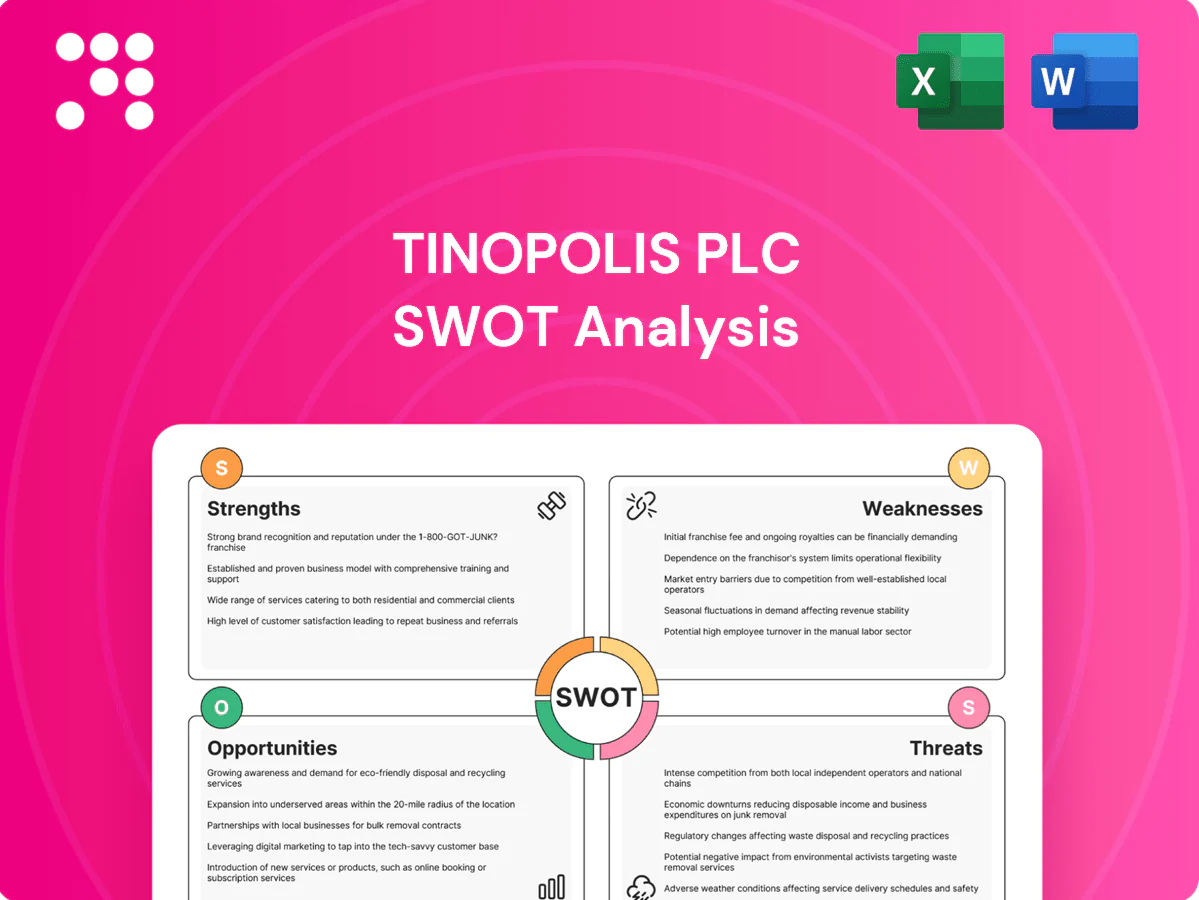
Tinopolis PLC SWOT Analysis

Make Insightful Decisions Backed by Expert Research
Tinopolis PLC’s SWOT snapshot reveals strong production capabilities and content library advantages, but also highlights market competition and digital transition risks. Want the full story behind its strengths, risks, and growth drivers? Purchase the complete SWOT analysis to gain a professionally written, editable report with strategic takeaways and an Excel matrix for investor-ready planning.
Strengths

Diverse multi-genre slate
Operating across four genres—factual, entertainment, drama and sports—smooths revenue volatility and broadens commissioning options. It enables cross-selling to different commissioners and time slots, increasing pipeline resilience. The portfolio mix helps rebalance cycles when one genre softens and supports higher utilisation of shared production resources.
Global broadcaster and platform relationships
Tinopolis supplies major broadcasters and global streamers, creating a steady pipeline of commissions that underpins recurring revenue. Deep commissioner trust shortens sales cycles and increases renewal probabilities, improving cashflow predictability. Multi-territory sales mitigate single-market exposure, while high repeat work enhances scheduling visibility and collective bargaining power.

Integrated distribution capability
Tinopolis’s in-house distribution monetizes finished programmes and formats across windows and territories, reportedly delivering roughly a 20% uplift to lifetime programme revenues in 2024. It extends lifecycle value via tape sales, remakes and ancillary rights, converting back-catalogue into recurring income streams. Distribution data feeds development decisions, sharpening commissioning and format investment. This vertical link retains margins otherwise ceded to third-party distributors.

Subsidiary network with specialist brands
Subsidiary network of specialist brands lets Tinopolis operate distinct labels that target specific genres and audiences, preserving creative identity while leveraging centralized finance, legal and distribution functions. Strong label reputations attract top creative talent and secure niche commissions, supporting parallel development slates across divisions and spreading commercial risk across multiple creative teams and buyers.
- Genre-focused labels preserve brand identity
- Centralized back-office drives scale
- Parallel slates diversify buyer and creative risk
Expandable IP library
Owned formats and series drive recurring revenue via renewals and international versions, smoothing cash flow across cycles. Extensive libraries enable catalogue sales and licensing during commissioning lulls, preserving revenue stability. IP can be refreshed with spin-offs and specials, and this asset base strengthens valuation metrics and grants financing flexibility.
- Recurring revenue from renewals and international formats
- Catalogue sales during commissioning gaps
- Refreshable IP via spin-offs/specials
- Stronger valuation and financing optionality
Four-genre strategy and broadcaster ties drive 20% revenue uplift
Tinopolis spreads risk across four genres, securing cross-commissioning and shared production utilisation. Strong relationships with major broadcasters and streamers sustain recurring commissions and scheduling visibility. In-house distribution delivered roughly a 20% uplift to lifetime programme revenues in 2024, converting catalogue and formats into repeatable income.
| Metric | Fact |
|---|---|
| Genres | 4 |
| Distribution uplift (2024) | ~20% |
What is included in the product
 Detailed Word Document
Delivers a strategic overview of Tinopolis PLC’s internal and external business factors, outlining strengths like diversified production capabilities and broadcaster relationships, weaknesses such as reliance on commission-based revenues, opportunities in streaming and international expansion, and threats from digital disruption and industry consolidation.

 Customizable Excel Spreadsheet
Provides a concise SWOT matrix for Tinopolis PLC to quickly identify strengths, weaknesses, opportunities and threats, enabling faster strategic decisions and streamlined stakeholder alignment.
Weaknesses

Commissioning dependence
Tinopolis plc (AIM: TIN) relies on third-party commissioning and broadcaster budget cycles, so programme greenlights drive revenue timing. Cancellations or deferrals from commissioners can abruptly disrupt cash flow and working capital. Limited control over scheduling often compresses margins and reduces utilisation, while negotiating power on marquee projects is constrained by commissioner dominance.
Hit-driven, project volatility
Performance concentrated in a few tentpoles creates material earnings swings for Tinopolis, as revenue volatility from single hits can dominate quarter results. Underperformance of a flagship show can ripple across multiple labels and distribution deals, amplifying margin pressure. High development costs are often expensed with uncertain payoff, raising breakeven risk. These dynamics make reliable quarter-to-quarter forecasting difficult for investors and management.

Margin pressure from cost inflation
Rising wage growth (UK average weekly earnings up ~6.5% in 2024) and location/insurance costs (industry premiums reported up c.20% in 2023–24) have outpaced some commissioning fee increases, compressing margins. Fixed-price contracts leave Tinopolis exposed when schedule or scope overruns occur, hitting profitability. Currency swings—GBP volatility versus USD/EUR—can erode margins on international shoots. Delivering premium quality within tighter budgets strains producers and increases risk of cost overruns.

Talent retention and capacity constraints
Coveted showrunners, editors and crews are highly mobile; major streamers (Netflix spent about $17.3bn on content in 2023) and deep-pocketed indies push rates and exclusivity, squeezing Tinopolis’ margin and talent pipeline.
Capacity bottlenecks risk delivery delays and penalty exposure, while maintaining culture and incentives across multiple labels complicates retention and scalability.
- Talent mobility pressure
- Premium bidding from streamers/indies
- Capacity = delay/penalty risk
- Complex cross-label culture/incentives
Operational complexity across labels
Operational complexity across Tinopolis labels raises overhead and coordination demands as multiple subsidiaries require centralized governance and shared services, increasing SG&A pressure.
Integrating disparate production systems, rights-tracking tools and compliance processes creates friction that delays content delivery and revenue recognition.
Functional duplication reduces scale benefits and cross-label decision-making can slow during collaborations.
Indie producer margin squeeze: +6.5% vs streamer spend
Tinopolis faces commissioner-driven revenue timing and hit-driven volatility, with high development write-offs and forecasting difficulty. Rising costs (UK wages +6.5% in 2024; industry insurance +~20% 2023–24) and fixed-price exposure compress margins. Talent poaching by deep-pocketed streamers (Netflix content spend $17.3bn in 2023) and multi-label overhead raise SG&A and delivery risk.
| Metric | Figure |
|---|---|
| UK wage growth (2024) | +6.5% |
| Industry insurance rise (2023–24) | ~+20% |
| Streamer content spend (2023) | Netflix $17.3bn |
Same Document Delivered
Tinopolis PLC SWOT Analysis
This is the actual Tinopolis PLC SWOT analysis document you’ll receive upon purchase—no surprises, just professional quality. The preview below is taken directly from the full report; buy to unlock the complete, editable version. It’s structured, actionable and ready to use.

Make Insightful Decisions Backed by Expert Research
Tinopolis PLC’s SWOT snapshot reveals strong production capabilities and content library advantages, but also highlights market competition and digital transition risks. Want the full story behind its strengths, risks, and growth drivers? Purchase the complete SWOT analysis to gain a professionally written, editable report with strategic takeaways and an Excel matrix for investor-ready planning.
Strengths
Diverse multi-genre slate
Operating across four genres—factual, entertainment, drama and sports—smooths revenue volatility and broadens commissioning options. It enables cross-selling to different commissioners and time slots, increasing pipeline resilience. The portfolio mix helps rebalance cycles when one genre softens and supports higher utilisation of shared production resources.
Global broadcaster and platform relationships
Tinopolis supplies major broadcasters and global streamers, creating a steady pipeline of commissions that underpins recurring revenue. Deep commissioner trust shortens sales cycles and increases renewal probabilities, improving cashflow predictability. Multi-territory sales mitigate single-market exposure, while high repeat work enhances scheduling visibility and collective bargaining power.
Integrated distribution capability
Tinopolis’s in-house distribution monetizes finished programmes and formats across windows and territories, reportedly delivering roughly a 20% uplift to lifetime programme revenues in 2024. It extends lifecycle value via tape sales, remakes and ancillary rights, converting back-catalogue into recurring income streams. Distribution data feeds development decisions, sharpening commissioning and format investment. This vertical link retains margins otherwise ceded to third-party distributors.
Subsidiary network with specialist brands
Subsidiary network of specialist brands lets Tinopolis operate distinct labels that target specific genres and audiences, preserving creative identity while leveraging centralized finance, legal and distribution functions. Strong label reputations attract top creative talent and secure niche commissions, supporting parallel development slates across divisions and spreading commercial risk across multiple creative teams and buyers.
- Genre-focused labels preserve brand identity
- Centralized back-office drives scale
- Parallel slates diversify buyer and creative risk
Expandable IP library
Owned formats and series drive recurring revenue via renewals and international versions, smoothing cash flow across cycles. Extensive libraries enable catalogue sales and licensing during commissioning lulls, preserving revenue stability. IP can be refreshed with spin-offs and specials, and this asset base strengthens valuation metrics and grants financing flexibility.
- Recurring revenue from renewals and international formats
- Catalogue sales during commissioning gaps
- Refreshable IP via spin-offs/specials
- Stronger valuation and financing optionality
Four-genre strategy and broadcaster ties drive 20% revenue uplift
Tinopolis spreads risk across four genres, securing cross-commissioning and shared production utilisation. Strong relationships with major broadcasters and streamers sustain recurring commissions and scheduling visibility. In-house distribution delivered roughly a 20% uplift to lifetime programme revenues in 2024, converting catalogue and formats into repeatable income.
| Metric | Fact |
|---|---|
| Genres | 4 |
| Distribution uplift (2024) | ~20% |
What is included in the product
Detailed Word Document
Delivers a strategic overview of Tinopolis PLC’s internal and external business factors, outlining strengths like diversified production capabilities and broadcaster relationships, weaknesses such as reliance on commission-based revenues, opportunities in streaming and international expansion, and threats from digital disruption and industry consolidation.
Customizable Excel Spreadsheet
Provides a concise SWOT matrix for Tinopolis PLC to quickly identify strengths, weaknesses, opportunities and threats, enabling faster strategic decisions and streamlined stakeholder alignment.
Weaknesses
Commissioning dependence
Tinopolis plc (AIM: TIN) relies on third-party commissioning and broadcaster budget cycles, so programme greenlights drive revenue timing. Cancellations or deferrals from commissioners can abruptly disrupt cash flow and working capital. Limited control over scheduling often compresses margins and reduces utilisation, while negotiating power on marquee projects is constrained by commissioner dominance.
Hit-driven, project volatility
Performance concentrated in a few tentpoles creates material earnings swings for Tinopolis, as revenue volatility from single hits can dominate quarter results. Underperformance of a flagship show can ripple across multiple labels and distribution deals, amplifying margin pressure. High development costs are often expensed with uncertain payoff, raising breakeven risk. These dynamics make reliable quarter-to-quarter forecasting difficult for investors and management.
Margin pressure from cost inflation
Rising wage growth (UK average weekly earnings up ~6.5% in 2024) and location/insurance costs (industry premiums reported up c.20% in 2023–24) have outpaced some commissioning fee increases, compressing margins. Fixed-price contracts leave Tinopolis exposed when schedule or scope overruns occur, hitting profitability. Currency swings—GBP volatility versus USD/EUR—can erode margins on international shoots. Delivering premium quality within tighter budgets strains producers and increases risk of cost overruns.
Talent retention and capacity constraints
Coveted showrunners, editors and crews are highly mobile; major streamers (Netflix spent about $17.3bn on content in 2023) and deep-pocketed indies push rates and exclusivity, squeezing Tinopolis’ margin and talent pipeline.
Capacity bottlenecks risk delivery delays and penalty exposure, while maintaining culture and incentives across multiple labels complicates retention and scalability.
- Talent mobility pressure
- Premium bidding from streamers/indies
- Capacity = delay/penalty risk
- Complex cross-label culture/incentives
Operational complexity across labels
Operational complexity across Tinopolis labels raises overhead and coordination demands as multiple subsidiaries require centralized governance and shared services, increasing SG&A pressure.
Integrating disparate production systems, rights-tracking tools and compliance processes creates friction that delays content delivery and revenue recognition.
Functional duplication reduces scale benefits and cross-label decision-making can slow during collaborations.
Indie producer margin squeeze: +6.5% vs streamer spend
Tinopolis faces commissioner-driven revenue timing and hit-driven volatility, with high development write-offs and forecasting difficulty. Rising costs (UK wages +6.5% in 2024; industry insurance +~20% 2023–24) and fixed-price exposure compress margins. Talent poaching by deep-pocketed streamers (Netflix content spend $17.3bn in 2023) and multi-label overhead raise SG&A and delivery risk.
| Metric | Figure |
|---|---|
| UK wage growth (2024) | +6.5% |
| Industry insurance rise (2023–24) | ~+20% |
| Streamer content spend (2023) | Netflix $17.3bn |
Same Document Delivered
Tinopolis PLC SWOT Analysis
This is the actual Tinopolis PLC SWOT analysis document you’ll receive upon purchase—no surprises, just professional quality. The preview below is taken directly from the full report; buy to unlock the complete, editable version. It’s structured, actionable and ready to use.
Description
Make Insightful Decisions Backed by Expert Research
Tinopolis PLC’s SWOT snapshot reveals strong production capabilities and content library advantages, but also highlights market competition and digital transition risks. Want the full story behind its strengths, risks, and growth drivers? Purchase the complete SWOT analysis to gain a professionally written, editable report with strategic takeaways and an Excel matrix for investor-ready planning.
Strengths
Diverse multi-genre slate
Operating across four genres—factual, entertainment, drama and sports—smooths revenue volatility and broadens commissioning options. It enables cross-selling to different commissioners and time slots, increasing pipeline resilience. The portfolio mix helps rebalance cycles when one genre softens and supports higher utilisation of shared production resources.
Global broadcaster and platform relationships
Tinopolis supplies major broadcasters and global streamers, creating a steady pipeline of commissions that underpins recurring revenue. Deep commissioner trust shortens sales cycles and increases renewal probabilities, improving cashflow predictability. Multi-territory sales mitigate single-market exposure, while high repeat work enhances scheduling visibility and collective bargaining power.
Integrated distribution capability
Tinopolis’s in-house distribution monetizes finished programmes and formats across windows and territories, reportedly delivering roughly a 20% uplift to lifetime programme revenues in 2024. It extends lifecycle value via tape sales, remakes and ancillary rights, converting back-catalogue into recurring income streams. Distribution data feeds development decisions, sharpening commissioning and format investment. This vertical link retains margins otherwise ceded to third-party distributors.
Subsidiary network with specialist brands
Subsidiary network of specialist brands lets Tinopolis operate distinct labels that target specific genres and audiences, preserving creative identity while leveraging centralized finance, legal and distribution functions. Strong label reputations attract top creative talent and secure niche commissions, supporting parallel development slates across divisions and spreading commercial risk across multiple creative teams and buyers.
- Genre-focused labels preserve brand identity
- Centralized back-office drives scale
- Parallel slates diversify buyer and creative risk
Expandable IP library
Owned formats and series drive recurring revenue via renewals and international versions, smoothing cash flow across cycles. Extensive libraries enable catalogue sales and licensing during commissioning lulls, preserving revenue stability. IP can be refreshed with spin-offs and specials, and this asset base strengthens valuation metrics and grants financing flexibility.
- Recurring revenue from renewals and international formats
- Catalogue sales during commissioning gaps
- Refreshable IP via spin-offs/specials
- Stronger valuation and financing optionality
Four-genre strategy and broadcaster ties drive 20% revenue uplift
Tinopolis spreads risk across four genres, securing cross-commissioning and shared production utilisation. Strong relationships with major broadcasters and streamers sustain recurring commissions and scheduling visibility. In-house distribution delivered roughly a 20% uplift to lifetime programme revenues in 2024, converting catalogue and formats into repeatable income.
| Metric | Fact |
|---|---|
| Genres | 4 |
| Distribution uplift (2024) | ~20% |
What is included in the product
Detailed Word Document
Delivers a strategic overview of Tinopolis PLC’s internal and external business factors, outlining strengths like diversified production capabilities and broadcaster relationships, weaknesses such as reliance on commission-based revenues, opportunities in streaming and international expansion, and threats from digital disruption and industry consolidation.
Customizable Excel Spreadsheet
Provides a concise SWOT matrix for Tinopolis PLC to quickly identify strengths, weaknesses, opportunities and threats, enabling faster strategic decisions and streamlined stakeholder alignment.
Weaknesses
Commissioning dependence
Tinopolis plc (AIM: TIN) relies on third-party commissioning and broadcaster budget cycles, so programme greenlights drive revenue timing. Cancellations or deferrals from commissioners can abruptly disrupt cash flow and working capital. Limited control over scheduling often compresses margins and reduces utilisation, while negotiating power on marquee projects is constrained by commissioner dominance.
Hit-driven, project volatility
Performance concentrated in a few tentpoles creates material earnings swings for Tinopolis, as revenue volatility from single hits can dominate quarter results. Underperformance of a flagship show can ripple across multiple labels and distribution deals, amplifying margin pressure. High development costs are often expensed with uncertain payoff, raising breakeven risk. These dynamics make reliable quarter-to-quarter forecasting difficult for investors and management.
Margin pressure from cost inflation
Rising wage growth (UK average weekly earnings up ~6.5% in 2024) and location/insurance costs (industry premiums reported up c.20% in 2023–24) have outpaced some commissioning fee increases, compressing margins. Fixed-price contracts leave Tinopolis exposed when schedule or scope overruns occur, hitting profitability. Currency swings—GBP volatility versus USD/EUR—can erode margins on international shoots. Delivering premium quality within tighter budgets strains producers and increases risk of cost overruns.
Talent retention and capacity constraints
Coveted showrunners, editors and crews are highly mobile; major streamers (Netflix spent about $17.3bn on content in 2023) and deep-pocketed indies push rates and exclusivity, squeezing Tinopolis’ margin and talent pipeline.
Capacity bottlenecks risk delivery delays and penalty exposure, while maintaining culture and incentives across multiple labels complicates retention and scalability.
- Talent mobility pressure
- Premium bidding from streamers/indies
- Capacity = delay/penalty risk
- Complex cross-label culture/incentives
Operational complexity across labels
Operational complexity across Tinopolis labels raises overhead and coordination demands as multiple subsidiaries require centralized governance and shared services, increasing SG&A pressure.
Integrating disparate production systems, rights-tracking tools and compliance processes creates friction that delays content delivery and revenue recognition.
Functional duplication reduces scale benefits and cross-label decision-making can slow during collaborations.
Indie producer margin squeeze: +6.5% vs streamer spend
Tinopolis faces commissioner-driven revenue timing and hit-driven volatility, with high development write-offs and forecasting difficulty. Rising costs (UK wages +6.5% in 2024; industry insurance +~20% 2023–24) and fixed-price exposure compress margins. Talent poaching by deep-pocketed streamers (Netflix content spend $17.3bn in 2023) and multi-label overhead raise SG&A and delivery risk.
| Metric | Figure |
|---|---|
| UK wage growth (2024) | +6.5% |
| Industry insurance rise (2023–24) | ~+20% |
| Streamer content spend (2023) | Netflix $17.3bn |
Same Document Delivered
Tinopolis PLC SWOT Analysis
This is the actual Tinopolis PLC SWOT analysis document you’ll receive upon purchase—no surprises, just professional quality. The preview below is taken directly from the full report; buy to unlock the complete, editable version. It’s structured, actionable and ready to use.











