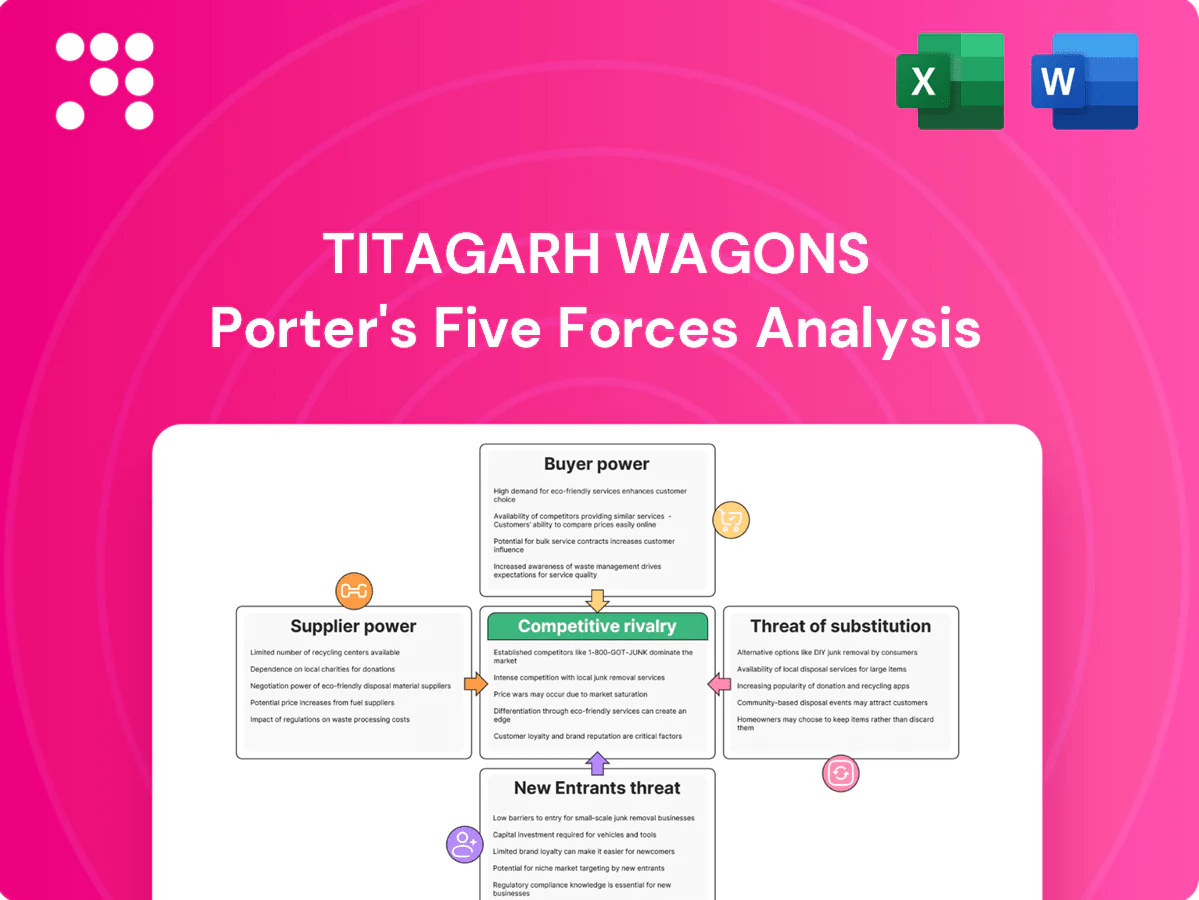
Titagarh Wagons Porter's Five Forces Analysis

From Overview to Strategy Blueprint
Titagarh Wagons faces moderate buyer power, concentrated OEM contracts, and rising competition from domestic and international rail manufacturers; supplier leverage is tempered by commodity sourcing but technology and after-sales service drive differentiation. This snapshot only scratches the surface. Unlock the full Porter's Five Forces Analysis to explore competitive dynamics, market pressures, and strategic advantages in detail.
Suppliers Bargaining Power

Critical components concentrated
Propulsion, braking and signaling for coaches/metros are concentrated among a handful of OEMs—top five suppliers held roughly 65–75% of the global market in 2024—giving suppliers strong leverage over pricing and specs. Qualification and safety certifications commonly take 12–24 months, raising switching costs and locking Titagarh into supplier timelines. Lead times of 9–18 months allow suppliers to influence delivery schedules. Titagarh must dual-source or form partnerships to mitigate supply and certification risk.
Commodity steel volatility
Steel plates, sections and wheelsets form the bulk of Titagarh Wagons’ input costs and face cyclical price swings driven by supply tightness; large domestic mills such as SAIL and RINL (RINL capacity ~7.3 MTPA) and select global suppliers constrain sourcing during tight cycles. Fixed-price tenders limit price pass-through, squeezing margins. Companies therefore rely on hedging and multi-year contracts to stabilize costs and protect EBITDA.

Partial backward integration
Partial backward integration with in-house steel castings and fabrication (expanded in 2024) cuts reliance on external suppliers for bogie frames and cast parts, reducing related procurement exposure and lowering supplier leverage; electronics and propulsion remain outsourced, representing a sizable portion of system value, so net supplier power is moderate in 2024.

Import dependence and geopolitics
Import dependence for advanced subsystems and wheelsets gives suppliers leverage as tariffs, logistics bottlenecks and export controls can delay deliveries and raise costs; currency swings further amplify input-price risk, while Titagarh Wagons' phased localization programs aim to reduce this exposure over time.
- Imported critical subsystems increase supplier bargaining
- Tariffs, logistics and export controls heighten leverage
- Currency volatility raises cost risk
- Localization programs gradually lower dependence
Qualification lock-ins
RDSO and metro authority approvals lock specific components to projects, creating qualification lock-ins that make switching suppliers costly; requalification commonly takes 6–12 months in 2024, deterring changes even after price hikes. Framework agreements frequently embed approved BoMs, and suppliers leverage these frictions to preserve premium margins.
- RDSO requal: 6–12 months (2024)
- Frameworks embed BoMs
- Switching deterrent: time + certification cost
Suppliers strong propulsion top5 65-75%, lead 9-18m
Suppliers exert moderate-to-high power in 2024: propulsion/signaling top-5 share 65–75%, RDSO requal 6–12 months, steel mills (SAIL/RINL) capacity ~7.3 MTPA constrains supply, lead times 9–18 months; Titagarh reduces risk via partial backward integration and localization programs.
| Metric | 2024 |
|---|---|
| Propulsion top-5 | 65–75% |
| RINL cap | ~7.3 MTPA |
| RDSO requal | 6–12 months |
| Lead times | 9–18 months |
What is included in the product
 Detailed Word Document
Concise Porter’s Five Forces evaluation of Titagarh Wagons, revealing competitive intensity, buyer/supplier leverage, threat of substitutes and entrants, and strategic levers to protect margins and market share.

 Customizable Excel Spreadsheet
A clear one-sheet Porter's Five Forces for Titagarh Wagons—quickly highlights supplier, buyer, entrant, substitute, and rivalry pressures to relieve strategic uncertainty. Customizable pressure levels and an instant spider chart make it slide-ready and easy to integrate into dashboards or reports.
Customers Bargaining Power

Few large public buyers
Indian Railways, metro corporations and defense account for the bulk of rolling-stock demand, with Indian Railways capex at about Rs 2.40 lakh crore in 2023–24 underpinning large, infrequent tenders that confer high buyer leverage. Procurement is L1- and compliance-driven, with payment schedules and liquidated damages clauses skewed toward buyers, pressuring margins and working capital for suppliers like Titagarh Wagons.
Tender-driven pricing
Tender-driven pricing compresses margins and standardizes specs for Titagarh Wagons, with competitive bids from peers like Texmaco and Jindal Rail narrowing EBITDA on routine wagon orders. Buyers—notably Indian Railways and private freight operators—can pit multiple qualified vendors against each other, limiting scope for premium pricing except on differentiated tech such as EMU or specialized freight designs. Long-term rate contracts and framework orders signed in 2024 further amplify buyer leverage; Titagarh reported an order book of around Rs 4,500 crore as of March 2024.

High switching barriers post-award
Once a design is approved buyers typically avoid switching due to delivery timelines and integration risk, which reduces their bargaining power during execution and locks suppliers into execution-phase margins. At rebid, however, purchaser evaluation resets competition by prioritizing qualifications and past performance, restoring buyer leverage. Service quality and on-time delivery materially influence future awards and long-term share in rolling-stock procurement.

Export agencies’ stringent requirements
International transit agencies impose strict safety and lifecycle guarantees, pushing Titagarh Wagons to meet global certification and long-term performance metrics; agencies also negotiate aggressive warranty clauses and penalty structures. Currency and financing terms frequently enter price talks, narrowing margins for commoditized wagons, so only differentiated offerings secure pricing latitude.
- safety and lifecycle guarantees
- aggressive warranties and penalties
- currency and financing in price talks
- only differentiated products win premium pricing
Aftermarket and services potential
Aftermarket services—maintenance, spares and upgrades—create recurring revenue for Titagarh Wagons and reduce customer price focus by enabling bundled O&M that increases switching costs. Performance‑based contracts shift buyer negotiation to lifecycle outcomes rather than upfront price, and fleet reliability data supports premium pricing and longer service agreements.
- Recurring revenue: maintenance, spares, upgrades
- Bundled O&M: lock‑in, lower buyer leverage
- Performance contracts: price → outcomes
- Data-driven reliability: justification for better terms
Railways' large tenders limit wagon makers' pricing; aftermarket and niche products improve terms
Large, infrequent Indian Railways tenders (capex ~Rs 2.40 lakh crore in 2023–24) give high buyer leverage, compressing margins for Titagarh Wagons; order book ~Rs 4,500 crore (Mar 2024) limits pricing power on commoditized wagons. Differentiated products and aftermarket O&M raise switching costs and enable better terms. International buyers add warranty, penalty and financing pressures.
| Buyer | Leverage | Impact | 2024 data |
|---|---|---|---|
| Indian Railways | High | Tender pricing, strict clauses | Capex Rs 2.40 lakh crore |
| Titagarh Wagons | Moderate | Aftermarket reduces price pressure | Order book ~Rs 4,500 crore |
Preview the Actual Deliverable
Titagarh Wagons Porter's Five Forces Analysis
This Titagarh Wagons Porter’s Five Forces analysis provides a concise evaluation of competitive rivalry, supplier and buyer power, threat of substitutes, and entry barriers; the preview you see is the exact, fully formatted document you will receive immediately after purchase with no placeholders or changes.

From Overview to Strategy Blueprint
Titagarh Wagons faces moderate buyer power, concentrated OEM contracts, and rising competition from domestic and international rail manufacturers; supplier leverage is tempered by commodity sourcing but technology and after-sales service drive differentiation. This snapshot only scratches the surface. Unlock the full Porter's Five Forces Analysis to explore competitive dynamics, market pressures, and strategic advantages in detail.
Suppliers Bargaining Power
Critical components concentrated
Propulsion, braking and signaling for coaches/metros are concentrated among a handful of OEMs—top five suppliers held roughly 65–75% of the global market in 2024—giving suppliers strong leverage over pricing and specs. Qualification and safety certifications commonly take 12–24 months, raising switching costs and locking Titagarh into supplier timelines. Lead times of 9–18 months allow suppliers to influence delivery schedules. Titagarh must dual-source or form partnerships to mitigate supply and certification risk.
Commodity steel volatility
Steel plates, sections and wheelsets form the bulk of Titagarh Wagons’ input costs and face cyclical price swings driven by supply tightness; large domestic mills such as SAIL and RINL (RINL capacity ~7.3 MTPA) and select global suppliers constrain sourcing during tight cycles. Fixed-price tenders limit price pass-through, squeezing margins. Companies therefore rely on hedging and multi-year contracts to stabilize costs and protect EBITDA.
Partial backward integration
Partial backward integration with in-house steel castings and fabrication (expanded in 2024) cuts reliance on external suppliers for bogie frames and cast parts, reducing related procurement exposure and lowering supplier leverage; electronics and propulsion remain outsourced, representing a sizable portion of system value, so net supplier power is moderate in 2024.
Import dependence and geopolitics
Import dependence for advanced subsystems and wheelsets gives suppliers leverage as tariffs, logistics bottlenecks and export controls can delay deliveries and raise costs; currency swings further amplify input-price risk, while Titagarh Wagons' phased localization programs aim to reduce this exposure over time.
- Imported critical subsystems increase supplier bargaining
- Tariffs, logistics and export controls heighten leverage
- Currency volatility raises cost risk
- Localization programs gradually lower dependence
Qualification lock-ins
RDSO and metro authority approvals lock specific components to projects, creating qualification lock-ins that make switching suppliers costly; requalification commonly takes 6–12 months in 2024, deterring changes even after price hikes. Framework agreements frequently embed approved BoMs, and suppliers leverage these frictions to preserve premium margins.
- RDSO requal: 6–12 months (2024)
- Frameworks embed BoMs
- Switching deterrent: time + certification cost
Suppliers strong propulsion top5 65-75%, lead 9-18m
Suppliers exert moderate-to-high power in 2024: propulsion/signaling top-5 share 65–75%, RDSO requal 6–12 months, steel mills (SAIL/RINL) capacity ~7.3 MTPA constrains supply, lead times 9–18 months; Titagarh reduces risk via partial backward integration and localization programs.
| Metric | 2024 |
|---|---|
| Propulsion top-5 | 65–75% |
| RINL cap | ~7.3 MTPA |
| RDSO requal | 6–12 months |
| Lead times | 9–18 months |
What is included in the product
Detailed Word Document
Concise Porter’s Five Forces evaluation of Titagarh Wagons, revealing competitive intensity, buyer/supplier leverage, threat of substitutes and entrants, and strategic levers to protect margins and market share.
Customizable Excel Spreadsheet
A clear one-sheet Porter's Five Forces for Titagarh Wagons—quickly highlights supplier, buyer, entrant, substitute, and rivalry pressures to relieve strategic uncertainty. Customizable pressure levels and an instant spider chart make it slide-ready and easy to integrate into dashboards or reports.
Customers Bargaining Power
Few large public buyers
Indian Railways, metro corporations and defense account for the bulk of rolling-stock demand, with Indian Railways capex at about Rs 2.40 lakh crore in 2023–24 underpinning large, infrequent tenders that confer high buyer leverage. Procurement is L1- and compliance-driven, with payment schedules and liquidated damages clauses skewed toward buyers, pressuring margins and working capital for suppliers like Titagarh Wagons.
Tender-driven pricing
Tender-driven pricing compresses margins and standardizes specs for Titagarh Wagons, with competitive bids from peers like Texmaco and Jindal Rail narrowing EBITDA on routine wagon orders. Buyers—notably Indian Railways and private freight operators—can pit multiple qualified vendors against each other, limiting scope for premium pricing except on differentiated tech such as EMU or specialized freight designs. Long-term rate contracts and framework orders signed in 2024 further amplify buyer leverage; Titagarh reported an order book of around Rs 4,500 crore as of March 2024.
High switching barriers post-award
Once a design is approved buyers typically avoid switching due to delivery timelines and integration risk, which reduces their bargaining power during execution and locks suppliers into execution-phase margins. At rebid, however, purchaser evaluation resets competition by prioritizing qualifications and past performance, restoring buyer leverage. Service quality and on-time delivery materially influence future awards and long-term share in rolling-stock procurement.
Export agencies’ stringent requirements
International transit agencies impose strict safety and lifecycle guarantees, pushing Titagarh Wagons to meet global certification and long-term performance metrics; agencies also negotiate aggressive warranty clauses and penalty structures. Currency and financing terms frequently enter price talks, narrowing margins for commoditized wagons, so only differentiated offerings secure pricing latitude.
- safety and lifecycle guarantees
- aggressive warranties and penalties
- currency and financing in price talks
- only differentiated products win premium pricing
Aftermarket and services potential
Aftermarket services—maintenance, spares and upgrades—create recurring revenue for Titagarh Wagons and reduce customer price focus by enabling bundled O&M that increases switching costs. Performance‑based contracts shift buyer negotiation to lifecycle outcomes rather than upfront price, and fleet reliability data supports premium pricing and longer service agreements.
- Recurring revenue: maintenance, spares, upgrades
- Bundled O&M: lock‑in, lower buyer leverage
- Performance contracts: price → outcomes
- Data-driven reliability: justification for better terms
Railways' large tenders limit wagon makers' pricing; aftermarket and niche products improve terms
Large, infrequent Indian Railways tenders (capex ~Rs 2.40 lakh crore in 2023–24) give high buyer leverage, compressing margins for Titagarh Wagons; order book ~Rs 4,500 crore (Mar 2024) limits pricing power on commoditized wagons. Differentiated products and aftermarket O&M raise switching costs and enable better terms. International buyers add warranty, penalty and financing pressures.
| Buyer | Leverage | Impact | 2024 data |
|---|---|---|---|
| Indian Railways | High | Tender pricing, strict clauses | Capex Rs 2.40 lakh crore |
| Titagarh Wagons | Moderate | Aftermarket reduces price pressure | Order book ~Rs 4,500 crore |
Preview the Actual Deliverable
Titagarh Wagons Porter's Five Forces Analysis
This Titagarh Wagons Porter’s Five Forces analysis provides a concise evaluation of competitive rivalry, supplier and buyer power, threat of substitutes, and entry barriers; the preview you see is the exact, fully formatted document you will receive immediately after purchase with no placeholders or changes.
Original: $10.00
-65%$10.00
$3.50Description
From Overview to Strategy Blueprint
Titagarh Wagons faces moderate buyer power, concentrated OEM contracts, and rising competition from domestic and international rail manufacturers; supplier leverage is tempered by commodity sourcing but technology and after-sales service drive differentiation. This snapshot only scratches the surface. Unlock the full Porter's Five Forces Analysis to explore competitive dynamics, market pressures, and strategic advantages in detail.
Suppliers Bargaining Power
Critical components concentrated
Propulsion, braking and signaling for coaches/metros are concentrated among a handful of OEMs—top five suppliers held roughly 65–75% of the global market in 2024—giving suppliers strong leverage over pricing and specs. Qualification and safety certifications commonly take 12–24 months, raising switching costs and locking Titagarh into supplier timelines. Lead times of 9–18 months allow suppliers to influence delivery schedules. Titagarh must dual-source or form partnerships to mitigate supply and certification risk.
Commodity steel volatility
Steel plates, sections and wheelsets form the bulk of Titagarh Wagons’ input costs and face cyclical price swings driven by supply tightness; large domestic mills such as SAIL and RINL (RINL capacity ~7.3 MTPA) and select global suppliers constrain sourcing during tight cycles. Fixed-price tenders limit price pass-through, squeezing margins. Companies therefore rely on hedging and multi-year contracts to stabilize costs and protect EBITDA.
Partial backward integration
Partial backward integration with in-house steel castings and fabrication (expanded in 2024) cuts reliance on external suppliers for bogie frames and cast parts, reducing related procurement exposure and lowering supplier leverage; electronics and propulsion remain outsourced, representing a sizable portion of system value, so net supplier power is moderate in 2024.
Import dependence and geopolitics
Import dependence for advanced subsystems and wheelsets gives suppliers leverage as tariffs, logistics bottlenecks and export controls can delay deliveries and raise costs; currency swings further amplify input-price risk, while Titagarh Wagons' phased localization programs aim to reduce this exposure over time.
- Imported critical subsystems increase supplier bargaining
- Tariffs, logistics and export controls heighten leverage
- Currency volatility raises cost risk
- Localization programs gradually lower dependence
Qualification lock-ins
RDSO and metro authority approvals lock specific components to projects, creating qualification lock-ins that make switching suppliers costly; requalification commonly takes 6–12 months in 2024, deterring changes even after price hikes. Framework agreements frequently embed approved BoMs, and suppliers leverage these frictions to preserve premium margins.
- RDSO requal: 6–12 months (2024)
- Frameworks embed BoMs
- Switching deterrent: time + certification cost
Suppliers strong propulsion top5 65-75%, lead 9-18m
Suppliers exert moderate-to-high power in 2024: propulsion/signaling top-5 share 65–75%, RDSO requal 6–12 months, steel mills (SAIL/RINL) capacity ~7.3 MTPA constrains supply, lead times 9–18 months; Titagarh reduces risk via partial backward integration and localization programs.
| Metric | 2024 |
|---|---|
| Propulsion top-5 | 65–75% |
| RINL cap | ~7.3 MTPA |
| RDSO requal | 6–12 months |
| Lead times | 9–18 months |
What is included in the product
Detailed Word Document
Concise Porter’s Five Forces evaluation of Titagarh Wagons, revealing competitive intensity, buyer/supplier leverage, threat of substitutes and entrants, and strategic levers to protect margins and market share.
Customizable Excel Spreadsheet
A clear one-sheet Porter's Five Forces for Titagarh Wagons—quickly highlights supplier, buyer, entrant, substitute, and rivalry pressures to relieve strategic uncertainty. Customizable pressure levels and an instant spider chart make it slide-ready and easy to integrate into dashboards or reports.
Customers Bargaining Power
Few large public buyers
Indian Railways, metro corporations and defense account for the bulk of rolling-stock demand, with Indian Railways capex at about Rs 2.40 lakh crore in 2023–24 underpinning large, infrequent tenders that confer high buyer leverage. Procurement is L1- and compliance-driven, with payment schedules and liquidated damages clauses skewed toward buyers, pressuring margins and working capital for suppliers like Titagarh Wagons.
Tender-driven pricing
Tender-driven pricing compresses margins and standardizes specs for Titagarh Wagons, with competitive bids from peers like Texmaco and Jindal Rail narrowing EBITDA on routine wagon orders. Buyers—notably Indian Railways and private freight operators—can pit multiple qualified vendors against each other, limiting scope for premium pricing except on differentiated tech such as EMU or specialized freight designs. Long-term rate contracts and framework orders signed in 2024 further amplify buyer leverage; Titagarh reported an order book of around Rs 4,500 crore as of March 2024.
High switching barriers post-award
Once a design is approved buyers typically avoid switching due to delivery timelines and integration risk, which reduces their bargaining power during execution and locks suppliers into execution-phase margins. At rebid, however, purchaser evaluation resets competition by prioritizing qualifications and past performance, restoring buyer leverage. Service quality and on-time delivery materially influence future awards and long-term share in rolling-stock procurement.
Export agencies’ stringent requirements
International transit agencies impose strict safety and lifecycle guarantees, pushing Titagarh Wagons to meet global certification and long-term performance metrics; agencies also negotiate aggressive warranty clauses and penalty structures. Currency and financing terms frequently enter price talks, narrowing margins for commoditized wagons, so only differentiated offerings secure pricing latitude.
- safety and lifecycle guarantees
- aggressive warranties and penalties
- currency and financing in price talks
- only differentiated products win premium pricing
Aftermarket and services potential
Aftermarket services—maintenance, spares and upgrades—create recurring revenue for Titagarh Wagons and reduce customer price focus by enabling bundled O&M that increases switching costs. Performance‑based contracts shift buyer negotiation to lifecycle outcomes rather than upfront price, and fleet reliability data supports premium pricing and longer service agreements.
- Recurring revenue: maintenance, spares, upgrades
- Bundled O&M: lock‑in, lower buyer leverage
- Performance contracts: price → outcomes
- Data-driven reliability: justification for better terms
Railways' large tenders limit wagon makers' pricing; aftermarket and niche products improve terms
Large, infrequent Indian Railways tenders (capex ~Rs 2.40 lakh crore in 2023–24) give high buyer leverage, compressing margins for Titagarh Wagons; order book ~Rs 4,500 crore (Mar 2024) limits pricing power on commoditized wagons. Differentiated products and aftermarket O&M raise switching costs and enable better terms. International buyers add warranty, penalty and financing pressures.
| Buyer | Leverage | Impact | 2024 data |
|---|---|---|---|
| Indian Railways | High | Tender pricing, strict clauses | Capex Rs 2.40 lakh crore |
| Titagarh Wagons | Moderate | Aftermarket reduces price pressure | Order book ~Rs 4,500 crore |
Preview the Actual Deliverable
Titagarh Wagons Porter's Five Forces Analysis
This Titagarh Wagons Porter’s Five Forces analysis provides a concise evaluation of competitive rivalry, supplier and buyer power, threat of substitutes, and entry barriers; the preview you see is the exact, fully formatted document you will receive immediately after purchase with no placeholders or changes.











