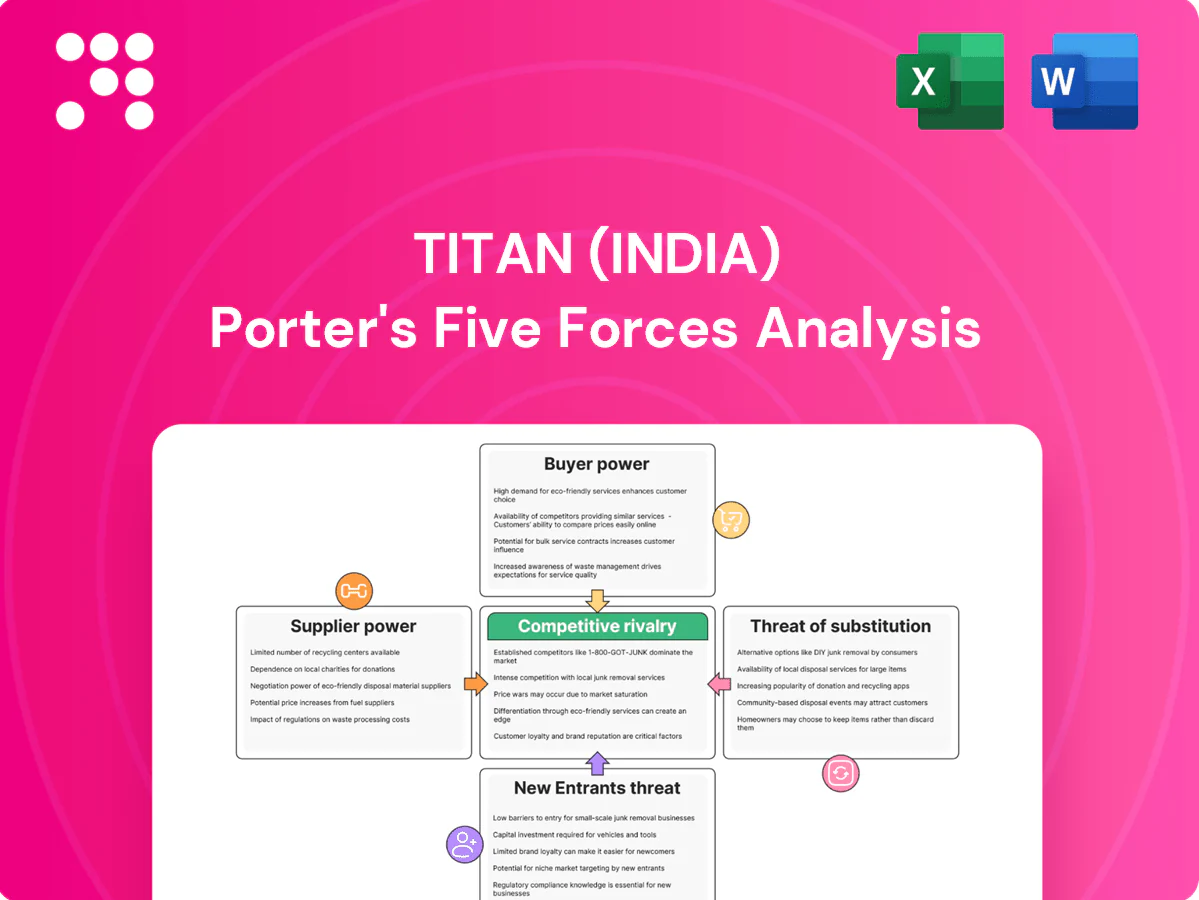
Titan (India) Porter's Five Forces Analysis

Elevate Your Analysis with the Complete Porter's Five Forces Analysis
Titan (India) faces intense intra-industry rivalry across watches, jewellery and eyewear, supported by a strong brand and expansive retail network that lower supplier leverage; buyer power is moderate with price-sensitive segments and substitutes like fashion accessories posing steady threat. This brief snapshot only scratches the surface. Unlock the full Porter's Five Forces Analysis to explore Titan (India)’s competitive dynamics, market pressures, and strategic advantages in detail.
Suppliers Bargaining Power

Precious inputs concentration
Gold, diamonds and gemstones are sourced from relatively concentrated global chains dominated by a few miners and traders (eg De Beers, ALROSA, Rio Tinto), giving upstream players leverage and exposure to price volatility and strict grading standards that can tighten terms for buyers like Titan. As of 2024, Titan’s large procurement scale and long‑term contracts partly mitigate supplier power, while its responsible sourcing programs have expanded certified supplier relationships and reduced reliance on a narrow supplier set.
Branded watch components
High-precision movements and sapphire glass (Mohs hardness 9) come from few global vendors (eg Swatch Group's ETA), giving suppliers leverage; COSC chronometer tolerances (-4/+6 s/day) and certification/tooling needs raise switching costs. Titan's in-house assembly and strategic alliances with movement suppliers reduce dependence. Ongoing localization initiatives have increased indigenous sourcing, tempering supplier bargaining power.

Eyewear and lens tech
Advanced lenses and frames depend on a handful of technology licensors and certified labs, letting IP, warranties and strict quality standards enable select suppliers to command premiums. Titan EyePlus’ private-label development and a lab network of about 1,000 stores in 2024 help counterbalance supplier power. Committed volumes and centralized procurement further improve bargaining leverage and secure better terms and pricing.

Fragrance and accessory OEMs
Fragrance and accessory OEMs wield bargaining power via formulation IP and MOQs, with long lead times and bespoke customization increasing Titan’s dependence; multibrand sourcing and Titan’s diversified portfolio mitigate concentration risk. Co-development agreements help align incentives, secure preferential pricing and shorten time-to-market, lowering supplier leverage.
- IP-driven leverage
- MOQs & lead-time risk
- Multi-sourcing diversification
- Co-development reduces costs
Compliance and sustainability
Compliance and sustainability narrow supplier pools as responsible sourcing (gold traceability, conflict-free diamonds) raises entry barriers; compliance costs and audits reinforce the bargaining power of certified vendors. Titan’s mature ESG framework and supplier-code enforcement widen access to compliant partners, while Titan’s scale allows shared investments in traceability systems that lower unit compliance costs over time.
- Responsible sourcing narrows eligible suppliers
- Compliance audits raise supplier stickiness
- ESG framework expands compliant partner pool
- Scale enables shared investment to cut unit costs
Watchmaker faces concentrated suppliers, COSC chronometer and sapphire supply constraints
Titan faces concentrated upstream power in gems (De Beers, ALROSA) and movement/glass suppliers (eg ETA) raising switching costs; COSC chronometer tolerances (-4/+6 s/day) and sapphire glass needs increase supplier leverage. Titan’s long‑term contracts, in‑house assembly and localization reduce dependence. Responsible sourcing narrows suppliers but Titan’s ESG programs expand compliant partners.
| Metric | 2024 |
|---|---|
| EyePlus lab/store network | ~1,000 |
| Chronometer spec | -4/+6 s/day (COSC) |
What is included in the product
 Detailed Word Document
Concise Porter's Five Forces analysis of Titan (India) highlighting competitive rivalry, buyer and supplier power, threat of new entrants and substitutes, and identifying key disruptive forces and entry barriers shaping its pricing power and long-term profitability.

 Customizable Excel Spreadsheet
Concise Porter's Five Forces snapshot for Titan (India) that pinpoints supplier/buyer power, competitive rivalry, and entrant/substitute threats—instantly revealing strategic pain points and suggested relief actions for faster decision-making.
Customers Bargaining Power

Informed urban consumers
Informed urban consumers compare prices, purity, and designs across online and offline channels, increasing bargaining power as branded jewellery penetration rises to about 20% of the Indian market in 2024; reviews and BIS certifications drive switching. Titan counters with Tanishq purity branding, warranties and transparent buyback policies, and its strong brand equity limits aggressive price haggling.
High-ticket jewelry purchases
Jewelry buyers are highly price-sensitive as gold rates are publicly visible and making charges typically range 8-12%, prompting negotiation on discounts, offers and exchange values; customers often reference live gold quotes to demand parity. Titan uses standardized pricing, festive promotions and exchange schemes to manage expectations, while loyalty programs and a wide design range dilute pure price pressure and improve wallet share.

Omnichannel transparency
Omnichannel transparency lets buyers do like-for-like comparisons via online catalogs and marketplaces, while click-and-collect and virtual try-ons shift bargaining power toward customers.
Titan offsets this by strengthening D2C platforms, exclusive collections and experiential stores—bolstered by a retail network of over 1,900 stores—and retaining differentiation.
Robust after-sales service and warranties further lock in customers, protecting margins despite greater buyer leverage.

Institutional and corporate buyers
Institutional and corporate buyers in India’s ₹~12,000 crore ($1.5bn) corporate gifting market in 2024 demand volume discounts and bespoke customizations, raising their bargaining power; easy brand switching amplifies leverage. Titan counters with tiered pricing, bespoke SKUs and account-level service; relationship management and dependable delivery keep churn low and preserve margins.
- Volume discounts
- Customization demands
- Switching leverage
- Tiered pricing
- Bespoke SKUs
- Account service & delivery
Regional taste diversity
Indian consumers show strong regional design preferences across 28 states and 8 union territories and 22 scheduled languages, pressuring assortments and inventory and prompting quick switching to local jewellers; Titan’s micro-market merchandising and data-led design cycles reduce mismatch risk and curb buyer leverage.
- Regional diversity: 28 states, 8 UTs, 22 scheduled languages
- Switching risk: local jewellers preferred for misaligned assortments
- Titan response: micro-market merchandising
- Mitigation: data-led design cycles reduce buyer bargaining
Branded jewellery ~20% boosts urban buyers' bargaining power
Informed urban buyers compare prices, purity and designs across channels as branded jewellery penetration rises to ~20% in 2024, boosting bargaining power; Titan leverages Tanishq purity branding, warranties and transparent buyback to limit price haggling. Visible gold rates and 8-12% making charges drive negotiations; Titan uses standardized pricing, festive promotions and loyalty to protect margins. Institutional buyers in the ~₹12,000 crore corporate gifting market demand volume discounts; Titan offers tiered pricing and bespoke SKUs.
| Metric | Value (2024) |
|---|---|
| Branded jewellery penetration | ~20% |
| Titan retail stores | >1,900 |
| Making charges | 8–12% |
| Corporate gifting market | ~₹12,000 crore ($1.5bn) |
Same Document Delivered
Titan (India) Porter's Five Forces Analysis
This preview shows the exact Titan (India) Porter’s Five Forces analysis you’ll receive after purchase—no placeholders. The document is fully formatted, professional and ready for immediate download and use. What you see here is the complete deliverable available instantly upon payment.

Elevate Your Analysis with the Complete Porter's Five Forces Analysis
Titan (India) faces intense intra-industry rivalry across watches, jewellery and eyewear, supported by a strong brand and expansive retail network that lower supplier leverage; buyer power is moderate with price-sensitive segments and substitutes like fashion accessories posing steady threat. This brief snapshot only scratches the surface. Unlock the full Porter's Five Forces Analysis to explore Titan (India)’s competitive dynamics, market pressures, and strategic advantages in detail.
Suppliers Bargaining Power
Precious inputs concentration
Gold, diamonds and gemstones are sourced from relatively concentrated global chains dominated by a few miners and traders (eg De Beers, ALROSA, Rio Tinto), giving upstream players leverage and exposure to price volatility and strict grading standards that can tighten terms for buyers like Titan. As of 2024, Titan’s large procurement scale and long‑term contracts partly mitigate supplier power, while its responsible sourcing programs have expanded certified supplier relationships and reduced reliance on a narrow supplier set.
Branded watch components
High-precision movements and sapphire glass (Mohs hardness 9) come from few global vendors (eg Swatch Group's ETA), giving suppliers leverage; COSC chronometer tolerances (-4/+6 s/day) and certification/tooling needs raise switching costs. Titan's in-house assembly and strategic alliances with movement suppliers reduce dependence. Ongoing localization initiatives have increased indigenous sourcing, tempering supplier bargaining power.
Eyewear and lens tech
Advanced lenses and frames depend on a handful of technology licensors and certified labs, letting IP, warranties and strict quality standards enable select suppliers to command premiums. Titan EyePlus’ private-label development and a lab network of about 1,000 stores in 2024 help counterbalance supplier power. Committed volumes and centralized procurement further improve bargaining leverage and secure better terms and pricing.
Fragrance and accessory OEMs
Fragrance and accessory OEMs wield bargaining power via formulation IP and MOQs, with long lead times and bespoke customization increasing Titan’s dependence; multibrand sourcing and Titan’s diversified portfolio mitigate concentration risk. Co-development agreements help align incentives, secure preferential pricing and shorten time-to-market, lowering supplier leverage.
- IP-driven leverage
- MOQs & lead-time risk
- Multi-sourcing diversification
- Co-development reduces costs
Compliance and sustainability
Compliance and sustainability narrow supplier pools as responsible sourcing (gold traceability, conflict-free diamonds) raises entry barriers; compliance costs and audits reinforce the bargaining power of certified vendors. Titan’s mature ESG framework and supplier-code enforcement widen access to compliant partners, while Titan’s scale allows shared investments in traceability systems that lower unit compliance costs over time.
- Responsible sourcing narrows eligible suppliers
- Compliance audits raise supplier stickiness
- ESG framework expands compliant partner pool
- Scale enables shared investment to cut unit costs
Watchmaker faces concentrated suppliers, COSC chronometer and sapphire supply constraints
Titan faces concentrated upstream power in gems (De Beers, ALROSA) and movement/glass suppliers (eg ETA) raising switching costs; COSC chronometer tolerances (-4/+6 s/day) and sapphire glass needs increase supplier leverage. Titan’s long‑term contracts, in‑house assembly and localization reduce dependence. Responsible sourcing narrows suppliers but Titan’s ESG programs expand compliant partners.
| Metric | 2024 |
|---|---|
| EyePlus lab/store network | ~1,000 |
| Chronometer spec | -4/+6 s/day (COSC) |
What is included in the product
Detailed Word Document
Concise Porter's Five Forces analysis of Titan (India) highlighting competitive rivalry, buyer and supplier power, threat of new entrants and substitutes, and identifying key disruptive forces and entry barriers shaping its pricing power and long-term profitability.
Customizable Excel Spreadsheet
Concise Porter's Five Forces snapshot for Titan (India) that pinpoints supplier/buyer power, competitive rivalry, and entrant/substitute threats—instantly revealing strategic pain points and suggested relief actions for faster decision-making.
Customers Bargaining Power
Informed urban consumers
Informed urban consumers compare prices, purity, and designs across online and offline channels, increasing bargaining power as branded jewellery penetration rises to about 20% of the Indian market in 2024; reviews and BIS certifications drive switching. Titan counters with Tanishq purity branding, warranties and transparent buyback policies, and its strong brand equity limits aggressive price haggling.
High-ticket jewelry purchases
Jewelry buyers are highly price-sensitive as gold rates are publicly visible and making charges typically range 8-12%, prompting negotiation on discounts, offers and exchange values; customers often reference live gold quotes to demand parity. Titan uses standardized pricing, festive promotions and exchange schemes to manage expectations, while loyalty programs and a wide design range dilute pure price pressure and improve wallet share.
Omnichannel transparency
Omnichannel transparency lets buyers do like-for-like comparisons via online catalogs and marketplaces, while click-and-collect and virtual try-ons shift bargaining power toward customers.
Titan offsets this by strengthening D2C platforms, exclusive collections and experiential stores—bolstered by a retail network of over 1,900 stores—and retaining differentiation.
Robust after-sales service and warranties further lock in customers, protecting margins despite greater buyer leverage.
Institutional and corporate buyers
Institutional and corporate buyers in India’s ₹~12,000 crore ($1.5bn) corporate gifting market in 2024 demand volume discounts and bespoke customizations, raising their bargaining power; easy brand switching amplifies leverage. Titan counters with tiered pricing, bespoke SKUs and account-level service; relationship management and dependable delivery keep churn low and preserve margins.
- Volume discounts
- Customization demands
- Switching leverage
- Tiered pricing
- Bespoke SKUs
- Account service & delivery
Regional taste diversity
Indian consumers show strong regional design preferences across 28 states and 8 union territories and 22 scheduled languages, pressuring assortments and inventory and prompting quick switching to local jewellers; Titan’s micro-market merchandising and data-led design cycles reduce mismatch risk and curb buyer leverage.
- Regional diversity: 28 states, 8 UTs, 22 scheduled languages
- Switching risk: local jewellers preferred for misaligned assortments
- Titan response: micro-market merchandising
- Mitigation: data-led design cycles reduce buyer bargaining
Branded jewellery ~20% boosts urban buyers' bargaining power
Informed urban buyers compare prices, purity and designs across channels as branded jewellery penetration rises to ~20% in 2024, boosting bargaining power; Titan leverages Tanishq purity branding, warranties and transparent buyback to limit price haggling. Visible gold rates and 8-12% making charges drive negotiations; Titan uses standardized pricing, festive promotions and loyalty to protect margins. Institutional buyers in the ~₹12,000 crore corporate gifting market demand volume discounts; Titan offers tiered pricing and bespoke SKUs.
| Metric | Value (2024) |
|---|---|
| Branded jewellery penetration | ~20% |
| Titan retail stores | >1,900 |
| Making charges | 8–12% |
| Corporate gifting market | ~₹12,000 crore ($1.5bn) |
Same Document Delivered
Titan (India) Porter's Five Forces Analysis
This preview shows the exact Titan (India) Porter’s Five Forces analysis you’ll receive after purchase—no placeholders. The document is fully formatted, professional and ready for immediate download and use. What you see here is the complete deliverable available instantly upon payment.
Description
Elevate Your Analysis with the Complete Porter's Five Forces Analysis
Titan (India) faces intense intra-industry rivalry across watches, jewellery and eyewear, supported by a strong brand and expansive retail network that lower supplier leverage; buyer power is moderate with price-sensitive segments and substitutes like fashion accessories posing steady threat. This brief snapshot only scratches the surface. Unlock the full Porter's Five Forces Analysis to explore Titan (India)’s competitive dynamics, market pressures, and strategic advantages in detail.
Suppliers Bargaining Power
Precious inputs concentration
Gold, diamonds and gemstones are sourced from relatively concentrated global chains dominated by a few miners and traders (eg De Beers, ALROSA, Rio Tinto), giving upstream players leverage and exposure to price volatility and strict grading standards that can tighten terms for buyers like Titan. As of 2024, Titan’s large procurement scale and long‑term contracts partly mitigate supplier power, while its responsible sourcing programs have expanded certified supplier relationships and reduced reliance on a narrow supplier set.
Branded watch components
High-precision movements and sapphire glass (Mohs hardness 9) come from few global vendors (eg Swatch Group's ETA), giving suppliers leverage; COSC chronometer tolerances (-4/+6 s/day) and certification/tooling needs raise switching costs. Titan's in-house assembly and strategic alliances with movement suppliers reduce dependence. Ongoing localization initiatives have increased indigenous sourcing, tempering supplier bargaining power.
Eyewear and lens tech
Advanced lenses and frames depend on a handful of technology licensors and certified labs, letting IP, warranties and strict quality standards enable select suppliers to command premiums. Titan EyePlus’ private-label development and a lab network of about 1,000 stores in 2024 help counterbalance supplier power. Committed volumes and centralized procurement further improve bargaining leverage and secure better terms and pricing.
Fragrance and accessory OEMs
Fragrance and accessory OEMs wield bargaining power via formulation IP and MOQs, with long lead times and bespoke customization increasing Titan’s dependence; multibrand sourcing and Titan’s diversified portfolio mitigate concentration risk. Co-development agreements help align incentives, secure preferential pricing and shorten time-to-market, lowering supplier leverage.
- IP-driven leverage
- MOQs & lead-time risk
- Multi-sourcing diversification
- Co-development reduces costs
Compliance and sustainability
Compliance and sustainability narrow supplier pools as responsible sourcing (gold traceability, conflict-free diamonds) raises entry barriers; compliance costs and audits reinforce the bargaining power of certified vendors. Titan’s mature ESG framework and supplier-code enforcement widen access to compliant partners, while Titan’s scale allows shared investments in traceability systems that lower unit compliance costs over time.
- Responsible sourcing narrows eligible suppliers
- Compliance audits raise supplier stickiness
- ESG framework expands compliant partner pool
- Scale enables shared investment to cut unit costs
Watchmaker faces concentrated suppliers, COSC chronometer and sapphire supply constraints
Titan faces concentrated upstream power in gems (De Beers, ALROSA) and movement/glass suppliers (eg ETA) raising switching costs; COSC chronometer tolerances (-4/+6 s/day) and sapphire glass needs increase supplier leverage. Titan’s long‑term contracts, in‑house assembly and localization reduce dependence. Responsible sourcing narrows suppliers but Titan’s ESG programs expand compliant partners.
| Metric | 2024 |
|---|---|
| EyePlus lab/store network | ~1,000 |
| Chronometer spec | -4/+6 s/day (COSC) |
What is included in the product
Detailed Word Document
Concise Porter's Five Forces analysis of Titan (India) highlighting competitive rivalry, buyer and supplier power, threat of new entrants and substitutes, and identifying key disruptive forces and entry barriers shaping its pricing power and long-term profitability.
Customizable Excel Spreadsheet
Concise Porter's Five Forces snapshot for Titan (India) that pinpoints supplier/buyer power, competitive rivalry, and entrant/substitute threats—instantly revealing strategic pain points and suggested relief actions for faster decision-making.
Customers Bargaining Power
Informed urban consumers
Informed urban consumers compare prices, purity, and designs across online and offline channels, increasing bargaining power as branded jewellery penetration rises to about 20% of the Indian market in 2024; reviews and BIS certifications drive switching. Titan counters with Tanishq purity branding, warranties and transparent buyback policies, and its strong brand equity limits aggressive price haggling.
High-ticket jewelry purchases
Jewelry buyers are highly price-sensitive as gold rates are publicly visible and making charges typically range 8-12%, prompting negotiation on discounts, offers and exchange values; customers often reference live gold quotes to demand parity. Titan uses standardized pricing, festive promotions and exchange schemes to manage expectations, while loyalty programs and a wide design range dilute pure price pressure and improve wallet share.
Omnichannel transparency
Omnichannel transparency lets buyers do like-for-like comparisons via online catalogs and marketplaces, while click-and-collect and virtual try-ons shift bargaining power toward customers.
Titan offsets this by strengthening D2C platforms, exclusive collections and experiential stores—bolstered by a retail network of over 1,900 stores—and retaining differentiation.
Robust after-sales service and warranties further lock in customers, protecting margins despite greater buyer leverage.
Institutional and corporate buyers
Institutional and corporate buyers in India’s ₹~12,000 crore ($1.5bn) corporate gifting market in 2024 demand volume discounts and bespoke customizations, raising their bargaining power; easy brand switching amplifies leverage. Titan counters with tiered pricing, bespoke SKUs and account-level service; relationship management and dependable delivery keep churn low and preserve margins.
- Volume discounts
- Customization demands
- Switching leverage
- Tiered pricing
- Bespoke SKUs
- Account service & delivery
Regional taste diversity
Indian consumers show strong regional design preferences across 28 states and 8 union territories and 22 scheduled languages, pressuring assortments and inventory and prompting quick switching to local jewellers; Titan’s micro-market merchandising and data-led design cycles reduce mismatch risk and curb buyer leverage.
- Regional diversity: 28 states, 8 UTs, 22 scheduled languages
- Switching risk: local jewellers preferred for misaligned assortments
- Titan response: micro-market merchandising
- Mitigation: data-led design cycles reduce buyer bargaining
Branded jewellery ~20% boosts urban buyers' bargaining power
Informed urban buyers compare prices, purity and designs across channels as branded jewellery penetration rises to ~20% in 2024, boosting bargaining power; Titan leverages Tanishq purity branding, warranties and transparent buyback to limit price haggling. Visible gold rates and 8-12% making charges drive negotiations; Titan uses standardized pricing, festive promotions and loyalty to protect margins. Institutional buyers in the ~₹12,000 crore corporate gifting market demand volume discounts; Titan offers tiered pricing and bespoke SKUs.
| Metric | Value (2024) |
|---|---|
| Branded jewellery penetration | ~20% |
| Titan retail stores | >1,900 |
| Making charges | 8–12% |
| Corporate gifting market | ~₹12,000 crore ($1.5bn) |
Same Document Delivered
Titan (India) Porter's Five Forces Analysis
This preview shows the exact Titan (India) Porter’s Five Forces analysis you’ll receive after purchase—no placeholders. The document is fully formatted, professional and ready for immediate download and use. What you see here is the complete deliverable available instantly upon payment.











