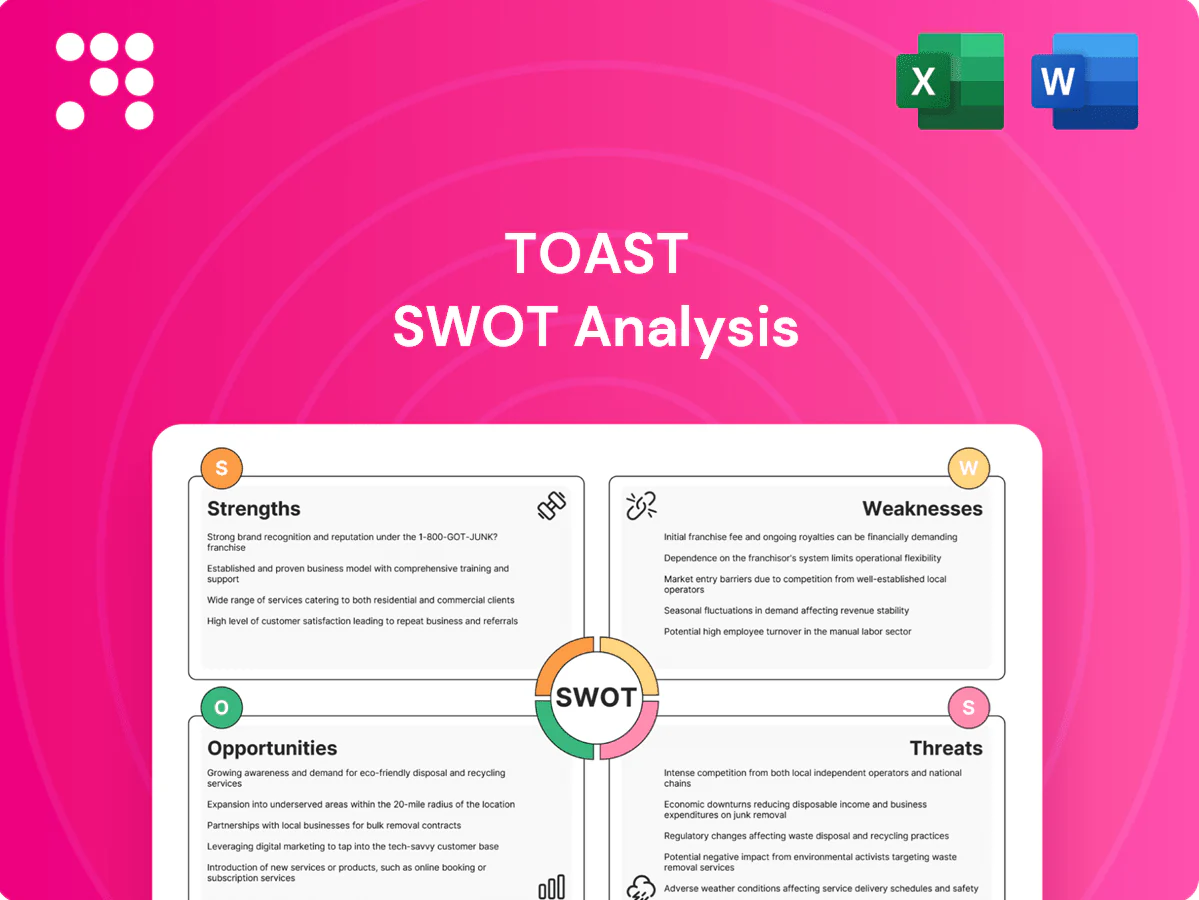
Toast SWOT Analysis

Go Beyond the Preview—Access the Full Strategic Report
Discover how Toast’s integrated restaurant POS, payments, and software ecosystem drives strong customer retention and recurring revenue, while competitive pressures and margin risks warrant close attention. Our brief highlights core strengths, market threats, and strategic opportunities but only scratches the surface. Purchase the full SWOT analysis for a research-backed, editable report and Excel matrix to support investor decisions, strategy, or pitch decks.
Strengths

All-in-one restaurant platform
Toast’s all-in-one platform—unified POS, front- and back-of-house, and digital ordering—cuts vendor sprawl and integration friction, while a single data layer improves visibility across operations and guest touchpoints; serving over 70,000 restaurant customers, this breadth increases stickiness and cross-sell potential and simplifies training and support for multi-location operators.
Vertical specialization
Vertical specialization lets Toast tailor workflows, menus, modifiers and kitchen flows specifically for restaurants, serving tens of thousands of restaurant customers and reflecting its restaurant-first product roadmap since the 2021 IPO. Purpose-built features consistently outperform horizontal POS tools during peak service, and industry-specific roadmaps resonate with operators, driving strong word-of-mouth across the restaurant community.

Integrated payments and fintech
Embedded payments streamline checkout, reconciliation, and cash flow within Toasts platform, supporting its scale alongside 2023 revenue of $2.09 billion. Fintech add-ons like payroll, tips, and working capital raise ARPU by embedding recurring, mission-critical services. Payments data feeds advanced risk and pricing models, and this tight integration reduces churn by locking in core restaurant operations.

Data and analytics
Toast centralizes transaction, labor, and menu data so operators optimize pricing, staffing, and menu engineering from one source; as of 2024 Toast serves roughly 77,000 restaurants and reports >$100B annualized payment volume, enabling peer benchmarking that surfaces best practices. Analytics elevate Toast from a POS tool to a decision platform driving measurable margin and labor gains.
- Centralized data
- 77,000 customers (2024)
- >$100B payment volume (2024)
- Benchmark-driven insights
Scalable for diverse formats
Toast's platform supports quick-service, full-service, cafes, bars and multi-unit franchises, enabling configuration across venue types. Modular packaging lets operators deploy right-sized hardware and software stacks from single sites to chain rollouts, while cloud-native architecture simplifies updates and remote management. Scalability broadens Toast's addressable market and enhances customer lifetime value.
- Supports diverse venue types
- Modular deployments for right-sized rollouts
- Cloud updates and remote management
- Expands TAM and LTV
Restaurant platform 77,000 >$100B $2.09B
Toast’s unified restaurant-first platform (POS, payments, payroll, ordering) increases stickiness and cross-sell, serving ~77,000 restaurants (2024) and processing >$100B annualized payment volume. Embedded payments and fintech add-ons lifted 2023 revenue to $2.09B, boosting ARPU and reducing churn. Cloud-native, modular deployments scale from single sites to multi-unit chains, expanding TAM and LTV.
| Metric | Value |
|---|---|
| Customers (2024) | ~77,000 |
| Payment volume (annualized) | >$100B |
| Revenue (2023) | $2.09B |
What is included in the product
 Detailed Word Document
Analyzes Toast’s competitive position by outlining its strengths, weaknesses, opportunities, and threats, offering a clear framework to assess the company’s market advantages, operational gaps, and growth risks.

 Customizable Excel Spreadsheet
Delivers a concise Toast SWOT matrix that pinpoints operational pain points and accelerates remediation planning for restaurants.
Weaknesses

SMB churn exposure
Many Toast customers are small restaurants, a segment where SBA data shows roughly 20% of firms fail in year one and about 50% by year five, exposing Toast to higher churn; Toast historically reported a 121% net revenue retention (S-1, 2021), but volatile SMB churn can offset new-logo growth, squeeze net retention and force higher sales and onboarding spend to backfill lost accounts.
Implementation complexity
Menu builds, hardware installs and staff training for Toast can be intensive, even for the platform used by over 74,000 restaurant customers; typical rollouts take 4–8 weeks. Go-live timelines can strain lean operator teams, increasing support tickets and error rates. Complex rollouts raise the risk of operator dissatisfaction, which can delay revenue recognition and reduce word‑of‑mouth referrals.

Hardware dependency
Reliance on terminals, printers, and kiosks increases capital and technical support costs for Toast, tying revenue growth to physical device deployment. Supply-chain disruptions have historically delayed rollouts and can extend time-to-revenue for new customers. Hardware failures during peak service hours cause immediate revenue loss and reputational risk. Regular replacement cycles compress gross margins through ongoing capex and service expenses.

Margin pressure from payments
Toast’s revenue mix tied to payment processing faces competitive compression as merchant incentives and partner buy-rates increasingly erode per-transaction margin. Heavy incentiveing can turn positive gross dollar volume into low or negative unit economics. A Durbin-style debit cap (about $0.21 + 0.05% per transaction in the US) would materially amplify pressure on processing revenue. Sustained profitability requires disciplined pricing and tight risk controls.
- Processing-dependent revenue vulnerable to buy-rate compression
- Incentives can flip margins negative on thin-ticket transactions
- Durbin cap (~$0.21 + 0.05%) would further reduce debit economics
- Profitability hinges on pricing discipline and credit/risk controls
Feature parity arms race
Rivals rapidly replicate popular Toast features, forcing continuous investment to stay differentiated; Toast’s expanding product roadmap has required rising R&D intensity as competition from Square, Lightspeed and Clover narrows gaps.
Fragmented operator needs across independent restaurants versus chains make prioritization difficult, and slow rollout of parity features risks eroding Toast’s perceived leadership and platform pricing power.
- Competitors: Square, Lightspeed, Clover
- Risk: higher R&D spend to defend differentiation
- Issue: fragmented customer needs complicate prioritization
- Consequence: slow gaps erode perceived leadership
SMB churn, 4–8 week rollouts and processing margin squeeze threaten payments economics
High SMB exposure (SBA: ~20% fail Y1, ~50% by Y5) drives churn risk despite 121% NRR (S-1, 2021); complex 4–8 week rollouts and hardware reliance raise support, capex and time‑to‑revenue. Processing margins face buy‑rate pressure and a Durbin‑style cap (~$0.21 + 0.05%) would materially cut economics; rivals (Square, Lightspeed, Clover) force rising R&D spend.
| Metric | Value |
|---|---|
| Customers | ~74,000 (S-1, 2021) |
| Net revenue retention | 121% (2021) |
| SMB failure | ~20% Y1, ~50% Y5 (SBA) |
| Rollout time | 4–8 weeks |
| Durbin-like cap | ~$0.21 + 0.05% |
Same Document Delivered
Toast SWOT Analysis
This is the actual Toast SWOT Analysis document you’ll receive upon purchase—no surprises, just professional quality. The preview below is taken directly from the full SWOT report; buy now to unlock the complete, editable version. You’re viewing a live excerpt of the final file, ready to download after checkout.

Go Beyond the Preview—Access the Full Strategic Report
Discover how Toast’s integrated restaurant POS, payments, and software ecosystem drives strong customer retention and recurring revenue, while competitive pressures and margin risks warrant close attention. Our brief highlights core strengths, market threats, and strategic opportunities but only scratches the surface. Purchase the full SWOT analysis for a research-backed, editable report and Excel matrix to support investor decisions, strategy, or pitch decks.
Strengths
All-in-one restaurant platform
Toast’s all-in-one platform—unified POS, front- and back-of-house, and digital ordering—cuts vendor sprawl and integration friction, while a single data layer improves visibility across operations and guest touchpoints; serving over 70,000 restaurant customers, this breadth increases stickiness and cross-sell potential and simplifies training and support for multi-location operators.
Vertical specialization
Vertical specialization lets Toast tailor workflows, menus, modifiers and kitchen flows specifically for restaurants, serving tens of thousands of restaurant customers and reflecting its restaurant-first product roadmap since the 2021 IPO. Purpose-built features consistently outperform horizontal POS tools during peak service, and industry-specific roadmaps resonate with operators, driving strong word-of-mouth across the restaurant community.
Integrated payments and fintech
Embedded payments streamline checkout, reconciliation, and cash flow within Toasts platform, supporting its scale alongside 2023 revenue of $2.09 billion. Fintech add-ons like payroll, tips, and working capital raise ARPU by embedding recurring, mission-critical services. Payments data feeds advanced risk and pricing models, and this tight integration reduces churn by locking in core restaurant operations.
Data and analytics
Toast centralizes transaction, labor, and menu data so operators optimize pricing, staffing, and menu engineering from one source; as of 2024 Toast serves roughly 77,000 restaurants and reports >$100B annualized payment volume, enabling peer benchmarking that surfaces best practices. Analytics elevate Toast from a POS tool to a decision platform driving measurable margin and labor gains.
- Centralized data
- 77,000 customers (2024)
- >$100B payment volume (2024)
- Benchmark-driven insights
Scalable for diverse formats
Toast's platform supports quick-service, full-service, cafes, bars and multi-unit franchises, enabling configuration across venue types. Modular packaging lets operators deploy right-sized hardware and software stacks from single sites to chain rollouts, while cloud-native architecture simplifies updates and remote management. Scalability broadens Toast's addressable market and enhances customer lifetime value.
- Supports diverse venue types
- Modular deployments for right-sized rollouts
- Cloud updates and remote management
- Expands TAM and LTV
Restaurant platform 77,000 >$100B $2.09B
Toast’s unified restaurant-first platform (POS, payments, payroll, ordering) increases stickiness and cross-sell, serving ~77,000 restaurants (2024) and processing >$100B annualized payment volume. Embedded payments and fintech add-ons lifted 2023 revenue to $2.09B, boosting ARPU and reducing churn. Cloud-native, modular deployments scale from single sites to multi-unit chains, expanding TAM and LTV.
| Metric | Value |
|---|---|
| Customers (2024) | ~77,000 |
| Payment volume (annualized) | >$100B |
| Revenue (2023) | $2.09B |
What is included in the product
Detailed Word Document
Analyzes Toast’s competitive position by outlining its strengths, weaknesses, opportunities, and threats, offering a clear framework to assess the company’s market advantages, operational gaps, and growth risks.
Customizable Excel Spreadsheet
Delivers a concise Toast SWOT matrix that pinpoints operational pain points and accelerates remediation planning for restaurants.
Weaknesses
SMB churn exposure
Many Toast customers are small restaurants, a segment where SBA data shows roughly 20% of firms fail in year one and about 50% by year five, exposing Toast to higher churn; Toast historically reported a 121% net revenue retention (S-1, 2021), but volatile SMB churn can offset new-logo growth, squeeze net retention and force higher sales and onboarding spend to backfill lost accounts.
Implementation complexity
Menu builds, hardware installs and staff training for Toast can be intensive, even for the platform used by over 74,000 restaurant customers; typical rollouts take 4–8 weeks. Go-live timelines can strain lean operator teams, increasing support tickets and error rates. Complex rollouts raise the risk of operator dissatisfaction, which can delay revenue recognition and reduce word‑of‑mouth referrals.
Hardware dependency
Reliance on terminals, printers, and kiosks increases capital and technical support costs for Toast, tying revenue growth to physical device deployment. Supply-chain disruptions have historically delayed rollouts and can extend time-to-revenue for new customers. Hardware failures during peak service hours cause immediate revenue loss and reputational risk. Regular replacement cycles compress gross margins through ongoing capex and service expenses.
Margin pressure from payments
Toast’s revenue mix tied to payment processing faces competitive compression as merchant incentives and partner buy-rates increasingly erode per-transaction margin. Heavy incentiveing can turn positive gross dollar volume into low or negative unit economics. A Durbin-style debit cap (about $0.21 + 0.05% per transaction in the US) would materially amplify pressure on processing revenue. Sustained profitability requires disciplined pricing and tight risk controls.
- Processing-dependent revenue vulnerable to buy-rate compression
- Incentives can flip margins negative on thin-ticket transactions
- Durbin cap (~$0.21 + 0.05%) would further reduce debit economics
- Profitability hinges on pricing discipline and credit/risk controls
Feature parity arms race
Rivals rapidly replicate popular Toast features, forcing continuous investment to stay differentiated; Toast’s expanding product roadmap has required rising R&D intensity as competition from Square, Lightspeed and Clover narrows gaps.
Fragmented operator needs across independent restaurants versus chains make prioritization difficult, and slow rollout of parity features risks eroding Toast’s perceived leadership and platform pricing power.
- Competitors: Square, Lightspeed, Clover
- Risk: higher R&D spend to defend differentiation
- Issue: fragmented customer needs complicate prioritization
- Consequence: slow gaps erode perceived leadership
SMB churn, 4–8 week rollouts and processing margin squeeze threaten payments economics
High SMB exposure (SBA: ~20% fail Y1, ~50% by Y5) drives churn risk despite 121% NRR (S-1, 2021); complex 4–8 week rollouts and hardware reliance raise support, capex and time‑to‑revenue. Processing margins face buy‑rate pressure and a Durbin‑style cap (~$0.21 + 0.05%) would materially cut economics; rivals (Square, Lightspeed, Clover) force rising R&D spend.
| Metric | Value |
|---|---|
| Customers | ~74,000 (S-1, 2021) |
| Net revenue retention | 121% (2021) |
| SMB failure | ~20% Y1, ~50% Y5 (SBA) |
| Rollout time | 4–8 weeks |
| Durbin-like cap | ~$0.21 + 0.05% |
Same Document Delivered
Toast SWOT Analysis
This is the actual Toast SWOT Analysis document you’ll receive upon purchase—no surprises, just professional quality. The preview below is taken directly from the full SWOT report; buy now to unlock the complete, editable version. You’re viewing a live excerpt of the final file, ready to download after checkout.
Original: $10.00
-65%$10.00
$3.50Description
Go Beyond the Preview—Access the Full Strategic Report
Discover how Toast’s integrated restaurant POS, payments, and software ecosystem drives strong customer retention and recurring revenue, while competitive pressures and margin risks warrant close attention. Our brief highlights core strengths, market threats, and strategic opportunities but only scratches the surface. Purchase the full SWOT analysis for a research-backed, editable report and Excel matrix to support investor decisions, strategy, or pitch decks.
Strengths
All-in-one restaurant platform
Toast’s all-in-one platform—unified POS, front- and back-of-house, and digital ordering—cuts vendor sprawl and integration friction, while a single data layer improves visibility across operations and guest touchpoints; serving over 70,000 restaurant customers, this breadth increases stickiness and cross-sell potential and simplifies training and support for multi-location operators.
Vertical specialization
Vertical specialization lets Toast tailor workflows, menus, modifiers and kitchen flows specifically for restaurants, serving tens of thousands of restaurant customers and reflecting its restaurant-first product roadmap since the 2021 IPO. Purpose-built features consistently outperform horizontal POS tools during peak service, and industry-specific roadmaps resonate with operators, driving strong word-of-mouth across the restaurant community.
Integrated payments and fintech
Embedded payments streamline checkout, reconciliation, and cash flow within Toasts platform, supporting its scale alongside 2023 revenue of $2.09 billion. Fintech add-ons like payroll, tips, and working capital raise ARPU by embedding recurring, mission-critical services. Payments data feeds advanced risk and pricing models, and this tight integration reduces churn by locking in core restaurant operations.
Data and analytics
Toast centralizes transaction, labor, and menu data so operators optimize pricing, staffing, and menu engineering from one source; as of 2024 Toast serves roughly 77,000 restaurants and reports >$100B annualized payment volume, enabling peer benchmarking that surfaces best practices. Analytics elevate Toast from a POS tool to a decision platform driving measurable margin and labor gains.
- Centralized data
- 77,000 customers (2024)
- >$100B payment volume (2024)
- Benchmark-driven insights
Scalable for diverse formats
Toast's platform supports quick-service, full-service, cafes, bars and multi-unit franchises, enabling configuration across venue types. Modular packaging lets operators deploy right-sized hardware and software stacks from single sites to chain rollouts, while cloud-native architecture simplifies updates and remote management. Scalability broadens Toast's addressable market and enhances customer lifetime value.
- Supports diverse venue types
- Modular deployments for right-sized rollouts
- Cloud updates and remote management
- Expands TAM and LTV
Restaurant platform 77,000 >$100B $2.09B
Toast’s unified restaurant-first platform (POS, payments, payroll, ordering) increases stickiness and cross-sell, serving ~77,000 restaurants (2024) and processing >$100B annualized payment volume. Embedded payments and fintech add-ons lifted 2023 revenue to $2.09B, boosting ARPU and reducing churn. Cloud-native, modular deployments scale from single sites to multi-unit chains, expanding TAM and LTV.
| Metric | Value |
|---|---|
| Customers (2024) | ~77,000 |
| Payment volume (annualized) | >$100B |
| Revenue (2023) | $2.09B |
What is included in the product
Detailed Word Document
Analyzes Toast’s competitive position by outlining its strengths, weaknesses, opportunities, and threats, offering a clear framework to assess the company’s market advantages, operational gaps, and growth risks.
Customizable Excel Spreadsheet
Delivers a concise Toast SWOT matrix that pinpoints operational pain points and accelerates remediation planning for restaurants.
Weaknesses
SMB churn exposure
Many Toast customers are small restaurants, a segment where SBA data shows roughly 20% of firms fail in year one and about 50% by year five, exposing Toast to higher churn; Toast historically reported a 121% net revenue retention (S-1, 2021), but volatile SMB churn can offset new-logo growth, squeeze net retention and force higher sales and onboarding spend to backfill lost accounts.
Implementation complexity
Menu builds, hardware installs and staff training for Toast can be intensive, even for the platform used by over 74,000 restaurant customers; typical rollouts take 4–8 weeks. Go-live timelines can strain lean operator teams, increasing support tickets and error rates. Complex rollouts raise the risk of operator dissatisfaction, which can delay revenue recognition and reduce word‑of‑mouth referrals.
Hardware dependency
Reliance on terminals, printers, and kiosks increases capital and technical support costs for Toast, tying revenue growth to physical device deployment. Supply-chain disruptions have historically delayed rollouts and can extend time-to-revenue for new customers. Hardware failures during peak service hours cause immediate revenue loss and reputational risk. Regular replacement cycles compress gross margins through ongoing capex and service expenses.
Margin pressure from payments
Toast’s revenue mix tied to payment processing faces competitive compression as merchant incentives and partner buy-rates increasingly erode per-transaction margin. Heavy incentiveing can turn positive gross dollar volume into low or negative unit economics. A Durbin-style debit cap (about $0.21 + 0.05% per transaction in the US) would materially amplify pressure on processing revenue. Sustained profitability requires disciplined pricing and tight risk controls.
- Processing-dependent revenue vulnerable to buy-rate compression
- Incentives can flip margins negative on thin-ticket transactions
- Durbin cap (~$0.21 + 0.05%) would further reduce debit economics
- Profitability hinges on pricing discipline and credit/risk controls
Feature parity arms race
Rivals rapidly replicate popular Toast features, forcing continuous investment to stay differentiated; Toast’s expanding product roadmap has required rising R&D intensity as competition from Square, Lightspeed and Clover narrows gaps.
Fragmented operator needs across independent restaurants versus chains make prioritization difficult, and slow rollout of parity features risks eroding Toast’s perceived leadership and platform pricing power.
- Competitors: Square, Lightspeed, Clover
- Risk: higher R&D spend to defend differentiation
- Issue: fragmented customer needs complicate prioritization
- Consequence: slow gaps erode perceived leadership
SMB churn, 4–8 week rollouts and processing margin squeeze threaten payments economics
High SMB exposure (SBA: ~20% fail Y1, ~50% by Y5) drives churn risk despite 121% NRR (S-1, 2021); complex 4–8 week rollouts and hardware reliance raise support, capex and time‑to‑revenue. Processing margins face buy‑rate pressure and a Durbin‑style cap (~$0.21 + 0.05%) would materially cut economics; rivals (Square, Lightspeed, Clover) force rising R&D spend.
| Metric | Value |
|---|---|
| Customers | ~74,000 (S-1, 2021) |
| Net revenue retention | 121% (2021) |
| SMB failure | ~20% Y1, ~50% Y5 (SBA) |
| Rollout time | 4–8 weeks |
| Durbin-like cap | ~$0.21 + 0.05% |
Same Document Delivered
Toast SWOT Analysis
This is the actual Toast SWOT Analysis document you’ll receive upon purchase—no surprises, just professional quality. The preview below is taken directly from the full SWOT report; buy now to unlock the complete, editable version. You’re viewing a live excerpt of the final file, ready to download after checkout.











