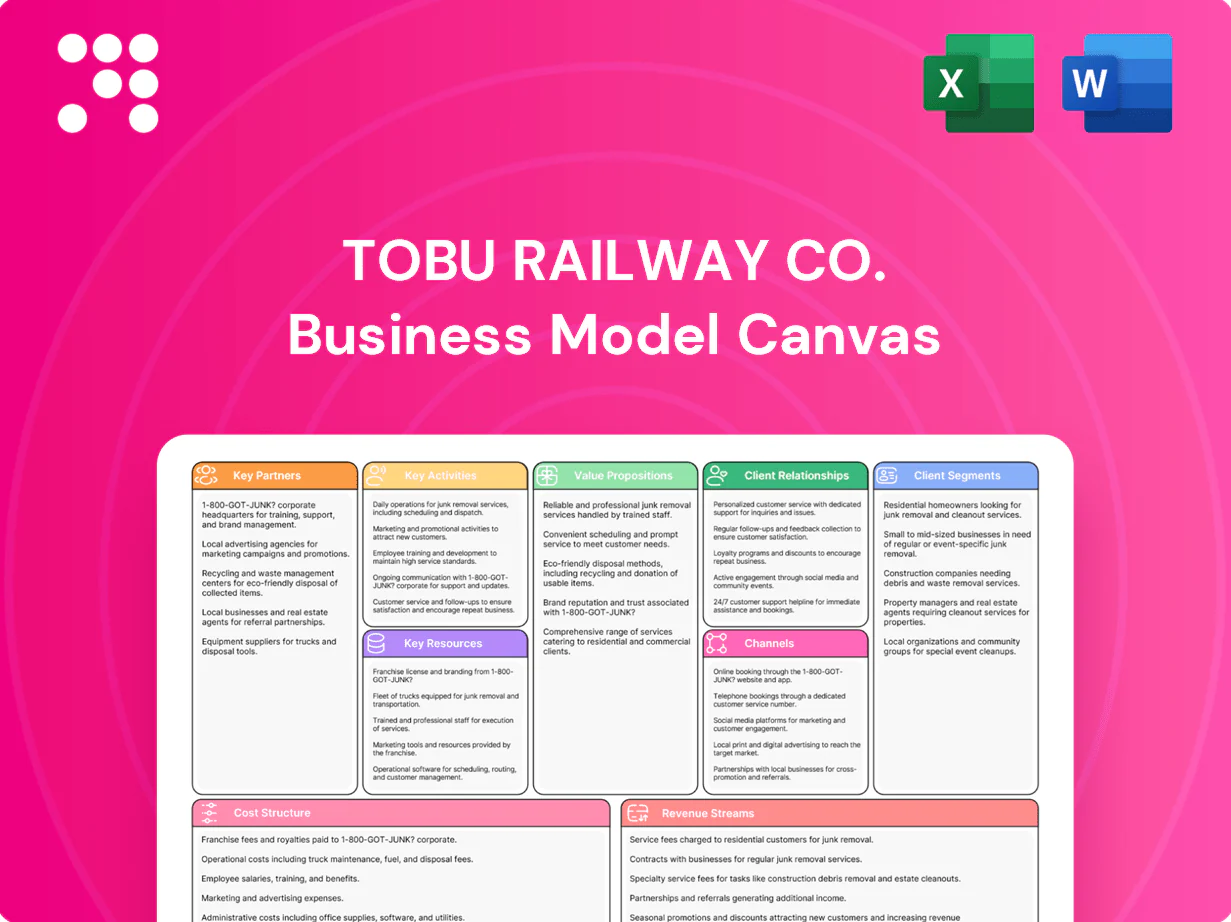
Tobu Railway Co. Business Model Canvas

Railway group's Business Model Canvas: transport, real estate and leisure value drivers
Unlock Tobu Railway Co.’s strategic blueprint with a concise Business Model Canvas that reveals how the company creates value across transport, real estate and leisure. See how it secures diverse revenue streams and leverages partnerships to scale. Ideal for investors and strategists—purchase the full Word/Excel Canvas to dive deeper.
Partnerships

Municipal & transit agencies
Collaboration with the Tokyo Metropolitan Government and local municipalities aligns Tobu Railway timetables, infrastructure upgrades and urban redevelopment across a metropolitan area of about 14 million residents. Joint planning enables integrated transport policies and measurable congestion relief on key corridors during peak hours. Access to public subsidies and streamlined permitting accelerates capital projects and station redevelopments. Disaster preparedness and safety standards are co-developed to boost network resilience.
Rolling stock & tech suppliers
Ties with manufacturers (Hitachi, Kawasaki Heavy Industries, Nippon Sharyo) and signaling/IoT vendors secure reliable fleets across Tobu's ~463.3 km network, while long-term maintenance contracts (often 10+ years) stabilize lifecycle costs. Co-innovation on energy efficiency and automation has cut energy use per train-km in pilot projects, and cybersecurity/data platforms are jointly maintained with vendors for compliant, resilient operations.

Real estate & construction partners
Developers, contractors and J-REITs co-invest in Tobu station-area mixed-use projects, leveraging Japan's J-REIT market cap of about ¥20 trillion in 2024 to scale investments. Design-build firms deliver transit-oriented developments on schedule, reducing time-to-market and cost overruns. Property managers optimize occupancy and tenant mix to sustain rental yields amid a Tokyo office vacancy near 3.5% in 2024, while financial partners recycle capital via asset sales and joint ventures.

Tourism & hospitality alliances
Partnerships with local governments, DMO/JNTO and hotel and theme-park operators enable bundled travel products and joint promotions that lift ridership on Tobu lines; JNTO reported 31.88 million inbound visitors in 2023, supporting demand recovery. Logistics partners handle luggage and last‑mile transfers, while cultural venues and event organizers enrich destination appeal and lengthen stays.
- Local governments: coordinated routes and subsidies
- DMO/JNTO: 31.88 million inbound tourists (2023) for joint marketing
- Theme parks & hotels: package deals, cross-promo
- Logistics & last-mile: luggage transfer, shuttle integration
- Cultural venues: events driving off-peak demand
Retailers & payment ecosystems
Convenience chains, mall tenants and 120+ F&B brands in Tobu stations drive non-fare revenue through rent and sales commissions, while digital wallet and IC card providers (Suica/TOICA etc.) enable seamless tap-and-go payments and boost transaction value; media partners monetize high-traffic advertising inventory and loyalty networks extend reach and enrich customer data for targeted offers.
- Non-fare anchors: retail, F&B, malls
- Payments: IC cards & digital wallets
- Media: in-station ad monetization
- Loyalty: expanded reach & richer data
Coordinated metro partnerships streamline peak flow across ~14M area
Tobu partners with metropolitan/local governments for coordinated timetables, subsidies and station redevelopments across a ~14M metro area, improving peak corridor flow; manufacturers and signaling vendors secure fleets on a ~463.3 km network with long-term maintenance contracts; developers/J-REITs co-invest in TODs (J-REIT market ≈ ¥20T in 2024) while retail, payments and media partners drive non-fare revenue.
| Partner | Role | 2024 metric |
|---|---|---|
| Local govt | Coordination/subsidies | Population ≈14M |
| Manufacturers | Fleets/maintenance | Network 463.3 km |
| Developers/J-REITs | TOD financing | J-REIT ≈ ¥20T |
What is included in the product
 Detailed Word Document
A comprehensive, pre-written Business Model Canvas for Tobu Railway Co. mapping its nine blocks—customer segments, value propositions, channels, customer relationships, revenue streams, key resources, key activities, key partners, and cost structure—reflecting real-world rail, retail, and real-estate operations. Ideal for presentations and investor discussions, it includes strategic insights, competitive advantages and linked SWOT analysis to support decision-making.

 Customizable Excel Spreadsheet
High-level view of Tobu Railway Co.'s business model with editable cells, relieving the pain of scattered strategic details by condensing operations, revenue streams and partnerships into one shareable, boardroom-ready snapshot.
Activities

Rail operations & safety
Daily scheduling, signaling, and fleet management deliver punctual service across Tobu Railway’s 463.3 km network, sustaining on-time performance above 99%. Safety inspections and mandatory driver training reduce incidents and meet regulatory standards. Capacity planning balances peak urban demand on key commuter corridors. Emergency response protocols enable rapid recovery and service restoration.
Network maintenance & expansion
Track, catenary, and station maintenance preserve asset life across Tobu Railway's 463.3 km network (2024), reducing lifecycle costs and safety risk. Capital projects add passing tracks, platform doors, and accessibility upgrades to boost capacity and compliance. Electrification and energy-efficiency upgrades lower emissions, while data-driven work windows minimize service disruption and lost revenue.

Real estate development
Real estate development around Tobu Railway’s 463.3 km network focuses on planning and executing station-area housing, offices and retail to boost land value and ridership.
Tenant acquisition and active lease management aim to optimize NOI through mix and yield management, with periodic asset recycling used to fund new projects.
Structured community engagement programs secure local approvals and align developments with transit demand.

Tourism product management
Designing rail passes, hotel packages and attraction bundles raises spend per visitor and supports Tobu Railway’s tourism focus across its 463.3 km network serving Nikko and Kinugawa; Nikko Toshogu attracts about 2 million visitors annually. Seasonal events smooth demand, while partnerships coordinate reservations and inventory and service quality is monitored across touchpoints.
- rail-passes
- hotel-packages
- attraction-bundles
- seasonal-events
- partner-reservations
- service-quality
Digital & customer analytics
Tobu uses mobile app, e-commerce and IC card telemetry to refine pricing and timetables, enabling personalization that boosts marketing ROI and targeted offers; predictive maintenance driven by sensor analytics cut unscheduled downtime and improved fleet availability in 2024. Feedback loops from in-app surveys and transaction data drive continuous timetable and service optimizations.
- IC card telemetry: 2024 national IC card base ~70 million
- Personalization: higher conversion and ROI
- Predictive maintenance: fewer service disruptions
- Feedback loops: ongoing service refinement
463.3 km, >99% on-time, 2M Nikko tourists, IC telemetry
Daily operations, safety inspections and capacity planning keep Tobu’s 463.3 km network running with on-time performance above 99%. Asset maintenance, capital upgrades and electrification preserve service and accessibility. Station-area real estate and tourism packages (Nikko Toshogu ~2M annual visitors) boost ridership and non-fare revenue; IC card telemetry (national base ~70M) enables targeted offers.
| Activity | Metric | 2024 |
|---|---|---|
| Network length | km | 463.3 |
| On-time rate | % | >99 |
| Nikko visitors | annual | ~2,000,000 |
| IC card base | users (national) | ~70,000,000 |
Delivered as Displayed
Business Model Canvas
The Tobu Railway Co. Business Model Canvas shown here is the authentic deliverable, not a mockup. When you purchase, you’ll receive this exact document—fully formatted and complete—with all content ready to edit and present. Files are provided in Word and Excel for immediate use.

Railway group's Business Model Canvas: transport, real estate and leisure value drivers
Unlock Tobu Railway Co.’s strategic blueprint with a concise Business Model Canvas that reveals how the company creates value across transport, real estate and leisure. See how it secures diverse revenue streams and leverages partnerships to scale. Ideal for investors and strategists—purchase the full Word/Excel Canvas to dive deeper.
Partnerships
Municipal & transit agencies
Collaboration with the Tokyo Metropolitan Government and local municipalities aligns Tobu Railway timetables, infrastructure upgrades and urban redevelopment across a metropolitan area of about 14 million residents. Joint planning enables integrated transport policies and measurable congestion relief on key corridors during peak hours. Access to public subsidies and streamlined permitting accelerates capital projects and station redevelopments. Disaster preparedness and safety standards are co-developed to boost network resilience.
Rolling stock & tech suppliers
Ties with manufacturers (Hitachi, Kawasaki Heavy Industries, Nippon Sharyo) and signaling/IoT vendors secure reliable fleets across Tobu's ~463.3 km network, while long-term maintenance contracts (often 10+ years) stabilize lifecycle costs. Co-innovation on energy efficiency and automation has cut energy use per train-km in pilot projects, and cybersecurity/data platforms are jointly maintained with vendors for compliant, resilient operations.
Real estate & construction partners
Developers, contractors and J-REITs co-invest in Tobu station-area mixed-use projects, leveraging Japan's J-REIT market cap of about ¥20 trillion in 2024 to scale investments. Design-build firms deliver transit-oriented developments on schedule, reducing time-to-market and cost overruns. Property managers optimize occupancy and tenant mix to sustain rental yields amid a Tokyo office vacancy near 3.5% in 2024, while financial partners recycle capital via asset sales and joint ventures.
Tourism & hospitality alliances
Partnerships with local governments, DMO/JNTO and hotel and theme-park operators enable bundled travel products and joint promotions that lift ridership on Tobu lines; JNTO reported 31.88 million inbound visitors in 2023, supporting demand recovery. Logistics partners handle luggage and last‑mile transfers, while cultural venues and event organizers enrich destination appeal and lengthen stays.
- Local governments: coordinated routes and subsidies
- DMO/JNTO: 31.88 million inbound tourists (2023) for joint marketing
- Theme parks & hotels: package deals, cross-promo
- Logistics & last-mile: luggage transfer, shuttle integration
- Cultural venues: events driving off-peak demand
Retailers & payment ecosystems
Convenience chains, mall tenants and 120+ F&B brands in Tobu stations drive non-fare revenue through rent and sales commissions, while digital wallet and IC card providers (Suica/TOICA etc.) enable seamless tap-and-go payments and boost transaction value; media partners monetize high-traffic advertising inventory and loyalty networks extend reach and enrich customer data for targeted offers.
- Non-fare anchors: retail, F&B, malls
- Payments: IC cards & digital wallets
- Media: in-station ad monetization
- Loyalty: expanded reach & richer data
Coordinated metro partnerships streamline peak flow across ~14M area
Tobu partners with metropolitan/local governments for coordinated timetables, subsidies and station redevelopments across a ~14M metro area, improving peak corridor flow; manufacturers and signaling vendors secure fleets on a ~463.3 km network with long-term maintenance contracts; developers/J-REITs co-invest in TODs (J-REIT market ≈ ¥20T in 2024) while retail, payments and media partners drive non-fare revenue.
| Partner | Role | 2024 metric |
|---|---|---|
| Local govt | Coordination/subsidies | Population ≈14M |
| Manufacturers | Fleets/maintenance | Network 463.3 km |
| Developers/J-REITs | TOD financing | J-REIT ≈ ¥20T |
What is included in the product
Detailed Word Document
A comprehensive, pre-written Business Model Canvas for Tobu Railway Co. mapping its nine blocks—customer segments, value propositions, channels, customer relationships, revenue streams, key resources, key activities, key partners, and cost structure—reflecting real-world rail, retail, and real-estate operations. Ideal for presentations and investor discussions, it includes strategic insights, competitive advantages and linked SWOT analysis to support decision-making.
Customizable Excel Spreadsheet
High-level view of Tobu Railway Co.'s business model with editable cells, relieving the pain of scattered strategic details by condensing operations, revenue streams and partnerships into one shareable, boardroom-ready snapshot.
Activities
Rail operations & safety
Daily scheduling, signaling, and fleet management deliver punctual service across Tobu Railway’s 463.3 km network, sustaining on-time performance above 99%. Safety inspections and mandatory driver training reduce incidents and meet regulatory standards. Capacity planning balances peak urban demand on key commuter corridors. Emergency response protocols enable rapid recovery and service restoration.
Network maintenance & expansion
Track, catenary, and station maintenance preserve asset life across Tobu Railway's 463.3 km network (2024), reducing lifecycle costs and safety risk. Capital projects add passing tracks, platform doors, and accessibility upgrades to boost capacity and compliance. Electrification and energy-efficiency upgrades lower emissions, while data-driven work windows minimize service disruption and lost revenue.
Real estate development
Real estate development around Tobu Railway’s 463.3 km network focuses on planning and executing station-area housing, offices and retail to boost land value and ridership.
Tenant acquisition and active lease management aim to optimize NOI through mix and yield management, with periodic asset recycling used to fund new projects.
Structured community engagement programs secure local approvals and align developments with transit demand.
Tourism product management
Designing rail passes, hotel packages and attraction bundles raises spend per visitor and supports Tobu Railway’s tourism focus across its 463.3 km network serving Nikko and Kinugawa; Nikko Toshogu attracts about 2 million visitors annually. Seasonal events smooth demand, while partnerships coordinate reservations and inventory and service quality is monitored across touchpoints.
- rail-passes
- hotel-packages
- attraction-bundles
- seasonal-events
- partner-reservations
- service-quality
Digital & customer analytics
Tobu uses mobile app, e-commerce and IC card telemetry to refine pricing and timetables, enabling personalization that boosts marketing ROI and targeted offers; predictive maintenance driven by sensor analytics cut unscheduled downtime and improved fleet availability in 2024. Feedback loops from in-app surveys and transaction data drive continuous timetable and service optimizations.
- IC card telemetry: 2024 national IC card base ~70 million
- Personalization: higher conversion and ROI
- Predictive maintenance: fewer service disruptions
- Feedback loops: ongoing service refinement
463.3 km, >99% on-time, 2M Nikko tourists, IC telemetry
Daily operations, safety inspections and capacity planning keep Tobu’s 463.3 km network running with on-time performance above 99%. Asset maintenance, capital upgrades and electrification preserve service and accessibility. Station-area real estate and tourism packages (Nikko Toshogu ~2M annual visitors) boost ridership and non-fare revenue; IC card telemetry (national base ~70M) enables targeted offers.
| Activity | Metric | 2024 |
|---|---|---|
| Network length | km | 463.3 |
| On-time rate | % | >99 |
| Nikko visitors | annual | ~2,000,000 |
| IC card base | users (national) | ~70,000,000 |
Delivered as Displayed
Business Model Canvas
The Tobu Railway Co. Business Model Canvas shown here is the authentic deliverable, not a mockup. When you purchase, you’ll receive this exact document—fully formatted and complete—with all content ready to edit and present. Files are provided in Word and Excel for immediate use.
Original: $10.00
-65%$10.00
$3.50Description
Railway group's Business Model Canvas: transport, real estate and leisure value drivers
Unlock Tobu Railway Co.’s strategic blueprint with a concise Business Model Canvas that reveals how the company creates value across transport, real estate and leisure. See how it secures diverse revenue streams and leverages partnerships to scale. Ideal for investors and strategists—purchase the full Word/Excel Canvas to dive deeper.
Partnerships
Municipal & transit agencies
Collaboration with the Tokyo Metropolitan Government and local municipalities aligns Tobu Railway timetables, infrastructure upgrades and urban redevelopment across a metropolitan area of about 14 million residents. Joint planning enables integrated transport policies and measurable congestion relief on key corridors during peak hours. Access to public subsidies and streamlined permitting accelerates capital projects and station redevelopments. Disaster preparedness and safety standards are co-developed to boost network resilience.
Rolling stock & tech suppliers
Ties with manufacturers (Hitachi, Kawasaki Heavy Industries, Nippon Sharyo) and signaling/IoT vendors secure reliable fleets across Tobu's ~463.3 km network, while long-term maintenance contracts (often 10+ years) stabilize lifecycle costs. Co-innovation on energy efficiency and automation has cut energy use per train-km in pilot projects, and cybersecurity/data platforms are jointly maintained with vendors for compliant, resilient operations.
Real estate & construction partners
Developers, contractors and J-REITs co-invest in Tobu station-area mixed-use projects, leveraging Japan's J-REIT market cap of about ¥20 trillion in 2024 to scale investments. Design-build firms deliver transit-oriented developments on schedule, reducing time-to-market and cost overruns. Property managers optimize occupancy and tenant mix to sustain rental yields amid a Tokyo office vacancy near 3.5% in 2024, while financial partners recycle capital via asset sales and joint ventures.
Tourism & hospitality alliances
Partnerships with local governments, DMO/JNTO and hotel and theme-park operators enable bundled travel products and joint promotions that lift ridership on Tobu lines; JNTO reported 31.88 million inbound visitors in 2023, supporting demand recovery. Logistics partners handle luggage and last‑mile transfers, while cultural venues and event organizers enrich destination appeal and lengthen stays.
- Local governments: coordinated routes and subsidies
- DMO/JNTO: 31.88 million inbound tourists (2023) for joint marketing
- Theme parks & hotels: package deals, cross-promo
- Logistics & last-mile: luggage transfer, shuttle integration
- Cultural venues: events driving off-peak demand
Retailers & payment ecosystems
Convenience chains, mall tenants and 120+ F&B brands in Tobu stations drive non-fare revenue through rent and sales commissions, while digital wallet and IC card providers (Suica/TOICA etc.) enable seamless tap-and-go payments and boost transaction value; media partners monetize high-traffic advertising inventory and loyalty networks extend reach and enrich customer data for targeted offers.
- Non-fare anchors: retail, F&B, malls
- Payments: IC cards & digital wallets
- Media: in-station ad monetization
- Loyalty: expanded reach & richer data
Coordinated metro partnerships streamline peak flow across ~14M area
Tobu partners with metropolitan/local governments for coordinated timetables, subsidies and station redevelopments across a ~14M metro area, improving peak corridor flow; manufacturers and signaling vendors secure fleets on a ~463.3 km network with long-term maintenance contracts; developers/J-REITs co-invest in TODs (J-REIT market ≈ ¥20T in 2024) while retail, payments and media partners drive non-fare revenue.
| Partner | Role | 2024 metric |
|---|---|---|
| Local govt | Coordination/subsidies | Population ≈14M |
| Manufacturers | Fleets/maintenance | Network 463.3 km |
| Developers/J-REITs | TOD financing | J-REIT ≈ ¥20T |
What is included in the product
Detailed Word Document
A comprehensive, pre-written Business Model Canvas for Tobu Railway Co. mapping its nine blocks—customer segments, value propositions, channels, customer relationships, revenue streams, key resources, key activities, key partners, and cost structure—reflecting real-world rail, retail, and real-estate operations. Ideal for presentations and investor discussions, it includes strategic insights, competitive advantages and linked SWOT analysis to support decision-making.
Customizable Excel Spreadsheet
High-level view of Tobu Railway Co.'s business model with editable cells, relieving the pain of scattered strategic details by condensing operations, revenue streams and partnerships into one shareable, boardroom-ready snapshot.
Activities
Rail operations & safety
Daily scheduling, signaling, and fleet management deliver punctual service across Tobu Railway’s 463.3 km network, sustaining on-time performance above 99%. Safety inspections and mandatory driver training reduce incidents and meet regulatory standards. Capacity planning balances peak urban demand on key commuter corridors. Emergency response protocols enable rapid recovery and service restoration.
Network maintenance & expansion
Track, catenary, and station maintenance preserve asset life across Tobu Railway's 463.3 km network (2024), reducing lifecycle costs and safety risk. Capital projects add passing tracks, platform doors, and accessibility upgrades to boost capacity and compliance. Electrification and energy-efficiency upgrades lower emissions, while data-driven work windows minimize service disruption and lost revenue.
Real estate development
Real estate development around Tobu Railway’s 463.3 km network focuses on planning and executing station-area housing, offices and retail to boost land value and ridership.
Tenant acquisition and active lease management aim to optimize NOI through mix and yield management, with periodic asset recycling used to fund new projects.
Structured community engagement programs secure local approvals and align developments with transit demand.
Tourism product management
Designing rail passes, hotel packages and attraction bundles raises spend per visitor and supports Tobu Railway’s tourism focus across its 463.3 km network serving Nikko and Kinugawa; Nikko Toshogu attracts about 2 million visitors annually. Seasonal events smooth demand, while partnerships coordinate reservations and inventory and service quality is monitored across touchpoints.
- rail-passes
- hotel-packages
- attraction-bundles
- seasonal-events
- partner-reservations
- service-quality
Digital & customer analytics
Tobu uses mobile app, e-commerce and IC card telemetry to refine pricing and timetables, enabling personalization that boosts marketing ROI and targeted offers; predictive maintenance driven by sensor analytics cut unscheduled downtime and improved fleet availability in 2024. Feedback loops from in-app surveys and transaction data drive continuous timetable and service optimizations.
- IC card telemetry: 2024 national IC card base ~70 million
- Personalization: higher conversion and ROI
- Predictive maintenance: fewer service disruptions
- Feedback loops: ongoing service refinement
463.3 km, >99% on-time, 2M Nikko tourists, IC telemetry
Daily operations, safety inspections and capacity planning keep Tobu’s 463.3 km network running with on-time performance above 99%. Asset maintenance, capital upgrades and electrification preserve service and accessibility. Station-area real estate and tourism packages (Nikko Toshogu ~2M annual visitors) boost ridership and non-fare revenue; IC card telemetry (national base ~70M) enables targeted offers.
| Activity | Metric | 2024 |
|---|---|---|
| Network length | km | 463.3 |
| On-time rate | % | >99 |
| Nikko visitors | annual | ~2,000,000 |
| IC card base | users (national) | ~70,000,000 |
Delivered as Displayed
Business Model Canvas
The Tobu Railway Co. Business Model Canvas shown here is the authentic deliverable, not a mockup. When you purchase, you’ll receive this exact document—fully formatted and complete—with all content ready to edit and present. Files are provided in Word and Excel for immediate use.











