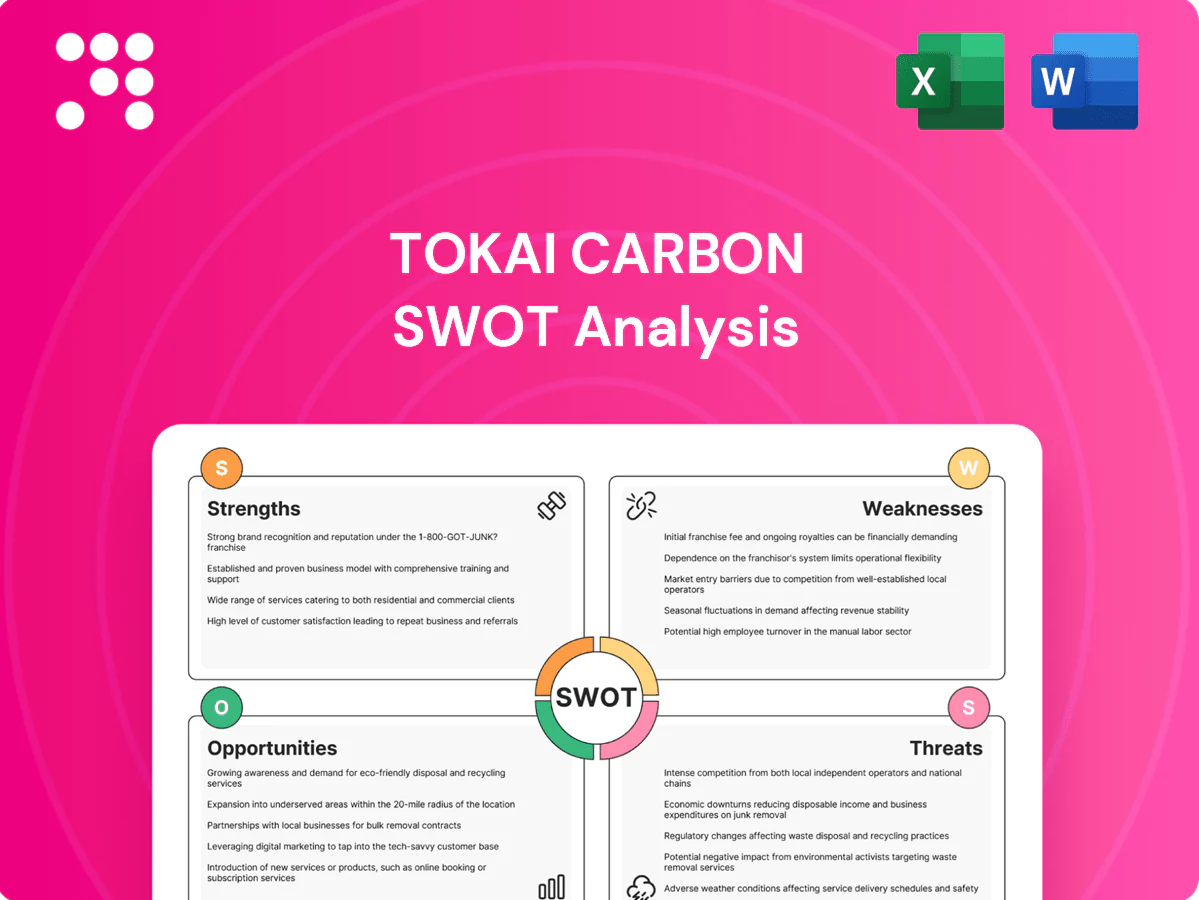
Tokai Carbon SWOT Analysis

Make Insightful Decisions Backed by Expert Research
Tokai Carbon’s diversified materials portfolio and strong R&D give it resilience in industrial markets, but exposure to cyclical demand and raw‑material volatility pose clear risks. Our full SWOT unpacks competitive advantages, regulatory threats, and growth levers in detail. Purchase the complete Word+Excel report to get editable, investor‑ready insights for strategy and valuation.
Strengths

Diverse carbon and graphite portfolio
Tokai Carbon’s diverse mix across carbon black, graphite electrodes, fine carbon and friction materials spreads revenue risk and supported consolidated revenue exceeding ¥200 billion in FY2024. Cross-selling across steel, automotive and semiconductor customers strengthens account penetration and boosts aftermarket sales. Serving cyclical steel and automotive markets alongside tech-driven semiconductor and battery segments enhances resilience, while management can rebalance capacity toward higher-margin lines.
Mission-critical supplier to key industries
Tokai Carbon supplies critical materials for EAF steelmaking, tire compounds, automotive braking systems and semiconductor tools, anchoring it to end-markets where EAF reached roughly 30% of global steel production (2023) and the semiconductor equipment market was about US$110B (2023). High switching costs from qualification and performance create durable margins. Long-term contracts and recurring demand embed Tokai Carbon deeply in customer supply chains.

Specialty graphite and advanced materials know-how
TOKAI CARBON's deep expertise in high-purity, isotropic and specialty graphite for high-temperature and precision applications supports critical roles in semiconductor fabs and advanced manufacturing. Robust R&D and engineering capabilities enable tailored product solutions and premium pricing. High technical barriers in materials processing and IP protect margins and create durable customer stickiness.

Global footprint and manufacturing scale
Tokai Carbon leverages a broad regional plant network to reduce logistics lead times and provide localized service, enabling faster responses to customer technical needs. Scale across procurement and production drives cost efficiencies and consistent quality control, supporting large-volume, repeat orders from multinational OEMs. Regional footprint also allows tailored formulations and quicker regulatory alignment.
- Global plants: improved logistics
- Scale: procurement and production savings
- Consistency: meets multinational volume needs
- Localization: faster response, tailored products
Quality, reliability, and certification track record
Tokai Carbon maintains stringent quality systems with ISO 9001 and ISO 14001 certifications across major sites, delivering consistent product performance that minimizes customer downtime risk; this reliability fosters repeat business and underpins long-term supply contracts, reinforcing its reputation as a trusted tier-1 supplier to semiconductor and automotive customers.
- ISO 9001/14001 certified
- Reduces customer downtime
- Drives repeat business
- Trusted tier-1 supplier
Carbon materials group tops ¥200B, benefiting from high technical barriers
Tokai Carbon’s diversified portfolio (carbon black, graphite electrodes, fine carbon, friction) drove consolidated revenue exceeding ¥200 billion in FY2024, enabling cross-selling into steel, automotive and semiconductor end-markets. High technical barriers, long-term contracts and ISO 9001/14001-certified sites sustain durable margins and customer stickiness.
| Metric | Value |
|---|---|
| FY2024 revenue | over ¥200 billion |
| Global EAF share (2023) | ~30% |
| Semiconductor equipment market (2023) | ~US$110B |
| Certifications | ISO 9001 / ISO 14001 |
What is included in the product
 Detailed Word Document
Provides a strategic overview of Tokai Carbon’s internal strengths and weaknesses and external opportunities and threats, assessing its competitive position across graphite electrode, fine carbon, and advanced materials while highlighting operational capabilities, market growth drivers, supply-chain risks and regulatory exposures.

 Customizable Excel Spreadsheet
Provides a concise SWOT matrix for Tokai Carbon, enabling rapid identification of strengths, weaknesses, opportunities and threats to streamline strategic decisions and mitigate pain points.
Weaknesses

Exposure to cyclical end markets
Tokai Carbon is highly exposed to cyclical steel and automotive volumes—global crude steel production was about 1.9 billion tonnes in 2023 and global light-vehicle output roughly 67 million units—amplifying earnings volatility in electrodes and carbon products. Capital goods and semiconductor tool cycles also swing specialty-line demand, while inventory buildups and pricing pressure in downcycles compress margins. Forecasting becomes harder and capacity utilization can drop sharply, stressing cash flow.
Energy- and carbon-intensive operations
Tokai Carbon's calcination and graphitization are highly energy- and process-emission intensive, driving substantial Scope 1/2 CO2 output from fuel combustion and carbonate decomposition; rising carbon costs from global ETS/tax developments and tighter reporting rules are increasing compliance expenses and could force substantial decarbonization capex for electrification and fuel switching; failure to act raises regulatory and reputational scrutiny from customers and investors.

Raw material and input cost volatility
Tokai Carbon is highly sensitive to needle coke, petroleum feedstocks and energy costs—needle coke shortages drove prices to more than double in 2021–22 and feedstock/energy remained elevated into 2024, squeezing margins. Long-term supply contracts and fixed pricing create a lag in passing spikes to customers, causing short-term margin compression during swift input inflation. Premium-grade needle coke faces tight supply security, limiting production flexibility and pricing power.

High capex and long lead times
Specialized furnaces and purification lines demand sizable, multi-year investments and plant builds that often span 12–30 months from groundbreaking to steady-state production. Commissioning and customer qualification cycles can add many more months, delaying revenue recognition. If end-market demand shifts, these high fixed-asset facilities face acute underutilization risk, and heavy capex commitments can strain the balance sheet during downturns.
- 12–30 months lead time
- Extended qualification cycles
- Utilization risk if demand falls
- Balance-sheet strain in downturns
Commoditization in carbon black
Commoditization in carbon black drives intense price competition and limited differentiation in standard grades, compressing margins as customers — with the tire sector representing roughly 70% of demand — exert strong bargaining power. Tokai Carbon’s margin uplift depends on shifting sales mix toward specialty grades, while exposure to low-cost regional producers, notably large Chinese capacity, leaves standard-grade volumes vulnerable and price-sensitive.
- High price competition
- Tire sector ~70% demand, strong bargaining power
- Margin uplift hinges on specialty mix shift
- Vulnerable to low-cost regional producers (large Chinese capacity)
Cyclical carbon-material risk: steel/auto demand swings, needle-coke squeeze, decarb capex
Tokai Carbon faces cyclical demand exposure—global crude steel ~1.9bn t (2023) and light vehicles ~67m (2023)—raising earnings volatility. Carbon processes are energy- and CO2‑intensive, forcing decarbonization capex amid rising carbon costs. Needle coke scarcity doubled prices in 2021–22, squeezing margins. Long 12–30 month lead times and >70% tire-linked carbon black demand increase utilization and pricing risk.
| Weakness | Metric | Impact |
|---|---|---|
| Cyclicality | Steel 1.9bn t; EV/auto 67m | Revenue volatility |
| Input cost | Needle coke ↑2x (2021–22) | Margin pressure |
What You See Is What You Get
Tokai Carbon SWOT Analysis
This is the actual SWOT analysis document you’ll receive upon purchase—no surprises, just professional quality. The preview below is taken directly from the full SWOT report you'll get; purchase unlocks the entire in-depth version. You’re viewing a live preview of the actual SWOT analysis file—buy now to access the complete, editable report.

Make Insightful Decisions Backed by Expert Research
Tokai Carbon’s diversified materials portfolio and strong R&D give it resilience in industrial markets, but exposure to cyclical demand and raw‑material volatility pose clear risks. Our full SWOT unpacks competitive advantages, regulatory threats, and growth levers in detail. Purchase the complete Word+Excel report to get editable, investor‑ready insights for strategy and valuation.
Strengths
Diverse carbon and graphite portfolio
Tokai Carbon’s diverse mix across carbon black, graphite electrodes, fine carbon and friction materials spreads revenue risk and supported consolidated revenue exceeding ¥200 billion in FY2024. Cross-selling across steel, automotive and semiconductor customers strengthens account penetration and boosts aftermarket sales. Serving cyclical steel and automotive markets alongside tech-driven semiconductor and battery segments enhances resilience, while management can rebalance capacity toward higher-margin lines.
Mission-critical supplier to key industries
Tokai Carbon supplies critical materials for EAF steelmaking, tire compounds, automotive braking systems and semiconductor tools, anchoring it to end-markets where EAF reached roughly 30% of global steel production (2023) and the semiconductor equipment market was about US$110B (2023). High switching costs from qualification and performance create durable margins. Long-term contracts and recurring demand embed Tokai Carbon deeply in customer supply chains.
Specialty graphite and advanced materials know-how
TOKAI CARBON's deep expertise in high-purity, isotropic and specialty graphite for high-temperature and precision applications supports critical roles in semiconductor fabs and advanced manufacturing. Robust R&D and engineering capabilities enable tailored product solutions and premium pricing. High technical barriers in materials processing and IP protect margins and create durable customer stickiness.
Global footprint and manufacturing scale
Tokai Carbon leverages a broad regional plant network to reduce logistics lead times and provide localized service, enabling faster responses to customer technical needs. Scale across procurement and production drives cost efficiencies and consistent quality control, supporting large-volume, repeat orders from multinational OEMs. Regional footprint also allows tailored formulations and quicker regulatory alignment.
- Global plants: improved logistics
- Scale: procurement and production savings
- Consistency: meets multinational volume needs
- Localization: faster response, tailored products
Quality, reliability, and certification track record
Tokai Carbon maintains stringent quality systems with ISO 9001 and ISO 14001 certifications across major sites, delivering consistent product performance that minimizes customer downtime risk; this reliability fosters repeat business and underpins long-term supply contracts, reinforcing its reputation as a trusted tier-1 supplier to semiconductor and automotive customers.
- ISO 9001/14001 certified
- Reduces customer downtime
- Drives repeat business
- Trusted tier-1 supplier
Carbon materials group tops ¥200B, benefiting from high technical barriers
Tokai Carbon’s diversified portfolio (carbon black, graphite electrodes, fine carbon, friction) drove consolidated revenue exceeding ¥200 billion in FY2024, enabling cross-selling into steel, automotive and semiconductor end-markets. High technical barriers, long-term contracts and ISO 9001/14001-certified sites sustain durable margins and customer stickiness.
| Metric | Value |
|---|---|
| FY2024 revenue | over ¥200 billion |
| Global EAF share (2023) | ~30% |
| Semiconductor equipment market (2023) | ~US$110B |
| Certifications | ISO 9001 / ISO 14001 |
What is included in the product
Detailed Word Document
Provides a strategic overview of Tokai Carbon’s internal strengths and weaknesses and external opportunities and threats, assessing its competitive position across graphite electrode, fine carbon, and advanced materials while highlighting operational capabilities, market growth drivers, supply-chain risks and regulatory exposures.
Customizable Excel Spreadsheet
Provides a concise SWOT matrix for Tokai Carbon, enabling rapid identification of strengths, weaknesses, opportunities and threats to streamline strategic decisions and mitigate pain points.
Weaknesses
Exposure to cyclical end markets
Tokai Carbon is highly exposed to cyclical steel and automotive volumes—global crude steel production was about 1.9 billion tonnes in 2023 and global light-vehicle output roughly 67 million units—amplifying earnings volatility in electrodes and carbon products. Capital goods and semiconductor tool cycles also swing specialty-line demand, while inventory buildups and pricing pressure in downcycles compress margins. Forecasting becomes harder and capacity utilization can drop sharply, stressing cash flow.
Energy- and carbon-intensive operations
Tokai Carbon's calcination and graphitization are highly energy- and process-emission intensive, driving substantial Scope 1/2 CO2 output from fuel combustion and carbonate decomposition; rising carbon costs from global ETS/tax developments and tighter reporting rules are increasing compliance expenses and could force substantial decarbonization capex for electrification and fuel switching; failure to act raises regulatory and reputational scrutiny from customers and investors.
Raw material and input cost volatility
Tokai Carbon is highly sensitive to needle coke, petroleum feedstocks and energy costs—needle coke shortages drove prices to more than double in 2021–22 and feedstock/energy remained elevated into 2024, squeezing margins. Long-term supply contracts and fixed pricing create a lag in passing spikes to customers, causing short-term margin compression during swift input inflation. Premium-grade needle coke faces tight supply security, limiting production flexibility and pricing power.
High capex and long lead times
Specialized furnaces and purification lines demand sizable, multi-year investments and plant builds that often span 12–30 months from groundbreaking to steady-state production. Commissioning and customer qualification cycles can add many more months, delaying revenue recognition. If end-market demand shifts, these high fixed-asset facilities face acute underutilization risk, and heavy capex commitments can strain the balance sheet during downturns.
- 12–30 months lead time
- Extended qualification cycles
- Utilization risk if demand falls
- Balance-sheet strain in downturns
Commoditization in carbon black
Commoditization in carbon black drives intense price competition and limited differentiation in standard grades, compressing margins as customers — with the tire sector representing roughly 70% of demand — exert strong bargaining power. Tokai Carbon’s margin uplift depends on shifting sales mix toward specialty grades, while exposure to low-cost regional producers, notably large Chinese capacity, leaves standard-grade volumes vulnerable and price-sensitive.
- High price competition
- Tire sector ~70% demand, strong bargaining power
- Margin uplift hinges on specialty mix shift
- Vulnerable to low-cost regional producers (large Chinese capacity)
Cyclical carbon-material risk: steel/auto demand swings, needle-coke squeeze, decarb capex
Tokai Carbon faces cyclical demand exposure—global crude steel ~1.9bn t (2023) and light vehicles ~67m (2023)—raising earnings volatility. Carbon processes are energy- and CO2‑intensive, forcing decarbonization capex amid rising carbon costs. Needle coke scarcity doubled prices in 2021–22, squeezing margins. Long 12–30 month lead times and >70% tire-linked carbon black demand increase utilization and pricing risk.
| Weakness | Metric | Impact |
|---|---|---|
| Cyclicality | Steel 1.9bn t; EV/auto 67m | Revenue volatility |
| Input cost | Needle coke ↑2x (2021–22) | Margin pressure |
What You See Is What You Get
Tokai Carbon SWOT Analysis
This is the actual SWOT analysis document you’ll receive upon purchase—no surprises, just professional quality. The preview below is taken directly from the full SWOT report you'll get; purchase unlocks the entire in-depth version. You’re viewing a live preview of the actual SWOT analysis file—buy now to access the complete, editable report.
Original: $10.00
-65%$10.00
$3.50Description
Make Insightful Decisions Backed by Expert Research
Tokai Carbon’s diversified materials portfolio and strong R&D give it resilience in industrial markets, but exposure to cyclical demand and raw‑material volatility pose clear risks. Our full SWOT unpacks competitive advantages, regulatory threats, and growth levers in detail. Purchase the complete Word+Excel report to get editable, investor‑ready insights for strategy and valuation.
Strengths
Diverse carbon and graphite portfolio
Tokai Carbon’s diverse mix across carbon black, graphite electrodes, fine carbon and friction materials spreads revenue risk and supported consolidated revenue exceeding ¥200 billion in FY2024. Cross-selling across steel, automotive and semiconductor customers strengthens account penetration and boosts aftermarket sales. Serving cyclical steel and automotive markets alongside tech-driven semiconductor and battery segments enhances resilience, while management can rebalance capacity toward higher-margin lines.
Mission-critical supplier to key industries
Tokai Carbon supplies critical materials for EAF steelmaking, tire compounds, automotive braking systems and semiconductor tools, anchoring it to end-markets where EAF reached roughly 30% of global steel production (2023) and the semiconductor equipment market was about US$110B (2023). High switching costs from qualification and performance create durable margins. Long-term contracts and recurring demand embed Tokai Carbon deeply in customer supply chains.
Specialty graphite and advanced materials know-how
TOKAI CARBON's deep expertise in high-purity, isotropic and specialty graphite for high-temperature and precision applications supports critical roles in semiconductor fabs and advanced manufacturing. Robust R&D and engineering capabilities enable tailored product solutions and premium pricing. High technical barriers in materials processing and IP protect margins and create durable customer stickiness.
Global footprint and manufacturing scale
Tokai Carbon leverages a broad regional plant network to reduce logistics lead times and provide localized service, enabling faster responses to customer technical needs. Scale across procurement and production drives cost efficiencies and consistent quality control, supporting large-volume, repeat orders from multinational OEMs. Regional footprint also allows tailored formulations and quicker regulatory alignment.
- Global plants: improved logistics
- Scale: procurement and production savings
- Consistency: meets multinational volume needs
- Localization: faster response, tailored products
Quality, reliability, and certification track record
Tokai Carbon maintains stringent quality systems with ISO 9001 and ISO 14001 certifications across major sites, delivering consistent product performance that minimizes customer downtime risk; this reliability fosters repeat business and underpins long-term supply contracts, reinforcing its reputation as a trusted tier-1 supplier to semiconductor and automotive customers.
- ISO 9001/14001 certified
- Reduces customer downtime
- Drives repeat business
- Trusted tier-1 supplier
Carbon materials group tops ¥200B, benefiting from high technical barriers
Tokai Carbon’s diversified portfolio (carbon black, graphite electrodes, fine carbon, friction) drove consolidated revenue exceeding ¥200 billion in FY2024, enabling cross-selling into steel, automotive and semiconductor end-markets. High technical barriers, long-term contracts and ISO 9001/14001-certified sites sustain durable margins and customer stickiness.
| Metric | Value |
|---|---|
| FY2024 revenue | over ¥200 billion |
| Global EAF share (2023) | ~30% |
| Semiconductor equipment market (2023) | ~US$110B |
| Certifications | ISO 9001 / ISO 14001 |
What is included in the product
Detailed Word Document
Provides a strategic overview of Tokai Carbon’s internal strengths and weaknesses and external opportunities and threats, assessing its competitive position across graphite electrode, fine carbon, and advanced materials while highlighting operational capabilities, market growth drivers, supply-chain risks and regulatory exposures.
Customizable Excel Spreadsheet
Provides a concise SWOT matrix for Tokai Carbon, enabling rapid identification of strengths, weaknesses, opportunities and threats to streamline strategic decisions and mitigate pain points.
Weaknesses
Exposure to cyclical end markets
Tokai Carbon is highly exposed to cyclical steel and automotive volumes—global crude steel production was about 1.9 billion tonnes in 2023 and global light-vehicle output roughly 67 million units—amplifying earnings volatility in electrodes and carbon products. Capital goods and semiconductor tool cycles also swing specialty-line demand, while inventory buildups and pricing pressure in downcycles compress margins. Forecasting becomes harder and capacity utilization can drop sharply, stressing cash flow.
Energy- and carbon-intensive operations
Tokai Carbon's calcination and graphitization are highly energy- and process-emission intensive, driving substantial Scope 1/2 CO2 output from fuel combustion and carbonate decomposition; rising carbon costs from global ETS/tax developments and tighter reporting rules are increasing compliance expenses and could force substantial decarbonization capex for electrification and fuel switching; failure to act raises regulatory and reputational scrutiny from customers and investors.
Raw material and input cost volatility
Tokai Carbon is highly sensitive to needle coke, petroleum feedstocks and energy costs—needle coke shortages drove prices to more than double in 2021–22 and feedstock/energy remained elevated into 2024, squeezing margins. Long-term supply contracts and fixed pricing create a lag in passing spikes to customers, causing short-term margin compression during swift input inflation. Premium-grade needle coke faces tight supply security, limiting production flexibility and pricing power.
High capex and long lead times
Specialized furnaces and purification lines demand sizable, multi-year investments and plant builds that often span 12–30 months from groundbreaking to steady-state production. Commissioning and customer qualification cycles can add many more months, delaying revenue recognition. If end-market demand shifts, these high fixed-asset facilities face acute underutilization risk, and heavy capex commitments can strain the balance sheet during downturns.
- 12–30 months lead time
- Extended qualification cycles
- Utilization risk if demand falls
- Balance-sheet strain in downturns
Commoditization in carbon black
Commoditization in carbon black drives intense price competition and limited differentiation in standard grades, compressing margins as customers — with the tire sector representing roughly 70% of demand — exert strong bargaining power. Tokai Carbon’s margin uplift depends on shifting sales mix toward specialty grades, while exposure to low-cost regional producers, notably large Chinese capacity, leaves standard-grade volumes vulnerable and price-sensitive.
- High price competition
- Tire sector ~70% demand, strong bargaining power
- Margin uplift hinges on specialty mix shift
- Vulnerable to low-cost regional producers (large Chinese capacity)
Cyclical carbon-material risk: steel/auto demand swings, needle-coke squeeze, decarb capex
Tokai Carbon faces cyclical demand exposure—global crude steel ~1.9bn t (2023) and light vehicles ~67m (2023)—raising earnings volatility. Carbon processes are energy- and CO2‑intensive, forcing decarbonization capex amid rising carbon costs. Needle coke scarcity doubled prices in 2021–22, squeezing margins. Long 12–30 month lead times and >70% tire-linked carbon black demand increase utilization and pricing risk.
| Weakness | Metric | Impact |
|---|---|---|
| Cyclicality | Steel 1.9bn t; EV/auto 67m | Revenue volatility |
| Input cost | Needle coke ↑2x (2021–22) | Margin pressure |
What You See Is What You Get
Tokai Carbon SWOT Analysis
This is the actual SWOT analysis document you’ll receive upon purchase—no surprises, just professional quality. The preview below is taken directly from the full SWOT report you'll get; purchase unlocks the entire in-depth version. You’re viewing a live preview of the actual SWOT analysis file—buy now to access the complete, editable report.











