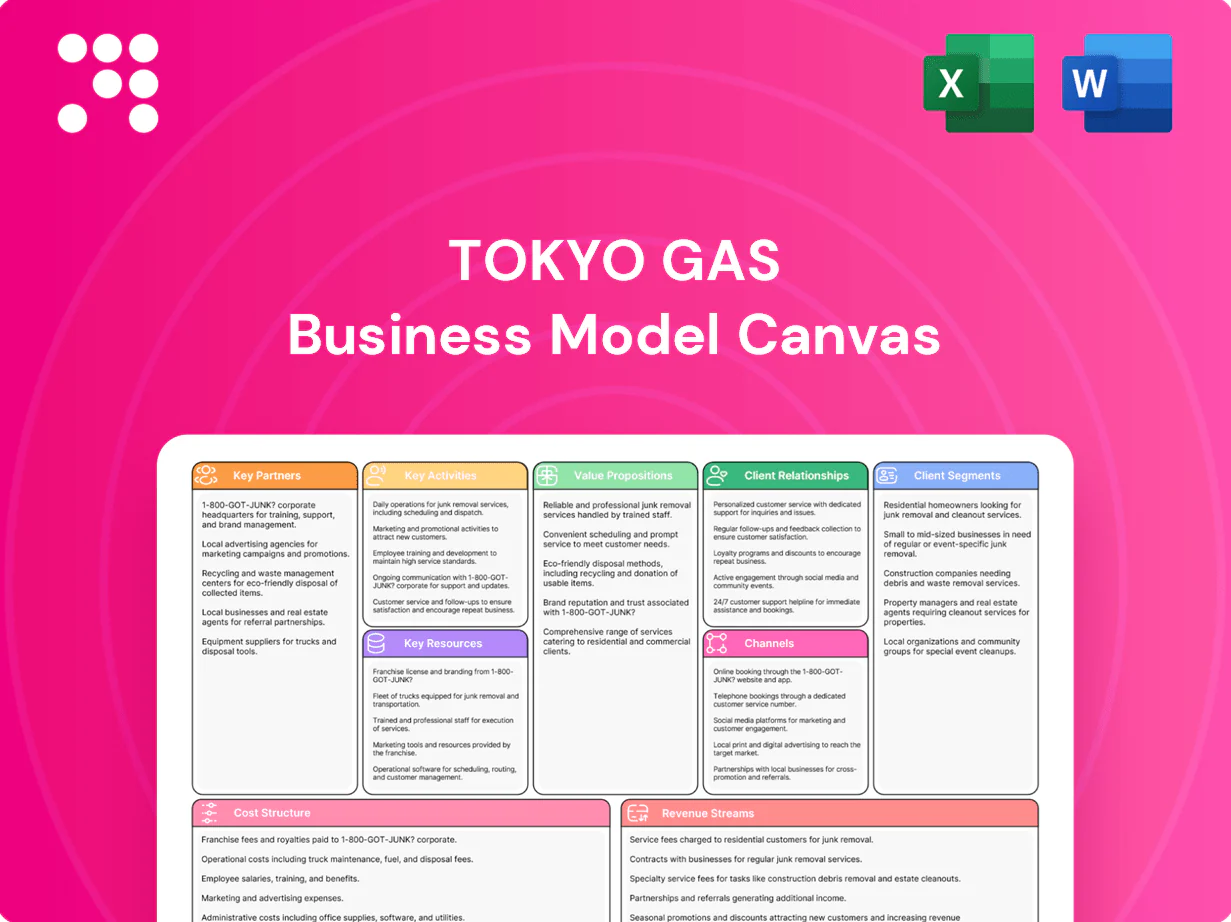
Tokyo Gas Business Model Canvas

Unlock the strategic Business Model Canvas of a leading Japanese energy firm for investors
Unlock the full strategic blueprint behind Tokyo Gas’s business model with our concise Business Model Canvas that maps value propositions, customer segments, and revenue streams. This in-depth snapshot reveals how Tokyo Gas captures market share, leverages partnerships, and manages costs—perfect for investors, consultants, and founders. Purchase the complete Word & Excel canvas to analyze each building block and apply proven strategies to your planning.
Partnerships

LNG suppliers and upstream gas partners
Secure long-term LNG procurement contracts to ensure stable fuel supply, aligning with Japan remaining a top global LNG importer in 2023 per IEA. Collaborate with upstream partners on flexible pricing and destination clauses to manage demand swings and co-develop decarbonized LNG and methane-emission reduction initiatives across the value chain. Maintain diversification across regions and counterparties to reduce geopolitical risk.
Electricity generators and grid operators
Partner with power producers for wholesale procurement and balancing, leveraging Japan’s capacity market launched in 2020 to secure firm supply and revenue streams. Coordinate closely with transmission and distribution operators under OCCTO (est. 2015) for reliability, grid access and cross‑regional balancing. Jointly plan peak demand, resiliency and integration of renewables to meet Japan’s 2030 target of 36–38% renewable generation.

Equipment manufacturers and technology vendors
Tokyo Gas partners with OEMs to supply gas appliances, smart meters, HEMS and CHP systems, leveraging its customer base of about 11 million households (2024). It co-innovates hydrogen-ready and high-efficiency devices with manufacturers to meet decarbonization targets. Long-term service and spare-parts agreements secure lifecycle support and revenue stability. Platform partners deliver IoT, analytics and cybersecurity integration for remote operations and predictive maintenance.

Renewables developers and EPC contractors
Tokyo Gas co-develops solar, wind and biomass to diversify away from gas, aligning with Japan’s 2030 renewables goal of 36–38% and targeting multi‑hundred MW projects to scale capacity.
EPC partners deliver projects on cost and schedule, supporting PPAs and third‑party ownership models to offer customers off‑balance renewable access.
Joint work on batteries and grid‑interactive solutions firms intermittent output, leveraging falling battery costs and system integration to stabilize supply.
Government, regulators, and local municipalities
Tokyo Gas engages government, regulators, and municipalities on safety standards, rate structures, and market liberalization, aligning regional energy transition and disaster preparedness plans; in 2024 Japan's GX policy mobilized roughly ¥10 trillion in public‑private green finance, opening subsidies for low‑carbon projects and hydrogen pilots.
- Safety & rates: regulatory collaboration
- Energy transition: regional planning & resilience hubs
- Finance: access to 2024 GX funds (~¥10T)
- Community: district heating & local energy partnerships
Secure LNG, scale multi-100MW renewables, retrofit ~11M homes with HEMS
Secure long‑term LNG contracts and diversify suppliers to mitigate geopolitical risk; Japan remained a top global LNG importer in 2023 (IEA). Partner with power producers, OCCTO and OEMs to integrate renewables and hydrogen‑ready appliances across about 11M households (2024). Co‑develop multi‑hundred MW renewables, storage and EPC delivery, leveraging ~¥10T 2024 GX public‑private finance.
| Partnership | Role | 2024/2023 metric |
|---|---|---|
| LNG suppliers | Fuel security, flexible contracts | Top LNG importer 2023 |
| OEMs & IoT | Appliances, HEMS, meters | ~11M households (2024) |
| Utilities/OCCTO | Grid balancing, PPAs | Renewables target 36–38% (2030) |
| Renewables/EPCs | Project delivery, storage | Scale to multi‑100MW |
| Government/finance | Regulatory, subsidies | ~¥10T GX funds (2024) |
What is included in the product
 Detailed Word Document
A comprehensive Business Model Canvas for Tokyo Gas mapping nine blocks—customer segments, channels, value propositions, revenue streams, key resources/activities/partners, cost structure—aligned with real operations and strategy; ideal for presentations, investor discussions and decision-making, including competitive advantages and linked SWOT insights for validation and planning.

 Customizable Excel Spreadsheet
High-level view of Tokyo Gas’s business model with editable cells, condensing strategy into a one-page snapshot for quick review and comparison; perfect for boardrooms, team collaboration, and saving hours of formatting.
Activities

Gas procurement, transportation, and distribution
Tokyo Gas secures LNG and pipeline gas from global suppliers, optimizing shipping and regasification to serve Japan’s roughly 60 million tonne annual LNG market (2024) and its own supply needs. It operates and maintains high-pressure transmission pipelines and extensive city gas networks with routine safety inspections, leak detection and emergency response teams. Seasonal underground storage and dynamic linepack management balance supply-demand during winter peaks.
Electricity retailing and portfolio management
Tokyo Gas procures wholesale power and hedges market exposure through forward contracts and JEPX purchases, operating within a Japanese retail market of over 900 suppliers in 2024. The company manages demand forecasting, scheduling and imbalance settlement using intraday optimization and EMS tools. It offers bundled gas-electricity tariffs and time-of-use plans to roughly 11 million gas customers (2024), and optimizes risk with derivatives and flexible generation contracts.

Energy solutions and services delivery
Tokyo Gas designs and installs gas appliances, CHP systems and HEMS across its ~11 million customer base, supporting a group revenue of about JPY 2.1 trillion in 2024. The company provides energy audits, consulting and decarbonization roadmaps, targeting operational CO2 reductions aligned with net-zero pathways. It runs maintenance, warranty and performance guarantees and implements ESCO projects with shared-savings contracts (often 5–15 years) to secure 5–20% measured savings.

Renewable project development and asset management
Renewable project development and asset management for Tokyo Gas focuses on identifying sites, securing permits, and structuring financing while overseeing EPC, commissioning, and O&M for solar, wind, and biomass to support Tokyo Gas's stated carbon neutrality by 2050.
- Site selection and permitting
- Project finance structuring
- EPC, commissioning, O&M oversight
- Revenue: PPAs, feed-in mechanisms, merchant exposure
- Asset optimization: availability, curtailment, lifecycle costs
Safety, compliance, and customer care
Tokyo Gas enforces rigorous safety protocols and training across its network serving about 11 million customers (2024), targeting zero incidents through regular drills and contractor audits; it maintains statutory regulatory reporting and ISO-based quality assurance, operates multi-channel customer support and billing with digital self-service, and runs energy-efficiency and disaster-readiness outreach programs.
- Safety: zero-incident target, regular drills
- Compliance: statutory reports, QA systems
- Customer care: omni-channel support, digital billing
- Outreach: energy-saving & disaster readiness
Japanese gas utility secures LNG ~60 Mtpa, 11M
Tokyo Gas secures LNG/pipeline supplies to serve Japan’s ~60 Mtpa LNG market (2024), managing shipping, regasification and seasonal storage to balance winter peaks. It operates transmission and city networks for ~11 million customers, provides bundled gas-electricity services amid 900+ retail suppliers (2024), and posted group revenue of JPY 2.1 trillion (2024). The company develops renewables and ESCO projects to meet carbon neutrality by 2050.
| Metric | 2024 |
|---|---|
| Customers | ~11,000,000 |
| Group revenue | JPY 2.1 trillion |
| Japan LNG market | ~60 Mtpa |
| Retail suppliers | 900+ |
Delivered as Displayed
Business Model Canvas
The Tokyo Gas Business Model Canvas shown here is the exact, live document you’ll receive after purchase—not a mockup or sample. When you buy, you’ll get this same complete, professionally formatted canvas ready to edit and present. Files are delivered in editable Word and Excel formats with all content intact.

Unlock the strategic Business Model Canvas of a leading Japanese energy firm for investors
Unlock the full strategic blueprint behind Tokyo Gas’s business model with our concise Business Model Canvas that maps value propositions, customer segments, and revenue streams. This in-depth snapshot reveals how Tokyo Gas captures market share, leverages partnerships, and manages costs—perfect for investors, consultants, and founders. Purchase the complete Word & Excel canvas to analyze each building block and apply proven strategies to your planning.
Partnerships
LNG suppliers and upstream gas partners
Secure long-term LNG procurement contracts to ensure stable fuel supply, aligning with Japan remaining a top global LNG importer in 2023 per IEA. Collaborate with upstream partners on flexible pricing and destination clauses to manage demand swings and co-develop decarbonized LNG and methane-emission reduction initiatives across the value chain. Maintain diversification across regions and counterparties to reduce geopolitical risk.
Electricity generators and grid operators
Partner with power producers for wholesale procurement and balancing, leveraging Japan’s capacity market launched in 2020 to secure firm supply and revenue streams. Coordinate closely with transmission and distribution operators under OCCTO (est. 2015) for reliability, grid access and cross‑regional balancing. Jointly plan peak demand, resiliency and integration of renewables to meet Japan’s 2030 target of 36–38% renewable generation.
Equipment manufacturers and technology vendors
Tokyo Gas partners with OEMs to supply gas appliances, smart meters, HEMS and CHP systems, leveraging its customer base of about 11 million households (2024). It co-innovates hydrogen-ready and high-efficiency devices with manufacturers to meet decarbonization targets. Long-term service and spare-parts agreements secure lifecycle support and revenue stability. Platform partners deliver IoT, analytics and cybersecurity integration for remote operations and predictive maintenance.
Renewables developers and EPC contractors
Tokyo Gas co-develops solar, wind and biomass to diversify away from gas, aligning with Japan’s 2030 renewables goal of 36–38% and targeting multi‑hundred MW projects to scale capacity.
EPC partners deliver projects on cost and schedule, supporting PPAs and third‑party ownership models to offer customers off‑balance renewable access.
Joint work on batteries and grid‑interactive solutions firms intermittent output, leveraging falling battery costs and system integration to stabilize supply.
Government, regulators, and local municipalities
Tokyo Gas engages government, regulators, and municipalities on safety standards, rate structures, and market liberalization, aligning regional energy transition and disaster preparedness plans; in 2024 Japan's GX policy mobilized roughly ¥10 trillion in public‑private green finance, opening subsidies for low‑carbon projects and hydrogen pilots.
- Safety & rates: regulatory collaboration
- Energy transition: regional planning & resilience hubs
- Finance: access to 2024 GX funds (~¥10T)
- Community: district heating & local energy partnerships
Secure LNG, scale multi-100MW renewables, retrofit ~11M homes with HEMS
Secure long‑term LNG contracts and diversify suppliers to mitigate geopolitical risk; Japan remained a top global LNG importer in 2023 (IEA). Partner with power producers, OCCTO and OEMs to integrate renewables and hydrogen‑ready appliances across about 11M households (2024). Co‑develop multi‑hundred MW renewables, storage and EPC delivery, leveraging ~¥10T 2024 GX public‑private finance.
| Partnership | Role | 2024/2023 metric |
|---|---|---|
| LNG suppliers | Fuel security, flexible contracts | Top LNG importer 2023 |
| OEMs & IoT | Appliances, HEMS, meters | ~11M households (2024) |
| Utilities/OCCTO | Grid balancing, PPAs | Renewables target 36–38% (2030) |
| Renewables/EPCs | Project delivery, storage | Scale to multi‑100MW |
| Government/finance | Regulatory, subsidies | ~¥10T GX funds (2024) |
What is included in the product
Detailed Word Document
A comprehensive Business Model Canvas for Tokyo Gas mapping nine blocks—customer segments, channels, value propositions, revenue streams, key resources/activities/partners, cost structure—aligned with real operations and strategy; ideal for presentations, investor discussions and decision-making, including competitive advantages and linked SWOT insights for validation and planning.
Customizable Excel Spreadsheet
High-level view of Tokyo Gas’s business model with editable cells, condensing strategy into a one-page snapshot for quick review and comparison; perfect for boardrooms, team collaboration, and saving hours of formatting.
Activities
Gas procurement, transportation, and distribution
Tokyo Gas secures LNG and pipeline gas from global suppliers, optimizing shipping and regasification to serve Japan’s roughly 60 million tonne annual LNG market (2024) and its own supply needs. It operates and maintains high-pressure transmission pipelines and extensive city gas networks with routine safety inspections, leak detection and emergency response teams. Seasonal underground storage and dynamic linepack management balance supply-demand during winter peaks.
Electricity retailing and portfolio management
Tokyo Gas procures wholesale power and hedges market exposure through forward contracts and JEPX purchases, operating within a Japanese retail market of over 900 suppliers in 2024. The company manages demand forecasting, scheduling and imbalance settlement using intraday optimization and EMS tools. It offers bundled gas-electricity tariffs and time-of-use plans to roughly 11 million gas customers (2024), and optimizes risk with derivatives and flexible generation contracts.
Energy solutions and services delivery
Tokyo Gas designs and installs gas appliances, CHP systems and HEMS across its ~11 million customer base, supporting a group revenue of about JPY 2.1 trillion in 2024. The company provides energy audits, consulting and decarbonization roadmaps, targeting operational CO2 reductions aligned with net-zero pathways. It runs maintenance, warranty and performance guarantees and implements ESCO projects with shared-savings contracts (often 5–15 years) to secure 5–20% measured savings.
Renewable project development and asset management
Renewable project development and asset management for Tokyo Gas focuses on identifying sites, securing permits, and structuring financing while overseeing EPC, commissioning, and O&M for solar, wind, and biomass to support Tokyo Gas's stated carbon neutrality by 2050.
- Site selection and permitting
- Project finance structuring
- EPC, commissioning, O&M oversight
- Revenue: PPAs, feed-in mechanisms, merchant exposure
- Asset optimization: availability, curtailment, lifecycle costs
Safety, compliance, and customer care
Tokyo Gas enforces rigorous safety protocols and training across its network serving about 11 million customers (2024), targeting zero incidents through regular drills and contractor audits; it maintains statutory regulatory reporting and ISO-based quality assurance, operates multi-channel customer support and billing with digital self-service, and runs energy-efficiency and disaster-readiness outreach programs.
- Safety: zero-incident target, regular drills
- Compliance: statutory reports, QA systems
- Customer care: omni-channel support, digital billing
- Outreach: energy-saving & disaster readiness
Japanese gas utility secures LNG ~60 Mtpa, 11M
Tokyo Gas secures LNG/pipeline supplies to serve Japan’s ~60 Mtpa LNG market (2024), managing shipping, regasification and seasonal storage to balance winter peaks. It operates transmission and city networks for ~11 million customers, provides bundled gas-electricity services amid 900+ retail suppliers (2024), and posted group revenue of JPY 2.1 trillion (2024). The company develops renewables and ESCO projects to meet carbon neutrality by 2050.
| Metric | 2024 |
|---|---|
| Customers | ~11,000,000 |
| Group revenue | JPY 2.1 trillion |
| Japan LNG market | ~60 Mtpa |
| Retail suppliers | 900+ |
Delivered as Displayed
Business Model Canvas
The Tokyo Gas Business Model Canvas shown here is the exact, live document you’ll receive after purchase—not a mockup or sample. When you buy, you’ll get this same complete, professionally formatted canvas ready to edit and present. Files are delivered in editable Word and Excel formats with all content intact.
Description
Unlock the strategic Business Model Canvas of a leading Japanese energy firm for investors
Unlock the full strategic blueprint behind Tokyo Gas’s business model with our concise Business Model Canvas that maps value propositions, customer segments, and revenue streams. This in-depth snapshot reveals how Tokyo Gas captures market share, leverages partnerships, and manages costs—perfect for investors, consultants, and founders. Purchase the complete Word & Excel canvas to analyze each building block and apply proven strategies to your planning.
Partnerships
LNG suppliers and upstream gas partners
Secure long-term LNG procurement contracts to ensure stable fuel supply, aligning with Japan remaining a top global LNG importer in 2023 per IEA. Collaborate with upstream partners on flexible pricing and destination clauses to manage demand swings and co-develop decarbonized LNG and methane-emission reduction initiatives across the value chain. Maintain diversification across regions and counterparties to reduce geopolitical risk.
Electricity generators and grid operators
Partner with power producers for wholesale procurement and balancing, leveraging Japan’s capacity market launched in 2020 to secure firm supply and revenue streams. Coordinate closely with transmission and distribution operators under OCCTO (est. 2015) for reliability, grid access and cross‑regional balancing. Jointly plan peak demand, resiliency and integration of renewables to meet Japan’s 2030 target of 36–38% renewable generation.
Equipment manufacturers and technology vendors
Tokyo Gas partners with OEMs to supply gas appliances, smart meters, HEMS and CHP systems, leveraging its customer base of about 11 million households (2024). It co-innovates hydrogen-ready and high-efficiency devices with manufacturers to meet decarbonization targets. Long-term service and spare-parts agreements secure lifecycle support and revenue stability. Platform partners deliver IoT, analytics and cybersecurity integration for remote operations and predictive maintenance.
Renewables developers and EPC contractors
Tokyo Gas co-develops solar, wind and biomass to diversify away from gas, aligning with Japan’s 2030 renewables goal of 36–38% and targeting multi‑hundred MW projects to scale capacity.
EPC partners deliver projects on cost and schedule, supporting PPAs and third‑party ownership models to offer customers off‑balance renewable access.
Joint work on batteries and grid‑interactive solutions firms intermittent output, leveraging falling battery costs and system integration to stabilize supply.
Government, regulators, and local municipalities
Tokyo Gas engages government, regulators, and municipalities on safety standards, rate structures, and market liberalization, aligning regional energy transition and disaster preparedness plans; in 2024 Japan's GX policy mobilized roughly ¥10 trillion in public‑private green finance, opening subsidies for low‑carbon projects and hydrogen pilots.
- Safety & rates: regulatory collaboration
- Energy transition: regional planning & resilience hubs
- Finance: access to 2024 GX funds (~¥10T)
- Community: district heating & local energy partnerships
Secure LNG, scale multi-100MW renewables, retrofit ~11M homes with HEMS
Secure long‑term LNG contracts and diversify suppliers to mitigate geopolitical risk; Japan remained a top global LNG importer in 2023 (IEA). Partner with power producers, OCCTO and OEMs to integrate renewables and hydrogen‑ready appliances across about 11M households (2024). Co‑develop multi‑hundred MW renewables, storage and EPC delivery, leveraging ~¥10T 2024 GX public‑private finance.
| Partnership | Role | 2024/2023 metric |
|---|---|---|
| LNG suppliers | Fuel security, flexible contracts | Top LNG importer 2023 |
| OEMs & IoT | Appliances, HEMS, meters | ~11M households (2024) |
| Utilities/OCCTO | Grid balancing, PPAs | Renewables target 36–38% (2030) |
| Renewables/EPCs | Project delivery, storage | Scale to multi‑100MW |
| Government/finance | Regulatory, subsidies | ~¥10T GX funds (2024) |
What is included in the product
Detailed Word Document
A comprehensive Business Model Canvas for Tokyo Gas mapping nine blocks—customer segments, channels, value propositions, revenue streams, key resources/activities/partners, cost structure—aligned with real operations and strategy; ideal for presentations, investor discussions and decision-making, including competitive advantages and linked SWOT insights for validation and planning.
Customizable Excel Spreadsheet
High-level view of Tokyo Gas’s business model with editable cells, condensing strategy into a one-page snapshot for quick review and comparison; perfect for boardrooms, team collaboration, and saving hours of formatting.
Activities
Gas procurement, transportation, and distribution
Tokyo Gas secures LNG and pipeline gas from global suppliers, optimizing shipping and regasification to serve Japan’s roughly 60 million tonne annual LNG market (2024) and its own supply needs. It operates and maintains high-pressure transmission pipelines and extensive city gas networks with routine safety inspections, leak detection and emergency response teams. Seasonal underground storage and dynamic linepack management balance supply-demand during winter peaks.
Electricity retailing and portfolio management
Tokyo Gas procures wholesale power and hedges market exposure through forward contracts and JEPX purchases, operating within a Japanese retail market of over 900 suppliers in 2024. The company manages demand forecasting, scheduling and imbalance settlement using intraday optimization and EMS tools. It offers bundled gas-electricity tariffs and time-of-use plans to roughly 11 million gas customers (2024), and optimizes risk with derivatives and flexible generation contracts.
Energy solutions and services delivery
Tokyo Gas designs and installs gas appliances, CHP systems and HEMS across its ~11 million customer base, supporting a group revenue of about JPY 2.1 trillion in 2024. The company provides energy audits, consulting and decarbonization roadmaps, targeting operational CO2 reductions aligned with net-zero pathways. It runs maintenance, warranty and performance guarantees and implements ESCO projects with shared-savings contracts (often 5–15 years) to secure 5–20% measured savings.
Renewable project development and asset management
Renewable project development and asset management for Tokyo Gas focuses on identifying sites, securing permits, and structuring financing while overseeing EPC, commissioning, and O&M for solar, wind, and biomass to support Tokyo Gas's stated carbon neutrality by 2050.
- Site selection and permitting
- Project finance structuring
- EPC, commissioning, O&M oversight
- Revenue: PPAs, feed-in mechanisms, merchant exposure
- Asset optimization: availability, curtailment, lifecycle costs
Safety, compliance, and customer care
Tokyo Gas enforces rigorous safety protocols and training across its network serving about 11 million customers (2024), targeting zero incidents through regular drills and contractor audits; it maintains statutory regulatory reporting and ISO-based quality assurance, operates multi-channel customer support and billing with digital self-service, and runs energy-efficiency and disaster-readiness outreach programs.
- Safety: zero-incident target, regular drills
- Compliance: statutory reports, QA systems
- Customer care: omni-channel support, digital billing
- Outreach: energy-saving & disaster readiness
Japanese gas utility secures LNG ~60 Mtpa, 11M
Tokyo Gas secures LNG/pipeline supplies to serve Japan’s ~60 Mtpa LNG market (2024), managing shipping, regasification and seasonal storage to balance winter peaks. It operates transmission and city networks for ~11 million customers, provides bundled gas-electricity services amid 900+ retail suppliers (2024), and posted group revenue of JPY 2.1 trillion (2024). The company develops renewables and ESCO projects to meet carbon neutrality by 2050.
| Metric | 2024 |
|---|---|
| Customers | ~11,000,000 |
| Group revenue | JPY 2.1 trillion |
| Japan LNG market | ~60 Mtpa |
| Retail suppliers | 900+ |
Delivered as Displayed
Business Model Canvas
The Tokyo Gas Business Model Canvas shown here is the exact, live document you’ll receive after purchase—not a mockup or sample. When you buy, you’ll get this same complete, professionally formatted canvas ready to edit and present. Files are delivered in editable Word and Excel formats with all content intact.











