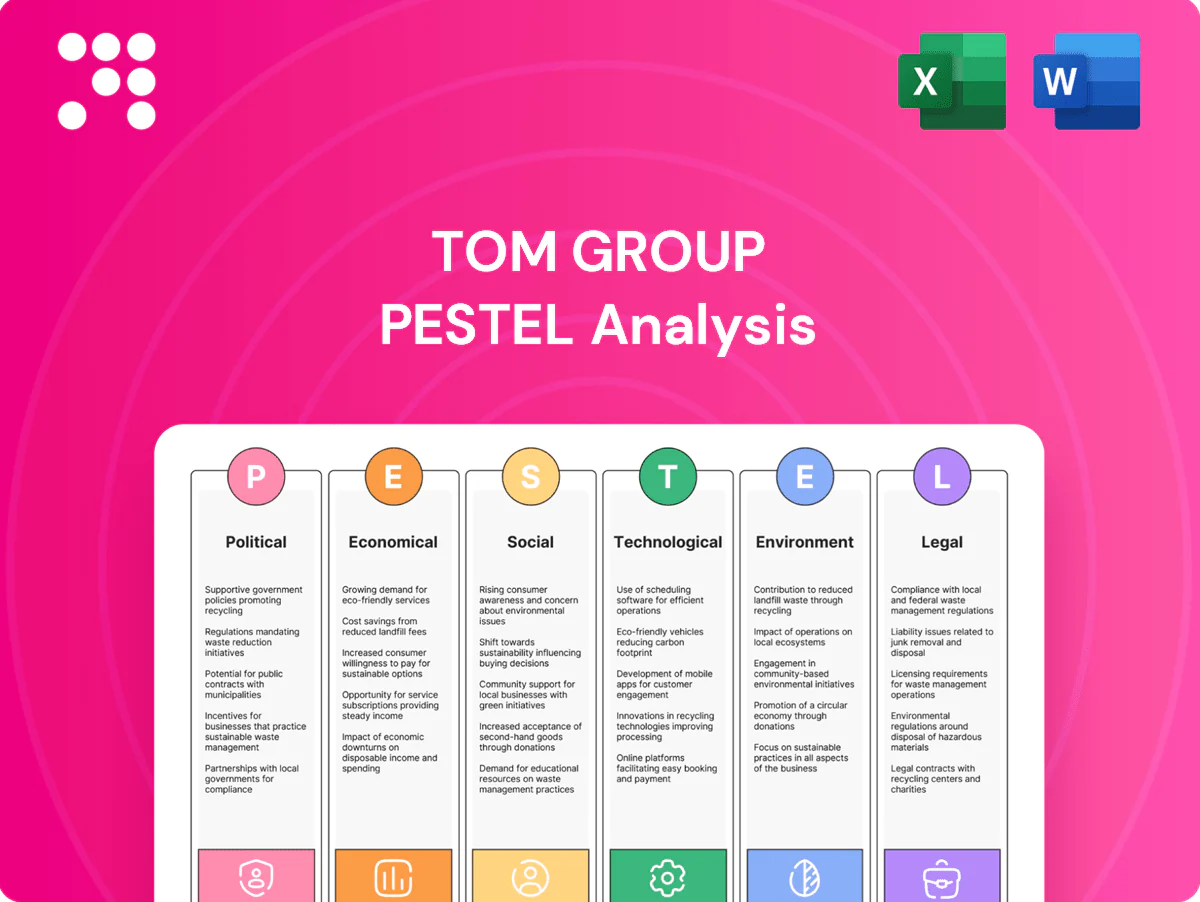
Tom Group PESTLE Analysis

Your Shortcut to Market Insight Starts Here
Gain strategic clarity with our PESTLE Analysis of Tom Group—three concise sections reveal how political, economic, and technological forces shape its trajectory. Ideal for investors and strategists, this report highlights risks and opportunities you can act on immediately. Purchase the full version to access the complete, editable dossier and make confident decisions fast.
Political factors

Mainland China media controls
Licensing, content approvals and censorship in the PRC determine what Tom Group can publish or distribute, with over 1 billion Chinese internet users amplifying impact; tightened oversight has historically delayed product launches and raised compliance spend for media firms. Building regulator relationships and robust internal review workflows is critical for resilience, while diversifying content categories and geographies reduces single-jurisdiction policy risk.
Cross-border operations Hong Kong–Mainland
Differences in Hong Kong and Mainland regulatory regimes affect data, advertising and publishing workflows, complicating cross-border content approvals and IP treatment; Mainland-directed digital ad spend reached about RMB 1.3 trillion in 2023 while Mainland buyers remain over 50% of Hong Kong trade (2023). Operational alignment must embed dual approvals and content standards; shifts in political relations can rapidly alter talent mobility and capital flows. Structuring entities and contracts for dual compliance lowers disruption risk.

Geopolitical tensions and trade policy
US export controls on advanced semiconductors to China began in October 2022 and were expanded through 2023–24 to target high-end AI chips and related software, which could constrain Tom Group’s cloud, adtech and analytics tool supply chains. Sanctions and export controls can restrict access to leading AI models and accelerators used in content operations. Brands have shifted ad spend regionally amid risk concerns, and scenario planning plus supplier redundancy are pragmatic mitigants.

Government support for digital economy
Policy pushes for digital transformation, 5G and smart cities expand addressable markets for Tom Group’s online platforms and outdoor media; China had about 2.59 million 5G base stations by end‑2023 and a digital economy worth CNY 50.2 trillion in 2023, while Hong Kong targets near‑universal 5G coverage—subsidies and pilot zones can cut deployment costs and open public‑sector partnerships if compliance and eligibility are tracked.
- Leverage 5G scale: 2.59M 5G base stations (China, 2023)
- Market size: CNY 50.2T digital economy (2023)
- Use subsidies/pilot zones to lower capex
- Join govt initiatives to access partnerships; monitor eligibility/compliance
Public procurement and state-linked advertisers
State-owned enterprises and public bodies are major buyers of advertising and media services, so Tom Group must meet strict tender rules and content suitability standards to win contracts. Compliance with bidding requirements and typical 30–90 day public-sector payment cycles affects cash flow and pricing strategies. Developing robust tender capabilities can unlock stable, long-term revenue from government-linked advertisers.
- SOE/public demand: major buyer
- Compliance: strict contract & content rules
- Cash flow: 30–90 day payment cycles
- Opportunity: tenders = stable revenue
PRC censorship, HK/Mainland split & US export controls squeeze AI adtech; 5G 2.59M
Regulatory censorship and licensing in the PRC (1.0B+ internet users) drive content approval delays and higher compliance costs; dual HK/Mainland regimes complicate data and ad workflows. US export controls (expanded 2023–24) threaten access to high‑end AI chips and adtech. 5G/digital policy expands addressable markets (2.59M 5G sites; CNY50.2T digital economy, 2023).
| Factor | 2023/24 datapoint |
|---|---|
| Mainland internet users | 1.0B+ |
| 5G base stations (CN) | 2.59M |
| Digital economy (CN) | CNY50.2T |
What is included in the product
 Detailed Word Document
Explores how macro-environmental factors impact Tom Group across Political, Economic, Social, Technological, Environmental and Legal dimensions, with data-backed trends and region-specific regulatory context; designed for executives and investors to identify risks, opportunities and support forward-looking strategy and scenario planning.

 Customizable Excel Spreadsheet
A concise Tom Group PESTLE summary that distills regulatory, economic, social and technological risks into an easily shareable slide-ready format for fast team alignment.
Economic factors

Advertising spend cyclicality
Ad budgets track Greater China macro conditions—China GDP grew 5.2% in 2023—so weaker growth or confidence cuts spend and delays buys.
Slowdowns compress CPMs and extend sales cycles across publishing, outdoor and online, reducing short-term revenue visibility.
Sector mix matters: consumer staples show resilience versus discretionary categories, and flexible pricing plus performance-based models help defend market share.
Consumer spending and e-commerce growth
Rising household income underpins higher online conversion and brand marketing spend, while China’s online retail sales of physical goods reached RMB 13.98 trillion in 2023 (NBS), highlighting scale for players like Tom Group. Expansion into lower-tier cities brings incremental volume but typically lower ARPU, pressuring overall ARPU. Heavy promotional intensity compresses platform margins. Optimizing traffic quality and merchant mix is essential to preserve unit economics.

Currency and capital markets
RMB moved around 7.2–7.4 per USD and HKD remained pegged near 7.75–7.85 in 2024–H1 2025, affecting Tom Group cross-border costs and reported earnings. Tighter funding and higher global rates (Fed funds ~5.25–5.50%) constrained content, tech and inventory investment. A 100–200bp rise lifts hurdle rates for adtech and data projects, reducing NPV. Active FX hedging and disciplined capex prioritization mitigate volatility.

SME advertiser health
SMEs drive over 50% of China’s digital ad demand, making their budget swings material for Tom Group; credit constraints or inventory gluts can rapidly cut campaign spend, as seen in periodic SME retrenchments since 2022. Self-serve tools and outcome-pricing help retain spend in downturns, while bundled marketing and payment terms boost stickiness and cash collection.
- SME share: >50% of digital ad demand
- Risk: rapid budget cuts from credit stress
- Mitigation: self-serve + outcome-pricing
- Retention: bundled solutions improve stickiness & collections
Outdoor media asset utilization
Outdoor media utilization for Tom Group is driven by foot traffic and mobility patterns that determine OOH impressions and yield; macroeconomic shifts and local events materially alter occupancy and availability, affecting network revenue. Dynamic pricing and programmatic OOH help smooth demand across peak and off-peak periods, while location analytics raises advertiser ROI and optimizes network planning.
- Foot traffic → impressions/yield
- Macroeconomic & events → occupancy swings
- Programmatic/dynamic pricing → demand smoothing
- Location analytics → higher ROI, better planning
PRC censorship, HK/Mainland split & US export controls squeeze AI adtech; 5G 2.59M
Ad spends track Greater China macro: China GDP +5.2% (2023) and online retail RMB13.98trn (2023) underpin demand but slowdowns cut CPMs and extend sales cycles. SMEs (>50% digital ad demand) cause volatility; self-serve/outcome pricing aids retention. RMB ~7.2–7.4/USD and Fed funds ~5.25–5.50% tighten funding, raise hurdle rates and capex discipline.
| Metric | 2023–H1 2025 |
|---|---|
| China GDP (2023) | +5.2% |
| Online retail | RMB13.98tn |
| SME share digital ads | >50% |
| RMB/USD | 7.2–7.4 |
| Fed funds | 5.25–5.50% |
Same Document Delivered
Tom Group PESTLE Analysis
The preview shown here is the exact Tom Group PESTLE Analysis you’ll receive after purchase—fully formatted and ready to use. This is a real snapshot of the product, delivered exactly as shown with comprehensive political, economic, social, technological, legal, and environmental insights. No placeholders or teasers—what you see is the final, downloadable file you’ll own immediately after checkout.

Your Shortcut to Market Insight Starts Here
Gain strategic clarity with our PESTLE Analysis of Tom Group—three concise sections reveal how political, economic, and technological forces shape its trajectory. Ideal for investors and strategists, this report highlights risks and opportunities you can act on immediately. Purchase the full version to access the complete, editable dossier and make confident decisions fast.
Political factors
Mainland China media controls
Licensing, content approvals and censorship in the PRC determine what Tom Group can publish or distribute, with over 1 billion Chinese internet users amplifying impact; tightened oversight has historically delayed product launches and raised compliance spend for media firms. Building regulator relationships and robust internal review workflows is critical for resilience, while diversifying content categories and geographies reduces single-jurisdiction policy risk.
Cross-border operations Hong Kong–Mainland
Differences in Hong Kong and Mainland regulatory regimes affect data, advertising and publishing workflows, complicating cross-border content approvals and IP treatment; Mainland-directed digital ad spend reached about RMB 1.3 trillion in 2023 while Mainland buyers remain over 50% of Hong Kong trade (2023). Operational alignment must embed dual approvals and content standards; shifts in political relations can rapidly alter talent mobility and capital flows. Structuring entities and contracts for dual compliance lowers disruption risk.
Geopolitical tensions and trade policy
US export controls on advanced semiconductors to China began in October 2022 and were expanded through 2023–24 to target high-end AI chips and related software, which could constrain Tom Group’s cloud, adtech and analytics tool supply chains. Sanctions and export controls can restrict access to leading AI models and accelerators used in content operations. Brands have shifted ad spend regionally amid risk concerns, and scenario planning plus supplier redundancy are pragmatic mitigants.
Government support for digital economy
Policy pushes for digital transformation, 5G and smart cities expand addressable markets for Tom Group’s online platforms and outdoor media; China had about 2.59 million 5G base stations by end‑2023 and a digital economy worth CNY 50.2 trillion in 2023, while Hong Kong targets near‑universal 5G coverage—subsidies and pilot zones can cut deployment costs and open public‑sector partnerships if compliance and eligibility are tracked.
- Leverage 5G scale: 2.59M 5G base stations (China, 2023)
- Market size: CNY 50.2T digital economy (2023)
- Use subsidies/pilot zones to lower capex
- Join govt initiatives to access partnerships; monitor eligibility/compliance
Public procurement and state-linked advertisers
State-owned enterprises and public bodies are major buyers of advertising and media services, so Tom Group must meet strict tender rules and content suitability standards to win contracts. Compliance with bidding requirements and typical 30–90 day public-sector payment cycles affects cash flow and pricing strategies. Developing robust tender capabilities can unlock stable, long-term revenue from government-linked advertisers.
- SOE/public demand: major buyer
- Compliance: strict contract & content rules
- Cash flow: 30–90 day payment cycles
- Opportunity: tenders = stable revenue
PRC censorship, HK/Mainland split & US export controls squeeze AI adtech; 5G 2.59M
Regulatory censorship and licensing in the PRC (1.0B+ internet users) drive content approval delays and higher compliance costs; dual HK/Mainland regimes complicate data and ad workflows. US export controls (expanded 2023–24) threaten access to high‑end AI chips and adtech. 5G/digital policy expands addressable markets (2.59M 5G sites; CNY50.2T digital economy, 2023).
| Factor | 2023/24 datapoint |
|---|---|
| Mainland internet users | 1.0B+ |
| 5G base stations (CN) | 2.59M |
| Digital economy (CN) | CNY50.2T |
What is included in the product
Detailed Word Document
Explores how macro-environmental factors impact Tom Group across Political, Economic, Social, Technological, Environmental and Legal dimensions, with data-backed trends and region-specific regulatory context; designed for executives and investors to identify risks, opportunities and support forward-looking strategy and scenario planning.
Customizable Excel Spreadsheet
A concise Tom Group PESTLE summary that distills regulatory, economic, social and technological risks into an easily shareable slide-ready format for fast team alignment.
Economic factors
Advertising spend cyclicality
Ad budgets track Greater China macro conditions—China GDP grew 5.2% in 2023—so weaker growth or confidence cuts spend and delays buys.
Slowdowns compress CPMs and extend sales cycles across publishing, outdoor and online, reducing short-term revenue visibility.
Sector mix matters: consumer staples show resilience versus discretionary categories, and flexible pricing plus performance-based models help defend market share.
Consumer spending and e-commerce growth
Rising household income underpins higher online conversion and brand marketing spend, while China’s online retail sales of physical goods reached RMB 13.98 trillion in 2023 (NBS), highlighting scale for players like Tom Group. Expansion into lower-tier cities brings incremental volume but typically lower ARPU, pressuring overall ARPU. Heavy promotional intensity compresses platform margins. Optimizing traffic quality and merchant mix is essential to preserve unit economics.
Currency and capital markets
RMB moved around 7.2–7.4 per USD and HKD remained pegged near 7.75–7.85 in 2024–H1 2025, affecting Tom Group cross-border costs and reported earnings. Tighter funding and higher global rates (Fed funds ~5.25–5.50%) constrained content, tech and inventory investment. A 100–200bp rise lifts hurdle rates for adtech and data projects, reducing NPV. Active FX hedging and disciplined capex prioritization mitigate volatility.
SME advertiser health
SMEs drive over 50% of China’s digital ad demand, making their budget swings material for Tom Group; credit constraints or inventory gluts can rapidly cut campaign spend, as seen in periodic SME retrenchments since 2022. Self-serve tools and outcome-pricing help retain spend in downturns, while bundled marketing and payment terms boost stickiness and cash collection.
- SME share: >50% of digital ad demand
- Risk: rapid budget cuts from credit stress
- Mitigation: self-serve + outcome-pricing
- Retention: bundled solutions improve stickiness & collections
Outdoor media asset utilization
Outdoor media utilization for Tom Group is driven by foot traffic and mobility patterns that determine OOH impressions and yield; macroeconomic shifts and local events materially alter occupancy and availability, affecting network revenue. Dynamic pricing and programmatic OOH help smooth demand across peak and off-peak periods, while location analytics raises advertiser ROI and optimizes network planning.
- Foot traffic → impressions/yield
- Macroeconomic & events → occupancy swings
- Programmatic/dynamic pricing → demand smoothing
- Location analytics → higher ROI, better planning
PRC censorship, HK/Mainland split & US export controls squeeze AI adtech; 5G 2.59M
Ad spends track Greater China macro: China GDP +5.2% (2023) and online retail RMB13.98trn (2023) underpin demand but slowdowns cut CPMs and extend sales cycles. SMEs (>50% digital ad demand) cause volatility; self-serve/outcome pricing aids retention. RMB ~7.2–7.4/USD and Fed funds ~5.25–5.50% tighten funding, raise hurdle rates and capex discipline.
| Metric | 2023–H1 2025 |
|---|---|
| China GDP (2023) | +5.2% |
| Online retail | RMB13.98tn |
| SME share digital ads | >50% |
| RMB/USD | 7.2–7.4 |
| Fed funds | 5.25–5.50% |
Same Document Delivered
Tom Group PESTLE Analysis
The preview shown here is the exact Tom Group PESTLE Analysis you’ll receive after purchase—fully formatted and ready to use. This is a real snapshot of the product, delivered exactly as shown with comprehensive political, economic, social, technological, legal, and environmental insights. No placeholders or teasers—what you see is the final, downloadable file you’ll own immediately after checkout.
Original: $10.00
-65%$10.00
$3.50Description
Your Shortcut to Market Insight Starts Here
Gain strategic clarity with our PESTLE Analysis of Tom Group—three concise sections reveal how political, economic, and technological forces shape its trajectory. Ideal for investors and strategists, this report highlights risks and opportunities you can act on immediately. Purchase the full version to access the complete, editable dossier and make confident decisions fast.
Political factors
Mainland China media controls
Licensing, content approvals and censorship in the PRC determine what Tom Group can publish or distribute, with over 1 billion Chinese internet users amplifying impact; tightened oversight has historically delayed product launches and raised compliance spend for media firms. Building regulator relationships and robust internal review workflows is critical for resilience, while diversifying content categories and geographies reduces single-jurisdiction policy risk.
Cross-border operations Hong Kong–Mainland
Differences in Hong Kong and Mainland regulatory regimes affect data, advertising and publishing workflows, complicating cross-border content approvals and IP treatment; Mainland-directed digital ad spend reached about RMB 1.3 trillion in 2023 while Mainland buyers remain over 50% of Hong Kong trade (2023). Operational alignment must embed dual approvals and content standards; shifts in political relations can rapidly alter talent mobility and capital flows. Structuring entities and contracts for dual compliance lowers disruption risk.
Geopolitical tensions and trade policy
US export controls on advanced semiconductors to China began in October 2022 and were expanded through 2023–24 to target high-end AI chips and related software, which could constrain Tom Group’s cloud, adtech and analytics tool supply chains. Sanctions and export controls can restrict access to leading AI models and accelerators used in content operations. Brands have shifted ad spend regionally amid risk concerns, and scenario planning plus supplier redundancy are pragmatic mitigants.
Government support for digital economy
Policy pushes for digital transformation, 5G and smart cities expand addressable markets for Tom Group’s online platforms and outdoor media; China had about 2.59 million 5G base stations by end‑2023 and a digital economy worth CNY 50.2 trillion in 2023, while Hong Kong targets near‑universal 5G coverage—subsidies and pilot zones can cut deployment costs and open public‑sector partnerships if compliance and eligibility are tracked.
- Leverage 5G scale: 2.59M 5G base stations (China, 2023)
- Market size: CNY 50.2T digital economy (2023)
- Use subsidies/pilot zones to lower capex
- Join govt initiatives to access partnerships; monitor eligibility/compliance
Public procurement and state-linked advertisers
State-owned enterprises and public bodies are major buyers of advertising and media services, so Tom Group must meet strict tender rules and content suitability standards to win contracts. Compliance with bidding requirements and typical 30–90 day public-sector payment cycles affects cash flow and pricing strategies. Developing robust tender capabilities can unlock stable, long-term revenue from government-linked advertisers.
- SOE/public demand: major buyer
- Compliance: strict contract & content rules
- Cash flow: 30–90 day payment cycles
- Opportunity: tenders = stable revenue
PRC censorship, HK/Mainland split & US export controls squeeze AI adtech; 5G 2.59M
Regulatory censorship and licensing in the PRC (1.0B+ internet users) drive content approval delays and higher compliance costs; dual HK/Mainland regimes complicate data and ad workflows. US export controls (expanded 2023–24) threaten access to high‑end AI chips and adtech. 5G/digital policy expands addressable markets (2.59M 5G sites; CNY50.2T digital economy, 2023).
| Factor | 2023/24 datapoint |
|---|---|
| Mainland internet users | 1.0B+ |
| 5G base stations (CN) | 2.59M |
| Digital economy (CN) | CNY50.2T |
What is included in the product
Detailed Word Document
Explores how macro-environmental factors impact Tom Group across Political, Economic, Social, Technological, Environmental and Legal dimensions, with data-backed trends and region-specific regulatory context; designed for executives and investors to identify risks, opportunities and support forward-looking strategy and scenario planning.
Customizable Excel Spreadsheet
A concise Tom Group PESTLE summary that distills regulatory, economic, social and technological risks into an easily shareable slide-ready format for fast team alignment.
Economic factors
Advertising spend cyclicality
Ad budgets track Greater China macro conditions—China GDP grew 5.2% in 2023—so weaker growth or confidence cuts spend and delays buys.
Slowdowns compress CPMs and extend sales cycles across publishing, outdoor and online, reducing short-term revenue visibility.
Sector mix matters: consumer staples show resilience versus discretionary categories, and flexible pricing plus performance-based models help defend market share.
Consumer spending and e-commerce growth
Rising household income underpins higher online conversion and brand marketing spend, while China’s online retail sales of physical goods reached RMB 13.98 trillion in 2023 (NBS), highlighting scale for players like Tom Group. Expansion into lower-tier cities brings incremental volume but typically lower ARPU, pressuring overall ARPU. Heavy promotional intensity compresses platform margins. Optimizing traffic quality and merchant mix is essential to preserve unit economics.
Currency and capital markets
RMB moved around 7.2–7.4 per USD and HKD remained pegged near 7.75–7.85 in 2024–H1 2025, affecting Tom Group cross-border costs and reported earnings. Tighter funding and higher global rates (Fed funds ~5.25–5.50%) constrained content, tech and inventory investment. A 100–200bp rise lifts hurdle rates for adtech and data projects, reducing NPV. Active FX hedging and disciplined capex prioritization mitigate volatility.
SME advertiser health
SMEs drive over 50% of China’s digital ad demand, making their budget swings material for Tom Group; credit constraints or inventory gluts can rapidly cut campaign spend, as seen in periodic SME retrenchments since 2022. Self-serve tools and outcome-pricing help retain spend in downturns, while bundled marketing and payment terms boost stickiness and cash collection.
- SME share: >50% of digital ad demand
- Risk: rapid budget cuts from credit stress
- Mitigation: self-serve + outcome-pricing
- Retention: bundled solutions improve stickiness & collections
Outdoor media asset utilization
Outdoor media utilization for Tom Group is driven by foot traffic and mobility patterns that determine OOH impressions and yield; macroeconomic shifts and local events materially alter occupancy and availability, affecting network revenue. Dynamic pricing and programmatic OOH help smooth demand across peak and off-peak periods, while location analytics raises advertiser ROI and optimizes network planning.
- Foot traffic → impressions/yield
- Macroeconomic & events → occupancy swings
- Programmatic/dynamic pricing → demand smoothing
- Location analytics → higher ROI, better planning
PRC censorship, HK/Mainland split & US export controls squeeze AI adtech; 5G 2.59M
Ad spends track Greater China macro: China GDP +5.2% (2023) and online retail RMB13.98trn (2023) underpin demand but slowdowns cut CPMs and extend sales cycles. SMEs (>50% digital ad demand) cause volatility; self-serve/outcome pricing aids retention. RMB ~7.2–7.4/USD and Fed funds ~5.25–5.50% tighten funding, raise hurdle rates and capex discipline.
| Metric | 2023–H1 2025 |
|---|---|
| China GDP (2023) | +5.2% |
| Online retail | RMB13.98tn |
| SME share digital ads | >50% |
| RMB/USD | 7.2–7.4 |
| Fed funds | 5.25–5.50% |
Same Document Delivered
Tom Group PESTLE Analysis
The preview shown here is the exact Tom Group PESTLE Analysis you’ll receive after purchase—fully formatted and ready to use. This is a real snapshot of the product, delivered exactly as shown with comprehensive political, economic, social, technological, legal, and environmental insights. No placeholders or teasers—what you see is the final, downloadable file you’ll own immediately after checkout.











