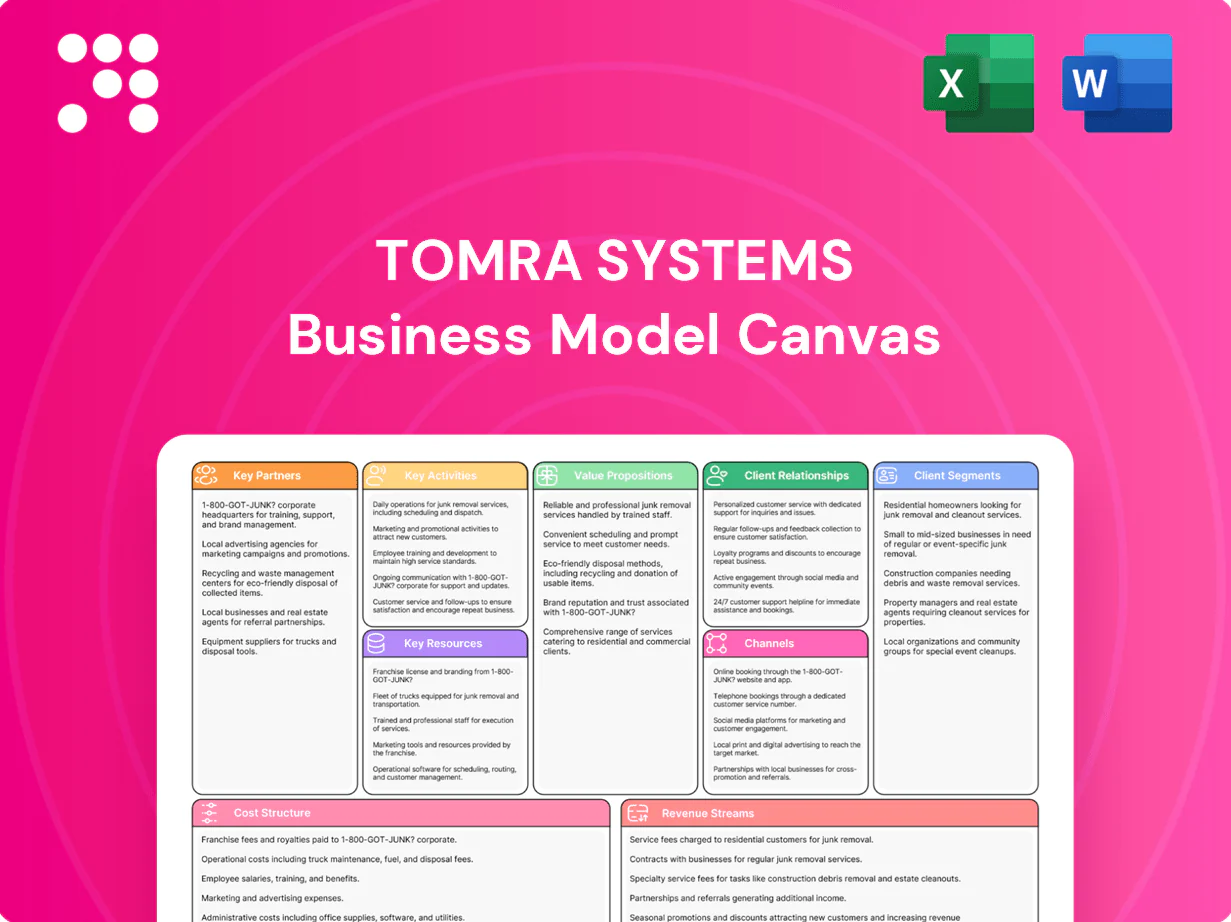
Tomra Systems Business Model Canvas

Strategic Business Model Canvas: Value Creation, Scaling, and Monetization Blueprint
Unlock the full strategic blueprint behind Tomra Systems' business model with our detailed Business Model Canvas—three to five concise sections reveal how the company creates value, scales operations, and monetizes innovation. Ideal for investors, consultants, and founders seeking actionable insights. Download the complete, editable canvas to benchmark and adapt proven strategies.
Partnerships

Municipalities and EPR schemes
Partnerships with municipalities and EPR organizations secure steady deployment of TOMRA’s collection systems across its network of over 80 markets, leveraging the company’s experience since 1972. These alliances align TOMRA solutions with national recycling targets and regulatory frameworks, improving compliance and reporting. Joint programs boost adoption and real-time data transparency to advance circular economy goals. Co-funding models materially lower customer capex barriers for rollouts.
Beverage brands and retailers
Alliances with bottlers and retail chains drive Tomra RVM rollouts, with a global installed base exceeding 80,000 machines that have collected over 40 billion containers, enabling compliant deposit-return operations and stronger brand sustainability. Integrated systems boost consumer returns, throughput and fraud prevention, while data-sharing speeds deposit clearing and refines inventory planning for partners.

Waste management and MRF operators
Collaborations with recyclers and 50+ MRF operators enable Tomra’s sensor-based sorting at scale, with joint pilots in 2023–24 proving purity above 98%, yield improvements of 5–15% and operational uptime >95%. Partners supply daily operational feedback to refine algorithms and hardware, while long-term service contracts tie performance guarantees to SLAs and shared CAPEX/OPEX metrics.

Food processors and packhouses
Partnerships with growers, processors and packhouses let Tomra align optical sorting to on-farm variability and packhouse flow, improving grade consistency and reducing rejections; Tomra operates in 80+ markets. Integrated solutions cut manual grading intensity and help address FAO's estimate that ~1.3 billion tonnes of food is lost or wasted annually. Co-development with processors ensures grading specs match retailer standards and field season peaks are supported by service networks to meet strict uptime targets.
- 80+ markets
- FAO: ~1.3 billion tonnes food loss/waste
- Co-development aligns grades to retailers
- Service networks cover seasonal peaks and uptime
Technology suppliers and research institutes
Alliances with sensor, optics, robotics and AI providers accelerate Tomra Systems innovation, shortening product development cycles and improving automation outcomes; Tomra reported over 4,000 patents and patent applications in 2024 reflecting this collaborative R&D intensity. Universities and labs advance materials science and machine learning models used in sorting and reverse-vending systems, while joint IP and standards work boosts interoperability and certification across supply chains. Supply partners secure resilient, high-quality component pipelines critical for uptime and global deployments.
- Patents: over 4,000 (2024)
- Focus: sensor, optics, robotics, AI
- Benefits: faster innovation, interoperability, certification
- Supply resilience: ensured for global installed base
Partnerships secure rollouts in 80+ markets, 80,000+ RVMs and 98%+ purity
Partnerships with municipalities/EPR secure deployments across 80+ markets and align TOMRA to recycling targets. Alliances with bottlers/retailers support 80,000+ RVMs that collected >40 billion containers. R&D and supply partners underpin >4,000 patents (2024) and sensor/AI innovation; recycler/MRF pilots (2023–24) show >98% purity, 5–15% yield uplift and uptime >95%.
| Partnership | Metric | Impact |
|---|---|---|
| Municipalities/EPR | 80+ markets | Regulatory alignment |
| Bottlers/Retail | 80,000+ RVMs; >40bn containers | Deposit compliance |
| R&D/Suppliers | >4,000 patents (2024) | Faster innovation |
| Recyclers/MRFs | >98% purity; 5–15% yield | Higher recovery |
What is included in the product
 Detailed Word Document
A comprehensive Business Model Canvas tailored to Tomra Systems, detailing customer segments, channels, value propositions and the nine BMC blocks to reflect its sensor-based sorting, reverse-vending and circular-economy operations. Ideal for presentations and investor discussions, it includes competitive advantages, SWOT-linked insights and practical validation for strategic decisions.

 Customizable Excel Spreadsheet
High-level view of Tomra Systems' business model with editable cells, helping teams quickly identify core recycling and sensor-based sorting value drivers and cut hours of formatting when preparing board-ready strategy snapshots.
Activities

Sensor and AI R&D
Developing optical, X-ray, hyperspectral sensors and AI models is core to TOMRA performance, with R&D covering hardware, firmware and cloud analytics to boost throughput and recovery rates. Continuous training on diverse material datasets — often millions of spectra — improves classification accuracy and reduces false positives. Validation combines lab testing and in-field trials; the hyperspectral market was estimated at ~USD 1.1bn in 2024, underscoring investment relevance.
Manufacturing and quality control
Precision assembly of Tomra sorting and collection equipment demands tight tolerances and automation to meet industrial uptime targets; rigorous QA simulates heavy-duty cycles to ensure reliability. Supplier qualification programs secure component consistency across more than 80 markets. Lean manufacturing and continuous improvement cut costs and shorten lead times; Tomra employed about 5,000 people in 2024.

Systems integration and project delivery
Customizing lines for recycling, food and mining sites aligns with Tomra's global installed base of over 80,000 sensor-based systems, delivering site-specific layouts that reach throughputs up to 50 t/h.
Engineering teams integrate conveyors, feeders, robotics and controls to boost sorting efficiency by ~20% and target material purity levels above 95%.
Commissioning and tuning typically cut startup downtime by about 30%, while detailed documentation and handover enable operators to sustain performance and traceability.

After-sales service and upgrades
Preventive maintenance programs maximize uptime and extend asset life, reducing total cost of ownership for Tomra's network of over 82,000 collection and sorting units operating in 80+ markets (2024). Remote monitoring and analytics enable predictive interventions to cut downtime and service costs. Regular software updates strengthen detection rates, fraud controls and UX, while centralized spare-parts logistics sustain global fleet availability.
- Preventive maintenance: longer asset life, lower TCO
- Remote monitoring: predictive interventions, less downtime
- Software updates: improved detection, fraud control, UX
- Spare parts logistics: global fleet uptime
Sales, partnerships, and compliance
Direct sales and partner enablement drive adoption, supported by Tomra’s global installed base of over 82,000 reverse vending and sorting systems (2024) and annual revenue of NOK 16.6 billion (2024). Regulatory tracking aligns products with DRS, food safety, and environmental rules; training and certification build customer capability, while marketing highlights measured ROI and sustainability outcomes.
- Installed base: 82,000+ systems (2024)
- Revenue: NOK 16.6 bn (2024)
- Focus: DRS, food safety, environmental compliance
- Activities: sales, partner enablement, training, ROI marketing
Optics, X-ray, hyperspectral and AI boost sorting across 82,000+ systems
R&D in optics, X-ray, hyperspectral sensors and AI drives classification accuracy and throughput across TOMRA’s 82,000+ systems, backed by a 2024 hyperspectral market ~USD 1.1bn. Precision manufacturing, QA and supplier programs support global deployment; Tomra had ~5,000 employees and NOK 16.6bn revenue in 2024. Commissioning, remote monitoring and preventive maintenance cut startup downtime ~30% and raise uptime.
| Metric | 2024 |
|---|---|
| Installed base | 82,000+ |
| Revenue | NOK 16.6 bn |
| Employees | ~5,000 |
| Hyperspectral market | ~USD 1.1 bn |
| Max throughput | 50 t/h |
Preview Before You Purchase
Business Model Canvas
The document you're previewing is the actual Tomra Systems Business Model Canvas you’ll receive after purchase. It’s not a mockup—this snapshot comes from the final editable file. After buying, you’ll instantly download the complete Word and Excel versions, formatted and ready to use. No surprises, just the same professional deliverable.

Strategic Business Model Canvas: Value Creation, Scaling, and Monetization Blueprint
Unlock the full strategic blueprint behind Tomra Systems' business model with our detailed Business Model Canvas—three to five concise sections reveal how the company creates value, scales operations, and monetizes innovation. Ideal for investors, consultants, and founders seeking actionable insights. Download the complete, editable canvas to benchmark and adapt proven strategies.
Partnerships
Municipalities and EPR schemes
Partnerships with municipalities and EPR organizations secure steady deployment of TOMRA’s collection systems across its network of over 80 markets, leveraging the company’s experience since 1972. These alliances align TOMRA solutions with national recycling targets and regulatory frameworks, improving compliance and reporting. Joint programs boost adoption and real-time data transparency to advance circular economy goals. Co-funding models materially lower customer capex barriers for rollouts.
Beverage brands and retailers
Alliances with bottlers and retail chains drive Tomra RVM rollouts, with a global installed base exceeding 80,000 machines that have collected over 40 billion containers, enabling compliant deposit-return operations and stronger brand sustainability. Integrated systems boost consumer returns, throughput and fraud prevention, while data-sharing speeds deposit clearing and refines inventory planning for partners.
Waste management and MRF operators
Collaborations with recyclers and 50+ MRF operators enable Tomra’s sensor-based sorting at scale, with joint pilots in 2023–24 proving purity above 98%, yield improvements of 5–15% and operational uptime >95%. Partners supply daily operational feedback to refine algorithms and hardware, while long-term service contracts tie performance guarantees to SLAs and shared CAPEX/OPEX metrics.
Food processors and packhouses
Partnerships with growers, processors and packhouses let Tomra align optical sorting to on-farm variability and packhouse flow, improving grade consistency and reducing rejections; Tomra operates in 80+ markets. Integrated solutions cut manual grading intensity and help address FAO's estimate that ~1.3 billion tonnes of food is lost or wasted annually. Co-development with processors ensures grading specs match retailer standards and field season peaks are supported by service networks to meet strict uptime targets.
- 80+ markets
- FAO: ~1.3 billion tonnes food loss/waste
- Co-development aligns grades to retailers
- Service networks cover seasonal peaks and uptime
Technology suppliers and research institutes
Alliances with sensor, optics, robotics and AI providers accelerate Tomra Systems innovation, shortening product development cycles and improving automation outcomes; Tomra reported over 4,000 patents and patent applications in 2024 reflecting this collaborative R&D intensity. Universities and labs advance materials science and machine learning models used in sorting and reverse-vending systems, while joint IP and standards work boosts interoperability and certification across supply chains. Supply partners secure resilient, high-quality component pipelines critical for uptime and global deployments.
- Patents: over 4,000 (2024)
- Focus: sensor, optics, robotics, AI
- Benefits: faster innovation, interoperability, certification
- Supply resilience: ensured for global installed base
Partnerships secure rollouts in 80+ markets, 80,000+ RVMs and 98%+ purity
Partnerships with municipalities/EPR secure deployments across 80+ markets and align TOMRA to recycling targets. Alliances with bottlers/retailers support 80,000+ RVMs that collected >40 billion containers. R&D and supply partners underpin >4,000 patents (2024) and sensor/AI innovation; recycler/MRF pilots (2023–24) show >98% purity, 5–15% yield uplift and uptime >95%.
| Partnership | Metric | Impact |
|---|---|---|
| Municipalities/EPR | 80+ markets | Regulatory alignment |
| Bottlers/Retail | 80,000+ RVMs; >40bn containers | Deposit compliance |
| R&D/Suppliers | >4,000 patents (2024) | Faster innovation |
| Recyclers/MRFs | >98% purity; 5–15% yield | Higher recovery |
What is included in the product
Detailed Word Document
A comprehensive Business Model Canvas tailored to Tomra Systems, detailing customer segments, channels, value propositions and the nine BMC blocks to reflect its sensor-based sorting, reverse-vending and circular-economy operations. Ideal for presentations and investor discussions, it includes competitive advantages, SWOT-linked insights and practical validation for strategic decisions.
Customizable Excel Spreadsheet
High-level view of Tomra Systems' business model with editable cells, helping teams quickly identify core recycling and sensor-based sorting value drivers and cut hours of formatting when preparing board-ready strategy snapshots.
Activities
Sensor and AI R&D
Developing optical, X-ray, hyperspectral sensors and AI models is core to TOMRA performance, with R&D covering hardware, firmware and cloud analytics to boost throughput and recovery rates. Continuous training on diverse material datasets — often millions of spectra — improves classification accuracy and reduces false positives. Validation combines lab testing and in-field trials; the hyperspectral market was estimated at ~USD 1.1bn in 2024, underscoring investment relevance.
Manufacturing and quality control
Precision assembly of Tomra sorting and collection equipment demands tight tolerances and automation to meet industrial uptime targets; rigorous QA simulates heavy-duty cycles to ensure reliability. Supplier qualification programs secure component consistency across more than 80 markets. Lean manufacturing and continuous improvement cut costs and shorten lead times; Tomra employed about 5,000 people in 2024.
Systems integration and project delivery
Customizing lines for recycling, food and mining sites aligns with Tomra's global installed base of over 80,000 sensor-based systems, delivering site-specific layouts that reach throughputs up to 50 t/h.
Engineering teams integrate conveyors, feeders, robotics and controls to boost sorting efficiency by ~20% and target material purity levels above 95%.
Commissioning and tuning typically cut startup downtime by about 30%, while detailed documentation and handover enable operators to sustain performance and traceability.
After-sales service and upgrades
Preventive maintenance programs maximize uptime and extend asset life, reducing total cost of ownership for Tomra's network of over 82,000 collection and sorting units operating in 80+ markets (2024). Remote monitoring and analytics enable predictive interventions to cut downtime and service costs. Regular software updates strengthen detection rates, fraud controls and UX, while centralized spare-parts logistics sustain global fleet availability.
- Preventive maintenance: longer asset life, lower TCO
- Remote monitoring: predictive interventions, less downtime
- Software updates: improved detection, fraud control, UX
- Spare parts logistics: global fleet uptime
Sales, partnerships, and compliance
Direct sales and partner enablement drive adoption, supported by Tomra’s global installed base of over 82,000 reverse vending and sorting systems (2024) and annual revenue of NOK 16.6 billion (2024). Regulatory tracking aligns products with DRS, food safety, and environmental rules; training and certification build customer capability, while marketing highlights measured ROI and sustainability outcomes.
- Installed base: 82,000+ systems (2024)
- Revenue: NOK 16.6 bn (2024)
- Focus: DRS, food safety, environmental compliance
- Activities: sales, partner enablement, training, ROI marketing
Optics, X-ray, hyperspectral and AI boost sorting across 82,000+ systems
R&D in optics, X-ray, hyperspectral sensors and AI drives classification accuracy and throughput across TOMRA’s 82,000+ systems, backed by a 2024 hyperspectral market ~USD 1.1bn. Precision manufacturing, QA and supplier programs support global deployment; Tomra had ~5,000 employees and NOK 16.6bn revenue in 2024. Commissioning, remote monitoring and preventive maintenance cut startup downtime ~30% and raise uptime.
| Metric | 2024 |
|---|---|
| Installed base | 82,000+ |
| Revenue | NOK 16.6 bn |
| Employees | ~5,000 |
| Hyperspectral market | ~USD 1.1 bn |
| Max throughput | 50 t/h |
Preview Before You Purchase
Business Model Canvas
The document you're previewing is the actual Tomra Systems Business Model Canvas you’ll receive after purchase. It’s not a mockup—this snapshot comes from the final editable file. After buying, you’ll instantly download the complete Word and Excel versions, formatted and ready to use. No surprises, just the same professional deliverable.
Description
Strategic Business Model Canvas: Value Creation, Scaling, and Monetization Blueprint
Unlock the full strategic blueprint behind Tomra Systems' business model with our detailed Business Model Canvas—three to five concise sections reveal how the company creates value, scales operations, and monetizes innovation. Ideal for investors, consultants, and founders seeking actionable insights. Download the complete, editable canvas to benchmark and adapt proven strategies.
Partnerships
Municipalities and EPR schemes
Partnerships with municipalities and EPR organizations secure steady deployment of TOMRA’s collection systems across its network of over 80 markets, leveraging the company’s experience since 1972. These alliances align TOMRA solutions with national recycling targets and regulatory frameworks, improving compliance and reporting. Joint programs boost adoption and real-time data transparency to advance circular economy goals. Co-funding models materially lower customer capex barriers for rollouts.
Beverage brands and retailers
Alliances with bottlers and retail chains drive Tomra RVM rollouts, with a global installed base exceeding 80,000 machines that have collected over 40 billion containers, enabling compliant deposit-return operations and stronger brand sustainability. Integrated systems boost consumer returns, throughput and fraud prevention, while data-sharing speeds deposit clearing and refines inventory planning for partners.
Waste management and MRF operators
Collaborations with recyclers and 50+ MRF operators enable Tomra’s sensor-based sorting at scale, with joint pilots in 2023–24 proving purity above 98%, yield improvements of 5–15% and operational uptime >95%. Partners supply daily operational feedback to refine algorithms and hardware, while long-term service contracts tie performance guarantees to SLAs and shared CAPEX/OPEX metrics.
Food processors and packhouses
Partnerships with growers, processors and packhouses let Tomra align optical sorting to on-farm variability and packhouse flow, improving grade consistency and reducing rejections; Tomra operates in 80+ markets. Integrated solutions cut manual grading intensity and help address FAO's estimate that ~1.3 billion tonnes of food is lost or wasted annually. Co-development with processors ensures grading specs match retailer standards and field season peaks are supported by service networks to meet strict uptime targets.
- 80+ markets
- FAO: ~1.3 billion tonnes food loss/waste
- Co-development aligns grades to retailers
- Service networks cover seasonal peaks and uptime
Technology suppliers and research institutes
Alliances with sensor, optics, robotics and AI providers accelerate Tomra Systems innovation, shortening product development cycles and improving automation outcomes; Tomra reported over 4,000 patents and patent applications in 2024 reflecting this collaborative R&D intensity. Universities and labs advance materials science and machine learning models used in sorting and reverse-vending systems, while joint IP and standards work boosts interoperability and certification across supply chains. Supply partners secure resilient, high-quality component pipelines critical for uptime and global deployments.
- Patents: over 4,000 (2024)
- Focus: sensor, optics, robotics, AI
- Benefits: faster innovation, interoperability, certification
- Supply resilience: ensured for global installed base
Partnerships secure rollouts in 80+ markets, 80,000+ RVMs and 98%+ purity
Partnerships with municipalities/EPR secure deployments across 80+ markets and align TOMRA to recycling targets. Alliances with bottlers/retailers support 80,000+ RVMs that collected >40 billion containers. R&D and supply partners underpin >4,000 patents (2024) and sensor/AI innovation; recycler/MRF pilots (2023–24) show >98% purity, 5–15% yield uplift and uptime >95%.
| Partnership | Metric | Impact |
|---|---|---|
| Municipalities/EPR | 80+ markets | Regulatory alignment |
| Bottlers/Retail | 80,000+ RVMs; >40bn containers | Deposit compliance |
| R&D/Suppliers | >4,000 patents (2024) | Faster innovation |
| Recyclers/MRFs | >98% purity; 5–15% yield | Higher recovery |
What is included in the product
Detailed Word Document
A comprehensive Business Model Canvas tailored to Tomra Systems, detailing customer segments, channels, value propositions and the nine BMC blocks to reflect its sensor-based sorting, reverse-vending and circular-economy operations. Ideal for presentations and investor discussions, it includes competitive advantages, SWOT-linked insights and practical validation for strategic decisions.
Customizable Excel Spreadsheet
High-level view of Tomra Systems' business model with editable cells, helping teams quickly identify core recycling and sensor-based sorting value drivers and cut hours of formatting when preparing board-ready strategy snapshots.
Activities
Sensor and AI R&D
Developing optical, X-ray, hyperspectral sensors and AI models is core to TOMRA performance, with R&D covering hardware, firmware and cloud analytics to boost throughput and recovery rates. Continuous training on diverse material datasets — often millions of spectra — improves classification accuracy and reduces false positives. Validation combines lab testing and in-field trials; the hyperspectral market was estimated at ~USD 1.1bn in 2024, underscoring investment relevance.
Manufacturing and quality control
Precision assembly of Tomra sorting and collection equipment demands tight tolerances and automation to meet industrial uptime targets; rigorous QA simulates heavy-duty cycles to ensure reliability. Supplier qualification programs secure component consistency across more than 80 markets. Lean manufacturing and continuous improvement cut costs and shorten lead times; Tomra employed about 5,000 people in 2024.
Systems integration and project delivery
Customizing lines for recycling, food and mining sites aligns with Tomra's global installed base of over 80,000 sensor-based systems, delivering site-specific layouts that reach throughputs up to 50 t/h.
Engineering teams integrate conveyors, feeders, robotics and controls to boost sorting efficiency by ~20% and target material purity levels above 95%.
Commissioning and tuning typically cut startup downtime by about 30%, while detailed documentation and handover enable operators to sustain performance and traceability.
After-sales service and upgrades
Preventive maintenance programs maximize uptime and extend asset life, reducing total cost of ownership for Tomra's network of over 82,000 collection and sorting units operating in 80+ markets (2024). Remote monitoring and analytics enable predictive interventions to cut downtime and service costs. Regular software updates strengthen detection rates, fraud controls and UX, while centralized spare-parts logistics sustain global fleet availability.
- Preventive maintenance: longer asset life, lower TCO
- Remote monitoring: predictive interventions, less downtime
- Software updates: improved detection, fraud control, UX
- Spare parts logistics: global fleet uptime
Sales, partnerships, and compliance
Direct sales and partner enablement drive adoption, supported by Tomra’s global installed base of over 82,000 reverse vending and sorting systems (2024) and annual revenue of NOK 16.6 billion (2024). Regulatory tracking aligns products with DRS, food safety, and environmental rules; training and certification build customer capability, while marketing highlights measured ROI and sustainability outcomes.
- Installed base: 82,000+ systems (2024)
- Revenue: NOK 16.6 bn (2024)
- Focus: DRS, food safety, environmental compliance
- Activities: sales, partner enablement, training, ROI marketing
Optics, X-ray, hyperspectral and AI boost sorting across 82,000+ systems
R&D in optics, X-ray, hyperspectral sensors and AI drives classification accuracy and throughput across TOMRA’s 82,000+ systems, backed by a 2024 hyperspectral market ~USD 1.1bn. Precision manufacturing, QA and supplier programs support global deployment; Tomra had ~5,000 employees and NOK 16.6bn revenue in 2024. Commissioning, remote monitoring and preventive maintenance cut startup downtime ~30% and raise uptime.
| Metric | 2024 |
|---|---|
| Installed base | 82,000+ |
| Revenue | NOK 16.6 bn |
| Employees | ~5,000 |
| Hyperspectral market | ~USD 1.1 bn |
| Max throughput | 50 t/h |
Preview Before You Purchase
Business Model Canvas
The document you're previewing is the actual Tomra Systems Business Model Canvas you’ll receive after purchase. It’s not a mockup—this snapshot comes from the final editable file. After buying, you’ll instantly download the complete Word and Excel versions, formatted and ready to use. No surprises, just the same professional deliverable.











