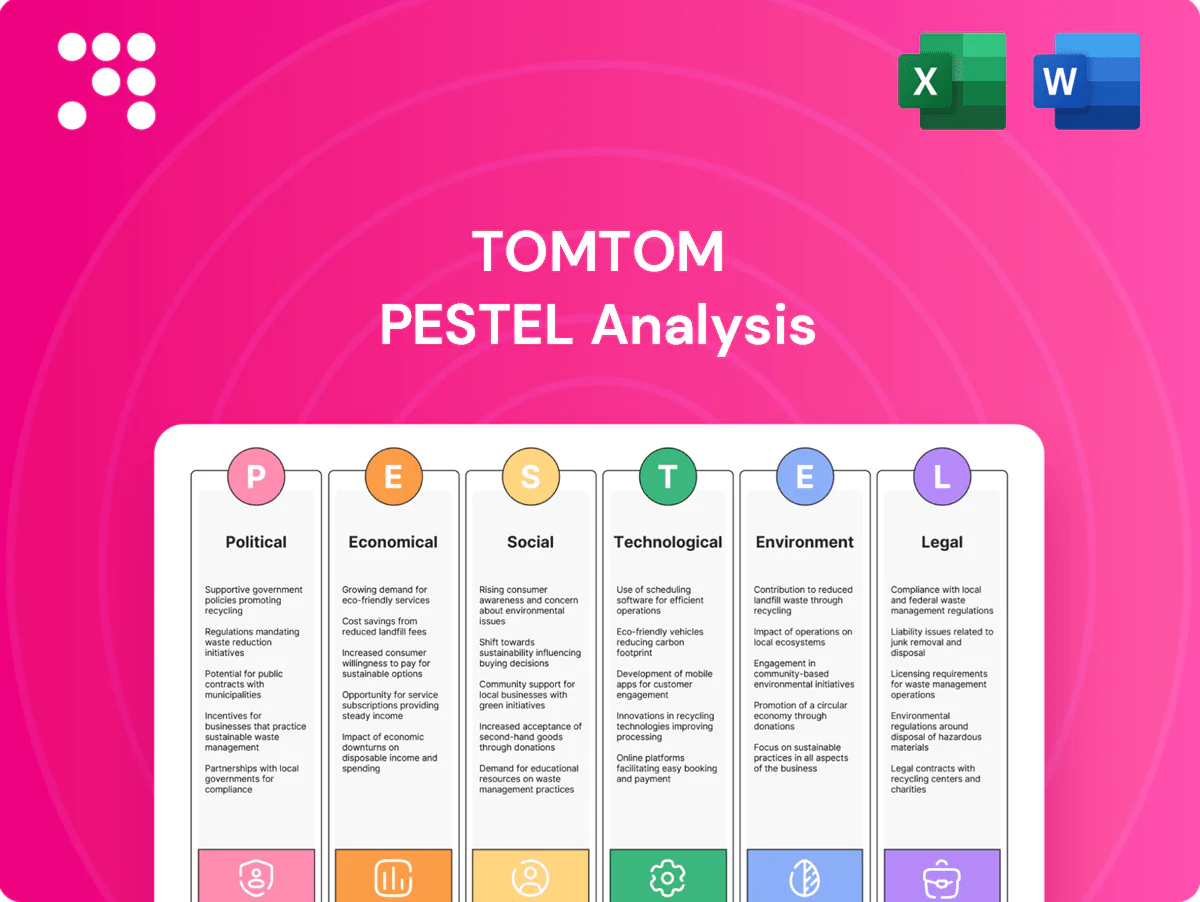
TomTom PESTLE Analysis

Make Smarter Strategic Decisions with a Complete PESTEL View
Our PESTLE Analysis for TomTom reveals how regulatory shifts, technological innovation, and changing mobility trends shape the company’s strategic outlook. Packed with actionable insights for investors and strategists, it highlights key risks and growth levers. Buy the full version to download the complete, editable report and make informed decisions.
Political factors

EU digital and mobility policies
EU smart mobility, interoperable data and digital competition rules set technical and access standards for maps and traffic services; CEF transport funding (~€33.7bn 2021-27) and Digital Europe (~€7.5bn) can accelerate deployment in public transport and road ops. Compliance with EU ITS frameworks and participation in programs unlock procurement channels, while shifting political priorities can alter project timelines and budgets.
Public–private infrastructure partnerships
Governments increasingly procure traffic and mapping solutions for urban management, creating demand for vendors like TomTom, which provides traffic services in 70+ countries and to over 1,000 cities. TomTom can win city and national contracts for congestion and safety, supporting recurring revenues—TomTom reported ~€661m revenue in 2024. Procurement rules and localization preferences affect competitiveness and contract win rates. Stable public partnerships help mitigate revenue cyclicality.

Geopolitical data restrictions
Geopolitical data restrictions — e.g., China’s state map licensing and domestic hosting, Russia’s 2015 data-localization rules, and India’s 2021 geospatial policy — constrain TomTom’s map detail and street imagery in those markets. GDPR (2018) limits cross-border flows, forcing EU-hosted infrastructure and local partnerships. Navigating approvals raises time-to-market and costs; GDPR fines exceeding €2.6bn by 2024 illustrate shutdown and penalty risks.

Automotive industrial policy
Automotive industrial policy—notably the EU 2035 new‑car zero‑emission mandate—plus rising EV/ADAS incentives (EVs ~14% of global car sales in 2023) accelerate demand for embedded navigation and HD maps, boosting TomTom Automotive opportunities.
Local content rules in markets like India and parts of Asia can shift OEM supplier selection, while policy swings change platform roadmaps and volume commitments, making close OEM policy alignment essential.
- EV mandate: EU 2035
- EV share: ~14% global sales (2023)
- Risk: local content rules alter sourcing
- Action: align with OEM policy landscapes
Transportation safety agendas
Governments driving Vision Zero and WHO's ~1.3M annual road-death figure push adoption of road-safety tech; EU mandated Intelligent Speed Assistance for new cars from July 2022, raising demand for high-quality map attributes. Certification/homologation (typically 12–24 months) slows time-to-revenue, while formal data-sharing deals with authorities strengthen TomTom's positioning.
- Vision Zero: policy momentum
- WHO ~1.3M deaths/yr
- EU ISA mandate since Jul 2022
- Certification 12–24 months
- Data-sharing boosts trust & contracts
EU funding and regulations drive recurring demand for mapping firms amid rising compliance costs
EU mobility and digital rules (CEF €33.7bn, Digital Europe €7.5bn) and procurement create recurring demand for TomTom (revenue ~€661m in 2024) but shifting budgets and certifications (12–24 months) affect timelines. Geopolitical map licensing (China, Russia, India) and GDPR (€2.6bn+ fines by 2024) raise hosting and compliance costs. EV/ADAS policy (EU 2035, EVs ~14% global sales 2023) and ISA mandate (since Jul 2022) expand automotive demand.
| Item | Figure/Year |
|---|---|
| TomTom revenue | €661m (2024) |
| CEF transport | €33.7bn (2021–27) |
| Digital Europe | €7.5bn |
| GDPR fines | €2.6bn+ (by 2024) |
| EV share | ~14% global sales (2023) |
What is included in the product
 Detailed Word Document
Explores how Political, Economic, Social, Technological, Environmental and Legal factors uniquely affect TomTom, with each section supported by current data and trend analysis to identify risks and opportunities. Designed for executives and investors, the analysis includes forward-looking insights and deck-ready findings specific to TomTom’s market and industry.

 Customizable Excel Spreadsheet
A clean, visually segmented PESTLE summary of TomTom that relieves briefing and planning pain points by providing concise, editable insights ideal for meetings, presentations and quick cross‑team alignment.
Economic factors

Auto cycle and OEM budgets
Vehicle production volumes—S&P Global Mobility estimated about 75 million light vehicles in 2024—directly drive TomTom's embedded navigation licensing, and downturns typically delay model launches and cut OEM software spend. Premium and EV segments, with EVs around 14% of global sales in 2023–24 (IEA), are more resilient for ADAS uptake. Diversification into enterprise SaaS helps smooth cyclicality.
Subscription and usage revenues
Recurring fees for map updates, traffic and APIs provide margin stability for TomTom by converting one-off sales into predictable streams tied to subscriptions. Usage-based pricing aligns revenue with mobility activity, capturing growth when miles driven or API calls increase. Enterprise fleet and logistics contracts underpin predictable cash flows, while churn management and ARPU expansion remain critical levers for scaling lifetime value.

Currency and cost pressures
TomTom reports in euros while generating the bulk of revenue globally, so FX swings materially affect reported results and pricing power. Rising cloud costs—global public cloud spending grew about 21.7% in 2023 per Gartner—along with inflation in talent and data acquisition compress margins. Active hedging and targeted efficiency programs are essential to protect cash flow and margin resilience.

Logistics and e-commerce growth
Rising last-mile and fleet-optimization demand—driven by global retail e-commerce sales of about $6.3 trillion in 2024 and ~140 billion parcels shipped in 2023—boosts demand for TomTom enterprise APIs; improved route planning and ETA accuracy cut customers’ operating costs and fuel use. Cross-selling traffic and geocoding services lifts wallet share per account, though macro slowdowns can temper volume growth.
- APIs: higher enterprise demand
- Cost: route/ETA reduce OPEX
- Upsell: traffic+geocoding increases ARPU
- Risk: macro slowdown limits volume
Capital intensity of map-making
Continuous data collection, tooling and sensor processing keep map-making capital intensive into 2024–25, requiring sustained investment in fleet sensors, cloud processing and storage. Automation and machine learning reduce per-kilometer costs but demand upfront R&D and annotation budgets. Partner data and crowdsourcing lower TomTom's capex exposure, while ROI hinges on reusing mapping platforms across automotive, logistics and consumer segments.
- Continuous collection: ongoing fleet and sensor spend
- Automation: high R&D, lower unit cost
- Partnerships: capex sharing via partners/crowdsourcing
- ROI: platform reuse across segments critical
EU funding and regulations drive recurring demand for mapping firms amid rising compliance costs
Vehicle production (~75m light vehicles in 2024) and EV penetration (~14% 2023–24) drive OEM ADAS demand, while recurring map/API fees and enterprise fleet work smooth cyclicality. FX (euro reporting), rising cloud spend (+21.7% 2023) and capex for sensors remain margin pressures. E‑commerce tailwinds ($6.3t global sales 2024) boost last‑mile API uptake.
| Metric | Value |
|---|---|
| Light vehicles 2024 | ~75m |
| EV share | ~14% |
| E‑commerce 2024 | $6.3t |
| Cloud spend growth 2023 | +21.7% |
Full Version Awaits
TomTom PESTLE Analysis
This TomTom PESTLE Analysis provides a concise, actionable assessment of political, economic, social, technological, legal, and environmental factors affecting TomTom. The preview shown here is the exact document you’ll receive after purchase—fully formatted and ready to use. No placeholders or surprises, just the finished, downloadable file.

Make Smarter Strategic Decisions with a Complete PESTEL View
Our PESTLE Analysis for TomTom reveals how regulatory shifts, technological innovation, and changing mobility trends shape the company’s strategic outlook. Packed with actionable insights for investors and strategists, it highlights key risks and growth levers. Buy the full version to download the complete, editable report and make informed decisions.
Political factors
EU digital and mobility policies
EU smart mobility, interoperable data and digital competition rules set technical and access standards for maps and traffic services; CEF transport funding (~€33.7bn 2021-27) and Digital Europe (~€7.5bn) can accelerate deployment in public transport and road ops. Compliance with EU ITS frameworks and participation in programs unlock procurement channels, while shifting political priorities can alter project timelines and budgets.
Public–private infrastructure partnerships
Governments increasingly procure traffic and mapping solutions for urban management, creating demand for vendors like TomTom, which provides traffic services in 70+ countries and to over 1,000 cities. TomTom can win city and national contracts for congestion and safety, supporting recurring revenues—TomTom reported ~€661m revenue in 2024. Procurement rules and localization preferences affect competitiveness and contract win rates. Stable public partnerships help mitigate revenue cyclicality.
Geopolitical data restrictions
Geopolitical data restrictions — e.g., China’s state map licensing and domestic hosting, Russia’s 2015 data-localization rules, and India’s 2021 geospatial policy — constrain TomTom’s map detail and street imagery in those markets. GDPR (2018) limits cross-border flows, forcing EU-hosted infrastructure and local partnerships. Navigating approvals raises time-to-market and costs; GDPR fines exceeding €2.6bn by 2024 illustrate shutdown and penalty risks.
Automotive industrial policy
Automotive industrial policy—notably the EU 2035 new‑car zero‑emission mandate—plus rising EV/ADAS incentives (EVs ~14% of global car sales in 2023) accelerate demand for embedded navigation and HD maps, boosting TomTom Automotive opportunities.
Local content rules in markets like India and parts of Asia can shift OEM supplier selection, while policy swings change platform roadmaps and volume commitments, making close OEM policy alignment essential.
- EV mandate: EU 2035
- EV share: ~14% global sales (2023)
- Risk: local content rules alter sourcing
- Action: align with OEM policy landscapes
Transportation safety agendas
Governments driving Vision Zero and WHO's ~1.3M annual road-death figure push adoption of road-safety tech; EU mandated Intelligent Speed Assistance for new cars from July 2022, raising demand for high-quality map attributes. Certification/homologation (typically 12–24 months) slows time-to-revenue, while formal data-sharing deals with authorities strengthen TomTom's positioning.
- Vision Zero: policy momentum
- WHO ~1.3M deaths/yr
- EU ISA mandate since Jul 2022
- Certification 12–24 months
- Data-sharing boosts trust & contracts
EU funding and regulations drive recurring demand for mapping firms amid rising compliance costs
EU mobility and digital rules (CEF €33.7bn, Digital Europe €7.5bn) and procurement create recurring demand for TomTom (revenue ~€661m in 2024) but shifting budgets and certifications (12–24 months) affect timelines. Geopolitical map licensing (China, Russia, India) and GDPR (€2.6bn+ fines by 2024) raise hosting and compliance costs. EV/ADAS policy (EU 2035, EVs ~14% global sales 2023) and ISA mandate (since Jul 2022) expand automotive demand.
| Item | Figure/Year |
|---|---|
| TomTom revenue | €661m (2024) |
| CEF transport | €33.7bn (2021–27) |
| Digital Europe | €7.5bn |
| GDPR fines | €2.6bn+ (by 2024) |
| EV share | ~14% global sales (2023) |
What is included in the product
Detailed Word Document
Explores how Political, Economic, Social, Technological, Environmental and Legal factors uniquely affect TomTom, with each section supported by current data and trend analysis to identify risks and opportunities. Designed for executives and investors, the analysis includes forward-looking insights and deck-ready findings specific to TomTom’s market and industry.
Customizable Excel Spreadsheet
A clean, visually segmented PESTLE summary of TomTom that relieves briefing and planning pain points by providing concise, editable insights ideal for meetings, presentations and quick cross‑team alignment.
Economic factors
Auto cycle and OEM budgets
Vehicle production volumes—S&P Global Mobility estimated about 75 million light vehicles in 2024—directly drive TomTom's embedded navigation licensing, and downturns typically delay model launches and cut OEM software spend. Premium and EV segments, with EVs around 14% of global sales in 2023–24 (IEA), are more resilient for ADAS uptake. Diversification into enterprise SaaS helps smooth cyclicality.
Subscription and usage revenues
Recurring fees for map updates, traffic and APIs provide margin stability for TomTom by converting one-off sales into predictable streams tied to subscriptions. Usage-based pricing aligns revenue with mobility activity, capturing growth when miles driven or API calls increase. Enterprise fleet and logistics contracts underpin predictable cash flows, while churn management and ARPU expansion remain critical levers for scaling lifetime value.
Currency and cost pressures
TomTom reports in euros while generating the bulk of revenue globally, so FX swings materially affect reported results and pricing power. Rising cloud costs—global public cloud spending grew about 21.7% in 2023 per Gartner—along with inflation in talent and data acquisition compress margins. Active hedging and targeted efficiency programs are essential to protect cash flow and margin resilience.
Logistics and e-commerce growth
Rising last-mile and fleet-optimization demand—driven by global retail e-commerce sales of about $6.3 trillion in 2024 and ~140 billion parcels shipped in 2023—boosts demand for TomTom enterprise APIs; improved route planning and ETA accuracy cut customers’ operating costs and fuel use. Cross-selling traffic and geocoding services lifts wallet share per account, though macro slowdowns can temper volume growth.
- APIs: higher enterprise demand
- Cost: route/ETA reduce OPEX
- Upsell: traffic+geocoding increases ARPU
- Risk: macro slowdown limits volume
Capital intensity of map-making
Continuous data collection, tooling and sensor processing keep map-making capital intensive into 2024–25, requiring sustained investment in fleet sensors, cloud processing and storage. Automation and machine learning reduce per-kilometer costs but demand upfront R&D and annotation budgets. Partner data and crowdsourcing lower TomTom's capex exposure, while ROI hinges on reusing mapping platforms across automotive, logistics and consumer segments.
- Continuous collection: ongoing fleet and sensor spend
- Automation: high R&D, lower unit cost
- Partnerships: capex sharing via partners/crowdsourcing
- ROI: platform reuse across segments critical
EU funding and regulations drive recurring demand for mapping firms amid rising compliance costs
Vehicle production (~75m light vehicles in 2024) and EV penetration (~14% 2023–24) drive OEM ADAS demand, while recurring map/API fees and enterprise fleet work smooth cyclicality. FX (euro reporting), rising cloud spend (+21.7% 2023) and capex for sensors remain margin pressures. E‑commerce tailwinds ($6.3t global sales 2024) boost last‑mile API uptake.
| Metric | Value |
|---|---|
| Light vehicles 2024 | ~75m |
| EV share | ~14% |
| E‑commerce 2024 | $6.3t |
| Cloud spend growth 2023 | +21.7% |
Full Version Awaits
TomTom PESTLE Analysis
This TomTom PESTLE Analysis provides a concise, actionable assessment of political, economic, social, technological, legal, and environmental factors affecting TomTom. The preview shown here is the exact document you’ll receive after purchase—fully formatted and ready to use. No placeholders or surprises, just the finished, downloadable file.
Description
Make Smarter Strategic Decisions with a Complete PESTEL View
Our PESTLE Analysis for TomTom reveals how regulatory shifts, technological innovation, and changing mobility trends shape the company’s strategic outlook. Packed with actionable insights for investors and strategists, it highlights key risks and growth levers. Buy the full version to download the complete, editable report and make informed decisions.
Political factors
EU digital and mobility policies
EU smart mobility, interoperable data and digital competition rules set technical and access standards for maps and traffic services; CEF transport funding (~€33.7bn 2021-27) and Digital Europe (~€7.5bn) can accelerate deployment in public transport and road ops. Compliance with EU ITS frameworks and participation in programs unlock procurement channels, while shifting political priorities can alter project timelines and budgets.
Public–private infrastructure partnerships
Governments increasingly procure traffic and mapping solutions for urban management, creating demand for vendors like TomTom, which provides traffic services in 70+ countries and to over 1,000 cities. TomTom can win city and national contracts for congestion and safety, supporting recurring revenues—TomTom reported ~€661m revenue in 2024. Procurement rules and localization preferences affect competitiveness and contract win rates. Stable public partnerships help mitigate revenue cyclicality.
Geopolitical data restrictions
Geopolitical data restrictions — e.g., China’s state map licensing and domestic hosting, Russia’s 2015 data-localization rules, and India’s 2021 geospatial policy — constrain TomTom’s map detail and street imagery in those markets. GDPR (2018) limits cross-border flows, forcing EU-hosted infrastructure and local partnerships. Navigating approvals raises time-to-market and costs; GDPR fines exceeding €2.6bn by 2024 illustrate shutdown and penalty risks.
Automotive industrial policy
Automotive industrial policy—notably the EU 2035 new‑car zero‑emission mandate—plus rising EV/ADAS incentives (EVs ~14% of global car sales in 2023) accelerate demand for embedded navigation and HD maps, boosting TomTom Automotive opportunities.
Local content rules in markets like India and parts of Asia can shift OEM supplier selection, while policy swings change platform roadmaps and volume commitments, making close OEM policy alignment essential.
- EV mandate: EU 2035
- EV share: ~14% global sales (2023)
- Risk: local content rules alter sourcing
- Action: align with OEM policy landscapes
Transportation safety agendas
Governments driving Vision Zero and WHO's ~1.3M annual road-death figure push adoption of road-safety tech; EU mandated Intelligent Speed Assistance for new cars from July 2022, raising demand for high-quality map attributes. Certification/homologation (typically 12–24 months) slows time-to-revenue, while formal data-sharing deals with authorities strengthen TomTom's positioning.
- Vision Zero: policy momentum
- WHO ~1.3M deaths/yr
- EU ISA mandate since Jul 2022
- Certification 12–24 months
- Data-sharing boosts trust & contracts
EU funding and regulations drive recurring demand for mapping firms amid rising compliance costs
EU mobility and digital rules (CEF €33.7bn, Digital Europe €7.5bn) and procurement create recurring demand for TomTom (revenue ~€661m in 2024) but shifting budgets and certifications (12–24 months) affect timelines. Geopolitical map licensing (China, Russia, India) and GDPR (€2.6bn+ fines by 2024) raise hosting and compliance costs. EV/ADAS policy (EU 2035, EVs ~14% global sales 2023) and ISA mandate (since Jul 2022) expand automotive demand.
| Item | Figure/Year |
|---|---|
| TomTom revenue | €661m (2024) |
| CEF transport | €33.7bn (2021–27) |
| Digital Europe | €7.5bn |
| GDPR fines | €2.6bn+ (by 2024) |
| EV share | ~14% global sales (2023) |
What is included in the product
Detailed Word Document
Explores how Political, Economic, Social, Technological, Environmental and Legal factors uniquely affect TomTom, with each section supported by current data and trend analysis to identify risks and opportunities. Designed for executives and investors, the analysis includes forward-looking insights and deck-ready findings specific to TomTom’s market and industry.
Customizable Excel Spreadsheet
A clean, visually segmented PESTLE summary of TomTom that relieves briefing and planning pain points by providing concise, editable insights ideal for meetings, presentations and quick cross‑team alignment.
Economic factors
Auto cycle and OEM budgets
Vehicle production volumes—S&P Global Mobility estimated about 75 million light vehicles in 2024—directly drive TomTom's embedded navigation licensing, and downturns typically delay model launches and cut OEM software spend. Premium and EV segments, with EVs around 14% of global sales in 2023–24 (IEA), are more resilient for ADAS uptake. Diversification into enterprise SaaS helps smooth cyclicality.
Subscription and usage revenues
Recurring fees for map updates, traffic and APIs provide margin stability for TomTom by converting one-off sales into predictable streams tied to subscriptions. Usage-based pricing aligns revenue with mobility activity, capturing growth when miles driven or API calls increase. Enterprise fleet and logistics contracts underpin predictable cash flows, while churn management and ARPU expansion remain critical levers for scaling lifetime value.
Currency and cost pressures
TomTom reports in euros while generating the bulk of revenue globally, so FX swings materially affect reported results and pricing power. Rising cloud costs—global public cloud spending grew about 21.7% in 2023 per Gartner—along with inflation in talent and data acquisition compress margins. Active hedging and targeted efficiency programs are essential to protect cash flow and margin resilience.
Logistics and e-commerce growth
Rising last-mile and fleet-optimization demand—driven by global retail e-commerce sales of about $6.3 trillion in 2024 and ~140 billion parcels shipped in 2023—boosts demand for TomTom enterprise APIs; improved route planning and ETA accuracy cut customers’ operating costs and fuel use. Cross-selling traffic and geocoding services lifts wallet share per account, though macro slowdowns can temper volume growth.
- APIs: higher enterprise demand
- Cost: route/ETA reduce OPEX
- Upsell: traffic+geocoding increases ARPU
- Risk: macro slowdown limits volume
Capital intensity of map-making
Continuous data collection, tooling and sensor processing keep map-making capital intensive into 2024–25, requiring sustained investment in fleet sensors, cloud processing and storage. Automation and machine learning reduce per-kilometer costs but demand upfront R&D and annotation budgets. Partner data and crowdsourcing lower TomTom's capex exposure, while ROI hinges on reusing mapping platforms across automotive, logistics and consumer segments.
- Continuous collection: ongoing fleet and sensor spend
- Automation: high R&D, lower unit cost
- Partnerships: capex sharing via partners/crowdsourcing
- ROI: platform reuse across segments critical
EU funding and regulations drive recurring demand for mapping firms amid rising compliance costs
Vehicle production (~75m light vehicles in 2024) and EV penetration (~14% 2023–24) drive OEM ADAS demand, while recurring map/API fees and enterprise fleet work smooth cyclicality. FX (euro reporting), rising cloud spend (+21.7% 2023) and capex for sensors remain margin pressures. E‑commerce tailwinds ($6.3t global sales 2024) boost last‑mile API uptake.
| Metric | Value |
|---|---|
| Light vehicles 2024 | ~75m |
| EV share | ~14% |
| E‑commerce 2024 | $6.3t |
| Cloud spend growth 2023 | +21.7% |
Full Version Awaits
TomTom PESTLE Analysis
This TomTom PESTLE Analysis provides a concise, actionable assessment of political, economic, social, technological, legal, and environmental factors affecting TomTom. The preview shown here is the exact document you’ll receive after purchase—fully formatted and ready to use. No placeholders or surprises, just the finished, downloadable file.











