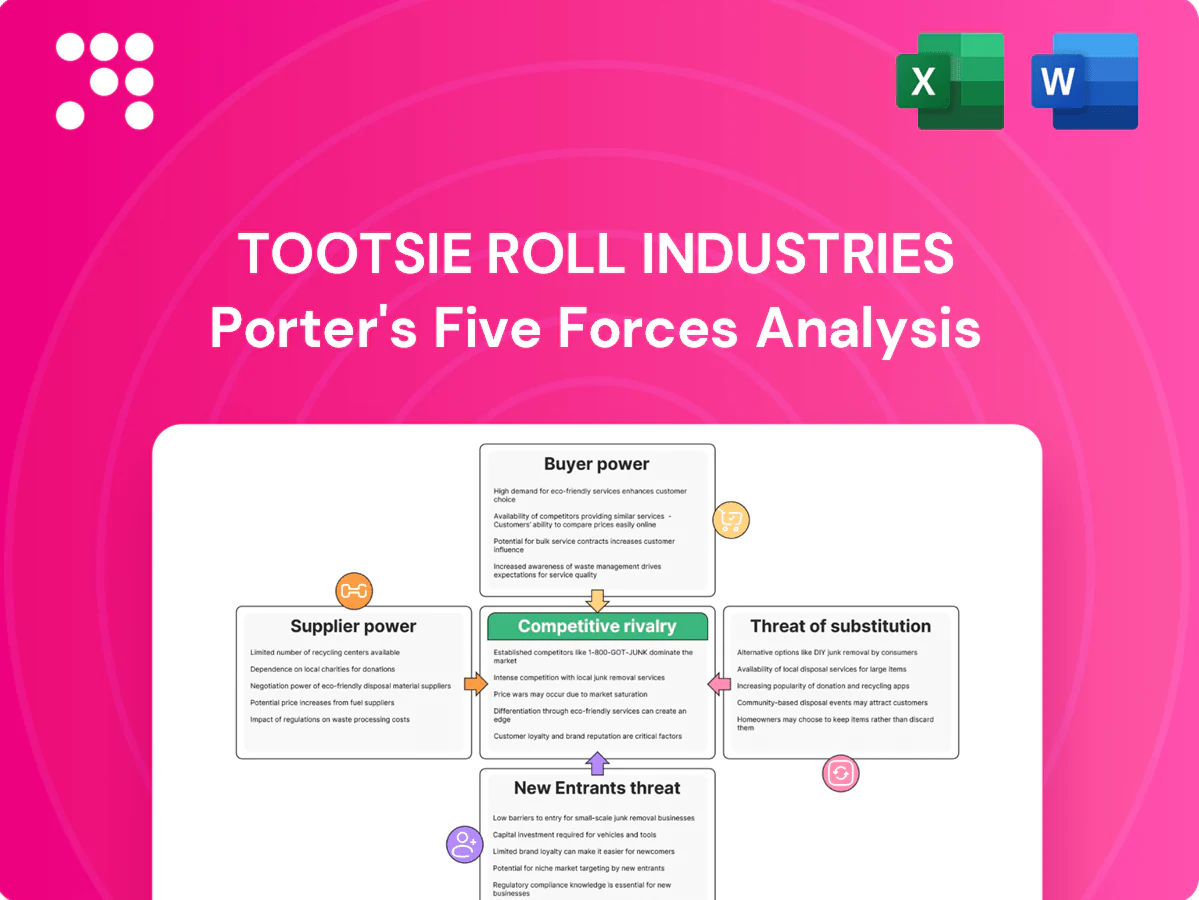
Tootsie Roll Industries Porter's Five Forces Analysis

Don't Miss the Bigger Picture
Tootsie Roll Industries faces moderate supplier power, steady buyer demand, low threat of new entrants, rising substitute pressure from new confectionery trends, and intense rivalry among branded and private‑label candies. This snapshot only scratches the surface. Unlock the full Porter's Five Forces Analysis to explore competitive dynamics, market pressures, and strategic advantages in detail.
Suppliers Bargaining Power

Commodity inputs volatility
Tootsie Roll depends on globally traded sugar, cocoa, corn syrup, dairy and packaging; ICE sugar futures averaged about $0.18/lb in 2024 and ICCO cocoa around $2,600/ton, so volatile swings can tighten supplier leverage during shortages. Long‑term contracts and hedges reduce but do not remove exposure, and supply shocks from weather, geopolitics or logistics can quickly compress margins.
Supplier fragmentation
Supplier fragmentation limits supplier power at Tootsie Roll Industries, as many inputs have multiple qualified vendors and the company reported net sales of about $576 million in fiscal 2023, supporting scale purchasing across its portfolio. For specialized ingredients or custom packaging the supplier pool narrows and leverage rises, prompting dual-sourcing and qualifying alternates. Scale buying across brands helps negotiate better terms and reduce single-supplier risk.

Quality and compliance requirements
Food safety, labeling and allergen controls raise switching costs for Tootsie Roll by requiring supplier qualifications and ingredient traceability, increasing reliance on compliant suppliers. Third-party audits and certifications like GFSI/SQF make rapid supplier changes costly and slow, giving compliant suppliers moderate bargaining power. Maintaining approved vendor lists provides continuity but constrains sourcing flexibility and negotiation leverage.

Logistics and lead times
Inbound transportation and cold-chain needs for certain ingredients raise supplier bargaining power for Tootsie Roll, as firms with proximity to U.S. plants or robust logistics networks can command premiums; lead-time variability raises expediting costs and dependency during disruptions, while diversified regional sourcing reduces shock exposure.
- Proximity premium: closer suppliers charge more
- Cold-chain adds logistical complexity and cost
- Disruptions → higher expediting spend
- Regional diversification cushions shocks
Brand resilience vs. input substitution
Tootsie Roll’s strong, stable formulations limit rapid reformulation to cheaper inputs, reducing input substitution and giving suppliers more leverage during raw-material cost spikes; this dynamic tightened in 2024 as global sugar and cocoa volatility increased. Steady, predictable volumes and the company’s long-standing supplier relationships (ticker TR, fiscal year end Sept 30) make Tootsie an attractive, reliable buyer. The offsetting forces keep supplier power moderate.
- Limited reformulation increases supplier sway
- 2024 commodity volatility raised short-term supplier leverage
- Predictable volumes and longevity reduce long-term supplier risk
- Net effect: moderate supplier power
Moderate power; volatile sugar $0.18/lb, cocoa $2,600/ton
Tootsie Roll faces moderate supplier power: globally traded sugar ($0.18/lb ICE 2024) and cocoa (~$2,600/ton ICCO 2024) create volatility that can tighten supplier leverage. Long‑term contracts, hedges and scale (net sales ~$576M FY2023) limit but do not eliminate risk. Food‑safety certifications and qualified‑supplier lists raise switching costs, while supplier fragmentation and regional sourcing counterbalance power.
| Metric | Value |
|---|---|
| ICE sugar (2024) | $0.18/lb |
| ICCO cocoa (2024) | $2,600/ton |
| Net sales FY2023 | $576M |
| Supplier power | Moderate |
What is included in the product
 Detailed Word Document
Tailored Porter's Five Forces analysis for Tootsie Roll Industries revealing competitive rivalry, supplier and buyer bargaining power, threat of substitutes and entry barriers, highlighting risks from private-label competitors and shifting consumer preferences while assessing pricing power and defensive advantages in brand recognition and distribution.

 Customizable Excel Spreadsheet
A concise one-sheet Porter's Five Forces for Tootsie Roll Industries—ideal for quick strategic decisions and investor briefings. Customize pressure levels and swap in current market data to reflect supply-chain shifts, private-label competition, or candy demand trends.
Customers Bargaining Power

Concentrated retail channels
Large retailers, wholesalers and mass merchants—led by Walmart with over $600 billion in annual revenue—command volume and shelf space, increasing their bargaining power and enabling demands for promotional support, slotting fees and favorable payment terms. Tootsie Roll must negotiate placement within category planograms and trade-promotion windows. Losing a major account would materially reduce visibility and throughput, squeezing margins and distribution reach.
Price sensitivity in confections
Consumers are price-aware for everyday candy, but small pack sizes (5–30g) blunt absolute price impact; Tootsie Roll Industries reported net sales of ≈$497M in fiscal 2024, reflecting resilience. Private-label penetration and promotional cycles (promo-driven weeks account for double-digit checkout lifts) pressure margins. Elasticity varies by brand equity—iconic SKUs sustain price better—net effect: moderate buyer power requiring tactical pricing.

Channel diversity
Tootsie Roll sells through retail, wholesale, convenience and vending, reducing dependence on any single channel and supporting 2024 net sales of $681.2 million. Vending and impulse channels, common in schools, transit and workplaces, dilute retailer leverage because locations create captive consumer purchases. E-commerce remains a small but growing outlet, under 5% of sales in 2024, further tempering buyer bargaining power.

Switching costs are low
Shoppers can easily switch among candy brands and flavors, and retail buyers rotate SKUs based on turns and promo funding, keeping pressure on Tootsie Roll’s trade spend and innovation cadence; Tootsie Roll reported roughly $597.6 million in net sales in FY2024, so churn impacts scale.
- Low switching: high shopper churn
- Retail SKU rotation: promo-driven
- Pressure on trade spend & innovation
- Brand loyalty mitigates but doesn’t eliminate risk
Seasonality and promo windows
Halloween, holiday seasons and back-to-school peaks concentrate retailer leverage in allocation and display talks, forcing Tootsie to concede deeper discounts to secure end-cap and feature placements. Retail buyers routinely trade premium space for price concessions, but accurate forecasting and on-time fill strengthen Tootsie’s position. Strong seasonal execution and sell-through can neutralize some price pressures.
- Seasonal peaks increase retailer leverage
- End-cap space traded for deeper discounts
- Accurate forecasting improves negotiation
- Execution offsets price demands
Scale and brand resilience vs. retailer leverage: candy sales withstand promo-driven seasonality
Large retailers like Walmart (over $600B revenue) hold significant shelf and promo leverage, extracting slotting, promotional support and payment concessions. Consumers are price-sensitive for everyday candy, but brand equity and FY2024 net sales of $681.2M provide resilience. Diversified channels (retail, vending, e‑comm <5% in 2024) reduce single-buyer risk, though seasonal peaks increase retailer bargaining.
| Metric | 2024 |
|---|---|
| Tootsie Roll net sales | $681.2M |
| Walmart revenue | >$600B |
| E‑commerce share | <5% |
| Promo uplift (peak weeks) | Double-digit |
What You See Is What You Get
Tootsie Roll Industries Porter's Five Forces Analysis
This preview shows the exact Porter's Five Forces analysis for Tootsie Roll Industries you'll receive immediately after purchase—no surprises. The document is fully formatted, professionally written, and ready to download. It covers competitive rivalry, supplier and buyer power, and threats of entry and substitution with actionable insights.

Don't Miss the Bigger Picture
Tootsie Roll Industries faces moderate supplier power, steady buyer demand, low threat of new entrants, rising substitute pressure from new confectionery trends, and intense rivalry among branded and private‑label candies. This snapshot only scratches the surface. Unlock the full Porter's Five Forces Analysis to explore competitive dynamics, market pressures, and strategic advantages in detail.
Suppliers Bargaining Power
Commodity inputs volatility
Tootsie Roll depends on globally traded sugar, cocoa, corn syrup, dairy and packaging; ICE sugar futures averaged about $0.18/lb in 2024 and ICCO cocoa around $2,600/ton, so volatile swings can tighten supplier leverage during shortages. Long‑term contracts and hedges reduce but do not remove exposure, and supply shocks from weather, geopolitics or logistics can quickly compress margins.
Supplier fragmentation
Supplier fragmentation limits supplier power at Tootsie Roll Industries, as many inputs have multiple qualified vendors and the company reported net sales of about $576 million in fiscal 2023, supporting scale purchasing across its portfolio. For specialized ingredients or custom packaging the supplier pool narrows and leverage rises, prompting dual-sourcing and qualifying alternates. Scale buying across brands helps negotiate better terms and reduce single-supplier risk.
Quality and compliance requirements
Food safety, labeling and allergen controls raise switching costs for Tootsie Roll by requiring supplier qualifications and ingredient traceability, increasing reliance on compliant suppliers. Third-party audits and certifications like GFSI/SQF make rapid supplier changes costly and slow, giving compliant suppliers moderate bargaining power. Maintaining approved vendor lists provides continuity but constrains sourcing flexibility and negotiation leverage.
Logistics and lead times
Inbound transportation and cold-chain needs for certain ingredients raise supplier bargaining power for Tootsie Roll, as firms with proximity to U.S. plants or robust logistics networks can command premiums; lead-time variability raises expediting costs and dependency during disruptions, while diversified regional sourcing reduces shock exposure.
- Proximity premium: closer suppliers charge more
- Cold-chain adds logistical complexity and cost
- Disruptions → higher expediting spend
- Regional diversification cushions shocks
Brand resilience vs. input substitution
Tootsie Roll’s strong, stable formulations limit rapid reformulation to cheaper inputs, reducing input substitution and giving suppliers more leverage during raw-material cost spikes; this dynamic tightened in 2024 as global sugar and cocoa volatility increased. Steady, predictable volumes and the company’s long-standing supplier relationships (ticker TR, fiscal year end Sept 30) make Tootsie an attractive, reliable buyer. The offsetting forces keep supplier power moderate.
- Limited reformulation increases supplier sway
- 2024 commodity volatility raised short-term supplier leverage
- Predictable volumes and longevity reduce long-term supplier risk
- Net effect: moderate supplier power
Moderate power; volatile sugar $0.18/lb, cocoa $2,600/ton
Tootsie Roll faces moderate supplier power: globally traded sugar ($0.18/lb ICE 2024) and cocoa (~$2,600/ton ICCO 2024) create volatility that can tighten supplier leverage. Long‑term contracts, hedges and scale (net sales ~$576M FY2023) limit but do not eliminate risk. Food‑safety certifications and qualified‑supplier lists raise switching costs, while supplier fragmentation and regional sourcing counterbalance power.
| Metric | Value |
|---|---|
| ICE sugar (2024) | $0.18/lb |
| ICCO cocoa (2024) | $2,600/ton |
| Net sales FY2023 | $576M |
| Supplier power | Moderate |
What is included in the product
Detailed Word Document
Tailored Porter's Five Forces analysis for Tootsie Roll Industries revealing competitive rivalry, supplier and buyer bargaining power, threat of substitutes and entry barriers, highlighting risks from private-label competitors and shifting consumer preferences while assessing pricing power and defensive advantages in brand recognition and distribution.
Customizable Excel Spreadsheet
A concise one-sheet Porter's Five Forces for Tootsie Roll Industries—ideal for quick strategic decisions and investor briefings. Customize pressure levels and swap in current market data to reflect supply-chain shifts, private-label competition, or candy demand trends.
Customers Bargaining Power
Concentrated retail channels
Large retailers, wholesalers and mass merchants—led by Walmart with over $600 billion in annual revenue—command volume and shelf space, increasing their bargaining power and enabling demands for promotional support, slotting fees and favorable payment terms. Tootsie Roll must negotiate placement within category planograms and trade-promotion windows. Losing a major account would materially reduce visibility and throughput, squeezing margins and distribution reach.
Price sensitivity in confections
Consumers are price-aware for everyday candy, but small pack sizes (5–30g) blunt absolute price impact; Tootsie Roll Industries reported net sales of ≈$497M in fiscal 2024, reflecting resilience. Private-label penetration and promotional cycles (promo-driven weeks account for double-digit checkout lifts) pressure margins. Elasticity varies by brand equity—iconic SKUs sustain price better—net effect: moderate buyer power requiring tactical pricing.
Channel diversity
Tootsie Roll sells through retail, wholesale, convenience and vending, reducing dependence on any single channel and supporting 2024 net sales of $681.2 million. Vending and impulse channels, common in schools, transit and workplaces, dilute retailer leverage because locations create captive consumer purchases. E-commerce remains a small but growing outlet, under 5% of sales in 2024, further tempering buyer bargaining power.
Switching costs are low
Shoppers can easily switch among candy brands and flavors, and retail buyers rotate SKUs based on turns and promo funding, keeping pressure on Tootsie Roll’s trade spend and innovation cadence; Tootsie Roll reported roughly $597.6 million in net sales in FY2024, so churn impacts scale.
- Low switching: high shopper churn
- Retail SKU rotation: promo-driven
- Pressure on trade spend & innovation
- Brand loyalty mitigates but doesn’t eliminate risk
Seasonality and promo windows
Halloween, holiday seasons and back-to-school peaks concentrate retailer leverage in allocation and display talks, forcing Tootsie to concede deeper discounts to secure end-cap and feature placements. Retail buyers routinely trade premium space for price concessions, but accurate forecasting and on-time fill strengthen Tootsie’s position. Strong seasonal execution and sell-through can neutralize some price pressures.
- Seasonal peaks increase retailer leverage
- End-cap space traded for deeper discounts
- Accurate forecasting improves negotiation
- Execution offsets price demands
Scale and brand resilience vs. retailer leverage: candy sales withstand promo-driven seasonality
Large retailers like Walmart (over $600B revenue) hold significant shelf and promo leverage, extracting slotting, promotional support and payment concessions. Consumers are price-sensitive for everyday candy, but brand equity and FY2024 net sales of $681.2M provide resilience. Diversified channels (retail, vending, e‑comm <5% in 2024) reduce single-buyer risk, though seasonal peaks increase retailer bargaining.
| Metric | 2024 |
|---|---|
| Tootsie Roll net sales | $681.2M |
| Walmart revenue | >$600B |
| E‑commerce share | <5% |
| Promo uplift (peak weeks) | Double-digit |
What You See Is What You Get
Tootsie Roll Industries Porter's Five Forces Analysis
This preview shows the exact Porter's Five Forces analysis for Tootsie Roll Industries you'll receive immediately after purchase—no surprises. The document is fully formatted, professionally written, and ready to download. It covers competitive rivalry, supplier and buyer power, and threats of entry and substitution with actionable insights.
Description
Don't Miss the Bigger Picture
Tootsie Roll Industries faces moderate supplier power, steady buyer demand, low threat of new entrants, rising substitute pressure from new confectionery trends, and intense rivalry among branded and private‑label candies. This snapshot only scratches the surface. Unlock the full Porter's Five Forces Analysis to explore competitive dynamics, market pressures, and strategic advantages in detail.
Suppliers Bargaining Power
Commodity inputs volatility
Tootsie Roll depends on globally traded sugar, cocoa, corn syrup, dairy and packaging; ICE sugar futures averaged about $0.18/lb in 2024 and ICCO cocoa around $2,600/ton, so volatile swings can tighten supplier leverage during shortages. Long‑term contracts and hedges reduce but do not remove exposure, and supply shocks from weather, geopolitics or logistics can quickly compress margins.
Supplier fragmentation
Supplier fragmentation limits supplier power at Tootsie Roll Industries, as many inputs have multiple qualified vendors and the company reported net sales of about $576 million in fiscal 2023, supporting scale purchasing across its portfolio. For specialized ingredients or custom packaging the supplier pool narrows and leverage rises, prompting dual-sourcing and qualifying alternates. Scale buying across brands helps negotiate better terms and reduce single-supplier risk.
Quality and compliance requirements
Food safety, labeling and allergen controls raise switching costs for Tootsie Roll by requiring supplier qualifications and ingredient traceability, increasing reliance on compliant suppliers. Third-party audits and certifications like GFSI/SQF make rapid supplier changes costly and slow, giving compliant suppliers moderate bargaining power. Maintaining approved vendor lists provides continuity but constrains sourcing flexibility and negotiation leverage.
Logistics and lead times
Inbound transportation and cold-chain needs for certain ingredients raise supplier bargaining power for Tootsie Roll, as firms with proximity to U.S. plants or robust logistics networks can command premiums; lead-time variability raises expediting costs and dependency during disruptions, while diversified regional sourcing reduces shock exposure.
- Proximity premium: closer suppliers charge more
- Cold-chain adds logistical complexity and cost
- Disruptions → higher expediting spend
- Regional diversification cushions shocks
Brand resilience vs. input substitution
Tootsie Roll’s strong, stable formulations limit rapid reformulation to cheaper inputs, reducing input substitution and giving suppliers more leverage during raw-material cost spikes; this dynamic tightened in 2024 as global sugar and cocoa volatility increased. Steady, predictable volumes and the company’s long-standing supplier relationships (ticker TR, fiscal year end Sept 30) make Tootsie an attractive, reliable buyer. The offsetting forces keep supplier power moderate.
- Limited reformulation increases supplier sway
- 2024 commodity volatility raised short-term supplier leverage
- Predictable volumes and longevity reduce long-term supplier risk
- Net effect: moderate supplier power
Moderate power; volatile sugar $0.18/lb, cocoa $2,600/ton
Tootsie Roll faces moderate supplier power: globally traded sugar ($0.18/lb ICE 2024) and cocoa (~$2,600/ton ICCO 2024) create volatility that can tighten supplier leverage. Long‑term contracts, hedges and scale (net sales ~$576M FY2023) limit but do not eliminate risk. Food‑safety certifications and qualified‑supplier lists raise switching costs, while supplier fragmentation and regional sourcing counterbalance power.
| Metric | Value |
|---|---|
| ICE sugar (2024) | $0.18/lb |
| ICCO cocoa (2024) | $2,600/ton |
| Net sales FY2023 | $576M |
| Supplier power | Moderate |
What is included in the product
Detailed Word Document
Tailored Porter's Five Forces analysis for Tootsie Roll Industries revealing competitive rivalry, supplier and buyer bargaining power, threat of substitutes and entry barriers, highlighting risks from private-label competitors and shifting consumer preferences while assessing pricing power and defensive advantages in brand recognition and distribution.
Customizable Excel Spreadsheet
A concise one-sheet Porter's Five Forces for Tootsie Roll Industries—ideal for quick strategic decisions and investor briefings. Customize pressure levels and swap in current market data to reflect supply-chain shifts, private-label competition, or candy demand trends.
Customers Bargaining Power
Concentrated retail channels
Large retailers, wholesalers and mass merchants—led by Walmart with over $600 billion in annual revenue—command volume and shelf space, increasing their bargaining power and enabling demands for promotional support, slotting fees and favorable payment terms. Tootsie Roll must negotiate placement within category planograms and trade-promotion windows. Losing a major account would materially reduce visibility and throughput, squeezing margins and distribution reach.
Price sensitivity in confections
Consumers are price-aware for everyday candy, but small pack sizes (5–30g) blunt absolute price impact; Tootsie Roll Industries reported net sales of ≈$497M in fiscal 2024, reflecting resilience. Private-label penetration and promotional cycles (promo-driven weeks account for double-digit checkout lifts) pressure margins. Elasticity varies by brand equity—iconic SKUs sustain price better—net effect: moderate buyer power requiring tactical pricing.
Channel diversity
Tootsie Roll sells through retail, wholesale, convenience and vending, reducing dependence on any single channel and supporting 2024 net sales of $681.2 million. Vending and impulse channels, common in schools, transit and workplaces, dilute retailer leverage because locations create captive consumer purchases. E-commerce remains a small but growing outlet, under 5% of sales in 2024, further tempering buyer bargaining power.
Switching costs are low
Shoppers can easily switch among candy brands and flavors, and retail buyers rotate SKUs based on turns and promo funding, keeping pressure on Tootsie Roll’s trade spend and innovation cadence; Tootsie Roll reported roughly $597.6 million in net sales in FY2024, so churn impacts scale.
- Low switching: high shopper churn
- Retail SKU rotation: promo-driven
- Pressure on trade spend & innovation
- Brand loyalty mitigates but doesn’t eliminate risk
Seasonality and promo windows
Halloween, holiday seasons and back-to-school peaks concentrate retailer leverage in allocation and display talks, forcing Tootsie to concede deeper discounts to secure end-cap and feature placements. Retail buyers routinely trade premium space for price concessions, but accurate forecasting and on-time fill strengthen Tootsie’s position. Strong seasonal execution and sell-through can neutralize some price pressures.
- Seasonal peaks increase retailer leverage
- End-cap space traded for deeper discounts
- Accurate forecasting improves negotiation
- Execution offsets price demands
Scale and brand resilience vs. retailer leverage: candy sales withstand promo-driven seasonality
Large retailers like Walmart (over $600B revenue) hold significant shelf and promo leverage, extracting slotting, promotional support and payment concessions. Consumers are price-sensitive for everyday candy, but brand equity and FY2024 net sales of $681.2M provide resilience. Diversified channels (retail, vending, e‑comm <5% in 2024) reduce single-buyer risk, though seasonal peaks increase retailer bargaining.
| Metric | 2024 |
|---|---|
| Tootsie Roll net sales | $681.2M |
| Walmart revenue | >$600B |
| E‑commerce share | <5% |
| Promo uplift (peak weeks) | Double-digit |
What You See Is What You Get
Tootsie Roll Industries Porter's Five Forces Analysis
This preview shows the exact Porter's Five Forces analysis for Tootsie Roll Industries you'll receive immediately after purchase—no surprises. The document is fully formatted, professionally written, and ready to download. It covers competitive rivalry, supplier and buyer power, and threats of entry and substitution with actionable insights.











