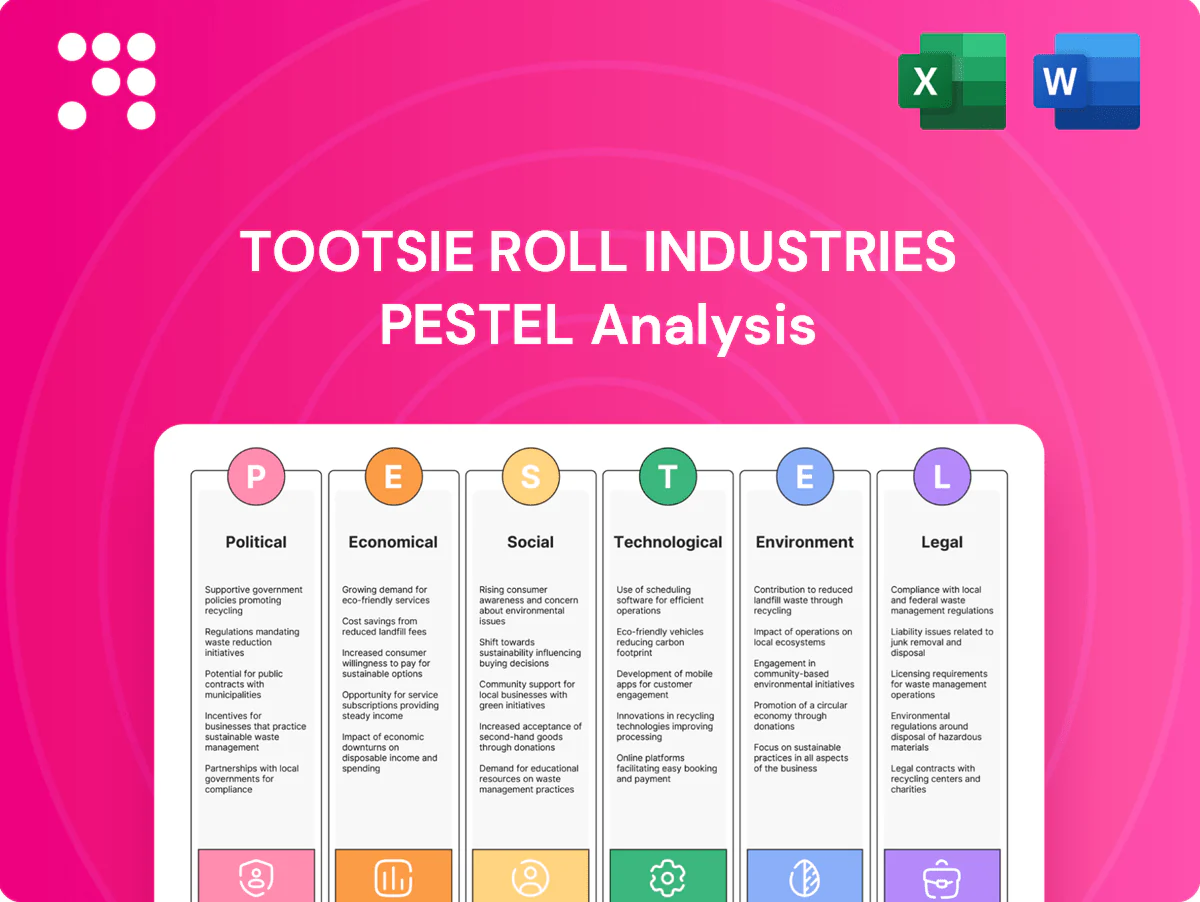
Tootsie Roll Industries PESTLE Analysis

Make Smarter Strategic Decisions with a Complete PESTEL View
Our PESTLE analysis for Tootsie Roll Industries reveals how political regulation, shifting consumer tastes, economic cycles, and sustainability pressures are reshaping its strategy and margins. Packed with actionable insights for investors and strategists, this concise preview shows key risks and opportunities. Purchase the full report to access the complete, editable analysis and make informed decisions quickly.
Political factors

USMCA trade dynamics
Tootsie Roll depends on cross-border flows across the U.S., Canada and Mexico, so USMCA stability since its July 1, 2020 entry is vital for predictable shipments. Changes to rules-of-origin or customs enforcement can lengthen lead times and raise landed costs. Political tensions or tariffs on inputs such as packaging and machinery could disrupt procurement. Proactive customs compliance and diversified customs brokers reduce exposure.
U.S. sugar program influence
U.S. sugar program policy, driven by lobbying and administered via tariff-rate quotas and loan supports, keeps domestic sugar above world-price levels, with U.S. wholesale sugar often trading in the roughly 30–40 cents per pound range versus lower global benchmarks; quotas and loans can therefore elevate input costs and compress Tootsie Roll margins. Policy shifts could ease or tighten this headwind, while long-term contracts and sweetener substitution hedge volatility.

Local snack and soda taxes
Municipal and state sugar taxes—now in over a dozen U.S. jurisdictions—can depress demand in taxed markets; Berkeley’s $0.01/oz levy was associated with ~9.6% lower SSB purchases in early studies and Philadelphia’s 1.5¢/oz tax generated roughly $72m in early revenue. Candy faces uneven taxation versus beverages but policy creep risks expansion into snacks. Patchwork rules raise compliance and pricing complexity, while geo-targeted pricing and channel mix shifts can blunt localized impacts.

Government procurement and school policies
Government nutrition standards — including USDA Smart Snacks and the National School Lunch Program (serving about 29 million children daily in 2022) — constrain vending and concession offerings, reducing sugary SKUs but preserving demand for compliant treats. Political focus on child health tightens access points, while local policy flexibility can create seasonal or compliant product slots; aligning portfolio and pack sizes (portion-controlled SKUs) preserves school procurement access.
- Market exposure: ~50 million K-12 students — key institutional channel
- Regulatory risk: Smart Snacks limits sugar/fat profiles
- Opportunity: seasonal/compliant SKUs gain shelves
- Mitigation: portfolio & pack-size alignment for procurement
Infrastructure and border security
Infrastructure funding such as the Bipartisan Infrastructure Law's roughly 17 billion for ports and waterways and highway grants affects transit reliability for Tootsie Roll. Political shifts and U.S. Customs and Border Protection staffing (~65,000 agents in 2024) can create bottlenecks; enhanced inspections often add 1–3 days and higher logistics costs. Buffer inventories and multi-node distribution improve resilience.
- Ports funding ~17B
- CBP staff ~65,000 (2024)
- Inspections add 1–3 days
- Use buffer stock & multi-node DCs
USMCA steady; customs shifts and 30–40¢/lb sugar support squeeze margins
USMCA stability (since July 1, 2020) underpins cross-border supply chains; customs shifts raise landed costs.
U.S. sugar support keeps wholesale sugar ~30–40¢/lb vs lower global prices, pressuring margins; long-term contracts mitigate risk.
Local sugar taxes (e.g., Berkeley 1¢/oz → ~9.6% drop) and school nutrition rules (29M students in NSLP) constrain channels; infrastructure funding (~$17B for ports) and CBP ~65,000 staff affect transit times.
| Metric | Value |
|---|---|
| Wholesale sugar | ~$0.30–0.40/lb |
| NSLP reach | ~29M students |
| Ports funding | $17B |
| CBP staff (2024) | ~65,000 |
What is included in the product
 Detailed Word Document
Explores how external macro-environmental factors uniquely affect Tootsie Roll Industries across Political, Economic, Social, Technological, Environmental and Legal dimensions; each section is data-backed, includes forward-looking insights and actionable implications to help executives, consultants and investors identify risks and opportunities and support strategic planning and scenario analysis.

 Customizable Excel Spreadsheet
A concise, visually segmented PESTLE summary for Tootsie Roll Industries that eases meeting prep, supports quick alignment across teams, and is editable/shareable for region- or product-specific notes.
Economic factors

Commodity cost volatility
Sugar, corn syrup, cocoa and dairy are the primary drivers of Tootsie Roll Industries’ COGS, so global supply-demand shocks and weather-driven crop disruptions can compress margins rapidly. The company uses hedging and multi-sourcing to stabilize input cost volatility. Reformulation and pack-price architecture are deployed to protect contribution per unit when raw-material inflation occurs.
Consumer spending and trade-down
Macro slowdowns and a 2024 US CPI rise of 3.4% have driven shoppers toward value packs and private-label confectionery, pressuring branded players like Tootsie Roll. Candy’s low-ticket indulgence remains resilient but shows price elasticity at shelf, with promotional cadence and EDLP mixes balancing volume and margin. Monitoring channel-specific elasticity informs targeted pricing and promo shifts to protect share and profitability.

FX exposure USD/CAD/MXN
Revenue and costs across North America expose Tootsie Roll to USD/CAD/MXN currency risk; USD/CAD traded near 1.36 and USD/MXN near 17.5 in July 2025, amplifying translation effects.
A stronger USD can compress CAD and MXN-derived sales when converted to USD, while inputs priced in local currencies raise margin volatility.
Natural hedges from local sales vs. local costs and use of forward contracts are employed to moderate FX volatility.

Inflation and wage pressures
Operating expenses for Tootsie Roll face upward pressure from labor, utilities and freight as US CPI rose 3.4% in 2024 and average hourly earnings grew ~4.1%; productivity gains and targeted automation are being used to offset margin compression. Price increases must track perceived value, while supplier negotiation and network optimization reduce overhead.
- Labor inflation: +4.1% avg hourly earnings 2024
- CPI: +3.4% 2024
- Automation/productivity offsets margins
- Price increases tied to perceived value
- Supplier negotiation and network optimization cut costs
Seasonality and holiday peaks
Halloween, winter holidays and Easter drive disproportionate volumes for Tootsie Roll Industries, with Halloween-linked US spending hitting about 11.4 billion dollars in 2023 per NRF, concentrating a large share of annual confectionery demand; forecast accuracy and inventory planning are critical to avoid markdowns and excess carry. Retailer OTIF and service levels feed annual vendor scores and listing priority, while preplanned post-peak liquidation preserves cash flow and margin.
- Season peaks: Halloween dominant (NRF 2023 $11.4B)
- Operational focus: forecast accuracy, inventory turns, OTIF/service levels
- Financial safeguard: structured post-peak liquidation to protect cash and margins
USMCA steady; customs shifts and 30–40¢/lb sugar support squeeze margins
Raw-material shocks (sugar, cocoa) and FX drive margin risk; company uses hedging and multisourcing while reformulating and adjusting pack pricing to protect contribution. 2024 inflation (CPI +3.4%, avg hourly earnings +4.1%) and 2025 FX (USD/CAD ~1.36, USD/MXN ~17.5) pressure Opex and translation; automation, supplier negotiation and targeted promotions mitigate impacts. Seasonal peaks (Halloween NRF 2023 $11.4B) require tight forecasting and post-peak liquidation.
| Metric | Value |
|---|---|
| CPI 2024 | +3.4% |
| Avg hourly earnings 2024 | +4.1% |
| USD/CAD Jul 2025 | ~1.36 |
| USD/MXN Jul 2025 | ~17.5 |
| Halloween spend 2023 | $11.4B |
Preview Before You Purchase
Tootsie Roll Industries PESTLE Analysis
This preview of the Tootsie Roll Industries PESTLE Analysis is the exact document you’ll receive after purchase—fully formatted and ready to use. It includes complete political, economic, social, technological, legal, and environmental assessments with no placeholders. Download the final file immediately after payment.

Make Smarter Strategic Decisions with a Complete PESTEL View
Our PESTLE analysis for Tootsie Roll Industries reveals how political regulation, shifting consumer tastes, economic cycles, and sustainability pressures are reshaping its strategy and margins. Packed with actionable insights for investors and strategists, this concise preview shows key risks and opportunities. Purchase the full report to access the complete, editable analysis and make informed decisions quickly.
Political factors
USMCA trade dynamics
Tootsie Roll depends on cross-border flows across the U.S., Canada and Mexico, so USMCA stability since its July 1, 2020 entry is vital for predictable shipments. Changes to rules-of-origin or customs enforcement can lengthen lead times and raise landed costs. Political tensions or tariffs on inputs such as packaging and machinery could disrupt procurement. Proactive customs compliance and diversified customs brokers reduce exposure.
U.S. sugar program influence
U.S. sugar program policy, driven by lobbying and administered via tariff-rate quotas and loan supports, keeps domestic sugar above world-price levels, with U.S. wholesale sugar often trading in the roughly 30–40 cents per pound range versus lower global benchmarks; quotas and loans can therefore elevate input costs and compress Tootsie Roll margins. Policy shifts could ease or tighten this headwind, while long-term contracts and sweetener substitution hedge volatility.
Local snack and soda taxes
Municipal and state sugar taxes—now in over a dozen U.S. jurisdictions—can depress demand in taxed markets; Berkeley’s $0.01/oz levy was associated with ~9.6% lower SSB purchases in early studies and Philadelphia’s 1.5¢/oz tax generated roughly $72m in early revenue. Candy faces uneven taxation versus beverages but policy creep risks expansion into snacks. Patchwork rules raise compliance and pricing complexity, while geo-targeted pricing and channel mix shifts can blunt localized impacts.
Government procurement and school policies
Government nutrition standards — including USDA Smart Snacks and the National School Lunch Program (serving about 29 million children daily in 2022) — constrain vending and concession offerings, reducing sugary SKUs but preserving demand for compliant treats. Political focus on child health tightens access points, while local policy flexibility can create seasonal or compliant product slots; aligning portfolio and pack sizes (portion-controlled SKUs) preserves school procurement access.
- Market exposure: ~50 million K-12 students — key institutional channel
- Regulatory risk: Smart Snacks limits sugar/fat profiles
- Opportunity: seasonal/compliant SKUs gain shelves
- Mitigation: portfolio & pack-size alignment for procurement
Infrastructure and border security
Infrastructure funding such as the Bipartisan Infrastructure Law's roughly 17 billion for ports and waterways and highway grants affects transit reliability for Tootsie Roll. Political shifts and U.S. Customs and Border Protection staffing (~65,000 agents in 2024) can create bottlenecks; enhanced inspections often add 1–3 days and higher logistics costs. Buffer inventories and multi-node distribution improve resilience.
- Ports funding ~17B
- CBP staff ~65,000 (2024)
- Inspections add 1–3 days
- Use buffer stock & multi-node DCs
USMCA steady; customs shifts and 30–40¢/lb sugar support squeeze margins
USMCA stability (since July 1, 2020) underpins cross-border supply chains; customs shifts raise landed costs.
U.S. sugar support keeps wholesale sugar ~30–40¢/lb vs lower global prices, pressuring margins; long-term contracts mitigate risk.
Local sugar taxes (e.g., Berkeley 1¢/oz → ~9.6% drop) and school nutrition rules (29M students in NSLP) constrain channels; infrastructure funding (~$17B for ports) and CBP ~65,000 staff affect transit times.
| Metric | Value |
|---|---|
| Wholesale sugar | ~$0.30–0.40/lb |
| NSLP reach | ~29M students |
| Ports funding | $17B |
| CBP staff (2024) | ~65,000 |
What is included in the product
Detailed Word Document
Explores how external macro-environmental factors uniquely affect Tootsie Roll Industries across Political, Economic, Social, Technological, Environmental and Legal dimensions; each section is data-backed, includes forward-looking insights and actionable implications to help executives, consultants and investors identify risks and opportunities and support strategic planning and scenario analysis.
Customizable Excel Spreadsheet
A concise, visually segmented PESTLE summary for Tootsie Roll Industries that eases meeting prep, supports quick alignment across teams, and is editable/shareable for region- or product-specific notes.
Economic factors
Commodity cost volatility
Sugar, corn syrup, cocoa and dairy are the primary drivers of Tootsie Roll Industries’ COGS, so global supply-demand shocks and weather-driven crop disruptions can compress margins rapidly. The company uses hedging and multi-sourcing to stabilize input cost volatility. Reformulation and pack-price architecture are deployed to protect contribution per unit when raw-material inflation occurs.
Consumer spending and trade-down
Macro slowdowns and a 2024 US CPI rise of 3.4% have driven shoppers toward value packs and private-label confectionery, pressuring branded players like Tootsie Roll. Candy’s low-ticket indulgence remains resilient but shows price elasticity at shelf, with promotional cadence and EDLP mixes balancing volume and margin. Monitoring channel-specific elasticity informs targeted pricing and promo shifts to protect share and profitability.
FX exposure USD/CAD/MXN
Revenue and costs across North America expose Tootsie Roll to USD/CAD/MXN currency risk; USD/CAD traded near 1.36 and USD/MXN near 17.5 in July 2025, amplifying translation effects.
A stronger USD can compress CAD and MXN-derived sales when converted to USD, while inputs priced in local currencies raise margin volatility.
Natural hedges from local sales vs. local costs and use of forward contracts are employed to moderate FX volatility.
Inflation and wage pressures
Operating expenses for Tootsie Roll face upward pressure from labor, utilities and freight as US CPI rose 3.4% in 2024 and average hourly earnings grew ~4.1%; productivity gains and targeted automation are being used to offset margin compression. Price increases must track perceived value, while supplier negotiation and network optimization reduce overhead.
- Labor inflation: +4.1% avg hourly earnings 2024
- CPI: +3.4% 2024
- Automation/productivity offsets margins
- Price increases tied to perceived value
- Supplier negotiation and network optimization cut costs
Seasonality and holiday peaks
Halloween, winter holidays and Easter drive disproportionate volumes for Tootsie Roll Industries, with Halloween-linked US spending hitting about 11.4 billion dollars in 2023 per NRF, concentrating a large share of annual confectionery demand; forecast accuracy and inventory planning are critical to avoid markdowns and excess carry. Retailer OTIF and service levels feed annual vendor scores and listing priority, while preplanned post-peak liquidation preserves cash flow and margin.
- Season peaks: Halloween dominant (NRF 2023 $11.4B)
- Operational focus: forecast accuracy, inventory turns, OTIF/service levels
- Financial safeguard: structured post-peak liquidation to protect cash and margins
USMCA steady; customs shifts and 30–40¢/lb sugar support squeeze margins
Raw-material shocks (sugar, cocoa) and FX drive margin risk; company uses hedging and multisourcing while reformulating and adjusting pack pricing to protect contribution. 2024 inflation (CPI +3.4%, avg hourly earnings +4.1%) and 2025 FX (USD/CAD ~1.36, USD/MXN ~17.5) pressure Opex and translation; automation, supplier negotiation and targeted promotions mitigate impacts. Seasonal peaks (Halloween NRF 2023 $11.4B) require tight forecasting and post-peak liquidation.
| Metric | Value |
|---|---|
| CPI 2024 | +3.4% |
| Avg hourly earnings 2024 | +4.1% |
| USD/CAD Jul 2025 | ~1.36 |
| USD/MXN Jul 2025 | ~17.5 |
| Halloween spend 2023 | $11.4B |
Preview Before You Purchase
Tootsie Roll Industries PESTLE Analysis
This preview of the Tootsie Roll Industries PESTLE Analysis is the exact document you’ll receive after purchase—fully formatted and ready to use. It includes complete political, economic, social, technological, legal, and environmental assessments with no placeholders. Download the final file immediately after payment.
Original: $10.00
-65%$10.00
$3.50Description
Make Smarter Strategic Decisions with a Complete PESTEL View
Our PESTLE analysis for Tootsie Roll Industries reveals how political regulation, shifting consumer tastes, economic cycles, and sustainability pressures are reshaping its strategy and margins. Packed with actionable insights for investors and strategists, this concise preview shows key risks and opportunities. Purchase the full report to access the complete, editable analysis and make informed decisions quickly.
Political factors
USMCA trade dynamics
Tootsie Roll depends on cross-border flows across the U.S., Canada and Mexico, so USMCA stability since its July 1, 2020 entry is vital for predictable shipments. Changes to rules-of-origin or customs enforcement can lengthen lead times and raise landed costs. Political tensions or tariffs on inputs such as packaging and machinery could disrupt procurement. Proactive customs compliance and diversified customs brokers reduce exposure.
U.S. sugar program influence
U.S. sugar program policy, driven by lobbying and administered via tariff-rate quotas and loan supports, keeps domestic sugar above world-price levels, with U.S. wholesale sugar often trading in the roughly 30–40 cents per pound range versus lower global benchmarks; quotas and loans can therefore elevate input costs and compress Tootsie Roll margins. Policy shifts could ease or tighten this headwind, while long-term contracts and sweetener substitution hedge volatility.
Local snack and soda taxes
Municipal and state sugar taxes—now in over a dozen U.S. jurisdictions—can depress demand in taxed markets; Berkeley’s $0.01/oz levy was associated with ~9.6% lower SSB purchases in early studies and Philadelphia’s 1.5¢/oz tax generated roughly $72m in early revenue. Candy faces uneven taxation versus beverages but policy creep risks expansion into snacks. Patchwork rules raise compliance and pricing complexity, while geo-targeted pricing and channel mix shifts can blunt localized impacts.
Government procurement and school policies
Government nutrition standards — including USDA Smart Snacks and the National School Lunch Program (serving about 29 million children daily in 2022) — constrain vending and concession offerings, reducing sugary SKUs but preserving demand for compliant treats. Political focus on child health tightens access points, while local policy flexibility can create seasonal or compliant product slots; aligning portfolio and pack sizes (portion-controlled SKUs) preserves school procurement access.
- Market exposure: ~50 million K-12 students — key institutional channel
- Regulatory risk: Smart Snacks limits sugar/fat profiles
- Opportunity: seasonal/compliant SKUs gain shelves
- Mitigation: portfolio & pack-size alignment for procurement
Infrastructure and border security
Infrastructure funding such as the Bipartisan Infrastructure Law's roughly 17 billion for ports and waterways and highway grants affects transit reliability for Tootsie Roll. Political shifts and U.S. Customs and Border Protection staffing (~65,000 agents in 2024) can create bottlenecks; enhanced inspections often add 1–3 days and higher logistics costs. Buffer inventories and multi-node distribution improve resilience.
- Ports funding ~17B
- CBP staff ~65,000 (2024)
- Inspections add 1–3 days
- Use buffer stock & multi-node DCs
USMCA steady; customs shifts and 30–40¢/lb sugar support squeeze margins
USMCA stability (since July 1, 2020) underpins cross-border supply chains; customs shifts raise landed costs.
U.S. sugar support keeps wholesale sugar ~30–40¢/lb vs lower global prices, pressuring margins; long-term contracts mitigate risk.
Local sugar taxes (e.g., Berkeley 1¢/oz → ~9.6% drop) and school nutrition rules (29M students in NSLP) constrain channels; infrastructure funding (~$17B for ports) and CBP ~65,000 staff affect transit times.
| Metric | Value |
|---|---|
| Wholesale sugar | ~$0.30–0.40/lb |
| NSLP reach | ~29M students |
| Ports funding | $17B |
| CBP staff (2024) | ~65,000 |
What is included in the product
Detailed Word Document
Explores how external macro-environmental factors uniquely affect Tootsie Roll Industries across Political, Economic, Social, Technological, Environmental and Legal dimensions; each section is data-backed, includes forward-looking insights and actionable implications to help executives, consultants and investors identify risks and opportunities and support strategic planning and scenario analysis.
Customizable Excel Spreadsheet
A concise, visually segmented PESTLE summary for Tootsie Roll Industries that eases meeting prep, supports quick alignment across teams, and is editable/shareable for region- or product-specific notes.
Economic factors
Commodity cost volatility
Sugar, corn syrup, cocoa and dairy are the primary drivers of Tootsie Roll Industries’ COGS, so global supply-demand shocks and weather-driven crop disruptions can compress margins rapidly. The company uses hedging and multi-sourcing to stabilize input cost volatility. Reformulation and pack-price architecture are deployed to protect contribution per unit when raw-material inflation occurs.
Consumer spending and trade-down
Macro slowdowns and a 2024 US CPI rise of 3.4% have driven shoppers toward value packs and private-label confectionery, pressuring branded players like Tootsie Roll. Candy’s low-ticket indulgence remains resilient but shows price elasticity at shelf, with promotional cadence and EDLP mixes balancing volume and margin. Monitoring channel-specific elasticity informs targeted pricing and promo shifts to protect share and profitability.
FX exposure USD/CAD/MXN
Revenue and costs across North America expose Tootsie Roll to USD/CAD/MXN currency risk; USD/CAD traded near 1.36 and USD/MXN near 17.5 in July 2025, amplifying translation effects.
A stronger USD can compress CAD and MXN-derived sales when converted to USD, while inputs priced in local currencies raise margin volatility.
Natural hedges from local sales vs. local costs and use of forward contracts are employed to moderate FX volatility.
Inflation and wage pressures
Operating expenses for Tootsie Roll face upward pressure from labor, utilities and freight as US CPI rose 3.4% in 2024 and average hourly earnings grew ~4.1%; productivity gains and targeted automation are being used to offset margin compression. Price increases must track perceived value, while supplier negotiation and network optimization reduce overhead.
- Labor inflation: +4.1% avg hourly earnings 2024
- CPI: +3.4% 2024
- Automation/productivity offsets margins
- Price increases tied to perceived value
- Supplier negotiation and network optimization cut costs
Seasonality and holiday peaks
Halloween, winter holidays and Easter drive disproportionate volumes for Tootsie Roll Industries, with Halloween-linked US spending hitting about 11.4 billion dollars in 2023 per NRF, concentrating a large share of annual confectionery demand; forecast accuracy and inventory planning are critical to avoid markdowns and excess carry. Retailer OTIF and service levels feed annual vendor scores and listing priority, while preplanned post-peak liquidation preserves cash flow and margin.
- Season peaks: Halloween dominant (NRF 2023 $11.4B)
- Operational focus: forecast accuracy, inventory turns, OTIF/service levels
- Financial safeguard: structured post-peak liquidation to protect cash and margins
USMCA steady; customs shifts and 30–40¢/lb sugar support squeeze margins
Raw-material shocks (sugar, cocoa) and FX drive margin risk; company uses hedging and multisourcing while reformulating and adjusting pack pricing to protect contribution. 2024 inflation (CPI +3.4%, avg hourly earnings +4.1%) and 2025 FX (USD/CAD ~1.36, USD/MXN ~17.5) pressure Opex and translation; automation, supplier negotiation and targeted promotions mitigate impacts. Seasonal peaks (Halloween NRF 2023 $11.4B) require tight forecasting and post-peak liquidation.
| Metric | Value |
|---|---|
| CPI 2024 | +3.4% |
| Avg hourly earnings 2024 | +4.1% |
| USD/CAD Jul 2025 | ~1.36 |
| USD/MXN Jul 2025 | ~17.5 |
| Halloween spend 2023 | $11.4B |
Preview Before You Purchase
Tootsie Roll Industries PESTLE Analysis
This preview of the Tootsie Roll Industries PESTLE Analysis is the exact document you’ll receive after purchase—fully formatted and ready to use. It includes complete political, economic, social, technological, legal, and environmental assessments with no placeholders. Download the final file immediately after payment.











