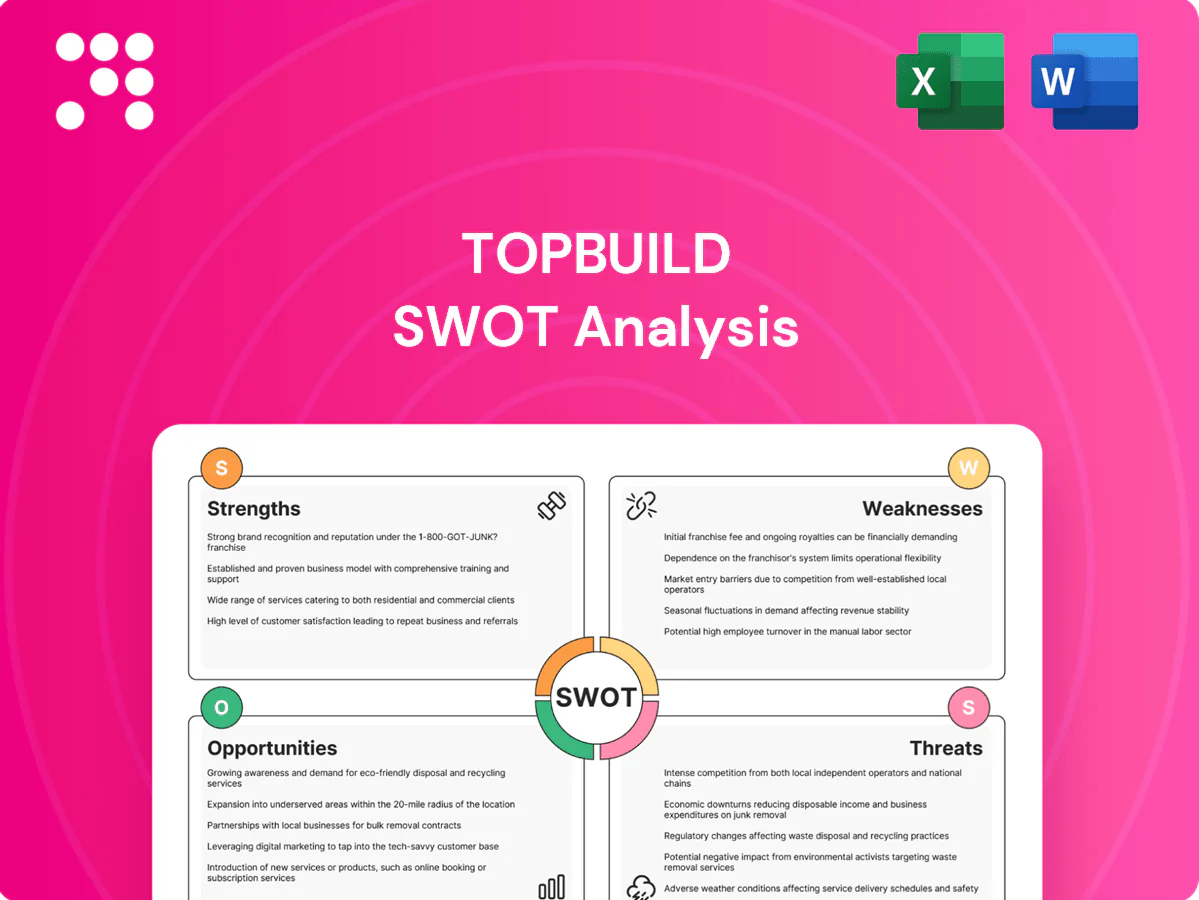
TopBuild SWOT Analysis

Your Strategic Toolkit Starts Here
Discover TopBuild's competitive edge and vulnerabilities with our concise SWOT overview. The full SWOT analysis delivers research-backed insights, financial context, and strategic recommendations to inform investment and planning. Purchase the complete report—editable Word and Excel files included—for actionable clarity.
Strengths

Scaled national footprint
TopBuild’s scaled national footprint with over 300 branch locations across the U.S. delivers volume leverage and closer customer proximity, enabling stronger purchasing power with manufacturers and streamlined logistics. The network supports multi-location builders with consistent service and helps smooth regional demand swings, contributing to the company’s scale-driven cost advantages.
Dual-segment model
TopBuild’s dual-segment model—TruTeam installation plus Service Partners distribution—creates vertical synergies that capture margin at multiple points of the value chain and balance mix across new build and retrofit. Cross-selling between segments boosts share-of-wallet with contractors and builders, leveraging a nationwide footprint and about 10,000 employees (2024). The model diversifies revenue streams and supports margin resilience through mixed project types.

Energy-efficiency focus
TopBuild's insulation and envelope solutions align with decarbonization trends as buildings and construction accounted for about 36% of final energy use and 37% of energy-related CO2 emissions (IEA, 2023). Customers see lower operating costs and comfort gains, with insulation often cutting heating/cooling loads by double-digit percentages. Regulatory tailwinds and incentives, including roughly $369 billion in federal climate investments under the IRA, support durable demand and differentiate TopBuild from commodity-only distributors.

Diverse end-market exposure
TopBuilds diverse end-market exposure across residential and commercial segments reduces single-cycle risk, while balanced exposure to new construction and retrofit work provides countercyclical buffers; product breadth beyond insulation—including HVAC and specialty services—adds resilience and supports steadier cash generation through cycles.
- Reduces single-cycle risk
- New build + retrofit = countercyclical buffer
- Product breadth enhances revenue stability
Strong contractor and builder relationships
TopBuild's deep installer network and reliable jobsite execution drive repeat business and contractor loyalty; schedule adherence and on‑time fulfillment are treated as mission‑critical in construction workflows. Preferred vendor status with large builders secures pipeline visibility and recurring projects, while consistent service quality supports premium pricing versus smaller local rivals.
- Installer network depth
- Schedule reliability
- Preferred vendor pipeline
- Premium service pricing
National retrofit platform with >300 branches, ~10,000 employees and IRA-aligned demand
TopBuild’s >300 branches and ~10,000 employees (2024) deliver scale, purchasing power and closer customer proximity. The TruTeam + Service Partners model captures margin across installation and distribution, boosting cross‑sell and mix resilience. Product set (insulation, HVAC, envelope) aligns with decarbonization trends and IRA climate investments, supporting durable retrofit demand.
| Metric | Value |
|---|---|
| Branches | >300 |
| Employees (2024) | ~10,000 |
| IRA climate funding | $369B |
What is included in the product
 Detailed Word Document
Delivers a strategic overview of TopBuild's internal and external business factors, outlining strengths, weaknesses, opportunities, and threats that shape its competitive position and growth prospects.

 Customizable Excel Spreadsheet
Provides a concise TopBuild SWOT matrix for fast, visual strategy alignment, relieving analysis bottlenecks by highlighting growth opportunities and contractor or supply-chain risks for quick, actionable decisions.
Weaknesses

Construction cyclicality
Revenue at TopBuild is highly sensitive to US housing starts, which fell to about 1.37 million units SAAR in 2023 (U.S. Census), so slower residential and commercial build rates quickly pressure backlog and margins. Fixed field-operation costs—labor, crews, equipment—amplify downside when volumes drop, and abrupt local market shifts make forecasting crew utilization and material needs much harder, tightening working-capital and margin flexibility.
Labor-intensive operations
Installation requires skilled crews and tight scheduling, making capacity sensitive to labor availability and turnover which can degrade service quality and delay projects. Ongoing training and safety programs create recurring costs that weighed on operations in 2024, while US wage growth of about 4.1% year-over-year (BLS, 2024) risks compressing margins if not passed through to customers.

Supplier concentration risks
TopBuild relies on a small set of insulation suppliers — three large manufacturers such as Owens Corning, Johns Manville and CertainTeed — so allocation shifts or price moves can quickly disrupt availability. This dependence limits negotiating flexibility in tight markets and can compress margins. Alternative sourcing often fails to match specs or lead times, creating operational backlogs seen in 2024.

Pricing and mix volatility
Input-cost swings in fiberglass, spray-foam and related materials through 2024–2025 drive pricing volatility for TopBuild; delayed pass-through of higher supplier costs has periodically eroded gross margins. Shifts between residential and commercial project mix change average ticket size and labor intensity, making per-job gross profit forecasting less predictable and increasing working-capital strain.
- Input-cost sensitivity: fiberglass/foam-driven
- Pass-through lag erodes margins
- Project mix alters ticket & labor
- GP per job forecasting more volatile
Integration and execution complexity
Integration and execution complexity from TopBuilds acquisition-driven, multi-branch expansion increases operational risk; aligning processes and culture across regions remains difficult. Scaling IT, routing and inventory systems reliably is critical, since missteps can degrade service levels and erode customer loyalty.
- Integration risk from rapid multi-branch growth
- Difficulty standardizing processes and culture
- Need scalable IT/routing/inventory systems
- Operational missteps can harm service and loyalty
Revenue linked to US starts 1.37M; wage growth 4.1% and 3 suppliers squeeze margins
TopBuild revenue is highly tied to US housing starts (≈1.37M SAAR in 2023), so slower builds quickly pressure backlog and margins. Fixed field costs and 4.1% US wage growth (BLS, 2024) compress margins if not passed through. Heavy reliance on three major insulation suppliers limits availability and negotiating power.
| Metric | Value | Weakness Impact |
|---|---|---|
| US housing starts | 1.37M SAAR (2023) | Revenue sensitivity |
| Wage growth | 4.1% YoY (2024) | Margin pressure |
| Supplier concentration | 3 major suppliers | Availability risk |
Full Version Awaits
TopBuild SWOT Analysis
This is the actual TopBuild SWOT analysis document you’ll receive upon purchase—no surprises, just professional quality. The preview below is taken directly from the full SWOT report you'll get, and the complete, editable version is unlocked after payment. Buy now to download the full, structured analysis ready for use in strategy or valuation.

Your Strategic Toolkit Starts Here
Discover TopBuild's competitive edge and vulnerabilities with our concise SWOT overview. The full SWOT analysis delivers research-backed insights, financial context, and strategic recommendations to inform investment and planning. Purchase the complete report—editable Word and Excel files included—for actionable clarity.
Strengths
Scaled national footprint
TopBuild’s scaled national footprint with over 300 branch locations across the U.S. delivers volume leverage and closer customer proximity, enabling stronger purchasing power with manufacturers and streamlined logistics. The network supports multi-location builders with consistent service and helps smooth regional demand swings, contributing to the company’s scale-driven cost advantages.
Dual-segment model
TopBuild’s dual-segment model—TruTeam installation plus Service Partners distribution—creates vertical synergies that capture margin at multiple points of the value chain and balance mix across new build and retrofit. Cross-selling between segments boosts share-of-wallet with contractors and builders, leveraging a nationwide footprint and about 10,000 employees (2024). The model diversifies revenue streams and supports margin resilience through mixed project types.
Energy-efficiency focus
TopBuild's insulation and envelope solutions align with decarbonization trends as buildings and construction accounted for about 36% of final energy use and 37% of energy-related CO2 emissions (IEA, 2023). Customers see lower operating costs and comfort gains, with insulation often cutting heating/cooling loads by double-digit percentages. Regulatory tailwinds and incentives, including roughly $369 billion in federal climate investments under the IRA, support durable demand and differentiate TopBuild from commodity-only distributors.
Diverse end-market exposure
TopBuilds diverse end-market exposure across residential and commercial segments reduces single-cycle risk, while balanced exposure to new construction and retrofit work provides countercyclical buffers; product breadth beyond insulation—including HVAC and specialty services—adds resilience and supports steadier cash generation through cycles.
- Reduces single-cycle risk
- New build + retrofit = countercyclical buffer
- Product breadth enhances revenue stability
Strong contractor and builder relationships
TopBuild's deep installer network and reliable jobsite execution drive repeat business and contractor loyalty; schedule adherence and on‑time fulfillment are treated as mission‑critical in construction workflows. Preferred vendor status with large builders secures pipeline visibility and recurring projects, while consistent service quality supports premium pricing versus smaller local rivals.
- Installer network depth
- Schedule reliability
- Preferred vendor pipeline
- Premium service pricing
National retrofit platform with >300 branches, ~10,000 employees and IRA-aligned demand
TopBuild’s >300 branches and ~10,000 employees (2024) deliver scale, purchasing power and closer customer proximity. The TruTeam + Service Partners model captures margin across installation and distribution, boosting cross‑sell and mix resilience. Product set (insulation, HVAC, envelope) aligns with decarbonization trends and IRA climate investments, supporting durable retrofit demand.
| Metric | Value |
|---|---|
| Branches | >300 |
| Employees (2024) | ~10,000 |
| IRA climate funding | $369B |
What is included in the product
Detailed Word Document
Delivers a strategic overview of TopBuild's internal and external business factors, outlining strengths, weaknesses, opportunities, and threats that shape its competitive position and growth prospects.
Customizable Excel Spreadsheet
Provides a concise TopBuild SWOT matrix for fast, visual strategy alignment, relieving analysis bottlenecks by highlighting growth opportunities and contractor or supply-chain risks for quick, actionable decisions.
Weaknesses
Construction cyclicality
Revenue at TopBuild is highly sensitive to US housing starts, which fell to about 1.37 million units SAAR in 2023 (U.S. Census), so slower residential and commercial build rates quickly pressure backlog and margins. Fixed field-operation costs—labor, crews, equipment—amplify downside when volumes drop, and abrupt local market shifts make forecasting crew utilization and material needs much harder, tightening working-capital and margin flexibility.
Labor-intensive operations
Installation requires skilled crews and tight scheduling, making capacity sensitive to labor availability and turnover which can degrade service quality and delay projects. Ongoing training and safety programs create recurring costs that weighed on operations in 2024, while US wage growth of about 4.1% year-over-year (BLS, 2024) risks compressing margins if not passed through to customers.
Supplier concentration risks
TopBuild relies on a small set of insulation suppliers — three large manufacturers such as Owens Corning, Johns Manville and CertainTeed — so allocation shifts or price moves can quickly disrupt availability. This dependence limits negotiating flexibility in tight markets and can compress margins. Alternative sourcing often fails to match specs or lead times, creating operational backlogs seen in 2024.
Pricing and mix volatility
Input-cost swings in fiberglass, spray-foam and related materials through 2024–2025 drive pricing volatility for TopBuild; delayed pass-through of higher supplier costs has periodically eroded gross margins. Shifts between residential and commercial project mix change average ticket size and labor intensity, making per-job gross profit forecasting less predictable and increasing working-capital strain.
- Input-cost sensitivity: fiberglass/foam-driven
- Pass-through lag erodes margins
- Project mix alters ticket & labor
- GP per job forecasting more volatile
Integration and execution complexity
Integration and execution complexity from TopBuilds acquisition-driven, multi-branch expansion increases operational risk; aligning processes and culture across regions remains difficult. Scaling IT, routing and inventory systems reliably is critical, since missteps can degrade service levels and erode customer loyalty.
- Integration risk from rapid multi-branch growth
- Difficulty standardizing processes and culture
- Need scalable IT/routing/inventory systems
- Operational missteps can harm service and loyalty
Revenue linked to US starts 1.37M; wage growth 4.1% and 3 suppliers squeeze margins
TopBuild revenue is highly tied to US housing starts (≈1.37M SAAR in 2023), so slower builds quickly pressure backlog and margins. Fixed field costs and 4.1% US wage growth (BLS, 2024) compress margins if not passed through. Heavy reliance on three major insulation suppliers limits availability and negotiating power.
| Metric | Value | Weakness Impact |
|---|---|---|
| US housing starts | 1.37M SAAR (2023) | Revenue sensitivity |
| Wage growth | 4.1% YoY (2024) | Margin pressure |
| Supplier concentration | 3 major suppliers | Availability risk |
Full Version Awaits
TopBuild SWOT Analysis
This is the actual TopBuild SWOT analysis document you’ll receive upon purchase—no surprises, just professional quality. The preview below is taken directly from the full SWOT report you'll get, and the complete, editable version is unlocked after payment. Buy now to download the full, structured analysis ready for use in strategy or valuation.
Original: $10.00
-65%$10.00
$3.50Description
Your Strategic Toolkit Starts Here
Discover TopBuild's competitive edge and vulnerabilities with our concise SWOT overview. The full SWOT analysis delivers research-backed insights, financial context, and strategic recommendations to inform investment and planning. Purchase the complete report—editable Word and Excel files included—for actionable clarity.
Strengths
Scaled national footprint
TopBuild’s scaled national footprint with over 300 branch locations across the U.S. delivers volume leverage and closer customer proximity, enabling stronger purchasing power with manufacturers and streamlined logistics. The network supports multi-location builders with consistent service and helps smooth regional demand swings, contributing to the company’s scale-driven cost advantages.
Dual-segment model
TopBuild’s dual-segment model—TruTeam installation plus Service Partners distribution—creates vertical synergies that capture margin at multiple points of the value chain and balance mix across new build and retrofit. Cross-selling between segments boosts share-of-wallet with contractors and builders, leveraging a nationwide footprint and about 10,000 employees (2024). The model diversifies revenue streams and supports margin resilience through mixed project types.
Energy-efficiency focus
TopBuild's insulation and envelope solutions align with decarbonization trends as buildings and construction accounted for about 36% of final energy use and 37% of energy-related CO2 emissions (IEA, 2023). Customers see lower operating costs and comfort gains, with insulation often cutting heating/cooling loads by double-digit percentages. Regulatory tailwinds and incentives, including roughly $369 billion in federal climate investments under the IRA, support durable demand and differentiate TopBuild from commodity-only distributors.
Diverse end-market exposure
TopBuilds diverse end-market exposure across residential and commercial segments reduces single-cycle risk, while balanced exposure to new construction and retrofit work provides countercyclical buffers; product breadth beyond insulation—including HVAC and specialty services—adds resilience and supports steadier cash generation through cycles.
- Reduces single-cycle risk
- New build + retrofit = countercyclical buffer
- Product breadth enhances revenue stability
Strong contractor and builder relationships
TopBuild's deep installer network and reliable jobsite execution drive repeat business and contractor loyalty; schedule adherence and on‑time fulfillment are treated as mission‑critical in construction workflows. Preferred vendor status with large builders secures pipeline visibility and recurring projects, while consistent service quality supports premium pricing versus smaller local rivals.
- Installer network depth
- Schedule reliability
- Preferred vendor pipeline
- Premium service pricing
National retrofit platform with >300 branches, ~10,000 employees and IRA-aligned demand
TopBuild’s >300 branches and ~10,000 employees (2024) deliver scale, purchasing power and closer customer proximity. The TruTeam + Service Partners model captures margin across installation and distribution, boosting cross‑sell and mix resilience. Product set (insulation, HVAC, envelope) aligns with decarbonization trends and IRA climate investments, supporting durable retrofit demand.
| Metric | Value |
|---|---|
| Branches | >300 |
| Employees (2024) | ~10,000 |
| IRA climate funding | $369B |
What is included in the product
Detailed Word Document
Delivers a strategic overview of TopBuild's internal and external business factors, outlining strengths, weaknesses, opportunities, and threats that shape its competitive position and growth prospects.
Customizable Excel Spreadsheet
Provides a concise TopBuild SWOT matrix for fast, visual strategy alignment, relieving analysis bottlenecks by highlighting growth opportunities and contractor or supply-chain risks for quick, actionable decisions.
Weaknesses
Construction cyclicality
Revenue at TopBuild is highly sensitive to US housing starts, which fell to about 1.37 million units SAAR in 2023 (U.S. Census), so slower residential and commercial build rates quickly pressure backlog and margins. Fixed field-operation costs—labor, crews, equipment—amplify downside when volumes drop, and abrupt local market shifts make forecasting crew utilization and material needs much harder, tightening working-capital and margin flexibility.
Labor-intensive operations
Installation requires skilled crews and tight scheduling, making capacity sensitive to labor availability and turnover which can degrade service quality and delay projects. Ongoing training and safety programs create recurring costs that weighed on operations in 2024, while US wage growth of about 4.1% year-over-year (BLS, 2024) risks compressing margins if not passed through to customers.
Supplier concentration risks
TopBuild relies on a small set of insulation suppliers — three large manufacturers such as Owens Corning, Johns Manville and CertainTeed — so allocation shifts or price moves can quickly disrupt availability. This dependence limits negotiating flexibility in tight markets and can compress margins. Alternative sourcing often fails to match specs or lead times, creating operational backlogs seen in 2024.
Pricing and mix volatility
Input-cost swings in fiberglass, spray-foam and related materials through 2024–2025 drive pricing volatility for TopBuild; delayed pass-through of higher supplier costs has periodically eroded gross margins. Shifts between residential and commercial project mix change average ticket size and labor intensity, making per-job gross profit forecasting less predictable and increasing working-capital strain.
- Input-cost sensitivity: fiberglass/foam-driven
- Pass-through lag erodes margins
- Project mix alters ticket & labor
- GP per job forecasting more volatile
Integration and execution complexity
Integration and execution complexity from TopBuilds acquisition-driven, multi-branch expansion increases operational risk; aligning processes and culture across regions remains difficult. Scaling IT, routing and inventory systems reliably is critical, since missteps can degrade service levels and erode customer loyalty.
- Integration risk from rapid multi-branch growth
- Difficulty standardizing processes and culture
- Need scalable IT/routing/inventory systems
- Operational missteps can harm service and loyalty
Revenue linked to US starts 1.37M; wage growth 4.1% and 3 suppliers squeeze margins
TopBuild revenue is highly tied to US housing starts (≈1.37M SAAR in 2023), so slower builds quickly pressure backlog and margins. Fixed field costs and 4.1% US wage growth (BLS, 2024) compress margins if not passed through. Heavy reliance on three major insulation suppliers limits availability and negotiating power.
| Metric | Value | Weakness Impact |
|---|---|---|
| US housing starts | 1.37M SAAR (2023) | Revenue sensitivity |
| Wage growth | 4.1% YoY (2024) | Margin pressure |
| Supplier concentration | 3 major suppliers | Availability risk |
Full Version Awaits
TopBuild SWOT Analysis
This is the actual TopBuild SWOT analysis document you’ll receive upon purchase—no surprises, just professional quality. The preview below is taken directly from the full SWOT report you'll get, and the complete, editable version is unlocked after payment. Buy now to download the full, structured analysis ready for use in strategy or valuation.











