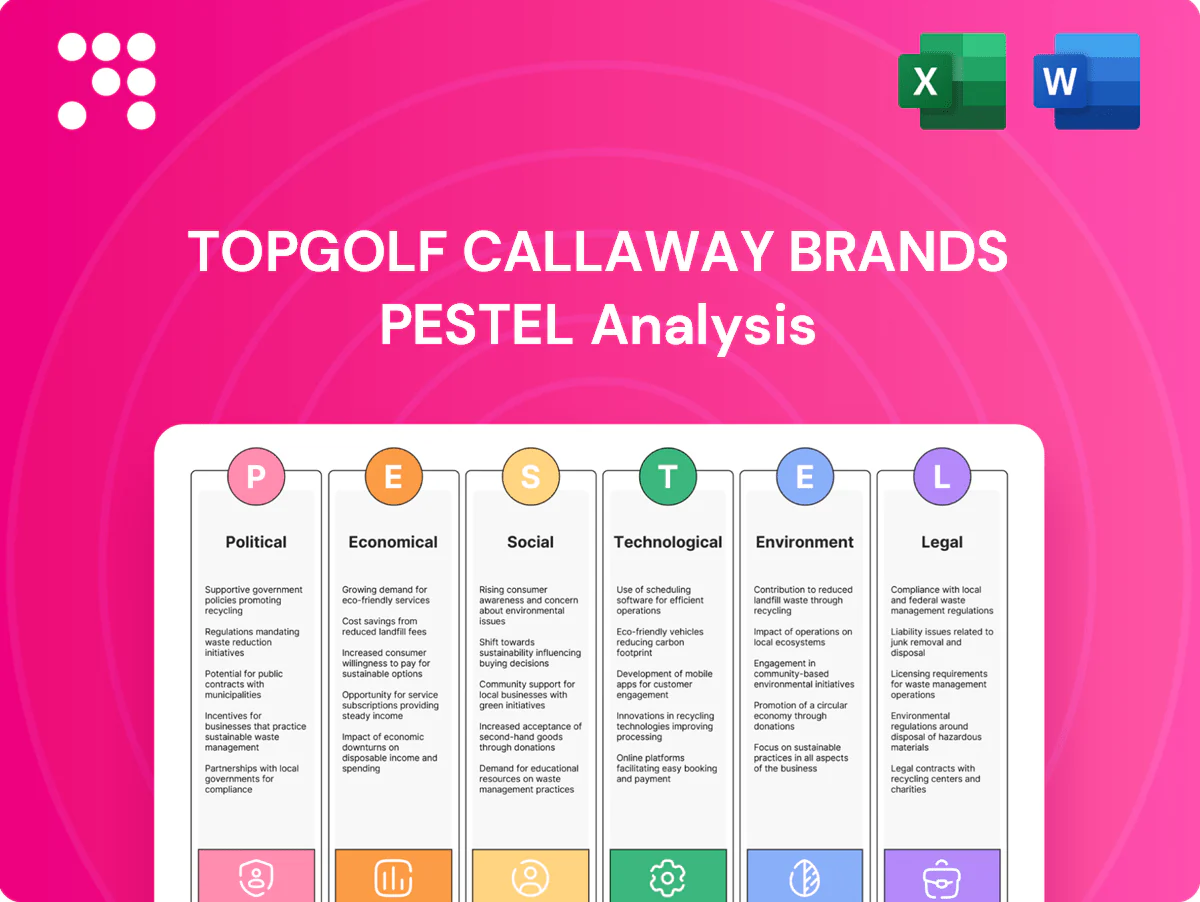
Topgolf Callaway Brands PESTLE Analysis

Skip the Research. Get the Strategy.
Our PESTLE analysis pinpoints the political, economic, social, technological, legal, and environmental forces shaping Topgolf Callaway Brands and reveals strategic risks and opportunities. Ideal for investors and planners, it translates trends into actionable insights. Purchase the full report to access the complete breakdown and download-ready recommendations.
Political factors

Trade policy shifts
Import tariffs — including US Section 301 duties covering roughly $550 billion of Chinese goods and rates up to 25% — raise COGS across clubs, apparel, and tracking hardware, squeezing margins. Shifts in US-China or EU trade relations can force sourcing changes, impacting procurement costs and lead times. Proactive supplier diversification and nearshoring mitigate volatility, and close monitoring of trade agreements is critical for pricing and inventory planning.
Permitting and zoning
New Topgolf venue approvals hinge on local zoning, community impact reviews and infrastructure capacity; Topgolf Callaway Brands operates over 80 venues worldwide as of 2024, so entitlement delays that extend timelines by months raise build costs and defer revenue ramps. Early stakeholder engagement and site-selection analytics materially reduce entitlement risk. Public-private partnerships have sped approvals in key growth markets.

Public health policy
Public health mandates can force Topgolf venues to cut capacity and hours, disrupting revenue from its more than 78 venues worldwide (2024) and event bookings. Equipment retail and Callaway’s e-commerce channels proved more resilient—DTC/digital sales comprised about 20% of Callaway Brands’ revenue in FY2023—helping offset venue downtime. Building flexible operating models preserves cash flow during policy shocks. Clear, published safety protocols sustain brand trust and accelerate demand recovery.

Sports and tourism support
Government recreation grants and local development incentives can raise project IRRs for Topgolf Callaway by reducing capex and shortening payback windows, while tourism promotion in destination cities increases venue footfall and ancillary spend.
Policy cuts that trim subsidies and tourism marketing budgets remove these tailwinds, but aligning venues with community wellness and active-living goals strengthens eligibility for remaining public support.
- grants: reduce upfront capex
- tourism: boosts foot traffic
- policy cuts: lower subsidies
- community alignment: improves funding odds
Geopolitical stability
Expansion in EMEA and Asia exposes Topgolf Callaway Brands to sanctions, political unrest and FX controls, which can disrupt logistics, staffing and consumer demand. Disruptions have repeatedly affected venue openings and supply chains. Hedging strategies and contingency inventories reduce operational risk. Portfolio balance between domestic and international markets helps smooth shocks.
- Exposure: sanctions, FX controls
- Impact: logistics, staffing, demand
- Mitigation: hedging, contingency inventory
- Resilience: domestic/international balance
Tariffs, zoning and health mandates squeeze margins; DTC and incentives cushion revenue
Import tariffs (US Section 301 covering ~$550bn of Chinese goods, rates up to 25%) elevate COGS across clubs, apparel and hardware, squeezing margins.
Local zoning and entitlement delays can push timelines and capex for 80+ Topgolf venues (2024), deferring revenue ramp.
Public-health mandates cut venue revenue while DTC/e‑commerce (~20% of Callaway Brands revenue FY2023) cushions shocks; grants/tourism incentives improve IRRs.
| Factor | Metric | Impact | Mitigation |
|---|---|---|---|
| Tariffs | $550bn, 25% | Higher COGS | Nearshoring |
| Zoning | 80+ venues | Delay/cost | Stakeholder engagement |
| Health/grants | 20% DTC | Revenue volatility | Flexible ops |
What is included in the product
 Detailed Word Document
Explores how Political, Economic, Social, Technological, Environmental, and Legal factors uniquely impact Topgolf Callaway Brands, with data-backed trends, actionable threats/opportunities, forward-looking scenario insights, and practical recommendations—designed for executives, consultants, and investors and ready for inclusion in plans, decks, or reports.

 Customizable Excel Spreadsheet
A concise PESTLE summary of Topgolf Callaway Brands that distills political, economic, social, technological, legal and environmental risks and opportunities into a single-slide ready format for fast alignment and decision-making. Ideal for presentations, team briefings, and consultant reports to quickly surface external threats and strategic levers.
Economic factors

Consumer discretionary cycles
Entertainment spend and premium apparel are cyclical and track real disposable income, with consumers shifting to value tiers and off-peak Topgolf visits during downturns; Topgolf had over 80 venues worldwide by end-2024, anchoring scale. Dynamic pricing and tiered product lines help protect volumes and mix, while memberships and corporate events — growing sources of recurring revenue — add resilience to seasonal swings.
Interest rates and capex
Higher policy rates (Fed funds ~5.25–5.50% in 2024) lift construction and working-capital costs, with commercial construction loan yields often nearer 7–9%, squeezing Topgolf Callaway Brands capex economics. Project hurdle rates have moved up roughly 200–400 bps, tightening site selection and elongating payback timelines. Phased rollouts and asset-light franchise or JV partnerships preserve returns, while refinancing windows and debt laddering reduce single-cycle exposure.

Labor and wage inflation
Venue operations rely heavily on hourly staff while the federal minimum wage remains $7.25, and many states have enacted higher floors, squeezing margins. Rising labor costs force scheduling optimization and tech-enabled service (automated booking, POS, labor-management tools) to protect unit economics. Cross-training frontline teams boosts productivity and retention, reducing reliance on agency labor. Strong employer brand and benefits lower turnover costs and recruiting spend.

FX and global revenues
- Translation risk
- Transaction risk
- Natural hedges: local sourcing
- Active hedging: forwards/options
Input and logistics costs
- resins: -10% vs 2022
- steel: ~$800/ton (2024 avg)
- freight: ~+30% vs 2019
- mitigants: dual-sourcing, buffers, modular design
Tariffs, zoning and health mandates squeeze margins; DTC and incentives cushion revenue
Entertainment spend tracks real disposable income; Topgolf scale (80+ venues end-2024) and memberships cushion downturns. Fed funds ~5.25–5.50% (2024) raises capex/loan costs; phased rollouts/JVs mitigate. Labor and input inflation (resins -10% vs 2022; steel ~$800/ton 2024; freight ~+30% vs 2019) squeeze margins; hedging and tech offset.
| Metric | Value |
|---|---|
| Venues | 80+ (end-2024) |
| Fed funds | 5.25–5.50% (2024) |
| DXY | ~105 (Jul 2025) |
| Steel | ~$800/ton (2024) |
| Freight | +30% vs 2019 |
| Resins | -10% vs 2022 |
What You See Is What You Get
Topgolf Callaway Brands PESTLE Analysis
The Topgolf Callaway Brands PESTLE Analysis preview shown here is the exact, fully formatted document you’ll receive after purchase, covering political, economic, social, technological, legal, and environmental factors. The layout, content, and structure visible are identical to the downloadable file—no placeholders, no surprises.

Skip the Research. Get the Strategy.
Our PESTLE analysis pinpoints the political, economic, social, technological, legal, and environmental forces shaping Topgolf Callaway Brands and reveals strategic risks and opportunities. Ideal for investors and planners, it translates trends into actionable insights. Purchase the full report to access the complete breakdown and download-ready recommendations.
Political factors
Trade policy shifts
Import tariffs — including US Section 301 duties covering roughly $550 billion of Chinese goods and rates up to 25% — raise COGS across clubs, apparel, and tracking hardware, squeezing margins. Shifts in US-China or EU trade relations can force sourcing changes, impacting procurement costs and lead times. Proactive supplier diversification and nearshoring mitigate volatility, and close monitoring of trade agreements is critical for pricing and inventory planning.
Permitting and zoning
New Topgolf venue approvals hinge on local zoning, community impact reviews and infrastructure capacity; Topgolf Callaway Brands operates over 80 venues worldwide as of 2024, so entitlement delays that extend timelines by months raise build costs and defer revenue ramps. Early stakeholder engagement and site-selection analytics materially reduce entitlement risk. Public-private partnerships have sped approvals in key growth markets.
Public health policy
Public health mandates can force Topgolf venues to cut capacity and hours, disrupting revenue from its more than 78 venues worldwide (2024) and event bookings. Equipment retail and Callaway’s e-commerce channels proved more resilient—DTC/digital sales comprised about 20% of Callaway Brands’ revenue in FY2023—helping offset venue downtime. Building flexible operating models preserves cash flow during policy shocks. Clear, published safety protocols sustain brand trust and accelerate demand recovery.
Sports and tourism support
Government recreation grants and local development incentives can raise project IRRs for Topgolf Callaway by reducing capex and shortening payback windows, while tourism promotion in destination cities increases venue footfall and ancillary spend.
Policy cuts that trim subsidies and tourism marketing budgets remove these tailwinds, but aligning venues with community wellness and active-living goals strengthens eligibility for remaining public support.
- grants: reduce upfront capex
- tourism: boosts foot traffic
- policy cuts: lower subsidies
- community alignment: improves funding odds
Geopolitical stability
Expansion in EMEA and Asia exposes Topgolf Callaway Brands to sanctions, political unrest and FX controls, which can disrupt logistics, staffing and consumer demand. Disruptions have repeatedly affected venue openings and supply chains. Hedging strategies and contingency inventories reduce operational risk. Portfolio balance between domestic and international markets helps smooth shocks.
- Exposure: sanctions, FX controls
- Impact: logistics, staffing, demand
- Mitigation: hedging, contingency inventory
- Resilience: domestic/international balance
Tariffs, zoning and health mandates squeeze margins; DTC and incentives cushion revenue
Import tariffs (US Section 301 covering ~$550bn of Chinese goods, rates up to 25%) elevate COGS across clubs, apparel and hardware, squeezing margins.
Local zoning and entitlement delays can push timelines and capex for 80+ Topgolf venues (2024), deferring revenue ramp.
Public-health mandates cut venue revenue while DTC/e‑commerce (~20% of Callaway Brands revenue FY2023) cushions shocks; grants/tourism incentives improve IRRs.
| Factor | Metric | Impact | Mitigation |
|---|---|---|---|
| Tariffs | $550bn, 25% | Higher COGS | Nearshoring |
| Zoning | 80+ venues | Delay/cost | Stakeholder engagement |
| Health/grants | 20% DTC | Revenue volatility | Flexible ops |
What is included in the product
Detailed Word Document
Explores how Political, Economic, Social, Technological, Environmental, and Legal factors uniquely impact Topgolf Callaway Brands, with data-backed trends, actionable threats/opportunities, forward-looking scenario insights, and practical recommendations—designed for executives, consultants, and investors and ready for inclusion in plans, decks, or reports.
Customizable Excel Spreadsheet
A concise PESTLE summary of Topgolf Callaway Brands that distills political, economic, social, technological, legal and environmental risks and opportunities into a single-slide ready format for fast alignment and decision-making. Ideal for presentations, team briefings, and consultant reports to quickly surface external threats and strategic levers.
Economic factors
Consumer discretionary cycles
Entertainment spend and premium apparel are cyclical and track real disposable income, with consumers shifting to value tiers and off-peak Topgolf visits during downturns; Topgolf had over 80 venues worldwide by end-2024, anchoring scale. Dynamic pricing and tiered product lines help protect volumes and mix, while memberships and corporate events — growing sources of recurring revenue — add resilience to seasonal swings.
Interest rates and capex
Higher policy rates (Fed funds ~5.25–5.50% in 2024) lift construction and working-capital costs, with commercial construction loan yields often nearer 7–9%, squeezing Topgolf Callaway Brands capex economics. Project hurdle rates have moved up roughly 200–400 bps, tightening site selection and elongating payback timelines. Phased rollouts and asset-light franchise or JV partnerships preserve returns, while refinancing windows and debt laddering reduce single-cycle exposure.
Labor and wage inflation
Venue operations rely heavily on hourly staff while the federal minimum wage remains $7.25, and many states have enacted higher floors, squeezing margins. Rising labor costs force scheduling optimization and tech-enabled service (automated booking, POS, labor-management tools) to protect unit economics. Cross-training frontline teams boosts productivity and retention, reducing reliance on agency labor. Strong employer brand and benefits lower turnover costs and recruiting spend.
FX and global revenues
- Translation risk
- Transaction risk
- Natural hedges: local sourcing
- Active hedging: forwards/options
Input and logistics costs
- resins: -10% vs 2022
- steel: ~$800/ton (2024 avg)
- freight: ~+30% vs 2019
- mitigants: dual-sourcing, buffers, modular design
Tariffs, zoning and health mandates squeeze margins; DTC and incentives cushion revenue
Entertainment spend tracks real disposable income; Topgolf scale (80+ venues end-2024) and memberships cushion downturns. Fed funds ~5.25–5.50% (2024) raises capex/loan costs; phased rollouts/JVs mitigate. Labor and input inflation (resins -10% vs 2022; steel ~$800/ton 2024; freight ~+30% vs 2019) squeeze margins; hedging and tech offset.
| Metric | Value |
|---|---|
| Venues | 80+ (end-2024) |
| Fed funds | 5.25–5.50% (2024) |
| DXY | ~105 (Jul 2025) |
| Steel | ~$800/ton (2024) |
| Freight | +30% vs 2019 |
| Resins | -10% vs 2022 |
What You See Is What You Get
Topgolf Callaway Brands PESTLE Analysis
The Topgolf Callaway Brands PESTLE Analysis preview shown here is the exact, fully formatted document you’ll receive after purchase, covering political, economic, social, technological, legal, and environmental factors. The layout, content, and structure visible are identical to the downloadable file—no placeholders, no surprises.
Original: $10.00
-65%$10.00
$3.50Description
Skip the Research. Get the Strategy.
Our PESTLE analysis pinpoints the political, economic, social, technological, legal, and environmental forces shaping Topgolf Callaway Brands and reveals strategic risks and opportunities. Ideal for investors and planners, it translates trends into actionable insights. Purchase the full report to access the complete breakdown and download-ready recommendations.
Political factors
Trade policy shifts
Import tariffs — including US Section 301 duties covering roughly $550 billion of Chinese goods and rates up to 25% — raise COGS across clubs, apparel, and tracking hardware, squeezing margins. Shifts in US-China or EU trade relations can force sourcing changes, impacting procurement costs and lead times. Proactive supplier diversification and nearshoring mitigate volatility, and close monitoring of trade agreements is critical for pricing and inventory planning.
Permitting and zoning
New Topgolf venue approvals hinge on local zoning, community impact reviews and infrastructure capacity; Topgolf Callaway Brands operates over 80 venues worldwide as of 2024, so entitlement delays that extend timelines by months raise build costs and defer revenue ramps. Early stakeholder engagement and site-selection analytics materially reduce entitlement risk. Public-private partnerships have sped approvals in key growth markets.
Public health policy
Public health mandates can force Topgolf venues to cut capacity and hours, disrupting revenue from its more than 78 venues worldwide (2024) and event bookings. Equipment retail and Callaway’s e-commerce channels proved more resilient—DTC/digital sales comprised about 20% of Callaway Brands’ revenue in FY2023—helping offset venue downtime. Building flexible operating models preserves cash flow during policy shocks. Clear, published safety protocols sustain brand trust and accelerate demand recovery.
Sports and tourism support
Government recreation grants and local development incentives can raise project IRRs for Topgolf Callaway by reducing capex and shortening payback windows, while tourism promotion in destination cities increases venue footfall and ancillary spend.
Policy cuts that trim subsidies and tourism marketing budgets remove these tailwinds, but aligning venues with community wellness and active-living goals strengthens eligibility for remaining public support.
- grants: reduce upfront capex
- tourism: boosts foot traffic
- policy cuts: lower subsidies
- community alignment: improves funding odds
Geopolitical stability
Expansion in EMEA and Asia exposes Topgolf Callaway Brands to sanctions, political unrest and FX controls, which can disrupt logistics, staffing and consumer demand. Disruptions have repeatedly affected venue openings and supply chains. Hedging strategies and contingency inventories reduce operational risk. Portfolio balance between domestic and international markets helps smooth shocks.
- Exposure: sanctions, FX controls
- Impact: logistics, staffing, demand
- Mitigation: hedging, contingency inventory
- Resilience: domestic/international balance
Tariffs, zoning and health mandates squeeze margins; DTC and incentives cushion revenue
Import tariffs (US Section 301 covering ~$550bn of Chinese goods, rates up to 25%) elevate COGS across clubs, apparel and hardware, squeezing margins.
Local zoning and entitlement delays can push timelines and capex for 80+ Topgolf venues (2024), deferring revenue ramp.
Public-health mandates cut venue revenue while DTC/e‑commerce (~20% of Callaway Brands revenue FY2023) cushions shocks; grants/tourism incentives improve IRRs.
| Factor | Metric | Impact | Mitigation |
|---|---|---|---|
| Tariffs | $550bn, 25% | Higher COGS | Nearshoring |
| Zoning | 80+ venues | Delay/cost | Stakeholder engagement |
| Health/grants | 20% DTC | Revenue volatility | Flexible ops |
What is included in the product
Detailed Word Document
Explores how Political, Economic, Social, Technological, Environmental, and Legal factors uniquely impact Topgolf Callaway Brands, with data-backed trends, actionable threats/opportunities, forward-looking scenario insights, and practical recommendations—designed for executives, consultants, and investors and ready for inclusion in plans, decks, or reports.
Customizable Excel Spreadsheet
A concise PESTLE summary of Topgolf Callaway Brands that distills political, economic, social, technological, legal and environmental risks and opportunities into a single-slide ready format for fast alignment and decision-making. Ideal for presentations, team briefings, and consultant reports to quickly surface external threats and strategic levers.
Economic factors
Consumer discretionary cycles
Entertainment spend and premium apparel are cyclical and track real disposable income, with consumers shifting to value tiers and off-peak Topgolf visits during downturns; Topgolf had over 80 venues worldwide by end-2024, anchoring scale. Dynamic pricing and tiered product lines help protect volumes and mix, while memberships and corporate events — growing sources of recurring revenue — add resilience to seasonal swings.
Interest rates and capex
Higher policy rates (Fed funds ~5.25–5.50% in 2024) lift construction and working-capital costs, with commercial construction loan yields often nearer 7–9%, squeezing Topgolf Callaway Brands capex economics. Project hurdle rates have moved up roughly 200–400 bps, tightening site selection and elongating payback timelines. Phased rollouts and asset-light franchise or JV partnerships preserve returns, while refinancing windows and debt laddering reduce single-cycle exposure.
Labor and wage inflation
Venue operations rely heavily on hourly staff while the federal minimum wage remains $7.25, and many states have enacted higher floors, squeezing margins. Rising labor costs force scheduling optimization and tech-enabled service (automated booking, POS, labor-management tools) to protect unit economics. Cross-training frontline teams boosts productivity and retention, reducing reliance on agency labor. Strong employer brand and benefits lower turnover costs and recruiting spend.
FX and global revenues
- Translation risk
- Transaction risk
- Natural hedges: local sourcing
- Active hedging: forwards/options
Input and logistics costs
- resins: -10% vs 2022
- steel: ~$800/ton (2024 avg)
- freight: ~+30% vs 2019
- mitigants: dual-sourcing, buffers, modular design
Tariffs, zoning and health mandates squeeze margins; DTC and incentives cushion revenue
Entertainment spend tracks real disposable income; Topgolf scale (80+ venues end-2024) and memberships cushion downturns. Fed funds ~5.25–5.50% (2024) raises capex/loan costs; phased rollouts/JVs mitigate. Labor and input inflation (resins -10% vs 2022; steel ~$800/ton 2024; freight ~+30% vs 2019) squeeze margins; hedging and tech offset.
| Metric | Value |
|---|---|
| Venues | 80+ (end-2024) |
| Fed funds | 5.25–5.50% (2024) |
| DXY | ~105 (Jul 2025) |
| Steel | ~$800/ton (2024) |
| Freight | +30% vs 2019 |
| Resins | -10% vs 2022 |
What You See Is What You Get
Topgolf Callaway Brands PESTLE Analysis
The Topgolf Callaway Brands PESTLE Analysis preview shown here is the exact, fully formatted document you’ll receive after purchase, covering political, economic, social, technological, legal, and environmental factors. The layout, content, and structure visible are identical to the downloadable file—no placeholders, no surprises.











