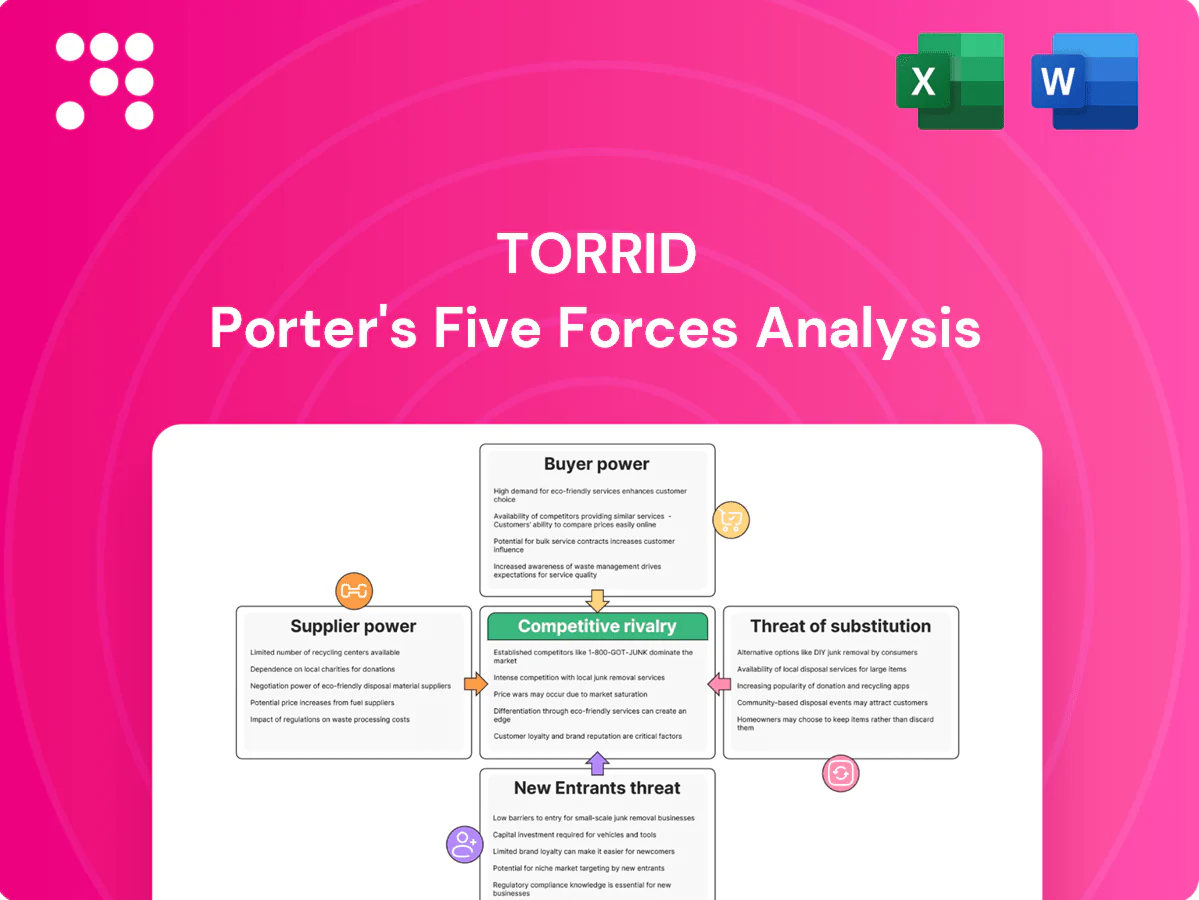
Torrid Porter's Five Forces Analysis

From Overview to Strategy Blueprint
Torrid faces strong buyer power and niche customer loyalty, while supplier leverage and scale-driven rivals shape its margin pressure; substitute apparel options and moderate entry barriers add complexity. This snapshot scratches the surface—unlock the full Porter's Five Forces Analysis for force-by-force ratings, visuals, and actionable strategy insights.
Suppliers Bargaining Power

Specialized fit and fabric requirements
Plus-size grading, unique pattern blocks, and rigorous fit-testing narrow Torrid’s supplier pool, giving specialized vendors greater leverage; technical fabrics for support, stretch recovery, and durability further restrict interchangeable sources, raising lead times and costs. Torrid mitigates by codifying specs and multi-sourcing where feasible.
Diversified private-label sourcing
Torrid largely relies on diversified private-label manufacturers across regions, diluting any single supplier’s leverage and enabling cost negotiation. Competitive bidding and dual-sourcing reduce hold-up risk, though MOQs and capacity constraints intensify during peak seasons in 2024. Strategic vendor scorecards track on-time delivery, defect rates and lead times to maintain discipline and supplier accountability.

Input cost volatility
Commodity swings in cotton and polyester and volatile freight push bargaining power toward mills and logistics providers, with container spot rates remaining about 50–70% below 2021 peaks through 2024 yet still prone to spikes that enable surcharges and price escalators.
Suppliers often pass through surcharges or demand contractual escalators; Torrid can use hedging, calendarized buys, fabric platforming and longer-term volume agreements to stabilize costs and exchange volume certainty for better pricing.

Compliance and ESG requirements
Compliance audits for labor, quality, and sustainability reduce the eligible vendor pool, boosting bargaining power for suppliers that meet standards; meeting chemical and traceability rules raises vendor costs that can be passed to Torrid. Torrid’s vendor development and consolidation toward high-performing partners mitigates supply risk but concentrates leverage in fewer suppliers, increasing supplier power.
- Fewer compliant vendors = higher supplier leverage
- Compliance overhead often priced into contracts
- Vendor consolidation reduces risk but centralizes power
Switching costs and IP in patterns
Transferring pattern blocks, specs and fit IP to new factories is time-consuming and costly—industry 2024 averages show re-onboarding taking 4–8 weeks and costing roughly $50k–$200k per style; fit inconsistency can raise return rates by about 20–30%, giving incumbent vendors roughly 10–15% negotiation leverage on price and lead times.
- Re-onboarding time: 4–8 weeks (2024)
- Re-onboarding cost: $50k–$200k per style (2024)
- Return increase from fit issues: ~20–30% (2024)
- Leverage for incumbents: ~10–15% pricing/terms advantage
- Digital fit libraries cut transition time 40–60% (2024)
Supplier squeeze: niche specs and 10–15% incumbent leverage
Specialized plus-size specs, unique blocks and compliance shrink the supplier pool, increasing supplier leverage and lead times.
Diversified private-label sourcing and dual-sourcing reduce single-vendor risk, but MOQs, peak capacity and commodity swings raise supplier bargaining.
Re-onboarding averages 4–8 weeks and $50k–$200k per style (2024), giving incumbents ~10–15% pricing leverage.
| Metric | 2024 Value |
|---|---|
| Freight vs 2021 peak | −50–70% |
| Re-onboard time | 4–8 weeks |
| Re-onboard cost | $50k–$200k |
| Incumbent leverage | ~10–15% |
What is included in the product
 Detailed Word Document
Comprehensive Porter's Five Forces analysis tailored for Torrid, uncovering key competitive drivers, buyer/supplier power, substitutes, entry barriers and disruptive threats, with strategic commentary and editable Word format.

 Customizable Excel Spreadsheet
A concise, one-sheet Torrid Porter’s Five Forces summary that clarifies competitive pressures and offers actionable mitigation steps—customizable for evolving market data and ready to drop into decks for fast strategic decisions.
Customers Bargaining Power

Fit-driven loyalty but price sensitivity
Many plus-size customers prioritize reliable fit, which reduces their price bargaining power and supports Torrid’s ability to command premium pricing; about two-thirds of U.S. women wear size 14 or larger, sustaining structural demand. Yet discretionary apparel spend is promotion-sensitive—retail sales dip in downturns—so Torrid must balance quality with competitive pricing. Loyalty programs can convert repeat buyers but often trade margin for retention through discounts and rewards.
Omnichannel transparency
Omnichannel transparency raises buyer power as an estimated 75% of US shoppers in 2024 compare prices online across Torrid, specialty peers and mass retailers before buying. Flash sales and widespread couponing mean roughly 62% of apparel shoppers wait for deals, pressuring margins. Detailed reviews and fit guidance can cut return rates by up to 30% and help defend price. Consistent in-store and online pricing reduces arbitrage and protects average selling price.

High returns in apparel e-commerce
Fit uncertainty drives elevated return rates in apparel e-commerce, with industry online apparel returns around 30% in 2024, effectively empowering buyers to trial products and pressuring Torrid’s pricing power. High reverse logistics costs—often 20–65% of original shipping costs—erode margins and force promotional pricing. Advanced size charts, fit tech and data-driven assortments have reduced returns by up to 10–15% in pilot programs. Store try-on and BOPIS further cut return incidence and fulfillment expense.

Expanding alternatives for plus-size
Mainstream brands adding extended sizes have materially increased alternatives for plus-size shoppers, broadening substitution and strengthening buyer leverage; Torrid must rely on superior fit consistency and deeper trend assortments to retain loyalty. Exclusive capsules and limited drops can lower direct comparability and help protect margins while shoppers shop across more retailers in 2024.
- Increased choices = higher buyer power
- Fit consistency is Torrid’s defense
- Exclusive capsules reduce direct substitution
Social media influence and reviews
User-generated content now shapes purchase decisions and expectations for quality and value; in 2024, 67% of shoppers reported social media influenced their apparel purchases, making negative sentiment capable of eroding pricing power and lowering willingness-to-pay by double-digit percentages. Proactive community engagement turns advocates into defenders of premium positioning, while rapid customer care (same-day responses) reduces churn and protects margins.
- User-generated content drives discovery: 67% influenced (2024)
- Negative sentiment can cut pricing power materially
- Community engagement creates premium defenders
- Rapid customer care (same-day) lowers churn
Fit beats price for plus-size shoppers; 66% of U.S. women wear 14+
Plus-size buyers' need for reliable fit limits pure price pressure—~66% of U.S. women wear size 14+ (2024)—but promotion sensitivity remains high. Omnichannel comparison raises leverage (75% compare prices; 62% wait for deals in 2024). E-commerce returns (~30%) and social influence (67%) further empower buyers; loyalty and exclusive assortments defend margin.
| Metric | 2024 |
|---|---|
| U.S. women size 14+ | ~66% |
| Compare prices online | 75% |
| Wait for deals | 62% |
| Apparel e‑comm returns | ~30% |
| Social influence | 67% |
Preview the Actual Deliverable
Torrid Porter's Five Forces Analysis
This preview shows the exact Torrid Porter’s Five Forces analysis you’ll receive immediately after purchase—no placeholders or revisions. The file displayed is the full, professionally formatted deliverable, ready for download and use the moment you buy. You’re viewing the final document; completing your purchase grants instant access to this identical file.

From Overview to Strategy Blueprint
Torrid faces strong buyer power and niche customer loyalty, while supplier leverage and scale-driven rivals shape its margin pressure; substitute apparel options and moderate entry barriers add complexity. This snapshot scratches the surface—unlock the full Porter's Five Forces Analysis for force-by-force ratings, visuals, and actionable strategy insights.
Suppliers Bargaining Power
Specialized fit and fabric requirements
Plus-size grading, unique pattern blocks, and rigorous fit-testing narrow Torrid’s supplier pool, giving specialized vendors greater leverage; technical fabrics for support, stretch recovery, and durability further restrict interchangeable sources, raising lead times and costs. Torrid mitigates by codifying specs and multi-sourcing where feasible.
Diversified private-label sourcing
Torrid largely relies on diversified private-label manufacturers across regions, diluting any single supplier’s leverage and enabling cost negotiation. Competitive bidding and dual-sourcing reduce hold-up risk, though MOQs and capacity constraints intensify during peak seasons in 2024. Strategic vendor scorecards track on-time delivery, defect rates and lead times to maintain discipline and supplier accountability.
Input cost volatility
Commodity swings in cotton and polyester and volatile freight push bargaining power toward mills and logistics providers, with container spot rates remaining about 50–70% below 2021 peaks through 2024 yet still prone to spikes that enable surcharges and price escalators.
Suppliers often pass through surcharges or demand contractual escalators; Torrid can use hedging, calendarized buys, fabric platforming and longer-term volume agreements to stabilize costs and exchange volume certainty for better pricing.
Compliance and ESG requirements
Compliance audits for labor, quality, and sustainability reduce the eligible vendor pool, boosting bargaining power for suppliers that meet standards; meeting chemical and traceability rules raises vendor costs that can be passed to Torrid. Torrid’s vendor development and consolidation toward high-performing partners mitigates supply risk but concentrates leverage in fewer suppliers, increasing supplier power.
- Fewer compliant vendors = higher supplier leverage
- Compliance overhead often priced into contracts
- Vendor consolidation reduces risk but centralizes power
Switching costs and IP in patterns
Transferring pattern blocks, specs and fit IP to new factories is time-consuming and costly—industry 2024 averages show re-onboarding taking 4–8 weeks and costing roughly $50k–$200k per style; fit inconsistency can raise return rates by about 20–30%, giving incumbent vendors roughly 10–15% negotiation leverage on price and lead times.
- Re-onboarding time: 4–8 weeks (2024)
- Re-onboarding cost: $50k–$200k per style (2024)
- Return increase from fit issues: ~20–30% (2024)
- Leverage for incumbents: ~10–15% pricing/terms advantage
- Digital fit libraries cut transition time 40–60% (2024)
Supplier squeeze: niche specs and 10–15% incumbent leverage
Specialized plus-size specs, unique blocks and compliance shrink the supplier pool, increasing supplier leverage and lead times.
Diversified private-label sourcing and dual-sourcing reduce single-vendor risk, but MOQs, peak capacity and commodity swings raise supplier bargaining.
Re-onboarding averages 4–8 weeks and $50k–$200k per style (2024), giving incumbents ~10–15% pricing leverage.
| Metric | 2024 Value |
|---|---|
| Freight vs 2021 peak | −50–70% |
| Re-onboard time | 4–8 weeks |
| Re-onboard cost | $50k–$200k |
| Incumbent leverage | ~10–15% |
What is included in the product
Detailed Word Document
Comprehensive Porter's Five Forces analysis tailored for Torrid, uncovering key competitive drivers, buyer/supplier power, substitutes, entry barriers and disruptive threats, with strategic commentary and editable Word format.
Customizable Excel Spreadsheet
A concise, one-sheet Torrid Porter’s Five Forces summary that clarifies competitive pressures and offers actionable mitigation steps—customizable for evolving market data and ready to drop into decks for fast strategic decisions.
Customers Bargaining Power
Fit-driven loyalty but price sensitivity
Many plus-size customers prioritize reliable fit, which reduces their price bargaining power and supports Torrid’s ability to command premium pricing; about two-thirds of U.S. women wear size 14 or larger, sustaining structural demand. Yet discretionary apparel spend is promotion-sensitive—retail sales dip in downturns—so Torrid must balance quality with competitive pricing. Loyalty programs can convert repeat buyers but often trade margin for retention through discounts and rewards.
Omnichannel transparency
Omnichannel transparency raises buyer power as an estimated 75% of US shoppers in 2024 compare prices online across Torrid, specialty peers and mass retailers before buying. Flash sales and widespread couponing mean roughly 62% of apparel shoppers wait for deals, pressuring margins. Detailed reviews and fit guidance can cut return rates by up to 30% and help defend price. Consistent in-store and online pricing reduces arbitrage and protects average selling price.
High returns in apparel e-commerce
Fit uncertainty drives elevated return rates in apparel e-commerce, with industry online apparel returns around 30% in 2024, effectively empowering buyers to trial products and pressuring Torrid’s pricing power. High reverse logistics costs—often 20–65% of original shipping costs—erode margins and force promotional pricing. Advanced size charts, fit tech and data-driven assortments have reduced returns by up to 10–15% in pilot programs. Store try-on and BOPIS further cut return incidence and fulfillment expense.
Expanding alternatives for plus-size
Mainstream brands adding extended sizes have materially increased alternatives for plus-size shoppers, broadening substitution and strengthening buyer leverage; Torrid must rely on superior fit consistency and deeper trend assortments to retain loyalty. Exclusive capsules and limited drops can lower direct comparability and help protect margins while shoppers shop across more retailers in 2024.
- Increased choices = higher buyer power
- Fit consistency is Torrid’s defense
- Exclusive capsules reduce direct substitution
Social media influence and reviews
User-generated content now shapes purchase decisions and expectations for quality and value; in 2024, 67% of shoppers reported social media influenced their apparel purchases, making negative sentiment capable of eroding pricing power and lowering willingness-to-pay by double-digit percentages. Proactive community engagement turns advocates into defenders of premium positioning, while rapid customer care (same-day responses) reduces churn and protects margins.
- User-generated content drives discovery: 67% influenced (2024)
- Negative sentiment can cut pricing power materially
- Community engagement creates premium defenders
- Rapid customer care (same-day) lowers churn
Fit beats price for plus-size shoppers; 66% of U.S. women wear 14+
Plus-size buyers' need for reliable fit limits pure price pressure—~66% of U.S. women wear size 14+ (2024)—but promotion sensitivity remains high. Omnichannel comparison raises leverage (75% compare prices; 62% wait for deals in 2024). E-commerce returns (~30%) and social influence (67%) further empower buyers; loyalty and exclusive assortments defend margin.
| Metric | 2024 |
|---|---|
| U.S. women size 14+ | ~66% |
| Compare prices online | 75% |
| Wait for deals | 62% |
| Apparel e‑comm returns | ~30% |
| Social influence | 67% |
Preview the Actual Deliverable
Torrid Porter's Five Forces Analysis
This preview shows the exact Torrid Porter’s Five Forces analysis you’ll receive immediately after purchase—no placeholders or revisions. The file displayed is the full, professionally formatted deliverable, ready for download and use the moment you buy. You’re viewing the final document; completing your purchase grants instant access to this identical file.
Original: $10.00
-65%$10.00
$3.50Description
From Overview to Strategy Blueprint
Torrid faces strong buyer power and niche customer loyalty, while supplier leverage and scale-driven rivals shape its margin pressure; substitute apparel options and moderate entry barriers add complexity. This snapshot scratches the surface—unlock the full Porter's Five Forces Analysis for force-by-force ratings, visuals, and actionable strategy insights.
Suppliers Bargaining Power
Specialized fit and fabric requirements
Plus-size grading, unique pattern blocks, and rigorous fit-testing narrow Torrid’s supplier pool, giving specialized vendors greater leverage; technical fabrics for support, stretch recovery, and durability further restrict interchangeable sources, raising lead times and costs. Torrid mitigates by codifying specs and multi-sourcing where feasible.
Diversified private-label sourcing
Torrid largely relies on diversified private-label manufacturers across regions, diluting any single supplier’s leverage and enabling cost negotiation. Competitive bidding and dual-sourcing reduce hold-up risk, though MOQs and capacity constraints intensify during peak seasons in 2024. Strategic vendor scorecards track on-time delivery, defect rates and lead times to maintain discipline and supplier accountability.
Input cost volatility
Commodity swings in cotton and polyester and volatile freight push bargaining power toward mills and logistics providers, with container spot rates remaining about 50–70% below 2021 peaks through 2024 yet still prone to spikes that enable surcharges and price escalators.
Suppliers often pass through surcharges or demand contractual escalators; Torrid can use hedging, calendarized buys, fabric platforming and longer-term volume agreements to stabilize costs and exchange volume certainty for better pricing.
Compliance and ESG requirements
Compliance audits for labor, quality, and sustainability reduce the eligible vendor pool, boosting bargaining power for suppliers that meet standards; meeting chemical and traceability rules raises vendor costs that can be passed to Torrid. Torrid’s vendor development and consolidation toward high-performing partners mitigates supply risk but concentrates leverage in fewer suppliers, increasing supplier power.
- Fewer compliant vendors = higher supplier leverage
- Compliance overhead often priced into contracts
- Vendor consolidation reduces risk but centralizes power
Switching costs and IP in patterns
Transferring pattern blocks, specs and fit IP to new factories is time-consuming and costly—industry 2024 averages show re-onboarding taking 4–8 weeks and costing roughly $50k–$200k per style; fit inconsistency can raise return rates by about 20–30%, giving incumbent vendors roughly 10–15% negotiation leverage on price and lead times.
- Re-onboarding time: 4–8 weeks (2024)
- Re-onboarding cost: $50k–$200k per style (2024)
- Return increase from fit issues: ~20–30% (2024)
- Leverage for incumbents: ~10–15% pricing/terms advantage
- Digital fit libraries cut transition time 40–60% (2024)
Supplier squeeze: niche specs and 10–15% incumbent leverage
Specialized plus-size specs, unique blocks and compliance shrink the supplier pool, increasing supplier leverage and lead times.
Diversified private-label sourcing and dual-sourcing reduce single-vendor risk, but MOQs, peak capacity and commodity swings raise supplier bargaining.
Re-onboarding averages 4–8 weeks and $50k–$200k per style (2024), giving incumbents ~10–15% pricing leverage.
| Metric | 2024 Value |
|---|---|
| Freight vs 2021 peak | −50–70% |
| Re-onboard time | 4–8 weeks |
| Re-onboard cost | $50k–$200k |
| Incumbent leverage | ~10–15% |
What is included in the product
Detailed Word Document
Comprehensive Porter's Five Forces analysis tailored for Torrid, uncovering key competitive drivers, buyer/supplier power, substitutes, entry barriers and disruptive threats, with strategic commentary and editable Word format.
Customizable Excel Spreadsheet
A concise, one-sheet Torrid Porter’s Five Forces summary that clarifies competitive pressures and offers actionable mitigation steps—customizable for evolving market data and ready to drop into decks for fast strategic decisions.
Customers Bargaining Power
Fit-driven loyalty but price sensitivity
Many plus-size customers prioritize reliable fit, which reduces their price bargaining power and supports Torrid’s ability to command premium pricing; about two-thirds of U.S. women wear size 14 or larger, sustaining structural demand. Yet discretionary apparel spend is promotion-sensitive—retail sales dip in downturns—so Torrid must balance quality with competitive pricing. Loyalty programs can convert repeat buyers but often trade margin for retention through discounts and rewards.
Omnichannel transparency
Omnichannel transparency raises buyer power as an estimated 75% of US shoppers in 2024 compare prices online across Torrid, specialty peers and mass retailers before buying. Flash sales and widespread couponing mean roughly 62% of apparel shoppers wait for deals, pressuring margins. Detailed reviews and fit guidance can cut return rates by up to 30% and help defend price. Consistent in-store and online pricing reduces arbitrage and protects average selling price.
High returns in apparel e-commerce
Fit uncertainty drives elevated return rates in apparel e-commerce, with industry online apparel returns around 30% in 2024, effectively empowering buyers to trial products and pressuring Torrid’s pricing power. High reverse logistics costs—often 20–65% of original shipping costs—erode margins and force promotional pricing. Advanced size charts, fit tech and data-driven assortments have reduced returns by up to 10–15% in pilot programs. Store try-on and BOPIS further cut return incidence and fulfillment expense.
Expanding alternatives for plus-size
Mainstream brands adding extended sizes have materially increased alternatives for plus-size shoppers, broadening substitution and strengthening buyer leverage; Torrid must rely on superior fit consistency and deeper trend assortments to retain loyalty. Exclusive capsules and limited drops can lower direct comparability and help protect margins while shoppers shop across more retailers in 2024.
- Increased choices = higher buyer power
- Fit consistency is Torrid’s defense
- Exclusive capsules reduce direct substitution
Social media influence and reviews
User-generated content now shapes purchase decisions and expectations for quality and value; in 2024, 67% of shoppers reported social media influenced their apparel purchases, making negative sentiment capable of eroding pricing power and lowering willingness-to-pay by double-digit percentages. Proactive community engagement turns advocates into defenders of premium positioning, while rapid customer care (same-day responses) reduces churn and protects margins.
- User-generated content drives discovery: 67% influenced (2024)
- Negative sentiment can cut pricing power materially
- Community engagement creates premium defenders
- Rapid customer care (same-day) lowers churn
Fit beats price for plus-size shoppers; 66% of U.S. women wear 14+
Plus-size buyers' need for reliable fit limits pure price pressure—~66% of U.S. women wear size 14+ (2024)—but promotion sensitivity remains high. Omnichannel comparison raises leverage (75% compare prices; 62% wait for deals in 2024). E-commerce returns (~30%) and social influence (67%) further empower buyers; loyalty and exclusive assortments defend margin.
| Metric | 2024 |
|---|---|
| U.S. women size 14+ | ~66% |
| Compare prices online | 75% |
| Wait for deals | 62% |
| Apparel e‑comm returns | ~30% |
| Social influence | 67% |
Preview the Actual Deliverable
Torrid Porter's Five Forces Analysis
This preview shows the exact Torrid Porter’s Five Forces analysis you’ll receive immediately after purchase—no placeholders or revisions. The file displayed is the full, professionally formatted deliverable, ready for download and use the moment you buy. You’re viewing the final document; completing your purchase grants instant access to this identical file.











