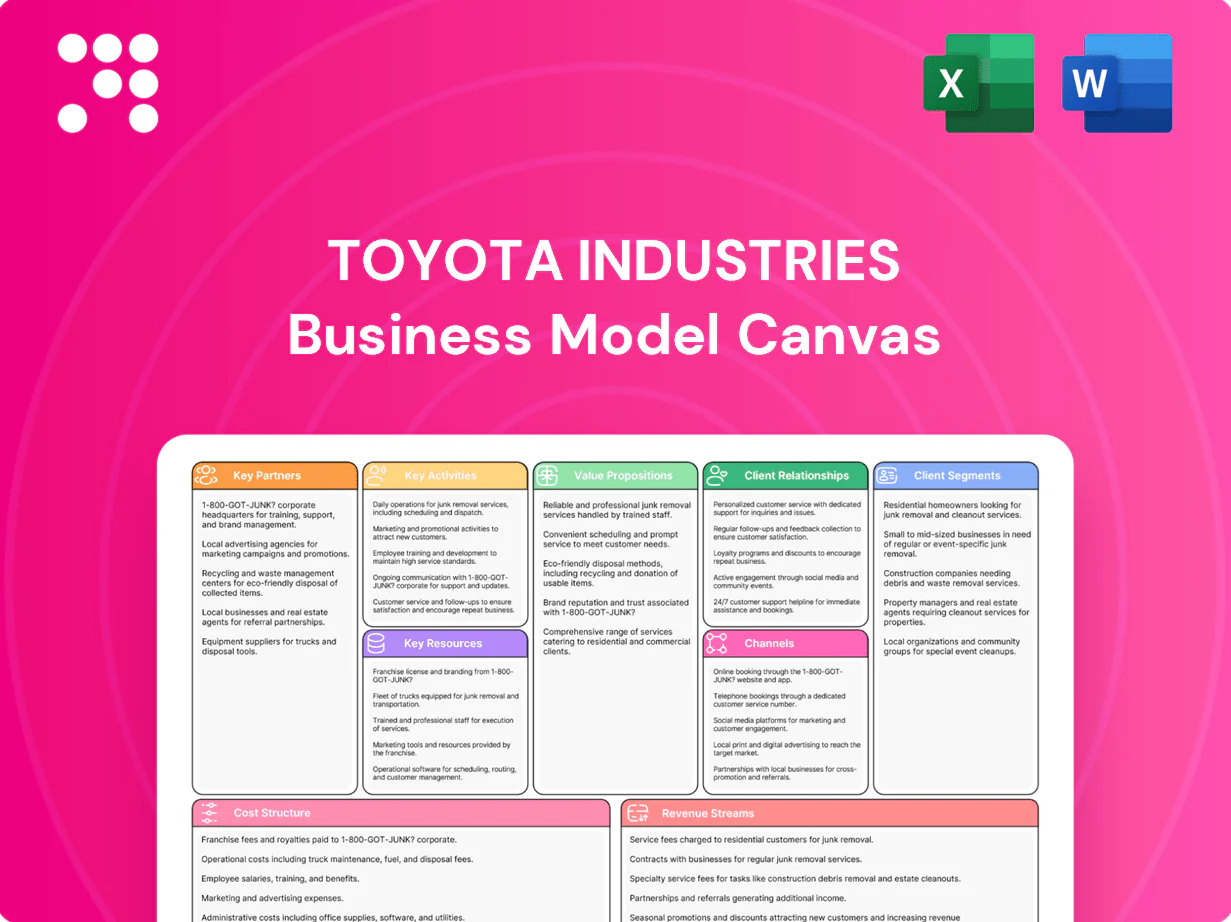
Toyota Industries Business Model Canvas

Business Model Canvas: Production, Aftermarket & Global Partnerships Driving Sustainable Growth
Explore Toyota Industries’ Business Model Canvas to see how it aligns production excellence, aftermarket services, and global partnerships to drive sustainable growth. This concise snapshot highlights customer segments, key activities, and revenue streams. Want deeper, actionable insights and editable templates? Purchase the full Canvas for a section-by-section breakdown in Word and Excel.
Partnerships

Automotive OEM collaborations
Partnerships with global automakers secure long-term compressor and engine supply programs, anchoring Toyota Industries to OEM pipelines and supporting its FY2023 consolidated revenue of ¥2,980 billion (year ended Mar 31, 2024). Joint development ensures fit, durability, and regulatory alignment across platforms, reducing redesign risk. These relationships stabilize volumes and provide early demand visibility, while co-engineering shortens time-to-market and lowers warranty exposure.
Industrial suppliers and tech vendors
Industrial suppliers for steel, castings, electronics, batteries and software underpin Toyota Industries product quality and cost; battery-pack prices fell to about $132/kWh (BNEF 2023), lowering EV component costs. Close supplier integration improves yield, shortens lead times and enables design-for-manufacture. Joint quality programs cut defects and downtime. Strategic sourcing and diversified contracts mitigate commodity volatility and supply disruptions.

Dealer and service network alliances
Authorized distributors extend Toyota Industries forklifts, parts and service into over 170 countries, helping capture share in a global forklift market valued at about $41 billion in 2024. Shared dealer systems provide near-real-time inventory visibility and rapid dispatch, reducing parts lead times by weeks. Certified technicians enforce uptime commitments and warranty standards across the network. Local partners tailor financing and after-sales support to regional needs.

Automation and logistics integrators
Academic and research institutions
Collaboration with academic and research institutions accelerates innovation in advanced materials, electrification, and mechatronics, shortening development timelines and enabling prototype co‑development. Access to university labs and graduates reduces R&D cycle times and talent gaps; in 2024 Toyota Industries reported multiple joint projects aimed at scaleable electrification. Shared IP frameworks with partners create clear commercialization pathways, while consortia align work with emerging standards and safety norms.
- Joint projects 2024: expanded academic engagements
- R&D speed: lab access reduces cycle times
- IP: shared frameworks enable market entry
- Consortia: align to new standards/safety
OEM partnerships and lower battery costs (US$132/kWh) drive global forklift & warehouse growth
Key partnerships anchor OEM supply (FY2023 revenue ¥2,980bn), stabilize volumes, and accelerate co‑engineering for electrification; supplier integration cuts costs as battery packs fell to ~$132/kWh (BNEF 2023). Distributor and dealer networks cover 170+ countries, supporting capture in a $41bn forklift market (2024) and $30bn warehouse automation market (2024).
| Metric | Value |
|---|---|
| FY2023 revenue | ¥2,980bn |
| Forklift market 2024 | US$41bn |
| Warehouse automation 2024 | US$30bn |
| Battery pack price 2023 | US$132/kWh |
| Distributor reach | 170+ countries |
What is included in the product
 Detailed Word Document
A comprehensive Business Model Canvas tailored to Toyota Industries, detailing customer segments, channels, and value propositions across the 9 classic BMC blocks with operational and strategic alignment. Includes competitive advantages, linked SWOT insights, and polished narratives ideal for presentations, investor discussions, and strategic decision-making.

 Customizable Excel Spreadsheet
High-level, editable Business Model Canvas for Toyota Industries that condenses complex manufacturing, logistics, and services strategies into a one-page snapshot to relieve analysis bottlenecks. Saves hours of formatting and enables fast team collaboration, comparison, and executive-ready summaries for strategic decision-making.
Activities

Design and engineering
Mechanical, electrical and software design at Toyota Industries covers forklifts, looms, compressors and engines, aligned with the global forklift market (~44 billion USD in 2024) to prioritize scalable investments. Platform modularization reduces SKUs and shortens time-to-market, enabling reuse across product lines. Validation ensures compliance with major regimes (EU, US, Japan) and continuous improvement uses field telematics and VOC to iterate designs.
Precision manufacturing
High-volume, high-precision machining and assembly produce engines, forklift components and logistics equipment with cycle times tuned to takt; Toyota Industries runs multi-shift lines achieving per-line takt measured in minutes to meet customer demand. Lean production, automation and strict SPC quality control drive consistency, targeting defect rates in low ppm levels and first-pass yields above 99%. Flexible lines and modular tooling enable rapid mix changes to absorb demand swings, while synchronized supplier coordination maintains takt, minimizing WIP and shortening lead times.

Aftermarket and lifecycle services
Preventive maintenance, repairs and genuine parts distribution form the backbone of Toyota Industries aftermarket operations, with emphasis on service contracts in FY2024 (year ended March 31, 2024). Remote diagnostics and predictive maintenance are deployed to improve uptime and reduce unplanned stops. Technician training and certification programs underpin consistent service quality, while refurbishment and end-of-life management lower total cost of ownership for customers.

Logistics and solution integration
Logistics and solution integration at Toyota Industries combines warehouse design, material-flow analysis and system integration to align layout with SKU velocity; global warehouse automation market ~ $20.1B in 2024 and automation typically yields 25–40% throughput gains. Deployments pair handling equipment with controls/software; projects run from scoping to commissioning with continuous optimization to sustain throughput and safety.
- warehouse design
- material flow analysis
- system integration
- equipment + software
- project management
- ongoing optimization
R&D in electrification and automation
R&D in electrification and automation targets development of electric powertrains, batteries and energy management systems, plus controls, sensors and autonomy for smart equipment; Toyota Industries invested ¥61.8bn in R&D in FY2024 and reports compressor/engine efficiency improvements of up to 12% while ensuring compliance with global emissions and energy standards.
Modular electrified forklifts: lean automated production, high yields, ¥61.8bn R&D
Integrated design, high-precision manufacturing and modular platforms drive product reuse and rapid launch. Lean, automated production and supplier takt control target high yields and low ppm defects. Aftermarket services, logistics integration and R&D in electrification (¥61.8bn R&D FY2024) sustain uptime and product evolution.
| Metric | 2024 |
|---|---|
| Forklift market | $44B |
| Warehouse automation | $20.1B |
| R&D spend | ¥61.8bn |
Full Document Unlocks After Purchase
Business Model Canvas
The document you're previewing is the actual Toyota Industries Business Model Canvas you’ll receive after purchase. It’s not a mockup—this live preview reflects the complete, professionally formatted file. After buying, you’ll download the same editable document ready for presentation and use.

Business Model Canvas: Production, Aftermarket & Global Partnerships Driving Sustainable Growth
Explore Toyota Industries’ Business Model Canvas to see how it aligns production excellence, aftermarket services, and global partnerships to drive sustainable growth. This concise snapshot highlights customer segments, key activities, and revenue streams. Want deeper, actionable insights and editable templates? Purchase the full Canvas for a section-by-section breakdown in Word and Excel.
Partnerships
Automotive OEM collaborations
Partnerships with global automakers secure long-term compressor and engine supply programs, anchoring Toyota Industries to OEM pipelines and supporting its FY2023 consolidated revenue of ¥2,980 billion (year ended Mar 31, 2024). Joint development ensures fit, durability, and regulatory alignment across platforms, reducing redesign risk. These relationships stabilize volumes and provide early demand visibility, while co-engineering shortens time-to-market and lowers warranty exposure.
Industrial suppliers and tech vendors
Industrial suppliers for steel, castings, electronics, batteries and software underpin Toyota Industries product quality and cost; battery-pack prices fell to about $132/kWh (BNEF 2023), lowering EV component costs. Close supplier integration improves yield, shortens lead times and enables design-for-manufacture. Joint quality programs cut defects and downtime. Strategic sourcing and diversified contracts mitigate commodity volatility and supply disruptions.
Dealer and service network alliances
Authorized distributors extend Toyota Industries forklifts, parts and service into over 170 countries, helping capture share in a global forklift market valued at about $41 billion in 2024. Shared dealer systems provide near-real-time inventory visibility and rapid dispatch, reducing parts lead times by weeks. Certified technicians enforce uptime commitments and warranty standards across the network. Local partners tailor financing and after-sales support to regional needs.
Automation and logistics integrators
Academic and research institutions
Collaboration with academic and research institutions accelerates innovation in advanced materials, electrification, and mechatronics, shortening development timelines and enabling prototype co‑development. Access to university labs and graduates reduces R&D cycle times and talent gaps; in 2024 Toyota Industries reported multiple joint projects aimed at scaleable electrification. Shared IP frameworks with partners create clear commercialization pathways, while consortia align work with emerging standards and safety norms.
- Joint projects 2024: expanded academic engagements
- R&D speed: lab access reduces cycle times
- IP: shared frameworks enable market entry
- Consortia: align to new standards/safety
OEM partnerships and lower battery costs (US$132/kWh) drive global forklift & warehouse growth
Key partnerships anchor OEM supply (FY2023 revenue ¥2,980bn), stabilize volumes, and accelerate co‑engineering for electrification; supplier integration cuts costs as battery packs fell to ~$132/kWh (BNEF 2023). Distributor and dealer networks cover 170+ countries, supporting capture in a $41bn forklift market (2024) and $30bn warehouse automation market (2024).
| Metric | Value |
|---|---|
| FY2023 revenue | ¥2,980bn |
| Forklift market 2024 | US$41bn |
| Warehouse automation 2024 | US$30bn |
| Battery pack price 2023 | US$132/kWh |
| Distributor reach | 170+ countries |
What is included in the product
Detailed Word Document
A comprehensive Business Model Canvas tailored to Toyota Industries, detailing customer segments, channels, and value propositions across the 9 classic BMC blocks with operational and strategic alignment. Includes competitive advantages, linked SWOT insights, and polished narratives ideal for presentations, investor discussions, and strategic decision-making.
Customizable Excel Spreadsheet
High-level, editable Business Model Canvas for Toyota Industries that condenses complex manufacturing, logistics, and services strategies into a one-page snapshot to relieve analysis bottlenecks. Saves hours of formatting and enables fast team collaboration, comparison, and executive-ready summaries for strategic decision-making.
Activities
Design and engineering
Mechanical, electrical and software design at Toyota Industries covers forklifts, looms, compressors and engines, aligned with the global forklift market (~44 billion USD in 2024) to prioritize scalable investments. Platform modularization reduces SKUs and shortens time-to-market, enabling reuse across product lines. Validation ensures compliance with major regimes (EU, US, Japan) and continuous improvement uses field telematics and VOC to iterate designs.
Precision manufacturing
High-volume, high-precision machining and assembly produce engines, forklift components and logistics equipment with cycle times tuned to takt; Toyota Industries runs multi-shift lines achieving per-line takt measured in minutes to meet customer demand. Lean production, automation and strict SPC quality control drive consistency, targeting defect rates in low ppm levels and first-pass yields above 99%. Flexible lines and modular tooling enable rapid mix changes to absorb demand swings, while synchronized supplier coordination maintains takt, minimizing WIP and shortening lead times.
Aftermarket and lifecycle services
Preventive maintenance, repairs and genuine parts distribution form the backbone of Toyota Industries aftermarket operations, with emphasis on service contracts in FY2024 (year ended March 31, 2024). Remote diagnostics and predictive maintenance are deployed to improve uptime and reduce unplanned stops. Technician training and certification programs underpin consistent service quality, while refurbishment and end-of-life management lower total cost of ownership for customers.
Logistics and solution integration
Logistics and solution integration at Toyota Industries combines warehouse design, material-flow analysis and system integration to align layout with SKU velocity; global warehouse automation market ~ $20.1B in 2024 and automation typically yields 25–40% throughput gains. Deployments pair handling equipment with controls/software; projects run from scoping to commissioning with continuous optimization to sustain throughput and safety.
- warehouse design
- material flow analysis
- system integration
- equipment + software
- project management
- ongoing optimization
R&D in electrification and automation
R&D in electrification and automation targets development of electric powertrains, batteries and energy management systems, plus controls, sensors and autonomy for smart equipment; Toyota Industries invested ¥61.8bn in R&D in FY2024 and reports compressor/engine efficiency improvements of up to 12% while ensuring compliance with global emissions and energy standards.
Modular electrified forklifts: lean automated production, high yields, ¥61.8bn R&D
Integrated design, high-precision manufacturing and modular platforms drive product reuse and rapid launch. Lean, automated production and supplier takt control target high yields and low ppm defects. Aftermarket services, logistics integration and R&D in electrification (¥61.8bn R&D FY2024) sustain uptime and product evolution.
| Metric | 2024 |
|---|---|
| Forklift market | $44B |
| Warehouse automation | $20.1B |
| R&D spend | ¥61.8bn |
Full Document Unlocks After Purchase
Business Model Canvas
The document you're previewing is the actual Toyota Industries Business Model Canvas you’ll receive after purchase. It’s not a mockup—this live preview reflects the complete, professionally formatted file. After buying, you’ll download the same editable document ready for presentation and use.
Original: $10.00
-65%$10.00
$3.50Description
Business Model Canvas: Production, Aftermarket & Global Partnerships Driving Sustainable Growth
Explore Toyota Industries’ Business Model Canvas to see how it aligns production excellence, aftermarket services, and global partnerships to drive sustainable growth. This concise snapshot highlights customer segments, key activities, and revenue streams. Want deeper, actionable insights and editable templates? Purchase the full Canvas for a section-by-section breakdown in Word and Excel.
Partnerships
Automotive OEM collaborations
Partnerships with global automakers secure long-term compressor and engine supply programs, anchoring Toyota Industries to OEM pipelines and supporting its FY2023 consolidated revenue of ¥2,980 billion (year ended Mar 31, 2024). Joint development ensures fit, durability, and regulatory alignment across platforms, reducing redesign risk. These relationships stabilize volumes and provide early demand visibility, while co-engineering shortens time-to-market and lowers warranty exposure.
Industrial suppliers and tech vendors
Industrial suppliers for steel, castings, electronics, batteries and software underpin Toyota Industries product quality and cost; battery-pack prices fell to about $132/kWh (BNEF 2023), lowering EV component costs. Close supplier integration improves yield, shortens lead times and enables design-for-manufacture. Joint quality programs cut defects and downtime. Strategic sourcing and diversified contracts mitigate commodity volatility and supply disruptions.
Dealer and service network alliances
Authorized distributors extend Toyota Industries forklifts, parts and service into over 170 countries, helping capture share in a global forklift market valued at about $41 billion in 2024. Shared dealer systems provide near-real-time inventory visibility and rapid dispatch, reducing parts lead times by weeks. Certified technicians enforce uptime commitments and warranty standards across the network. Local partners tailor financing and after-sales support to regional needs.
Automation and logistics integrators
Academic and research institutions
Collaboration with academic and research institutions accelerates innovation in advanced materials, electrification, and mechatronics, shortening development timelines and enabling prototype co‑development. Access to university labs and graduates reduces R&D cycle times and talent gaps; in 2024 Toyota Industries reported multiple joint projects aimed at scaleable electrification. Shared IP frameworks with partners create clear commercialization pathways, while consortia align work with emerging standards and safety norms.
- Joint projects 2024: expanded academic engagements
- R&D speed: lab access reduces cycle times
- IP: shared frameworks enable market entry
- Consortia: align to new standards/safety
OEM partnerships and lower battery costs (US$132/kWh) drive global forklift & warehouse growth
Key partnerships anchor OEM supply (FY2023 revenue ¥2,980bn), stabilize volumes, and accelerate co‑engineering for electrification; supplier integration cuts costs as battery packs fell to ~$132/kWh (BNEF 2023). Distributor and dealer networks cover 170+ countries, supporting capture in a $41bn forklift market (2024) and $30bn warehouse automation market (2024).
| Metric | Value |
|---|---|
| FY2023 revenue | ¥2,980bn |
| Forklift market 2024 | US$41bn |
| Warehouse automation 2024 | US$30bn |
| Battery pack price 2023 | US$132/kWh |
| Distributor reach | 170+ countries |
What is included in the product
Detailed Word Document
A comprehensive Business Model Canvas tailored to Toyota Industries, detailing customer segments, channels, and value propositions across the 9 classic BMC blocks with operational and strategic alignment. Includes competitive advantages, linked SWOT insights, and polished narratives ideal for presentations, investor discussions, and strategic decision-making.
Customizable Excel Spreadsheet
High-level, editable Business Model Canvas for Toyota Industries that condenses complex manufacturing, logistics, and services strategies into a one-page snapshot to relieve analysis bottlenecks. Saves hours of formatting and enables fast team collaboration, comparison, and executive-ready summaries for strategic decision-making.
Activities
Design and engineering
Mechanical, electrical and software design at Toyota Industries covers forklifts, looms, compressors and engines, aligned with the global forklift market (~44 billion USD in 2024) to prioritize scalable investments. Platform modularization reduces SKUs and shortens time-to-market, enabling reuse across product lines. Validation ensures compliance with major regimes (EU, US, Japan) and continuous improvement uses field telematics and VOC to iterate designs.
Precision manufacturing
High-volume, high-precision machining and assembly produce engines, forklift components and logistics equipment with cycle times tuned to takt; Toyota Industries runs multi-shift lines achieving per-line takt measured in minutes to meet customer demand. Lean production, automation and strict SPC quality control drive consistency, targeting defect rates in low ppm levels and first-pass yields above 99%. Flexible lines and modular tooling enable rapid mix changes to absorb demand swings, while synchronized supplier coordination maintains takt, minimizing WIP and shortening lead times.
Aftermarket and lifecycle services
Preventive maintenance, repairs and genuine parts distribution form the backbone of Toyota Industries aftermarket operations, with emphasis on service contracts in FY2024 (year ended March 31, 2024). Remote diagnostics and predictive maintenance are deployed to improve uptime and reduce unplanned stops. Technician training and certification programs underpin consistent service quality, while refurbishment and end-of-life management lower total cost of ownership for customers.
Logistics and solution integration
Logistics and solution integration at Toyota Industries combines warehouse design, material-flow analysis and system integration to align layout with SKU velocity; global warehouse automation market ~ $20.1B in 2024 and automation typically yields 25–40% throughput gains. Deployments pair handling equipment with controls/software; projects run from scoping to commissioning with continuous optimization to sustain throughput and safety.
- warehouse design
- material flow analysis
- system integration
- equipment + software
- project management
- ongoing optimization
R&D in electrification and automation
R&D in electrification and automation targets development of electric powertrains, batteries and energy management systems, plus controls, sensors and autonomy for smart equipment; Toyota Industries invested ¥61.8bn in R&D in FY2024 and reports compressor/engine efficiency improvements of up to 12% while ensuring compliance with global emissions and energy standards.
Modular electrified forklifts: lean automated production, high yields, ¥61.8bn R&D
Integrated design, high-precision manufacturing and modular platforms drive product reuse and rapid launch. Lean, automated production and supplier takt control target high yields and low ppm defects. Aftermarket services, logistics integration and R&D in electrification (¥61.8bn R&D FY2024) sustain uptime and product evolution.
| Metric | 2024 |
|---|---|
| Forklift market | $44B |
| Warehouse automation | $20.1B |
| R&D spend | ¥61.8bn |
Full Document Unlocks After Purchase
Business Model Canvas
The document you're previewing is the actual Toyota Industries Business Model Canvas you’ll receive after purchase. It’s not a mockup—this live preview reflects the complete, professionally formatted file. After buying, you’ll download the same editable document ready for presentation and use.











