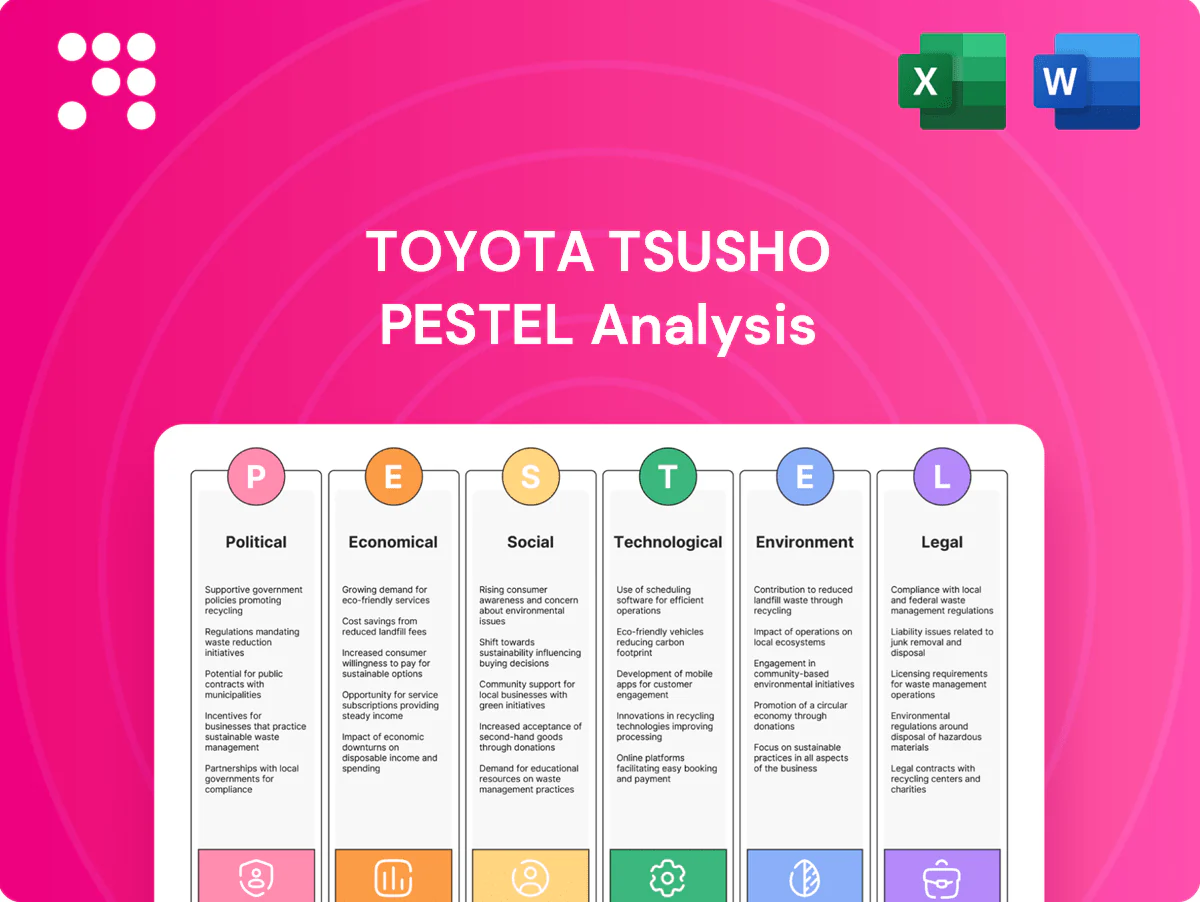
Toyota Tsusho PESTLE Analysis

Your Competitive Advantage Starts with This Report
Our PESTLE Analysis of Toyota Tsusho reveals how political shifts, economic cycles, and rapid technological change reshape its trading, logistics, and automotive investments; environmental and regulatory trends add both risk and opportunity. Perfect for investors and strategists, the full report is ready to download—buy now to access the complete, actionable breakdown.
Political factors

Trade policy volatility
Shifting tariffs, export controls and non-tariff barriers—eg US-China tariffs on roughly 550 billion USD of bilateral trade—increase costs across Toyota Tsusho’s metal, machinery and auto flows and raise margin risk. Exposure to US-China-EU frictions is partially offset by Japan’s FTAs, notably CPTPP (11 members, ~13% world GDP) and the EU–Japan EPA, which lower tariffs. Diversified sourcing and alternative routings reduce duty impact, while advanced customs agility and trade-compliance systems form operational moats.
Geopolitical risk hotspots
Instability in resource-rich regions such as DRC (about 70% of global cobalt mine production) and the Middle East risks disrupting Toyota Tsusho procurement and project timelines; political risk insurance and local JV structures are used to mitigate exposure. Multi-sourcing and supplier diversification, plus scenario planning and inventory buffers covering several months of downstream demand, protect customers. Robust sanctions screening is enforced in high-risk corridors after expanded post-2022 regimes.

Energy and industrial policy
Government incentives reshape Toyota Tsusho pipelines: the US IRA allocates about $369 billion in clean-energy tax credits and the CHIPS Act adds $52 billion for semiconductors, while the EU targets roughly €43 billion in strategic chip and net‑zero support, tilting returns toward batteries, semiconductors and grid projects. Japan’s GX and hydrogen subsidies plus concessional finance and public–private partnerships lower EPC risk and boost IRRs. Localization clauses in grants and tax credits increasingly dictate capex siting and supply‑chain reshoring.

Resource nationalism
Host states increasingly tighten royalties, local content and export quotas for critical minerals; DRC supplies roughly 70% of global cobalt, while Indonesia has driven downstream nickel processing since 2020. Toyota Tsusho must embed robust contract structures and offtake agreements with clear community benefits and beneficiation commitments to retain licenses. Monitor abrupt policy shifts and expropriation risk with political-risk insurance and sovereign escrow clauses.
- Contract: long-term offtake + stabilization clauses
- Local value-add: processing targets, jobs, capex commitments
- Risk tools: insurance, escrow, arbitration
- KPIs: community royalties, % local procurement
Public procurement and PPPs
Large energy and plant projects for Toyota Tsusho depend heavily on state tenders and PPP frameworks, where strong prequalification, strict compliance, and robust governance win contracts and ensure payment certainty.
Sovereign guarantees, currency convertibility clauses and step-in rights materially de-risk projects by securing cashflows and transfer risk to governments or DFIs.
Delivering national infrastructure enhances Toyota Tsusho’s reputation, often unlocking follow-on contracts and favorable financing.
Tariffs, DRC cobalt risk and $369B IRA shift returns to batteries, semiconductors, autos
Geopolitical tariffs and US-China frictions raise margin risk across metals and autos; CPTPP (~13% world GDP) and FTAs partially offset exposure. Resource-state instability (DRC ~70% cobalt) threatens supply; multi-sourcing and political-risk insurance mitigate. Large subsidies (US IRA $369bn, CHIPS $52bn, EU ~€43bn) tilt returns to batteries, semiconductors and grids.
| Factor | 2024/25 metric | Impact |
|---|---|---|
| Tariffs | US-China ~$550bn trade | ↑Costs |
| Resources | DRC ~70% cobalt | Supply risk |
| Subsidies | IRA $369bn | ↑Project IRR |
What is included in the product
 Detailed Word Document
Examines how Political, Economic, Social, Technological, Environmental, and Legal forces uniquely impact Toyota Tsusho’s trading, logistics, and mobility businesses, highlighting region-specific risks and opportunities. Backed by current data and forward-looking insights, the analysis is tailored for executives and advisors to inform strategy, risk management, and investment decisions.

 Customizable Excel Spreadsheet
A concise, visually segmented PESTLE summary of Toyota Tsusho that’s easy to drop into presentations or share across teams, allowing quick interpretation of external risks and editable notes for regional or business-line context.
Economic factors

Commodity cycle exposure
Price swings in steel, non-ferrous metals and chemicals (often 20–40% across cycles) materially compress Toyota Tsusho margins and raise working-capital needs through higher inventories and receivables. The company mitigates exposure via hedging, index-linked contracts and strict inventory discipline, while demand tracks global auto and construction cycles. Portfolio balance between trading and fee/annuity project income cushions earnings volatility.
FX and interest rate swings
Yen volatility—moving from roughly ¥115/USD in 2021 to about ¥155/USD by 2024 (≈35% swing)—heightens Toyota Tsusho’s translation and transaction risk across multi-currency cash flows, managed via natural hedges, forwards and balance-sheet matching. With global policy rates near 5.25–5.5% (Fed mid-2024/25), project WACC and trade finance costs have risen, prompting focus on selective high-IRR pipelines and shorter cash-conversion cycles.

Global growth dispersion
Divergent growth in the US (~2.4% in 2024), Euro area (~0.6% in 2024) and Emerging Asia/Africa (Emerging Asia ~5.2%, Sub‑Saharan Africa ~3.7% in 2024) shifts Toyota Tsusho’s volume mix toward faster regions.

Supply chain resilience
Port congestion, shocks and logistics cost spikes compress margins; container rates fell roughly 70% from their 2021 peak by 2024 but volatility remains, forcing Toyota Tsusho to pursue multimodal routing, nearshoring and supplier redundancy to protect spreads. Digital visibility and contractual SLAs underpin service levels while critical safety stocks are maintained for strategic customers.
- multimodal routing
- nearshoring
- supplier redundancy
- digital visibility & SLAs
- critical safety stocks
Inflation and cost pass-through
Input inflation in energy, freight and wage costs (Japan CPI ~3% in 2024; wage growth ~2–3%) compresses Toyota Tsusho margins, while global container rates remain roughly 50% below 2021 peaks but volatile. The company increasingly uses surcharge clauses and dynamic pricing in commodity and logistics contracts to protect margins, and drives productivity through automation and process redesign while steering sales mix to higher-value services and solutions.
- Input inflation pressure: energy, freight, labor
- Contract levers: surcharges, dynamic pricing
- Productivity: automation, process redesign
- Strategic shift: mix upgrade to higher-value services
Tariffs, DRC cobalt risk and $369B IRA shift returns to batteries, semiconductors, autos
Yen swung ~¥115→¥155 (≈35% to 2024), raising translation/transaction risk. Steel/non‑ferrous swings 20–40% push inventory and margin volatility; container rates ~70% below 2021 peak by 2024 but remain volatile. Global growth: US 2.4%, Euro 0.6%, Emerging Asia 5.2% (2024). Japan CPI ~3%, global policy rates ~5.25–5.5% (mid‑2024/25).
| Metric | 2024 | Impact |
|---|---|---|
| Yen/USD | ¥155 | FX risk |
| Global growth | US 2.4%, EA 0.6%, EAfrica 5.2% | Volume mix |
| Japan CPI | 3% | Input cost |
| Policy rates | 5.25–5.5% | WACC/trade cost |
Same Document Delivered
Toyota Tsusho PESTLE Analysis
The preview shown here is the exact document you’ll receive after purchase—fully formatted and ready to use. This Toyota Tsusho PESTLE Analysis covers political, economic, social, technological, legal and environmental factors in a professional structure. No placeholders or teasers—download the final file instantly after payment.

Your Competitive Advantage Starts with This Report
Our PESTLE Analysis of Toyota Tsusho reveals how political shifts, economic cycles, and rapid technological change reshape its trading, logistics, and automotive investments; environmental and regulatory trends add both risk and opportunity. Perfect for investors and strategists, the full report is ready to download—buy now to access the complete, actionable breakdown.
Political factors
Trade policy volatility
Shifting tariffs, export controls and non-tariff barriers—eg US-China tariffs on roughly 550 billion USD of bilateral trade—increase costs across Toyota Tsusho’s metal, machinery and auto flows and raise margin risk. Exposure to US-China-EU frictions is partially offset by Japan’s FTAs, notably CPTPP (11 members, ~13% world GDP) and the EU–Japan EPA, which lower tariffs. Diversified sourcing and alternative routings reduce duty impact, while advanced customs agility and trade-compliance systems form operational moats.
Geopolitical risk hotspots
Instability in resource-rich regions such as DRC (about 70% of global cobalt mine production) and the Middle East risks disrupting Toyota Tsusho procurement and project timelines; political risk insurance and local JV structures are used to mitigate exposure. Multi-sourcing and supplier diversification, plus scenario planning and inventory buffers covering several months of downstream demand, protect customers. Robust sanctions screening is enforced in high-risk corridors after expanded post-2022 regimes.
Energy and industrial policy
Government incentives reshape Toyota Tsusho pipelines: the US IRA allocates about $369 billion in clean-energy tax credits and the CHIPS Act adds $52 billion for semiconductors, while the EU targets roughly €43 billion in strategic chip and net‑zero support, tilting returns toward batteries, semiconductors and grid projects. Japan’s GX and hydrogen subsidies plus concessional finance and public–private partnerships lower EPC risk and boost IRRs. Localization clauses in grants and tax credits increasingly dictate capex siting and supply‑chain reshoring.
Resource nationalism
Host states increasingly tighten royalties, local content and export quotas for critical minerals; DRC supplies roughly 70% of global cobalt, while Indonesia has driven downstream nickel processing since 2020. Toyota Tsusho must embed robust contract structures and offtake agreements with clear community benefits and beneficiation commitments to retain licenses. Monitor abrupt policy shifts and expropriation risk with political-risk insurance and sovereign escrow clauses.
- Contract: long-term offtake + stabilization clauses
- Local value-add: processing targets, jobs, capex commitments
- Risk tools: insurance, escrow, arbitration
- KPIs: community royalties, % local procurement
Public procurement and PPPs
Large energy and plant projects for Toyota Tsusho depend heavily on state tenders and PPP frameworks, where strong prequalification, strict compliance, and robust governance win contracts and ensure payment certainty.
Sovereign guarantees, currency convertibility clauses and step-in rights materially de-risk projects by securing cashflows and transfer risk to governments or DFIs.
Delivering national infrastructure enhances Toyota Tsusho’s reputation, often unlocking follow-on contracts and favorable financing.
Tariffs, DRC cobalt risk and $369B IRA shift returns to batteries, semiconductors, autos
Geopolitical tariffs and US-China frictions raise margin risk across metals and autos; CPTPP (~13% world GDP) and FTAs partially offset exposure. Resource-state instability (DRC ~70% cobalt) threatens supply; multi-sourcing and political-risk insurance mitigate. Large subsidies (US IRA $369bn, CHIPS $52bn, EU ~€43bn) tilt returns to batteries, semiconductors and grids.
| Factor | 2024/25 metric | Impact |
|---|---|---|
| Tariffs | US-China ~$550bn trade | ↑Costs |
| Resources | DRC ~70% cobalt | Supply risk |
| Subsidies | IRA $369bn | ↑Project IRR |
What is included in the product
Detailed Word Document
Examines how Political, Economic, Social, Technological, Environmental, and Legal forces uniquely impact Toyota Tsusho’s trading, logistics, and mobility businesses, highlighting region-specific risks and opportunities. Backed by current data and forward-looking insights, the analysis is tailored for executives and advisors to inform strategy, risk management, and investment decisions.
Customizable Excel Spreadsheet
A concise, visually segmented PESTLE summary of Toyota Tsusho that’s easy to drop into presentations or share across teams, allowing quick interpretation of external risks and editable notes for regional or business-line context.
Economic factors
Commodity cycle exposure
Price swings in steel, non-ferrous metals and chemicals (often 20–40% across cycles) materially compress Toyota Tsusho margins and raise working-capital needs through higher inventories and receivables. The company mitigates exposure via hedging, index-linked contracts and strict inventory discipline, while demand tracks global auto and construction cycles. Portfolio balance between trading and fee/annuity project income cushions earnings volatility.
FX and interest rate swings
Yen volatility—moving from roughly ¥115/USD in 2021 to about ¥155/USD by 2024 (≈35% swing)—heightens Toyota Tsusho’s translation and transaction risk across multi-currency cash flows, managed via natural hedges, forwards and balance-sheet matching. With global policy rates near 5.25–5.5% (Fed mid-2024/25), project WACC and trade finance costs have risen, prompting focus on selective high-IRR pipelines and shorter cash-conversion cycles.
Global growth dispersion
Divergent growth in the US (~2.4% in 2024), Euro area (~0.6% in 2024) and Emerging Asia/Africa (Emerging Asia ~5.2%, Sub‑Saharan Africa ~3.7% in 2024) shifts Toyota Tsusho’s volume mix toward faster regions.
Supply chain resilience
Port congestion, shocks and logistics cost spikes compress margins; container rates fell roughly 70% from their 2021 peak by 2024 but volatility remains, forcing Toyota Tsusho to pursue multimodal routing, nearshoring and supplier redundancy to protect spreads. Digital visibility and contractual SLAs underpin service levels while critical safety stocks are maintained for strategic customers.
- multimodal routing
- nearshoring
- supplier redundancy
- digital visibility & SLAs
- critical safety stocks
Inflation and cost pass-through
Input inflation in energy, freight and wage costs (Japan CPI ~3% in 2024; wage growth ~2–3%) compresses Toyota Tsusho margins, while global container rates remain roughly 50% below 2021 peaks but volatile. The company increasingly uses surcharge clauses and dynamic pricing in commodity and logistics contracts to protect margins, and drives productivity through automation and process redesign while steering sales mix to higher-value services and solutions.
- Input inflation pressure: energy, freight, labor
- Contract levers: surcharges, dynamic pricing
- Productivity: automation, process redesign
- Strategic shift: mix upgrade to higher-value services
Tariffs, DRC cobalt risk and $369B IRA shift returns to batteries, semiconductors, autos
Yen swung ~¥115→¥155 (≈35% to 2024), raising translation/transaction risk. Steel/non‑ferrous swings 20–40% push inventory and margin volatility; container rates ~70% below 2021 peak by 2024 but remain volatile. Global growth: US 2.4%, Euro 0.6%, Emerging Asia 5.2% (2024). Japan CPI ~3%, global policy rates ~5.25–5.5% (mid‑2024/25).
| Metric | 2024 | Impact |
|---|---|---|
| Yen/USD | ¥155 | FX risk |
| Global growth | US 2.4%, EA 0.6%, EAfrica 5.2% | Volume mix |
| Japan CPI | 3% | Input cost |
| Policy rates | 5.25–5.5% | WACC/trade cost |
Same Document Delivered
Toyota Tsusho PESTLE Analysis
The preview shown here is the exact document you’ll receive after purchase—fully formatted and ready to use. This Toyota Tsusho PESTLE Analysis covers political, economic, social, technological, legal and environmental factors in a professional structure. No placeholders or teasers—download the final file instantly after payment.
Description
Your Competitive Advantage Starts with This Report
Our PESTLE Analysis of Toyota Tsusho reveals how political shifts, economic cycles, and rapid technological change reshape its trading, logistics, and automotive investments; environmental and regulatory trends add both risk and opportunity. Perfect for investors and strategists, the full report is ready to download—buy now to access the complete, actionable breakdown.
Political factors
Trade policy volatility
Shifting tariffs, export controls and non-tariff barriers—eg US-China tariffs on roughly 550 billion USD of bilateral trade—increase costs across Toyota Tsusho’s metal, machinery and auto flows and raise margin risk. Exposure to US-China-EU frictions is partially offset by Japan’s FTAs, notably CPTPP (11 members, ~13% world GDP) and the EU–Japan EPA, which lower tariffs. Diversified sourcing and alternative routings reduce duty impact, while advanced customs agility and trade-compliance systems form operational moats.
Geopolitical risk hotspots
Instability in resource-rich regions such as DRC (about 70% of global cobalt mine production) and the Middle East risks disrupting Toyota Tsusho procurement and project timelines; political risk insurance and local JV structures are used to mitigate exposure. Multi-sourcing and supplier diversification, plus scenario planning and inventory buffers covering several months of downstream demand, protect customers. Robust sanctions screening is enforced in high-risk corridors after expanded post-2022 regimes.
Energy and industrial policy
Government incentives reshape Toyota Tsusho pipelines: the US IRA allocates about $369 billion in clean-energy tax credits and the CHIPS Act adds $52 billion for semiconductors, while the EU targets roughly €43 billion in strategic chip and net‑zero support, tilting returns toward batteries, semiconductors and grid projects. Japan’s GX and hydrogen subsidies plus concessional finance and public–private partnerships lower EPC risk and boost IRRs. Localization clauses in grants and tax credits increasingly dictate capex siting and supply‑chain reshoring.
Resource nationalism
Host states increasingly tighten royalties, local content and export quotas for critical minerals; DRC supplies roughly 70% of global cobalt, while Indonesia has driven downstream nickel processing since 2020. Toyota Tsusho must embed robust contract structures and offtake agreements with clear community benefits and beneficiation commitments to retain licenses. Monitor abrupt policy shifts and expropriation risk with political-risk insurance and sovereign escrow clauses.
- Contract: long-term offtake + stabilization clauses
- Local value-add: processing targets, jobs, capex commitments
- Risk tools: insurance, escrow, arbitration
- KPIs: community royalties, % local procurement
Public procurement and PPPs
Large energy and plant projects for Toyota Tsusho depend heavily on state tenders and PPP frameworks, where strong prequalification, strict compliance, and robust governance win contracts and ensure payment certainty.
Sovereign guarantees, currency convertibility clauses and step-in rights materially de-risk projects by securing cashflows and transfer risk to governments or DFIs.
Delivering national infrastructure enhances Toyota Tsusho’s reputation, often unlocking follow-on contracts and favorable financing.
Tariffs, DRC cobalt risk and $369B IRA shift returns to batteries, semiconductors, autos
Geopolitical tariffs and US-China frictions raise margin risk across metals and autos; CPTPP (~13% world GDP) and FTAs partially offset exposure. Resource-state instability (DRC ~70% cobalt) threatens supply; multi-sourcing and political-risk insurance mitigate. Large subsidies (US IRA $369bn, CHIPS $52bn, EU ~€43bn) tilt returns to batteries, semiconductors and grids.
| Factor | 2024/25 metric | Impact |
|---|---|---|
| Tariffs | US-China ~$550bn trade | ↑Costs |
| Resources | DRC ~70% cobalt | Supply risk |
| Subsidies | IRA $369bn | ↑Project IRR |
What is included in the product
Detailed Word Document
Examines how Political, Economic, Social, Technological, Environmental, and Legal forces uniquely impact Toyota Tsusho’s trading, logistics, and mobility businesses, highlighting region-specific risks and opportunities. Backed by current data and forward-looking insights, the analysis is tailored for executives and advisors to inform strategy, risk management, and investment decisions.
Customizable Excel Spreadsheet
A concise, visually segmented PESTLE summary of Toyota Tsusho that’s easy to drop into presentations or share across teams, allowing quick interpretation of external risks and editable notes for regional or business-line context.
Economic factors
Commodity cycle exposure
Price swings in steel, non-ferrous metals and chemicals (often 20–40% across cycles) materially compress Toyota Tsusho margins and raise working-capital needs through higher inventories and receivables. The company mitigates exposure via hedging, index-linked contracts and strict inventory discipline, while demand tracks global auto and construction cycles. Portfolio balance between trading and fee/annuity project income cushions earnings volatility.
FX and interest rate swings
Yen volatility—moving from roughly ¥115/USD in 2021 to about ¥155/USD by 2024 (≈35% swing)—heightens Toyota Tsusho’s translation and transaction risk across multi-currency cash flows, managed via natural hedges, forwards and balance-sheet matching. With global policy rates near 5.25–5.5% (Fed mid-2024/25), project WACC and trade finance costs have risen, prompting focus on selective high-IRR pipelines and shorter cash-conversion cycles.
Global growth dispersion
Divergent growth in the US (~2.4% in 2024), Euro area (~0.6% in 2024) and Emerging Asia/Africa (Emerging Asia ~5.2%, Sub‑Saharan Africa ~3.7% in 2024) shifts Toyota Tsusho’s volume mix toward faster regions.
Supply chain resilience
Port congestion, shocks and logistics cost spikes compress margins; container rates fell roughly 70% from their 2021 peak by 2024 but volatility remains, forcing Toyota Tsusho to pursue multimodal routing, nearshoring and supplier redundancy to protect spreads. Digital visibility and contractual SLAs underpin service levels while critical safety stocks are maintained for strategic customers.
- multimodal routing
- nearshoring
- supplier redundancy
- digital visibility & SLAs
- critical safety stocks
Inflation and cost pass-through
Input inflation in energy, freight and wage costs (Japan CPI ~3% in 2024; wage growth ~2–3%) compresses Toyota Tsusho margins, while global container rates remain roughly 50% below 2021 peaks but volatile. The company increasingly uses surcharge clauses and dynamic pricing in commodity and logistics contracts to protect margins, and drives productivity through automation and process redesign while steering sales mix to higher-value services and solutions.
- Input inflation pressure: energy, freight, labor
- Contract levers: surcharges, dynamic pricing
- Productivity: automation, process redesign
- Strategic shift: mix upgrade to higher-value services
Tariffs, DRC cobalt risk and $369B IRA shift returns to batteries, semiconductors, autos
Yen swung ~¥115→¥155 (≈35% to 2024), raising translation/transaction risk. Steel/non‑ferrous swings 20–40% push inventory and margin volatility; container rates ~70% below 2021 peak by 2024 but remain volatile. Global growth: US 2.4%, Euro 0.6%, Emerging Asia 5.2% (2024). Japan CPI ~3%, global policy rates ~5.25–5.5% (mid‑2024/25).
| Metric | 2024 | Impact |
|---|---|---|
| Yen/USD | ¥155 | FX risk |
| Global growth | US 2.4%, EA 0.6%, EAfrica 5.2% | Volume mix |
| Japan CPI | 3% | Input cost |
| Policy rates | 5.25–5.5% | WACC/trade cost |
Same Document Delivered
Toyota Tsusho PESTLE Analysis
The preview shown here is the exact document you’ll receive after purchase—fully formatted and ready to use. This Toyota Tsusho PESTLE Analysis covers political, economic, social, technological, legal and environmental factors in a professional structure. No placeholders or teasers—download the final file instantly after payment.











