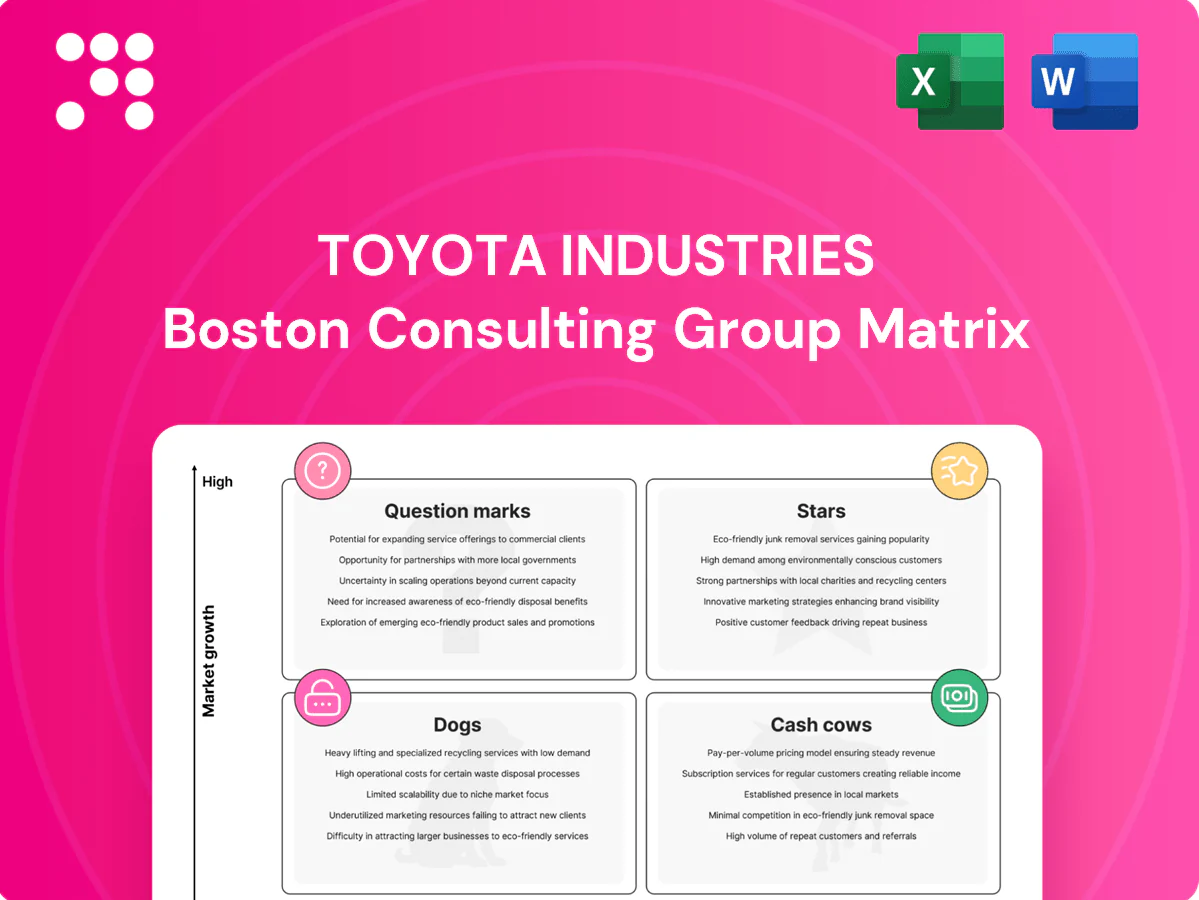
Toyota Industries Boston Consulting Group Matrix

Download Your Competitive Advantage
Toyota Industries' BCG Matrix snapshot shows where its heavy machinery, auto components, and logistics units sit in the competitive landscape—who’s pulling their weight and who needs a rethink. This preview highlights trends and trade-offs; the full BCG Matrix delivers quadrant-level placements, data-backed moves, and a ready-to-use Word + Excel pack. Buy the complete report to cut through the noise and act with confidence.
Stars

Warehouse automation systems
Fast-growing e-commerce and omni‑channel demand—online retail at about 22% of global retail sales in 2024—is accelerating warehouse automation where Toyota Industries, with integrated automation and high in‑market share, competes as a Star. Programs are sticky and multi‑year, absorbing capex and engineering hours but anchoring recurring service revenue. Continued investment to scale software, controls, and global delivery capacity is warranted to secure leadership.
Core forklift trucks (global)
Core Toyota-branded forklift trucks are a Star as global logistics buildout lifts material handling demand; Toyota is among the top three global suppliers by volume and Toyota Industries reported robust materials-handling sales in FY2024 that sustained scale advantages. Volume leadership plus a deep dealer network keeps a positive flywheel, supporting margin resilience and faster aftermarket uptake. Growth still requires working capital for inventory and ongoing product refresh cycles. Prioritize premium safety features, energy-efficiency (battery/ICE mix) and uptime guarantees to defend leadership.

Electric forklifts (lithium‑ion)
Shift from IC to electric is secular and accelerating, supported by lithium‑ion pack costs that fell to about $132/kWh (BNEF 2023), tightening the TCO gap for fleets. Toyota Industries leverages brand strength, unmatched channel reach and a broad spec sheet, giving clear share advantages in material‑handling. Growth is high and cash‑hungry (cells, packs, chargers, integration), so prioritize vertical energy partnerships and closed‑loop battery lifecycle to defend margin.

Integrated logistics solutions
End-to-end warehousing design, automation and bundled services are driving larger project values; the global warehouse automation market was roughly $39B in 2024, validating scale economics. Customers demand one throat to choke and Toyota (via Vanderlande and TICO units) can credibly lead. Execution is complex, but high attach rates and recurring service margins justify investment; continue building software and services around installed bases.
- Focus: one‑stop E2E solutions
- Metric: ~$39B market (2024)
- Strategy: scale software + service attach
Airport and parcel sortation automation
Global travel and parcel volumes rebounded strongly by 2024, with air traffic recovering to roughly 95% of 2019 levels (IATA) and e-commerce-driven parcel demand remaining elevated; high-spec automation and reference-site proof points create strong entry barriers favoring Toyota Industries.
Projects are engineering-intensive but lock customers into multi-year contracts and service lifecycles; investing in throughput analytics and remote support expands uptime and widens the competitive moat.
- Star: high growth, strong share
- Barriers: technical specs, reference sites
- Risk: engineering capacity
- Opportunity: throughput analytics, remote service
Warehouse automation & forklifts: defend margins with software, batteries and services
High-growth Stars: Toyota Industries leads in warehouse automation and forklifts amid 22% e-commerce share of retail (2024), a ~$39B global warehouse automation market (2024) and top-3 global forklift volume (FY2024); investments in software, batteries and services are required to defend share and margins.
| Metric | 2024 | Source |
|---|---|---|
| E‑commerce share | 22% | Global retail 2024 |
| Warehouse automation | $39B | Market 2024 |
| Li‑ion cost | $132/kWh | BNEF 2023 |
What is included in the product
 Detailed Word Document
Comprehensive BCG matrix for Toyota Industries, mapping Stars, Cash Cows, Question Marks, Dogs with investment, hold, divest guidance.

 Customizable Excel Spreadsheet
One-page BCG map of Toyota Industries: clear quadrant view to spot underperformers and fuel strategic focus.
Cash Cows

Automotive A/C compressors
Automotive A/C compressors sit in a mature category for Toyota Industries with top-tier OEM share and steady, reliable demand from Toyota and other automakers.
Scale and proprietary process know‑how deliver strong margins and low promotional needs, so incremental efficiency gains flow directly to cash.
Maintain production rigor, accelerate automation to cut unit costs, and milk cash generation to fund targeted growth bets in adjacent electrification and thermal-management technologies.
Engines and key auto components
Engines and key auto components supply anchor customer Toyota Motor under predictable long-term programs, delivering stable volumes and low churn. Growth is limited, but high plant utilization and component quality generate steady operating cash. Minimal selling expense and targeted incremental capex (line upgrades rather than new greenfield spend) boosts yield per asset. Maintain continuous line improvements and harvest cash.

Forklift parts, service, and rentals
Toyota Industries' forklift parts, service and rentals act as a cash cow: a large installed base (over 1 million units globally) produces annuity‑like, high‑margin, low‑volatility revenue with strong dealer lock‑in. Growth is modest but retention rates exceed industry averages; expanding contracts, uptime SLAs and digital maintenance (telematics) will deepen share of wallet and boost lifetime value.

Conventional IC forklifts (mature niches)
Certain applications still favor internal combustion forklifts and Toyota Industries retained ~17% global market share in 2024, keeping this segment as a reliable cash cow with steady aftermarket and replacement demand.
Category growth is low but replacement cycles are dependable, requiring limited capex beyond emissions compliance and durability investments while generating stable margins; focus is on maintaining leadership and migrating adjacent use-cases to electric over time.
- Steady cash flow: dependable replacement cycles
- 2024 share: ~17% global market
- Low growth, low incremental investment
- Strategy: defend share, convert adjacencies to electric
Textile machinery (core lines)
Textile machinery (core lines) leverages nearly 100 years of heritage since Toyoda Automatic Loom Works (est. 1926), delivering established OEM relationships and strong technical credibility; aftermarket parts and service contracts provide steady, high-margin cash streams. Market growth is modest and cyclical, but cash generation is sound when capacity is tuned and fixed costs are tight; promotional needs remain light. Run lean, protect aftermarket revenue, and prioritize profitable orders to sustain cash cow status.
- Heritage: nearly 100 years
- Revenue role: stable aftermarket margins
- Market: modest, cyclical demand
- Strategy: run lean, protect parts/service, prioritize profitable orders
High-margin annuities: defend forklift aftermarket, reinvest in electrification & telematics
Business units like A/C compressors, engines/components, forklifts and textile machinery generate high-margin, annuity cash with low growth and limited incremental capex. Forklift aftermarket benefits from >1,000,000 installed units and ~17% global share in 2024, underpinning predictable replacement cycles. Focus on efficiency, automation and reinvesting cash into adjacent electrification and telematics.
| Segment | Role | 2024 metric | Strategy |
|---|---|---|---|
| A/C compressors | Cash generator | Top-tier OEM share | Scale, efficiency |
| Engines/components | Stable supply | Long-term programs | High utilization |
| Forklifts | Aftermarket annuity | >1,000,000 units; ~17% share | Defend, electrify |
| Textile machinery | Heritage cash | Nearly 100-year legacy | Protect parts/service |
Delivered as Shown
Toyota Industries BCG Matrix
The file you're previewing here is the exact Toyota Industries BCG Matrix report you'll get after purchase. No watermarks, no demo pages—just a fully formatted, ready-to-use analysis designed for clarity. It's built by strategy pros and arrives editable so you can present, print, or tweak immediately. Buy once, download instantly, and drop it into your planning or investor decks without surprises.

Download Your Competitive Advantage
Toyota Industries' BCG Matrix snapshot shows where its heavy machinery, auto components, and logistics units sit in the competitive landscape—who’s pulling their weight and who needs a rethink. This preview highlights trends and trade-offs; the full BCG Matrix delivers quadrant-level placements, data-backed moves, and a ready-to-use Word + Excel pack. Buy the complete report to cut through the noise and act with confidence.
Stars
Warehouse automation systems
Fast-growing e-commerce and omni‑channel demand—online retail at about 22% of global retail sales in 2024—is accelerating warehouse automation where Toyota Industries, with integrated automation and high in‑market share, competes as a Star. Programs are sticky and multi‑year, absorbing capex and engineering hours but anchoring recurring service revenue. Continued investment to scale software, controls, and global delivery capacity is warranted to secure leadership.
Core forklift trucks (global)
Core Toyota-branded forklift trucks are a Star as global logistics buildout lifts material handling demand; Toyota is among the top three global suppliers by volume and Toyota Industries reported robust materials-handling sales in FY2024 that sustained scale advantages. Volume leadership plus a deep dealer network keeps a positive flywheel, supporting margin resilience and faster aftermarket uptake. Growth still requires working capital for inventory and ongoing product refresh cycles. Prioritize premium safety features, energy-efficiency (battery/ICE mix) and uptime guarantees to defend leadership.
Electric forklifts (lithium‑ion)
Shift from IC to electric is secular and accelerating, supported by lithium‑ion pack costs that fell to about $132/kWh (BNEF 2023), tightening the TCO gap for fleets. Toyota Industries leverages brand strength, unmatched channel reach and a broad spec sheet, giving clear share advantages in material‑handling. Growth is high and cash‑hungry (cells, packs, chargers, integration), so prioritize vertical energy partnerships and closed‑loop battery lifecycle to defend margin.
Integrated logistics solutions
End-to-end warehousing design, automation and bundled services are driving larger project values; the global warehouse automation market was roughly $39B in 2024, validating scale economics. Customers demand one throat to choke and Toyota (via Vanderlande and TICO units) can credibly lead. Execution is complex, but high attach rates and recurring service margins justify investment; continue building software and services around installed bases.
- Focus: one‑stop E2E solutions
- Metric: ~$39B market (2024)
- Strategy: scale software + service attach
Airport and parcel sortation automation
Global travel and parcel volumes rebounded strongly by 2024, with air traffic recovering to roughly 95% of 2019 levels (IATA) and e-commerce-driven parcel demand remaining elevated; high-spec automation and reference-site proof points create strong entry barriers favoring Toyota Industries.
Projects are engineering-intensive but lock customers into multi-year contracts and service lifecycles; investing in throughput analytics and remote support expands uptime and widens the competitive moat.
- Star: high growth, strong share
- Barriers: technical specs, reference sites
- Risk: engineering capacity
- Opportunity: throughput analytics, remote service
Warehouse automation & forklifts: defend margins with software, batteries and services
High-growth Stars: Toyota Industries leads in warehouse automation and forklifts amid 22% e-commerce share of retail (2024), a ~$39B global warehouse automation market (2024) and top-3 global forklift volume (FY2024); investments in software, batteries and services are required to defend share and margins.
| Metric | 2024 | Source |
|---|---|---|
| E‑commerce share | 22% | Global retail 2024 |
| Warehouse automation | $39B | Market 2024 |
| Li‑ion cost | $132/kWh | BNEF 2023 |
What is included in the product
Detailed Word Document
Comprehensive BCG matrix for Toyota Industries, mapping Stars, Cash Cows, Question Marks, Dogs with investment, hold, divest guidance.
Customizable Excel Spreadsheet
One-page BCG map of Toyota Industries: clear quadrant view to spot underperformers and fuel strategic focus.
Cash Cows
Automotive A/C compressors
Automotive A/C compressors sit in a mature category for Toyota Industries with top-tier OEM share and steady, reliable demand from Toyota and other automakers.
Scale and proprietary process know‑how deliver strong margins and low promotional needs, so incremental efficiency gains flow directly to cash.
Maintain production rigor, accelerate automation to cut unit costs, and milk cash generation to fund targeted growth bets in adjacent electrification and thermal-management technologies.
Engines and key auto components
Engines and key auto components supply anchor customer Toyota Motor under predictable long-term programs, delivering stable volumes and low churn. Growth is limited, but high plant utilization and component quality generate steady operating cash. Minimal selling expense and targeted incremental capex (line upgrades rather than new greenfield spend) boosts yield per asset. Maintain continuous line improvements and harvest cash.
Forklift parts, service, and rentals
Toyota Industries' forklift parts, service and rentals act as a cash cow: a large installed base (over 1 million units globally) produces annuity‑like, high‑margin, low‑volatility revenue with strong dealer lock‑in. Growth is modest but retention rates exceed industry averages; expanding contracts, uptime SLAs and digital maintenance (telematics) will deepen share of wallet and boost lifetime value.
Conventional IC forklifts (mature niches)
Certain applications still favor internal combustion forklifts and Toyota Industries retained ~17% global market share in 2024, keeping this segment as a reliable cash cow with steady aftermarket and replacement demand.
Category growth is low but replacement cycles are dependable, requiring limited capex beyond emissions compliance and durability investments while generating stable margins; focus is on maintaining leadership and migrating adjacent use-cases to electric over time.
- Steady cash flow: dependable replacement cycles
- 2024 share: ~17% global market
- Low growth, low incremental investment
- Strategy: defend share, convert adjacencies to electric
Textile machinery (core lines)
Textile machinery (core lines) leverages nearly 100 years of heritage since Toyoda Automatic Loom Works (est. 1926), delivering established OEM relationships and strong technical credibility; aftermarket parts and service contracts provide steady, high-margin cash streams. Market growth is modest and cyclical, but cash generation is sound when capacity is tuned and fixed costs are tight; promotional needs remain light. Run lean, protect aftermarket revenue, and prioritize profitable orders to sustain cash cow status.
- Heritage: nearly 100 years
- Revenue role: stable aftermarket margins
- Market: modest, cyclical demand
- Strategy: run lean, protect parts/service, prioritize profitable orders
High-margin annuities: defend forklift aftermarket, reinvest in electrification & telematics
Business units like A/C compressors, engines/components, forklifts and textile machinery generate high-margin, annuity cash with low growth and limited incremental capex. Forklift aftermarket benefits from >1,000,000 installed units and ~17% global share in 2024, underpinning predictable replacement cycles. Focus on efficiency, automation and reinvesting cash into adjacent electrification and telematics.
| Segment | Role | 2024 metric | Strategy |
|---|---|---|---|
| A/C compressors | Cash generator | Top-tier OEM share | Scale, efficiency |
| Engines/components | Stable supply | Long-term programs | High utilization |
| Forklifts | Aftermarket annuity | >1,000,000 units; ~17% share | Defend, electrify |
| Textile machinery | Heritage cash | Nearly 100-year legacy | Protect parts/service |
Delivered as Shown
Toyota Industries BCG Matrix
The file you're previewing here is the exact Toyota Industries BCG Matrix report you'll get after purchase. No watermarks, no demo pages—just a fully formatted, ready-to-use analysis designed for clarity. It's built by strategy pros and arrives editable so you can present, print, or tweak immediately. Buy once, download instantly, and drop it into your planning or investor decks without surprises.
Original: $10.00
-65%$10.00
$3.50Description
Download Your Competitive Advantage
Toyota Industries' BCG Matrix snapshot shows where its heavy machinery, auto components, and logistics units sit in the competitive landscape—who’s pulling their weight and who needs a rethink. This preview highlights trends and trade-offs; the full BCG Matrix delivers quadrant-level placements, data-backed moves, and a ready-to-use Word + Excel pack. Buy the complete report to cut through the noise and act with confidence.
Stars
Warehouse automation systems
Fast-growing e-commerce and omni‑channel demand—online retail at about 22% of global retail sales in 2024—is accelerating warehouse automation where Toyota Industries, with integrated automation and high in‑market share, competes as a Star. Programs are sticky and multi‑year, absorbing capex and engineering hours but anchoring recurring service revenue. Continued investment to scale software, controls, and global delivery capacity is warranted to secure leadership.
Core forklift trucks (global)
Core Toyota-branded forklift trucks are a Star as global logistics buildout lifts material handling demand; Toyota is among the top three global suppliers by volume and Toyota Industries reported robust materials-handling sales in FY2024 that sustained scale advantages. Volume leadership plus a deep dealer network keeps a positive flywheel, supporting margin resilience and faster aftermarket uptake. Growth still requires working capital for inventory and ongoing product refresh cycles. Prioritize premium safety features, energy-efficiency (battery/ICE mix) and uptime guarantees to defend leadership.
Electric forklifts (lithium‑ion)
Shift from IC to electric is secular and accelerating, supported by lithium‑ion pack costs that fell to about $132/kWh (BNEF 2023), tightening the TCO gap for fleets. Toyota Industries leverages brand strength, unmatched channel reach and a broad spec sheet, giving clear share advantages in material‑handling. Growth is high and cash‑hungry (cells, packs, chargers, integration), so prioritize vertical energy partnerships and closed‑loop battery lifecycle to defend margin.
Integrated logistics solutions
End-to-end warehousing design, automation and bundled services are driving larger project values; the global warehouse automation market was roughly $39B in 2024, validating scale economics. Customers demand one throat to choke and Toyota (via Vanderlande and TICO units) can credibly lead. Execution is complex, but high attach rates and recurring service margins justify investment; continue building software and services around installed bases.
- Focus: one‑stop E2E solutions
- Metric: ~$39B market (2024)
- Strategy: scale software + service attach
Airport and parcel sortation automation
Global travel and parcel volumes rebounded strongly by 2024, with air traffic recovering to roughly 95% of 2019 levels (IATA) and e-commerce-driven parcel demand remaining elevated; high-spec automation and reference-site proof points create strong entry barriers favoring Toyota Industries.
Projects are engineering-intensive but lock customers into multi-year contracts and service lifecycles; investing in throughput analytics and remote support expands uptime and widens the competitive moat.
- Star: high growth, strong share
- Barriers: technical specs, reference sites
- Risk: engineering capacity
- Opportunity: throughput analytics, remote service
Warehouse automation & forklifts: defend margins with software, batteries and services
High-growth Stars: Toyota Industries leads in warehouse automation and forklifts amid 22% e-commerce share of retail (2024), a ~$39B global warehouse automation market (2024) and top-3 global forklift volume (FY2024); investments in software, batteries and services are required to defend share and margins.
| Metric | 2024 | Source |
|---|---|---|
| E‑commerce share | 22% | Global retail 2024 |
| Warehouse automation | $39B | Market 2024 |
| Li‑ion cost | $132/kWh | BNEF 2023 |
What is included in the product
Detailed Word Document
Comprehensive BCG matrix for Toyota Industries, mapping Stars, Cash Cows, Question Marks, Dogs with investment, hold, divest guidance.
Customizable Excel Spreadsheet
One-page BCG map of Toyota Industries: clear quadrant view to spot underperformers and fuel strategic focus.
Cash Cows
Automotive A/C compressors
Automotive A/C compressors sit in a mature category for Toyota Industries with top-tier OEM share and steady, reliable demand from Toyota and other automakers.
Scale and proprietary process know‑how deliver strong margins and low promotional needs, so incremental efficiency gains flow directly to cash.
Maintain production rigor, accelerate automation to cut unit costs, and milk cash generation to fund targeted growth bets in adjacent electrification and thermal-management technologies.
Engines and key auto components
Engines and key auto components supply anchor customer Toyota Motor under predictable long-term programs, delivering stable volumes and low churn. Growth is limited, but high plant utilization and component quality generate steady operating cash. Minimal selling expense and targeted incremental capex (line upgrades rather than new greenfield spend) boosts yield per asset. Maintain continuous line improvements and harvest cash.
Forklift parts, service, and rentals
Toyota Industries' forklift parts, service and rentals act as a cash cow: a large installed base (over 1 million units globally) produces annuity‑like, high‑margin, low‑volatility revenue with strong dealer lock‑in. Growth is modest but retention rates exceed industry averages; expanding contracts, uptime SLAs and digital maintenance (telematics) will deepen share of wallet and boost lifetime value.
Conventional IC forklifts (mature niches)
Certain applications still favor internal combustion forklifts and Toyota Industries retained ~17% global market share in 2024, keeping this segment as a reliable cash cow with steady aftermarket and replacement demand.
Category growth is low but replacement cycles are dependable, requiring limited capex beyond emissions compliance and durability investments while generating stable margins; focus is on maintaining leadership and migrating adjacent use-cases to electric over time.
- Steady cash flow: dependable replacement cycles
- 2024 share: ~17% global market
- Low growth, low incremental investment
- Strategy: defend share, convert adjacencies to electric
Textile machinery (core lines)
Textile machinery (core lines) leverages nearly 100 years of heritage since Toyoda Automatic Loom Works (est. 1926), delivering established OEM relationships and strong technical credibility; aftermarket parts and service contracts provide steady, high-margin cash streams. Market growth is modest and cyclical, but cash generation is sound when capacity is tuned and fixed costs are tight; promotional needs remain light. Run lean, protect aftermarket revenue, and prioritize profitable orders to sustain cash cow status.
- Heritage: nearly 100 years
- Revenue role: stable aftermarket margins
- Market: modest, cyclical demand
- Strategy: run lean, protect parts/service, prioritize profitable orders
High-margin annuities: defend forklift aftermarket, reinvest in electrification & telematics
Business units like A/C compressors, engines/components, forklifts and textile machinery generate high-margin, annuity cash with low growth and limited incremental capex. Forklift aftermarket benefits from >1,000,000 installed units and ~17% global share in 2024, underpinning predictable replacement cycles. Focus on efficiency, automation and reinvesting cash into adjacent electrification and telematics.
| Segment | Role | 2024 metric | Strategy |
|---|---|---|---|
| A/C compressors | Cash generator | Top-tier OEM share | Scale, efficiency |
| Engines/components | Stable supply | Long-term programs | High utilization |
| Forklifts | Aftermarket annuity | >1,000,000 units; ~17% share | Defend, electrify |
| Textile machinery | Heritage cash | Nearly 100-year legacy | Protect parts/service |
Delivered as Shown
Toyota Industries BCG Matrix
The file you're previewing here is the exact Toyota Industries BCG Matrix report you'll get after purchase. No watermarks, no demo pages—just a fully formatted, ready-to-use analysis designed for clarity. It's built by strategy pros and arrives editable so you can present, print, or tweak immediately. Buy once, download instantly, and drop it into your planning or investor decks without surprises.











