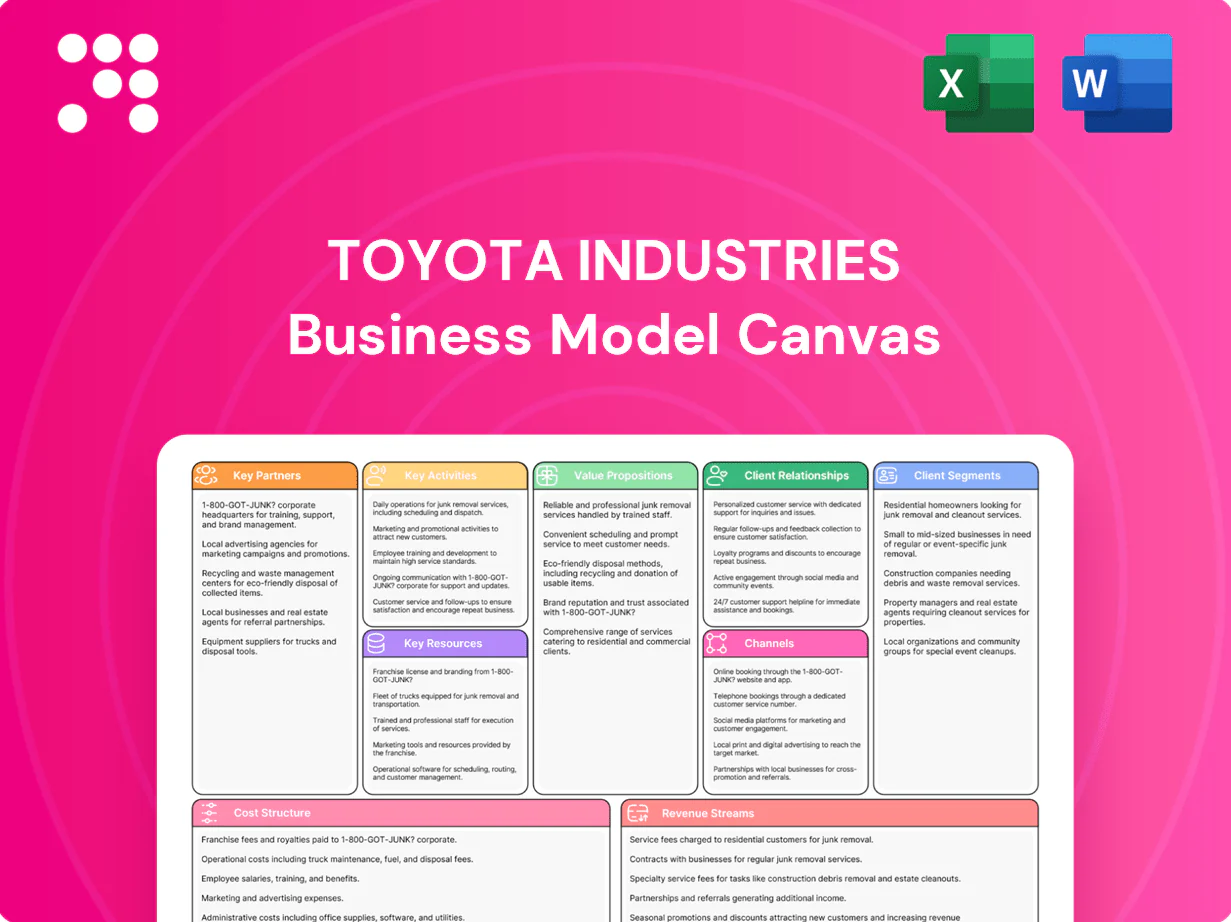
Toyota Industries Business Model Canvas

Discover an analyst-grade Business Model Canvas: value props, partners, revenue mechanics
Discover Toyota Industries' strategic blueprint with our Business Model Canvas that maps its value propositions, key partners, and revenue mechanics. This concise, analyst-grade snapshot highlights competitive advantages and growth levers. Purchase the full Canvas in Word/Excel for section-by-section insights and ready-to-use templates.
Partnerships

Toyota Group alliances
Strategic collaboration with Toyota Motor Corporation and affiliates anchors component supply, production synergies, and shared manufacturing philosophies, supporting Toyota Motor’s global production of about 8.7 million vehicles in 2023. Joint planning aligns engine and compressor demand directly with vehicle programs, smoothing capacity and inventory. Harmonized TPS-based quality frameworks reduce variability and secure scale advantages across the group.
Automotive OEM and Tier-1 customers
Partnerships with global automakers and Tier-1 system suppliers secure long-term programs for compressors, engines and electronics, underpinning Toyota Industries' FY2024 consolidated revenue of about ¥2.15 trillion. Co-engineering with OEMs ensures fit, performance and regulatory compliance across markets. Multi-year supply agreements stabilize volumes and capital planning, while collaboration on warranty, field data and continuous improvement reduces lifecycle costs and recall risk.

Suppliers of metals, electronics, batteries
Toyota Industries sources steel, castings, semiconductors, sensors and lithium-ion cells through strategic supplier networks; the global lithium-ion battery market was valued at about USD 63.4 billion in 2023, underscoring supplier importance. Joint quality audits and VAVE programs reduce cost and defects across the supply base. Dual-sourcing and regionalization bolster resilience against disruptions. Sustainability programs focus on CO2 reduction and traceability with supplier alignment.

Dealers, distributors, and logistics integrators
Independent and captive dealers extend Toyota Material Handling, BT, and Raymond reach, while logistics integrators co-deliver warehouse automation and retrofit projects to accelerate on-site implementation. Partners supply local service, rentals, and operator training, strengthening lifecycle support and reducing downtime. This network speeds deployment and enhances total-cost-of-ownership outcomes for customers.
- Dealers: brand reach and local service
- Integrators: automation + retrofits
- Offerings: rentals, training, parts
- Impact: faster deployment, stronger lifecycle support
Technology, software, and research partners
- AMR market: ~$5.1B (2024)
- Pilot payback: ~12 months
- Scale: analytics for fleets 1,000+
OEM alliance secures TPS synergies tied to ~8.7M units and ¥2.15T
Strategic alliances with Toyota Motor and affiliates secure volume, quality and TPS synergies tied to ~8.7M vehicles (2023) and ¥2.15T consolidated revenue (FY2024). Long-term OEM and supplier contracts stabilize compressor, engine and electronics programs and lower lifecycle costs. Partnerships with AMR, battery and cloud firms accelerate automation deployment and analytics at scale.
| Metric | Value |
|---|---|
| Toyota vehicle production (2023) | ~8.7M |
| Toyota Industries revenue (FY2024) | ¥2.15T |
| Li-ion market (2023) | USD63.4B |
| AMR market (2024) | ~USD5.1B |
| Pilot payback | ~12 months |
What is included in the product
 Detailed Word Document
A comprehensive Business Model Canvas for Toyota Industries covering all nine blocks—customer segments, value propositions, channels, customer relationships, revenue streams, key resources, key activities, key partners and cost structure—reflecting real-world operations, competitive advantages and linked SWOT insights, ideal for presentations, funding discussions and strategic analysis.

 Customizable Excel Spreadsheet
High-level view of Toyota Industries' business model with editable cells, condensing complex manufacturing, logistics, and mobility strategy into a one-page snapshot—save hours formatting while enabling boardroom-ready reviews, team collaboration, and quick comparisons across business models.
Activities

Design and R&D for equipment and components
Continuous engineering of forklifts, AS/RS, AMRs, compressors and engines drives incremental performance and efficiency, with 2024 programs prioritizing energy density and uptime. Compliance testing meets global safety and emissions regimes such as Euro 6 and EPA Tier 4. Modular platforms cut complexity across product lines, enabling faster variants. Digital twins and simulation de-risk launches and shorten validation cycles.
Lean manufacturing and quality management
Over 50 global manufacturing sites execute the Toyota Production System to deliver high-mix, high-quality output; Toyota Industries reported consolidated revenue of ¥2.4 trillion in FY2024, underscoring scale. Automation, in-line inspection and traceability target defect rates below industry benchmarks, while supplier quality integration spans roughly 1,000 partners to assure incoming material standards. Remanufacturing programs extend product life and reduce waste, supporting sustainability targets.

Supply chain, sourcing, and logistics
Planning balances regional demand with component availability, mitigating a semiconductor-driven production shortfall that cut global auto output by about 7.7 million units in 2021; Toyota Industries aligns sourcing across regions to smooth supply. Inventory optimization targets lower working capital and faster turnover. Risk management prioritizes semiconductor and battery continuity. Finished-goods logistics secures on-time delivery and installation.

Sales, rentals, and after-sales services
Direct and dealer sales teams tailor Toyota Industries forklifts and intralogistics solutions by application, from warehousing to heavy manufacturing. Rentals and leasing options improve customer cash flow and operational flexibility. Preventive maintenance, genuine parts, and field service maximize uptime, while telemetry-driven Toyota I_Site analytics reduces unplanned downtime.
- Sales: application-specific solutions
- Rentals: cash-flow flexibility
- Service: preventive maintenance & parts
- Telemetry: reduced unplanned downtime
Systems integration and software deployment
Systems integration and commissioning deliver end-to-end warehouse design and automation solutions, with 2024 warehouse automation market value ~22.7 billion USD; WMS, fleet management and telematics are configured to customer workflows to raise utilization and throughput. Change management and operator training smooth adoption, while continuous performance monitoring drives iterative improvement.
- Systems integration
- WMS & fleet telematics
- Change management & training
- Performance monitoring
Uptime-led engineering; revenue ¥2.4T in a $22.7B warehouse market
Continuous engineering of forklifts, AS/RS, AMRs, compressors and engines improves energy density and uptime; Toyota Industries reported consolidated revenue ¥2.4 trillion in FY2024. TPS-driven 50+ plants deliver high-mix output; supplier network ~1,000 partners. Services include rentals, preventive maintenance, telematics (Toyota I_Site) and systems integration in a $22.7B 2024 warehouse automation market.
| Metric | 2024 Value |
|---|---|
| Revenue | ¥2.4 trillion |
| Manufacturing sites | 50+ |
| Suppliers | ~1,000 |
| Warehouse automation market | $22.7B |
What You See Is What You Get
Business Model Canvas
The Toyota Industries Business Model Canvas you’re previewing is the actual deliverable, not a mockup. It’s a direct snapshot of the full file you’ll receive after purchase. Upon ordering you’ll get this exact document—complete, editable and formatted—for immediate download in Word and Excel.

Discover an analyst-grade Business Model Canvas: value props, partners, revenue mechanics
Discover Toyota Industries' strategic blueprint with our Business Model Canvas that maps its value propositions, key partners, and revenue mechanics. This concise, analyst-grade snapshot highlights competitive advantages and growth levers. Purchase the full Canvas in Word/Excel for section-by-section insights and ready-to-use templates.
Partnerships
Toyota Group alliances
Strategic collaboration with Toyota Motor Corporation and affiliates anchors component supply, production synergies, and shared manufacturing philosophies, supporting Toyota Motor’s global production of about 8.7 million vehicles in 2023. Joint planning aligns engine and compressor demand directly with vehicle programs, smoothing capacity and inventory. Harmonized TPS-based quality frameworks reduce variability and secure scale advantages across the group.
Automotive OEM and Tier-1 customers
Partnerships with global automakers and Tier-1 system suppliers secure long-term programs for compressors, engines and electronics, underpinning Toyota Industries' FY2024 consolidated revenue of about ¥2.15 trillion. Co-engineering with OEMs ensures fit, performance and regulatory compliance across markets. Multi-year supply agreements stabilize volumes and capital planning, while collaboration on warranty, field data and continuous improvement reduces lifecycle costs and recall risk.
Suppliers of metals, electronics, batteries
Toyota Industries sources steel, castings, semiconductors, sensors and lithium-ion cells through strategic supplier networks; the global lithium-ion battery market was valued at about USD 63.4 billion in 2023, underscoring supplier importance. Joint quality audits and VAVE programs reduce cost and defects across the supply base. Dual-sourcing and regionalization bolster resilience against disruptions. Sustainability programs focus on CO2 reduction and traceability with supplier alignment.
Dealers, distributors, and logistics integrators
Independent and captive dealers extend Toyota Material Handling, BT, and Raymond reach, while logistics integrators co-deliver warehouse automation and retrofit projects to accelerate on-site implementation. Partners supply local service, rentals, and operator training, strengthening lifecycle support and reducing downtime. This network speeds deployment and enhances total-cost-of-ownership outcomes for customers.
- Dealers: brand reach and local service
- Integrators: automation + retrofits
- Offerings: rentals, training, parts
- Impact: faster deployment, stronger lifecycle support
Technology, software, and research partners
- AMR market: ~$5.1B (2024)
- Pilot payback: ~12 months
- Scale: analytics for fleets 1,000+
OEM alliance secures TPS synergies tied to ~8.7M units and ¥2.15T
Strategic alliances with Toyota Motor and affiliates secure volume, quality and TPS synergies tied to ~8.7M vehicles (2023) and ¥2.15T consolidated revenue (FY2024). Long-term OEM and supplier contracts stabilize compressor, engine and electronics programs and lower lifecycle costs. Partnerships with AMR, battery and cloud firms accelerate automation deployment and analytics at scale.
| Metric | Value |
|---|---|
| Toyota vehicle production (2023) | ~8.7M |
| Toyota Industries revenue (FY2024) | ¥2.15T |
| Li-ion market (2023) | USD63.4B |
| AMR market (2024) | ~USD5.1B |
| Pilot payback | ~12 months |
What is included in the product
Detailed Word Document
A comprehensive Business Model Canvas for Toyota Industries covering all nine blocks—customer segments, value propositions, channels, customer relationships, revenue streams, key resources, key activities, key partners and cost structure—reflecting real-world operations, competitive advantages and linked SWOT insights, ideal for presentations, funding discussions and strategic analysis.
Customizable Excel Spreadsheet
High-level view of Toyota Industries' business model with editable cells, condensing complex manufacturing, logistics, and mobility strategy into a one-page snapshot—save hours formatting while enabling boardroom-ready reviews, team collaboration, and quick comparisons across business models.
Activities
Design and R&D for equipment and components
Continuous engineering of forklifts, AS/RS, AMRs, compressors and engines drives incremental performance and efficiency, with 2024 programs prioritizing energy density and uptime. Compliance testing meets global safety and emissions regimes such as Euro 6 and EPA Tier 4. Modular platforms cut complexity across product lines, enabling faster variants. Digital twins and simulation de-risk launches and shorten validation cycles.
Lean manufacturing and quality management
Over 50 global manufacturing sites execute the Toyota Production System to deliver high-mix, high-quality output; Toyota Industries reported consolidated revenue of ¥2.4 trillion in FY2024, underscoring scale. Automation, in-line inspection and traceability target defect rates below industry benchmarks, while supplier quality integration spans roughly 1,000 partners to assure incoming material standards. Remanufacturing programs extend product life and reduce waste, supporting sustainability targets.
Supply chain, sourcing, and logistics
Planning balances regional demand with component availability, mitigating a semiconductor-driven production shortfall that cut global auto output by about 7.7 million units in 2021; Toyota Industries aligns sourcing across regions to smooth supply. Inventory optimization targets lower working capital and faster turnover. Risk management prioritizes semiconductor and battery continuity. Finished-goods logistics secures on-time delivery and installation.
Sales, rentals, and after-sales services
Direct and dealer sales teams tailor Toyota Industries forklifts and intralogistics solutions by application, from warehousing to heavy manufacturing. Rentals and leasing options improve customer cash flow and operational flexibility. Preventive maintenance, genuine parts, and field service maximize uptime, while telemetry-driven Toyota I_Site analytics reduces unplanned downtime.
- Sales: application-specific solutions
- Rentals: cash-flow flexibility
- Service: preventive maintenance & parts
- Telemetry: reduced unplanned downtime
Systems integration and software deployment
Systems integration and commissioning deliver end-to-end warehouse design and automation solutions, with 2024 warehouse automation market value ~22.7 billion USD; WMS, fleet management and telematics are configured to customer workflows to raise utilization and throughput. Change management and operator training smooth adoption, while continuous performance monitoring drives iterative improvement.
- Systems integration
- WMS & fleet telematics
- Change management & training
- Performance monitoring
Uptime-led engineering; revenue ¥2.4T in a $22.7B warehouse market
Continuous engineering of forklifts, AS/RS, AMRs, compressors and engines improves energy density and uptime; Toyota Industries reported consolidated revenue ¥2.4 trillion in FY2024. TPS-driven 50+ plants deliver high-mix output; supplier network ~1,000 partners. Services include rentals, preventive maintenance, telematics (Toyota I_Site) and systems integration in a $22.7B 2024 warehouse automation market.
| Metric | 2024 Value |
|---|---|
| Revenue | ¥2.4 trillion |
| Manufacturing sites | 50+ |
| Suppliers | ~1,000 |
| Warehouse automation market | $22.7B |
What You See Is What You Get
Business Model Canvas
The Toyota Industries Business Model Canvas you’re previewing is the actual deliverable, not a mockup. It’s a direct snapshot of the full file you’ll receive after purchase. Upon ordering you’ll get this exact document—complete, editable and formatted—for immediate download in Word and Excel.
Original: $10.00
-65%$10.00
$3.50Description
Discover an analyst-grade Business Model Canvas: value props, partners, revenue mechanics
Discover Toyota Industries' strategic blueprint with our Business Model Canvas that maps its value propositions, key partners, and revenue mechanics. This concise, analyst-grade snapshot highlights competitive advantages and growth levers. Purchase the full Canvas in Word/Excel for section-by-section insights and ready-to-use templates.
Partnerships
Toyota Group alliances
Strategic collaboration with Toyota Motor Corporation and affiliates anchors component supply, production synergies, and shared manufacturing philosophies, supporting Toyota Motor’s global production of about 8.7 million vehicles in 2023. Joint planning aligns engine and compressor demand directly with vehicle programs, smoothing capacity and inventory. Harmonized TPS-based quality frameworks reduce variability and secure scale advantages across the group.
Automotive OEM and Tier-1 customers
Partnerships with global automakers and Tier-1 system suppliers secure long-term programs for compressors, engines and electronics, underpinning Toyota Industries' FY2024 consolidated revenue of about ¥2.15 trillion. Co-engineering with OEMs ensures fit, performance and regulatory compliance across markets. Multi-year supply agreements stabilize volumes and capital planning, while collaboration on warranty, field data and continuous improvement reduces lifecycle costs and recall risk.
Suppliers of metals, electronics, batteries
Toyota Industries sources steel, castings, semiconductors, sensors and lithium-ion cells through strategic supplier networks; the global lithium-ion battery market was valued at about USD 63.4 billion in 2023, underscoring supplier importance. Joint quality audits and VAVE programs reduce cost and defects across the supply base. Dual-sourcing and regionalization bolster resilience against disruptions. Sustainability programs focus on CO2 reduction and traceability with supplier alignment.
Dealers, distributors, and logistics integrators
Independent and captive dealers extend Toyota Material Handling, BT, and Raymond reach, while logistics integrators co-deliver warehouse automation and retrofit projects to accelerate on-site implementation. Partners supply local service, rentals, and operator training, strengthening lifecycle support and reducing downtime. This network speeds deployment and enhances total-cost-of-ownership outcomes for customers.
- Dealers: brand reach and local service
- Integrators: automation + retrofits
- Offerings: rentals, training, parts
- Impact: faster deployment, stronger lifecycle support
Technology, software, and research partners
- AMR market: ~$5.1B (2024)
- Pilot payback: ~12 months
- Scale: analytics for fleets 1,000+
OEM alliance secures TPS synergies tied to ~8.7M units and ¥2.15T
Strategic alliances with Toyota Motor and affiliates secure volume, quality and TPS synergies tied to ~8.7M vehicles (2023) and ¥2.15T consolidated revenue (FY2024). Long-term OEM and supplier contracts stabilize compressor, engine and electronics programs and lower lifecycle costs. Partnerships with AMR, battery and cloud firms accelerate automation deployment and analytics at scale.
| Metric | Value |
|---|---|
| Toyota vehicle production (2023) | ~8.7M |
| Toyota Industries revenue (FY2024) | ¥2.15T |
| Li-ion market (2023) | USD63.4B |
| AMR market (2024) | ~USD5.1B |
| Pilot payback | ~12 months |
What is included in the product
Detailed Word Document
A comprehensive Business Model Canvas for Toyota Industries covering all nine blocks—customer segments, value propositions, channels, customer relationships, revenue streams, key resources, key activities, key partners and cost structure—reflecting real-world operations, competitive advantages and linked SWOT insights, ideal for presentations, funding discussions and strategic analysis.
Customizable Excel Spreadsheet
High-level view of Toyota Industries' business model with editable cells, condensing complex manufacturing, logistics, and mobility strategy into a one-page snapshot—save hours formatting while enabling boardroom-ready reviews, team collaboration, and quick comparisons across business models.
Activities
Design and R&D for equipment and components
Continuous engineering of forklifts, AS/RS, AMRs, compressors and engines drives incremental performance and efficiency, with 2024 programs prioritizing energy density and uptime. Compliance testing meets global safety and emissions regimes such as Euro 6 and EPA Tier 4. Modular platforms cut complexity across product lines, enabling faster variants. Digital twins and simulation de-risk launches and shorten validation cycles.
Lean manufacturing and quality management
Over 50 global manufacturing sites execute the Toyota Production System to deliver high-mix, high-quality output; Toyota Industries reported consolidated revenue of ¥2.4 trillion in FY2024, underscoring scale. Automation, in-line inspection and traceability target defect rates below industry benchmarks, while supplier quality integration spans roughly 1,000 partners to assure incoming material standards. Remanufacturing programs extend product life and reduce waste, supporting sustainability targets.
Supply chain, sourcing, and logistics
Planning balances regional demand with component availability, mitigating a semiconductor-driven production shortfall that cut global auto output by about 7.7 million units in 2021; Toyota Industries aligns sourcing across regions to smooth supply. Inventory optimization targets lower working capital and faster turnover. Risk management prioritizes semiconductor and battery continuity. Finished-goods logistics secures on-time delivery and installation.
Sales, rentals, and after-sales services
Direct and dealer sales teams tailor Toyota Industries forklifts and intralogistics solutions by application, from warehousing to heavy manufacturing. Rentals and leasing options improve customer cash flow and operational flexibility. Preventive maintenance, genuine parts, and field service maximize uptime, while telemetry-driven Toyota I_Site analytics reduces unplanned downtime.
- Sales: application-specific solutions
- Rentals: cash-flow flexibility
- Service: preventive maintenance & parts
- Telemetry: reduced unplanned downtime
Systems integration and software deployment
Systems integration and commissioning deliver end-to-end warehouse design and automation solutions, with 2024 warehouse automation market value ~22.7 billion USD; WMS, fleet management and telematics are configured to customer workflows to raise utilization and throughput. Change management and operator training smooth adoption, while continuous performance monitoring drives iterative improvement.
- Systems integration
- WMS & fleet telematics
- Change management & training
- Performance monitoring
Uptime-led engineering; revenue ¥2.4T in a $22.7B warehouse market
Continuous engineering of forklifts, AS/RS, AMRs, compressors and engines improves energy density and uptime; Toyota Industries reported consolidated revenue ¥2.4 trillion in FY2024. TPS-driven 50+ plants deliver high-mix output; supplier network ~1,000 partners. Services include rentals, preventive maintenance, telematics (Toyota I_Site) and systems integration in a $22.7B 2024 warehouse automation market.
| Metric | 2024 Value |
|---|---|
| Revenue | ¥2.4 trillion |
| Manufacturing sites | 50+ |
| Suppliers | ~1,000 |
| Warehouse automation market | $22.7B |
What You See Is What You Get
Business Model Canvas
The Toyota Industries Business Model Canvas you’re previewing is the actual deliverable, not a mockup. It’s a direct snapshot of the full file you’ll receive after purchase. Upon ordering you’ll get this exact document—complete, editable and formatted—for immediate download in Word and Excel.











