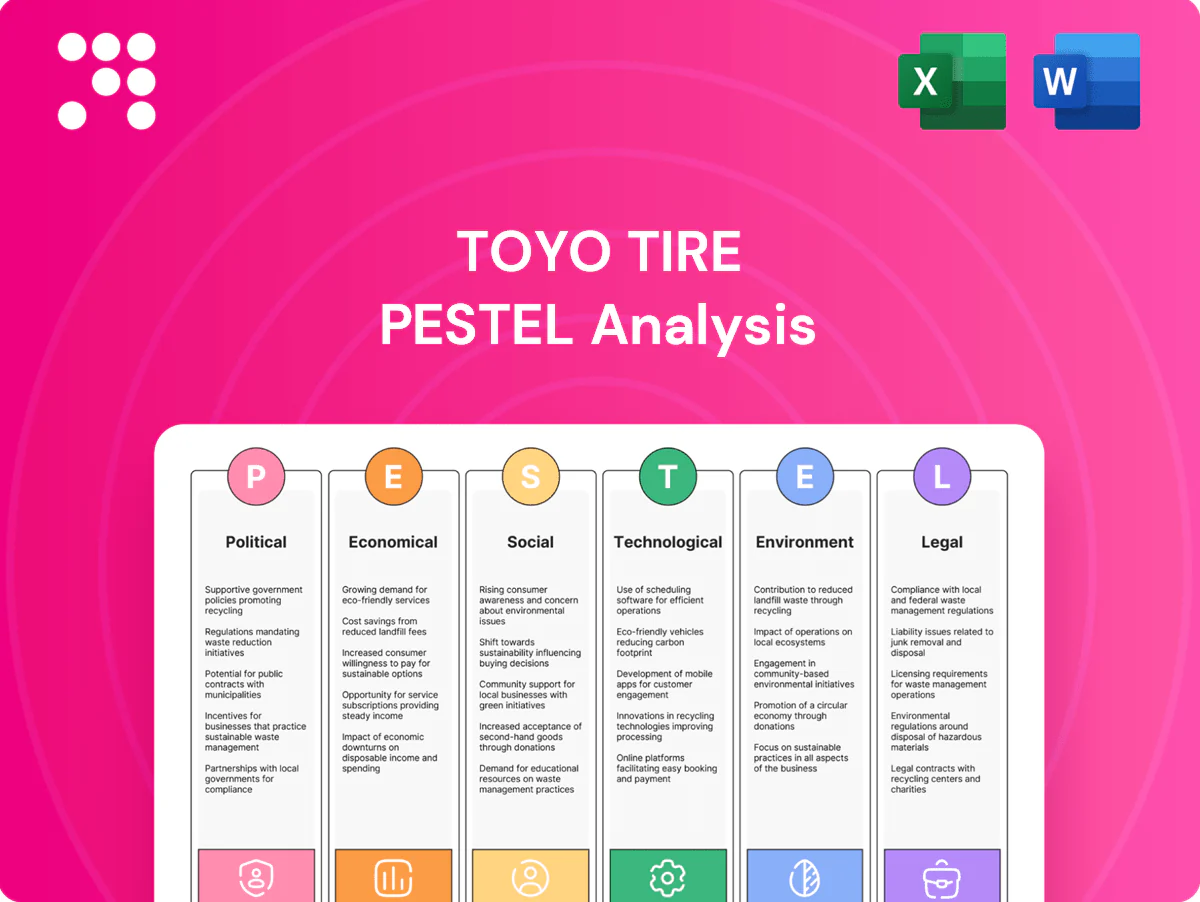
Toyo Tire PESTLE Analysis

Your Competitive Advantage Starts with This Report
Unlock how political shifts, supply-chain economics, and green-tech trends are reshaping Toyo Tire’s strategy and risk profile in our concise PESTLE snapshot. Designed for investors and strategists, this analysis highlights immediate threats and growth levers. Buy the full PESTLE to access detailed, actionable insights and ready-to-use charts for decision-making.
Political factors

Trade tariffs and market access
Shifting tariffs on tires and auto parts—including lingering 25% Section 301 US duties on many Chinese imports—can materially alter Toyo Tire’s price competitiveness across the US, EU and emerging markets, affecting margins and sales mix. Anti-dumping or safeguard duties can constrain specific SKUs and force production shifts; firms have reported tariff-driven relocations of capacity by 10–30% regionally. Proactive export diversification and localized manufacturing hedge policy risk, and active engagement with WTO/trade bodies helps anticipate and shape outcomes.
Geopolitical supply chain exposure
Geopolitical tensions disrupt flows of natural rubber (global production ~13 Mt/year) and petrochemicals and hit Asia‑Pacific logistics — the region handles about 60% of global container throughput — extending lead times and raising working capital needs. Disruptions can push supplier lead times by weeks and force higher inventory funding; building multi‑sourcing and regional inventories (eg 60–90 days) stabilizes service levels. Scenario planning supports allocation and priority decisions during shocks.

Industrial policies and incentives
Government incentives for EVs and advanced manufacturing — exemplified by the US Inflation Reduction Act (≈$369 billion) and up to $7,500 consumer EV tax credits — can co-fund Toyo Tire R&D and plant automation investments. Global EV sales of about 14 million in 2023 expand addressable demand and justify capex. Local content and final-assembly rules affect siting for subsidy eligibility. Continuous policy monitoring maximizes grant capture and ensures compliance.

Infrastructure and transport policy
Public investment in roads and freight corridors accelerates tire replacement cycles and boosts commercial tire demand; urban mobility policies shift vehicle mix and last-mile delivery needs, changing specifications toward durability and low rolling resistance; participation in municipal pilot programs highlights low-noise, low-wear Toyo solutions; data-sharing with authorities enables fit-for-purpose product matching.
- Public investment: increases replacement cycles
- Urban policy: alters vehicle mix/last-mile specs
- Pilot programs: showcase low-noise/low-wear tires
- Data-sharing: enables tailored offerings
Political stability in key markets
Regime shifts can change import rules, safety standards, and labor costs rapidly, forcing Toyo Tire (Tokyo Stock Exchange: 5105) to adjust supply chains across its network in over 120 countries. Stable jurisdictions encourage long-term capex for mixing, curing, and testing facilities, with regional plants in the US, Japan and Southeast Asia prioritized. Country risk assessments plus insurance and FX/commodity hedges guide capital allocation and distributor agreements to limit policy-reversal losses.
- Focus: prioritize capex in low-country-risk markets
- Mitigation: insurance and hedging for abrupt policy shifts
- Governance: distributor terms tied to country-risk scores
Tariffs (25%), rubber (13 Mt), APAC (60%) pressure EV demand
Tariff shifts (eg 25% Section 301 on many Chinese auto parts) and anti‑dumping duties materially affect Toyo Tire’s pricing and margins across the US, EU and emerging markets. Geopolitical disruptions raise lead times and working capital needs given global natural rubber ~13 Mt/year and APAC handling ~60% of container throughput. EV incentives (IRA ≈$369bn; $7,500 tax credits) expand addressable demand (global EVs ~14m in 2023).
| Risk | Metric | Impact |
|---|---|---|
| Tariffs | 25% Section 301 | Price/margin pressure |
| Supply | Natural rubber 13 Mt/yr | Input volatility |
| Logistics | APAC 60% throughput | Lead‑time risk |
| Demand | EVs ~14m (2023) | R&D & capex opportunity |
What is included in the product
 Detailed Word Document
Explores how Political, Economic, Social, Technological, Environmental, and Legal forces uniquely affect Toyo Tire, with data-driven trends and region-specific regulatory context; designed for executives and investors, it highlights threats, opportunities, and forward-looking scenarios in ready-to-use format for strategy, planning, and funding materials.

 Customizable Excel Spreadsheet
Concise, visually segmented PESTLE summary for Toyo Tire that eases meeting prep, supports risk discussion and slide-ready sharing, and lets teams add region-specific notes quickly.
Economic factors

Raw material price volatility
Natural rubber and oil-derived inputs drive COGS at Toyo Tire, with Brent crude averaging about 86 USD/barrel in 2024 and natural rubber benchmarks rising notably through 2023–24, increasing margin volatility. Price spikes compress profitability unless surcharges, premium product mix or index-linked pricing are implemented. Long-term supply contracts, commodity hedges and ongoing material- and process-innovation lower exposure, while value engineering reduces material intensity and protects unit margins.
Currency fluctuations (JPY/USD/EUR)
Revenue–cost mismatches leave Toyo Tire earnings exposed to FX swings: USD/JPY averaged about 150 and EUR/JPY about 160 in 2024, so a stronger yen cuts export margins while a weaker yen raises import costs for raw materials and equipment.
Natural hedging from regional production and invoicing alignment and layered hedging programs (forwards, swaps) are used to stabilize results and smooth quarterly volatility.

Auto cycle and replacement demand
New vehicle production (≈80 million light vehicles globally in 2024) directly affects Toyo Tire OE volumes, while a global parc of about 1.4 billion vehicles underpins steady replacement demand. Economic slowdowns defer new purchases, but mandatory safety standards and wear rates sustain recurring tyre sales. Focusing on replacement channels and premium tiers, plus fleet and TBR segments, cushions downturns and offers counter-cyclical revenue.

Freight and logistics costs
Container rate volatility and port congestion materially raise Toyo Tire delivered costs and pressure OTIF; for example the US West Coast backlog peaked at about 109 vessels in Jan 2022 and, despite easing, schedule reliability only recovered toward pre‑pandemic levels by 2024, keeping spot and contract freight exposure elevated. Increased logistics expense can erase product‑mix margin gains if unmanaged, while nearshoring and DC optimization shorten transit miles and reduce variability. Collaborative forecasting with dealers improves load factors and service, lowering per‑unit logistics spend.
- Container rate spikes: pandemic peak → elevated 2021–22; normalized toward 2024
- Port congestion: LA backlog ~109 ships (Jan 2022) evidence of disruption
- Nearshoring/DC optimization: cuts miles, variability, transit time
- Collaborative forecasting: improves load factors and OTIF
Interest rates and capex
Higher global policy rates (US fed funds 5.25–5.50% in 2024–25) push up financing costs for Toyo Tire’s plant upgrades, testing rigs and automation, while tighter credit for dealers and fleets compresses tyre replacement and OEM demand; prioritised ROI pipelines and leasing solutions are used to preserve growth capex. Productivity must exceed a typical automotive WACC (~7–9%) to protect EVA.
- Higher rates: US fed funds 5.25–5.50% (2024–25)
- Capex focus: ROI-prioritised projects, leasing
- Demand risk: tighter dealer/fleet credit
- Value guard: productivity > WACC (~7–9%)
Tariffs (25%), rubber (13 Mt), APAC (60%) pressure EV demand
Natural rubber and Brent (≈86 USD/bbl in 2024) raise COGS and margin volatility; hedges and value engineering mitigate impact. FX (USD/JPY ≈150, EUR/JPY ≈160 in 2024) and freight/port disruption lift cost risk; OE tied to ~80M light vehicle builds (2024) while 1.4B vehicles support replacement. Higher rates (US fed funds 5.25–5.50% 2024–25) raise capex financing needs.
| Metric | 2024/2025 |
|---|---|
| Brent crude | ~86 USD/bbl (2024) |
| USD/JPY | ~150 (2024) |
| Global LVP | ~80M (2024) |
| Fed funds | 5.25–5.50% (2024–25) |
Preview Before You Purchase
Toyo Tire PESTLE Analysis
The preview shown here is the exact Toyo Tire PESTLE Analysis you’ll receive after purchase—fully formatted and ready to use. It covers political, economic, social, technological, legal and environmental factors with charts and cited insights. No placeholders or surprises; you’ll download the final, professionally structured file immediately after checkout.

Your Competitive Advantage Starts with This Report
Unlock how political shifts, supply-chain economics, and green-tech trends are reshaping Toyo Tire’s strategy and risk profile in our concise PESTLE snapshot. Designed for investors and strategists, this analysis highlights immediate threats and growth levers. Buy the full PESTLE to access detailed, actionable insights and ready-to-use charts for decision-making.
Political factors
Trade tariffs and market access
Shifting tariffs on tires and auto parts—including lingering 25% Section 301 US duties on many Chinese imports—can materially alter Toyo Tire’s price competitiveness across the US, EU and emerging markets, affecting margins and sales mix. Anti-dumping or safeguard duties can constrain specific SKUs and force production shifts; firms have reported tariff-driven relocations of capacity by 10–30% regionally. Proactive export diversification and localized manufacturing hedge policy risk, and active engagement with WTO/trade bodies helps anticipate and shape outcomes.
Geopolitical supply chain exposure
Geopolitical tensions disrupt flows of natural rubber (global production ~13 Mt/year) and petrochemicals and hit Asia‑Pacific logistics — the region handles about 60% of global container throughput — extending lead times and raising working capital needs. Disruptions can push supplier lead times by weeks and force higher inventory funding; building multi‑sourcing and regional inventories (eg 60–90 days) stabilizes service levels. Scenario planning supports allocation and priority decisions during shocks.
Industrial policies and incentives
Government incentives for EVs and advanced manufacturing — exemplified by the US Inflation Reduction Act (≈$369 billion) and up to $7,500 consumer EV tax credits — can co-fund Toyo Tire R&D and plant automation investments. Global EV sales of about 14 million in 2023 expand addressable demand and justify capex. Local content and final-assembly rules affect siting for subsidy eligibility. Continuous policy monitoring maximizes grant capture and ensures compliance.
Infrastructure and transport policy
Public investment in roads and freight corridors accelerates tire replacement cycles and boosts commercial tire demand; urban mobility policies shift vehicle mix and last-mile delivery needs, changing specifications toward durability and low rolling resistance; participation in municipal pilot programs highlights low-noise, low-wear Toyo solutions; data-sharing with authorities enables fit-for-purpose product matching.
- Public investment: increases replacement cycles
- Urban policy: alters vehicle mix/last-mile specs
- Pilot programs: showcase low-noise/low-wear tires
- Data-sharing: enables tailored offerings
Political stability in key markets
Regime shifts can change import rules, safety standards, and labor costs rapidly, forcing Toyo Tire (Tokyo Stock Exchange: 5105) to adjust supply chains across its network in over 120 countries. Stable jurisdictions encourage long-term capex for mixing, curing, and testing facilities, with regional plants in the US, Japan and Southeast Asia prioritized. Country risk assessments plus insurance and FX/commodity hedges guide capital allocation and distributor agreements to limit policy-reversal losses.
- Focus: prioritize capex in low-country-risk markets
- Mitigation: insurance and hedging for abrupt policy shifts
- Governance: distributor terms tied to country-risk scores
Tariffs (25%), rubber (13 Mt), APAC (60%) pressure EV demand
Tariff shifts (eg 25% Section 301 on many Chinese auto parts) and anti‑dumping duties materially affect Toyo Tire’s pricing and margins across the US, EU and emerging markets. Geopolitical disruptions raise lead times and working capital needs given global natural rubber ~13 Mt/year and APAC handling ~60% of container throughput. EV incentives (IRA ≈$369bn; $7,500 tax credits) expand addressable demand (global EVs ~14m in 2023).
| Risk | Metric | Impact |
|---|---|---|
| Tariffs | 25% Section 301 | Price/margin pressure |
| Supply | Natural rubber 13 Mt/yr | Input volatility |
| Logistics | APAC 60% throughput | Lead‑time risk |
| Demand | EVs ~14m (2023) | R&D & capex opportunity |
What is included in the product
Detailed Word Document
Explores how Political, Economic, Social, Technological, Environmental, and Legal forces uniquely affect Toyo Tire, with data-driven trends and region-specific regulatory context; designed for executives and investors, it highlights threats, opportunities, and forward-looking scenarios in ready-to-use format for strategy, planning, and funding materials.
Customizable Excel Spreadsheet
Concise, visually segmented PESTLE summary for Toyo Tire that eases meeting prep, supports risk discussion and slide-ready sharing, and lets teams add region-specific notes quickly.
Economic factors
Raw material price volatility
Natural rubber and oil-derived inputs drive COGS at Toyo Tire, with Brent crude averaging about 86 USD/barrel in 2024 and natural rubber benchmarks rising notably through 2023–24, increasing margin volatility. Price spikes compress profitability unless surcharges, premium product mix or index-linked pricing are implemented. Long-term supply contracts, commodity hedges and ongoing material- and process-innovation lower exposure, while value engineering reduces material intensity and protects unit margins.
Currency fluctuations (JPY/USD/EUR)
Revenue–cost mismatches leave Toyo Tire earnings exposed to FX swings: USD/JPY averaged about 150 and EUR/JPY about 160 in 2024, so a stronger yen cuts export margins while a weaker yen raises import costs for raw materials and equipment.
Natural hedging from regional production and invoicing alignment and layered hedging programs (forwards, swaps) are used to stabilize results and smooth quarterly volatility.
Auto cycle and replacement demand
New vehicle production (≈80 million light vehicles globally in 2024) directly affects Toyo Tire OE volumes, while a global parc of about 1.4 billion vehicles underpins steady replacement demand. Economic slowdowns defer new purchases, but mandatory safety standards and wear rates sustain recurring tyre sales. Focusing on replacement channels and premium tiers, plus fleet and TBR segments, cushions downturns and offers counter-cyclical revenue.
Freight and logistics costs
Container rate volatility and port congestion materially raise Toyo Tire delivered costs and pressure OTIF; for example the US West Coast backlog peaked at about 109 vessels in Jan 2022 and, despite easing, schedule reliability only recovered toward pre‑pandemic levels by 2024, keeping spot and contract freight exposure elevated. Increased logistics expense can erase product‑mix margin gains if unmanaged, while nearshoring and DC optimization shorten transit miles and reduce variability. Collaborative forecasting with dealers improves load factors and service, lowering per‑unit logistics spend.
- Container rate spikes: pandemic peak → elevated 2021–22; normalized toward 2024
- Port congestion: LA backlog ~109 ships (Jan 2022) evidence of disruption
- Nearshoring/DC optimization: cuts miles, variability, transit time
- Collaborative forecasting: improves load factors and OTIF
Interest rates and capex
Higher global policy rates (US fed funds 5.25–5.50% in 2024–25) push up financing costs for Toyo Tire’s plant upgrades, testing rigs and automation, while tighter credit for dealers and fleets compresses tyre replacement and OEM demand; prioritised ROI pipelines and leasing solutions are used to preserve growth capex. Productivity must exceed a typical automotive WACC (~7–9%) to protect EVA.
- Higher rates: US fed funds 5.25–5.50% (2024–25)
- Capex focus: ROI-prioritised projects, leasing
- Demand risk: tighter dealer/fleet credit
- Value guard: productivity > WACC (~7–9%)
Tariffs (25%), rubber (13 Mt), APAC (60%) pressure EV demand
Natural rubber and Brent (≈86 USD/bbl in 2024) raise COGS and margin volatility; hedges and value engineering mitigate impact. FX (USD/JPY ≈150, EUR/JPY ≈160 in 2024) and freight/port disruption lift cost risk; OE tied to ~80M light vehicle builds (2024) while 1.4B vehicles support replacement. Higher rates (US fed funds 5.25–5.50% 2024–25) raise capex financing needs.
| Metric | 2024/2025 |
|---|---|
| Brent crude | ~86 USD/bbl (2024) |
| USD/JPY | ~150 (2024) |
| Global LVP | ~80M (2024) |
| Fed funds | 5.25–5.50% (2024–25) |
Preview Before You Purchase
Toyo Tire PESTLE Analysis
The preview shown here is the exact Toyo Tire PESTLE Analysis you’ll receive after purchase—fully formatted and ready to use. It covers political, economic, social, technological, legal and environmental factors with charts and cited insights. No placeholders or surprises; you’ll download the final, professionally structured file immediately after checkout.
Description
Your Competitive Advantage Starts with This Report
Unlock how political shifts, supply-chain economics, and green-tech trends are reshaping Toyo Tire’s strategy and risk profile in our concise PESTLE snapshot. Designed for investors and strategists, this analysis highlights immediate threats and growth levers. Buy the full PESTLE to access detailed, actionable insights and ready-to-use charts for decision-making.
Political factors
Trade tariffs and market access
Shifting tariffs on tires and auto parts—including lingering 25% Section 301 US duties on many Chinese imports—can materially alter Toyo Tire’s price competitiveness across the US, EU and emerging markets, affecting margins and sales mix. Anti-dumping or safeguard duties can constrain specific SKUs and force production shifts; firms have reported tariff-driven relocations of capacity by 10–30% regionally. Proactive export diversification and localized manufacturing hedge policy risk, and active engagement with WTO/trade bodies helps anticipate and shape outcomes.
Geopolitical supply chain exposure
Geopolitical tensions disrupt flows of natural rubber (global production ~13 Mt/year) and petrochemicals and hit Asia‑Pacific logistics — the region handles about 60% of global container throughput — extending lead times and raising working capital needs. Disruptions can push supplier lead times by weeks and force higher inventory funding; building multi‑sourcing and regional inventories (eg 60–90 days) stabilizes service levels. Scenario planning supports allocation and priority decisions during shocks.
Industrial policies and incentives
Government incentives for EVs and advanced manufacturing — exemplified by the US Inflation Reduction Act (≈$369 billion) and up to $7,500 consumer EV tax credits — can co-fund Toyo Tire R&D and plant automation investments. Global EV sales of about 14 million in 2023 expand addressable demand and justify capex. Local content and final-assembly rules affect siting for subsidy eligibility. Continuous policy monitoring maximizes grant capture and ensures compliance.
Infrastructure and transport policy
Public investment in roads and freight corridors accelerates tire replacement cycles and boosts commercial tire demand; urban mobility policies shift vehicle mix and last-mile delivery needs, changing specifications toward durability and low rolling resistance; participation in municipal pilot programs highlights low-noise, low-wear Toyo solutions; data-sharing with authorities enables fit-for-purpose product matching.
- Public investment: increases replacement cycles
- Urban policy: alters vehicle mix/last-mile specs
- Pilot programs: showcase low-noise/low-wear tires
- Data-sharing: enables tailored offerings
Political stability in key markets
Regime shifts can change import rules, safety standards, and labor costs rapidly, forcing Toyo Tire (Tokyo Stock Exchange: 5105) to adjust supply chains across its network in over 120 countries. Stable jurisdictions encourage long-term capex for mixing, curing, and testing facilities, with regional plants in the US, Japan and Southeast Asia prioritized. Country risk assessments plus insurance and FX/commodity hedges guide capital allocation and distributor agreements to limit policy-reversal losses.
- Focus: prioritize capex in low-country-risk markets
- Mitigation: insurance and hedging for abrupt policy shifts
- Governance: distributor terms tied to country-risk scores
Tariffs (25%), rubber (13 Mt), APAC (60%) pressure EV demand
Tariff shifts (eg 25% Section 301 on many Chinese auto parts) and anti‑dumping duties materially affect Toyo Tire’s pricing and margins across the US, EU and emerging markets. Geopolitical disruptions raise lead times and working capital needs given global natural rubber ~13 Mt/year and APAC handling ~60% of container throughput. EV incentives (IRA ≈$369bn; $7,500 tax credits) expand addressable demand (global EVs ~14m in 2023).
| Risk | Metric | Impact |
|---|---|---|
| Tariffs | 25% Section 301 | Price/margin pressure |
| Supply | Natural rubber 13 Mt/yr | Input volatility |
| Logistics | APAC 60% throughput | Lead‑time risk |
| Demand | EVs ~14m (2023) | R&D & capex opportunity |
What is included in the product
Detailed Word Document
Explores how Political, Economic, Social, Technological, Environmental, and Legal forces uniquely affect Toyo Tire, with data-driven trends and region-specific regulatory context; designed for executives and investors, it highlights threats, opportunities, and forward-looking scenarios in ready-to-use format for strategy, planning, and funding materials.
Customizable Excel Spreadsheet
Concise, visually segmented PESTLE summary for Toyo Tire that eases meeting prep, supports risk discussion and slide-ready sharing, and lets teams add region-specific notes quickly.
Economic factors
Raw material price volatility
Natural rubber and oil-derived inputs drive COGS at Toyo Tire, with Brent crude averaging about 86 USD/barrel in 2024 and natural rubber benchmarks rising notably through 2023–24, increasing margin volatility. Price spikes compress profitability unless surcharges, premium product mix or index-linked pricing are implemented. Long-term supply contracts, commodity hedges and ongoing material- and process-innovation lower exposure, while value engineering reduces material intensity and protects unit margins.
Currency fluctuations (JPY/USD/EUR)
Revenue–cost mismatches leave Toyo Tire earnings exposed to FX swings: USD/JPY averaged about 150 and EUR/JPY about 160 in 2024, so a stronger yen cuts export margins while a weaker yen raises import costs for raw materials and equipment.
Natural hedging from regional production and invoicing alignment and layered hedging programs (forwards, swaps) are used to stabilize results and smooth quarterly volatility.
Auto cycle and replacement demand
New vehicle production (≈80 million light vehicles globally in 2024) directly affects Toyo Tire OE volumes, while a global parc of about 1.4 billion vehicles underpins steady replacement demand. Economic slowdowns defer new purchases, but mandatory safety standards and wear rates sustain recurring tyre sales. Focusing on replacement channels and premium tiers, plus fleet and TBR segments, cushions downturns and offers counter-cyclical revenue.
Freight and logistics costs
Container rate volatility and port congestion materially raise Toyo Tire delivered costs and pressure OTIF; for example the US West Coast backlog peaked at about 109 vessels in Jan 2022 and, despite easing, schedule reliability only recovered toward pre‑pandemic levels by 2024, keeping spot and contract freight exposure elevated. Increased logistics expense can erase product‑mix margin gains if unmanaged, while nearshoring and DC optimization shorten transit miles and reduce variability. Collaborative forecasting with dealers improves load factors and service, lowering per‑unit logistics spend.
- Container rate spikes: pandemic peak → elevated 2021–22; normalized toward 2024
- Port congestion: LA backlog ~109 ships (Jan 2022) evidence of disruption
- Nearshoring/DC optimization: cuts miles, variability, transit time
- Collaborative forecasting: improves load factors and OTIF
Interest rates and capex
Higher global policy rates (US fed funds 5.25–5.50% in 2024–25) push up financing costs for Toyo Tire’s plant upgrades, testing rigs and automation, while tighter credit for dealers and fleets compresses tyre replacement and OEM demand; prioritised ROI pipelines and leasing solutions are used to preserve growth capex. Productivity must exceed a typical automotive WACC (~7–9%) to protect EVA.
- Higher rates: US fed funds 5.25–5.50% (2024–25)
- Capex focus: ROI-prioritised projects, leasing
- Demand risk: tighter dealer/fleet credit
- Value guard: productivity > WACC (~7–9%)
Tariffs (25%), rubber (13 Mt), APAC (60%) pressure EV demand
Natural rubber and Brent (≈86 USD/bbl in 2024) raise COGS and margin volatility; hedges and value engineering mitigate impact. FX (USD/JPY ≈150, EUR/JPY ≈160 in 2024) and freight/port disruption lift cost risk; OE tied to ~80M light vehicle builds (2024) while 1.4B vehicles support replacement. Higher rates (US fed funds 5.25–5.50% 2024–25) raise capex financing needs.
| Metric | 2024/2025 |
|---|---|
| Brent crude | ~86 USD/bbl (2024) |
| USD/JPY | ~150 (2024) |
| Global LVP | ~80M (2024) |
| Fed funds | 5.25–5.50% (2024–25) |
Preview Before You Purchase
Toyo Tire PESTLE Analysis
The preview shown here is the exact Toyo Tire PESTLE Analysis you’ll receive after purchase—fully formatted and ready to use. It covers political, economic, social, technological, legal and environmental factors with charts and cited insights. No placeholders or surprises; you’ll download the final, professionally structured file immediately after checkout.











