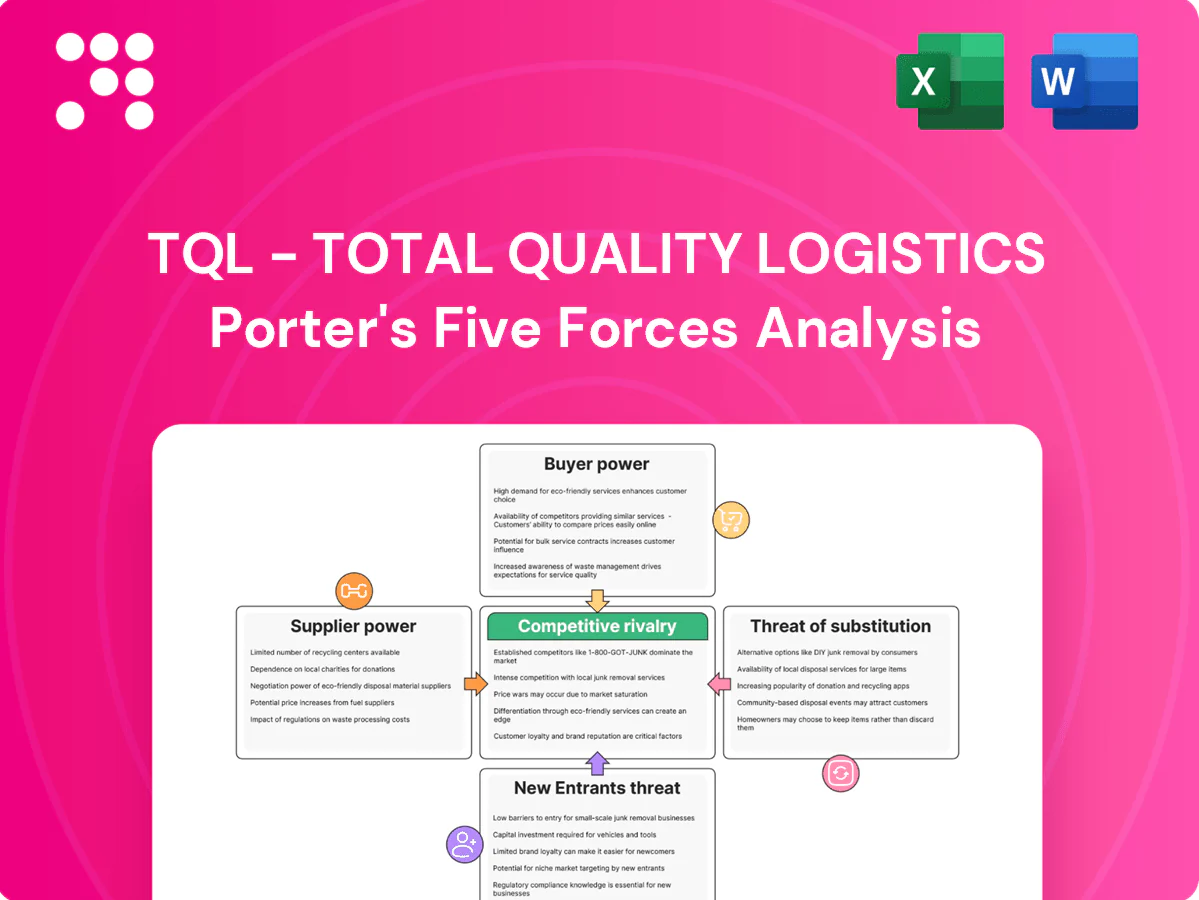
TQL - Total Quality Logistics Porter's Five Forces Analysis

Don't Miss the Bigger Picture
In the dynamic logistics landscape, TQL - Total Quality Logistics faces significant competitive pressures. Understanding the intensity of rivalry among existing players and the bargaining power of both suppliers and customers is crucial for strategic planning.
The threat of substitute services and the potential for new entrants to disrupt the market also present key challenges. These forces collectively define TQL's operating environment.
The complete report reveals the real forces shaping TQL - Total Quality Logistics’s industry—from supplier influence to threat of new entrants. Gain actionable insights to drive smarter decision-making.
Suppliers Bargaining Power

Supplier Dependence on Brokerage
The reliance of carriers, especially smaller trucking operations, on freight brokers like Total Quality Logistics (TQL) to secure loads and minimize costly empty miles is a significant factor. TQL's vast network, boasting over 140,000 carriers, offers these smaller entities a reliable stream of business, making TQL a crucial partner for their operational stability.
This consistent demand for freight services from a major broker like TQL can indeed dilute the individual bargaining power of a single carrier. When a broker can easily substitute one carrier for another due to the sheer volume of available options, the carrier's leverage to negotiate higher rates or more favorable terms is naturally diminished.
Driver Shortage and Capacity Constraints
The trucking industry faces a persistent driver shortage, projected to exceed 80,000 drivers by late 2025. This significant deficit directly constricts available trucking capacity.
This scarcity empowers carriers, allowing them to command higher freight rates and be more discerning about the shipments they undertake. TQL must effectively manage these capacity limitations to ensure reliable transportation for its clientele.

Fuel and Operational Costs
Fluctuating diesel fuel prices significantly impact carrier profitability, a critical factor for TQL. For instance, in early 2024, diesel prices saw considerable volatility, with average on-highway prices hovering around $4.00 per gallon, a notable increase from previous years. This rise in operational costs directly translates into carriers demanding higher freight rates from brokers like TQL.
These increased expenses squeeze carrier margins, reducing their flexibility on pricing and consequently strengthening their bargaining power. When carriers face higher fuel surcharges and maintenance costs, they are less willing to absorb rate reductions, making their negotiation position more robust.
TQL must strategically account for these variable and rising operational costs when negotiating with its carrier network. Understanding the direct correlation between fuel expenses and carrier rate demands is essential for maintaining competitive pricing while ensuring carrier satisfaction and capacity availability.

Specialized Equipment and Lanes
Carriers with specialized equipment, like refrigerated trucks for temperature-sensitive goods or heavy-haul trucks for oversized loads, often wield greater bargaining power. This is because the pool of carriers capable of handling these specific needs is significantly smaller, limiting options for logistics providers like TQL. For instance, the demand for refrigerated trucking in the US, a critical sector for food and pharmaceuticals, consistently outstrips supply, allowing these specialized carriers to dictate terms.
Similarly, carriers operating on high-demand, niche transportation lanes, where capacity is tight and demand is robust, can command higher rates. TQL's extensive network, a key strength, helps to diversify its carrier base and mitigate the impact of this. However, securing this specialized capacity can still lead to increased costs for TQL, directly impacting its cost of service and overall profitability.
- Specialized Equipment: Carriers with refrigerated or oversized equipment face less competition.
- Niche Lanes: High-demand, limited-capacity routes empower carriers.
- Impact on TQL: Increased costs for securing specialized capacity.
- Market Dynamics: Limited alternatives for specialized needs drive up rates.
Direct Shipper Relationships
The increasing trend of large shippers directly contracting with carriers for consistent freight volumes can significantly impact the bargaining power of suppliers, including logistics brokers like TQL. This direct engagement reduces carriers' reliance on intermediaries, potentially shifting leverage towards the carriers themselves.
When carriers secure these direct, long-term agreements, their need for spot market freight sourced through brokers diminishes. For instance, in 2024, many large manufacturers have been actively building their own carrier networks to ensure capacity and control, bypassing traditional broker models for a substantial portion of their freight. This directly lessens the demand for broker services.
- Direct Shipper Contracts: Large shippers are increasingly negotiating directly with carriers, securing dedicated capacity and predictable freight flows.
- Reduced Carrier Reliance on Brokers: As carriers gain more direct shipper relationships, their dependence on brokers for load fulfillment decreases.
- Increased Carrier Bargaining Power: This shift empowers carriers, allowing them to negotiate better rates and terms, potentially reducing the margins available for brokers.
- Competitive Broker Market: Brokers face heightened competition for carrier capacity as carriers prioritize their direct shipper commitments.
Carrier Power: Factors Driving Up Logistics Expenses
The bargaining power of suppliers, in this case, the carriers TQL works with, is influenced by several factors. When carriers have specialized equipment or operate on high-demand, niche routes, their leverage increases significantly. For example, the demand for refrigerated trucking in the US consistently outstrips supply, allowing these specialized carriers to dictate terms.
Furthermore, industry-wide capacity constraints, such as the projected driver shortage of over 80,000 by late 2025, empower carriers. This scarcity allows them to command higher freight rates and be more selective about the shipments they accept, directly impacting TQL's operational costs.
Rising operational costs, particularly fluctuating diesel fuel prices which averaged around $4.00 per gallon in early 2024, also strengthen carrier bargaining power. These increased expenses leave carriers less flexibility on pricing, making them less willing to absorb rate reductions.
The trend of large shippers contracting directly with carriers reduces carriers' reliance on brokers like TQL. In 2024, many manufacturers actively built their own carrier networks, bypassing intermediaries and shifting leverage towards the carriers.
| Factor | Impact on Carrier Bargaining Power | Implication for TQL |
|---|---|---|
| Specialized Equipment | Increased | Higher costs for securing capacity |
| Niche Transportation Lanes | Increased | Higher rates and limited options |
| Truck Driver Shortage (2025 projection: 80,000+) | Increased | Constricted capacity, higher freight rates |
| Rising Diesel Fuel Prices (Early 2024 average: ~$4.00/gallon) | Increased | Higher operational costs necessitate higher rates |
| Direct Shipper Contracts | Increased | Reduced reliance on brokers, stronger negotiation position |
What is included in the product
 Detailed Word Document
This Porter's Five Forces analysis provides a comprehensive examination of the competitive landscape for TQL - Total Quality Logistics, detailing the intensity of rivalry, threat of new entrants, bargaining power of buyers and suppliers, and the threat of substitutes.

 Customizable Excel Spreadsheet
Effortlessly assess TQL's competitive landscape by visualizing the impact of each force, transforming complex analysis into actionable insights.
Customers Bargaining Power

Abundance of 3PL Options
The freight brokerage and 3PL market is incredibly crowded, boasting a vast number of companies, from giants to specialized outfits. This sheer volume of options means shippers have a lot of power to shop around for the best deals.
In 2024, the U.S. freight market saw continued intense competition among 3PL providers. Shippers can easily compare pricing and service offerings across dozens of brokers, putting downward pressure on brokerage fees. This competitive landscape means companies like TQL need to stand out by offering superior service and advanced technology.
Cost-Cutting Imperatives
Shippers are laser-focused on cutting costs and making their supply chains run smoother, especially when the economy is a bit shaky. This means they're pushing hard for better prices and extra services from their logistics partners, which gives them more leverage. For instance, in 2023, many businesses reported that transportation costs were a significant portion of their overall operating expenses, making negotiation a key strategy.
This constant drive for savings means brokers like TQL must continuously offer competitive rates and find ways to optimize routes and loads to keep clients happy. Failing to do so can lead to customers looking elsewhere, impacting TQL's ability to retain business and grow.

Digital Platforms and Price Transparency
The rise of digital freight platforms has significantly boosted price transparency for shippers. These online marketplaces allow easy comparison of bids from numerous brokers and carriers, giving customers more leverage. For instance, in 2024, the freight brokerage market saw continued growth in digital adoption, with many shippers actively using these platforms to secure competitive rates, often reducing their reliance on traditional, less transparent methods.
This increased visibility empowers shippers to make better-informed decisions, potentially bypassing traditional brokers for straightforward, transactional shipments. This trend puts pressure on brokers to offer more value beyond just price. TQL addresses this by investing heavily in its proprietary technology, offering advanced tracking and analytics, and emphasizing personalized service to build stronger, lasting relationships with its clients, differentiating itself in a more commoditized digital landscape.

Low Switching Costs for Standard Services
For many standard freight services, the cost and effort for a shipper to switch from one broker to another are quite low. This ease of switching significantly boosts customer power, allowing them to easily move their business if they find better pricing or service elsewhere. In 2024, the freight brokerage market remains highly competitive, with numerous providers offering similar transactional services, reinforcing this dynamic.
Total Quality Logistics (TQL) recognizes this and actively works to create stronger customer loyalty by offering integrated solutions that go beyond basic freight matching. These solutions often involve technology platforms, supply chain visibility, and customized support, making it more complex and costly for a shipper to leave.
- Low Switching Costs: Shippers can often change freight brokers with minimal disruption for basic, transactional loads.
- Customer Power: This ease of movement gives customers leverage to negotiate better rates and service terms.
- TQL's Strategy: TQL aims to mitigate this by providing value-added, integrated solutions that foster deeper customer relationships.
Shipper Size and Volume
Large-volume shippers wield considerable bargaining power. Their ability to commit substantial freight volumes allows them to negotiate better rates and more favorable contract terms with logistics providers like TQL. This leverage stems directly from the sheer scale of their shipping needs.
TQL, while serving a broad spectrum of clients, acknowledges the influence of its major accounts. These significant customers can impact pricing structures and the specifics of service level agreements due to the consistent business they represent.
In 2024, the freight volume handled by major logistics providers often dictates their negotiating stance. For instance, shippers tend to secure lower per-unit costs when their annual freight spend exceeds several million dollars, a common threshold for significant volume discounts.
- Shipper Size: Companies shipping over 1,000 truckloads annually often gain substantial negotiating leverage.
- Volume Discounts: Expect discounts of 5-15% on base rates for shippers consistently moving high volumes.
- TQL's Clientele: TQL's diverse client base includes many large-volume shippers, necessitating flexible pricing strategies.
- Market Influence: The concentration of freight among a few large shippers can significantly influence overall market pricing for transportation services.
Shippers' Strong Hand: Competition Fuels Freight Bargaining Power
The bargaining power of customers in the freight brokerage sector is significant, driven by a highly competitive market and the availability of numerous providers. Shippers can easily compare pricing and services, leading to downward pressure on brokerage fees and a constant demand for cost optimization.
In 2024, the U.S. freight market continued to exhibit intense competition among 3PL providers, allowing shippers to readily compare rates and service offerings. This environment grants customers considerable leverage to negotiate better terms. For example, many businesses reported transportation costs as a substantial portion of their operating expenses in 2023, intensifying their focus on cost reduction through negotiation.
The ease with which shippers can switch between brokers, especially for standard services, further amplifies their bargaining power. Digital freight platforms have enhanced price transparency, enabling shippers to easily compare bids and potentially bypass traditional brokers. TQL counters this by offering integrated solutions and advanced technology to foster customer loyalty and differentiate its services beyond mere price competition.
| Factor | Impact on Customer Bargaining Power | 2024 Market Trend Example |
|---|---|---|
| Market Competition | High competition among 3PLs empowers shippers to demand lower rates. | Continued growth in digital freight platforms facilitates easy comparison of multiple broker quotes. |
| Ease of Switching | Low switching costs for transactional shipments allow customers to move business easily. | Many providers offer similar transactional services, reinforcing the ease of switching. |
| Price Transparency | Digital platforms increase visibility into market pricing, strengthening shipper negotiation. | Shippers actively use online marketplaces to secure competitive rates, reducing reliance on less transparent methods. |
| Shipper Volume | Large-volume shippers have significant leverage due to committed freight volumes. | Shippers with annual freight spend exceeding several million dollars often secure lower per-unit costs. |
Preview the Actual Deliverable
TQL - Total Quality Logistics Porter's Five Forces Analysis
This preview shows the exact document you'll receive immediately after purchase—no surprises, no placeholders. The comprehensive Porter's Five Forces analysis of Total Quality Logistics (TQL) meticulously details the competitive landscape, including the threat of new entrants, the bargaining power of buyers, the bargaining power of suppliers, the threat of substitute services, and the intensity of rivalry within the logistics industry, providing actionable insights for strategic decision-making.

Don't Miss the Bigger Picture
In the dynamic logistics landscape, TQL - Total Quality Logistics faces significant competitive pressures. Understanding the intensity of rivalry among existing players and the bargaining power of both suppliers and customers is crucial for strategic planning.
The threat of substitute services and the potential for new entrants to disrupt the market also present key challenges. These forces collectively define TQL's operating environment.
The complete report reveals the real forces shaping TQL - Total Quality Logistics’s industry—from supplier influence to threat of new entrants. Gain actionable insights to drive smarter decision-making.
Suppliers Bargaining Power
Supplier Dependence on Brokerage
The reliance of carriers, especially smaller trucking operations, on freight brokers like Total Quality Logistics (TQL) to secure loads and minimize costly empty miles is a significant factor. TQL's vast network, boasting over 140,000 carriers, offers these smaller entities a reliable stream of business, making TQL a crucial partner for their operational stability.
This consistent demand for freight services from a major broker like TQL can indeed dilute the individual bargaining power of a single carrier. When a broker can easily substitute one carrier for another due to the sheer volume of available options, the carrier's leverage to negotiate higher rates or more favorable terms is naturally diminished.
Driver Shortage and Capacity Constraints
The trucking industry faces a persistent driver shortage, projected to exceed 80,000 drivers by late 2025. This significant deficit directly constricts available trucking capacity.
This scarcity empowers carriers, allowing them to command higher freight rates and be more discerning about the shipments they undertake. TQL must effectively manage these capacity limitations to ensure reliable transportation for its clientele.
Fuel and Operational Costs
Fluctuating diesel fuel prices significantly impact carrier profitability, a critical factor for TQL. For instance, in early 2024, diesel prices saw considerable volatility, with average on-highway prices hovering around $4.00 per gallon, a notable increase from previous years. This rise in operational costs directly translates into carriers demanding higher freight rates from brokers like TQL.
These increased expenses squeeze carrier margins, reducing their flexibility on pricing and consequently strengthening their bargaining power. When carriers face higher fuel surcharges and maintenance costs, they are less willing to absorb rate reductions, making their negotiation position more robust.
TQL must strategically account for these variable and rising operational costs when negotiating with its carrier network. Understanding the direct correlation between fuel expenses and carrier rate demands is essential for maintaining competitive pricing while ensuring carrier satisfaction and capacity availability.
Specialized Equipment and Lanes
Carriers with specialized equipment, like refrigerated trucks for temperature-sensitive goods or heavy-haul trucks for oversized loads, often wield greater bargaining power. This is because the pool of carriers capable of handling these specific needs is significantly smaller, limiting options for logistics providers like TQL. For instance, the demand for refrigerated trucking in the US, a critical sector for food and pharmaceuticals, consistently outstrips supply, allowing these specialized carriers to dictate terms.
Similarly, carriers operating on high-demand, niche transportation lanes, where capacity is tight and demand is robust, can command higher rates. TQL's extensive network, a key strength, helps to diversify its carrier base and mitigate the impact of this. However, securing this specialized capacity can still lead to increased costs for TQL, directly impacting its cost of service and overall profitability.
- Specialized Equipment: Carriers with refrigerated or oversized equipment face less competition.
- Niche Lanes: High-demand, limited-capacity routes empower carriers.
- Impact on TQL: Increased costs for securing specialized capacity.
- Market Dynamics: Limited alternatives for specialized needs drive up rates.
Direct Shipper Relationships
The increasing trend of large shippers directly contracting with carriers for consistent freight volumes can significantly impact the bargaining power of suppliers, including logistics brokers like TQL. This direct engagement reduces carriers' reliance on intermediaries, potentially shifting leverage towards the carriers themselves.
When carriers secure these direct, long-term agreements, their need for spot market freight sourced through brokers diminishes. For instance, in 2024, many large manufacturers have been actively building their own carrier networks to ensure capacity and control, bypassing traditional broker models for a substantial portion of their freight. This directly lessens the demand for broker services.
- Direct Shipper Contracts: Large shippers are increasingly negotiating directly with carriers, securing dedicated capacity and predictable freight flows.
- Reduced Carrier Reliance on Brokers: As carriers gain more direct shipper relationships, their dependence on brokers for load fulfillment decreases.
- Increased Carrier Bargaining Power: This shift empowers carriers, allowing them to negotiate better rates and terms, potentially reducing the margins available for brokers.
- Competitive Broker Market: Brokers face heightened competition for carrier capacity as carriers prioritize their direct shipper commitments.
Carrier Power: Factors Driving Up Logistics Expenses
The bargaining power of suppliers, in this case, the carriers TQL works with, is influenced by several factors. When carriers have specialized equipment or operate on high-demand, niche routes, their leverage increases significantly. For example, the demand for refrigerated trucking in the US consistently outstrips supply, allowing these specialized carriers to dictate terms.
Furthermore, industry-wide capacity constraints, such as the projected driver shortage of over 80,000 by late 2025, empower carriers. This scarcity allows them to command higher freight rates and be more selective about the shipments they accept, directly impacting TQL's operational costs.
Rising operational costs, particularly fluctuating diesel fuel prices which averaged around $4.00 per gallon in early 2024, also strengthen carrier bargaining power. These increased expenses leave carriers less flexibility on pricing, making them less willing to absorb rate reductions.
The trend of large shippers contracting directly with carriers reduces carriers' reliance on brokers like TQL. In 2024, many manufacturers actively built their own carrier networks, bypassing intermediaries and shifting leverage towards the carriers.
| Factor | Impact on Carrier Bargaining Power | Implication for TQL |
|---|---|---|
| Specialized Equipment | Increased | Higher costs for securing capacity |
| Niche Transportation Lanes | Increased | Higher rates and limited options |
| Truck Driver Shortage (2025 projection: 80,000+) | Increased | Constricted capacity, higher freight rates |
| Rising Diesel Fuel Prices (Early 2024 average: ~$4.00/gallon) | Increased | Higher operational costs necessitate higher rates |
| Direct Shipper Contracts | Increased | Reduced reliance on brokers, stronger negotiation position |
What is included in the product
Detailed Word Document
This Porter's Five Forces analysis provides a comprehensive examination of the competitive landscape for TQL - Total Quality Logistics, detailing the intensity of rivalry, threat of new entrants, bargaining power of buyers and suppliers, and the threat of substitutes.
Customizable Excel Spreadsheet
Effortlessly assess TQL's competitive landscape by visualizing the impact of each force, transforming complex analysis into actionable insights.
Customers Bargaining Power
Abundance of 3PL Options
The freight brokerage and 3PL market is incredibly crowded, boasting a vast number of companies, from giants to specialized outfits. This sheer volume of options means shippers have a lot of power to shop around for the best deals.
In 2024, the U.S. freight market saw continued intense competition among 3PL providers. Shippers can easily compare pricing and service offerings across dozens of brokers, putting downward pressure on brokerage fees. This competitive landscape means companies like TQL need to stand out by offering superior service and advanced technology.
Cost-Cutting Imperatives
Shippers are laser-focused on cutting costs and making their supply chains run smoother, especially when the economy is a bit shaky. This means they're pushing hard for better prices and extra services from their logistics partners, which gives them more leverage. For instance, in 2023, many businesses reported that transportation costs were a significant portion of their overall operating expenses, making negotiation a key strategy.
This constant drive for savings means brokers like TQL must continuously offer competitive rates and find ways to optimize routes and loads to keep clients happy. Failing to do so can lead to customers looking elsewhere, impacting TQL's ability to retain business and grow.
Digital Platforms and Price Transparency
The rise of digital freight platforms has significantly boosted price transparency for shippers. These online marketplaces allow easy comparison of bids from numerous brokers and carriers, giving customers more leverage. For instance, in 2024, the freight brokerage market saw continued growth in digital adoption, with many shippers actively using these platforms to secure competitive rates, often reducing their reliance on traditional, less transparent methods.
This increased visibility empowers shippers to make better-informed decisions, potentially bypassing traditional brokers for straightforward, transactional shipments. This trend puts pressure on brokers to offer more value beyond just price. TQL addresses this by investing heavily in its proprietary technology, offering advanced tracking and analytics, and emphasizing personalized service to build stronger, lasting relationships with its clients, differentiating itself in a more commoditized digital landscape.
Low Switching Costs for Standard Services
For many standard freight services, the cost and effort for a shipper to switch from one broker to another are quite low. This ease of switching significantly boosts customer power, allowing them to easily move their business if they find better pricing or service elsewhere. In 2024, the freight brokerage market remains highly competitive, with numerous providers offering similar transactional services, reinforcing this dynamic.
Total Quality Logistics (TQL) recognizes this and actively works to create stronger customer loyalty by offering integrated solutions that go beyond basic freight matching. These solutions often involve technology platforms, supply chain visibility, and customized support, making it more complex and costly for a shipper to leave.
- Low Switching Costs: Shippers can often change freight brokers with minimal disruption for basic, transactional loads.
- Customer Power: This ease of movement gives customers leverage to negotiate better rates and service terms.
- TQL's Strategy: TQL aims to mitigate this by providing value-added, integrated solutions that foster deeper customer relationships.
Shipper Size and Volume
Large-volume shippers wield considerable bargaining power. Their ability to commit substantial freight volumes allows them to negotiate better rates and more favorable contract terms with logistics providers like TQL. This leverage stems directly from the sheer scale of their shipping needs.
TQL, while serving a broad spectrum of clients, acknowledges the influence of its major accounts. These significant customers can impact pricing structures and the specifics of service level agreements due to the consistent business they represent.
In 2024, the freight volume handled by major logistics providers often dictates their negotiating stance. For instance, shippers tend to secure lower per-unit costs when their annual freight spend exceeds several million dollars, a common threshold for significant volume discounts.
- Shipper Size: Companies shipping over 1,000 truckloads annually often gain substantial negotiating leverage.
- Volume Discounts: Expect discounts of 5-15% on base rates for shippers consistently moving high volumes.
- TQL's Clientele: TQL's diverse client base includes many large-volume shippers, necessitating flexible pricing strategies.
- Market Influence: The concentration of freight among a few large shippers can significantly influence overall market pricing for transportation services.
Shippers' Strong Hand: Competition Fuels Freight Bargaining Power
The bargaining power of customers in the freight brokerage sector is significant, driven by a highly competitive market and the availability of numerous providers. Shippers can easily compare pricing and services, leading to downward pressure on brokerage fees and a constant demand for cost optimization.
In 2024, the U.S. freight market continued to exhibit intense competition among 3PL providers, allowing shippers to readily compare rates and service offerings. This environment grants customers considerable leverage to negotiate better terms. For example, many businesses reported transportation costs as a substantial portion of their operating expenses in 2023, intensifying their focus on cost reduction through negotiation.
The ease with which shippers can switch between brokers, especially for standard services, further amplifies their bargaining power. Digital freight platforms have enhanced price transparency, enabling shippers to easily compare bids and potentially bypass traditional brokers. TQL counters this by offering integrated solutions and advanced technology to foster customer loyalty and differentiate its services beyond mere price competition.
| Factor | Impact on Customer Bargaining Power | 2024 Market Trend Example |
|---|---|---|
| Market Competition | High competition among 3PLs empowers shippers to demand lower rates. | Continued growth in digital freight platforms facilitates easy comparison of multiple broker quotes. |
| Ease of Switching | Low switching costs for transactional shipments allow customers to move business easily. | Many providers offer similar transactional services, reinforcing the ease of switching. |
| Price Transparency | Digital platforms increase visibility into market pricing, strengthening shipper negotiation. | Shippers actively use online marketplaces to secure competitive rates, reducing reliance on less transparent methods. |
| Shipper Volume | Large-volume shippers have significant leverage due to committed freight volumes. | Shippers with annual freight spend exceeding several million dollars often secure lower per-unit costs. |
Preview the Actual Deliverable
TQL - Total Quality Logistics Porter's Five Forces Analysis
This preview shows the exact document you'll receive immediately after purchase—no surprises, no placeholders. The comprehensive Porter's Five Forces analysis of Total Quality Logistics (TQL) meticulously details the competitive landscape, including the threat of new entrants, the bargaining power of buyers, the bargaining power of suppliers, the threat of substitute services, and the intensity of rivalry within the logistics industry, providing actionable insights for strategic decision-making.
Original: $10.00
-65%$10.00
$3.50Description
Don't Miss the Bigger Picture
In the dynamic logistics landscape, TQL - Total Quality Logistics faces significant competitive pressures. Understanding the intensity of rivalry among existing players and the bargaining power of both suppliers and customers is crucial for strategic planning.
The threat of substitute services and the potential for new entrants to disrupt the market also present key challenges. These forces collectively define TQL's operating environment.
The complete report reveals the real forces shaping TQL - Total Quality Logistics’s industry—from supplier influence to threat of new entrants. Gain actionable insights to drive smarter decision-making.
Suppliers Bargaining Power
Supplier Dependence on Brokerage
The reliance of carriers, especially smaller trucking operations, on freight brokers like Total Quality Logistics (TQL) to secure loads and minimize costly empty miles is a significant factor. TQL's vast network, boasting over 140,000 carriers, offers these smaller entities a reliable stream of business, making TQL a crucial partner for their operational stability.
This consistent demand for freight services from a major broker like TQL can indeed dilute the individual bargaining power of a single carrier. When a broker can easily substitute one carrier for another due to the sheer volume of available options, the carrier's leverage to negotiate higher rates or more favorable terms is naturally diminished.
Driver Shortage and Capacity Constraints
The trucking industry faces a persistent driver shortage, projected to exceed 80,000 drivers by late 2025. This significant deficit directly constricts available trucking capacity.
This scarcity empowers carriers, allowing them to command higher freight rates and be more discerning about the shipments they undertake. TQL must effectively manage these capacity limitations to ensure reliable transportation for its clientele.
Fuel and Operational Costs
Fluctuating diesel fuel prices significantly impact carrier profitability, a critical factor for TQL. For instance, in early 2024, diesel prices saw considerable volatility, with average on-highway prices hovering around $4.00 per gallon, a notable increase from previous years. This rise in operational costs directly translates into carriers demanding higher freight rates from brokers like TQL.
These increased expenses squeeze carrier margins, reducing their flexibility on pricing and consequently strengthening their bargaining power. When carriers face higher fuel surcharges and maintenance costs, they are less willing to absorb rate reductions, making their negotiation position more robust.
TQL must strategically account for these variable and rising operational costs when negotiating with its carrier network. Understanding the direct correlation between fuel expenses and carrier rate demands is essential for maintaining competitive pricing while ensuring carrier satisfaction and capacity availability.
Specialized Equipment and Lanes
Carriers with specialized equipment, like refrigerated trucks for temperature-sensitive goods or heavy-haul trucks for oversized loads, often wield greater bargaining power. This is because the pool of carriers capable of handling these specific needs is significantly smaller, limiting options for logistics providers like TQL. For instance, the demand for refrigerated trucking in the US, a critical sector for food and pharmaceuticals, consistently outstrips supply, allowing these specialized carriers to dictate terms.
Similarly, carriers operating on high-demand, niche transportation lanes, where capacity is tight and demand is robust, can command higher rates. TQL's extensive network, a key strength, helps to diversify its carrier base and mitigate the impact of this. However, securing this specialized capacity can still lead to increased costs for TQL, directly impacting its cost of service and overall profitability.
- Specialized Equipment: Carriers with refrigerated or oversized equipment face less competition.
- Niche Lanes: High-demand, limited-capacity routes empower carriers.
- Impact on TQL: Increased costs for securing specialized capacity.
- Market Dynamics: Limited alternatives for specialized needs drive up rates.
Direct Shipper Relationships
The increasing trend of large shippers directly contracting with carriers for consistent freight volumes can significantly impact the bargaining power of suppliers, including logistics brokers like TQL. This direct engagement reduces carriers' reliance on intermediaries, potentially shifting leverage towards the carriers themselves.
When carriers secure these direct, long-term agreements, their need for spot market freight sourced through brokers diminishes. For instance, in 2024, many large manufacturers have been actively building their own carrier networks to ensure capacity and control, bypassing traditional broker models for a substantial portion of their freight. This directly lessens the demand for broker services.
- Direct Shipper Contracts: Large shippers are increasingly negotiating directly with carriers, securing dedicated capacity and predictable freight flows.
- Reduced Carrier Reliance on Brokers: As carriers gain more direct shipper relationships, their dependence on brokers for load fulfillment decreases.
- Increased Carrier Bargaining Power: This shift empowers carriers, allowing them to negotiate better rates and terms, potentially reducing the margins available for brokers.
- Competitive Broker Market: Brokers face heightened competition for carrier capacity as carriers prioritize their direct shipper commitments.
Carrier Power: Factors Driving Up Logistics Expenses
The bargaining power of suppliers, in this case, the carriers TQL works with, is influenced by several factors. When carriers have specialized equipment or operate on high-demand, niche routes, their leverage increases significantly. For example, the demand for refrigerated trucking in the US consistently outstrips supply, allowing these specialized carriers to dictate terms.
Furthermore, industry-wide capacity constraints, such as the projected driver shortage of over 80,000 by late 2025, empower carriers. This scarcity allows them to command higher freight rates and be more selective about the shipments they accept, directly impacting TQL's operational costs.
Rising operational costs, particularly fluctuating diesel fuel prices which averaged around $4.00 per gallon in early 2024, also strengthen carrier bargaining power. These increased expenses leave carriers less flexibility on pricing, making them less willing to absorb rate reductions.
The trend of large shippers contracting directly with carriers reduces carriers' reliance on brokers like TQL. In 2024, many manufacturers actively built their own carrier networks, bypassing intermediaries and shifting leverage towards the carriers.
| Factor | Impact on Carrier Bargaining Power | Implication for TQL |
|---|---|---|
| Specialized Equipment | Increased | Higher costs for securing capacity |
| Niche Transportation Lanes | Increased | Higher rates and limited options |
| Truck Driver Shortage (2025 projection: 80,000+) | Increased | Constricted capacity, higher freight rates |
| Rising Diesel Fuel Prices (Early 2024 average: ~$4.00/gallon) | Increased | Higher operational costs necessitate higher rates |
| Direct Shipper Contracts | Increased | Reduced reliance on brokers, stronger negotiation position |
What is included in the product
Detailed Word Document
This Porter's Five Forces analysis provides a comprehensive examination of the competitive landscape for TQL - Total Quality Logistics, detailing the intensity of rivalry, threat of new entrants, bargaining power of buyers and suppliers, and the threat of substitutes.
Customizable Excel Spreadsheet
Effortlessly assess TQL's competitive landscape by visualizing the impact of each force, transforming complex analysis into actionable insights.
Customers Bargaining Power
Abundance of 3PL Options
The freight brokerage and 3PL market is incredibly crowded, boasting a vast number of companies, from giants to specialized outfits. This sheer volume of options means shippers have a lot of power to shop around for the best deals.
In 2024, the U.S. freight market saw continued intense competition among 3PL providers. Shippers can easily compare pricing and service offerings across dozens of brokers, putting downward pressure on brokerage fees. This competitive landscape means companies like TQL need to stand out by offering superior service and advanced technology.
Cost-Cutting Imperatives
Shippers are laser-focused on cutting costs and making their supply chains run smoother, especially when the economy is a bit shaky. This means they're pushing hard for better prices and extra services from their logistics partners, which gives them more leverage. For instance, in 2023, many businesses reported that transportation costs were a significant portion of their overall operating expenses, making negotiation a key strategy.
This constant drive for savings means brokers like TQL must continuously offer competitive rates and find ways to optimize routes and loads to keep clients happy. Failing to do so can lead to customers looking elsewhere, impacting TQL's ability to retain business and grow.
Digital Platforms and Price Transparency
The rise of digital freight platforms has significantly boosted price transparency for shippers. These online marketplaces allow easy comparison of bids from numerous brokers and carriers, giving customers more leverage. For instance, in 2024, the freight brokerage market saw continued growth in digital adoption, with many shippers actively using these platforms to secure competitive rates, often reducing their reliance on traditional, less transparent methods.
This increased visibility empowers shippers to make better-informed decisions, potentially bypassing traditional brokers for straightforward, transactional shipments. This trend puts pressure on brokers to offer more value beyond just price. TQL addresses this by investing heavily in its proprietary technology, offering advanced tracking and analytics, and emphasizing personalized service to build stronger, lasting relationships with its clients, differentiating itself in a more commoditized digital landscape.
Low Switching Costs for Standard Services
For many standard freight services, the cost and effort for a shipper to switch from one broker to another are quite low. This ease of switching significantly boosts customer power, allowing them to easily move their business if they find better pricing or service elsewhere. In 2024, the freight brokerage market remains highly competitive, with numerous providers offering similar transactional services, reinforcing this dynamic.
Total Quality Logistics (TQL) recognizes this and actively works to create stronger customer loyalty by offering integrated solutions that go beyond basic freight matching. These solutions often involve technology platforms, supply chain visibility, and customized support, making it more complex and costly for a shipper to leave.
- Low Switching Costs: Shippers can often change freight brokers with minimal disruption for basic, transactional loads.
- Customer Power: This ease of movement gives customers leverage to negotiate better rates and service terms.
- TQL's Strategy: TQL aims to mitigate this by providing value-added, integrated solutions that foster deeper customer relationships.
Shipper Size and Volume
Large-volume shippers wield considerable bargaining power. Their ability to commit substantial freight volumes allows them to negotiate better rates and more favorable contract terms with logistics providers like TQL. This leverage stems directly from the sheer scale of their shipping needs.
TQL, while serving a broad spectrum of clients, acknowledges the influence of its major accounts. These significant customers can impact pricing structures and the specifics of service level agreements due to the consistent business they represent.
In 2024, the freight volume handled by major logistics providers often dictates their negotiating stance. For instance, shippers tend to secure lower per-unit costs when their annual freight spend exceeds several million dollars, a common threshold for significant volume discounts.
- Shipper Size: Companies shipping over 1,000 truckloads annually often gain substantial negotiating leverage.
- Volume Discounts: Expect discounts of 5-15% on base rates for shippers consistently moving high volumes.
- TQL's Clientele: TQL's diverse client base includes many large-volume shippers, necessitating flexible pricing strategies.
- Market Influence: The concentration of freight among a few large shippers can significantly influence overall market pricing for transportation services.
Shippers' Strong Hand: Competition Fuels Freight Bargaining Power
The bargaining power of customers in the freight brokerage sector is significant, driven by a highly competitive market and the availability of numerous providers. Shippers can easily compare pricing and services, leading to downward pressure on brokerage fees and a constant demand for cost optimization.
In 2024, the U.S. freight market continued to exhibit intense competition among 3PL providers, allowing shippers to readily compare rates and service offerings. This environment grants customers considerable leverage to negotiate better terms. For example, many businesses reported transportation costs as a substantial portion of their operating expenses in 2023, intensifying their focus on cost reduction through negotiation.
The ease with which shippers can switch between brokers, especially for standard services, further amplifies their bargaining power. Digital freight platforms have enhanced price transparency, enabling shippers to easily compare bids and potentially bypass traditional brokers. TQL counters this by offering integrated solutions and advanced technology to foster customer loyalty and differentiate its services beyond mere price competition.
| Factor | Impact on Customer Bargaining Power | 2024 Market Trend Example |
|---|---|---|
| Market Competition | High competition among 3PLs empowers shippers to demand lower rates. | Continued growth in digital freight platforms facilitates easy comparison of multiple broker quotes. |
| Ease of Switching | Low switching costs for transactional shipments allow customers to move business easily. | Many providers offer similar transactional services, reinforcing the ease of switching. |
| Price Transparency | Digital platforms increase visibility into market pricing, strengthening shipper negotiation. | Shippers actively use online marketplaces to secure competitive rates, reducing reliance on less transparent methods. |
| Shipper Volume | Large-volume shippers have significant leverage due to committed freight volumes. | Shippers with annual freight spend exceeding several million dollars often secure lower per-unit costs. |
Preview the Actual Deliverable
TQL - Total Quality Logistics Porter's Five Forces Analysis
This preview shows the exact document you'll receive immediately after purchase—no surprises, no placeholders. The comprehensive Porter's Five Forces analysis of Total Quality Logistics (TQL) meticulously details the competitive landscape, including the threat of new entrants, the bargaining power of buyers, the bargaining power of suppliers, the threat of substitute services, and the intensity of rivalry within the logistics industry, providing actionable insights for strategic decision-making.











