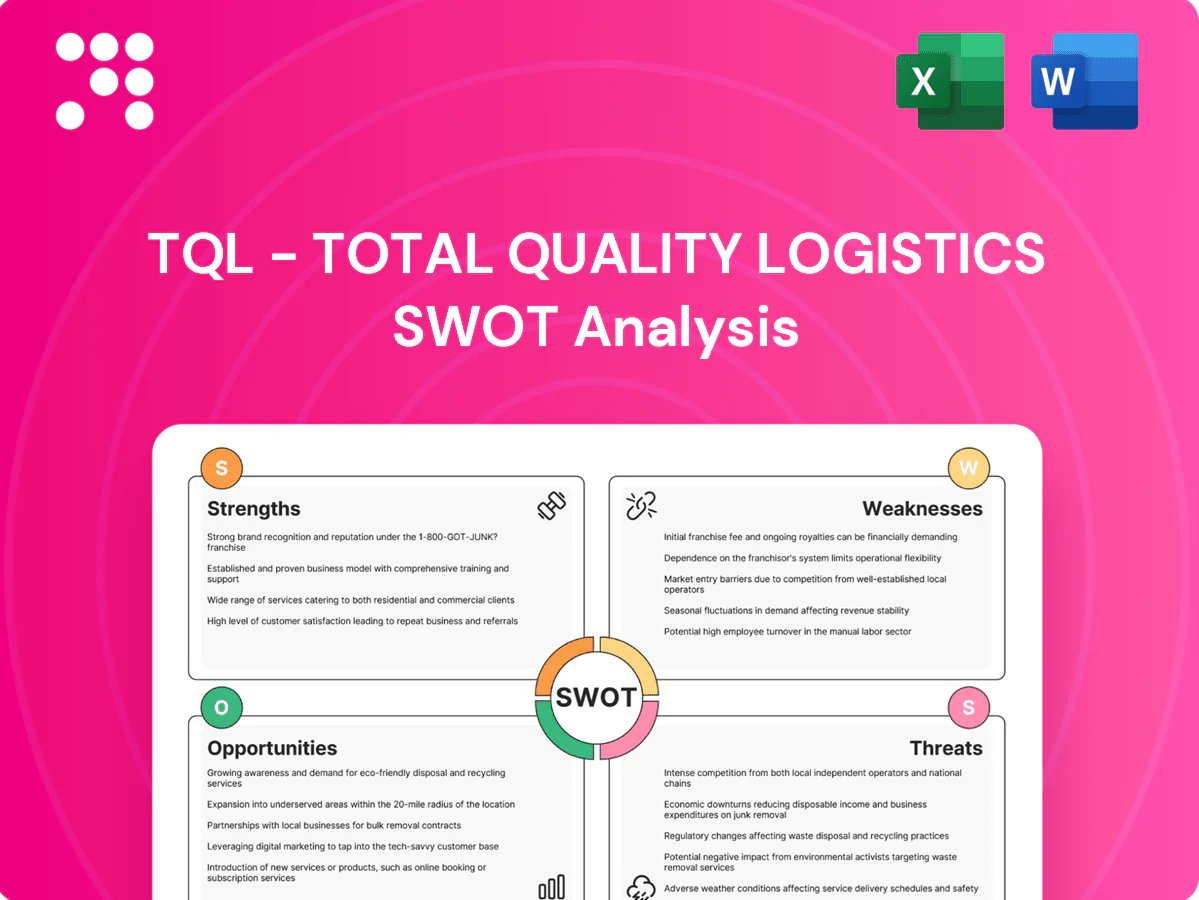
TQL - Total Quality Logistics SWOT Analysis

Dive Deeper Into the Company’s Strategic Blueprint
Total Quality Logistics (TQL) boasts significant strengths in its expansive network and customer-centric approach, but faces challenges in market saturation and evolving technological demands. Understanding these dynamics is crucial for anyone looking to navigate the freight brokerage landscape.
Want the full story behind TQL's competitive advantages, potential vulnerabilities, and future growth drivers? Purchase the complete SWOT analysis to gain access to a professionally written, fully editable report designed to support your strategic planning and investment decisions.
Strengths

Market Leadership and Scale
TQL stands as one of North America's largest freight brokerage firms, frequently recognized as the second-largest. This substantial market presence grants TQL significant influence within the logistics industry.
Its impressive scale allows TQL to maintain a competitive edge and deploy extensive operational capabilities. This market leadership translates into strong negotiating power and the ability to handle large volumes of freight efficiently.
The company's vast network, built over years of operation, and its established reputation foster sustained growth and deep customer trust, solidifying its position in the market.
Advanced Proprietary Technology
Total Quality Logistics (TQL) has heavily invested in its advanced, proprietary technology, notably its TQL TRAX platform. This system is designed to significantly boost operational efficiency and simplify workflows, ultimately enhancing the experience for both customers and carriers.
The technological backbone of TQL, including real-time tracking capabilities and robust data integration, is a key differentiator in the highly competitive logistics sector. Furthermore, TQL's commitment to advanced analytics supports informed decision-making and drives continuous growth, as evidenced by their consistent revenue increases.

Diverse Service Portfolio
TQL's strength lies in its extensive service portfolio, extending far beyond its foundational Full Truckload (FTL) offerings. This includes Less Than Truckload (LTL), intermodal, drayage, air, and ocean freight services, demonstrating a robust capability to handle diverse shipping requirements.
This broad spectrum of services allows TQL to serve a wide range of industries and niche markets. For instance, in 2023, TQL reported moving over 10 million loads, a testament to the breadth of their operational capacity and client base across these varied service types.

24/7/365 Customer and Carrier Support
TQL's 24/7/365 customer and carrier support is a significant strength, offering round-the-clock assistance that sets it apart in the logistics industry. This constant availability ensures that critical transportation needs are addressed without delay, from the initial pickup to the final delivery. This unwavering commitment to service excellence directly translates into enhanced customer satisfaction and fosters loyalty, leading to repeat business and a stable revenue stream.
The ability to provide continuous support is particularly valuable in the fast-paced and often unpredictable world of freight. TQL's infrastructure and staffing model are built to handle inquiries and resolve issues at any hour, which is crucial for businesses that operate across different time zones or have time-sensitive shipments. For instance, in 2024, TQL reported handling over 10 million shipments, underscoring the scale at which their continuous support is a critical operational advantage.
- Uninterrupted Service: Ensures that client and carrier needs are met regardless of the time or day, minimizing disruptions.
- Relationship Building: Constant availability fosters trust and strengthens partnerships, leading to higher retention rates.
- Operational Efficiency: Prompt issue resolution and support contribute to smoother logistics operations for all parties involved.
- Competitive Edge: Differentiates TQL by offering a level of reliability that many competitors struggle to match.
Commitment to Environmental Sustainability
TQL's dedication to environmental sustainability is a significant strength, particularly with its Empty Miles Reduction Program. In 2023, TQL reported a 12% reduction in empty miles, surpassing their 10% goal. This focus on efficiency not only cuts down on emissions but also resonates with a growing market preference for eco-conscious logistics partners.
The company actively champions intermodal transportation, a method inherently less carbon-intensive than full truckloads. By facilitating these greener options, TQL positions itself as a forward-thinking provider. Their continued recognition as a SmartWay Partner underscores this commitment, highlighting their proactive approach to reducing their environmental footprint in the logistics sector.
- Reduced Empty Miles: TQL's Empty Miles Reduction Program achieved a 12% reduction in empty miles in 2023, exceeding their 10% target.
- Intermodal Promotion: Actively promotes intermodal services, offering a less carbon-intensive shipping alternative.
- SmartWay Partner: Recognized as a SmartWay Partner, validating their commitment to environmental responsibility.
- Corporate Responsibility: Enhances TQL's corporate image and aligns with increasing industry demand for sustainable practices.
Logistics Dominance: Tech-Driven Scale, Global Reach, Sustainable Solutions
TQL's position as one of North America's largest freight brokers, often ranked second, signifies its substantial market influence and operational scale. This leadership allows for significant negotiating power and efficient handling of vast freight volumes.
The company's proprietary technology, TQL TRAX, is a key differentiator, enhancing operational efficiency and user experience through real-time tracking and data integration. This technological investment supports informed decision-making and drives consistent revenue growth.
TQL offers a comprehensive suite of services beyond Full Truckload (FTL), including LTL, intermodal, drayage, air, and ocean freight, catering to diverse industry needs. In 2023, TQL moved over 10 million loads, demonstrating its broad operational capacity.
A significant strength is TQL's 24/7/365 customer and carrier support, ensuring constant availability for critical logistics needs. This commitment fosters customer loyalty and operational smoothness, as evidenced by handling over 10 million shipments in 2024.
TQL's commitment to sustainability, highlighted by its Empty Miles Reduction Program achieving a 12% reduction in 2023 (exceeding its 10% goal), and its promotion of intermodal transport, positions it as an environmentally conscious logistics provider and a recognized SmartWay Partner.
What is included in the product
 Detailed Word Document
Delivers a strategic overview of TQL - Total Quality Logistics’s internal and external business factors, highlighting its strengths in customer service and market presence alongside potential weaknesses in technology adoption and opportunities for expansion.

 Customizable Excel Spreadsheet
Offers a clear, actionable SWOT framework to identify and address TQL's operational challenges and market vulnerabilities.
Weaknesses

Reliance on External Carrier Network
Total Quality Logistics (TQL), as a non-asset-based third-party logistics provider, leans heavily on its extensive network of independent truckload carriers. This fundamental reliance means TQL's ability to operate efficiently and manage costs is directly tied to external forces like carrier availability and fluctuating fuel prices. For instance, in early 2024, the trucking industry faced capacity constraints and rising operational costs, directly impacting the rates TQL could offer its clients and its own margins.
Intense Industry Competition
The freight brokerage and broader 3PL market is incredibly crowded, with many established companies and new tech-focused platforms constantly appearing. This intense competition, as seen in the 3PL sector which is projected to grow to over $1.3 trillion globally by 2027, can force companies like TQL to lower prices. This pressure can squeeze profit margins and make it harder to hold onto market share.

Vulnerability to Economic Downturns
Total Quality Logistics, like many in the freight brokerage sector, faces significant headwinds during economic slowdowns. As consumer spending and industrial output contract, the demand for shipping services naturally declines. For instance, a projected slowdown in US GDP growth for 2024 could translate into reduced freight volumes, directly impacting TQL's top line.
Inflationary pressures and rising interest rates also pose a threat. Higher operating costs for carriers can be passed on, increasing shipping expenses for TQL's clients, potentially dampening demand. Furthermore, increased borrowing costs could impact TQL's own investment and expansion plans, creating a challenging financial environment.

Potential for Employee Turnover Challenges
Despite TQL's recognition as a great place to work, the freight brokerage sector generally experiences significant employee churn, especially within sales departments. This high turnover rate, a common industry issue, can strain TQL's ability to maintain a stable and seasoned team.
The constant need to recruit and train new employees can affect service consistency and client rapport. For instance, in 2023, the freight brokerage industry saw an average sales turnover rate of around 30%, a figure TQL likely navigates. This cycle demands continuous investment in talent acquisition and development to mitigate potential disruptions.
- High Industry Turnover: Freight brokerage sales roles often face turnover rates exceeding 30% annually.
- Impact on Service: Frequent staff changes can lead to inconsistencies in service delivery and client relationship management.
- Recruitment & Training Costs: Sustaining a workforce requires ongoing expenditure on hiring and onboarding processes.
Lack of Asset Ownership Limitations
TQL's reliance on third-party carriers, rather than owning its own fleet, presents a distinct weakness. This lack of direct ownership over the physical assets used for transportation means TQL has less granular control over the day-to-day execution of shipments. For instance, while TQL reported facilitating over 3 million loads in 2023, the actual trucks and drivers are managed by external companies, impacting TQL's ability to directly dictate operational efficiencies or guarantee absolute service consistency.
This model can create challenges in responding swiftly to sudden capacity crunches or ensuring specific, high-touch service levels that an asset-based carrier might more readily provide. While TQL's brokerage model offers flexibility, it inherently means less direct influence over the critical last mile of delivery and the operational nuances that come with managing a proprietary fleet.
Navigating Freight Brokerage Challenges and Market Volatility
TQL’s dependence on external carriers means less direct control over operational execution and service quality. While they facilitated over 3 million loads in 2023, the actual transportation is managed by third parties, potentially limiting their ability to ensure consistent delivery standards or react to immediate capacity issues with the same agility as an asset-owning competitor.
The competitive landscape of freight brokerage is intense, with numerous players vying for market share. This crowded environment, within a sector projected to exceed $1.3 trillion globally by 2027, can lead to pricing pressures that impact profit margins and make it difficult to differentiate services effectively.
Economic downturns pose a significant risk, as reduced consumer spending and industrial activity directly decrease freight demand. A projected slowdown in US GDP growth for 2024, for example, could translate into lower shipping volumes, negatively affecting TQL's revenue streams.
Same Document Delivered
TQL - Total Quality Logistics SWOT Analysis
This is the actual SWOT analysis document you’ll receive upon purchase—no surprises, just professional quality. You're seeing the genuine insights into TQL's Strengths, Weaknesses, Opportunities, and Threats, ready for your strategic planning.
The preview below is taken directly from the full SWOT report you'll get. Purchase unlocks the entire in-depth version, giving you a comprehensive understanding of TQL's competitive landscape.

Dive Deeper Into the Company’s Strategic Blueprint
Total Quality Logistics (TQL) boasts significant strengths in its expansive network and customer-centric approach, but faces challenges in market saturation and evolving technological demands. Understanding these dynamics is crucial for anyone looking to navigate the freight brokerage landscape.
Want the full story behind TQL's competitive advantages, potential vulnerabilities, and future growth drivers? Purchase the complete SWOT analysis to gain access to a professionally written, fully editable report designed to support your strategic planning and investment decisions.
Strengths
Market Leadership and Scale
TQL stands as one of North America's largest freight brokerage firms, frequently recognized as the second-largest. This substantial market presence grants TQL significant influence within the logistics industry.
Its impressive scale allows TQL to maintain a competitive edge and deploy extensive operational capabilities. This market leadership translates into strong negotiating power and the ability to handle large volumes of freight efficiently.
The company's vast network, built over years of operation, and its established reputation foster sustained growth and deep customer trust, solidifying its position in the market.
Advanced Proprietary Technology
Total Quality Logistics (TQL) has heavily invested in its advanced, proprietary technology, notably its TQL TRAX platform. This system is designed to significantly boost operational efficiency and simplify workflows, ultimately enhancing the experience for both customers and carriers.
The technological backbone of TQL, including real-time tracking capabilities and robust data integration, is a key differentiator in the highly competitive logistics sector. Furthermore, TQL's commitment to advanced analytics supports informed decision-making and drives continuous growth, as evidenced by their consistent revenue increases.
Diverse Service Portfolio
TQL's strength lies in its extensive service portfolio, extending far beyond its foundational Full Truckload (FTL) offerings. This includes Less Than Truckload (LTL), intermodal, drayage, air, and ocean freight services, demonstrating a robust capability to handle diverse shipping requirements.
This broad spectrum of services allows TQL to serve a wide range of industries and niche markets. For instance, in 2023, TQL reported moving over 10 million loads, a testament to the breadth of their operational capacity and client base across these varied service types.
24/7/365 Customer and Carrier Support
TQL's 24/7/365 customer and carrier support is a significant strength, offering round-the-clock assistance that sets it apart in the logistics industry. This constant availability ensures that critical transportation needs are addressed without delay, from the initial pickup to the final delivery. This unwavering commitment to service excellence directly translates into enhanced customer satisfaction and fosters loyalty, leading to repeat business and a stable revenue stream.
The ability to provide continuous support is particularly valuable in the fast-paced and often unpredictable world of freight. TQL's infrastructure and staffing model are built to handle inquiries and resolve issues at any hour, which is crucial for businesses that operate across different time zones or have time-sensitive shipments. For instance, in 2024, TQL reported handling over 10 million shipments, underscoring the scale at which their continuous support is a critical operational advantage.
- Uninterrupted Service: Ensures that client and carrier needs are met regardless of the time or day, minimizing disruptions.
- Relationship Building: Constant availability fosters trust and strengthens partnerships, leading to higher retention rates.
- Operational Efficiency: Prompt issue resolution and support contribute to smoother logistics operations for all parties involved.
- Competitive Edge: Differentiates TQL by offering a level of reliability that many competitors struggle to match.
Commitment to Environmental Sustainability
TQL's dedication to environmental sustainability is a significant strength, particularly with its Empty Miles Reduction Program. In 2023, TQL reported a 12% reduction in empty miles, surpassing their 10% goal. This focus on efficiency not only cuts down on emissions but also resonates with a growing market preference for eco-conscious logistics partners.
The company actively champions intermodal transportation, a method inherently less carbon-intensive than full truckloads. By facilitating these greener options, TQL positions itself as a forward-thinking provider. Their continued recognition as a SmartWay Partner underscores this commitment, highlighting their proactive approach to reducing their environmental footprint in the logistics sector.
- Reduced Empty Miles: TQL's Empty Miles Reduction Program achieved a 12% reduction in empty miles in 2023, exceeding their 10% target.
- Intermodal Promotion: Actively promotes intermodal services, offering a less carbon-intensive shipping alternative.
- SmartWay Partner: Recognized as a SmartWay Partner, validating their commitment to environmental responsibility.
- Corporate Responsibility: Enhances TQL's corporate image and aligns with increasing industry demand for sustainable practices.
Logistics Dominance: Tech-Driven Scale, Global Reach, Sustainable Solutions
TQL's position as one of North America's largest freight brokers, often ranked second, signifies its substantial market influence and operational scale. This leadership allows for significant negotiating power and efficient handling of vast freight volumes.
The company's proprietary technology, TQL TRAX, is a key differentiator, enhancing operational efficiency and user experience through real-time tracking and data integration. This technological investment supports informed decision-making and drives consistent revenue growth.
TQL offers a comprehensive suite of services beyond Full Truckload (FTL), including LTL, intermodal, drayage, air, and ocean freight, catering to diverse industry needs. In 2023, TQL moved over 10 million loads, demonstrating its broad operational capacity.
A significant strength is TQL's 24/7/365 customer and carrier support, ensuring constant availability for critical logistics needs. This commitment fosters customer loyalty and operational smoothness, as evidenced by handling over 10 million shipments in 2024.
TQL's commitment to sustainability, highlighted by its Empty Miles Reduction Program achieving a 12% reduction in 2023 (exceeding its 10% goal), and its promotion of intermodal transport, positions it as an environmentally conscious logistics provider and a recognized SmartWay Partner.
What is included in the product
Detailed Word Document
Delivers a strategic overview of TQL - Total Quality Logistics’s internal and external business factors, highlighting its strengths in customer service and market presence alongside potential weaknesses in technology adoption and opportunities for expansion.
Customizable Excel Spreadsheet
Offers a clear, actionable SWOT framework to identify and address TQL's operational challenges and market vulnerabilities.
Weaknesses
Reliance on External Carrier Network
Total Quality Logistics (TQL), as a non-asset-based third-party logistics provider, leans heavily on its extensive network of independent truckload carriers. This fundamental reliance means TQL's ability to operate efficiently and manage costs is directly tied to external forces like carrier availability and fluctuating fuel prices. For instance, in early 2024, the trucking industry faced capacity constraints and rising operational costs, directly impacting the rates TQL could offer its clients and its own margins.
Intense Industry Competition
The freight brokerage and broader 3PL market is incredibly crowded, with many established companies and new tech-focused platforms constantly appearing. This intense competition, as seen in the 3PL sector which is projected to grow to over $1.3 trillion globally by 2027, can force companies like TQL to lower prices. This pressure can squeeze profit margins and make it harder to hold onto market share.
Vulnerability to Economic Downturns
Total Quality Logistics, like many in the freight brokerage sector, faces significant headwinds during economic slowdowns. As consumer spending and industrial output contract, the demand for shipping services naturally declines. For instance, a projected slowdown in US GDP growth for 2024 could translate into reduced freight volumes, directly impacting TQL's top line.
Inflationary pressures and rising interest rates also pose a threat. Higher operating costs for carriers can be passed on, increasing shipping expenses for TQL's clients, potentially dampening demand. Furthermore, increased borrowing costs could impact TQL's own investment and expansion plans, creating a challenging financial environment.
Potential for Employee Turnover Challenges
Despite TQL's recognition as a great place to work, the freight brokerage sector generally experiences significant employee churn, especially within sales departments. This high turnover rate, a common industry issue, can strain TQL's ability to maintain a stable and seasoned team.
The constant need to recruit and train new employees can affect service consistency and client rapport. For instance, in 2023, the freight brokerage industry saw an average sales turnover rate of around 30%, a figure TQL likely navigates. This cycle demands continuous investment in talent acquisition and development to mitigate potential disruptions.
- High Industry Turnover: Freight brokerage sales roles often face turnover rates exceeding 30% annually.
- Impact on Service: Frequent staff changes can lead to inconsistencies in service delivery and client relationship management.
- Recruitment & Training Costs: Sustaining a workforce requires ongoing expenditure on hiring and onboarding processes.
Lack of Asset Ownership Limitations
TQL's reliance on third-party carriers, rather than owning its own fleet, presents a distinct weakness. This lack of direct ownership over the physical assets used for transportation means TQL has less granular control over the day-to-day execution of shipments. For instance, while TQL reported facilitating over 3 million loads in 2023, the actual trucks and drivers are managed by external companies, impacting TQL's ability to directly dictate operational efficiencies or guarantee absolute service consistency.
This model can create challenges in responding swiftly to sudden capacity crunches or ensuring specific, high-touch service levels that an asset-based carrier might more readily provide. While TQL's brokerage model offers flexibility, it inherently means less direct influence over the critical last mile of delivery and the operational nuances that come with managing a proprietary fleet.
Navigating Freight Brokerage Challenges and Market Volatility
TQL’s dependence on external carriers means less direct control over operational execution and service quality. While they facilitated over 3 million loads in 2023, the actual transportation is managed by third parties, potentially limiting their ability to ensure consistent delivery standards or react to immediate capacity issues with the same agility as an asset-owning competitor.
The competitive landscape of freight brokerage is intense, with numerous players vying for market share. This crowded environment, within a sector projected to exceed $1.3 trillion globally by 2027, can lead to pricing pressures that impact profit margins and make it difficult to differentiate services effectively.
Economic downturns pose a significant risk, as reduced consumer spending and industrial activity directly decrease freight demand. A projected slowdown in US GDP growth for 2024, for example, could translate into lower shipping volumes, negatively affecting TQL's revenue streams.
Same Document Delivered
TQL - Total Quality Logistics SWOT Analysis
This is the actual SWOT analysis document you’ll receive upon purchase—no surprises, just professional quality. You're seeing the genuine insights into TQL's Strengths, Weaknesses, Opportunities, and Threats, ready for your strategic planning.
The preview below is taken directly from the full SWOT report you'll get. Purchase unlocks the entire in-depth version, giving you a comprehensive understanding of TQL's competitive landscape.
Original: $10.00
-65%$10.00
$3.50Description
Dive Deeper Into the Company’s Strategic Blueprint
Total Quality Logistics (TQL) boasts significant strengths in its expansive network and customer-centric approach, but faces challenges in market saturation and evolving technological demands. Understanding these dynamics is crucial for anyone looking to navigate the freight brokerage landscape.
Want the full story behind TQL's competitive advantages, potential vulnerabilities, and future growth drivers? Purchase the complete SWOT analysis to gain access to a professionally written, fully editable report designed to support your strategic planning and investment decisions.
Strengths
Market Leadership and Scale
TQL stands as one of North America's largest freight brokerage firms, frequently recognized as the second-largest. This substantial market presence grants TQL significant influence within the logistics industry.
Its impressive scale allows TQL to maintain a competitive edge and deploy extensive operational capabilities. This market leadership translates into strong negotiating power and the ability to handle large volumes of freight efficiently.
The company's vast network, built over years of operation, and its established reputation foster sustained growth and deep customer trust, solidifying its position in the market.
Advanced Proprietary Technology
Total Quality Logistics (TQL) has heavily invested in its advanced, proprietary technology, notably its TQL TRAX platform. This system is designed to significantly boost operational efficiency and simplify workflows, ultimately enhancing the experience for both customers and carriers.
The technological backbone of TQL, including real-time tracking capabilities and robust data integration, is a key differentiator in the highly competitive logistics sector. Furthermore, TQL's commitment to advanced analytics supports informed decision-making and drives continuous growth, as evidenced by their consistent revenue increases.
Diverse Service Portfolio
TQL's strength lies in its extensive service portfolio, extending far beyond its foundational Full Truckload (FTL) offerings. This includes Less Than Truckload (LTL), intermodal, drayage, air, and ocean freight services, demonstrating a robust capability to handle diverse shipping requirements.
This broad spectrum of services allows TQL to serve a wide range of industries and niche markets. For instance, in 2023, TQL reported moving over 10 million loads, a testament to the breadth of their operational capacity and client base across these varied service types.
24/7/365 Customer and Carrier Support
TQL's 24/7/365 customer and carrier support is a significant strength, offering round-the-clock assistance that sets it apart in the logistics industry. This constant availability ensures that critical transportation needs are addressed without delay, from the initial pickup to the final delivery. This unwavering commitment to service excellence directly translates into enhanced customer satisfaction and fosters loyalty, leading to repeat business and a stable revenue stream.
The ability to provide continuous support is particularly valuable in the fast-paced and often unpredictable world of freight. TQL's infrastructure and staffing model are built to handle inquiries and resolve issues at any hour, which is crucial for businesses that operate across different time zones or have time-sensitive shipments. For instance, in 2024, TQL reported handling over 10 million shipments, underscoring the scale at which their continuous support is a critical operational advantage.
- Uninterrupted Service: Ensures that client and carrier needs are met regardless of the time or day, minimizing disruptions.
- Relationship Building: Constant availability fosters trust and strengthens partnerships, leading to higher retention rates.
- Operational Efficiency: Prompt issue resolution and support contribute to smoother logistics operations for all parties involved.
- Competitive Edge: Differentiates TQL by offering a level of reliability that many competitors struggle to match.
Commitment to Environmental Sustainability
TQL's dedication to environmental sustainability is a significant strength, particularly with its Empty Miles Reduction Program. In 2023, TQL reported a 12% reduction in empty miles, surpassing their 10% goal. This focus on efficiency not only cuts down on emissions but also resonates with a growing market preference for eco-conscious logistics partners.
The company actively champions intermodal transportation, a method inherently less carbon-intensive than full truckloads. By facilitating these greener options, TQL positions itself as a forward-thinking provider. Their continued recognition as a SmartWay Partner underscores this commitment, highlighting their proactive approach to reducing their environmental footprint in the logistics sector.
- Reduced Empty Miles: TQL's Empty Miles Reduction Program achieved a 12% reduction in empty miles in 2023, exceeding their 10% target.
- Intermodal Promotion: Actively promotes intermodal services, offering a less carbon-intensive shipping alternative.
- SmartWay Partner: Recognized as a SmartWay Partner, validating their commitment to environmental responsibility.
- Corporate Responsibility: Enhances TQL's corporate image and aligns with increasing industry demand for sustainable practices.
Logistics Dominance: Tech-Driven Scale, Global Reach, Sustainable Solutions
TQL's position as one of North America's largest freight brokers, often ranked second, signifies its substantial market influence and operational scale. This leadership allows for significant negotiating power and efficient handling of vast freight volumes.
The company's proprietary technology, TQL TRAX, is a key differentiator, enhancing operational efficiency and user experience through real-time tracking and data integration. This technological investment supports informed decision-making and drives consistent revenue growth.
TQL offers a comprehensive suite of services beyond Full Truckload (FTL), including LTL, intermodal, drayage, air, and ocean freight, catering to diverse industry needs. In 2023, TQL moved over 10 million loads, demonstrating its broad operational capacity.
A significant strength is TQL's 24/7/365 customer and carrier support, ensuring constant availability for critical logistics needs. This commitment fosters customer loyalty and operational smoothness, as evidenced by handling over 10 million shipments in 2024.
TQL's commitment to sustainability, highlighted by its Empty Miles Reduction Program achieving a 12% reduction in 2023 (exceeding its 10% goal), and its promotion of intermodal transport, positions it as an environmentally conscious logistics provider and a recognized SmartWay Partner.
What is included in the product
Detailed Word Document
Delivers a strategic overview of TQL - Total Quality Logistics’s internal and external business factors, highlighting its strengths in customer service and market presence alongside potential weaknesses in technology adoption and opportunities for expansion.
Customizable Excel Spreadsheet
Offers a clear, actionable SWOT framework to identify and address TQL's operational challenges and market vulnerabilities.
Weaknesses
Reliance on External Carrier Network
Total Quality Logistics (TQL), as a non-asset-based third-party logistics provider, leans heavily on its extensive network of independent truckload carriers. This fundamental reliance means TQL's ability to operate efficiently and manage costs is directly tied to external forces like carrier availability and fluctuating fuel prices. For instance, in early 2024, the trucking industry faced capacity constraints and rising operational costs, directly impacting the rates TQL could offer its clients and its own margins.
Intense Industry Competition
The freight brokerage and broader 3PL market is incredibly crowded, with many established companies and new tech-focused platforms constantly appearing. This intense competition, as seen in the 3PL sector which is projected to grow to over $1.3 trillion globally by 2027, can force companies like TQL to lower prices. This pressure can squeeze profit margins and make it harder to hold onto market share.
Vulnerability to Economic Downturns
Total Quality Logistics, like many in the freight brokerage sector, faces significant headwinds during economic slowdowns. As consumer spending and industrial output contract, the demand for shipping services naturally declines. For instance, a projected slowdown in US GDP growth for 2024 could translate into reduced freight volumes, directly impacting TQL's top line.
Inflationary pressures and rising interest rates also pose a threat. Higher operating costs for carriers can be passed on, increasing shipping expenses for TQL's clients, potentially dampening demand. Furthermore, increased borrowing costs could impact TQL's own investment and expansion plans, creating a challenging financial environment.
Potential for Employee Turnover Challenges
Despite TQL's recognition as a great place to work, the freight brokerage sector generally experiences significant employee churn, especially within sales departments. This high turnover rate, a common industry issue, can strain TQL's ability to maintain a stable and seasoned team.
The constant need to recruit and train new employees can affect service consistency and client rapport. For instance, in 2023, the freight brokerage industry saw an average sales turnover rate of around 30%, a figure TQL likely navigates. This cycle demands continuous investment in talent acquisition and development to mitigate potential disruptions.
- High Industry Turnover: Freight brokerage sales roles often face turnover rates exceeding 30% annually.
- Impact on Service: Frequent staff changes can lead to inconsistencies in service delivery and client relationship management.
- Recruitment & Training Costs: Sustaining a workforce requires ongoing expenditure on hiring and onboarding processes.
Lack of Asset Ownership Limitations
TQL's reliance on third-party carriers, rather than owning its own fleet, presents a distinct weakness. This lack of direct ownership over the physical assets used for transportation means TQL has less granular control over the day-to-day execution of shipments. For instance, while TQL reported facilitating over 3 million loads in 2023, the actual trucks and drivers are managed by external companies, impacting TQL's ability to directly dictate operational efficiencies or guarantee absolute service consistency.
This model can create challenges in responding swiftly to sudden capacity crunches or ensuring specific, high-touch service levels that an asset-based carrier might more readily provide. While TQL's brokerage model offers flexibility, it inherently means less direct influence over the critical last mile of delivery and the operational nuances that come with managing a proprietary fleet.
Navigating Freight Brokerage Challenges and Market Volatility
TQL’s dependence on external carriers means less direct control over operational execution and service quality. While they facilitated over 3 million loads in 2023, the actual transportation is managed by third parties, potentially limiting their ability to ensure consistent delivery standards or react to immediate capacity issues with the same agility as an asset-owning competitor.
The competitive landscape of freight brokerage is intense, with numerous players vying for market share. This crowded environment, within a sector projected to exceed $1.3 trillion globally by 2027, can lead to pricing pressures that impact profit margins and make it difficult to differentiate services effectively.
Economic downturns pose a significant risk, as reduced consumer spending and industrial activity directly decrease freight demand. A projected slowdown in US GDP growth for 2024, for example, could translate into lower shipping volumes, negatively affecting TQL's revenue streams.
Same Document Delivered
TQL - Total Quality Logistics SWOT Analysis
This is the actual SWOT analysis document you’ll receive upon purchase—no surprises, just professional quality. You're seeing the genuine insights into TQL's Strengths, Weaknesses, Opportunities, and Threats, ready for your strategic planning.
The preview below is taken directly from the full SWOT report you'll get. Purchase unlocks the entire in-depth version, giving you a comprehensive understanding of TQL's competitive landscape.











