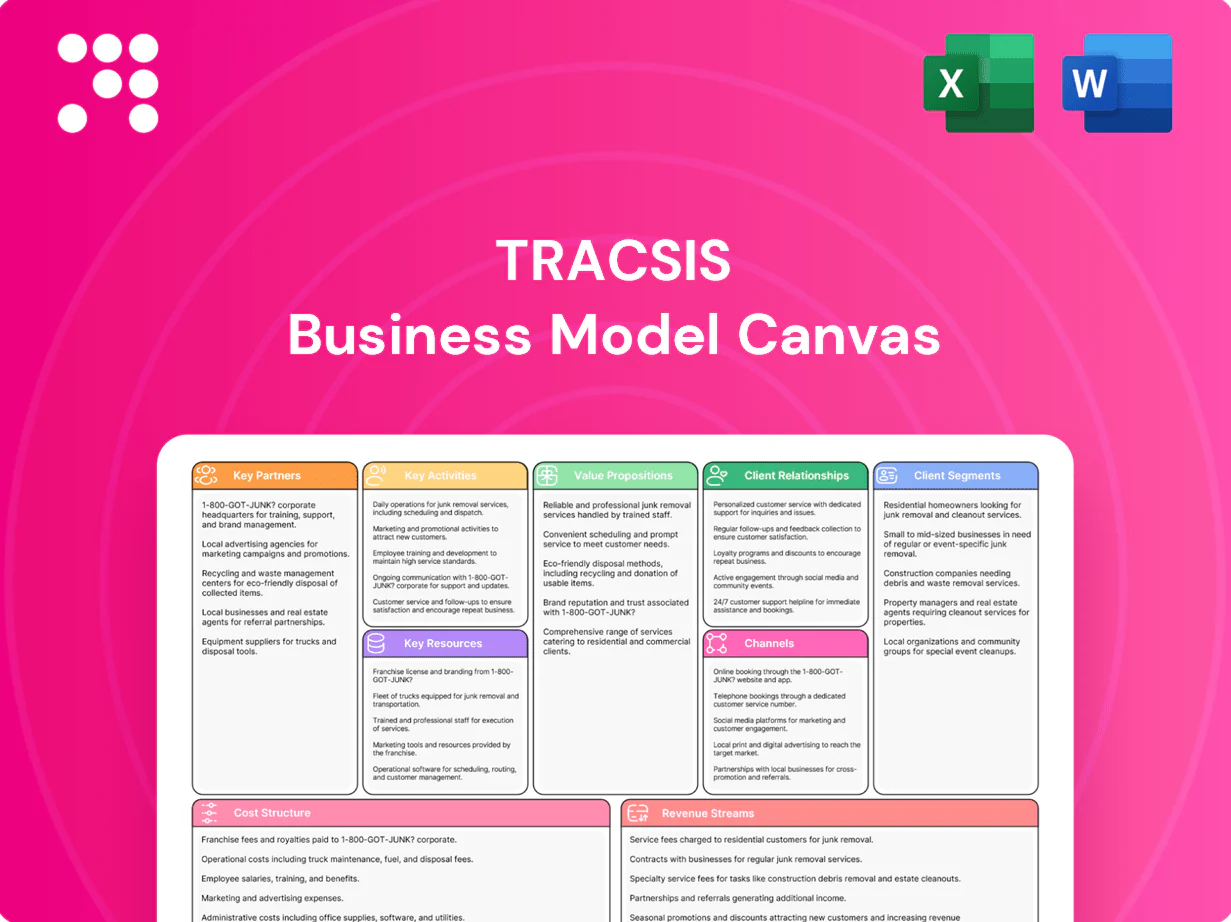
Tracsis Business Model Canvas

Unlock the full strategic blueprint of a transport-tech business model — download the canvas
Unlock the full strategic blueprint behind Tracsis's business model. This Business Model Canvas maps value propositions, key partners, revenue streams and cost structure with company-specific insight. Ideal for investors and strategists seeking actionable analysis—download the full Word/Excel canvas to benchmark and plan.
Partnerships

Rail operators and transit agencies
Collaborations with 20+ UK train operating companies and public transport authorities provide domain input and deployment opportunities, leveraging live networks that carry over a billion passenger journeys annually. Joint pilots validate performance and safety at scale across routes and rolling stock. Long-term framework agreements enable steady rollouts and upgrades; shared roadmaps align features to operational KPIs.
Infrastructure owners and regulators
Partnerships with infrastructure managers such as Network Rail and regulators like the Office of Rail and Road ensure compliance and interoperability across the UK rail network of roughly 10,000 route miles. Access to technical standards and regulator engagement accelerates certification timelines. Co-development projects enable integrated asset management and timetable alignment, while regulatory alignment reduces adoption friction and procurement delays.

Hardware OEMs and sensor vendors
Alliances with edge device, CCTV, LiDAR and IoT suppliers enable Tracsis to capture multi-modal, high-fidelity rail data at the track edge, improving detection and analytics coverage. Pre-integration of hardware and software lowers installation risk and reduces on-site commissioning time and cost. Joint testing with OEMs validates durability and reliability in harsh rail environments. Bundled, vendor-backed solutions simplify procurement and deployment for operators.

Systems integrators and implementation partners
SI partners extend Tracsis delivery across UK, EU and APAC and enable integration across legacy signalling, ERP and control-room systems. Shared playbooks reduced time-to-value by ~30% in 2024 pilots. Co-bidding lifted large-tender win rates by ~25% in 2024 rail/infrastructure deals.
- Regional capacity expansion
- Legacy–ERP–control room bridging
- Shared playbooks → ~30% faster TTV (2024)
- Co-bidding → ~25% higher win rate (2024)
Academic, data, and mapping partners
Links with universities and data providers enhance Tracsis algorithms and models, feeding peer-reviewed methods into production. Access to geospatial and mobility datasets improves operational and predictive accuracy for scheduling, demand forecasting and incident detection. Research partnerships de-risk innovation and publications strengthen credibility with technical buyers.
- Academic validation of models
- Rich geospatial and mobility inputs
- Reduced R&D risk via collaborations
- Publications bolster buyer trust
Partnerships enable pilots across >1bn journeys; time-to-value cut ~30%
Tracsis leverages 20+ TOCs and transport authorities providing access to networks with >1bn annual journeys and 10,000 route miles, enabling live pilots and deployments. Strategic SI, hardware and regulator alliances cut time-to-value ~30% and lifted large-tender win rates ~25% in 2024. University and data partnerships strengthen models and reduce R&D risk while pre-integrated vendors lower commissioning cost and time.
| Partner type | Role | 2024 metric |
|---|---|---|
| Train operators/TOCs | Deployment & pilots | 20+ partners; >1bn journeys |
| Infrastructure/regulators | Compliance | 10,000 route miles |
| SIs/vendors | Integration & delivery | TTV -30%; win rate +25% |
| Academia/data | Models & datasets | Peer-reviewed inputs |
What is included in the product
 Detailed Word Document
A comprehensive, pre-written Business Model Canvas tailored to Tracsis that maps customer segments, channels, value propositions and revenue streams alongside operations and partnerships. Organized into the 9 classic BMC blocks with SWOT-linked insights and competitive advantages—ideal for presentations, investor discussions and strategic decision-making.

 Customizable Excel Spreadsheet
Condenses Tracsis’s transport technology strategy into a digestible one-page snapshot, editable for team collaboration and fast executive summaries to save time on structuring and comparison.
Activities

Product development and roadmap management
Designing and iterating resource planning, asset management and decision‑support software is core, with product backlogs prioritising safety, reliability and UX and targeting 99.9% uptime SLAs. Modular architecture enables rapid extension to new modes and geographies, supporting API‑driven integrations. Continuous delivery with monthly release cadence keeps systems current and reduces time‑to‑value for customers.
Data engineering and analytics
Ingesting, cleaning and fusing multi-source transport data (millions of events daily in 2024) produces actionable insights for timetabling and capacity planning. Model development underpins prediction, optimization and anomaly detection, improving punctuality and resource allocation. MLOps enforces reproducibility and live monitoring, while KPI dashboards translate outputs into operational decisions for controllers and planners.

Hardware integration and field deployment
Specifying, installing and commissioning edge devices ensures accurate data capture and supports 99.9% operational SLAs. Site surveys and network design mitigate downtime by aligning coverage and capacity. Ruggedization and testing to IP67 and industrial temperature ranges (-40 to +85°C) assure field performance. Ongoing calibration and maintenance cycles preserve measurement integrity for operational decision-making.

Customer success, training, and support
Onboarding accelerates adoption and workflow change, cutting time-to-value by up to 30%; SLAs, helpdesk and proactive monitoring target 99.9% uptime; training builds in-house capability and can lift internal adoption ~25%; continuous feedback loops drive ~15% of product roadmap prioritisation.
- Onboarding: -30% time-to-value
- Uptime: 99.9% SLA
- Training: +25% adoption
- Feedback: 15% roadmap influence
Sales, tendering, and compliance
Responding to RFPs and framework agreements is critical to securing public transport contracts, with frameworks remaining the primary procurement route for rail and bus services in 2024. Tracsis embeds ROI models and value cases to secure approvals and align with procurement KPIs. Security, safety, and privacy compliance are maintained to GDPR and ISO 27001 standards in 2024, and close partner coordination strengthens bid delivery.
- RFPs/frameworks: primary 2024 route
- Compliance: GDPR, ISO 27001 (2024)
- Value cases: ROI-driven approvals
- Partners: coordinated bid execution
Modular transport platform — 99.9% uptime, 2M events/day, -30% onboarding
Designing modular transport software with 99.9% uptime, monthly releases and API integrations; processing millions of events/day (2024) for prediction and optimization; deploying IP67 edge sensors, commissioning and 24/7 support driving -30% onboarding time and +25% adoption.
| Metric | 2024 |
|---|---|
| Events/day | ≈2M |
| Uptime SLA | 99.9% |
| Onboarding time | -30% |
Full Document Unlocks After Purchase
Business Model Canvas
The Tracsis Business Model Canvas preview shown here is the exact document you'll receive after purchase, not a mockup. When you complete your order you'll get this same professionally formatted file ready for editing and presentation. No placeholders or surprises—what you see is the deliverable.

Unlock the full strategic blueprint of a transport-tech business model — download the canvas
Unlock the full strategic blueprint behind Tracsis's business model. This Business Model Canvas maps value propositions, key partners, revenue streams and cost structure with company-specific insight. Ideal for investors and strategists seeking actionable analysis—download the full Word/Excel canvas to benchmark and plan.
Partnerships
Rail operators and transit agencies
Collaborations with 20+ UK train operating companies and public transport authorities provide domain input and deployment opportunities, leveraging live networks that carry over a billion passenger journeys annually. Joint pilots validate performance and safety at scale across routes and rolling stock. Long-term framework agreements enable steady rollouts and upgrades; shared roadmaps align features to operational KPIs.
Infrastructure owners and regulators
Partnerships with infrastructure managers such as Network Rail and regulators like the Office of Rail and Road ensure compliance and interoperability across the UK rail network of roughly 10,000 route miles. Access to technical standards and regulator engagement accelerates certification timelines. Co-development projects enable integrated asset management and timetable alignment, while regulatory alignment reduces adoption friction and procurement delays.
Hardware OEMs and sensor vendors
Alliances with edge device, CCTV, LiDAR and IoT suppliers enable Tracsis to capture multi-modal, high-fidelity rail data at the track edge, improving detection and analytics coverage. Pre-integration of hardware and software lowers installation risk and reduces on-site commissioning time and cost. Joint testing with OEMs validates durability and reliability in harsh rail environments. Bundled, vendor-backed solutions simplify procurement and deployment for operators.
Systems integrators and implementation partners
SI partners extend Tracsis delivery across UK, EU and APAC and enable integration across legacy signalling, ERP and control-room systems. Shared playbooks reduced time-to-value by ~30% in 2024 pilots. Co-bidding lifted large-tender win rates by ~25% in 2024 rail/infrastructure deals.
- Regional capacity expansion
- Legacy–ERP–control room bridging
- Shared playbooks → ~30% faster TTV (2024)
- Co-bidding → ~25% higher win rate (2024)
Academic, data, and mapping partners
Links with universities and data providers enhance Tracsis algorithms and models, feeding peer-reviewed methods into production. Access to geospatial and mobility datasets improves operational and predictive accuracy for scheduling, demand forecasting and incident detection. Research partnerships de-risk innovation and publications strengthen credibility with technical buyers.
- Academic validation of models
- Rich geospatial and mobility inputs
- Reduced R&D risk via collaborations
- Publications bolster buyer trust
Partnerships enable pilots across >1bn journeys; time-to-value cut ~30%
Tracsis leverages 20+ TOCs and transport authorities providing access to networks with >1bn annual journeys and 10,000 route miles, enabling live pilots and deployments. Strategic SI, hardware and regulator alliances cut time-to-value ~30% and lifted large-tender win rates ~25% in 2024. University and data partnerships strengthen models and reduce R&D risk while pre-integrated vendors lower commissioning cost and time.
| Partner type | Role | 2024 metric |
|---|---|---|
| Train operators/TOCs | Deployment & pilots | 20+ partners; >1bn journeys |
| Infrastructure/regulators | Compliance | 10,000 route miles |
| SIs/vendors | Integration & delivery | TTV -30%; win rate +25% |
| Academia/data | Models & datasets | Peer-reviewed inputs |
What is included in the product
Detailed Word Document
A comprehensive, pre-written Business Model Canvas tailored to Tracsis that maps customer segments, channels, value propositions and revenue streams alongside operations and partnerships. Organized into the 9 classic BMC blocks with SWOT-linked insights and competitive advantages—ideal for presentations, investor discussions and strategic decision-making.
Customizable Excel Spreadsheet
Condenses Tracsis’s transport technology strategy into a digestible one-page snapshot, editable for team collaboration and fast executive summaries to save time on structuring and comparison.
Activities
Product development and roadmap management
Designing and iterating resource planning, asset management and decision‑support software is core, with product backlogs prioritising safety, reliability and UX and targeting 99.9% uptime SLAs. Modular architecture enables rapid extension to new modes and geographies, supporting API‑driven integrations. Continuous delivery with monthly release cadence keeps systems current and reduces time‑to‑value for customers.
Data engineering and analytics
Ingesting, cleaning and fusing multi-source transport data (millions of events daily in 2024) produces actionable insights for timetabling and capacity planning. Model development underpins prediction, optimization and anomaly detection, improving punctuality and resource allocation. MLOps enforces reproducibility and live monitoring, while KPI dashboards translate outputs into operational decisions for controllers and planners.
Hardware integration and field deployment
Specifying, installing and commissioning edge devices ensures accurate data capture and supports 99.9% operational SLAs. Site surveys and network design mitigate downtime by aligning coverage and capacity. Ruggedization and testing to IP67 and industrial temperature ranges (-40 to +85°C) assure field performance. Ongoing calibration and maintenance cycles preserve measurement integrity for operational decision-making.
Customer success, training, and support
Onboarding accelerates adoption and workflow change, cutting time-to-value by up to 30%; SLAs, helpdesk and proactive monitoring target 99.9% uptime; training builds in-house capability and can lift internal adoption ~25%; continuous feedback loops drive ~15% of product roadmap prioritisation.
- Onboarding: -30% time-to-value
- Uptime: 99.9% SLA
- Training: +25% adoption
- Feedback: 15% roadmap influence
Sales, tendering, and compliance
Responding to RFPs and framework agreements is critical to securing public transport contracts, with frameworks remaining the primary procurement route for rail and bus services in 2024. Tracsis embeds ROI models and value cases to secure approvals and align with procurement KPIs. Security, safety, and privacy compliance are maintained to GDPR and ISO 27001 standards in 2024, and close partner coordination strengthens bid delivery.
- RFPs/frameworks: primary 2024 route
- Compliance: GDPR, ISO 27001 (2024)
- Value cases: ROI-driven approvals
- Partners: coordinated bid execution
Modular transport platform — 99.9% uptime, 2M events/day, -30% onboarding
Designing modular transport software with 99.9% uptime, monthly releases and API integrations; processing millions of events/day (2024) for prediction and optimization; deploying IP67 edge sensors, commissioning and 24/7 support driving -30% onboarding time and +25% adoption.
| Metric | 2024 |
|---|---|
| Events/day | ≈2M |
| Uptime SLA | 99.9% |
| Onboarding time | -30% |
Full Document Unlocks After Purchase
Business Model Canvas
The Tracsis Business Model Canvas preview shown here is the exact document you'll receive after purchase, not a mockup. When you complete your order you'll get this same professionally formatted file ready for editing and presentation. No placeholders or surprises—what you see is the deliverable.
Original: $10.00
-65%$10.00
$3.50Description
Unlock the full strategic blueprint of a transport-tech business model — download the canvas
Unlock the full strategic blueprint behind Tracsis's business model. This Business Model Canvas maps value propositions, key partners, revenue streams and cost structure with company-specific insight. Ideal for investors and strategists seeking actionable analysis—download the full Word/Excel canvas to benchmark and plan.
Partnerships
Rail operators and transit agencies
Collaborations with 20+ UK train operating companies and public transport authorities provide domain input and deployment opportunities, leveraging live networks that carry over a billion passenger journeys annually. Joint pilots validate performance and safety at scale across routes and rolling stock. Long-term framework agreements enable steady rollouts and upgrades; shared roadmaps align features to operational KPIs.
Infrastructure owners and regulators
Partnerships with infrastructure managers such as Network Rail and regulators like the Office of Rail and Road ensure compliance and interoperability across the UK rail network of roughly 10,000 route miles. Access to technical standards and regulator engagement accelerates certification timelines. Co-development projects enable integrated asset management and timetable alignment, while regulatory alignment reduces adoption friction and procurement delays.
Hardware OEMs and sensor vendors
Alliances with edge device, CCTV, LiDAR and IoT suppliers enable Tracsis to capture multi-modal, high-fidelity rail data at the track edge, improving detection and analytics coverage. Pre-integration of hardware and software lowers installation risk and reduces on-site commissioning time and cost. Joint testing with OEMs validates durability and reliability in harsh rail environments. Bundled, vendor-backed solutions simplify procurement and deployment for operators.
Systems integrators and implementation partners
SI partners extend Tracsis delivery across UK, EU and APAC and enable integration across legacy signalling, ERP and control-room systems. Shared playbooks reduced time-to-value by ~30% in 2024 pilots. Co-bidding lifted large-tender win rates by ~25% in 2024 rail/infrastructure deals.
- Regional capacity expansion
- Legacy–ERP–control room bridging
- Shared playbooks → ~30% faster TTV (2024)
- Co-bidding → ~25% higher win rate (2024)
Academic, data, and mapping partners
Links with universities and data providers enhance Tracsis algorithms and models, feeding peer-reviewed methods into production. Access to geospatial and mobility datasets improves operational and predictive accuracy for scheduling, demand forecasting and incident detection. Research partnerships de-risk innovation and publications strengthen credibility with technical buyers.
- Academic validation of models
- Rich geospatial and mobility inputs
- Reduced R&D risk via collaborations
- Publications bolster buyer trust
Partnerships enable pilots across >1bn journeys; time-to-value cut ~30%
Tracsis leverages 20+ TOCs and transport authorities providing access to networks with >1bn annual journeys and 10,000 route miles, enabling live pilots and deployments. Strategic SI, hardware and regulator alliances cut time-to-value ~30% and lifted large-tender win rates ~25% in 2024. University and data partnerships strengthen models and reduce R&D risk while pre-integrated vendors lower commissioning cost and time.
| Partner type | Role | 2024 metric |
|---|---|---|
| Train operators/TOCs | Deployment & pilots | 20+ partners; >1bn journeys |
| Infrastructure/regulators | Compliance | 10,000 route miles |
| SIs/vendors | Integration & delivery | TTV -30%; win rate +25% |
| Academia/data | Models & datasets | Peer-reviewed inputs |
What is included in the product
Detailed Word Document
A comprehensive, pre-written Business Model Canvas tailored to Tracsis that maps customer segments, channels, value propositions and revenue streams alongside operations and partnerships. Organized into the 9 classic BMC blocks with SWOT-linked insights and competitive advantages—ideal for presentations, investor discussions and strategic decision-making.
Customizable Excel Spreadsheet
Condenses Tracsis’s transport technology strategy into a digestible one-page snapshot, editable for team collaboration and fast executive summaries to save time on structuring and comparison.
Activities
Product development and roadmap management
Designing and iterating resource planning, asset management and decision‑support software is core, with product backlogs prioritising safety, reliability and UX and targeting 99.9% uptime SLAs. Modular architecture enables rapid extension to new modes and geographies, supporting API‑driven integrations. Continuous delivery with monthly release cadence keeps systems current and reduces time‑to‑value for customers.
Data engineering and analytics
Ingesting, cleaning and fusing multi-source transport data (millions of events daily in 2024) produces actionable insights for timetabling and capacity planning. Model development underpins prediction, optimization and anomaly detection, improving punctuality and resource allocation. MLOps enforces reproducibility and live monitoring, while KPI dashboards translate outputs into operational decisions for controllers and planners.
Hardware integration and field deployment
Specifying, installing and commissioning edge devices ensures accurate data capture and supports 99.9% operational SLAs. Site surveys and network design mitigate downtime by aligning coverage and capacity. Ruggedization and testing to IP67 and industrial temperature ranges (-40 to +85°C) assure field performance. Ongoing calibration and maintenance cycles preserve measurement integrity for operational decision-making.
Customer success, training, and support
Onboarding accelerates adoption and workflow change, cutting time-to-value by up to 30%; SLAs, helpdesk and proactive monitoring target 99.9% uptime; training builds in-house capability and can lift internal adoption ~25%; continuous feedback loops drive ~15% of product roadmap prioritisation.
- Onboarding: -30% time-to-value
- Uptime: 99.9% SLA
- Training: +25% adoption
- Feedback: 15% roadmap influence
Sales, tendering, and compliance
Responding to RFPs and framework agreements is critical to securing public transport contracts, with frameworks remaining the primary procurement route for rail and bus services in 2024. Tracsis embeds ROI models and value cases to secure approvals and align with procurement KPIs. Security, safety, and privacy compliance are maintained to GDPR and ISO 27001 standards in 2024, and close partner coordination strengthens bid delivery.
- RFPs/frameworks: primary 2024 route
- Compliance: GDPR, ISO 27001 (2024)
- Value cases: ROI-driven approvals
- Partners: coordinated bid execution
Modular transport platform — 99.9% uptime, 2M events/day, -30% onboarding
Designing modular transport software with 99.9% uptime, monthly releases and API integrations; processing millions of events/day (2024) for prediction and optimization; deploying IP67 edge sensors, commissioning and 24/7 support driving -30% onboarding time and +25% adoption.
| Metric | 2024 |
|---|---|
| Events/day | ≈2M |
| Uptime SLA | 99.9% |
| Onboarding time | -30% |
Full Document Unlocks After Purchase
Business Model Canvas
The Tracsis Business Model Canvas preview shown here is the exact document you'll receive after purchase, not a mockup. When you complete your order you'll get this same professionally formatted file ready for editing and presentation. No placeholders or surprises—what you see is the deliverable.











